
The Scarab Beetle Symbol: Ancient Rebirth, Modern Power
The scarab beetle symbol embodies transformation and regeneration across cultures. From ancient Egyptian tombs to modern tattoos, this humble insect carries the weight of resurrection, perseverance, and cosmic order. Discover what the scarab meant to the ancients and why it still captivates us today.
Contents
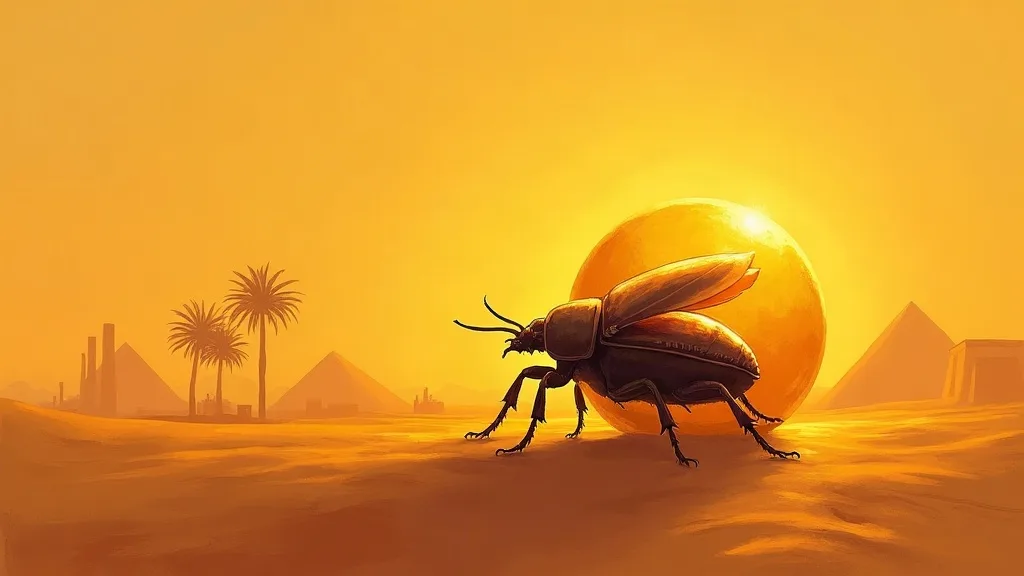
In the pre-dawn sand of Egypt's Western Desert, a beetle no larger than a thumbnail rolls a ball of dung across the ground. To any observer, it is pure mechanics: the insect's survival instinct at work. But to the ancient Egyptians watching this same scene five thousand years ago, they witnessed something sacred. They saw the sun god Khepri (also spelled Kheper) moving across the sky each dawn, rolling the solar disc from death back into life. The scarab beetle was not merely an animal. It was a mirror of cosmic resurrection, a living hieroglyph of how the universe renews itself each morning.
The scarab beetle symbol represents far more than a simple insect. It is one of mythology's most profound visual languages: a code for understanding how ancient peoples conceived of time, death, renewal, and the sacred order underlying existence. That same image traveled across continents, from Egyptian temples to Mesopotamian seals to pre-Columbian American craftsmanship. Today, the scarab persists in tattoo ink, amulet form, and cultural memory as one of humanity's most enduring emblems of transformation.
This article maps the scarab's journey through mythology, explores why it held such power across cultures, and shows what it means for modern bearers of this ancient symbol.
The Scarab in Egyptian Mythology and Belief
The ancient Egyptians called the dung beetle khepri, and the name itself encoded the philosophy. Khepri derives from kheper, meaning "to become" or "to transform". The god Khepri, depicted as a scarab or a human with a scarab head, was not simply an allegory. He was the embodiment of becoming itself: the force that propels renewal, metamorphosis, and the daily resurrection of order from chaos.
Each dawn, the Egyptians believed, Khepri pushed the sun (called Ra, the solar disc) up the eastern sky. The sun had died during the night, descending into the Duat (the Egyptian underworld). It was Khepri's labour that restored it. By noon, the sun had become Ra in his full glory. By evening, he aged into Atum. But at midnight, in the depths of the Duat, Khepri began his eternal work again. The scarab was the god's proxy in the visible world: a tiny creature performing the same rolling motion that kept the cosmos turning.
This mythology was not abstract theology. Egyptians could literally see scarabs at work, especially during the flood season when the Nile receded and the insects emerged to breed. The sight was a daily sermon in metamorphosis. The beetle would burrow underground (symbolic death), emerge transformed (resurrection), and perpetually labour in cycles of renewal. No other animal made the cycle so visible.

The scarab also became central to Egyptian funerary practice. Scarabs were carved from stone, faience, and precious materials and placed in tombs alongside the deceased. The most famous is the pectoral scarab, a large ceremonial piece worn as a pendant by the pharaoh or buried with the dead. The scarab amulet was believed to protect the heart of the deceased during judgment in the afterlife, helping the soul navigate rebirth. Spell 30B of the Book of the Dead (a collection of funerary texts compiled over centuries) explicitly invokes the scarab, asking it to prevent the heart from testifying against the deceased before Osiris, god of the afterlife.
Scarab seals were also inscribed with the names and titles of pharaohs, creating a double symbolism: the insect rolling its sphere echoed the pharaoh's divine duty to maintain Ma'at (cosmic order) and keep chaos at bay. When a seal impressed clay, the scarab's image transferred power and legitimacy, making the symbol a tool of political and spiritual authority.
The Scarab Across Mediterranean and Near Eastern Cultures
The scarab's resonance was not confined to the Nile Valley. Minoan Crete adopted scarab imagery around 1500 BCE, and from there it spread throughout the Mediterranean. Phoenician traders carried scarab seals into Mesopotamia, the Levant, and eventually into Greek and Etruscan contexts. The insect became a currency of symbolic prestige: to possess a scarab seal meant connection to Egyptian spiritual power and cosmic knowledge.
In Mesopotamia, the scarab was less a religious focal point than a status object. Wealthy Babylonians and Assyrians collected Egyptian scarab seals as signs of refined taste and international reach. Yet the underlying belief transferred: the scarab retained its association with transformation and protection. When Mesopotamian craftspeople created their own cylinder seals (the Mesopotamian equivalent of scarab seals), they sometimes incorporated scarab motifs, adapting the symbol to their own narrative traditions.
The Greeks encountered the scarab through their contact with Egypt and retained the symbol with particular enthusiasm. Greek scarabs, often made of jasper or carnelian, bore inscriptions in Greek rather than hieroglyphics. Greek and later Roman elites wore scarab rings as protective talismans and status markers. The Romans, inheriting Greek taste, continued the tradition throughout the empire, and scarab seals appear in archaeological digs from Britain to North Africa, evidence of how thoroughly the symbol had been woven into Mediterranean consciousness.

Symbolic Meanings: Why the Scarab Endures
The power of the scarab beetle symbol lies in its multiple layers of meaning, all of which reinforce each other. For the ancient Egyptians, the scarab represented:
- Regeneration and rebirth: The daily cycle of the sun mirrored the beetle's own cycle of burrowing and emerging. Death was not final; it was a stage in endless renewal.
- Solar power and divine light: Khepri, the scarab god, was the force that animated the sun. To wear or carry a scarab was to ally oneself with cosmic vitality.
- Protection and transformation: Scarabs were worn or buried to protect the living from harm and the dead from the chaos of the afterlife.
- Human agency and labour: The scarab's persistent rolling of its sphere symbolized human effort, perseverance, and the cultivation of order from disorder.
- Ma'at and cosmic balance: The beetle's tireless work maintained the turning of the wheel. It was a living reminder of duty and justice.
In Mesopotamia and later Mediterranean traditions, the scarab took on slightly different but compatible meanings:
- Authority and legitimacy: Scarab seals bore the names of kings and gods, making the insect a vessel of power.
- Protective amulet: Like Egyptian practice, the scarab was believed to ward off evil and ensure safe passage.
- Artistic refinement and exoticism: Possession of a scarab marked the owner as cultured and connected to foreign wisdom.
The scarab's symbol retained these associations across centuries because they corresponded to observable reality. Everyone could see a beetle rolling a ball; everyone experienced cycles of death and renewal in nature; everyone needed protection and renewal in their own lives. The symbol was not imposed from above but grew from genuine observation.
Scarab Symbolism in Tattoo Tradition and Modern Practice
The resurgence of interest in scarab symbolism in contemporary tattoo culture reflects the deep human need for symbols that speak to transformation and resilience. A scarab tattoo today typically carries one or more of these modern interpretations:
- Personal rebirth and resilience: The wearer marks themselves as someone who has endured hardship and emerged transformed.
- Protection: Like the ancient amulet, the scarab is chosen as a spiritual guardian against negative forces.
- Continuous self-improvement: The scarab's eternal labour is read as a metaphor for personal growth and the refusal to stagnate.
- Connection to ancient wisdom: Wearing a scarab links the bearer to Egyptian civilization and the continuity of human spirituality across time.
- Transformation through work and effort: The scarab symbolizes the hard work required to change oneself or one's circumstances.
Tattoo placements vary, though back pieces and forearm designs are common, allowing the scarab to be displayed prominently. Artists often pair the scarab with complementary symbols: the sun or solar disc above the beetle, Egyptian hieroglyphics, or geometric patterns evoking ancient design traditions. Some tattoo designs blend the scarab with modern imagery, placing the beetle within abstract or naturalistic contexts.
The choice of a scarab tattoo often reflects the wearer's conscious engagement with mythology, their interest in ancient civilizations, or their spiritual practice. Unlike generic symbols, the scarab carries intellectual and emotional weight for the person who chooses it.

The Scarab Across Cultures: A Comparative View
While the scarab was most prominent in Egyptian culture, dung beetles and flying insects held sacred or symbolic significance across many ancient civilizations. Comparing these traditions illuminates what made the scarab so particularly potent.
In Mesoamerica, no direct scarab equivalent existed (dung beetles were not prominent in the Aztec or Maya environments), yet the Aztecs revered the xolotl, a dog-headed creature associated with the evening star and the underworld, who played a role in cosmic cycles not unlike Khepri's. The Aztec cosmos also operated on cyclical transformation: the Fifth Sun (the current world epoch) would eventually end and give way to another. The scarab's role in Egyptian thought as the engine of renewal across temporal boundaries had a conceptual echo in Aztec cosmology, even though the symbol itself did not travel.
In Hindu tradition, beetles and insects occasionally appear in stories of transformation, though the tradition is richer in other animal symbols. The dung beetle of Indian literature, however, is occasionally referenced in narratives of persistent labour and humility, echoing the Egyptian valuation of the scarab's steadiness.
The scarab's near-universal absence in cultures beyond Egypt, the Mediterranean, and the Near East suggests something important: the scarab symbol was not universally hardwired into human consciousness but was historically transmitted through trade, conquest, and cultural diffusion. Where the scarab did not travel, cultures developed their own symbols of transformation and renewal suited to their local ecology and spiritual needs.
What Primary Sources Reveal About Scarab Worship
The Egyptian texts confirm that scarab symbolism was not sentimental but deeply theological. The Pyramid Texts (inscriptions inside Old Kingdom burial chambers dating to circa 2400-2300 BCE) directly invoke Khepri and reference the scarab's transformative power. The Coffin Texts (similar funerary inscriptions from the Middle Kingdom, circa 2100-1800 BCE) elaborate on the scarab's role in the afterlife journey.
The Book of the Dead, compiled and refined over centuries, contains numerous spells and invocations referencing the scarab. Spell 76 describes the deceased transforming into various forms, echoing the scarab's perpetual becoming. The imagery was not metaphorical to the ancient Egyptians; they believed the scarab held literal power to facilitate transformation and protect against annihilation.
Greco-Roman texts provide less theological depth but confirm the widespread adoption of scarab symbolism. Pliny the Elder, the Roman naturalist, mentions the esteem in which scarab seals were held and their association with Egyptian sacred knowledge. Greek inscriptions on scarab amulets occasionally invoke the names of gods or protective formulas, showing that Greeks and Romans integrated the scarab into their own spiritual practice rather than treating it as a mere curiosity.
The Scarab's Decline and Modern Revival
As Christianity and Islam spread through Egypt and the Mediterranean, the active worship of Khepri and the theological centrality of the scarab faded. By the Medieval period, scarab symbolism survived mainly in artistic tradition, archaeological memory, and the residual prestige attached to "Egyptian" objects as markers of ancient wisdom.
The 19th-century Egyptological movement, driven by Napoleon's campaign and later by systematic Western scholarship, recovered scarab symbolism and made it newly fashionable. Victorian and Edwardian collectors treasured scarab seals, amulets, and artistic representations. Theosophical movements and esoteric spiritual traditions (which drew heavily on Egyptian imagery) further revived the scarab as a symbol of mystical transformation.
By the late 20th century, the scarab had become a recognizable icon of ancient spirituality, suitable for jewelry, tattoos, and decorative art. The symbol carried an aura of authenticity and depth that appealed to people seeking connection to ancient wisdom. Unlike symbols invented for modern marketing purposes, the scarab bore the weight of genuine history and real belief. This authenticity remains its primary appeal in contemporary culture.
Scarab Symbolism and Modern Spiritual Practice
Today, the scarab appears in a wide range of spiritual and therapeutic contexts. Some people wear scarab amulets for protection, drawing on Egyptian funerary traditions. Others incorporate the scarab into meditation or visualization practices, using the image of the beetle rolling its sphere as a focus for contemplating perseverance, transformation, or the cyclical nature of life and death.
New Age and contemporary pagan communities sometimes invoke Khepri or the scarab principle in rituals focused on personal transformation or renewal. The beetle becomes a symbol of spiritual alchemy: the process by which the base material of oneself is transmuted into something sacred and whole.
Therapists and life coaches occasionally reference the scarab as a metaphor for resilience and personal growth. The image of continuous labour, of rolling a burden uphill, resonates with anyone engaged in the difficult work of self-improvement or recovery.
The scarab has also become iconic in popular culture. It appears in films, novels, video games, and graphic art as a symbol of ancient Egypt, mystical power, or transformation. While pop-cultural uses sometimes simplify or distort the original meaning, they keep the scarab alive in collective imagination and introduce new generations to the symbol.
Scarab Motifs in Visual Art and Craftsmanship
From ancient times to the present, artisans have rendered the scarab in materials ranging from lapis lazuli to faience to modern polymer clay. Ancient scarab amulets were often carved with meticulous detail, showing the beetle's wings, segmented body, and the legs in dynamic posture. The craftsmanship reflected the sacredness of the subject: a poorly made scarab would not carry power.
Renaissance and later European artists incorporated scarab motifs into inlays, jewelry, and decorative schemes, often alongside other Egyptian symbols. The scarab appeared in cameos, brooches, and architectural ornamentation. By the Victorian era, scarab-inspired jewelry was mass-produced for a growing market of collectors and spiritually-inclined consumers.
Contemporary scarab art encompasses fine art paintings and sculptures, digital design, tattoo artistry, and jewelry design. Artists today often blend historical accuracy with personal vision, creating scarabs that honour the ancient symbol while expressing modern aesthetics. The scarab's simple, recognizable form makes it infinitely adaptable to different artistic styles and media.
Frequently asked questions about the scarab beetle symbol
Frequently asked questions
What does the scarab beetle symbol truly mean in ancient Egypt?
The scarab represented Khepri, the god of becoming and transformation, who rolled the sun across the sky each day. The symbol encoded the Egyptian understanding of cosmic renewal: death followed by rebirth, disorder followed by the restoration of order. The scarab was a visible, daily reminder of how the universe perpetually regenerates itself through labour and divine will.
Why did the scarab symbol spread beyond Egypt to Greece and Rome?
The scarab's association with Egyptian spiritual power and its practical use as a decorative seal made it a valuable trade commodity. Greeks and Romans adopted scarab amulets and seals not simply as art objects but as conduits of protection and spiritual authority. The symbol carried prestige because it connected the wearer to ancient Egyptian wisdom and cosmic knowledge.
Is the scarab beetle symbol connected to any other world mythologies?
While the scarab itself is distinctly Egyptian, the concept it represents, cosmic renewal through cycles of death and rebirth, appears across cultures in different forms. Mesoamerican civilizations like the Aztecs understood time as cyclical transformation, though they used different symbols. Hindu and other Asian traditions also feature insect or animal symbols of transformation, though not the scarab specifically.
What should someone consider before getting a scarab beetle tattoo?
A scarab tattoo carries real historical and spiritual weight, not merely aesthetic appeal. Before committing, research the symbol's meaning in Egyptian mythology and consider what resonates personally: resilience, transformation, protection, or connection to ancient wisdom. Choose an artist experienced in symbolic tattoo work, preferably one familiar with Egyptian imagery and willing to render the scarab with respect for its origins. The placement and accompanying imagery (sun symbols, hieroglyphics) can deepen the meaning.
Are scarab amulets still used in modern spiritual practice, and do they function differently than ancient ones?
Yes, contemporary spiritual practitioners wear scarab amulets for protection and transformation. Modern amulets work through the wearer's belief and intention rather than through the religious system that originally empowered them. A person using a scarab amulet today is engaging in personal spiritual practice informed by ancient tradition, not participating in original Egyptian religion. The psychological and symbolic benefit remains genuine even though the theistic framework has changed.
How can I identify an authentic ancient scarab versus a modern reproduction?
Authentic ancient scarabs show signs of age: patina, surface wear, occasional damage, and the marks of hand-carving. Modern reproductions often appear too uniform and pristine. Scarabs carved from faience (Egyptian blue-green ceramic) develop a characteristic craquelure (fine cracking) over millennia. Weight, material density, and the quality of carved detail differ between ancient and modern work. Archaeological experts and reputable collectors can authenticate scarabs through material analysis and provenance documentation.
The Scarab's Unfinished Journey
The scarab beetle symbol endures because it speaks to something perennial in human experience: the need to understand transformation, to believe in renewal, and to find meaning in labour and persistence. An ancient Egyptian watching a beetle roll its sphere experienced the same contemplative moment that a modern person experiences when viewing a scarab tattoo or amulet. The symbol bridges time.
Yet the scarab's future remains open. As interest in ancient spirituality continues to grow, and as tattoo culture becomes ever more sophisticated and symbolically literate, the scarab may deepen in significance. Or it may become diluted through overuse and misunderstanding, reduced to a decorative motif divorced from its original power. The symbol's fate depends partly on whether bearers and artists remain engaged with its genuine history and meaning.
What seems certain is that as long as humans observe cycles of death and renewal in nature, and as long as we need symbols to help us understand our own transformations, the scarab will remain alive. Not as the Egyptians knew it, but transformed itself, carrying its ancient meaning into new contexts and new lives.
Free 25-page sample
Want the whole story?
Take the first 25 pages free. If it pulls you in, the full edition is yours as an instant PDF download, with a paperback on Amazon for selected titles.

Mythology
The World Mythology Book: The Gods, Heroes and Myths of Every Culture
The Gods, Heroes and Myths of Every Culture, in One Volume
The whole of world mythology in a single volume: Greek, Norse, Egyptian, Japanese, Hindu, Celtic, Slavic, Mesoamerican and African myths gathered side by side, each drawn from the primary sources.