

Scylla and Charybdis: The Strait Monsters of Greek Myth
Between two cliffs in a narrow sea passage, Scylla seized sailors with six serpentine heads while Charybdis swallowed the ocean whole. Their myth is older, stranger, and richer than any summary admits.
Contents
The ship moves fast through the channel. On the left, the water darkens without warning, a funnel opening in the sea's floor like a throat being cleared. On the right, high on a sheer rock face, something shifts in the shadows of a cave. The helmsman knows both sides will kill him. The only question is which death he chooses.
Scylla and Charybdis the strait monsters have haunted Greek seafaring imagination since at least the eighth century BCE, when Homer placed them in the path of Odysseus during his long voyage home. They are not gods, not heroes, not abstractions. They are visceral obstacles with texture and sound: the gulp of a whirlpool, the yelp of a dog-headed neck shooting downward to snatch a man off his oar bench. Their myth is a navigation problem turned cosmic, a parable about impossible choices dressed in scales and brine.
Most treatments stop at Homer. The truth is richer. Scylla and Charybdis appear in Hesiod's genealogies, in Apollonius of Rhodes, in Ovid, in Virgil. Each telling adds a layer, a backstory, a wound. By the time the Roman poets finish with Scylla, she has a name, a failed love story, and a transformation that rivals Medusa in its cruelty.
Origins: Who Made These Monsters?
Ancient sources disagree on parentage, and that disagreement is itself meaningful.
Homer does not explain how Scylla came to be. In Book XII of the Odyssey, the witch Circe describes her clinical detail: twelve feet dangling beneath her body, six necks "of endless length," each neck ending in a head with three rows of teeth. She yelps like a puppy, Circe says, which makes the image stranger. Charybdis, in Homer, is almost personless: a creature that drinks the black water three times a day and belches it back, creating the whirlpool. No body is described. She is the sea's gullet.
Hesiod in the Theogony names Scylla's parents as Phorcys and Hecate (in some manuscript traditions; others give Crataeis, a sea nymph, as her mother). Phorcys is a primordial sea god, the grey-bearded patriarch of monsters; he is also father of the Gorgons and the Graeae. This parentage places Scylla squarely inside the oldest layer of Greek monster genealogy, the pre-Olympian chthonic order that predates Zeus and his family.
Charybdis has a different pedigree. Several ancient sources name her daughter of Poseidon and Gaia. The pairing is significant: sea and earth, the two forces that produce the churning interface where coastlines shatter ships. Zeus punished her by throwing her into the sea after she stole Heracles' cattle, though this detail sits awkwardly in the broader tradition and may be a later rationalisation.

Apollonius of Rhodes in the Argonautica (third century BCE) passes the Argo near these same straits, describing how Thetis and her Nereids guided the ship safely through, the sea nymphs passing the vessel hand to hand over the rocks like a ball. Here the monsters are backdrop rather than protagonist, which tells us something about how the myth could be modulated: the same geography that destroys Odysseus's companions can be navigated with divine help.
The Transformation Story: Scylla Before the Teeth
The most psychologically complex version of Scylla's origin appears in Ovid's Metamorphoses (Book XIII-XIV, written around 8 CE). Here she begins as a beautiful sea nymph, companion to other Nereids, fond of sitting on warm rocks above the surf. The sea god Glaucus falls in love with her. He was once a mortal fisherman who ate a magical herb and became half-fish, half-man, a being suspended between worlds. Scylla rejects him with a kind of careless cruelty that youth often carries.
Glaucus, devastated, travels to Circe and begs for a love potion. Circe falls for Glaucus herself. He refuses her. Circe's jealousy turns specific: she poisons the pool where Scylla bathes. When Scylla wades into the water, dogs burst from her lower body. Six heads erupt from her torso. She cannot pull herself free of her own transformation. She becomes exactly what she never intended: permanent, monstrous, and fixed to one rock.
This version is important not just as backstory but as moral architecture. Scylla did not sin against the gods. She rejected an unwanted suitor. Circe, a goddess of transformation, weaponised her craft out of wounded pride. The monster is the victim. Her ferocity with sailors is, in this reading, a grief that has nowhere else to go.
Scylla and Charybdis in the Odyssey: The Passage Scene
Book XII of the Odyssey is one of the most concentrated passages in all ancient literature. Homer devotes 59 lines to the strait crossing, and nearly every word does nautical or psychological work.
Circe has warned Odysseus in advance. She tells him Scylla cannot be killed: even if he armours up and stands on the bow with a spear, he will only waste time and lose more men when he fails. Her tactical advice is brutal: hug Scylla's cliff, accept six deaths, and do not stop rowing. The alternative, Charybdis, could swallow the whole ship.
Odysseus makes the calculation. He hugs the rock. He does not tell his crew. He watches, he writes, as Scylla's six heads descend and take six men mid-stroke. He names them: Perimedes, Eurylochus, and four unnamed others. "I saw their hands and feet flailing in the air above me," Homer writes (in Richard Lattimore's translation, Odyssey XII.256). They screamed his name. He could not help them. This is the choice the myth encodes: there is no winning, only a selection of losses.

The return journey in Book XII replays the same passage but without Circe's guidance. Now Odysseus is alone, his ship smashed by Zeus in punishment for his crew eating the cattle of Helios. He clings to a fig tree above Charybdis and waits while the whirlpool drinks his raft down and spits the planks back. He drops onto the floating debris and rows away. Scylla, Homer notes, is sleeping.
The detail about Scylla sleeping is quietly terrifying. The monster does not choose to spare Odysseus on the return. She simply does not notice him. Survival in this passage is not heroism. It is chance.
The Argonauts and the Earlier Crossing
Apollonius of Rhodes complicates the chronology by having Jason and the Argonauts pass through the same straits before Odysseus, guided by the Nereids. The Argonautica was written in the third century BCE and consciously positions itself as a prequel to Homer, the voyage of the Argo as the first great sea expedition in Greek literary memory.
The contrast in method is pointed. Where Odysseus loses six men, the Argonauts lose none because Thetis and fifty Nereids physically carry the ship. Where Odysseus must make a moral calculation about acceptable sacrifice, Jason's passage is a matter of divine patronage. Hera protects the Argo because she needs Jason to reach Colchis and bring back the Golden Fleece. Divine politics insulate the hero.
This does not make Jason's journey less dangerous in absolute terms, but Apollonius knows his audience will feel the difference. The Argonautica passage is a set piece of miraculous escape. The Odyssey passage is a scene of horror and helplessness. Both use the same monsters. The moral register is entirely different.
Symbolism: What the Monsters Actually Mean
Ancient readers and modern scholars have proposed several symbolic readings. None is mutually exclusive.
The nautical-literal reading remains the most grounded. The Strait of Messina produces unpredictable currents, a famous eddy system on the Sicilian side near Capo Peloro, and the rocky promontory of Scilla (which preserves the name to this day) on the Calabrian coast. Ancient Greek sailors rounding the toe of Italy knew this passage. Homer gave their fear a body.
The moral-philosophical reading took hold in antiquity itself. Plato and later Stoic commentators read Scylla's multiple heads as the fragmentation of the soul pulled by appetites, each head representing a different desire. Charybdis became oblivion, the complete dissolution of the self. Navigation between them was the ethical life: neither fragmenting into appetite nor surrendering into formlessness.
The political-rhetorical reading is the root of the idiom we still use. "Between Scylla and Charybdis" became a standard Latin phrase for any dilemma where both options carry serious cost. Cicero used the phrase. So did Livy. The monsters entered Roman political discourse as a model for impossible binds, not a metaphor for seafaring at all.
The gender-power reading has gained traction in contemporary classical scholarship. Both monsters are female. Both occupy the margins, the interstitial space between land and deep sea, the boundary that does not belong to either Poseidon's ocean or the cities of men. The Odyssey is full of powerful women (Circe, Calypso, Nausicaa, Penelope) who present obstacles or aids to Odysseus's homecoming. Scylla and Charybdis are the most extreme version of this pattern: women whose agency has become lethal, who cannot be seduced, persuaded, or bested in combat.
The Dog Motif
Scylla's yelp like a puppy deserves its own attention. Homer mentions it twice. It is the detail most readers miss and the one that lingers longest.
Dogs in Greek myth occupy a liminal space. Hecate, goddess of thresholds and magic, is accompanied by dogs. Cerberus guards the underworld gate. The dog is the animal of the boundary, the creature that marks where one world ends and another begins. Scylla sits on a cliff between sea and sky, between the Odysseus-world and the abyss. Her dog voices are a sonic signature of that threshold. She sounds harmless. She is not.
Virgil's Aeneid: The Monsters Through Roman Eyes
Virgil places Aeneas near Scylla and Charybdis in Aeneid Book III (composed around 29-19 BCE). The prophet Helenus warns Aeneas to avoid the strait entirely, to sail around Sicily's western coast rather than attempt the passage. This is, in geographical terms, the longer route. Helenus frames it as the only option: Charybdis and Scylla are simply impassable for Aeneas's fleet.
The choice matters for what it says about Virgil's relationship to Homer. Odysseus passes through and loses men. Aeneas is wise enough not to try. The Roman hero exercises the prudentia (practical wisdom) that his Greek predecessor lacks in this moment. Virgil does not want his founding hero anywhere near the screaming necks and the whirlpool. The Trojan-Roman story has too much weight on it to risk that kind of loss.

Scylla appears again near the end of Aeneid Book VI, in the underworld, where Aeneas glimpses her among the monsters clustered at the entrance to Tartarus. She is listed alongside Briareus, the Lernean Hydra, and the Chimaera. In the underworld catalogue, she functions as an image of cosmic danger contained, all the terrors of the living world gathered and made visible to the hero who will pass through and emerge into the light.
Cross-Cultural Parallels: Narrow Passages and Double Dangers
The pattern of two flanking dangers at a sea passage appears in traditions far older than Homer.
Mesopotamian myth offers the Scorpion People who guard the twin peaks of Mount Mashu in the Epic of Gilgamesh (composed in Sumerian as early as 2100 BCE). The hero must pass between them to enter the darkness beneath the mountain. They are not quite analogous to Scylla and Charybdis, but the structural logic is identical: one path, two guardians, both lethal, no alternative.
Norse mythology has the passage between the clashing rocks Symplegades, though those actually appear in the Greek Argonaut tradition (the Clashing Rocks of the Bosphorus, which the Argo passed before reaching the Black Sea). The Norse world tree Yggdrasil structures its own version of this problem: every major passage in Norse cosmography involves a dangerous threshold guardian.
In Japanese tradition, the Naruto Strait between Awaji Island and Shikoku produces the largest tidal whirlpools in the world. Japanese sailors mapped them carefully; Shinto ritual at local shrines addressed the spiritual forces held responsible. The cultural response differs from Homer's, but the root phenomenon is identical: a geographic choke point where the sea behaves unpredictably, where the boundary between safety and death is a matter of yards.
What Greek myth did with Scylla and Charybdis that other traditions rarely managed is encode the double danger as a moral problem, not just a survival problem. The choice between them is the choice every navigator, every general, every leader eventually faces: which loss can you live with?
Scylla and Charybdis in Art and Reception
Ancient visual culture treated the monsters with some caution. Scylla appears on several red-figure vases from the fifth century BCE, typically shown as a woman from the waist up with dog heads emerging from her midsection and a fish tail below. The composition is necessarily awkward; the artists had to make formal decisions about bodies that Homer left productively vague. A well-known mosaic from Bardo National Museum in Tunis (second century CE) shows her in this same tripartite form, half woman, half dogs, half fish.
Charybdis almost never appears in visual art, which makes its own point. A whirlpool is by definition formless. The ancient visual imagination had nothing to work with. Even her literary descriptions resist the pictorial. She remains a force rather than a figure, which is why she functions so differently in the myth than Scylla does.
Renaissance and Baroque painters occasionally placed the strait scene in the background of larger Odyssean canvases. It rarely achieved the prominence of, say, the Cyclops episode or Circe's court. The monsters required a scale and dynamism that easel painting struggled to manage before Turner.
William Turner's 1832 painting Ulysses Deriding Polyphemus does not show the strait, but its atmospheric energy, the ship small against overwhelming natural violence, captures the emotional register of the Scylla-Charybdis episode better than any work that depicts the monsters directly.
In contemporary fiction, the idiom "between Scylla and Charybdis" appears in political analysis, strategic theory, and psychological writing. Margaret Atwood invokes it. Umberto Eco uses it as a structural metaphor in The Name of the Rose. Both monsters have been assimilated into the standard toolkit of Western rhetorical culture.
The Monsters' Geography: Locating the Myth
Strabo, the first-century BCE geographer, firmly identified the monsters with the Strait of Messina in his Geographica (Book I). He noted that the eddies on the Sicilian side near Pelorus produced a genuine whirlpool effect, and that the rocks on the Calabrian side near Rhegium (modern Reggio Calabria) matched Homer's description of Scylla's sheer cliff. The Italian city of Scilla (Calabria) preserves the name and sits on the exact promontory Strabo identified.
This localisation was not universally accepted. Some ancient commentators placed the monsters at the Bosphorus, near the Clashing Rocks that the Argo had already passed. Others, following Thucydides, suggested the whole geography of the Odyssey was intentionally vague, set in a mythological western Mediterranean that was not meant to map precisely onto the real world.
The disagreement matters because it reflects two different theories about how myth works. Either it encodes real geography and real maritime knowledge, passed down through oral tradition by sailors who actually knew the Strait of Messina, or it creates a symbolic elsewhere, a space where normal navigation rules no longer apply and only story-logic governs. Both readings can be right simultaneously. The myth's endurance suggests it performs both functions at once.
What Comes After the Strait
Odysseus survives the passage. He loses six men to Scylla. He later escapes Charybdis by clinging to a fig tree. He reaches the island of Thrinacia, where the cattle of Helios graze in their divine perfection. His crew, starving and faithless, slaughters those cattle. Zeus destroys the ship with a lightning bolt. Every surviving crew member except Odysseus drowns.
The strait, in this reading, is not the crisis. It is the prelude to the crisis. The real test was the cattle, the choice between starvation and sacrilege. Scylla and Charybdis forced Odysseus to make the hardest navigational decision of his life. The cattle forced his crew to make the hardest moral one. They fail. He survives, alone, because the gods need him to reach Ithaca. The monsters at the strait are part of a longer structure of impossible choices that defines the second half of the Odyssey.
This is why Scylla and Charybdis the strait monsters cannot be understood in isolation. They are nodes in a narrative web that begins with the Trojan War and ends on a small island in the Ionian Sea where a man's wife has been waiting twenty years. Their horror is real. Their meaning is relational.
Frequently Asked Questions About Scylla and Charybdis
Frequently asked questions
Are Scylla and Charybdis based on real geographic features?
Most ancient and modern scholars locate them in the Strait of Messina, between Sicily and Calabria in southern Italy. The Sicilian side produces a genuine tidal eddy near Capo Peloro, and the Calabrian town of Scilla sits on a rocky promontory matching Homer's description. Strabo made this identification explicit in the first century BCE. Whether Homer encoded knowledge of this specific passage or created a symbolic geography remains debated, but the physical correspondence is striking enough that sailors in antiquity treated the strait with ritual respect.
How does Ovid's version of Scylla differ from Homer's?
Homer presents Scylla as an already-monstrous fact, a creature Circe describes without origin story. Ovid in the Metamorphoses (Books XIII-XIV) gives her a backstory as a beautiful sea nymph who rejected the love-sick fisherman-turned-god Glaucus. When Glaucus sought Circe's help, Circe became jealous and poisoned Scylla's bathing pool. The transformation is Circe's revenge, not divine punishment for any sin Scylla herself committed. This version substantially changes the moral valence: the monster is a victim of someone else's wounded pride.
Did any hero actually defeat Scylla or Charybdis?
No. Both survive every encounter described in Greek and Roman literature. Odysseus accepts six deaths and escapes. The Argonauts are physically carried past by the Nereids; they do not fight the monsters. Aeneas, following Helenus's advice, sails around Sicily entirely and avoids the strait. No tradition records anyone killing Scylla or draining Charybdis. Their persistence is part of the point: some dangers cannot be overcome, only navigated or avoided.
What does the phrase 'between Scylla and Charybdis' mean in modern usage?
It describes any dilemma where avoiding one serious danger puts you directly in the path of another, equally serious one. The phrase entered Latin from Greek, was used by Cicero and Livy in political and rhetorical contexts, and passed into Renaissance vernacular languages. It is the ancient predecessor of the English idiom "between a rock and a hard place," which carries the same spatial logic of forced choice with no safe middle ground.
How do the monsters appear differently in the Odyssey's two crossings?
On the outward crossing (Book XII), Odysseus has Circe's briefing: he knows what to expect, has made a calculation to hug Scylla's cliff, and watches six named men die. On the return crossing, he is alone on a raft after Zeus's lightning destroys his ship. He survives Charybdis by grabbing a fig tree overhanging the whirlpool and waiting for the debris of his raft to resurface. Scylla does not attack him on this second pass because she happens to be sleeping. The asymmetry between planned heroism and dumb luck is deliberate: Homer is showing what survival actually looks like.
Are there cross-cultural parallels to the Scylla and Charybdis myth?
Several traditions encode the pattern of paired dangers flanking a necessary passage. The Clashing Rocks (Symplegades) of the Bosphorus in the Argonaut myth function similarly, as do the Scorpion People guarding Mount Mashu in the Gilgamesh epic. Japanese folklore around the Naruto Strait attributes its powerful whirlpools to sea spirits requiring propitiation. What distinguishes the Greek version is the specific moral architecture: the choice is not just physical navigation but a decision about which loss is bearable, a philosophical problem dressed as a geographic one.
The Monsters That Scholarship Cannot Fully Tame
Modern classical scholarship has not settled on a single account of how Scylla and Charybdis entered Greek tradition. The oral-formulaic hypothesis, developed by Milman Parry and Albert Lord in the twentieth century, suggests the Homeric poems assembled existing story-patterns and local geographic traditions into a unified narrative. On this reading, the strait monsters may have circulated in independent seafaring lore long before any unified Odyssey existed, attached to the Strait of Messina by sailors who needed stories to explain a genuinely dangerous passage.
The Near Eastern influence hypothesis, advanced by Martin West in The East Face of Helicon (1997), points to Mesopotamian and Levantine parallels for many Greek monster figures, including the double-guardian pattern. The degree of direct transmission versus parallel development from shared maritime experience remains genuinely open.
What both camps agree on is that Scylla and Charybdis the strait monsters occupy a unique structural position in Greek heroic myth. They are not enemies to be defeated, not tests of strength or wit in the conventional sense. They are the condition of passage itself: the permanent, unavoidable cost of going anywhere worth going. Every sailor, every reader who has faced a situation where every path carries loss, recognises that cliff and that whirlpool. Homer knew this. He named the men who died there.
Read the full book
Want the whole story?
The complete edition is an instant PDF download here, with a paperback on Amazon for selected titles.
Mythology
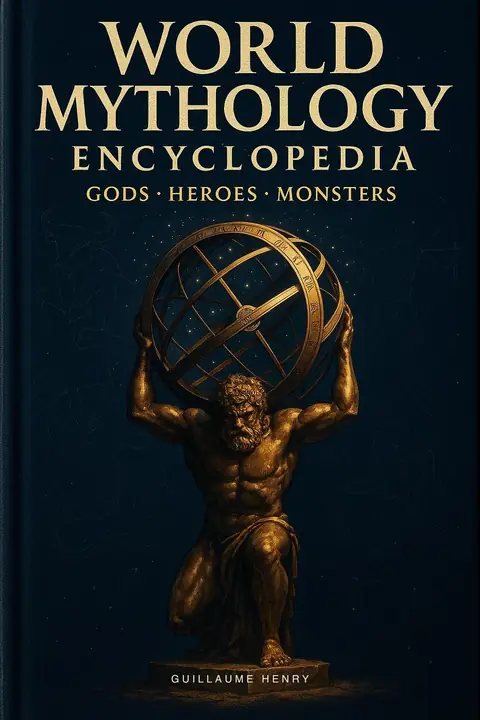
The World Mythology Book: The Gods, Heroes and Myths of Every Culture
The Gods, Heroes and Myths of Every Culture, in One Volume
The whole of world mythology in a single volume: Greek, Norse, Egyptian, Japanese, Hindu, Celtic, Slavic, Mesoamerican and African myths gathered side by side, each drawn from the primary sources.