
Yggdrasil the World Tree: Axis of the Norse Cosmos
Yggdrasil the World Tree stands at the center of Norse cosmology, binding nine worlds in its roots and branches. Explore the myths, creatures, and sacred meanings woven into its eternal bark.
Contents
The Tree That Holds Everything Together
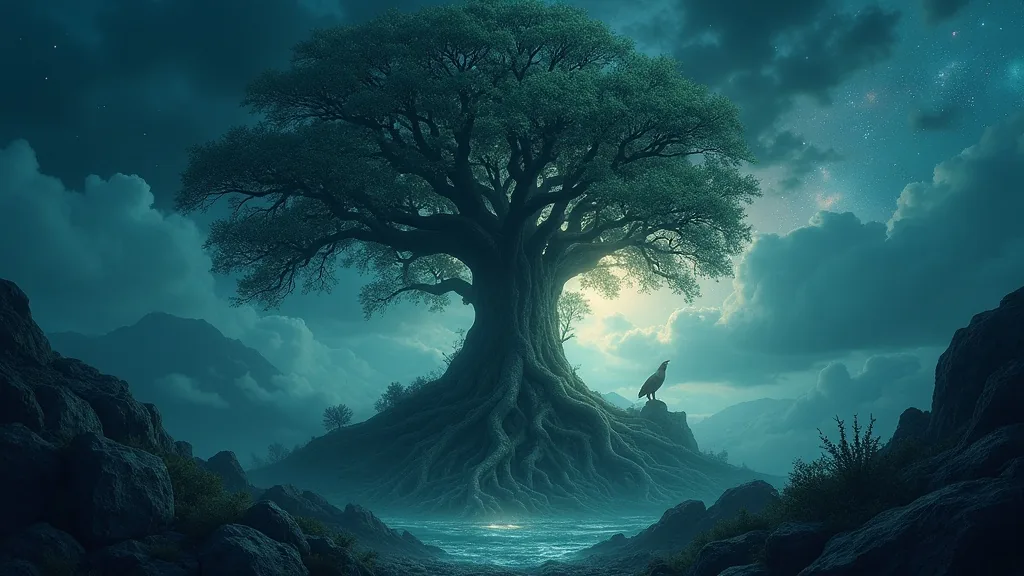
At the heart of Norse cosmology stands a tree so vast that its branches cradle the heavens and its roots drink from wells older than memory. This is Yggdrasil the World Tree, the great ash whose trunk is the axis of all existence. It is not merely a symbol. In the Old Norse imagination, Yggdrasil was the literal scaffold of reality, the living structure upon which nine distinct worlds were arranged, connected, and sustained.
The name itself carries weight. "Yggdrasil" is most commonly interpreted as "Odin's horse," a compound of Yggr (a name for Odin meaning "the Terrible One") and drasill (horse). The kenning refers to the gallows, for a hanged man rides the gallows tree. This etymology points directly to one of the most arresting episodes in Norse myth: Odin's self-sacrifice upon the tree to win the runes. Yggdrasil is thus not a passive backdrop. It is a site of ordeal, revelation, and power.
The primary sources for Yggdrasil are the Poetic Edda and the Prose Edda, compiled in Iceland during the thirteenth century, drawing on traditions that stretch back into the Viking Age and beyond. The Völuspá (Seeress's Prophecy) and Grímnismál (Sayings of Grimnir) offer the richest descriptions, painting the tree in mythological detail that remains vivid nearly a thousand years later.
Three Roots, Three Wells
Yggdrasil's structure is defined by its three great roots, each reaching into a different realm and each nourished by a different source of cosmic water or wisdom.
The Root in Ásgarðr
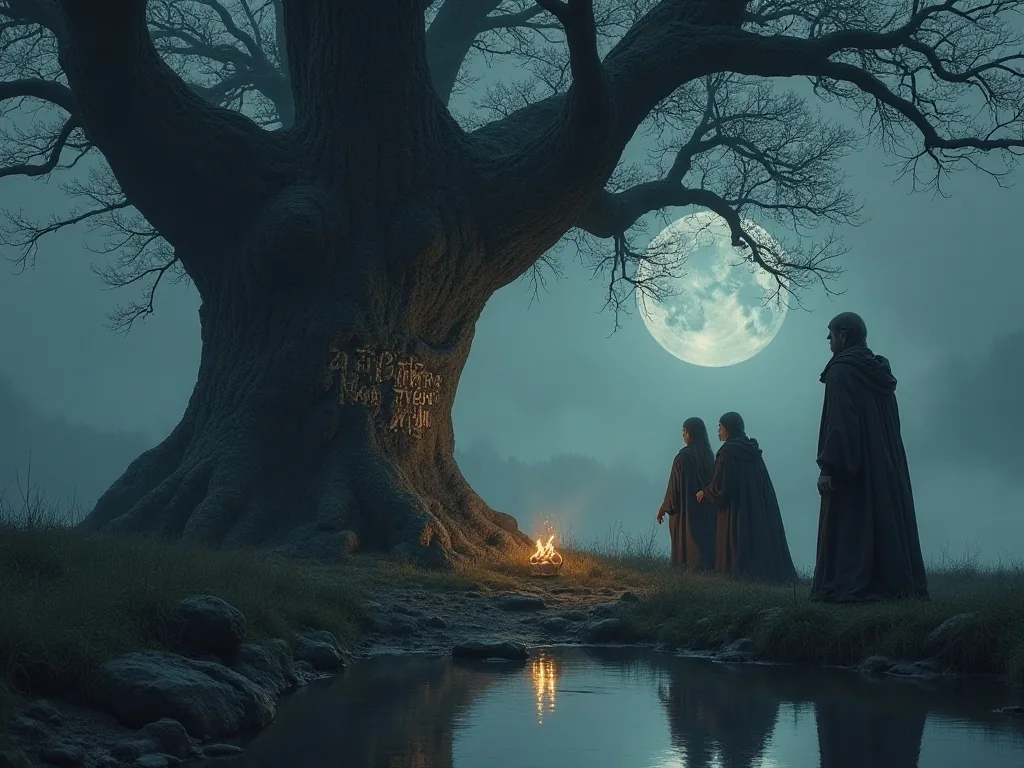
One root reaches into Ásgarðr, the realm of the Aesir gods, where it drinks near the sacred spring of Urðarbrunnr, the Well of Urð. Beside this well the three Norns reside: Urð (What Has Been), Verðandi (What Is Becoming), and Skuld (What Shall Be). These three figures carve the fates of gods and mortals into the trunk of the tree, weaving time itself. Each day they draw water from the well and mix it with the surrounding clay, pouring it over the branches of Yggdrasil to keep the bark white and the wood from rotting.
The Root in Jötunheimr
A second root descends into Jötunheimr, the land of the giants, near the spring of Mímisbrunnr, the Well of Mímir. This well holds wisdom and intelligence of a kind so concentrated that Odin himself paid his left eye to drink from it. Mímir, described in the sources as an extraordinarily wise being, guards the well jealously. The knowledge Odin gained there informed much of his capacity for prophecy and strategy, though the price was permanent.
The Root in Niflheimr
The third root plunges into Niflheimr, the primordial realm of ice and mist, where the spring Hvergelmir bubbles up from the deep. This is the oldest of all springs, described in the Prose Edda as the source from which all rivers flow. Here, gnawing at the root from below, the dragon Níðhöggr chews ceaselessly, working to sever the very foundation of the cosmic tree.
The Creatures of the World Tree
Yggdrasil is never still. It thrums with the movement of creatures whose existence is bound up with the tree's health and its eventual destruction.
The Eagle and the Serpents
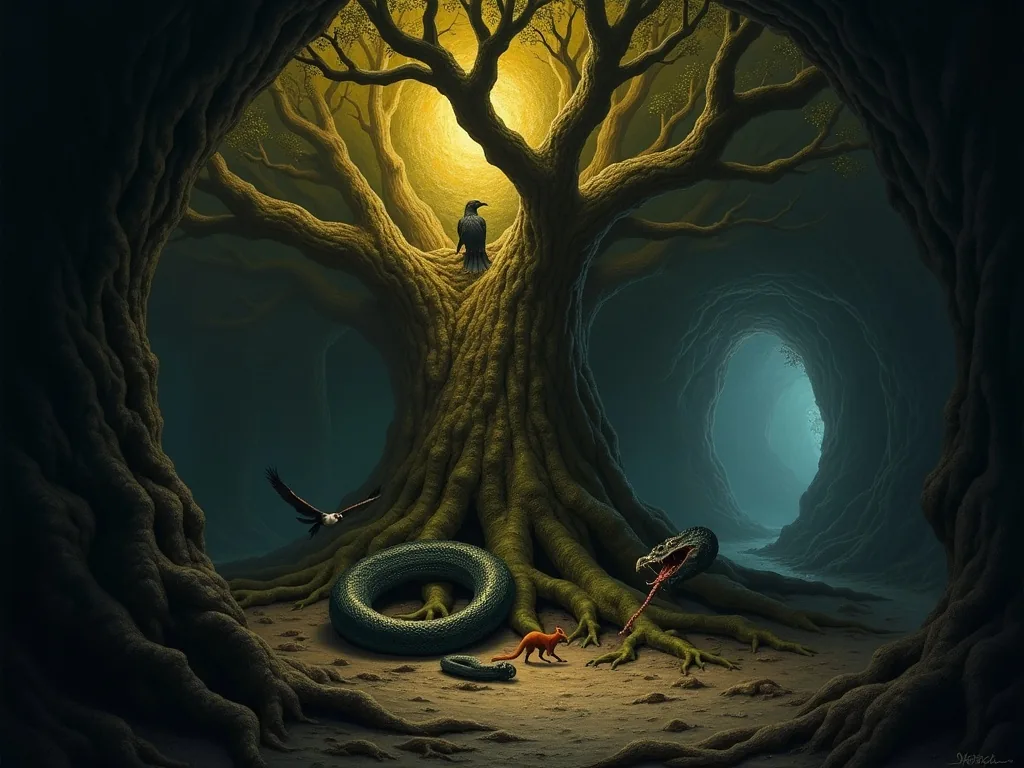
Perched at the crown of Yggdrasil sits an unnamed eagle of tremendous wisdom, flanked between its eyes by the hawk Veðrfölnir. This eagle and the dragon Níðhöggr are ancient enemies. Between them runs the squirrel Ratatoskr, a deliberately mischievous messenger who carries insults from the eagle down to the dragon and slurs from the dragon up to the eagle, keeping their mutual hatred at a perpetual boil.
Below the surface, Níðhöggr is not alone. The Grímnismál lists a host of serpents gnawing at the roots: Góinn, Móinn, Grábakr, Grafvölluðr, Ófnir, and Svábfnir among them. Their collective gnawing is a slow apocalyptic act, the erosion of the world's structural integrity from within.
The Four Stags
Four stags, named Dáinn, Dvalinn, Duneyrr, and Duraþrór, roam the branches of Yggdrasil, nibbling the foliage and buds of the tree as they go. Their constant feeding represents the relentless consumption of time, each bite a moment of the world's life spent and gone. Some scholars identify them with the four directions or the four seasons, though the texts themselves do not make this explicit.
The Serpent Níðhöggr
Níðhöggr deserves particular attention. Translated as "Malice Striker" or "Corpse Gnawer," this creature is one of the most enduring villains of Norse myth. In the Völuspá, the seeress describes Níðhöggr flying from Náströnd, the shore of corpses in Hel, carrying the bodies of the dead in its wings at Ragnarök. This detail suggests that Níðhöggr is not merely a destroyer of the tree but something more ancient and more fundamental: a force of entropy that no cosmic order can permanently contain.
Odin's Sacrifice and the Runes
Of all the events associated with Yggdrasil the World Tree, none is more philosophically charged than Odin's self-hanging. The Hávamál, a poem attributed to Odin himself, contains the famous stanzas describing the ordeal:
"I know that I hung on the wind-battered tree,
nine full nights, wounded with a spear,
and given to Odin, myself to myself,
on that tree of which no man knows from what roots it rises."
The sacrifice is paradoxical by design. Odin gives himself to himself. He is simultaneously the sacrifice and the deity receiving it. After nine nights in agony, without food or drink, he peers downward into the darkness and seizes the runes as they rise to meet him, screaming. The runes are not simply letters. They are cosmic forces, the underlying grammar of reality, and they could only be won through death and rebirth on the axis of the world.
The choice of nine nights echoes throughout Norse myth, nine being the sacred number of the Norse cosmos (nine worlds, nine nights, nine roots in some interpretations). Yggdrasil is thus the locus of initiation, the place where suffering transforms into wisdom, where the boundary between living and dying dissolves into revelation.
Nine Worlds in the Branches and Roots
The Prose Edda, as compiled by Snorri Sturluson around 1220, describes nine worlds contained within Yggdrasil's structure, though the exact arrangement has been interpreted in various ways across different sources. The worlds most consistently named include:
- Ásgarðr: realm of the Aesir gods
- Vanaheimr: realm of the Vanir gods
- Álfheimr: realm of the light elves
- Miðgarðr: the world of humanity, the middle enclosure
- Jötunheimr: realm of the giants
- Svartálfaheimr: realm of the dwarves (dark elves)
- Niflheimr: realm of ice, mist, and primordial cold
- Múspellsheimr: realm of fire, ruled by Surtr
- Hel: the realm of the dead, governed by the goddess Hel
These are not simply locations stacked vertically. They interpenetrate and influence one another, connected by pathways, rivers, and the great branches of the tree itself. The Bifröst, the rainbow bridge, links Miðgarðr to Ásgarðr, and the rivers named in the Grímnismál flow from Hvergelmir outward into all the worlds.
Ragnarök and the Trembling of the Tree
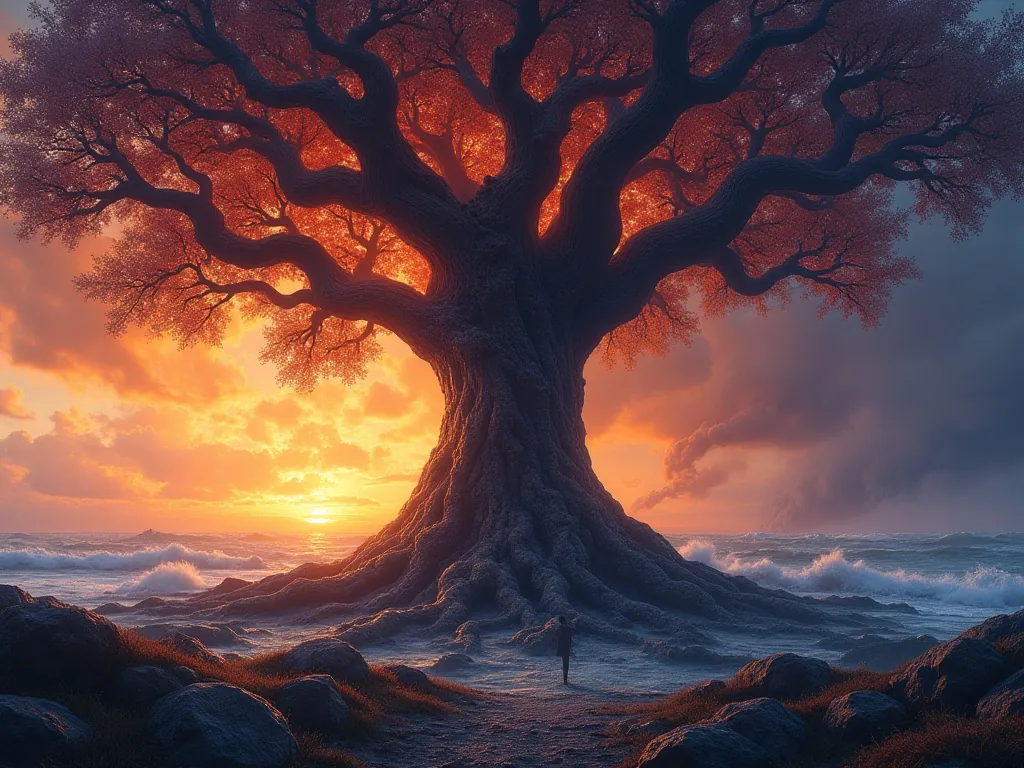
No account of Yggdrasil is complete without reckoning with its fate. As Ragnarök, the doom of the gods, approaches, the tree shudders. The Völuspá describes the ash tree trembling, the old tree groaning, and the giant being Jörmungandr, the World Serpent, thrashing as it rises from the ocean floor. Níðhöggr intensifies its gnawing. The Norns continue their work but cannot halt what the weaving of fate has already set in motion.
Yet Yggdrasil does not fall entirely. In the aftermath of Ragnarök, the Völuspá envisions a reborn world, green and fertile, rising from the sea. The earth re-emerges. A hall called Gimlé, brighter than the sun, stands ready. And from Yggdrasil, as if sheltered within the wood itself, two humans named Líf and Lífþrasir survive by hiding in the tree, emerging to repopulate the new world. Even in its damaged state, Yggdrasil is a vessel of continuity, the archive of life that not even cosmic destruction can fully erase.
The World Tree as Living Cosmological Metaphor
Yggdrasil the World Tree belongs to a broader Indo-European tradition of cosmic trees and world pillars, found in Vedic myth (the Ashvattha tree), Siberian shamanic traditions (the axis mundi pole), and the sacred trees of Finnish and Baltic peoples. What distinguishes Yggdrasil within this tradition is its moral complexity. The tree is not simply a symbol of order and fertility. It is also a gallows, a site of sacrifice, a thing being devoured from below, trembling in perpetual tension between creation and dissolution.
This tension is precisely what makes the tree theologically rich. The Norse cosmos is not sustained by divine omnipotence but by constant effort, ritual, the daily ministrations of the Norns, the wisdom bought with Odin's eye, the uneasy balance between the eagle's vigilance and Níðhöggr's gnawing. Yggdrasil does not simply exist; it endures. And in that endurance, it models something the Norse mythological tradition understood with unusual clarity: that the world is not given to us in safety. It is held together, moment by moment, by sacrifice, knowledge, and the refusal to stop tending what sustains us all.
Free 25-page sample
Want the whole story?
Take the first 25 pages free. If it pulls you in, the full edition is yours as an instant PDF download, with a paperback on Amazon for selected titles.
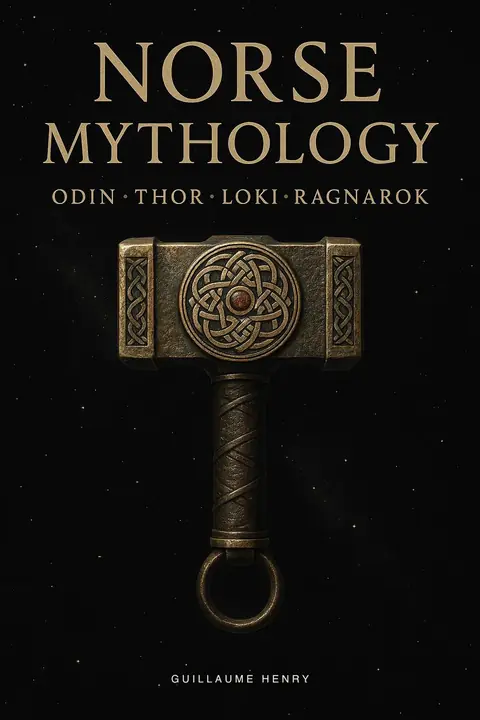
Norse
The Norse Mythology Book: Odin, Thor, Loki, Ragnarok and the Sagas of the Vikings
Odin, Thor, Loki, Ragnarok and the Sagas of the Vikings
The complete guide to Norse mythology drawn from the Eddas, the sagas, and the scholarship of those who read the source texts. Every god, every world, every myth.
More from Norse
All articles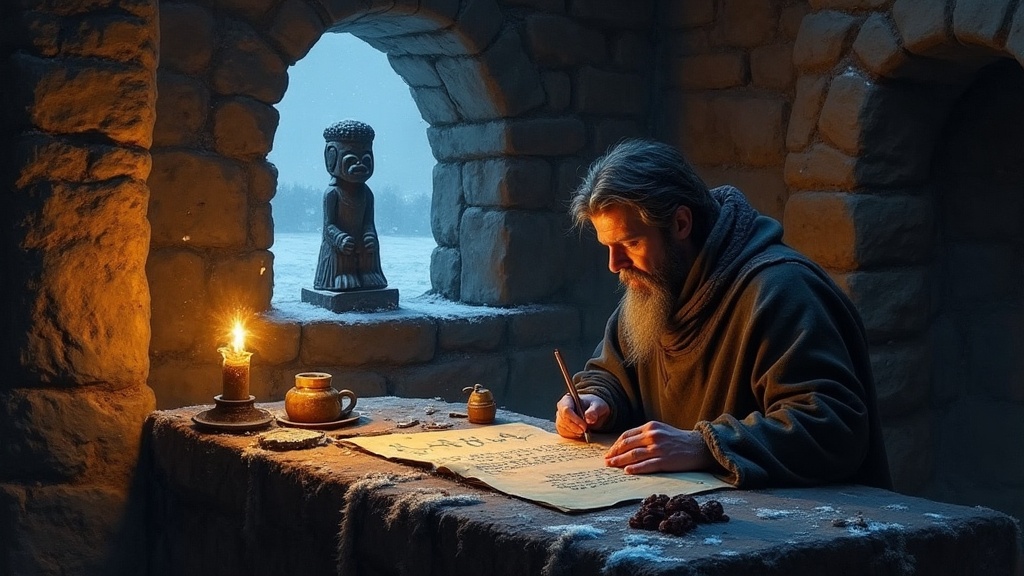
Norse
The Prose Edda and Poetic Edda: Primary Sources of Norse Myth
The Prose Edda and Poetic Edda are the two great written pillars of Norse mythology, preserved in medieval Iceland centuries after the gods had stopped receiving sacrifices. Without them, Odin, Yggdrasil, and Ragnarok would be shadows.
Norse
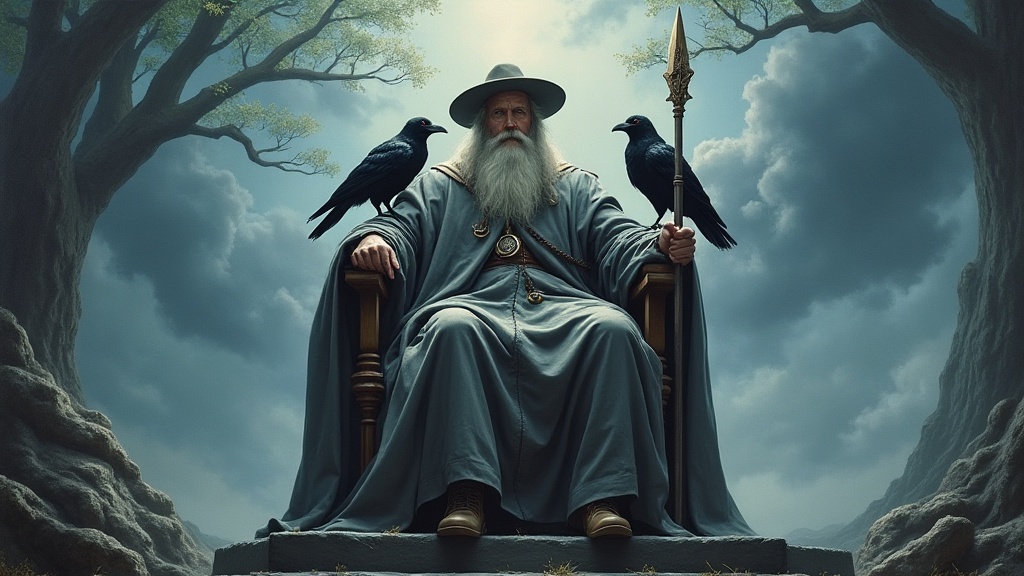
Odin: Allfather of Asgard
Odin stands at the center of Norse cosmology as ruler, wanderer, and keeper of forbidden wisdom. His contradictions make him the most haunting deity in the Germanic pantheon.
Norse
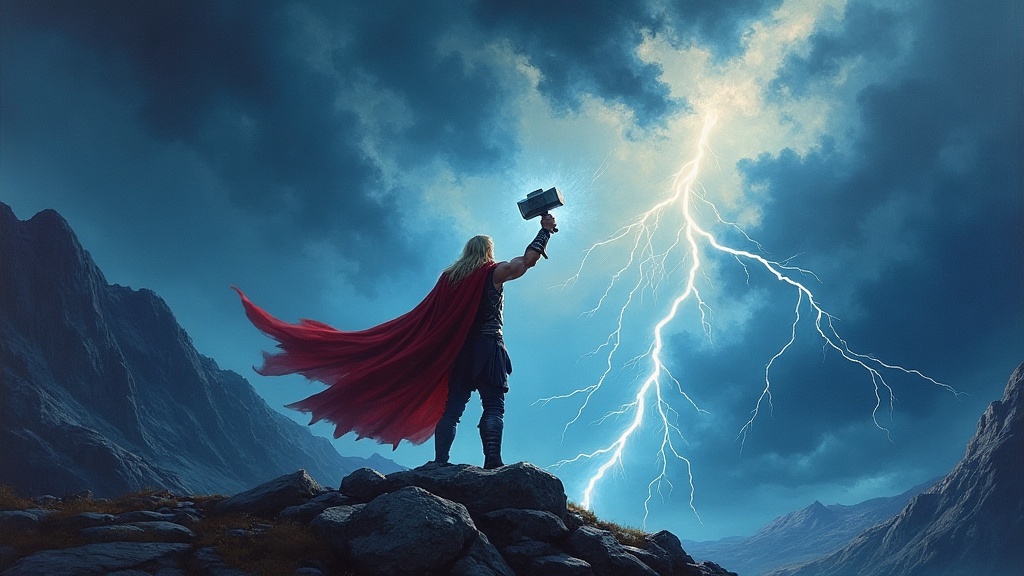
Mjolnir: The Sacred Symbol of Thor's Hammer
Mjolnir, the hammer of Thor, is one of the most potent symbols in Norse mythology, a weapon of divine thunder, a ward against chaos, and a mark of sacred covenant worn by Vikings for centuries.
Norse
Thor, God of Thunder: Hammer, Storm, and the Sacred Defender of Worlds
Thor, the Norse god of thunder, stands as one of the most powerful and beloved figures in world mythology. Son of Odin, wielder of Mjolnir, and eternal guardian of Asgard and Midgard alike.