
Sekhmet the Lioness of War: Egypt's Fierce Protector of Divine Order
Sekhmet, the lion-headed goddess of plague and healing, was ancient Egypt's most fearsome protector of order. Discover her role in solar ritual, her healing powers, and why pharaohs worshipped her as the shield of Ra.
Contents
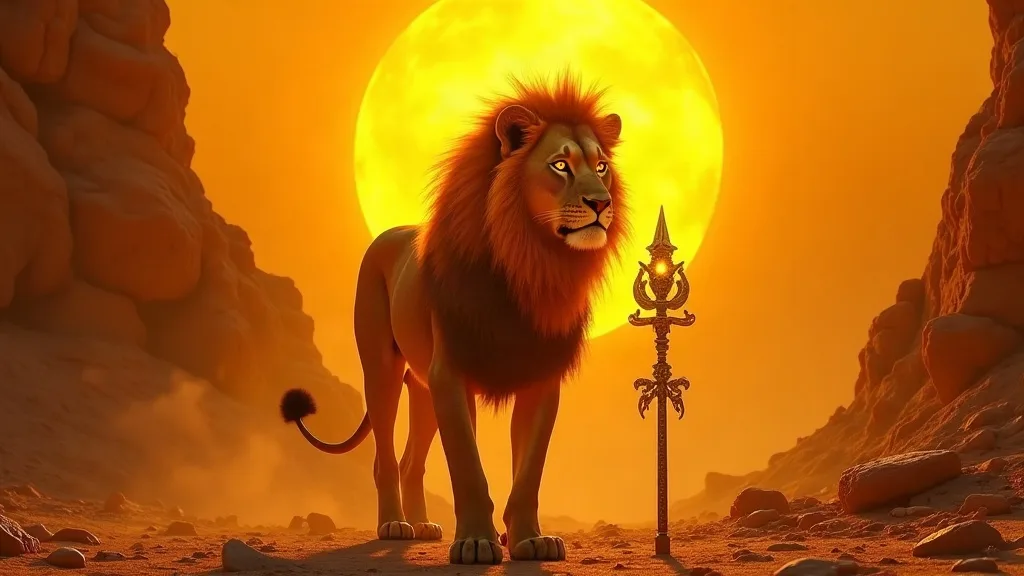
The sun blazes merciless across the desert. Ra, the sun god, rides his sacred boat across the sky each day, but chaos threatens always. When disorder rises, when enemies gather, when disease spreads, Sekhmet steps forward. Her mane is the color of flame. Her eyes burn with divine wrath. In her left hand, she carries the ankh, the symbol of life itself. In her right, she grips the was scepter, the emblem of power. She is the daughter of Ra. She is his weapon. She is his healer. For over three thousand years, ancient Egyptians feared and revered her, building temples in her honor and praying to her when plague arrived or when their pharaoh marched to war.
Sekhmet was not merely a god of destruction. She embodied a necessary force in Egyptian thought. Chaos, called isfet in the ancient Egyptian language, was the enemy of order, or ma'at. Without Sekhmet's fierce protection, the world would collapse into darkness. But she was also a healer. In temples, priests called upon her knowledge of medicine and herbs. She moved between destruction and restoration, between the plague and the cure. This paradox made her one of ancient Egypt's most complex and powerful deities.
Her worship stretched across the Nile Valley for millennia. From the New Kingdom through the late Ptolemaic period, Sekhmet remained central to state ritual and private prayer. Kings made offerings to her before battle. Mothers called upon her for protection of their children. The sick lay in temples bearing her name, hoping for her touch. To know Sekhmet is to understand how ancient Egyptians viewed power, danger, healing, and the sacred duty of maintaining order in a world perpetually threatened by chaos.
The Daughter of Ra: Origins and Divine Parentage
Sekhmet's story begins in the heavens above Egypt. The ancient Egyptians did not imagine their gods emerging from nothing. Instead, gods were born, they had parents, they had relationships with one another. Ra, the sun god, was the supreme creator force, but even Ra was not alone. He had many children, and among them was Sekhmet.
The Pyramid Texts, a collection of spells and religious utterances carved into the tombs of Old Kingdom pharaohs around 2400 to 2300 BCE, first mention Sekhmet explicitly. She appears as Ra's daughter, often paired with other female deities as the "eye of Ra" or the "daughter of Ra." The ancient Egyptians believed that Ra created other gods through different means. Some texts say Sekhmet was born from Ra's tears or his sweat. Other versions claim she came from the solar power itself, a manifestation of Ra's might given independent form.
One of the most famous myths involving Sekhmet describes her as the embodiment of Ra's vengeance. When humankind began to rebel against the aging sun god, Ra grew angry. He decided to send his daughter Sekhmet to punish the rebels. She descended to earth in the form of a lioness, and there she slaughtered vast numbers of humans. The Contendings of Horus and Set, a narrative from the New Kingdom, and the Book of the Dead, a collection of magical texts meant to guide souls in the afterlife, both reference Sekhmet's role as Ra's avenging instrument.
Yet Sekhmet also had a gentler genealogy. She was frequently identified with Hathor, the goddess of love, music, and motherhood. In some myths, Hathor and Sekhmet were two aspects of the same divine being: Hathor representing the benevolent side, Sekhmet the fierce side. Temple reliefs show both goddesses wearing the solar disk crowns, and priests often invoked them together. This fluidity between identities was characteristic of Egyptian theology. Gods were not always distinct beings with hard boundaries between them; they could merge, transform, and contain multiple natures.
Sekhmet's place in the divine hierarchy was secure from the earliest written records. She was not a minor deity who faded from memory. Instead, her importance only grew as the centuries passed. By the New Kingdom, she was among the most widely worshipped goddesses in Egypt, rivaled only by Isis and Hathor.
The Eye of Ra and the Myth of Divine Vengeance
One of the most visceral and complex myths involving Sekhmet centers on her role as the "Eye of Ra." This was not merely a poetic title. The Egyptians believed that Ra's eye possessed independent agency and power. It could protect him, it could attack his enemies, and it could move through the world with terrifying force.
The most famous version of this myth appears in the Contendings of Horus and Set, a Middle Kingdom narrative. When Ra aged and grew weary of his duties, humankind began to plot rebellion. They whispered in corners. They refused to obey the laws of ma'at. They spread isfet, chaos, across the land. Ra's divine council, other gods who advised him, noticed the unrest. They told Ra that his authority was being challenged. The sun god's rage ignited.
Ra decided that humanity needed to be taught a lesson. He gathered his divine power and sent it forth in the shape of his daughter Sekhmet. In some versions of the myth, Hathor takes on the violent form of Sekhmet for this purpose. But the result is the same: a fierce lioness descended upon the earth, and she began a slaughter that seemed unstoppable.
For day after day, Sekhmet hunted humankind across the desert and through the villages. Her golden fur gleamed in the sun. Blood stained the sand red. The humans fled in terror. They hid in caves and in the marshes. But Sekhmet's hunger for vengeance grew greater with each passing hour. She drank blood as if it were beer. She ate human flesh. Her fury seemed infinite.
Yet eventually, Ra began to reconsider. Perhaps the punishment had gone too far. Perhaps if Sekhmet continued, humanity would be completely annihilated, leaving Ra with no worshippers, no one to make offerings, no one to sustain him through ritual and prayer. So Ra devised a plan. He ordered the brewing of a vast quantity of beer, mixed it with pomegranate juice to make it resemble blood, and poured it across the earth where Sekhmet hunted.
When Sekhmet saw the crimson liquid, she mistook it for human blood. She drank it greedily. As the beer worked its magic, the goddess's rage began to fade. Intoxicated and satisfied, she lay down to sleep. When she awoke, the fury had passed. Sekhmet transformed, or perhaps merged back with Hathor, and the killing ceased. Humanity was spared, though humbled by the terror they had experienced.
This myth encapsulates the Egyptian understanding of Sekhmet. She was not evil. She was not capricious. She was the necessary instrument of divine will. When order was threatened, she struck. When the crisis passed, she could return to a calmer state. Her violence served a purpose: the restoration and maintenance of ma'at.
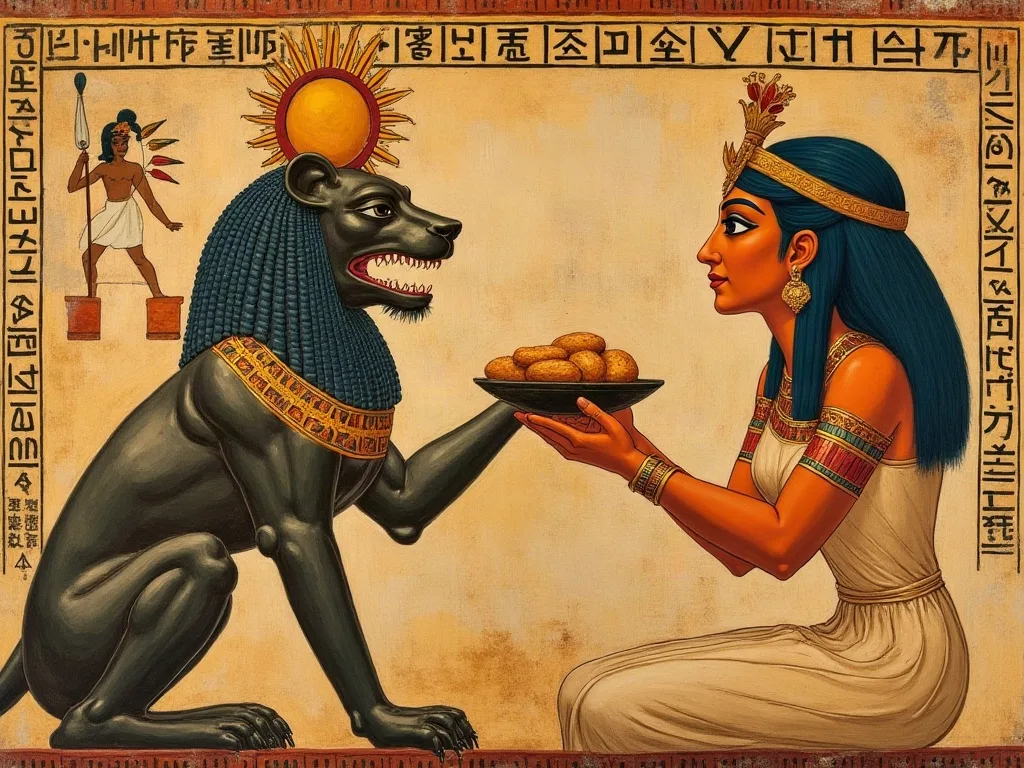
The myth also reveals something essential about Egyptian religion. The gods were not perfect beings existing in a timeless realm. They made decisions, sometimes ones they had to reconsider. They were moved by emotion, by anger, by the need for veneration. Ra himself depended on the loyalty of his subjects. This made Egyptian theology different from many other ancient religions. The gods were powerful, yes, but they were also embedded in the world, affected by it, dependent on human participation in ritual.
The Lady of Pestilence and the Goddess of Healing
Perhaps no aspect of Sekhmet puzzled medieval scholars more than her dual nature. She was simultaneously the goddess of plague and the goddess of medicine. She brought death, yet she could cure. She spread disease, yet physicians invoked her name.
This paradox made perfect sense to the ancient Egyptians. In their view, the same divine force could destroy or heal depending on the will of the god and the needs of the moment. Sekhmet embodied this principle completely. When she was angry, when her eye burned with wrath, she could strike a person down with sickness. When she was placated, when prayers and offerings moved her to compassion, she could remove that very same illness.
Egyptian physicians, called sunu in the ancient language, were often priests of Sekhmet. They understood that healing required two elements: practical knowledge of herbs, anatomy, and treatment, and divine intervention through Sekhmet's power. A medical papyrus, now in the Louvre, contains recipes for remedies alongside prayers to Sekhmet. The healer would prepare an ointment or a potion according to the formula, then recite an invocation asking Sekhmet to guide the treatment and remove the sickness.
The Egyptians catalogued a vast array of diseases: fevers, infections, tumors, eye diseases, afflictions of the joints. They understood that some illnesses came from outside the body (caused by bad air or contaminated food) while others seemed to arise from within. Sekhmet was believed to control all of these. Her serpent form, visible in her uraeus crown, connected her to the cobra, which was deadly yet also the emblem of protection. The cobra's venom was poison, but small amounts of it could be used medicinally. This symbolism reinforced Sekhmet's role as the balance point between poison and cure.
In the New Kingdom, temples dedicated to Sekhmet became healing centers. The most famous was her sanctuary in Memphis, the ancient capital of Egypt, where priests maintained her cult for over a thousand years. People came to these temples suffering from serious illness or injury. They would spend nights in the temple, sleeping in specially designated rooms. In their dreams, they might receive visions of Sekhmet or be guided toward healing by the priests. Some texts describe miraculous cures attributed to the goddess's intervention.
Sekhmet's healing power extended to the pharaoh himself. The king was considered a living god, the earthly manifestation of Horus and the son of Ra. He was also the primary intermediary between the human and divine worlds. When the pharaoh was ill, when plague threatened his reign, the stability of the entire kingdom was thought to be at risk. Priests would perform elaborate rituals to restore Sekhmet's favor, offering sacrifices and reciting prayers on behalf of the king.
The Lioness and Solar Ritual: Sekhmet's Role in Cosmic Order
To understand Sekhmet fully, one must grasp the central Egyptian concept of ma'at. This word, pronounced "mah-aht," refers to order, justice, truth, and cosmic harmony. It is often translated as "divine order" or "cosmic equilibrium." Every morning when Ra woke and began his daily journey across the sky, the entire universe depended on ma'at being maintained. Every evening when Ra descended into the underworld, ma'at had to be preserved against the forces of isfet, chaos and disorder.
Sekhmet was one of the primary guardians of ma'at. She did not maintain order through persuasion or diplomacy. She maintained it through force. When chaos threatened, she was the enforcer, the warrior, the instrument of cosmic justice. This is why pharaohs, who saw themselves as the human embodiment of divine order, honored Sekhmet above many other goddesses.
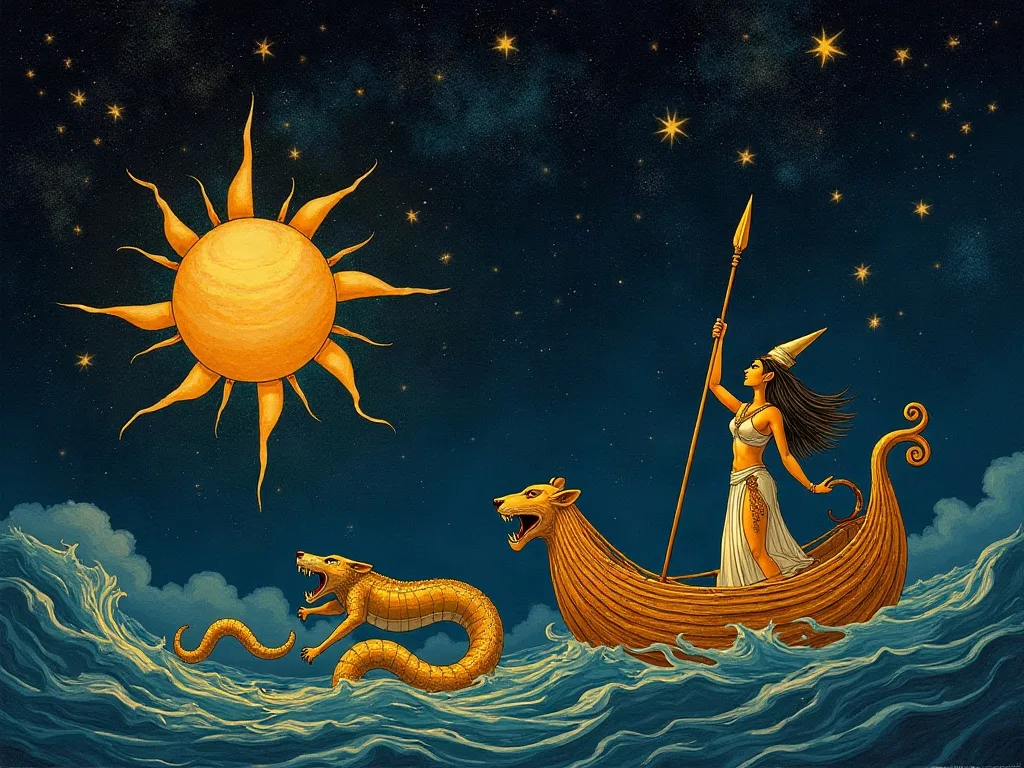
In the daily solar ritual performed by Egyptian priests, Sekhmet played a crucial role. Each morning, priests would awaken the statue of Ra in the temple's inner sanctum. They would purify themselves, light incense, and make offerings of food, drink, and flowers. As part of this ritual, they would invoke Sekhmet's power to protect Ra throughout the day. They asked her to shield him from Apophis, the serpent of chaos who lurked in the underworld, seeking to devour Ra and prevent the sun from rising again.
The battle between Ra and Apophis was eternal. Each night, as Ra traveled through the twelve hours of the underworld, Apophis would rise up to attack him. Ra's companions, including Sekhmet, had to defend him. In the temple reliefs and in the Amduat, a text describing the journey through the underworld, Sekhmet appears as a fierce protector. She is shown wielding a spear, standing beside Ra, ready to strike down the serpent.
This cosmic battle was not metaphorical to the Egyptians. They believed it was genuinely happening every single night. If the proper rituals were not performed, if the prayers were not said with genuine devotion, if the offerings were not made with respect, then Ra might be defeated. The sun might not rise. The world might end in darkness and chaos. Every priest who participated in the daily ritual understood that their actions had real consequences for the continuation of existence itself.
Sekhmet's golden mane was thought to resemble the sun's rays. In temple reliefs, she is sometimes depicted with a solar disk between her ears, directly linking her to Ra's power. She was not merely subordinate to the sun god; she was an extension of his force. When priests invoked her during the ritual, they were drawing upon the same power that kept chaos at bay and allowed order to flourish.
Sekhmet in the Pantheon: Relationships with Other Gods
Egyptian theology was rich and complex, with gods forming relationships that were sometimes harmonious and sometimes fraught with tension. Sekhmet's position in the divine pantheon was multifaceted.
Her relationship with Ra was fundamental. As his daughter and his instrument, she served his will. Yet she also had her own temples, her own priesthood, her own worshippers. She was not merely Ra's appendage; she was a powerful goddess in her own right.
Sekhmet's connection to Hathor was equally important. In many texts and temple reliefs, the two goddesses are nearly indistinguishable. Both wear the solar disk crown. Both are called "daughters of Ra" or "eyes of Ra." In the myth of divine vengeance, Hathor sometimes transforms into Sekhmet, and in other versions, Hathor is the gentle day form while Sekhmet is the fierce night form of the same goddess. This duality reflected an Egyptian theological principle: a single divine force could have multiple manifestations depending on circumstances.
Sekhmet was also closely associated with Thoth, the god of wisdom and writing. In some myths, Thoth is credited with inventing the remedy that stopped Sekhmet's rampage. He is depicted as the calming, intellectual force to her wild, destructive power. Yet they are not opposed in a simple way. Both Sekhmet and Thoth serve ma'at. Thoth maintains order through wisdom and judgment, while Sekhmet maintains it through force and protection.
Her relationship with Ptah, the creator god who was worshipped primarily in Memphis, was also significant. In Memphis, Sekhmet and Ptah were recognized as partners. Ptah represented the creative, constructive force that brought things into being through divine will and intelligence. Sekhmet represented the protective, destructive force that removed obstacles and preserved what Ptah had created. Together, they embodied the complete cycle of creation, maintenance, and transformation.
Sekhmet appeared alongside Osiris in afterlife scenes depicted in tombs. She is shown in the "Hall of Two Truths," the Egyptian conception of the afterlife, where the deceased's heart is weighed against the feather of ma'at. Sekhmet's presence underscored that the dead would face judgment, that they must have lived with ma'at as their guide.
This network of relationships demonstrates that Egyptian gods were not isolated figures. They were members of a complex divine society, each with distinct roles but all working toward the maintenance of cosmic order. Sekhmet's power was unique and necessary precisely because the other gods could not do what she did. No other goddess embodied both absolute wrath and absolute healing. This made her irreplaceable.
Temples and Worship: Where Sekhmet Dwelt on Earth
Sekhmet was not an abstract principle worshipped only in the minds of philosophers. She had temples. She had priests. She received offerings and prayers from the living. The most important of these temples stood in Memphis, the ancient capital of Egypt, where her shrine was tended for over two thousand years.
The main temple of Sekhmet in Memphis was constructed during the New Kingdom, roughly the 1500s to 1100 BCE, though worship at the site may have begun earlier. The temple followed the standard Egyptian design: a massive pylon gateway with towers, courtyards open to the sky, then progressively narrower rooms, until finally the inner sanctum where the statue of Sekhmet stood. Only the high priest could enter this inner chamber. There, behind multiple doors and walls, the goddess was believed to dwell.
The daily ritual in Sekhmet's temple would have been elaborate. Before dawn, priests would rise and purify themselves in the sacred pool. They would wear clean white linen and remove all signs of impurity. Carrying torches, they would approach the inner sanctum. A senior priest, called the hm ntr or "servant of the god," would unlock the doors. Inside, the statue of Sekhmet waited, carved from stone, often made of granite or limestone, her form perfect and unchanging.
The priest would greet her. "Awake in peace," he would say, or invoke her by one of her many names. He would wash the statue with water from the sacred pool, then dress her in fine linen. He would apply cosmetics, paint her eyes and lips, place a crown on her head. He would offer her food: bread, meat, fresh fruit, honey cakes, beer. He would burn incense, precious resins that would fill the sanctuary with fragrance. All of this was done with reverence and precision. The ritual had to be performed correctly, or it was believed that the goddess might withdraw her favor.
Outside the inner sanctum, in the courtyards and outer chambers, other Egyptians could come to pray. They brought offerings: written prayers on papyrus, carved amulets, small statues. They might stay for hours, sitting in the temple courtyard, speaking to Sekhmet in their hearts. Mothers came to ask for protection of their children. The sick came seeking healing. Soldiers came before battle, asking for Sekhmet's favor.
Other temples dedicated to Sekhmet stood in Heliopolis, another great religious center, and in other cities throughout Egypt. Each had its own priesthood, its own local traditions. Yet all served the same fundamental purpose: maintaining a connection between the human world and the divine realm where Sekhmet resided.
By the late period of ancient Egypt, around 700 to 300 BCE, Sekhmet's worship had spread beyond Egypt itself. Greek colonists who settled in Egypt and Egyptian priests who migrated to other lands carried knowledge of her cult. When Alexander the Great conquered Egypt, Greek soldiers and settlers encountered Sekhmet in the temples. Some of them began to identify her with Greek goddesses like Ares (god of war) or Artemis (goddess of the hunt). Yet her worship maintained its distinctive Egyptian character.
Symbols, Hieroglyphs, and Iconography
When ancient Egyptians saw Sekhmet depicted in temple reliefs or tomb paintings, they recognized her immediately. Her iconography was distinctive and consistent across centuries.
The most obvious symbol was her lion head. The lion was one of the most powerful animals known to the Egyptians. Lionesses were particularly fierce hunters and protective mothers. By depicting Sekhmet with a lion's head, artists communicated her power, her fierceness, and her protective nature simultaneously. Only Sekhmet and Hathor shared this lioness form, which underscored the deep connection between these two goddesses.
Sekhmet typically wore a solar disk crown, the circular sun symbol often topped with a serpent (the uraeus). The uraeus was a royal insignia, marking her as a daughter of Ra and a protector of the pharaoh. The serpent represented both her power to strike (like a cobra's venom) and her wisdom (snakes were considered wise in Egyptian thought).
In her hands, Sekhmet held symbolic objects. The ankh, a cross with a rounded top, represented life itself. By holding the ankh, Sekhmet reminded the viewer that even the fearsome destroyer was fundamentally connected to the principle of life. The was scepter, a staff with a forked base topped with an animal head, represented divine power and authority. These objects were held by many gods, but their presence in Sekhmet's hands emphasized her status as a divine being of utmost importance.
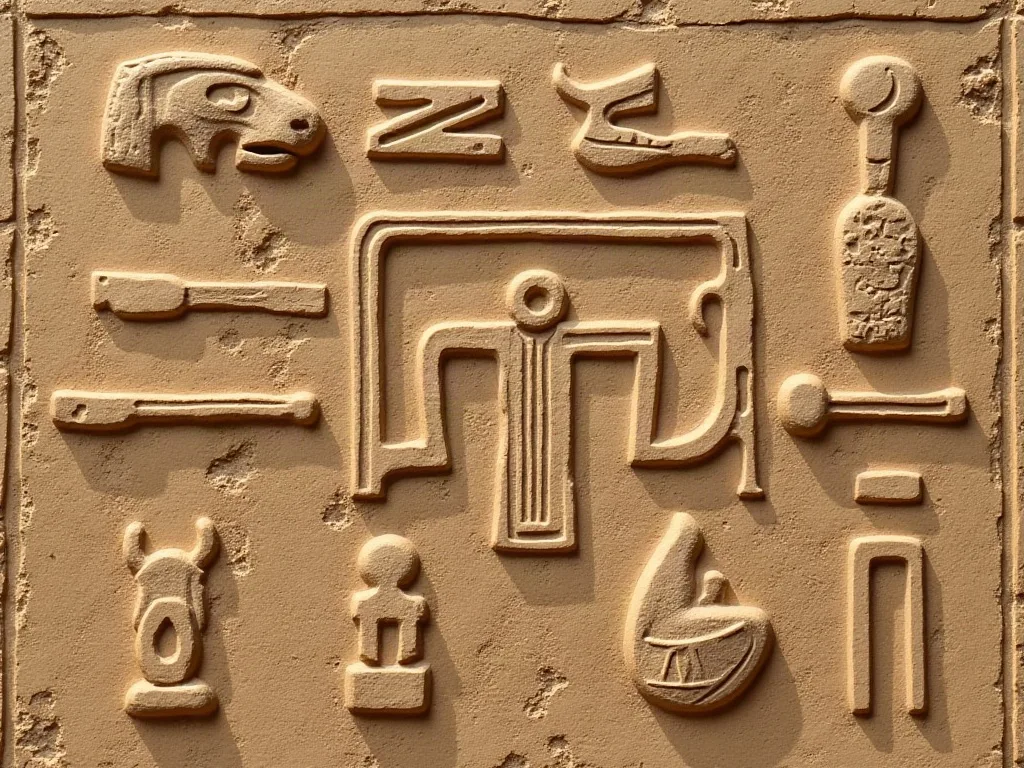
In hieroglyphic writing, Sekhmet's name was written as a lion's head or sometimes as a seated woman with a lion's head. The Egyptians used determinatives, small symbols added to the end of words to clarify their meaning. Sekhmet's determinative was the lion symbol. When scribes carved her name into stone, they were simultaneously writing her as a concept (fierce power, healing, the eye of Ra) and depicting her visually.
The color associations with Sekhmet were also significant. Red and gold were her colors, reflecting both the sun and blood. In temple reliefs, she might be painted with golden skin and red accents, emphasizing her solar connection and her association with warfare and violence. When amulets of Sekhmet were crafted, they were often made from red stone like jasper or red granite, materials thought to carry her protective power.
The Decline and Transformation: Sekhmet in the Late Periods
For most of ancient Egyptian history, Sekhmet's worship remained strong. But as centuries passed and Egypt fell under foreign rule, her significance gradually shifted. When the Greeks took control of Egypt in the Hellenistic period, after Alexander the Great's conquest in 332 BCE, Egyptian priests and Greek rulers made compromises. Some Egyptian traditions were maintained, but new ideas entered the religious landscape.
Sekhmet was increasingly identified with Greek goddesses and sometimes with Astarte, a goddess from Syria. The clear lines between Egyptian deities began to blur. Yet Sekhmet's core function, as a protective and healing force, remained recognizable even under these new names and interpretations.
When Rome conquered Egypt in 30 BCE, the process of religious transformation accelerated. Roman emperors funded some temples and suppressed others. Christianity eventually came to Egypt and eventually became dominant. The worship of Sekhmet and all the old gods was abandoned. Temples fell into disrepair. Priests ceased their rituals. The knowledge of how to read hieroglyphics was lost.
For over a thousand years, Sekhmet existed only in ruins and ancient texts. Yet she was not truly forgotten. When scholars began to rediscover ancient Egypt in the 19th and 20th centuries, they found her name everywhere in the remnants of temples, on papyri, carved into statues. Modern Egyptologists have spent decades understanding her role, her myths, her symbolism. In some ways, she is more widely known today than she has been for many centuries.
Today, Sekhmet inspires modern spiritual practitioners who draw on Egyptian tradition. Some people make offerings to her in new rituals. Writers and artists have used her as a subject and inspiration. She appears in novels, in video games, in popular culture. The lioness who once terrified ancient Egyptians and healed the sick in her temples has become a symbol of fierce feminine power in the modern imagination.
Frequently asked questions about Sekhmet the lioness of war
Frequently asked questions
Was Sekhmet truly a dangerous goddess, or was she only a protector?
Sekhmet was both. The ancient Egyptians did not see this as a contradiction. She was dangerous because protection sometimes required destruction. When chaos threatened, she struck without mercy. When order was restored, she could also heal. The ancient texts make clear that her violence was not random; it served the purpose of maintaining ma'at, divine order. Pharaohs worshipped her precisely because she was dangerous, understanding that true protection required power and willingness to use it.
How did ancient Egyptians distinguish Sekhmet from Hathor if they were so similar?
In some contexts, Sekhmet and Hathor were treated as a single goddess with two aspects. In others, they were distinct beings who sometimes merged or transformed. Modern readers often expect gods to have fixed, unchanging identities, but Egyptian theology was more fluid. A goddess could be gentle one moment and fierce the next, depending on what the situation required. Priests understood that the divine realm operated according to different rules than the visible world.
What evidence do we have that ancient Egyptians actually prayed to Sekhmet for healing?
The evidence comes from multiple sources. Medical papyri like the Ebers Papyrus contain remedies alongside prayers to Sekhmet. Temple inscriptions describe people coming to Sekhmet's shrines seeking cures. Votive statues and offerings left in temples show that ordinary people made requests to Sekhmet. Tomb paintings depict the goddess in scenes of healing and protection. The consistency of these sources across centuries shows that healing through Sekhmet was a widespread, accepted practice.
Did Sekhmet have any enemies or rivals among the Egyptian gods?
Sekhmet had no true enemies among the gods. She had partners with different roles, like Thoth, who represented wisdom, or Ptah, who represented creation. Even Apophis, the chaos serpent, was not a rival god but an enemy of the entire divine order. Sekhmet stood with Ra and the other gods against him. The Egyptian pantheon was not structured as a battleground where gods fought for dominance. Instead, each god served a function in maintaining the cosmic system.
How long was Sekhmet worshipped in ancient Egypt, and when did her worship end?
Sekhmet was worshipped for over three thousand years, from the Old Kingdom (around 2600 BCE) through the late Ptolemaic period (roughly 300 BCE). When Christianity became dominant in Egypt around 380 CE, worship of all the old gods ceased, including Sekhmet. This represents a continuous religious tradition of extraordinary length, comparable to how long Christianity has been practiced today.
Are there any surviving temples dedicated to Sekhmet that modern visitors can see?
Yes, though most are in ruins. The temple of Sekhmet in Memphis has been significantly damaged, but archaeologists have excavated and studied it. Fragments and reliefs showing Sekhmet can be seen in museums throughout the world, particularly the Egyptian Museum in Cairo and major European museums. Temple reliefs depicting her survive in larger temple complexes like Karnak, where she is shown in various ritual contexts.
Sekhmet's Legacy: From Ancient Temples to Modern Imagination
The story of Sekhmet did not end when the last priest left her temple. In some ways, it transformed. The modern world has discovered her through archaeology and scholarship, and she has become a symbol with renewed meaning.
Egyptologists continue to study Sekhmet because she reveals how ancient Egyptians thought about power, danger, and healing. The concept that the same force could destroy or cure challenged simple moral categories. It suggested a universe where opposites could exist in paradox, where violence could be justified if it served order, where fear and reverence were not opposites but companions.
Historians of medicine have found in Sekhmet's story evidence that ancient Egyptians understood the connection between supernatural belief and practical healing. When someone took a remedy while praying to Sekhmet, they combined pharmacology with psychology. Modern research suggests that such combinations can be genuinely effective. The Egyptians, though they did not use modern scientific vocabulary, seemed to understand that belief and physical treatment worked together.
Writers and artists have been drawn to Sekhmet for centuries. She appears in poems, novels, operas. Each generation reimagines her in its own image. To some, she represents feminine power and fierce independence. To others, she embodies the necessity of controlled violence in service of a greater good. These modern interpretations are not the same as what ancient Egyptians believed, but they reflect genuine aspects of her mythological character.
The lioness has not returned to her temples. The priests no longer wake before dawn to dress her statue and make offerings. Yet in a strange way, Sekhmet has endured. She exists now in human imagination, in scholarly research, in the cultural memory of a civilization that has been dead for two thousand years yet continues to speak to us across that vast distance. The ancient Egyptians would probably recognize her there, in the minds of people trying to understand what she meant, still calling upon her in their own way, still seeking to comprehend the balance between destruction and healing that she embodied so perfectly.
Free 25-page sample
Want the whole story?
Take the first 25 pages free. If it pulls you in, the full edition is yours as an instant PDF download, with a paperback on Amazon for selected titles.

Mythology
The World Mythology Book: The Gods, Heroes and Myths of Every Culture
The Gods, Heroes and Myths of Every Culture, in One Volume
The whole of world mythology in a single volume: Greek, Norse, Egyptian, Japanese, Hindu, Celtic, Slavic, Mesoamerican and African myths gathered side by side, each drawn from the primary sources.