
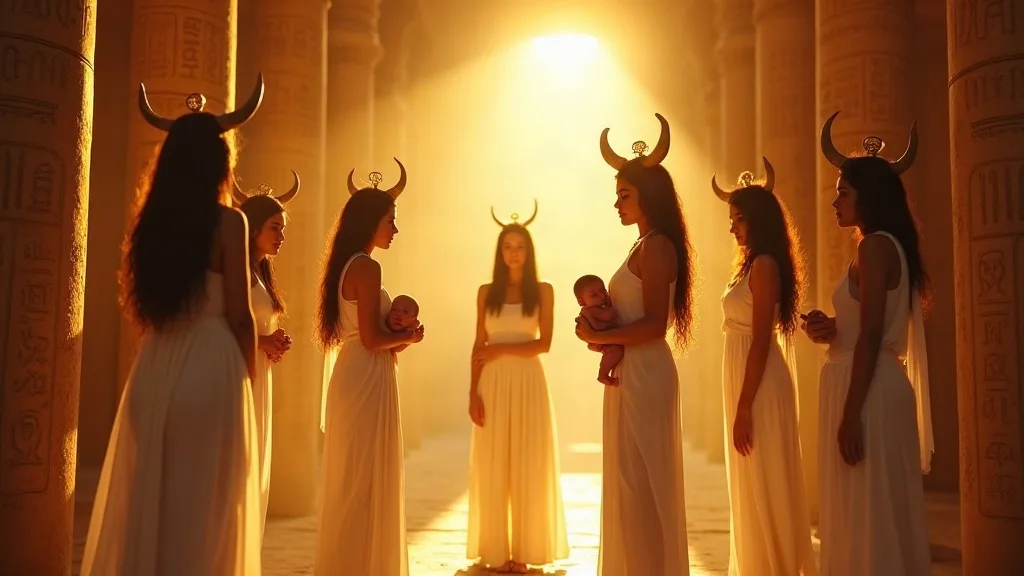
The Seven Hathors and Fate: Weavers of Destiny in Ancient Egypt
The seven Hathors were Egypt's divine weavers of fate, present at every birth to declare a person's destiny. Discover how these protectors shaped Egyptian understanding of inevitability, protection, and the power of love across life and death.
Contents
When a child drew first breath in ancient Egypt, seven divine women entered the room. Not as midwives, but as witnesses to destiny itself. They were the seven Hathors, and their arrival meant a human life had been measured against cosmic law. They spoke the future. They could not be refused.
The seven Hathors sit at the intersection of two Egyptian truths: the absolute certainty of fate (what the Egyptians called shai, pronounced "shah-ee"), and the goddess Hathor's role as protector, lover, and healer of all living things. To understand them is to glimpse how ancient Egypt imagined the moment when mortality becomes real.
Who Were the Seven Hathors?
The seven Hathors were not separate goddesses, but seven manifestations or aspects of Hathor herself. Hathor was the sky goddess, the daughter of the sun god Ra, associated with love, music, dance, fertility, and maternal protection. When the Egyptians needed to express the idea that fate arrived at birth in multiple forms, each distinct but unified, they envisioned seven.
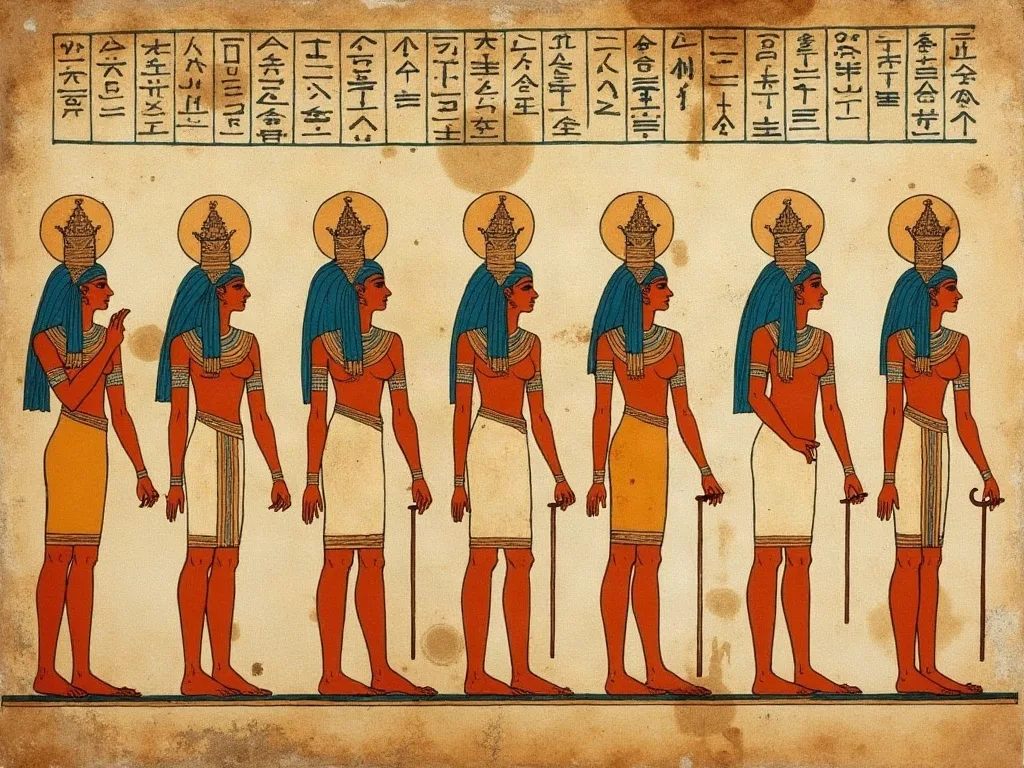
The earliest written record of the seven Hathors appears in the Pyramid Texts, the oldest collection of religious writings ever found, carved into the walls of royal tombs around 2400 BC. One spell invokes them directly: "The seven Hathors come to you in this hour, to tell you what will happen in your life." By the time the story of Sinuhe was written (around 1875 BC), their presence was so familiar that scribes barely needed to explain who they were. Everyone knew.
In artistic depictions, the seven Hathors typically appear as women wearing the solar disk (a circle) balanced on horns, the crown of Hathor. Sometimes they wear the menat necklace, a heavy counterweight ornament sacred to her. They move together, speak together, and their verdict is binding. The number seven itself carried power: seven represented completeness, perfection, a cycle closed.
The Birth Scene: When Fate Enters
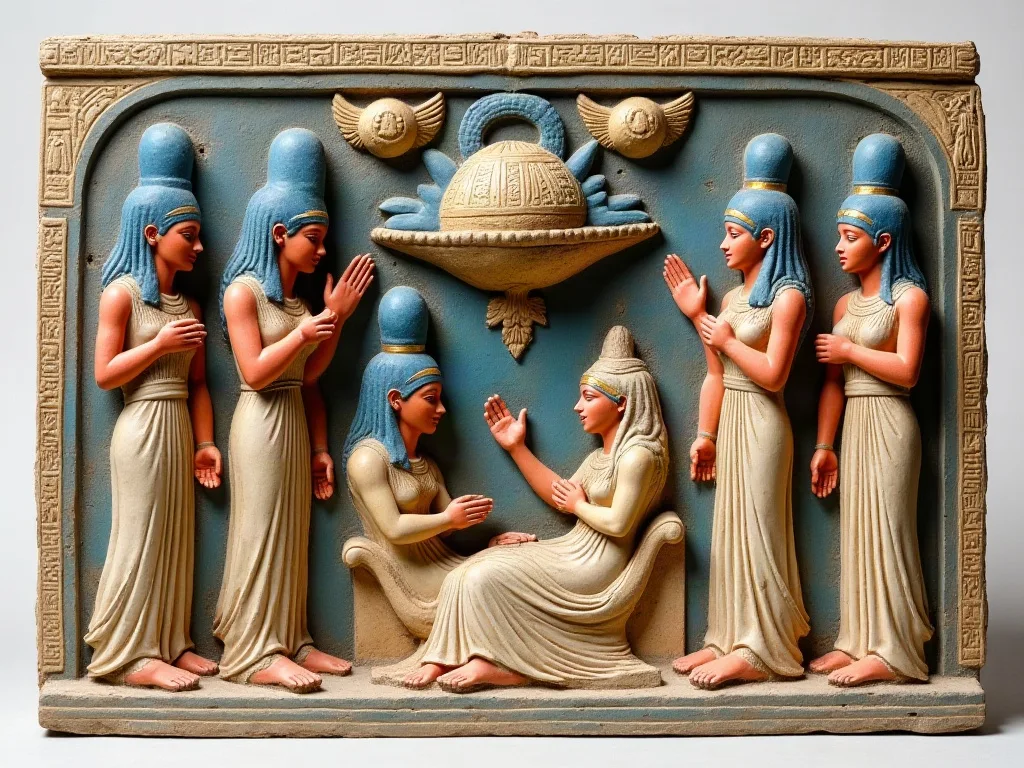
The most vivid moment for the seven Hathors occurs at a child's birth. Egyptian mothers understood this as a cosmic event. When labour began, the Hathors were already en route. They would gather in the birthing chamber (called a "birth house" or ibes), invisible to mortal eyes but sensed by priests and magicians who could perceive the divine.
The moment the child was born, the seven Hathors would declare the newborn's shai. This was not a gentle blessing. It was a statement of what would come, what could not be undone. A Hathor might say: "This child will be healthy, but will know sorrow in love." Another: "This child will serve the king and receive honour." These were not predictions, but the actual weaving of destiny into the fabric of the child's existence.
Once a Hathor had spoken, it was done. Even the gods could not undo it. This made the moment of birth the most fateful instant of human existence. What was declared then shaped everything that followed. The Egyptians did not see this as cruel. Rather, they saw it as order imposed on chaos, pattern imposed on possibility.
The seven Hathors also served as protectors of women during labour. Women in Egypt called upon them, sometimes by name. Amulets and papyri from the Middle Kingdom (around 1975 BC) show formulas asking the Hathors to "come with your power, come with your strength, bring the child forth safely." They were midwives of the soul before the body ever drew breath.
The Relationship Between the Seven Hathors and Fate Itself
To understand the seven Hathors fully, you must grasp how the ancient Egyptians imagined fate. They distinguished between several forces:
Shai (shai) was the personal destiny, the individual path carved out for one person alone. It was immutable, written at birth. Even Osiris, god of the afterlife and judge of souls, could not erase a person's shai. The Egyptians accepted this with a kind of peaceful resignation. Your shai was yours; you could not outrun it, but you could walk it with dignity.
Renenet was the goddess of destiny in a broader sense, closely associated with the harvest and the Nile's inundation. She represented the larger cycles of the universe, the seasons turning, abundance and scarcity. While the seven Hathors declared individual shai, Renenet oversaw the cosmic pattern.
Maat, the goddess of truth, justice, and cosmic order, ensured that every destiny aligned with the larger fabric of the universe. She was the standard against which all things were measured. If the seven Hathors spoke well of your shai, it was because Maat had already woven your thread into the larger tapestry of existence.
The seven Hathors were thus the executors of fate, the ones who brought abstract necessity into concrete utterance. They were not cruel or indifferent. They were the hands of destiny itself.
The Seven Hathors in Egyptian Literature and Daily Life
The seven Hathors appear throughout Egyptian texts, but they shine most vividly in narrative and practical magical contexts.
In the Tale of the Seven Hathors (preserved in a papyrus from around 1160 BC), a royal daughter is born. The seven Hathors appear and declare: "She will die by poison or a snake bite." Her father builds a tower to protect her, but destiny arrives anyway. However, the story complicates the simple notion of fate. The daughter survives the snake bite, marries a prince, and lives. The Hathors' prophecy came true in letter (she was bitten) but was transformed by other forces in the world. This taught the Egyptians that while fate was certain, its shape could be bent by wisdom, magic, and love.
In everyday life, mothers would invoke the seven Hathors during pregnancy. Amulets shaped like the seven-petaled flower (a symbol of Hathor) were worn to protect mother and child. Magical papyri give detailed spells to call the Hathors by names, asking them to "come with joy, come with life." Some lists name them individually:
- Hathor of Dendera (a major temple city)
- Hathor of Philae (an island in the south)
- Hathor of Faiyum (an oasis region)
- Hathor of Heliopolis (the sun god's great temple city)
- Hathor of Hermopolis (a centre of wisdom)
- Hathor of Thebes (the southern capital)
- Hathor of Aphroditopolis (a city of joy and fertility)
However, these names were not fixed. Different regions and time periods named them differently, based on local Hathor temples. What mattered was not the individual names but the collective power: seven voices speaking as one.
In marriage ceremonies, couples would invoke the seven Hathors to bless the union. In royal coronations, the new pharaoh would sometimes be presented to the seven Hathors in a ritual that asked for their approval of his shai as ruler. The Hathors, in turn, represented the blessing of the divine feminine, the continuity of creation.
Hathor, Protector and Lover: The Maternal Power Behind the Seven
To understand the seven Hathors, you must first understand Hathor herself. She was one of Egypt's most ancient goddesses, with roots reaching back to the predynastic period (before 3000 BC). She was the sky itself, stretched above the earth as a cow with a star-spangled belly. She was the daughter of Ra, the sun god, born each day as he crossed the sky.
But Hathor was far more than a distant cosmic force. She was intimate, embodied, sensual. She was the milk that fed the pharaoh (pharaohs were sometimes called "Children of Hathor"). She was the music of the sistrum, a rattling instrument that seemed to carry divine joy. She was dance, intoxication, the ecstasy of love. When women made love, Hathor was present. When wine was drunk in celebration, it was her blessing.
At the same time, Hathor could be fierce. In the myth of Ra and the Eye of Ra (a solar deity often identified with Hathor herself), the goddess becomes the Sekhmet-like force of divine wrath, sent to punish humanity for its disobedience. She drinks the blood of mortals, reveling in destruction, until she is tricked by Ra into drinking beer coloured red like blood, which intoxicates her and transforms her rage into joy.
The seven Hathors inherited both aspects: the protective grace of the love goddess and the inexorable power of fate itself. When they spoke a child's destiny, they were acting as the ultimate mothers, speaking with love even when the future held sorrow.
The Hathors and the Afterlife
The seven Hathors' role did not end at death. In the journey through the Duat (the Egyptian underworld, pronounced "doo-aht"), the deceased encountered many perils, but the Hathors' declarations continued to matter.
In the Book of the Dead (a collection of magical spells and maps for the afterlife, compiled over many centuries), the seven Hathors appear as judges and protectors. They guide the soul toward the Hall of Two Truths, where Osiris and Anubis await to weigh the heart against the feather of Maat. The Hathors ensure that the journey is safe, that the soul travels according to its shai.
One Book of the Dead spell invokes the Hathors in the moment of greatest vulnerability, when the soul stands before the judges: "Seven Hathors, come with your words of power. Speak for me, as you spoke at my birth. Let my shai be remembered. Let my heart be light."
The Egyptians believed that the seven Hathors would remember what they had declared at birth and would advocate for the soul in the afterlife. Your shai, announced in the moment of coming into the world, would follow you through eternity.
Cross-Cultural Echoes: Fate Speakers in Other Traditions
The seven Hathors were Egypt's answer to a question asked across many ancient cultures: who determines what will happen? How is human life shaped by forces beyond our control?
In Greek mythology, the Moirai (the Fates) were three women, not seven, who spun, measured, and cut the thread of each human life. Their power was absolute, and even Zeus obeyed them. The parallel to the seven Hathors is striking: both were female forces of destiny, both acted at birth or near it, both were implacable.
In Norse mythology, the Norns (particularly Urd, Verdandi, and Skuld, representing past, present, and future) carved runes into the trunk of Yggdrasil, the world tree, determining the fate of gods and humans alike. Again, we see a pattern: female wisdom keepers, the power to declare and shape destiny, a cosmic inevitability.
In Hindu tradition, the concept of karma and dharma (duty, cosmic law) served similar functions. While not personified as specific goddesses declaring fate, the underlying idea was the same: actions have consequences, lives are shaped by unseen forces, and acceptance of one's role in the cosmic order brings peace.
The seven Hathors, then, represent a distinctly Egyptian answer to questions about freedom, fate, and the nature of a human life. Where other traditions saw fate as a thread to be cut or runes to be carved, Egypt saw it as a declaration of love and protection spoken by the ultimate mother goddess at the threshold of existence.
The Decline and Transformation of the Seven Hathors
As Egypt's religious life changed, particularly during the Greco-Roman period (after 332 BC), the seven Hathors gradually faded from prominence. Hathor herself endured, sometimes conflated with Greek Aphrodite or Roman Venus, goddesses of love. But the specifically Egyptian idea of seven fate-speakers declaring shai became less central to religious practice.
By the time of the late Ptolemaic and Roman periods, Egyptian religion was increasingly syncretistic (mixing gods from different traditions). The old certainties gave way to new questions and new gods. The temples dedicated to Hathor, particularly at Dendera, continued to receive worshippers and offerings, but the philosophical and magical framework that made the seven Hathors essential had shifted.
Yet traces of their influence persisted. Coptic Christian Egypt, which absorbed and transformed many older Egyptian religious ideas, preserved stories and incantations that invoked the Hathors' protection. Magical papyri from the Byzantine period still call upon "the seven goddesses of fate" in formulas that echo the ancient rites.
In the modern world, the seven Hathors have experienced a quiet renaissance among those who study Egyptian spirituality and ancient religion. They represent a vision of divine femininity that is neither soft nor passive: these are mothers who speak truth, healers who accept hard realities, lovers who understand that protection sometimes means letting go.
The Hathors in Art and Iconography
Depicting the seven Hathors presented a challenge to Egyptian artists. How do you show one goddess appearing as seven? The solution was both simple and elegant.
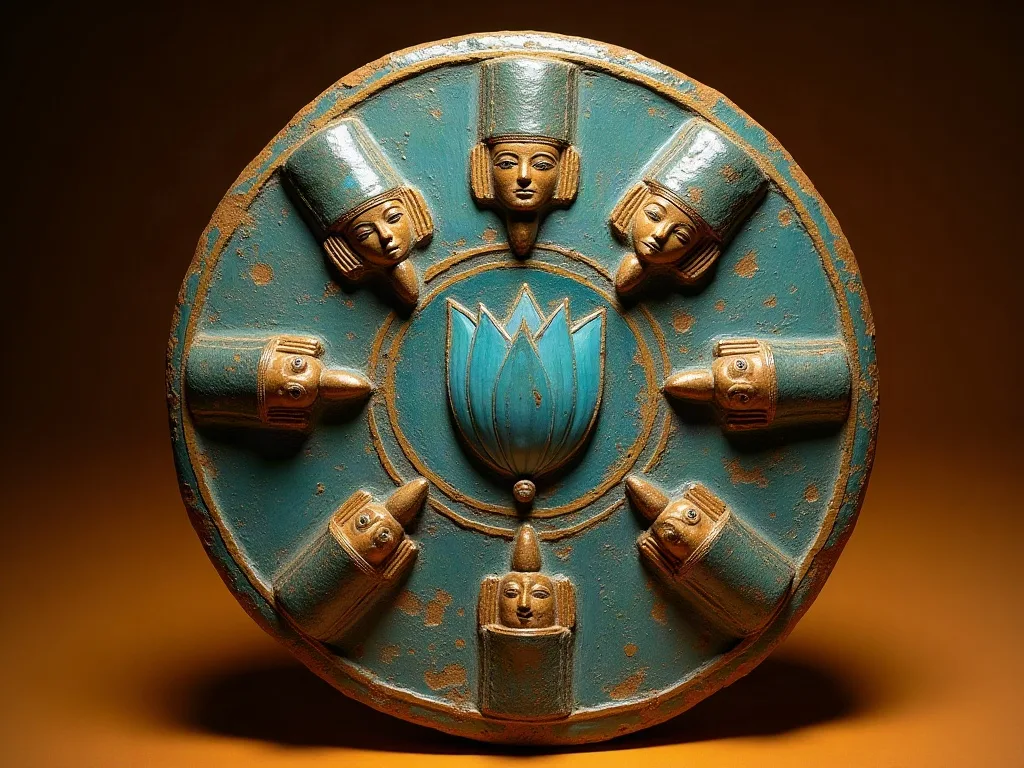
In temple reliefs and papyri, the Hathors are typically shown as seven identical female figures, standing in a line or arranged in a group. Each wears the solar disk and horns (the crown of Hathor). Some hold the menat necklace, others a sistrum (the rattle used in her worship). Their faces are serene, almost enigmatic. They do not smile, but neither do they frown. They are beyond emotion; they are the personification of what must be.
In some images, particularly from the Ramesside period (around 1290-1070 BC), the seven Hathors are shown seated, as if in judgment. The deceased, or the newborn, stands before them, tiny in comparison. This visual metaphor reinforced the message: the Hathors are vast, eternal, and their word reshapes reality.
Colors associated with the Hathors included turquoise and lapis lazuli blue (associated with Hathor's sky aspect), gold (associated with the sun and divine radiance), and red ochre (associated with both life force and danger). Amulets depicting the seven Hathors often combined these colours, creating pieces of striking beauty that were as much art as spiritual technology.
Frequently asked questions about the seven Hathors and fate
Frequently asked questions
Were the seven Hathors actually seven separate goddesses, or just seven aspects of one goddess?
They were seven aspects of one goddess, Hathor. The ancient Egyptians used the number seven to express totality and completeness. When they needed to convey the idea that fate arrived in multiple forms, or that Hathor's protection encompassed every realm of existence, they envisioned her as appearing in seven forms. This was not a logical contradiction but a way of expressing divine multiplicity. Different regions of Egypt sometimes named these seven aspects after local Hathor temples, but the underlying theology was consistent: one goddess, seven voices, one destiny.
Could the Hathors' declaration of fate be changed or escaped?
No. Once the seven Hathors declared a person's shai at birth, it was considered immutable, even by other gods. However, the ancient Egyptians did not see this as purely restrictive. The Tale of the Seven Hathors shows that while the broad outlines of fate could not be erased, the texture and meaning of events could be transformed through magic, wisdom, and love. A predicted death might still occur, but the way one faced it could be dignified and meaningful. This reflects a mature acceptance of mortality while still maintaining agency over how one lived.
Did all children receive a declaration from the seven Hathors, or only royalty?
The Pyramid Texts and later sources suggest that the seven Hathors attended every birth, not only royal ones. However, royal births were recorded and remembered. What survives in Egyptian literature and art tends to focus on pharaohs and the nobility, simply because their tombs and temples endured. Ordinary Egyptians would have invoked the Hathors during pregnancy and childbirth, believing in their presence and protection, even if those moments were not recorded for eternity.
How did the seven Hathors relate to other Egyptian concepts of fate and magic?
The seven Hathors were the speakers of shai (personal destiny), but they worked within a larger system that included Renenet (goddess of destiny in a broader sense), Maat (goddess of truth and cosmic order), and the Ren (the true name of a person, which carried its own power). Magicians and priests understood that while the Hathors' declaration was certain, magic could work within that destiny to shift its texture. For example, knowing your shai included a particular danger, a priest might perform a ritual to make that danger pass swiftly and with honour, rather than trying to prevent it entirely.
Why did the seven Hathors fade from prominence in later Egyptian periods?
As Egypt encountered Greek, Roman, and later Christian influences, the older theological frameworks changed. Hathor herself endured, often syncretised with Greek Aphrodite, but the specifically Egyptian idea of seven fate-speakers announcing shai at birth gradually lost its centrality to religious life. This reflected broader shifts in how people thought about divinity, free will, and the relationship between the human and the divine. By the Roman period, Egyptian religion was increasingly a blend of traditions.
The Shadow of Inevitability: What the Hathors Tell Us About Egyptian Thought
The seven Hathors reveal something profound about how the ancient Egyptians understood existence. They did not see life as a battlefield between free will and tyranny. Instead, they imagined a cosmos in which fate was not an enemy but a mother's voice, speaking the truth at the threshold of birth.
This acceptance of inevitability was not fatalism, in the modern sense. It was realism. Droughts came, lives ended, suffering touched everyone. Rather than deny these truths or rage against them, the Egyptians built a philosophical and religious system that integrated them. The Hathors' declarations meant: this is real, this is certain, and it is still worthy of respect and dignity.
To invoke the Hathors was to ask not for escape from shai, but for grace in walking it. It was to say: let me face my destiny as my ancestors did, with courage and with love. Let the future hold what it must, but let me not be alone in it. This is the message the seven goddesses carried into every birth chamber in ancient Egypt, across the centuries, into a future they had already foreseen.
Free 25-page sample
Want the whole story?
Take the first 25 pages free. If it pulls you in, the full edition is yours as an instant PDF download, with a paperback on Amazon for selected titles.

Mythology
The World Mythology Book: The Gods, Heroes and Myths of Every Culture
The Gods, Heroes and Myths of Every Culture, in One Volume
The whole of world mythology in a single volume: Greek, Norse, Egyptian, Japanese, Hindu, Celtic, Slavic, Mesoamerican and African myths gathered side by side, each drawn from the primary sources.