

The Seven Lucky Gods (Shichifukujin): Fortune, Abundance, and the Sacred in Japanese Tradition
The Shichifukujin are seven kami and foreign deities who embody fortune, abundance, and joy in Japanese tradition. From Ebisu the fisherman to Benzaiten the musician, they emerge from Shinto, Buddhism, and Taoist folklore to become Japan's most beloved sacred figures.
Contents
Seven beings arrive together in most Japanese homes during New Year. They sail in a treasure ship (takarabune) across the night sky, showering prosperity and laughter on households that honor them. These are the Shichifukujin, the Seven Lucky Gods, and their cult represents one of Japan's most alive, syncretic spiritual traditions, blending Shinto kami, Buddhist bodhisattvas, and Daoist deities into a single joyful pantheon.
Unlike the austere cosmic forces that dominate most mythological systems, the Seven Lucky Gods feel intimate and practical. Japanese families display their images on amulets and talismans. Temples dedicate shrines. Businesses invoke them for smooth trade. Yet beneath the cheerfulness lies a deeper current: these seven represent the full spectrum of human desire and merit, from sensual pleasure to ethical integrity, all sanctified within Japan's flexible, pragmatic approach to the sacred.
This is not a tradition bound by rigid dogma. A god who began in Chinese Daoism becomes Japanese kami. A bodhisattva who appears in Sanskrit texts finds herself worshipped in a fishing village shrine. The Shichifukujin embody Japan's genius for cultural synthesis: taking what arrives from abroad, honoring what already exists at home, and weaving them together into something wholly Japanese.
The Origins of the Seven Lucky Gods
The roster solidified between the 16th and 17th centuries, though the veneration of individual deities stretches much further back. Ebisu, the most distinctly Japanese among them, appears in the Kojiki (Japan's oldest written chronicle, compiled in 712 CE) as the son of Izanami and Izanagi, the cosmic pair who created the Japanese islands themselves. Originally named Hiruko (leech-child), this deformed infant was cast into the sea. He washed ashore and became the god of fishing, merchants, and good fortune.

Daikoku, by contrast, is a thoroughly Japanese remaking of Mahakala, the wrathful Hindu deity. In Japan, Mahakala softened into warmth. Daikoku became the god of wealth, kitchen hearths, and agricultural bounty. Farmers left him rice offerings. Merchants painted him on shop walls. Traders carried his image as they sailed the Silk Road routes that connected Japan to the broader Asian world.
Benzaiten stands alone as the only female deity among the seven. She descends from Saraswati, the Sanskrit goddess of music, learning, and flowing waters. When Saraswati crossed the East China Sea into Japanese culture, she acquired Japanese names (Benten, Benzaiten) and Japanese attributes. She became guardian of rivers, patron of artists and musicians, giver of eloquence and wisdom. In some temples, she is depicted riding a serpent or standing beside a koto, the thirteen-stringed zither.
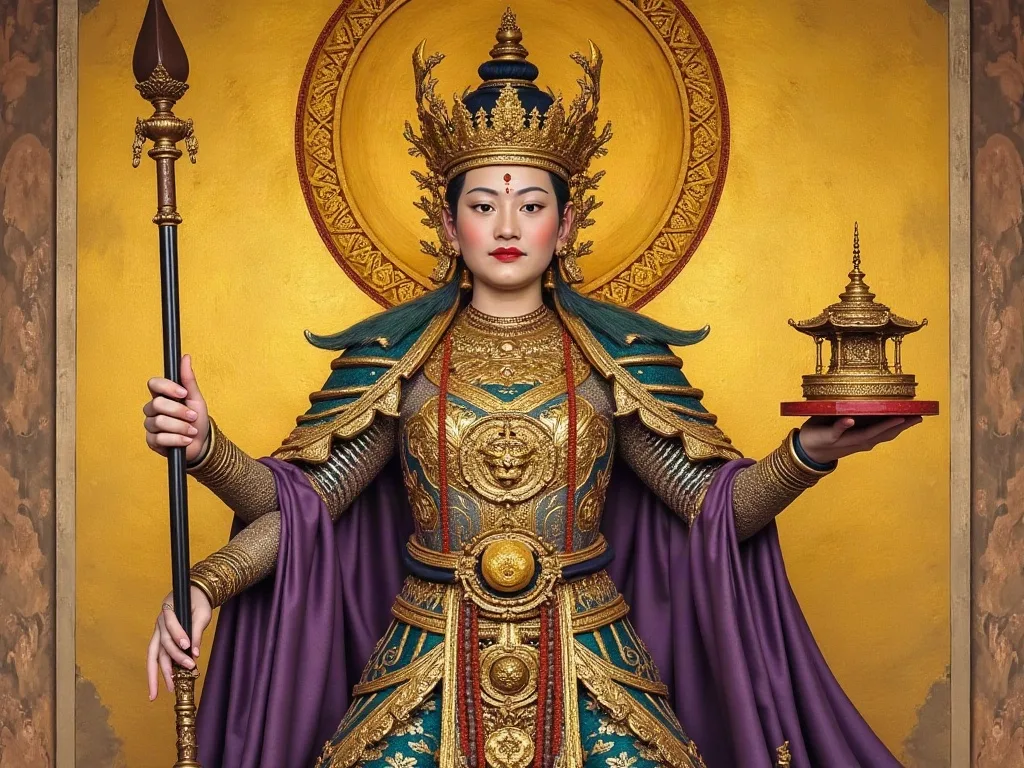
Bishamonten originates in Buddhist cosmology as Vaisravana, the northern guardian king (lokapala) of the Four Divine Kings. In Japanese temples, he appears in armor, crowned, carrying a pagoda in one hand and a spear in the other. He protects warriors, grants victory, and watches over travelers and merchants. His origin in Buddhist iconography never dimmed his appeal: he became one of Japan's most revered protective deities.
Hotei derives from the Chinese Budai, the Laughing Buddha, though Budai is not truly Buddha in the strict sense but a folk deity associated with contentment and abundance. Rotund, bare-bellied, often depicted as jovial and surrounded by children, Hotei embodies happiness and peace. In Japan, he became the patron of abundance and alehouses, the god you rub to gain joy and fortune.
Fukurokuju and Jurojin both emerged from Chinese Daoism, where they belong to a trio of Star Gods representing longevity, happiness, and wealth. Fukurokuju appears as a wizened figure with a distinctively tall, dome-shaped head (called otafuku in Japanese, meaning "many fortunes"). Jurojin arrives as an elder carrying a staff and accompanied by a white deer or crane, symbol of long life. Together, they promise endurance and the wisdom that comes with years.
The seven began appearing together systematically in the Edo period (1603-1868), when merchants and artisans sought blessings for stable trade and the leisure to enjoy it. Block prints (ukiyo-e) depicted the Shichifukujin in their famous treasure ship. Shrines dedicated to all seven sprang up across Japan. By the 18th century, the veneration of these seven as a cluster had become one of Japan's most widespread folk practices.
The Individual Deities: Roles, Symbols, and Worship
Each of the seven carries distinct attributes, visual symbols, and domains of influence. Understanding them individually reveals how Japanese spirituality honors multiple virtues simultaneously, rather than seeking perfection in a single model.
Ebisu appears as a cheerful figure with round, ruddy features, often holding a fishing rod and a sea bream (tai). He wears merchant's clothes or fisher's garb, sometimes a red hat. In the Kojiki, he is born when Izanami and Izanagi first attempt to create the world, but something goes wrong; he is malformed and cast away. Yet he survives, learns, and thrives. His story teaches that failure and disability do not disqualify you from blessing others. Ebisu shrines flourish in fishing villages and market districts. On Ebisu Day (the 20th of the month in traditional calendars, or the 10th in some regions), believers flock to his shrines to buy small rakes decorated with good luck charms. Merchants still invoke Ebisu at dawn, asking for prosperity in the coming day's trade.

Daikoku embodies wealth that springs from the land and from honest work. He is depicted wearing a pointed black hood and holding a large sack over one shoulder, a mallet in his other hand. The mallet (uchide no kozuchi) is a wish-granting tool: strike it, and rice and treasures pour forth. Daikoku often stands atop bales of rice or among heaps of gold coins. He is gentler in temperament than his Hindu ancestor Mahakala, a being without the terrible wrathfulness of the original. Japanese households place Daikoku figurines in kitchens and store rooms, inviting him to multiply their rice supply and keep their families fed.
Benzaiten commands flowing water, artistic inspiration, and the gifts of the tongue. She is painted with a musical instrument (often the biwa, a lute-like stringed instrument, rather than the koto). Sometimes she appears with a serpent coiled around her, a legacy of her connection to rivers and the water dragons (ryuu) of East Asian lore. Benzaiten's appeal extends beyond farmers and fishers to poets, dancers, and musicians. The great artist Hokusai painted her; the kabuki theater honors her as patron of performance. In Kyoto, Fushimi Inari's daughter shrine, Kasuga Taisha, keeps a Benzaiten shrine by a spring. Women seeking safe childbirth and eloquence have prayed before her image for centuries.
Bishamonten stands as the warrior's protector and the keeper of cosmic order. His Japanese name sometimes appears as Tamonten, meaning "heavenly king who listens to all things." He is portrayed in full suit of armor, often gold, with a pagoda (to) in his left hand and a spear or trident in his right. The pagoda he holds is not merely architectural: it represents the cosmic structure itself, the stacked levels of reality. Monks in battle invoked Bishamonten. Samurai wore his image as a talisman. Unlike Daikoku's gentleness or Ebisu's humor, Bishamonten radiates discipline and protective might.
Hotei is perhaps the most beloved and instantly recognizable. His rotund belly (often exposed), his laughing face, his open palms suggest someone unburdened by worry, content with little, radiating abundance through sheer joy. In Chinese tradition, Budai is sometimes called the future Buddha, a folk interpretation of Buddhist teaching. In Japan, Hotei shed this eschatological weight and became purely present-tense: the god of present-moment happiness. Hotei figurines clutter tourist shops and home altars throughout Japan. Rubbing his belly is said to bring good fortune, a ritual so widespread that some antique Hotei statues show a polished, shining belly from centuries of hands.
Fukurokuju and Jurojin round out the pantheon with promises of duration and continuity. Fukurokuju is often shown holding a scroll or staff, his impossibly tall cranium a mark of wisdom and age. Some traditions depict him with a crane or tortoise at his feet, creatures that symbolize thousand-year lifespans in East Asian lore. Jurojin appears as a frail but cheerful sage, leaning on a staff topped with a scroll, attended by a white deer. Where Fukurokuju emphasizes happiness achieved through long life (fuku-roku-ju means "happiness-wealth-longevity"), Jurojin embodies the joy of old age itself: the earned wisdom, the lightness of letting go, the contentment of completing a full circle.
Shinto, Buddhism, and Daoism: A Syncretic Tradition
The Shichifukujin exemplify shinbutsu-shugo (the fusion of Shinto and Buddhism), a theological accommodation that dominated Japanese spiritual life for over a thousand years. Rather than viewing kami (Shinto spirits) and buddhas (butsu) as competing, Japanese practice wove them together.
Benzaiten illustrates this seamlessly. In Buddhist temples across Japan, you will find Benzaiten enshrined alongside the Buddha. Her Sanskrit origin (Saraswati) does not diminish her status as a kami. In fact, she is often venerated as a manifestation (gongen) of a Shinto deity, a temporary appearance of a local kami wearing a Buddhist face. The same flexibility allowed Daikoku to serve as both a Hindu-Buddhist figure (Mahakala) and a guardian spirit of Japanese farms.
This was not sloppy syncretism or confusion. It was deliberate theological work. Japanese priests argued that different traditions revealed the same truths through different doors. A merchant could pray to Daikoku at his warehouse, understanding him as a Buddhist deity guiding him toward the virtue of generosity, while simultaneously experiencing him as the kami of prosperity that had blessed Japanese soil for centuries.
The Daoist element, introduced primarily through Chinese texts and travelers, added another layer. Fukurokuju and Jurojin came directly from Chinese Star Gods and immortals (sennin), yet they found a home in Japanese practice without requiring any theological restructuring. They were simply adopted, their Chinese attributes honored, their Japanese worship sanctified.
When the Meiji government (1868-1912) sought to "purify" Shinto by separating it from Buddhism, Shinto reformers faced a problem: the Shichifukujin could not be easily disentangled. So rather than erase them, Japanese practice simply allowed both traditions to coexist, with some shrines emphasizing the Buddhist elements and others the Shinto. The seven remained intact, their fusion unbroken.
The Treasure Ship and New Year Worship
The visual symbol most associated with the Shichifukujin is the takarabune, the treasure ship in which they sail together. This image, popularized in woodblock prints from the Edo period onward, depicts the seven crowded into a boat laden with gold, jewels, sacred scrolls, and the mallet of Daikoku. The ship sails through the night sky, or across mythological waters, bringing fortune to all who honor it.
The tradition holds that on New Year's Eve (or the first night of the new year, depending on region and calendar), believers should display a picture of the treasure ship beneath their pillow and sleep upon it. The ema, a small wooden prayer plaque left at Shinto shrines, often features the seven in their ship. Families purchase amulets and figurines of the treasure ship to hang in homes and businesses. The image combines commercial optimism (the open boat, the heaped treasures) with spiritual reverence (the divine figures, the cosmic night journey).
The treasure ship motif also reveals something essential about Japanese spirituality: it emphasizes circulation and movement rather than static accumulation. The wealth is not hoarded; it is being transported, shared, brought to human homes. To display the treasure ship is to invite flow, to participate in a cosmic distribution of fortune.
During New Year celebrations, many Japanese households perform a ritual called Shichifukujin matsuri, or "Seven Lucky Gods festival." Pilgrims visit seven temples or shrines dedicated to each of the seven in sequence, collecting stamps or drawings that prove their devotion. This practice, called shichifukujin meguri (the Seven Lucky Gods circuit), transforms the worship of the seven into a journey, a pilgrimage that physically binds a community.
Yokai, Kami, and the Broader Spirit World
The Shichifukujin exist within a far larger ecosystem of supernatural beings in Japanese folklore. To understand them fully requires understanding the categories into which Japanese cosmology divides the nonhuman.
Kami (神) are divine beings or spirits, often associated with natural phenomena: mountain spirits, river spirits, the spirit of a great tree. They are not inherently good or evil; they are powerful and deserve respect. The term kami applies equally to the sun goddess Amaterasu and to the spirit inhabiting a particular rock. Kami are typically enshrined in Shinto shrines and approached through ritual purification and offerings.
Yokai (妖怪) are stranger beings: shapeshifters, tricksters, creatures of ambiguous moral status. A yokai might be a kitsune (fox spirit) that seduces humans, a tanuki (badger spirit) that plays pranks, or a tengu (mountain goblin) that abducts monks. Yokai occupy a twilight zone between the sacred and the monstrous. Some become kami over time through veneration. Others remain eternally unpredictable. Yokai appear far less commonly in formal Shinto shrines but feature prominently in folktales, visual art, and contemporary anime and manga.
The Shichifukujin belong firmly in the kami category: they are approached with reverence, enshrined in temples and shrines, invoked through formal prayer. Yet the boundary between kami and yokai is not rigid. Some regional variations of Ebisu folklore describe him as beginning his existence as a yokai-like creature (malformed, alien, uncanny) before becoming a benevolent kami through the transformation of human belief and need. This movement from yokai to kami mirrors broader patterns in Japanese spirituality: the dangerous or strange thing that earns respect and transforms into something sacred.
The kitsune and tanuki, for instance, occupy an analogous space. They are feared and ridiculed in folk stories, yet certain kitsune shrines have received formal worship for centuries. Inari, the Shinto deity of rice and commerce, is often depicted alongside foxes, suggesting a deep connection between this divine figure and the kitsune tradition. Yokai, in other words, are not simply monsters to be banished; they are part of the sacred landscape, creatures whose power must be acknowledged and negotiated.
Modern anime and manga have rehabilitated the yokai in popular consciousness. Studio Ghibli's "Spirited Away" presents a bathhouse populated by yokai, spirits, and gods, none of them purely evil, all of them strange and worthy of respect. Jigoku Shoujo (Hell Girl) and other contemporary works continue this tradition, depicting yokai and supernatural beings as complex, neither wholly evil nor wholly good. This reflects something true about the Japanese imagination: the sacred and the monstrous are not opposite poles but points along a spectrum.
The Shichifukujin in Modern Japan and Global Culture
The seven remain deeply woven into Japanese commercial and domestic life. Department stores display them during New Year. Convenience stores sell small figurines as good luck charms. Restaurants invoke them in names and décor. Pachinkō parlors (gambling halls) feature their images prominently, hoping to inspire luck. They appear on lottery tickets, restaurant menus, and business cards.
This is not decline into mere superstition. It is continuity. The Shichifukujin have always blended the sacred and the practical, the cosmic and the commercial. A farmer leaving rice at a Daikoku shrine is not pretending the gesture has no material intent; he is acknowledging that the material world and the spiritual are one. A merchant decorating his shop with a Bishamonten amulet is not investing in magic as opposed to business acumen; he is performing both simultaneously, in the conviction that intention, belief, and material action reinforce one another.
The seven have also become ambassadors of Japanese culture globally. Tourists buy miniature treasure ships and Hotei figurines. Museums exhibit Edo-period ukiyo-e prints of the Shichifukujin. Japanese restaurants worldwide use their images in branding. This export of spiritual imagery has sometimes prompted anxiety among scholars about commodification, yet it also demonstrates the flexibility and resilience of the tradition. A Hotei figurine purchased in a Los Angeles gift shop may not carry the exact resonance it held for an Edo merchant, but it still transmits the core idea: that joy, abundance, and good fortune are blessings to be invited into one's life.
Scholarly Debates and Contested Histories
Historians of Japanese religion continue to debate the exact chronology and theological underpinnings of the Shichifukujin cult. Some scholars argue that the systematic grouping of seven deities reflects Daoist cosmological thinking (the Seven Stars, the Seven Directions, the numerology of fortune in East Asian tradition). Others trace the practice more to merchant guild organization during the Edo period, when craft guilds and trading associations sought divine patronage and found in the seven a comprehensive pantheon that honored multiple virtues without privileging any single tradition.
The question of which seven, and in what order, was not always settled. Some regional traditions substitute one deity for another, or add an eighth. The Yoshida Shinto priests, one of Japan's most influential Shinto schools, produced influential texts that canonicalized the roster and provided theological justifications for their grouping. Yet even these texts acknowledge that the tradition is relatively recent and that flexibility in the roster is acceptable.
There is also lively debate about the extent to which the Shichifukujin represent authentic Shinto as opposed to later syncretism and commercialization. Some traditionalists view them as a dilution of pure kami worship. Others argue that this purism misunderstands Japanese religious history: that synthesis and adaptation have always been central to how kami are understood and honored. The Kojiki itself, the foundational text of Shinto, records stories of kami adopting attributes and names from other sources, adjusting to the needs of new communities.
More recent scholarship, particularly work informed by gender studies and queer theory, has focused on Benzaiten as an example of how female deities navigate religious systems that are often male-dominated. Her persistence across multiple tradition-boundaries, her association with flowing water and change, and her appeal to artists and women seeking agency suggest ways that marginalized figures carve out power and influence even within hierarchical structures.
The Shichifukujin and Afterlife in Modern Media
Contemporary Japanese media have made the Shichifukujin central to how young people encounter mythology. The anime "Yamishibai: Japanese Ghost Stories" includes episodes featuring individual members of the seven. Light novels and manga stories frequently invoke their imagery and names. In video games, from "Okami" to "Fire Emblem," the Shichifukujin appear as allies, patrons, or powerful beings to be negotiated with.
What is striking about these modern retellings is that they rarely attempt to explain the seven in doctrinal terms. Instead, they treat them as part of the ambient spiritual world of Japan, as naturally present as temples and shrines. A character might pray to Benzaiten before a music performance, or invoke Daikoku's protection when opening a business, without the narrative stopping to explain why or what this means. This reflects how the seven function in lived Japanese religion: not as objects of dogmatic study but as trusted presences, close at hand.
Studio Ghibli's work deserves particular mention. Hayao Miyazaki's films are saturated with Shinto and Buddhist imagery, yet rarely in didactic fashion. "Spirited Away" never names Amaterasu or the Shichifukujin explicitly, yet its entire cosmology rests on understanding kami as the film depicts them: powerful, strange, neither hostile nor comforting, demanding respect and negotiation. The film's bathhouse, where spirits bathe and eat, echoes the worlds inhabited by the seven in traditional art. Miyazaki's approach has introduced millions of non-Japanese viewers to Japanese spiritual thinking without reducing it to exotic spectacle.
The persistence of the seven in anime, manga, and games suggests that they have not been displaced by modernity or globalization but have instead evolved into a toolkit for expressing Japanese identity and sensibility. They are at once deeply local (specific shrine practices, regional festival variations) and globally recognizable (the treasure ship, Hotei's laugh, Benzaiten's beauty).
The Seven as a Unified System of Values
Stepping back, the Shichifukujin as a collective reveal a distinctive vision of human flourishing. Rather than elevating a single virtue (renunciation, duty, martial prowess), the seven affirm a spectrum of desires and achievements.
Ebisu grants success in work and trade, honoring the courage needed to venture onto uncertain waters and the dignity of honest commerce. Daikoku multiplies prosperity and nourishes the home, blessing agricultural and domestic life. Benzaiten bestows eloquence, creativity, and wisdom, sanctifying artistic endeavor and learning. Bishamonten offers protection and order, affirming that security and defense have spiritual weight. Hotei grants contentment and joy, suggesting that happiness is not a distraction from the spiritual path but central to it. Fukurokuju and Jurojin together promise longevity and the satisfaction of a full life.
There is no requirement to choose among them. A person may invoke Daikoku for prosperity, Benzaiten for artistic inspiration, and Jurojin for the hope of a long life, all in the same week, without theological contradiction. This multiplicity reflects a pragmatic rather than dogmatic approach to the sacred: the spiritual world is rich, various, and responsive to specific human needs.
This vision differs sharply from traditions built on the pursuit of transcendence or the denial of worldly desire. The Shichifukujin affirm the world as it is and the human desires that inhabit it. They suggest that the sacred does not require the suppression of appetite but rather its right ordering: the pursuit of wealth that is shared, of joy that includes others, of work that is honest, of art that expresses truth.
What draws worshippers to the Shichifukujin today?
For many Japanese people, the appeal of the seven remains what it was in the Edo period: they offer a unified set of blessings that address the full range of human aspiration. A business owner might visit a Daikoku shrine to ask for prosperity, a student might light incense before Benzaiten before a music recital, a family might display the treasure ship at New Year hoping for good fortune in the coming year. The seven do not demand conversion or exclusive loyalty. They coexist peacefully with Buddhist practice, Christian elements adopted by Japanese culture, and secular modern life. This flexibility has kept them alive across centuries of social change.
How did the Shichifukujin move from Chinese and Hindu origins to become distinctly Japanese?
The seven were not adopted wholesale but adapted. Mahakala became the jovial Daikoku, shedding his wrathfulness. Saraswati became Benzaiten, her Hindu domains of music and learning preserved but her expression made more delicate and Japanese. Budai became Hotei, the eschatological hope of future enlightenment replaced with present contentment. Each deity was remade through centuries of Japanese practice and artistic representation, until the connection to the original source became almost invisible. This is not theft but transformation: Japan took foreign forms and filled them with new meaning, creating something that felt native because it had been so thoroughly lived.
Are the Shichifukujin worshipped differently in different regions of Japan?
Yes, significantly. Fishing villages emphasize Ebisu to a degree that inland agricultural communities do not. In Kyoto, where artistic traditions run deep, Benzaiten's shrines receive particular devotion. Merchant quarters in Osaka and Edo (Tokyo) historically showed special favor to Daikoku. Some regions observe the shichifukujin meguri (shrine circuit) as an organized annual pilgrimage; others practice the seven through household amulets and New Year rituals only. Regional differences in which deity holds prominence or how the treasure ship is depicted on amulets reflect local history and economic focus. Yet the seven as a cluster remain recognizable everywhere.
Why is Hotei the most recognizable of the seven internationally?
Hotei's visual impact transcends cultural boundaries in a way the others do not. His rotund belly, bare chest, and laughing expression communicate instant contentment across language barriers. His image requires no theological explanation; the joy radiates without text. This simplicity, combined with the universal human desire for happiness and good fortune, has made him the Shichifukujin most likely to appear in tourist merchandise and Western popular culture. Yet ironically, Hotei's ubiquity sometimes obscures the richness of the entire seven: people encounter him in isolation and assume the others are variations rather than distinct presences with their own histories and domains.
Frequently asked questions
What is the difference between kami and yokai in Japanese spirituality?
Kami are divine beings or spirits associated with natural phenomena and worthy of formal reverence and shrine worship. Yokai are stranger, more ambiguous creatures like foxes, badgers, and mountain goblins that occupy a twilight zone between the sacred and the monstrous. The boundary is not rigid: a creature feared as a yokai can become venerated as a kami through centuries of human belief and respect. The Shichifukujin belong firmly in the kami category, though some versions of Ebisu's myth describe him beginning as a strange, even yokai-like creature before transformation into a beloved kami.
Did the Shichifukujin exist before the Edo period, or were they entirely constructed then?
The individual deities have much older roots. Ebisu appears in the Kojiki, Japan's oldest written chronicle from 712 CE. Daikoku has connections to kami worship stretching back centuries. Benzaiten was integrated into Japanese practice by the medieval period. However, the systematic grouping of seven specific deities into a unified pantheon with coordinated worship, shared imagery (the treasure ship), and nationwide cult following crystallized during the Edo period (1603-1868), when merchants and urban communities embraced them most enthusiastically. The tradition is both ancient and relatively recent, its components old, its unified form modern.
How can someone practice veneration of the Shichifukujin today?
The most common practices are displaying or purchasing amulets and figurines of the seven or the treasure ship; visiting shrines dedicated to the Shichifukujin, especially during New Year or their individual festival days; and performing the shichifukujin meguri, a pilgrimage to seven temples or shrines in sequence. Many Japanese households place a small image of the treasure ship beneath their pillow on New Year's Eve. Some participate in regional Shichifukujin matsuri (festivals) where the seven are honored with music, processions, and communal meals. These practices require no formal initiation and are open to people of any or no religious affiliation; they operate within the Japanese cultural logic that treats the seven as accessible, practical blessings.
Why does the Shichifukujin include deities from different religious traditions (Shinto, Buddhism, Daoism)?
Japan's genius was the theological framework of shinbutsu-shugo, the fusion of Shinto and Buddhism, which taught that different traditions revealed the same truths through different doors. Rather than viewing a Buddhist bodhisattva and a Shinto kami as competitors, they were understood as complementary or even identical in different manifestations. The addition of Daoist elements (Fukurokuju and Jurojin) followed the same logic: a wise, long-lived sage could be venerated whether his origin was Hindu, Buddhist, or Daoist. This flexibility allowed Japan to adopt foreign deities without requiring them to renounce their origins. The seven represent Japan's refusal to enforce religious purity or exclusivity, a pragmatic approach that kept them alive and beloved across centuries.
How has anime and modern media changed how Japanese people understand the Shichifukujin?
Contemporary media (anime, manga, video games) have made the Shichifukujin familiar to young Japanese people in new ways, depicting them not as historical religious figures requiring study but as natural inhabitants of Japan's spiritual landscape. Works like Yamishibai, Spirited Away, and various games treat them as part of the ambient world, neither exotic nor explained, simply present. This approach mirrors how the seven function in lived religion: not as doctrinal teaching but as trusted presences woven into daily life. Media has also given international audiences their first encounter with the seven, though often filtered through a lens of fantasy or entertainment rather than religious practice.
The Treasure Ship at the Edge of Winter
The Shichifukujin endure because they solve a problem that every spiritual tradition faces: how to honor the full range of human life without reducing it to a single virtue or path. They say that success, beauty, protection, joy, learning, and long life are all blessings worth pursuing. They say that the sacred is not separate from commerce, agriculture, art, or pleasure but suffuses them.
In a country shaped by mountain and sea, earthquake and typhoon, where subsistence was never guaranteed and fortune has always felt both fragile and precious, the seven emerged as guides who acknowledged difficulty while affirming hope. A family displays the treasure ship on New Year's Eve not because they believe magic will fill their house with gold, but because they choose to begin the year with intention, gratitude, and the invitation of good things. The ritual and the image are the blessing.
The Shichifukujin continue to sail their treasure ship through the Japanese imagination, adapting to each era, each medium, each new world that receives them. They have proven that a tradition need not be rigid to endure, that gods can change form without losing power, and that seven beings sailing together in the night can teach us something about how to wish for the world.
Free 25-page sample
Want the whole story?
Take the first 25 pages free. If it pulls you in, the full edition is yours as an instant PDF download, with a paperback on Amazon for selected titles.

Mythology
The World Mythology Book: The Gods, Heroes and Myths of Every Culture
The Gods, Heroes and Myths of Every Culture, in One Volume
The whole of world mythology in a single volume: Greek, Norse, Egyptian, Japanese, Hindu, Celtic, Slavic, Mesoamerican and African myths gathered side by side, each drawn from the primary sources.