

Shinigami: Japanese Death Spirits and the Kami of the Boundary
Shinigami are Japan's death spirits, boundary-keepers who guide souls between worlds. Rooted in Shinto cosmology and folklore, these kami embody death not as evil but as transformation. Discover their origins in the Kojiki, their role in yokai hierarchy, and why modern anime echoes ancient Shinto belief.
Contents
In the Kojiki, Japan's oldest written record, the creator goddess Izanami descends into Yomi, the land of the dead, and returns transformed into corruption incarnate. Her descent marks the moment death entered the world, and with it, the spirits that manage its passage. These are not demons in the Western sense. They are kami, the sacred forces that inhabit every corner of Japan's supernatural landscape. Among them, shinigami, the death spirits, occupy a liminal space: not evil, not good, but essential. They are the keepers of a boundary that every living thing must eventually cross.
The word shinigami (死神) literally means "death god," though the modern usage conflates ancient Shinto cosmology with folk belief and centuries of literary invention. To understand shinigami is to understand how Japan sees death not as finality but as passage, not as punishment but as transformation. It reveals why Japanese mythology, unlike many Western traditions, places spirits of death on the spectrum of kami rather than outside it.
The Underworld and Death in Shinto Cosmology
Death enters Japanese mythology through Izanami's tragedy. In the Kojiki (712 CE), the oldest surviving Japanese historical text, Izanami and her partner Izanagi create the islands of Japan by stirring the primordial sea with a jeweled spear. Their children include islands, mountains, and the kami of wind and water. But Izanami dies after giving birth to Kagu-tsuchi, the fire kami, and her body falls into rot.
Izanagi, grief-stricken, descends to Yomi (黄泉), the shadowed realm beneath the earth. He finds Izanami sitting in darkness, her flesh already decomposing. She begs him to leave, but he looks anyway. The sight horrifies him so completely that he flees, pursued by Izanami and the "eight thunder kami of decay" who dwell in the corpse. Izanagi escapes, seals the entrance with a stone, and Izanami becomes the sovereign of Yomi: the first death spirit, neither kami nor demon, but a transformed being who rules the realm where spirits go.
This story establishes the Japanese death realm's central truth: it is not Hell. Yomi is not a place of punishment. It is the natural repository of the dead, a mirror world existing beneath or alongside the living realm. Spirits dwell there in a state neither fully present nor fully gone. They are mononoke (物の怪), spirits of things, or yuurei (幽霊), ghosts whose attachment to the living world keeps them bound.
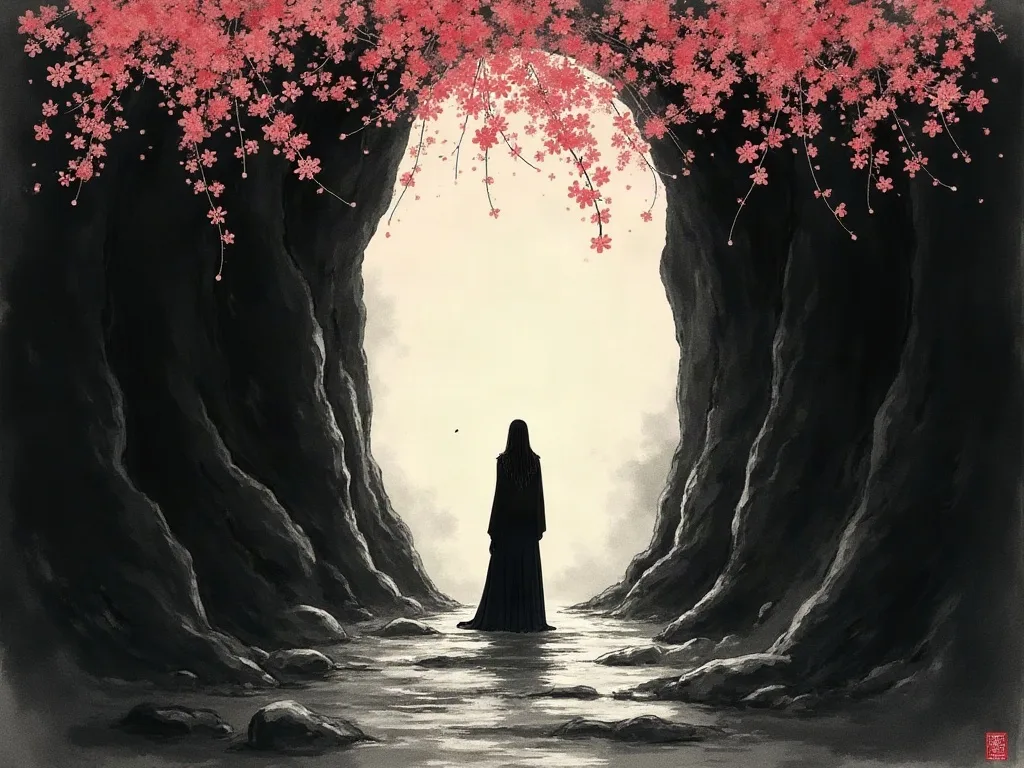
Into this framework, shinigami emerge. Unlike Izanami, who is singular and sovereign, shinigami are a class of kami whose role is to facilitate the movement of souls from the living world to Yomi. They are not jailers. They are ferrymen, guides, and in some contexts, psychopomps who accompany the dying on their last journey.
Shinigami in Historical Japanese Thought and Literature
The term "shinigami" does not appear in the classical Kojiki or Nihon Shoki (720 CE, Japan's second-oldest written historical record). Instead, earlier sources speak of shikami (死神) or simply kami of death and decay. The modern concept of shinigami crystallized during the Edo period (1603-1868), when Japanese literature and kabuki theatre elaborated on folk beliefs and Buddhist influences.
Buddhism, which arrived in Japan in the 6th century, profoundly reshaped how death was understood. Buddhist monks taught of the Six Realms, karmic rebirth, and the Sanzu River, a river that the dead must cross with the aid of a ferryman kami. This is not native Shinto; it is a synthesis. The shimigami of folklore took on qualities of the Buddhist ferryman Sanzo, who guides souls to judgment. In turn, folk tales populated the spaces between these theologies with smaller death kami: spirits that hover near sickbeds, that guide the dying, that mark the boundary between worlds.
The Edo period saw an explosion of kaidan (怪談), supernatural tales, and yomihon (読本), narrative fiction that mined yokai and death spirits for drama. One celebrated story cycle, collected in the Konjaku Monogatarishu (Tales of Times Past, compiled 12th century), describes encounters with shinigami who tempt or test the living. These are not always malevolent. A shinigami might appear to a dying person in the form of a relative, easing the transition. Or it might appear as an ambiguous figure: a beautiful woman who vanishes, or a messenger cloaked in mist.
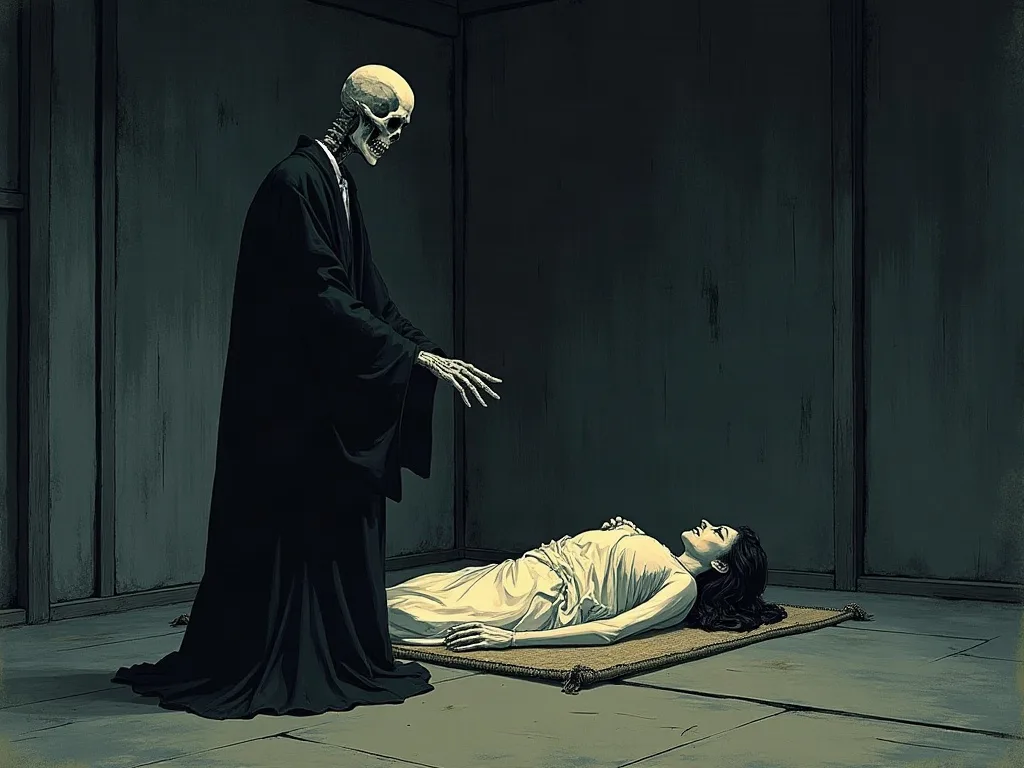
Shinigami appear in Kabuki and Noh theatre as well. Noh, the classical masked drama that emerged in the 14th century, often features scenes in which the protagonist encounters a spirit guide or a manifestation of death. The Noh Masks themselves, carved to suggest both beauty and decay, embody the Japanese aesthetic of seeing death not as ugly but as a transformation worthy of profound artistic attention.
The Yokai Hierarchy: Where Shinigami Sit
To understand shinigami, one must place them within the broader category of yokai (妖怪), a term meaning "mysterious thing" or "strange occurrence" that encompasses everything from minor household spirits to powerful demons. Yokai are not a unified class in Japanese belief; they span from benign to malevolent, from natural phenomena personified to malicious spirits born of human emotion or curse.
Shinigami occupy a unique position in this hierarchy. They are not oni (鬼), the ogre-demons of Japanese folklore, though both can appear as terrifying figures. Oni are chaotic, often cruel, associated with hunger and transgression. Shinigami, by contrast, operate according to principle: they govern the boundary of death, which is absolute and unavoidable. They are more kin to Fudo, a wrathful Buddhist protector deity who guards sacred thresholds, than to a demon that spreads chaos.
Shinigami are also distinct from common yuurei, the ghosts of the deceased. A yuurei is a human spirit trapped between worlds, usually by strong attachment, trauma, or unfinished business. A shinigami is a permanent supernatural being whose domain is to facilitate transitions. Some folklore suggests that particularly powerful yuurei might become shinigami over centuries; others posit that shinigami exist in a class of their own, born not from death but from the principle of death itself.
The closest Western analogue might be a psychopomp: a guide of souls. But shinigami are more nuanced. They are not always guides in the sense of compassionate helpers. They are agents of transition, which can manifest as mercy or as inevitability.
Forms and Manifestations of Shinigami
Shinigami are not typically depicted as solid creatures in classical Japanese art. Instead, they manifest in multiple forms depending on context and the observer's state of mind.
The Robed Messenger: In many Edo-period illustrations, a shinigami appears as a tall, skeletal figure draped in dark robes, sometimes with a sickle or staff. This form is clearly influenced by Daoism and Buddhism, particularly the image of the yama (the death god of Buddhist and Hindu tradition). The imagery migrated to Japan through cultural contact and was absorbed into folk practice.
The Beautiful Woman or Man: In other tales, a shinigami appears as a figure of extraordinary beauty who beckons the dying to follow. This form exploits the Japanese aesthetic of mono no aware (物の哀れ), the bittersweet beauty of transience. The shinigami lures not through malice but through the seduction of acceptance: following beauty into death is not cruel; it is artful.
The Fox or Bird: Some regional variants describe shinigami as shapeshifters, taking the form of kitsune (foxes) or tengu (bird-like creatures). These forms emphasize the liminal nature of death: foxes and tengu are themselves liminal beings, neither fully animal nor fully human, able to slip between worlds.
The Mist or Shadow: Perhaps most commonly in classical descriptions, a shinigami is simply a presence: a cold wind, a shadow at the foot of a sickbed, a figure glimpsed only in peripheral vision. This form reflects Shinto's original concept of kami as not necessarily visible; they are forces, presences, the animating principle of phenomena.
The Boundary and the Kami's Role
In Shinto thought, kami are beings that dwell at boundaries and thresholds: the kami of the gate, the kami of the crossroads, the kami of the forest edge. Shinigami are fundamentally boundary kami. Their domain is the threshold between life and death, the animate and the still.
This explains much about their portrayal in Japanese literature and folklore. Shinigami do not bring death; death is already present in the human condition. Rather, they facilitate passage across a line that separates one state from another. They are, in effect, the kami of inevitability.
This role has particular resonance in Japanese aesthetics and philosophy. The concept of karoshi (過労死), death from overwork, and the cultural acceptance of seppuku (切腹), ritual suicide, reflect a society that, at certain historical moments, accepted death as a response to specific conditions. Shinigami in folklore often appear at these culturally charged moments, not as intruders but as witnesses or guides to what is already decided.
In another register, Shinto purification rituals (misogi, ritual bathing, and harae, ritual cleansing) are designed to remove spiritual pollution, including the pollution incurred by contact with death. The presence of shinigami in this context suggests they are not themselves polluting; rather, they mark the space where pollution (the spiritual weight of death) is transformed and managed.
Shinigami in Buddhist and Folk Synthesis
By the medieval period, shinigami had absorbed influences from Buddhist cosmology without losing their Shinto roots. Buddhist teaching included detailed descriptions of the Sanzu River, which souls must cross after death. Different Buddhist texts placed a toll-taker or ferryman at this river, sometimes depicted as a bodhisattva, sometimes as a fearsome kami.
This figure, known variously as Sanzo, Datsue-ba (the "old woman who strips clothes"), or the Jizou-like figure Kshitigarbha, merged in folk consciousness with native shinigami. The result was a hybrid spiritual geography: Yomi, the native underworld, began to be imagined with Buddhist features. Shinigami became figures who knew the way to the Sanzu River and could negotiate passage.
One famous folk tale, preserved in Konjaku Monogatarishu, tells of a man who encounters a beautiful woman by a river at night. He falls in love and wishes to marry her. A monk warns him that she is a shinigami, a death spirit. The man ignores the warning and marries her. She becomes pregnant, and in her final labour, her true form is revealed: she is ancient and decaying, the very image of death. The man's love had blinded him to her true nature. The tale carries no moral condemnation; it simply observes that death cannot be denied by romance or desire. The shinigami was not cruel; she was simply truth.
Modern Incarnations: From Folklore to Anime and Manga
The term "shinigami" and the concept underwent a major transformation in the 20th century, particularly in manga, anime, and contemporary Japanese popular culture. Where classical folklore depicted shinigami as ambiguous boundary spirits, modern media often portrays them as clearer archetypes: the Grim Reaper in Japanese dress, or as complex characters caught between duty and emotion.
The anime series Bleach (2004-2012) treats shinigami as an organization of supernatural beings who police the boundary between life and death, eliminating dangerous spirits. While this is a complete departure from classical belief, it reiterates a core feature: shinigami are fundamentally associated with regulation and transition. The series' shinigami may be warriors and bureaucrats, but they are still boundary-keepers.
Hayao Miyazaki's Spirited Away (2001), though not explicitly depicting shinigami, shows a mastery of this liminal aesthetic. The film's protagonist enters a bathhouse for spirits; the living and dead commingle in a space outside normal time. The film's mood and visual language draw directly from Japanese folklore's treatment of boundaries as places of transformation rather than violation.
Death Note (2006-2007), another famous anime, features a shinigami as a neutral observer of human fate. The shinigami Ryuk is neither good nor evil; he simply exists at the margin, watching and occasionally intervening according to principles beyond human morality. This characterization is closer to classical folklore than Bleach's militarized shinigami, though both reflect a core assumption: shinigami operate outside human moral categories.
These modern works, for all their departure from historical accuracy, preserve an essential Japanese intuition: death is not a villain, but a force. Spirits of death are not enemies but agents of an order that supersedes human desire. In this, contemporary anime echoes the philosophy embedded in the Kojiki itself.
Shinigami and Japanese Death Aesthetics
The persistence and popularity of shinigami in Japanese culture reflects a larger philosophical stance toward death. Japan has long harbored an aesthetic of transience, mortality, and acceptance. The wabi-sabi (侘寂) aesthetic celebrates the beauty of impermanence, incompleteness, and decay. Cherry blossoms are prized precisely because they bloom briefly and fall. Tea ceremony emphasizes the finality of each gathering; it will never occur again in precisely the form it takes today.
Shinigami fit seamlessly into this worldview. They are not horrible because they represent death; they are artful, even beautiful, because they embody acceptance of necessity. A shinigami appearing at the bedside of the dying is not a tragedy unless the death itself is premature or unjust. Often, the shinigami's arrival is portrayed as merciful: a release, a transition, an opening into another mode of being.
This stands in contrast to many Western traditions, where death is framed as the ultimate failure, the adversary to be fought at any cost. In Japanese cosmology, shinigami are not adversaries but mirrors, showing us the boundary we will all eventually cross.
Regional Variants and Lesser-Known Death Kami
Beyond the central concept of shinigami, Japanese folklore preserves numerous regional variants and related death spirits.
Ubume (産女) are spirits of women who die in childbirth, often depicted as yokai that appear to warn the living of the dangers of pregnancy. While not strictly death kami, they are associated with mortality and inhabit the threshold between motherhood and death.
Nozuchi (野槌) and other serpentine yokai are sometimes associated with death in certain regions; they mark places where death is likely (treacherous roads, deep water).
Inugami (犬神) and bakeneko (化け猫) are animal spirits that can become harbingers of death in their malevolent forms, appearing as portents before a death occurs.
Rokurobi (六郎火) or similar will-o'-the-wisp-like spirits mark boundary zones between the living and dead worlds. They are not death kami proper, but they inhabit the same liminal territories.
These variants show that shinigami are not an isolated concept but part of a dense, interconnected web of supernatural beings, each with specific domains and characteristics.
Primary Sources and Textual Evidence
The Kojiki provides the foundational myth: Izanami's descent into Yomi and her transformation into a being of decay. The Nihon Shoki elaborates on this myth in slightly different language but with the same narrative arc.
The Manyoushu (万葉集), an 8th-century poetry anthology, contains numerous references to death, grief, and the spirit world, though not explicitly to shinigami.
The Konjaku Monogatarishu (12th century), a collection of tales both Buddhist and secular, preserves folk narratives in which death spirits, kami, and human characters interact. These tales are crucial evidence of how shinigami had crystallized as a folk concept by the medieval period.
The Hyaku Monogatarinin, a later tale collection, contains further shinigami narratives.
Kabuki plays and Noh drama texts, particularly those dealing with ghosts and death, reference death kami and spirits navigating the boundary between worlds. These texts are performances, not theological treatises, but they reflect lived belief and cultural assumptions about death's role in the cosmic order.
Shinigami and the Afterlife: Questions of Judgment and Rebirth
A crucial distinction separates Shinto and Buddhist conceptions of what happens after death.
In early Shinto belief, as reflected in the Kojiki, Yomi is not a place of judgment. The dead simply go there, in a state neither fully alive nor fully present. There is no explicit doctrine of reward or punishment based on deeds in life.
Buddhism, by contrast, teaches that the dead are judged according to their karma. Buddhist texts such as the Sukhavativyuha Sutra and Japanese interpretations thereof describe a process of judgment and assignment to one of the Six Realms.
Shinigami occupy an interesting space in this theological contest. In folk belief, they are guides who do not judge but facilitate passage. A shinigami may ensure that a soul reaches the appropriate destination (the Buddhist judgment court, or the native Yomi), but the shigiami itself is not the judge. It is merely the agent of transition.
This allows shinigami to persist in Japanese thought even as Buddhism transformed the understanding of the afterlife. Shinigami are compatible with both pre-Buddhist Shinto cosmology and later Buddhist reinterpretation because their role is purely transitional.
Frequently asked questions about shinigami and death spirits in Japanese mythology?
Frequently asked questions
Are shinigami the same as the Western Grim Reaper?
Not quite. The Grim Reaper is typically portrayed as an agent of death itself, a figure who collects souls when they are due. Shinigami, by contrast, are boundary kami whose role is to facilitate passage; they are not death's servants but the stewards of transition. Shinigami emerged from a Japanese cosmology where death is a natural transformation, not a violation. The visual similarity in modern media (dark robes, skeletal features) reflects centuries of cultural synthesis between Shinto, Buddhism, and European artistic influence, but the underlying concepts remain distinct.
Do shinigami appear in the Kojiki or other classical Japanese texts?
The term "shinigami" does not appear in the Kojiki or Nihon Shoki, which are Japan's oldest written records. However, the concept's roots are present: Izanami becomes a being of decay in Yomi, and the Kojiki describes kami associated with death and corruption. The modern term "shinigami" solidified during the Edo period (1603-1868), when folk tales, Buddhist cosmology, and literary elaboration crystallized the concept into the figure we recognize today. The Konjaku Monogatarishu and other medieval tale collections provide the earliest explicit references to death kami operating as shinigami do.
Is death evil or punitive in Japanese mythology?
Not inherently. In Shinto cosmology, death is a natural transformation, as evidenced by Izanami's descent to Yomi. There is no explicit doctrine of punishment in early Shinto; Yomi is where the dead go, a shadow realm neither good nor bad. Buddhism, arriving in Japan around the 6th century, introduced ideas of karmic judgment and assignment to one of the Six Realms. Shinigami, however, remain neutral agents of transition; they do not judge. This reflects a Japanese philosophical stance that death is necessity, not morality, and that acceptance of impermanence is wisdom rather than resignation.
How did Buddhism change the concept of shinigami?
Buddhism introduced the Sanzu River, judgment deities, and the Six Realms of rebirth into Japanese death cosmology. Folk figures like the Sanzo (the ferryman) merged with native Shinto conceptions of death kami, creating a hybrid theology. Shinigami began to be imagined not only as rulers of Yomi but also as guides to the Sanzu River and the Buddhist judgment process. This synthesis allowed shinigami to persist and evolve as Japanese religious practice incorporated both Shinto and Buddhist elements, a coexistence that persists today in most Japanese homes, which maintain both Shinto and Buddhist altars.
Why do modern anime portray shinigami so differently from classical folklore?
Modern anime reflects contemporary storytelling priorities: conflict, organization, clear characters. Bleach depicts shinigami as a supernatural police force; classical folklore showed them as ambiguous boundary spirits. However, both versions preserve a core element: shinigami are boundary-keepers who operate outside normal human society and morality. Modern media simplify and dramatize, but they retain the intuition that death is not chaos but order, and that spirits of death are agents of transition rather than malice. The difference is one of emphasis, not fundamental concept.
Are there female shinigami in Japanese belief?
Yes, though less commonly depicted than male figures. Izanami herself, the sovereign of Yomi, is female and is in some sense the first death spirit. Ubume, spirits of women who die in childbirth, are death-adjacent beings. In folk tales, shinigami sometimes appear as beautiful women who seduce or guide the dying. Classical noh theatre features female death spirits and guides. Modern manga and anime have popularized female shinigami characters. The original Shinto cosmology places equal weight on male and female kami; gender divisions in shinigami representation are largely cultural elaborations, not foundational doctrine.
Shinigami in Global Context: Death Spirits Across Cultures
Shinigami are unique to Japanese tradition, yet the archetype they represent appears across cultures. Charon, the ferryman of the dead in Greek mythology, shares shinigami's role as a boundary keeper who guides souls across a threshold. Anubis, the Egyptian god of embalming and the dead, presides over a liminal space where the living cannot tread. Yama, the Vedic god of death and justice in Hindu and Buddhist traditions, judges the dead and assigns them to their next birth.
What distinguishes shinigami is the emphasis on transition and acceptance. While Charon demands payment, while Anubis conducts judgment, and while Yama determines karmic consequence, shinigami typically appear simply to facilitate passage. They are not transactional, not judicial, not punitive in the primary sense. They are phenomenological: they embody the fact of death as a boundary that will inevitably be crossed.
This reflects a broader difference in how Japanese culture approaches endings. The wabi-sabi aesthetic finds beauty in incompleteness and transience. The samurai code, bushidou, emphasized acceptance of death as a natural outcome of service. These cultural values shaped shinigami into a figure that resonates not through fear but through recognition: yes, death will come, and these spirits are its agents, and that is not tragedy but truth.
The globalization of Japanese media has made shinigami familiar to Western audiences, often reframing them through Western expectations (the Grim Reaper analogue). Yet the most faithful and compelling portrayals, such as in Spirited Away or certain episodes of anime that emphasize melancholy rather than combat, preserve the original aesthetic: a spirit of death that is terrible and beautiful at once, a transition that is inevitable and, in its way, right.
Free 25-page sample
Want the whole story?
Take the first 25 pages free. If it pulls you in, the full edition is yours as an instant PDF download, with a paperback on Amazon for selected titles.

Mythology
The World Mythology Book: The Gods, Heroes and Myths of Every Culture
The Gods, Heroes and Myths of Every Culture, in One Volume
The whole of world mythology in a single volume: Greek, Norse, Egyptian, Japanese, Hindu, Celtic, Slavic, Mesoamerican and African myths gathered side by side, each drawn from the primary sources.