
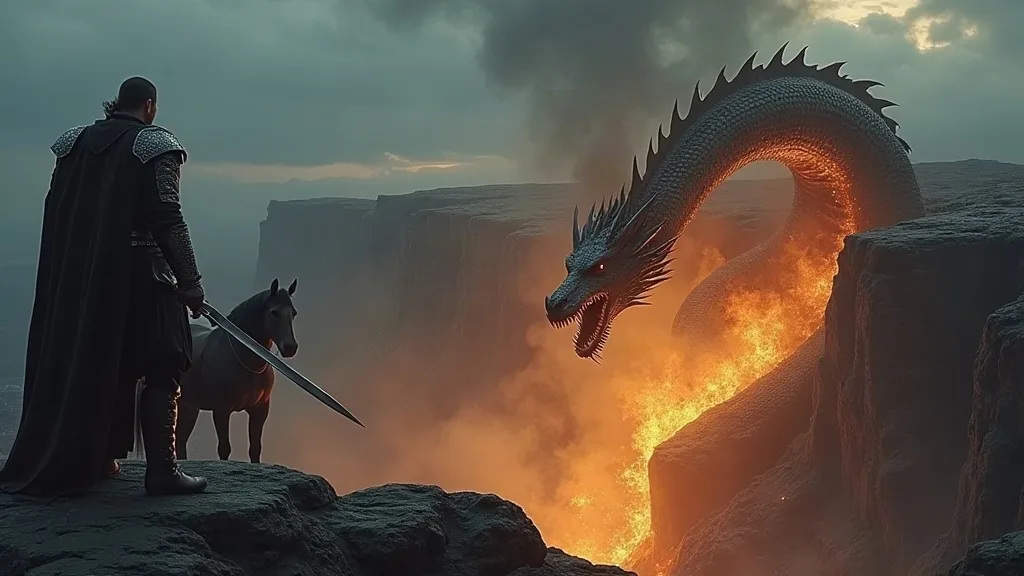
Sigurd the Dragon Slayer: The Hero Who Burned Fafnir and Won Cursed Gold
Meet Sigurd, the greatest dragon slayer of Norse legend. Forged a broken sword, killed the dragon Fafnir, tasted dragon blood and gained the speech of birds, and claimed the cursed treasure that would haunt him forever. His saga burns through the Eddas and the Volsunga Saga as the defining mortal hero of the Norse world.
Contents
The sword Gram lay shattered on the ground. A blacksmith named Regin showed the pieces to a young man and asked a single question: would he dare to forge them whole again?
The young man's name was Sigurd the dragon slayer, and he would become the most towering hero of Norse legend. Not a god, not immortal, but a mortal with the strength to do what even the Aesir hesitated to do: walk into a dragon's lair and emerge alive with gold in hand and a curse on his head.
His tale survives in two great texts: the Voelsunga Saga, a prose narrative written down in Iceland around the 13th century, and scattered verses in the Poetic Edda, a collection of Old Norse poems from even older sources. Both tell how one man's courage and cunning rewrote the fate of kingdoms.
The Broken Sword and the Birth of Gram
Sigurd was not born into comfort. His father, Sigmundr, was a legendary king of the Volsungs, a line descended from Wodan (Odin) himself. But Sigmundr died in battle before Sigurd drew his first breath, leaving the boy to grow up in hiding while his mother, Hjordis, fled to the forest. She remarried a king named Alf, and Sigurd was raised in obscurity, tending horses and learning the ways of war from the ground up.
When Sigurd reached manhood, he caught the attention of a dwarf named Andvaranaut. No, wait: that was the curse. The dwarf who truly shaped Sigurd's destiny was Regin, a shape-shifter who could take the form of a man or a serpent, and who harbored a bitter resentment against his own brother.
Regin told Sigurd this story: once, the dwarf's father owned a hoard of gold. A dragon named Fafnir, Regin's own brother, had grown so greedy that he transformed himself into a serpent to guard it. Now Fafnir lay coiled around that treasure, poisoning the earth with his breath. Regin wanted revenge. He wanted Sigurd to kill Fafnir and retrieve the gold.
But Sigurd had no weapon worthy of a dragon. So Regin brought him the pieces of a sword that had once belonged to Sigmundr, Sigurd's father. The blade was called Gram. It had been shattered in Sigmundr's last battle, but Regin believed that if Sigurd could reforge it, the steel would be strong enough to pierce a dragon's hide.
Sigurd took those fragments to a smith's forge. He heated them until they glowed like the sun, then hammered them together with a will that seemed to burn from within. The Voelsunga Saga says he worked with such force that the broken pieces merged as if they had never been parted. When he tested Gram on an anvil, the blade cleaved through the iron without slowing.
For the first time, Sigurd held a sword that was truly his own.
The Dwarf's Gold and the Dragon's Lair
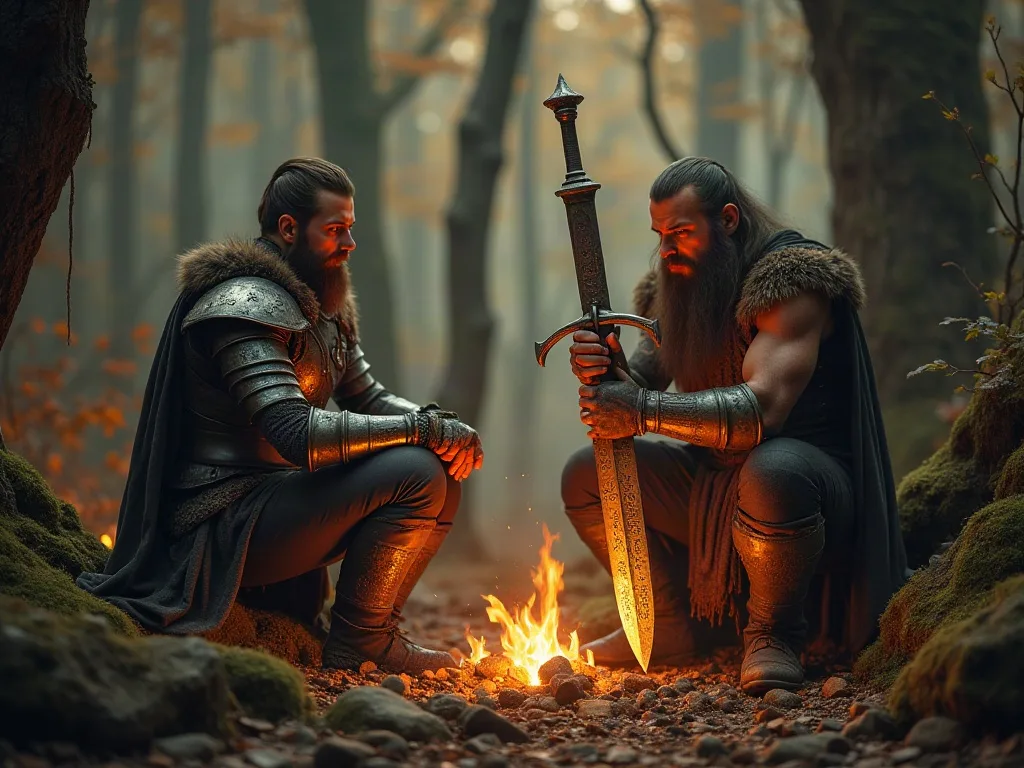
Regin now led Sigurd to the place where Fafnir dwelt. It was a barren stretch of land, scarred by the dragon's venom. The ground was poisoned. Nothing grew there. The air itself seemed to sicken with each breath.
Fafnir emerged from his cave not as a nimble serpent, but as a vast, slow thing; the transformation from man to dragon had taken centuries, and his greed had made him massive. His scales were like castle walls. His breath could melt stone. His eyes held the cunning of a creature that had spent ages brooding over gold and nursing ancient rage.
When Fafnir saw Sigurd, he laughed. It was not the laugh of a creature that feared anything.
But Sigurd did not charge headlong. He dug a pit in the path where Fafnir crawled, deep enough that the dragon would have to pass over it. Then he crouched in that pit, raised Gram, and waited.
The dragon slithered forward, unworried. When Fafnir's belly passed over the pit, Sigurd thrust upward with all his strength. Gram pierced the scales and found the heart.
The Poetic Edda preserves the moment in a fragment of verse: Fafnir dies, and his blood runs hot across the earth. Sigurd wipes his sword clean and walks up to the dragon's cave. The gold lies there, heaped in the darkness, more wealth than any mortal had ever seen.
The Blood of Dragons and the Language of Birds
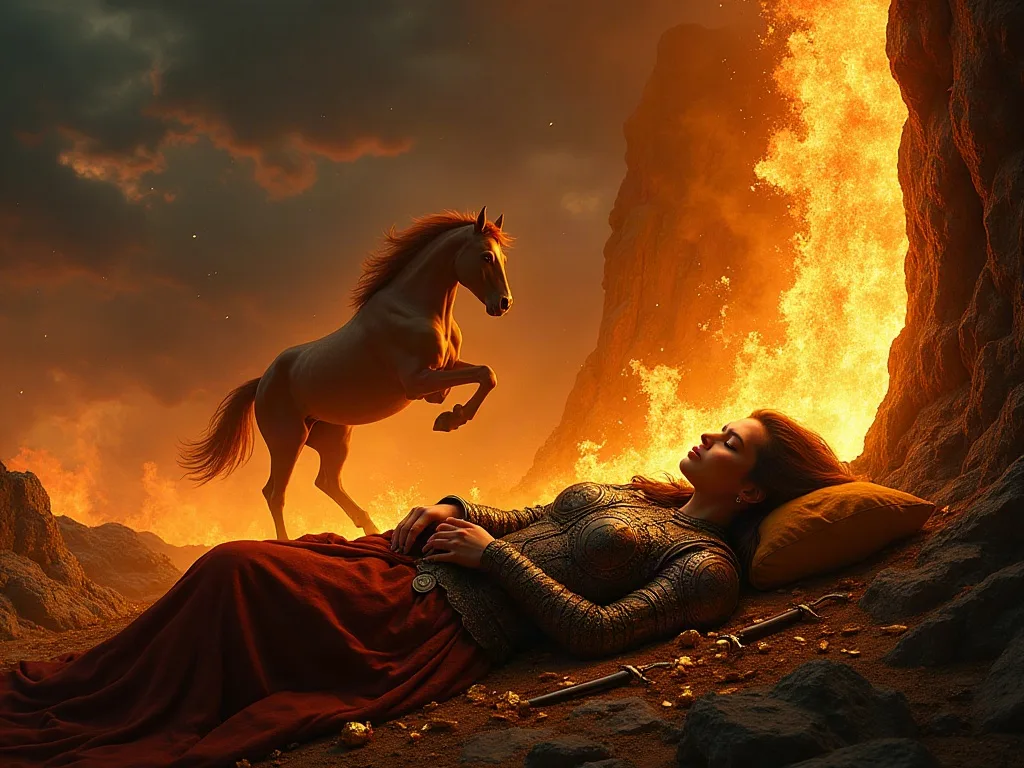
As Sigurd stood over Fafnir's corpse, the dragon's blood began to steam. It was still warm, still alive in its way. In the Norse belief, dragon's blood held power. It was not poison: it was transformation.
Sigurd's finger brushed the blood, and without thinking, he brought it to his mouth to taste it.
In that instant, something changed. His body was flooded with knowledge that had not been his moments before. The speech of birds, which had always been nothing but chirping, now became clear as human words. A raven perched in a nearby tree began to speak to him, its voice sharp and urgent.
The raven told him a truth that Regin had hidden: the dwarf meant to murder Sigurd once the gold was in hand. Regin wanted the hoard for himself. The Poetic Edda preserves this moment too, the raven's warning cutting through the otherwise warm affection Sigurd felt toward the smith who had raised him.
Sigurd made a choice. He returned to where Regin waited, and when the dwarf bent over Fafnir's body, examining the wound with fascination, Sigurd raised Gram and struck off Regin's head with a single blow.
It was a brutal necessity. Regin had raised him, taught him, sent him to glory. But Regin had also meant to betray him. In the Norse world, loyalty was sacred, but so was survival. Sigurd chose to live.
The Cursed Gold: Andvaranaut's Hoard
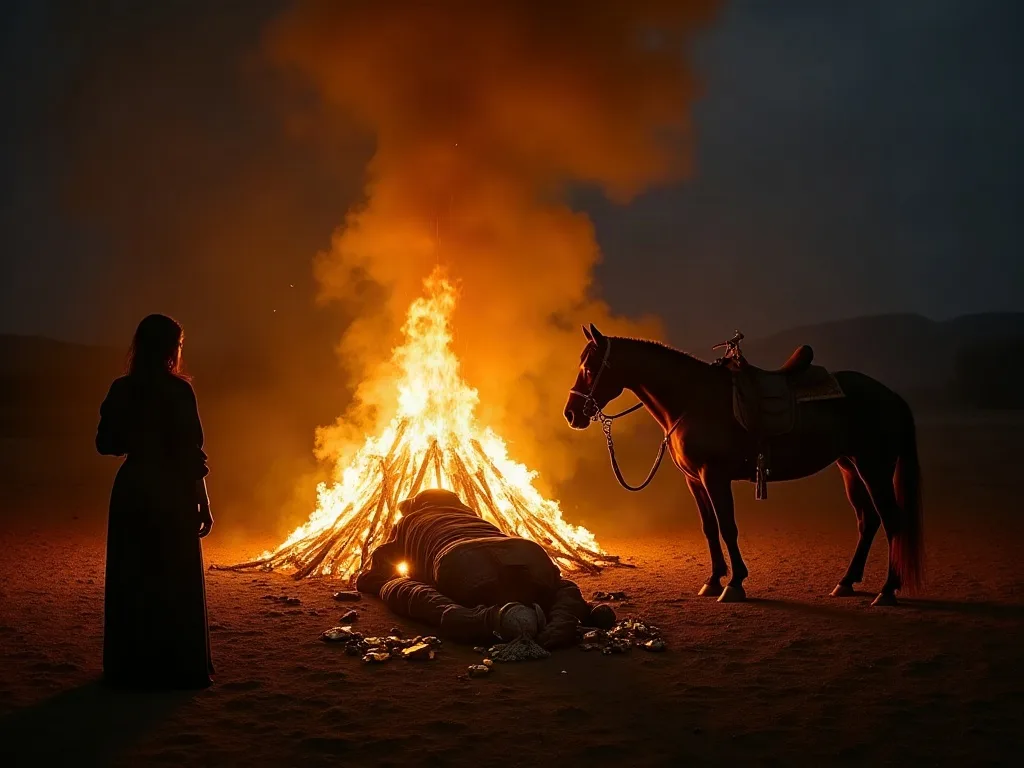
Now Sigurd dragged the gold from Fafnir's cave. It was immense. The Voelsunga Saga describes how he filled his horse Grani with as much as the beast could carry, yet the hoard seemed endless. There was so much wealth that it took him days to haul it all from the dark.
But every coin and every ring carried a curse.
The gold had belonged to a dwarf named Andvaranaut. Centuries before, the Aesir (the chief gods of the Norse pantheon) had killed Andvaranaut's son by accident. To make amends, the gods demanded that the dwarf give up all his gold as compensation. Andvaranaut agreed, but as he handed over his treasure, he placed a curse upon it: whoever possessed this hoard would be destroyed by it.
The dwarf's words haunted the gold like a ghost. Fafnir had known the curse and grown paranoid, hoarding and brooding until he transformed into a dragon to guard it. Regin had known the curse and still wanted it enough to kill. Now Sigurd claimed it, and the curse settled onto his shoulders.
The Ring That Bound Fate
Among Andvaranaut's treasure was a ring called Andvaranaut's Ring, sometimes simply "the Ring." It was small, beautiful, and inscribed with runes. The Poetic Edda hints that this ring held power over fate itself. Whoever wore it would find their power growing, their wealth increasing, their influence spreading like fire. But the more the ring gave, the more it demanded in return.
Sigurd took the ring and fastened it on his finger. He did not understand yet that he was binding himself to a path from which there would be no turning back.
Brynhildr and the Wall of Fire
From Fafnir's cave, Sigurd rode north. The Voelsunga Saga and the Poetic Edda tell of how he came to a mountain where a wall of flame burned eternally. In that fire lived a valkyrie named Brynhildr, a warrior maiden who had disobeyed the god Odin and been sentenced to sleep until a hero brave enough to ride through the flames would find her.
Sigurd did not hesitate. He urged Grani forward. The horse, enchanted by the dragon's blood and by Sigurd's touch, leaped through the flames as if they were nothing.
Brynhildr lay on a bed of silk, encased in armor made of gold. When she woke and saw Sigurd, she knew immediately that this was the man she had been waiting for. They swore vows to each other under the stars. It was a union born from the most romantic of meetings, and it was sealed by Sigurd offering her the cursed ring.
Brynhildr accepted the ring and wore it as a token of his love. In that moment, the curse began to move into motion.
The Tragedy of the Gjukungs
The curse required betrayal. The Voelsunga Saga tells how, after leaving Brynhildr, Sigurd rode to the court of a king named Gjuki. Gjuki had three sons: Gunnarr, Hogni, and the younger Gutthormr. He also had a daughter named Gudrun.
Gudrun was beautiful. Sigurd fell under her spell as deeply as he had fallen for Brynhildr, and the Gjukings, seeing the hero's fame and his gold, offered him a place in their family. They gave him Gudrun as a bride.
It seemed a happy match. But the curse was patient. The Poetic Edda hints at what happened next: one day, Sigurd and Gudrun rode by a river, and Gudrun asked him why he rode so pensively. Sigurd let slip a truth. He told her that his heart belonged to another, a valkyrie he had sworn to above all else.
Gudrun was struck by this confession. A seed of jealousy took root. She spoke to her brothers.
The Gjukungs had become envious of Sigurd's power and his gold. The cursed hoard was now in their keeping, and it filled their minds with thoughts of domination. They wanted Sigurd to marry Brynhildr himself, so that the valkyrie would become one of their family and they could control her power. But Sigurd had already sworn to Gudrun.
The brothers hatched a plot. Using a potion that robbed Sigurd of his memory, they made him forget his vows to Brynhildr entirely. Then they went to Brynhildr themselves, and Gunnarr, the eldest, offered to marry her if she would agree to leave the mountain.
Brynhildr tested him. She told Gunnarr to ride through the wall of flames, as only her destined husband could do. Gunnarr's horse faltered and refused. He could not pass.
So Gunnarr used a trick. He took the form of Sigurd (perhaps through magic, perhaps through the intervention of the curse itself) and rode through the flames wearing Sigurd's face. Brynhildr, deceived, believed that Sigurd had come for her after all, and broken their vows. She agreed to marry Gunnarr, and the ring was taken from her and given to Gudrun.
When Brynhildr learned the truth, that she had been tricked, that the man who rode through the flames had not been Sigurd at all, her heart turned to ice. She felt the full weight of betrayal. The Poetic Edda preserves her anguish in verses that still burn across a thousand years.
She went to Gunnarr and demanded he kill Sigurd. Only then could she forgive the deception.
The Death of a Dragon Slayer
Gunnarr refused at first. He owed Sigurd loyalty; they had sworn brotherhood. But Brynhildr's rage was relentless. She threatened to leave him, to curse his name, to ensure that he would never know peace.
The curse moved through the family like poison. Gutthormr, the youngest brother, was the one finally persuaded. In the darkness of night, he came to Sigurd's bed.
Sigurd woke to find a blade at his heart. He reached for Gram, but his strength was already fading. The Voelsunga Saga says he threw his sword with his last breath, and it flew across the room and split Gutthormr's head in half. But Sigurd was already falling.
Brynhildr came to see his body. The accounts differ on what happened next. Some versions say she wept and took her own life to join him in death. Others say she cursed the Gjukungs with her dying breath, prophesying that Gudrun would never find peace, that her sorrow would outlive them all.
The curse had consumed its wielder. The gold outlasted them. The ring passed from hand to hand, bringing ruin with it.
How Sigurd Lives in the Northern Sagas
The Norse remembered Sigurd not as a distant figure from a golden age, but as a hero whose choices still mattered. The Voelsunga Saga was written in the 13th century by an Icelandic author whose name is lost, but the story he recorded came from sources centuries older, preserved in oral tradition.
The Poetic Edda, compiled around the same time, preserves the oldest versions in verse. The Lay of the Volsungs (Volsunga Kvida) and the Lay of Sigurd (Sigurdar Kvida) contain material that scholars believe dates back to the pagan Germanic world, before Christianity reached the North.
Sigurd also appears in the Eddic cycle as a parallel figure to other heroes. The Lay of Regin (Reginsmol) covers his childhood. The Lay of Fafnir (Fafnismol) records his dialogue with the dying dragon. The Lay of the Gjukungs (Gjukunga Kvida) and the Lay of Hamdir (Hamdir Kvida) follow the family's tragic unraveling after his death.
In Germanic tradition, Sigurd was known as Siegfried. The Middle High German epic the Nibelungenlied, composed around 1200, relocates his story to the Rhine, renames the characters, and adds new episodes, but the core remains: a hero of impossible strength, a dragon of impossible greed, and a curse that no courage can outrun.
The Dragon's Wisdom in Sigurd's Blood
The moment Sigurd tasted Fafnir's blood and gained the speech of birds, something profound shifted. In Norse thought, gaining knowledge was not passive; it was dangerous. The gods themselves had paid terrible prices for wisdom: Odin hung himself on Yggdrasil for nine nights to learn the runes. Mimir lost his eye for a sip from the Well of Wisdom.
Sigurd's knowledge came unbidden, burned into his body by the dragon's essence. The Poetic Edda suggests that this transformation was both gift and burden. He could hear truths that were hidden from others, but he could not unhear them. He learned of Regin's treachery when it was almost too late. He learned of Brynhildr's existence when he was already sworn to another.
The dragon's blood made him wise, but wisdom did not spare him from the curse.
Sigurd in Modern Memory
In the 19th century, Sigurd captured the imagination of Romanticism. Richard Wagner based his operatic cycle The Ring of the Nibelung partly on Sigurd's saga, weaving it together with other Norse myths and adding layers of psychological complexity. Wagner's Siegfried (Sigurd's German equivalent) became an archetype of heroic idealism facing a corrupted world.
Today, Sigurd appears in fantasy literature, video games, and modern retellings because his story touches something primal: a young man proves his worth through an impossible deed, wins a treasure and a woman, and is destroyed not by his enemies but by the tangled web of relationships and oaths that bind him to his world.
The curse matters as much as the sword. His power matters less than his choices. That is why readers still care.
Frequently asked questions about Sigurd the dragon slayer?
Frequently asked questions
Did Sigurd really exist, or is he purely mythological?
Scholars debate whether Sigurd was inspired by a real historical hero. The Volsungs may have been a real royal lineage in ancient Germany or Scandinavia, and traces of a legendary dragon-slayer may have been woven into their family stories over centuries. But the Sigurd of the sagas, the dragon-slayer who drank dragon blood and gained the speech of birds, is a creation of Norse mythology, not a historical record. What matters is that the Norse people treated his story as true in the sense that matters: a story about fate, choice, and the price of power.
What does the curse of Andvaranaut's gold actually do?
The curse is not a magical spell with visible effects. Instead, it works through human nature. Whoever possesses the gold becomes obsessed with it, grows paranoid, makes poor choices, and eventually brings suffering on themselves and those around them. Fafnir transformed into a dragon out of greed. Regin plotted murder. The Gjukungs turned on Sigurd out of envy. The curse does not move objects; it poisons the mind. In a sense, it is the most realistic curse in Norse mythology: wealth corrupting character.
Why did Sigurd break his vows to Brynhildr?
Sigurd did not knowingly break his vows. The Gjukungs gave him a potion that erased his memory of his oath to Brynhildr, and he genuinely fell in love with Gudrun. When Gunnarr (or his magical double) rode through the flames, Brynhildr believed she had been betrayed by Sigurd himself. The tragedy is that no one was truly at fault, the curse and the magic did the breaking. This is what makes the Norse sagas so powerful: they show how even heroes cannot control their own fates.
How did Sigurd compare to other Norse heroes?
Sigurd was the greatest mortal hero of Norse legend, but he was not a god. Unlike the Aesir, he could be killed. Unlike trolls, he was born human and remained mortal. His strength came from his sword, his dragon's blood, and his courage, but also from the oaths that bound him to others. The Lay of Hamdir and other sagas show that after Sigurd's death, his family continued his vendetta, suggesting that his legacy extended beyond his lifetime. In the Norse worldview, a hero's greatest monument is the story that survives him.
What happened to Andvaranaut's ring after Sigurd died?
The Voelsunga Saga and the Poetic Edda preserve different versions of the ring's fate. In some accounts, Gudrun kept it and eventually threw it into the Rhine out of sorrow, where it lay until the end of time. In other versions, it passed to her daughter Svanhildr and her descendants. Wagner's Ring Cycle uses the image of the ring being cast into the river as a symbol of redemption. In all versions, the ring's curse continues to haunt those who possess it, a tangible reminder that no hero, no matter how strong, can escape the weight of the past.
The Hero Who Burned So Bright He Could Not Last
Sigurd's story is not a story of triumph, despite his victory over Fafnir. It is a story about what happens when a hero tries to live in a world bound by oaths, by kinship, by curses older than himself.
He was given a broken sword and made it whole. He was given a dragon to slay and slew it. He was given a woman to love and loved her. But he could not give himself the gift of peace. The Poetic Edda preserves a final image of Sigurd standing in his grave, his sword laid across his chest, the gold piled around him like a monument to everything he could not keep.
The Norse did not see Sigurd as a failure. They saw him as the measure of what a mortal man could do against the forces that shaped him. He slew a dragon. He heard the speech of birds. He loved so deeply that his rival took her own life out of grief. In the end, he fell not to his enemies but to the machinery of fate itself, and there is no shame in that.
He remains the greatest dragon slayer of the North, not because his sword was sharpest, but because he knew what it would cost him, and he did it anyway.
Free 25-page sample
Want the whole story?
Take the first 25 pages free. If it pulls you in, the full edition is yours as an instant PDF download, with a paperback on Amazon for selected titles.

Mythology
The World Mythology Book: The Gods, Heroes and Myths of Every Culture
The Gods, Heroes and Myths of Every Culture, in One Volume
The whole of world mythology in a single volume: Greek, Norse, Egyptian, Japanese, Hindu, Celtic, Slavic, Mesoamerican and African myths gathered side by side, each drawn from the primary sources.