
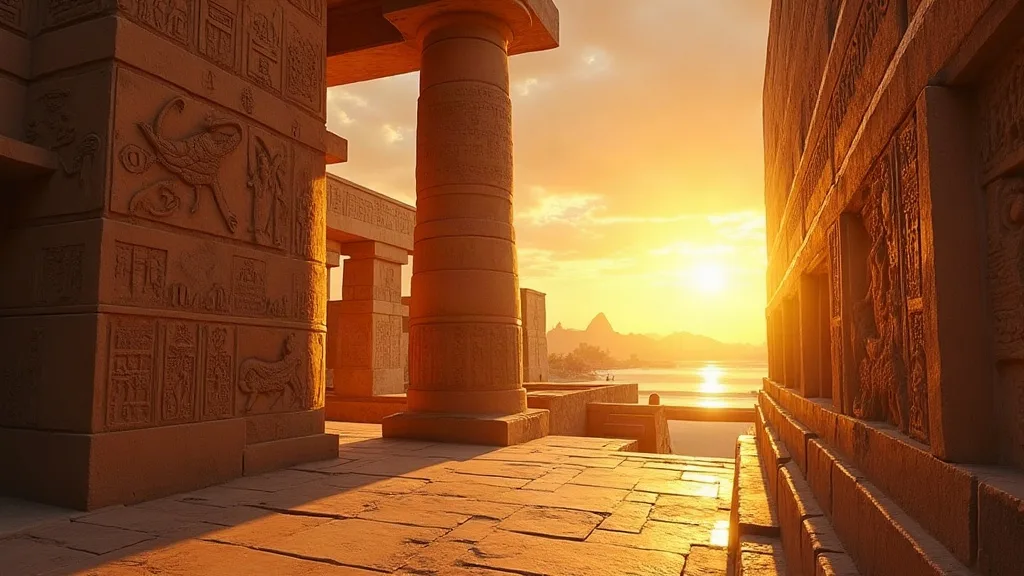
Sobek the Crocodile God: Egypt's Ferocious Guardian of Waters and Pharaonic Power
Sobek, the crocodile god of ancient Egypt, embodied both the Nile's life-giving power and its primal danger. From pyramid texts to royal rituals, discover how Egyptians worshipped their most feared predator as a protector, a judge of souls, and a symbol of pharaonic might.
Contents
A crocodile slides into the Nile at dawn, massive jaw gaping. For ancient Egyptians, this moment held no simple answer: was it a threat or a blessing? The creature emerging from those waters was Sobek, one of Egypt's oldest and most paradoxical gods. He guarded the Nile itself. He killed without mercy. And Egyptians built temples to worship him, painted his image on amulets they wore against their hearts, and believed his favour could grant them eternal life.
Sobek the crocodile god occupied a unique place in Egyptian thought. He was neither purely protective nor purely destructive, but something more unsettling: the embodiment of primal power that simply existed, indifferent to human categories of good and evil. To approach him required respect, cleverness, and ritual. The Egyptians built an entire theological apparatus around this scaled predator, one that would endure for three thousand years.
Origins and the Primordial Waters
Sobek's origins lie in chaos itself. In the earliest Egyptian creation accounts, preserved in texts like the Pyramid Texts (a collection of spells and utterances carved inside royal burial chambers around 2400 BC), Sobek emerged from the primordial waters at the beginning of time. These waters, called Nun, were not wet in the modern sense but rather the undifferentiated chaos from which all order came. The world was born from Nun through the will of divine intelligence, but Nun remained always present, always dangerous, always fertile.
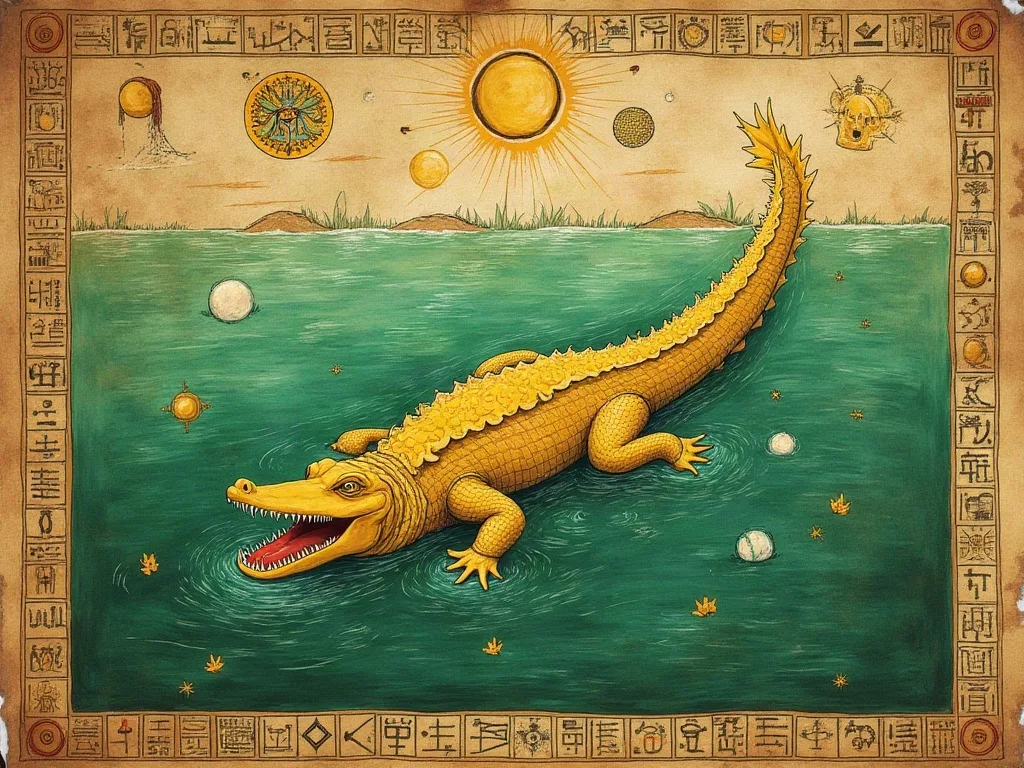
Sobek was one of the few deities who embodied this dual nature. The Pyramid Texts describe him as existing alongside Ra, the sun god, in those first moments of creation. Some traditions held that Sobek's eyes were the sun and moon; others said he was the very teeth of creation itself. He was not born from parents as many gods were. He simply was, like the crocodile that appears in the Nile without announcement, patient and inevitable.
By the Middle Kingdom (around 2000-1700 BC), Sobek had accumulated layers of meaning. He became associated with royal power. The pharaohs, those semi-divine kings who ruled Egypt, took Sobek into their names and claimed his strength as their own. A king might call himself "Amenemhat the Crocodile" or "Sebek-hotep," meaning "Sobek is satisfied" or "Sobek is pleased." The connection was not poetic. Pharaohs were believed to be the earthly manifestations of divine power, and Sobek's strength, speed, and ruthlessness made him an ideal symbol of royal dominion.
Worship and Sacred Spaces
The cult of Sobek centred on two major temple cities: Crocodilopolis (the Greeks called it this; Egyptians knew it as Faiyum) and Kom Ombo in Upper Egypt. At Crocodilopolis, pilgrims came to worship a living crocodile that was believed to be an incarnation of Sobek himself. This was not mere symbolism. The Egyptians treated the sacred crocodile with ceremonial care, adorning it with jewels, housing it in a sacred pool, and consulting it as an oracle. When the god's earthly body died, it was mummified with the same care given to royal dead, wrapped in linen and interred in a sacred tomb. A new crocodile was then chosen to embody Sobek in the world.
Kom Ombo, located where the Nile's navigation shifted between north and south, hosted one of Egypt's most important dual temples. This sanctuary honoured both Sobek and Horus, the falcon-headed god of the sky. The temple's walls, built in the Ptolemaic period (around 300 BC, when Greek rulers governed Egypt), depict Sobek with meticulous detail. His scaled hide is rendered in greens and golds. His powerful tail coils beneath his body. Hieroglyphic inscriptions identify him with formulas like "Sobek of the Waters" and record the names of priests who conducted rituals in his name.
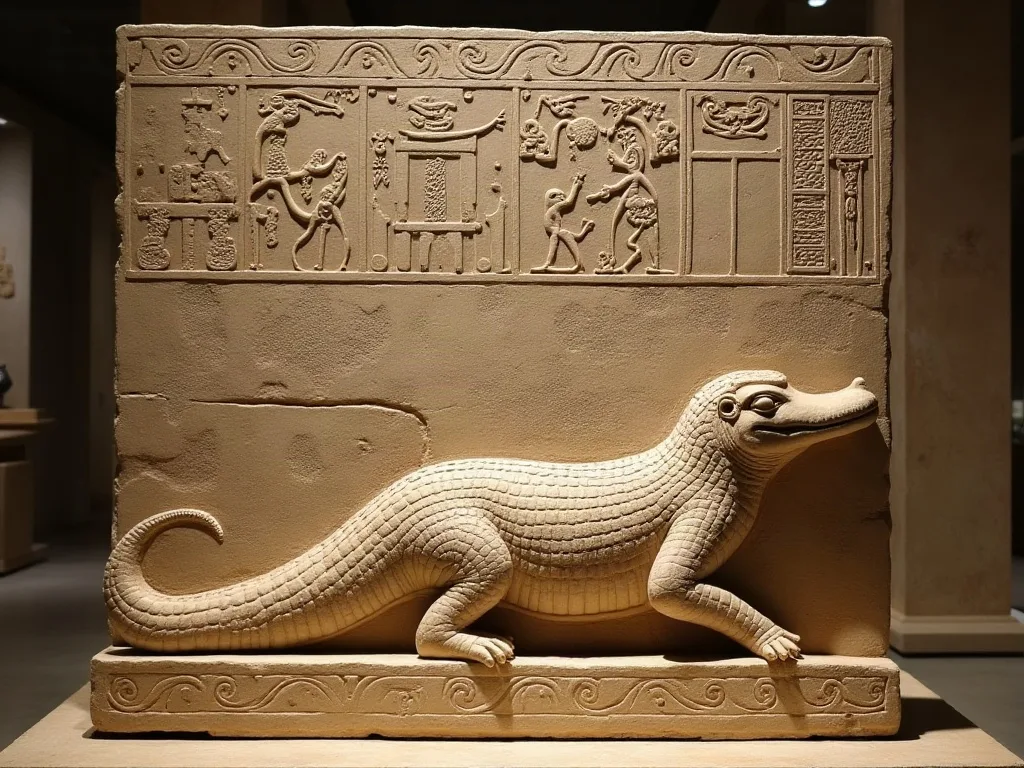
Ordinary Egyptians wore amulets shaped like Sobek. Some were carved from faience, a glazed ceramic material that could be moulded into intricate forms. Others were fashioned from stones like carnelian or emerald. These talismans were believed to transfer Sobek's protective strength to the wearer. A mother might place a crocodile amulet in her child's crib. A soldier might wear one into battle. A merchant would carry one for luck in trade. The amulets were small enough to hold in a closed fist, but the power they represented was immense: the fearlessness of the apex predator, the fertility of the life-giving river, the unstoppable force of nature.
Mythology and Divine Relationships
Sobek's relationship with other gods shaped his role in the cosmos. The Pyramid Texts and later sources like the Coffin Texts (funerary writings from the Middle Kingdom) reveal a complex network of alliances and conflicts. Sobek was sometimes portrayed as a servant of Osiris, the god of the afterlife, helping to protect the deceased in the underworld. At other moments, he was cast as a threat that even Osiris had to manage. In one account, Sobek's crocodile form is actually the disguise of a dangerous force that must be constrained through ritual.
More commonly, Sobek was aligned with Ra, particularly in his form as Ra-Sobek (or Sobek-Ra). This fusion emphasized Sobek's solar qualities. Just as the sun god travelled through the sky, Sobek journeyed through the waters. Both were associated with heat, power, and the regulation of natural cycles. At noon, when Ra's disk blazed directly overhead, crocodiles basked on riverbanks with their mouths open. Egyptians saw this as Sobek welcoming the sun god's daily passage.
Sobek also held a peculiar status in scenes of divine judgment. In the Book of the Dead (a collection of spells meant to aid the deceased in the afterlife), Sobek appears in the Hall of Judgment alongside Anubis, the jackal-headed god of mummification, and Thoth, the ibis-headed god of wisdom. The dead person's heart was weighed against the feather of truth (representing justice and order), and Sobek's role was never entirely clear. Was he a judge, a guardian, a potential devourer? This ambiguity was intentional. Sobek's very nature meant that no one could fully predict or control him. He represented the wild element of existence that human law and morality could not entirely domesticate.
Symbolism and Sacred Attributes
The crocodile itself carried rich symbolic weight in Egyptian thought. The Nile, source of Egypt's life, was also a place of drowning. Crocodiles were everywhere in the river, and their attacks were real and sudden. A farmer leading cattle to water, a child playing at the bank, a soldier crossing during a campaign: all faced the possibility of becoming prey. This danger was not exotic or distant. It was part of the rhythm of existence.
Yet the Nile also deposited the rich black silt that made Egyptian agriculture possible. Without the annual inundation, Egypt was a desert. Sobek embodied this paradox. His power flooded the land and also devoured those who approached carelessly. He was not separate from the river; he was its essential nature made flesh. To revere Sobek was to respect the river itself, to understand that nature's gifts come packaged with nature's violence.
Sobek's symbolism extended to fertility and regeneration. Crocodiles lay hundreds of eggs; in them lay the promise of new life. Egyptians associated Sobek with childbirth and the successful bearing of children. Pregnant women might wear Sobek amulets and make offerings at his shrine. The fierce protective instinct of crocodiles guarding their nests resonated with Egyptian concepts of maternal and paternal duty. Sobek defended what mattered most.
The god's green or golden colour represented both the river's waters and the verdant growth of the Nile valley. His teeth, often emphasized in artistic depictions, symbolized power and danger but also the ability to bite through obstacles. His tail, massive and muscular, embodied control and precision. Every crocodile's attribute became theological language.
The Pharaoh and Sobek's Political Theology
By the New Kingdom (1550-1070 BC), Sobek had become deeply woven into royal ideology. Pharaohs did not simply worship Sobek; they claimed to embody his power. When a king was crowned, he took on Sobek's attributes. Reliefs show pharaohs in the form of crocodiles, their scaled bodies moving through the waters of the cosmic ocean. The message was clear: the pharaoh, like Sobek, was supreme in his domain, feared and respected, capable of protecting his people and destroying his enemies.
One of the most famous examples comes from the reign of Amenhotep III (1390-1352 BC), whose temple at Kom Ombo became a centre for Sobek worship and royal ritual. Inscriptions describe the pharaoh performing ceremonies to ensure Sobek's satisfaction, offering him meat and grain, pouring libations of wine and water. In return, Sobek would ensure the Nile's prosperity, the fertility of the land, and the security of the realm.
This was not mere symbolism or propaganda. To the Egyptians, these rituals worked. They maintained cosmic order (called ma'at, a concept encompassing justice, truth, harmony, and proper function). Without such rituals, the sun would not rise, the Nile would not flood, and chaos would reclaim the world. A pharaoh who neglected Sobek's temple or ignored his cult was not merely being irreverent; he was allowing the universe to slip toward dissolution.
Sobek in the Afterlife
The Egyptian afterlife was not a place of peace and meditation. It was a perilous journey through the underworld called the Duat, where the dead faced numerous threats, trials, and supernatural obstacles. Sobek's role in this realm was complex and sometimes contradictory, reflecting his ambiguous nature in the world above.
In some funerary texts, Sobek serves as a protector. The deceased invokes his name to gain safe passage: "I am Sobek, I devour my enemies, I am protected by his name." The crocodile's predatory excellence becomes, paradoxically, a shield against other predators. Sobek drives away demons and hostile spirits.
In other accounts, Sobek is the threat itself. The dead must know his seventy-seven names to avoid being eaten. Spells and utterances in the Coffin Texts enumerate these names, each representing a different aspect of the god's nature. By knowing Sobek, one could theoretically control him, or at least predict his behaviour. Knowledge of divine names was a form of magical power in Egyptian thought.
The most elaborate role emerges in the scenes of the weighing of the heart. After death, the deceased stood before a tribunal of 42 judges (sometimes including Sobek) to account for their deeds. Their heart, believed to be the seat of memory, intention, and morality, was weighed against the feather of truth. Anubis oversaw the scales. Thoth recorded the verdict. Sobek's presence in this scene likely reflected the Egyptian belief that moral judgment required not just wisdom (Thoth) and order (ma'at) but also the primal force that could execute judgment. If the heart was heavier than the feather (meaning the person had committed grave sins), hungry creatures including a devourer with crocodilian features would consume the heart, ensuring the person's annihilation in the afterlife.
Transformation and Divine Forms
Like many Egyptian gods, Sobek was understood to exist in multiple forms or manifestations. The most significant was Sobek-Ra, the fusion of Sobek with the sun god. This syncretism emphasized Sobek's cosmic importance. He was not merely a river god but a force that participated in the daily cycle of creation and destruction that Ra embodied.
Another form, Khenti-Imentiu-Sobek ("Sobek, Chief of the Westerners"), linked him explicitly to the afterlife and the western horizon where the sun set and the journey into the underworld began. This composite god represented Sobek's role as guardian of the threshold between the living world and the realm of the dead.
Egyptians also understood Sobek to assume different forms depending on context. In the morning, he might manifest as a small crocodile; at noon, as the massive beast in full strength; in the evening, as something half-submerged and mysterious. Each form held different theological weight. Each could be addressed through different ritual approaches.
Priesthood and Ritual Practice
The priests of Sobek formed a distinct and prestigious order. They underwent strict purification rituals before approaching the god's shrine. The Edicts of Ptolemy III (around 245 BC) provide detailed information about Sobek's priesthood, describing the elaborate ceremonies conducted on his festival days. Priests would wake before dawn, bathe, don white linen, and prepare offerings.
The most important ceremony was likely the daily feeding ritual. Priests would bring meat, fish, and bread to the sacred pool where the living incarnation of Sobek resided. They would call his name and invite him to eat. The care taken in feeding a living crocodile was meticulous. The meat had to be fresh, of proper quality, and offered with correct words and gestures. This was not caretaking of an animal; it was engagement with a god.
On certain festival days, larger ceremonies took place. Crowds of pilgrims gathered. Priests performed elaborate rituals, sometimes lasting for hours. The sacred crocodile might be displayed to the public, draped in cloth of gold. Music would play. Incense would burn. The boundary between the divine and human was thinned, and the god's presence felt immediate and overwhelming.
Decline and Legacy
Sobek's cult endured longer than most Egyptian deities. Even after the rise of Christianity in Egypt and the decline of traditional polytheism, references to Sobek persisted in magical texts and folk practice. The Ptolemaic period (Greek rulers from around 305-30 BC) actually saw a flourishing of Sobek worship, with new temples built and existing ones expanded.
Yet with the Christianization of Egypt in the 4th and 5th centuries AD, public worship of Sobek ceased. His temples fell into disuse. The priestly orders dissolved. The living crocodiles that had been kept as divine incarnations were no longer maintained. The god who had commanded fear and reverence for three thousand years passed into history.
What remained were echoes. His image survived in museums and archaeological sites. His name appeared in lists of gods compiled by Greek and Roman writers like Plutarch and Manetho, who sought to translate Egyptian religion for their audiences. Medieval Islamic and Christian travelers passing through Egypt occasionally recorded legends about ancient crocodile worship.
In modern times, Sobek has been rediscovered not through continuous tradition but through archaeology and Egyptology. Scholars reading hieroglyphic inscriptions and examining temple reliefs have painstakingly reconstructed his theology and practice. The god of the Nile has become a subject of academic study, his power now manifested not in living crocodiles but in the curiosity and awe of those who encounter his surviving traces.

Sobek's Resonance Across Cultures
Sobek's theological position had parallels in other ancient religions. The Mesopotamian god Tiamat, a primordial water dragon, shared Sobek's association with chaos and creative power. The Hindu god Makara, a crocodile or sea monster, embodied similar paradoxes of danger and fertility. Even in cultures without crocodile predators, there were gods of wild waters, untameable forces that human ritual could only manage, never truly control.
This speaks to something universal in religious thought: the need to acknowledge and address forces that cannot be eliminated, only understood and negotiated with. Sobek was powerful precisely because he could not be made safe. Egyptians did not pray for him to stop being dangerous. They prayed to understand his nature and survive his attention.
In contemporary popular culture, Sobek has experienced a minor revival through fantasy literature, video games, and films that draw on Egyptian mythology. Yet these modern representations often strip away the theological subtlety that made Sobek remarkable. He becomes merely a villain to be defeated or a monster to be slain. This misses the essence of how the Egyptians related to him: not as an enemy to vanquish but as a power to respect, honour, and carefully negotiate with.
Frequently asked questions about Sobek the crocodile god
Frequently asked questions
Was Sobek worshipped as a protective god or a dangerous predator?
Both simultaneously. Ancient Egyptians understood Sobek not as either-or but as paradoxically both. He embodied the Nile's life-giving power and its predatory danger. Pilgrims wore his amulets for protection while also performing rituals to appease his destructive potential. This paradox was theologically essential, not a contradiction to be resolved.
What was the sacred crocodile of Crocodilopolis actually used for?
The living crocodile kept at Crocodilopolis was understood to be a direct incarnation of Sobek himself in the material world. Priests maintained it in a sacred pool, fed it daily with ritual care, and sometimes consulted it as an oracle. When the crocodile died, it was mummified with the same burial rites as a human being, and a new crocodile was chosen to embody the god.
Did pharaohs really see themselves as Sobek?
Yes. Pharaohs not only saw themselves in Sobek but performed rituals claiming his identity and power. Reliefs show kings in crocodile form, and royal names included titles like "the Crocodile" to invoke his strength and dominion. This was not metaphorical but theological: the pharaoh's authority was understood as flowing directly from divine forces like Sobek.
How does Sobek compare to Anubis or Osiris in Egyptian religion?
Sobek occupied a different theological niche. Anubis was god of mummification and cemeteries, Osiris god of the afterlife and resurrection, while Sobek embodied primal cosmic power tied to the Nile and royal strength. All three appeared in funerary contexts, but Sobek represented the untameable, amoral force rather than the structured systems of death and rebirth.
What ancient sources tell us most about Sobek's mythology and worship?
The Pyramid Texts (carved inside royal tombs around 2400 BC) contain some of the oldest references. The Coffin Texts and Book of the Dead offer funerary contexts. Temple inscriptions from Kom Ombo and Crocodilopolis provide information about ritual practice. Greek writers like Plutarch and Strabo documented Sobek worship during the late Ptolemaic period, translating Egyptian religion for Mediterranean audiences.
Why did Sobek's worship last longer than most other Egyptian gods?
Sobek's cult remained vigorous into the Ptolemaic and even Roman periods because he fulfilled a persistent religious need. His primal, amoral nature meant he did not depend on the kind of moral theology that later religions challenged. Even as monotheistic religions (Christianity, Islam) spread through Egypt, the older folk and magical practices associated with Sobek lingered in some form.
The Crocodile and the Mirror: What Sobek Still Teaches
Sobek stands as a reminder of something modern religion often tries to domesticate: the sacred that does not care about human morality. We construct elaborate theological systems to argue that divine powers are benevolent, rational, orderly. The Egyptians knew better. They built a system that honoured the sacred that is simply powerful and indifferent, that exists in its own interest first.
Standing at the edge of the Nile as the sun rises, watching a crocodile slide into the water, a modern visitor might feel something of what an ancient Egyptian felt: a mixture of awe, fear, respect, and strange recognition. That creature is not evil. It is not good. It simply is, vast and patient and utterly beyond moral judgment. To live near such power requires a different kind of wisdom than the wisdom of ethics. It requires the wisdom of survival.
Sobek embodied that wisdom. In temples where his image was carved, in amulets worn close to the heart, in the words of spells meant to navigate the underworld, Egyptians encoded their understanding that humans live in a cosmos of forces vastly greater than themselves. To thrrive, they had to acknowledge those forces, not with the hope of making them gentle, but with the intention of understanding them well enough to dance with danger and not be devoured.
Free 25-page sample
Want the whole story?
Take the first 25 pages free. If it pulls you in, the full edition is yours as an instant PDF download, with a paperback on Amazon for selected titles.

Mythology
The World Mythology Book: The Gods, Heroes and Myths of Every Culture
The Gods, Heroes and Myths of Every Culture, in One Volume
The whole of world mythology in a single volume: Greek, Norse, Egyptian, Japanese, Hindu, Celtic, Slavic, Mesoamerican and African myths gathered side by side, each drawn from the primary sources.