

Talos the Bronze Giant: Myth, Meaning, and the First Robot of Ancient Greece
Talos, the bronze automaton who guarded Crete, was the ancient Greek imagination's most vivid answer to a timeless question: what happens when a god builds a man of metal?
Contents
Three times a day, the bronze figure walked the perimeter of Crete. His footsteps left scorched stone. Sailors who spotted him from the sea pulled hard on their oars and changed course. He was not alive in any way the Greeks understood life, yet he moved with purpose, hurled boulders with precision, and ran hot with something close to blood. He was Talos the bronze giant, and he may be the oldest automaton in recorded Western literature.
He appears in sources stretching from Apollonius of Rhodes in the third century BCE all the way back to fragments and vase paintings that predate him by two centuries. He is simultaneously a guardian, a weapon, a warning, and a theological puzzle. Who made him, how he was destroyed, and what he was meant to mean have occupied mythographers, philosophers, and now robotics engineers for millennia.
Who Made Talos: Hephaestus, Minos, and a Gift From the Gods
The question of Talos's origin fractures across sources, and that fracture is itself revealing.
The most persistent tradition, followed by Apollonius in Argonautica Book IV (written around 250 BCE), holds that Talos was the work of Hephaestus, the divine smith, and that Zeus gave him to Europa as a gift when the king of the gods brought her to Crete. This version places Talos inside a lineage of divine automation: the same Hephaestus who forged the golden handmaidens who assisted him at his forge, and who built the bronze tables that rolled themselves to the feasts of the Olympians.
A second, older tradition preserved in scholia on Pindar and in Simonides calls Talos a survivor of the Bronze Race (genos khalkoun), the third of Hesiod's five ages. In Hesiod's Works and Days, the Bronze Race was made of ash-tree wood and given over entirely to warfare; they were strong, hard, and without the gift of grain. They destroyed themselves. Talos, by this reading, is the last specimen of that race, or at least an echo of it: a being constituted entirely of metal, answering to no emotional register, existing to guard and to destroy.
A third and less common strand, found in Apollodorus's Bibliotheca, gives Talos to King Minos directly, either as a creation of Hephaestus or as a relic inherited from the first Cretan dynasty. In this version, Minos uses him as a living border patrol: Talos circles the island three times each day, throwing boulders at any ship that approaches without permission.
These three origins are not contradictions so much as layers. The oldest stratum (the Bronze Race reading) anchors Talos in cosmogony. The middle stratum (Zeus-to-Europa) places him in heroic mythology. The latest stratum (Minos's possession) turns him into statecraft.

The Anatomy of Bronze: How Talos Worked
Ancient commentators were not incurious about Talos's mechanics. Two competing descriptions circulate in the sources, and they deserve careful reading.
The vein of ichor. Apollonius describes Talos as having a single vein (phleps) running from his neck to his ankle, closed at the lower end by a bronze nail or membrane. Through this vein flows ichor, the divine fluid that runs through the Olympians instead of blood. The vein is at once a circulatory system and a fatal architecture: the fluid makes Talos animate; the single closure point is his only vulnerability. Scholars like Adrienne Mayor, in The First Fossil Hunters and her later Gods and Robots, connect this to the early Greek observation of fossil bones in Cretan and Aegean limestone. Enormous, mineralized remains were sometimes interpreted as the bodies of the pre-human races.
The heated bronze body. A separate tradition, referenced in a scholion on Apollonius and in later Byzantine commentaries, describes Talos not as an automaton with internal fluid, but as a figure who heats himself red-hot in fire and then embraces unwelcome visitors to burn them to death. This second image is darker and more sacrificial. It resonates with descriptions of the Phoenician idol Moloch in Hebrew and Greek polemical literature, and some historians of religion have suggested a connection between the Cretan bronze giant and ritual burning associated with pre-Hellenic Aegean cults.
Both descriptions share one quality: Talos is impenetrable everywhere except at a single, concealed point. This is a structure Greek myth applies with almost architectural regularity: Achilles and his heel, the Nemean Lion and the space between neck and shoulder. Invulnerability in Greek thinking is never total. It is always bounded by a hidden threshold, and that threshold is always where the story ends.
Talos (Greek)
- Built by a god (Hephaestus), given as political gift
- Animated by ichor, a divine fluid
- Destroyed by removing a bronze nail or draining the vein
- Guards a geographic boundary (the island of Crete)
- Represents divine craftsmanship and cosmological power
- First attested circa 5th century BCE (vase paintings)
Golem (Jewish Folklore)
- Created by a rabbi or scholar using sacred knowledge (Kabbalah)
- Animated by the Hebrew word emet (truth) inscribed on the forehead
- Destroyed by erasing the first letter to form met (death)
- Guards a human community (typically Prague's Jewish ghetto)
- Represents human aspiration and the limits of creation
- First detailed texts circa 16th century CE (Maharal of Prague)
The Argonauts and the Death of Talos
The decisive mythological episode is the confrontation between Talos and the Argonauts, told in full in Argonautica IV.1638-1688. After Jason's crew escape Circe and survive the Clashing Rocks, they make for Crete. Talos spots the Argo from the cliff-tops and begins hurling fragments of rock, each one capable of swamping the ship.
The Argonauts would have turned back, but Medea intervenes. What she does next is the passage's most debated moment. Apollonius writes that Medea fixes her gaze on Talos, mutters words under her breath, and sends keres (death-spirits, or perhaps she simply calls on them as witnesses) toward him. In some manuscript traditions she also physically approaches him. The bronze giant, distracted or perhaps truly hexed, stumbles. His ankle scrapes against the sharp rock of the cliff. The nail or membrane is dislodged. The ichor pours out.
The image Apollonius gives us is not triumphant. Talos falls like a tree cut from its roots, his collapse shaking the shore, the sea churning. He is, in that moment, not monstrous. He is almost tragic. The Argonauts do not cheer. Apollonius notes the silence.

This restraint is unusual in ancient epic. Monsters die loudly in the Odyssey and the Iliad. The Cyclops screams; the suitors bleed across the hall floor. Apollonius's Talos collapses without a cry, because he was never given a voice, never given an intention. He was executing his function. Medea undoes not a will but a mechanism, and the distinction seems to matter to the poet.
Medea's Role: Witch, Pharmacist, or Hacker?
The scholars most interested in Talos have always returned to this question. Medea is a sorceress trained by Hecate, but her methods throughout the Argonautica are practical as well as magical. She knows poisons, she knows physiology, and she knows the stories of the gods.
Some readings of the Talos episode treat her intervention as purely magical: she uses the evil eye (baskania) to disorient him. Others, including the classicist Karelisa Hartigan in her work on Medea across genres, treat this moment as an act of technical knowledge. Medea knows where the nail is. She knows what it seals. She engineers a situation in which a being with no capacity for doubt or self-preservation scrapes his own vulnerability against the rock.
This is not witchcraft in the popular sense. It is closer to what we would now call a systems exploit. The being is not defeated; the architecture is.
Talos in Earlier Sources: Vase Paintings and Fragments
The written tradition does not hold the earliest evidence. A red-figure krater now held in the Museo Archeologico Nazionale in Ruvo di Puglia (southern Italy), dated to approximately 400-390 BCE, shows Talos's death in remarkable detail: the giant collapses in the arms of the Dioscuri (Castor and Pollux), who are present among the Argonauts, while other crew members watch. His body is outsized, clearly metallic in convention, and clearly male. The Dioscuri hold him not with hostility but with something like solemnity.
This vase predates Apollonius by 150 years, confirming that the death-of-Talos narrative was established in the fifth century BCE, likely connected to the Attic theatrical and rhapsodic tradition. A fragment attributed to Sophocles references a play called Daedalus or Kamikoi in which bronze figures animated by Hephaestus appear; the overlap with the Talos tradition is probable though not certain.
The word Talos itself has uncertain etymology. Some ancient grammarians connected it to telas or talanton (balance, endurance, the bearing of weight), linking it to the solar association some sources give him: in Cretan dialect, Talos was sometimes identified with the sun, and his three daily circuits of the island mapped onto the movement of the sun across the sky. A solar Talos burns his enemies with reflected or internal heat. A mechanical Talos guards a border. The two images are not incompatible: border guardianship and solar sovereignty overlap in many ancient Mediterranean traditions.
Talos Across Cultures: Guardians of Metal and Mechanism
Talos the bronze giant is unusual in Greek myth, but he is not alone in the broader mythology of the ancient world. Comparative reading sharpens what makes him distinct.
The Vedic tradition knows the Rbhus, divine craftsmen who fashioned objects that moved of their own accord, including a self-replenishing chalice for Indra. The Norse Mjolnir returns to Thor's hand without being thrown back: a weapon with mechanical fidelity. Hephaestus himself built self-moving tripods and golden handmaidens, placing Talos in a larger workshop of divine automation.
The Mesopotamian tradition offers Humbaba, the guardian of the Cedar Forest in the Epic of Gilgamesh: a being appointed by the god Enlil to protect sacred terrain, powerful, bounded, and ultimately destroyed not by greater strength but by manipulation and psychological pressure. Like Talos, Humbaba falls not because his opponent is stronger, but because the appointed guardian cannot adapt to deception.
In Mesoamerican myth, the maize-men of the Popol Vuh are humans manufactured from material substance by divine craftsmen in repeated attempts to create adequate caretakers of the earth. The first attempts fail because the beings lack consciousness and gratitude. Talos, read against this tradition, is a precursor-figure: the perfectly obedient creation that fails precisely because it cannot disobey.
The difference that matters: Talos has no consciousness, and his sources do not lament this. He is not treated as a proto-human. He is treated as a tool of cosmic statecraft that happens to have the form of a man.

Talos in Ancient Philosophy: Automata and the Question of Soul
Aristotle, who thought carefully about artificial beings, uses the category of the automaton (self-mover) in the Physics and in the Nicomachean Ethics. He does not cite Talos by name in these contexts, but his framework is directly applicable. For Aristotle, a true animal moves itself from an internal principle, a soul (psykhe). A machine moves because something external has been applied to it: a force, a winding, a trick of fluids.
Talos, by Apollonius's description, runs on ichor: a divine fluid that is not his own, sealed into him by another's work. He has motion but not self-motion. He has task but not intention. Aristotle would classify him as a very complex artificial device, not a living being.
This distinction was not purely academic. It touched on the question of whether Talos could sin, suffer, or receive the attention of the gods. Stoic philosophy, developing in the centuries after Apollonius, was interested in pneuma, the breath-like substance that animated all things. A Stoic reading of Talos would ask: does ichor function like pneuma? Does he participate in the logos of the cosmos? The silence in the text seems to say: no. He participates in nothing. He only guards.
The horror of Talos, for ancient readers attuned to these questions, was not that he was monstrous. It was that he was complete. He needed nothing, wanted nothing, and could be stopped only by emptying him.
Talos in Modern Culture: Robots, Anxieties, and a 1963 Film
The modern afterlife of Talos is long and genuinely interesting.
The most influential direct adaptation is Ray Harryhausen's stop-motion bronze giant in Jason and the Argonauts (1963, dir. Don Chaffey). Harryhausen's Talos is a colossal armored statue that animates when Jason's crew interferes with the treasure of the gods. He moves with grinding, creaking menace, his joints audibly straining, his size reducing the heroes to insects. When he dies, he dies slowly, the scraping of his heel against his own shoulder guard (rather than a cliff) releasing the fluid. The sequence remains one of the most technically accomplished pieces of practical effects work in cinema history.
What Harryhausen understood intuitively was that Talos's power is partly architectural. His size, his slowness, his absolute lack of expression make him more frightening than a dragon. A dragon has appetite. Talos has assignment.
In later culture, the name Talos attaches to autonomous defense systems with regularity. The U.S. Navy's TALOS program (Tactical Assault Light Operator Suit, 2013-2019) drew on the name consciously: a powered exoskeleton designed to make a soldier nearly invulnerable at the extremities, with one deliberate gap. Engineers acknowledged the mythological reference. The program was ultimately cancelled, but the naming choice was not accidental.
In fiction, Talos appears as a faction name in The Elder Scrolls V: Skyrim (the Stormcloaks fight under his banner), though the Skyrim Talos is a deified human emperor rather than a bronze automaton. The British novelist Pat Barker's The Women of Troy (2021) mentions the Talos tradition obliquely through Trojan bronze-work. Adrienne Mayor's 2018 academic study Gods and Robots gives him a central chapter and reads him as the first textual instance of what she terms "self-moving artificial life."
The pattern holds: every culture that encounters Talos the bronze giant for the first time asks the same question. Not "how was he built?" but "who controls him now?"
Frequently Asked Questions About Talos the Bronze Giant
Frequently asked questions
What is Talos in Greek mythology exactly?
Talos is a giant automaton made of bronze who guarded the island of Crete. Ancient sources describe him as the creation of the divine smith Hephaestus, given to either Europa or King Minos as a protector. He is animated by a single vein of ichor (divine fluid) running from neck to ankle, sealed by a bronze nail. He is the closest figure Greek mythology produces to what modern readers would call a robot or autonomous weapon.
How was Talos killed, and why could he be killed at all?
Talos was killed by Medea during the Argonauts' return voyage. She either used sorcery (the evil eye, or baskania), or she directed his attention so that he scraped his ankle against a cliff, dislodging the nail that sealed his vein of ichor. The fluid drained, and he collapsed. His one vulnerability illustrates a recurring Greek logic: every invulnerable being carries a hidden threshold, usually tied to the mechanism of its power rather than to any natural weakness.
Is Talos the same as the Cretan god Talos?
Possibly related but probably not identical. In Cretan cult tradition, "Talos" was a local name for a solar deity associated with the sun's movement across the sky, which is why some ancient sources describe the bronze giant as making three circuits of Crete each day, mirroring the sun. Whether the automaton myth grew from the solar cult, or whether they merely share a name, is debated. Classicist Martin Nilsson argued for a genuine Minoan-era cult origin; others treat the solar identification as folk etymology.
What is the earliest evidence for Talos in ancient sources?
The earliest surviving evidence is visual, not literary: a red-figure krater from around 400-390 BCE (Ruvo di Puglia, southern Italy) showing the death of Talos in the arms of the Dioscuri. The earliest substantial literary account is in Apollonius of Rhodes's Argonautica, Book IV, written around 250 BCE. Fragments of Sophocles and Simonides suggest familiarity with related automation myths in the fifth century BCE, but no complete earlier text of the Talos narrative survives.
How does Talos compare to other artificial beings in world mythology?
The parallels are striking. The Jewish Golem (most fully articulated in 16th-century Kabbalistic texts) shares the animated-by-inscription mechanism and the destruction-by-erasure logic. Mesopotamian Humbaba is a divine guardian of sacred terrain who falls to deception rather than force. The Vedic Rbhus are divine craftsmen who make self-moving objects. The Mesoamerican wooden men of the Popol Vuh are failed pre-human creations, discarded because they lacked interior life. Talos is older and more mechanistic than most of these parallels, which is what makes the Greek case distinctive.
Did real ancient engineers draw on the Talos myth?
There is no direct evidence that Hellenistic engineers in Alexandria (Hero of Alexandria, Ctesibius) cited Talos explicitly, but Hero's Pneumatica describes automated figures, self-opening temple doors, and singing mechanical birds that share the same conceptual architecture. Adrienne Mayor, in Gods and Robots (Princeton University Press, 2018), argues that Greek mythological automata functioned as imaginative templates, not blueprints, normalizing the idea of artificial beings and giving engineers a cultural language for their work.
The Anxiety Talos Has Always Carried: Guardianship, Autonomy, and the Unasked Question
Every retelling of the Talos myth eventually reaches the same silence. He guards faithfully. He destroys without hesitation. He has no capacity for mercy, no mechanism for receiving a petition, no way to recognize innocence. He cannot distinguish the pirate from the refugee, the hostile warship from the ship blown off course by a storm.
Minos may have found this useful. The island stays clear. But the myth never shows us Minos being satisfied by Talos. It shows us Talos falling, and the Argonauts sailing away into the silence.
The Greek tradition was not naive about this. The same Hephaestus who built Talos built the net that trapped Ares and Aphrodite in adultery: a mechanism that worked perfectly, indiscriminately, with no care for the gods who stumbled into its reach. Divine craftsmanship in Greek myth is consistently double-edged. The Pandora story, in Hesiod's Works and Days, makes the same point with biological rather than mechanical material: Hephaestus shapes her, Athena breathes skill into her, and what results is both beautiful and catastrophic.
Talos is the Pandora problem in armor. He does exactly what he was told to do, forever, without revision, and the problem is not that he is evil. The problem is that he is complete.
Ancient philosophy caught this. Modern robotics ethics has rediscovered it. The question of how to build a guardian that can recognize context, exercise restraint, and respond to human variation is the same question that Apollonius encoded in a bronze giant running three times around an island in the third century BCE. The question remains open. Talos remains, in every retelling, the most honest image of what happens when it is not.
Read the full book
Want the whole story?
The complete edition is an instant PDF download here, with a paperback on Amazon for selected titles.
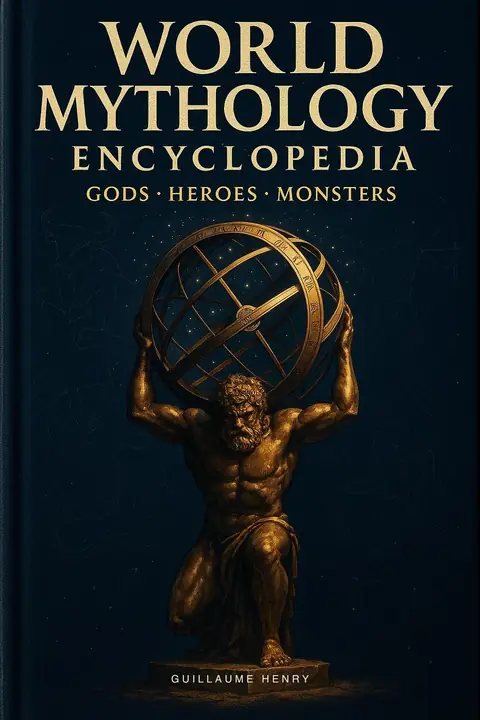
Mythology
The World Mythology Book: The Gods, Heroes and Myths of Every Culture
The Gods, Heroes and Myths of Every Culture, in One Volume
The whole of world mythology in a single volume: Greek, Norse, Egyptian, Japanese, Hindu, Celtic, Slavic, Mesoamerican and African myths gathered side by side, each drawn from the primary sources.