
Tanuki: The Shapeshifting Raccoon Dog of Japanese Myth and Folklore
Meet the tanuki, Japan's mischievous shapeshifter who blurs the line between myth, folklore, and modern pop culture. Respected as a kami in shrines yet feared as a trickster, this raccoon dog has captivated storytellers for over a thousand years.
Contents
The tanuki appears on a moonlit mountain road in ancient Japan, belly rounded and laugh echoing off the trees. A farmer sees what looks like an old woman crossing the path, but then recognizes the glint in her eyes. The shape dissolves. Only a low-slung creature with a striped tail remains, chittering as she vanishes into the forest. This moment, repeated across a thousand folktales, captures the essence of the tanuki: trickster, transformer, sacred spirit all at once.
The tanuki the shapeshifting raccoon dog occupies one of Japan's most liminal spaces in the supernatural world. It is simultaneously an everyday animal (the common raccoon dog, Nyctereutes procyonoides, found across East Asia), a respected kami or Shinto spirit worthy of shrine worship, and one of Japan's most beloved yokai: a class of supernatural beings that blur the boundary between human and animal, sacred and mischievous. Few creatures in world mythology straddle such contradictory roles so naturally, or with such persistent charm across centuries.
Unlike the kitsune (the nine-tailed fox, another famous Japanese shapeshifter), the tanuki is rarely portrayed as purely malevolent. Its deceptions tend toward the playful, the comic, the gently chaotic. A tanuki might trick a traveler into drinking urine thinking it wine, steal a merchant's goods only to return them later, or seduce a man through disguise. Yet these same creatures are honored in shrines across Japan, petted in gardens as statues called tanuki-zuka, and believed to bring good fortune to shops and homes. This duality, between reverence and roguery, makes the tanuki one of the most complex supernatural figures in Japanese religious practice and folklore.
The Tanuki in Ancient Japanese Scripture and Early Shinto
The earliest written records of tanuki appear in Buddhist and Shinto texts compiled during Japan's classical period, though oral traditions certainly predate them by centuries. The Kojiki, Japan's oldest historical chronicle compiled in 712 CE, does not mention the tanuki by name, but references to shape-changing animals of all kinds appear scattered throughout accounts of kami interactions with the human realm. The more comprehensive Nihon Shoki, completed in 720 CE, similarly treats the tanuki as an acknowledged presence in the supernatural landscape without dramatic origin narratives.
What emerges instead is a gradual, almost matter-of-fact acceptance: the tanuki simply exists as one class of being among many in Japan's densely populated spirit world. The earliest explicit tanuki stories appear in medieval Buddhist texts, particularly collections of folk legends compiled by monks seeking to illustrate Buddhist principles through local Japanese tales. A good example is the Konjaku Monogatarish'u (Tales of Now and Then), a massive collection of Indian, Chinese, and Japanese stories compiled around the 12th century. Here, tanuki appear as agents of karma, mischief-makers whose tricks often carry moral weight or teach humans valuable lessons.
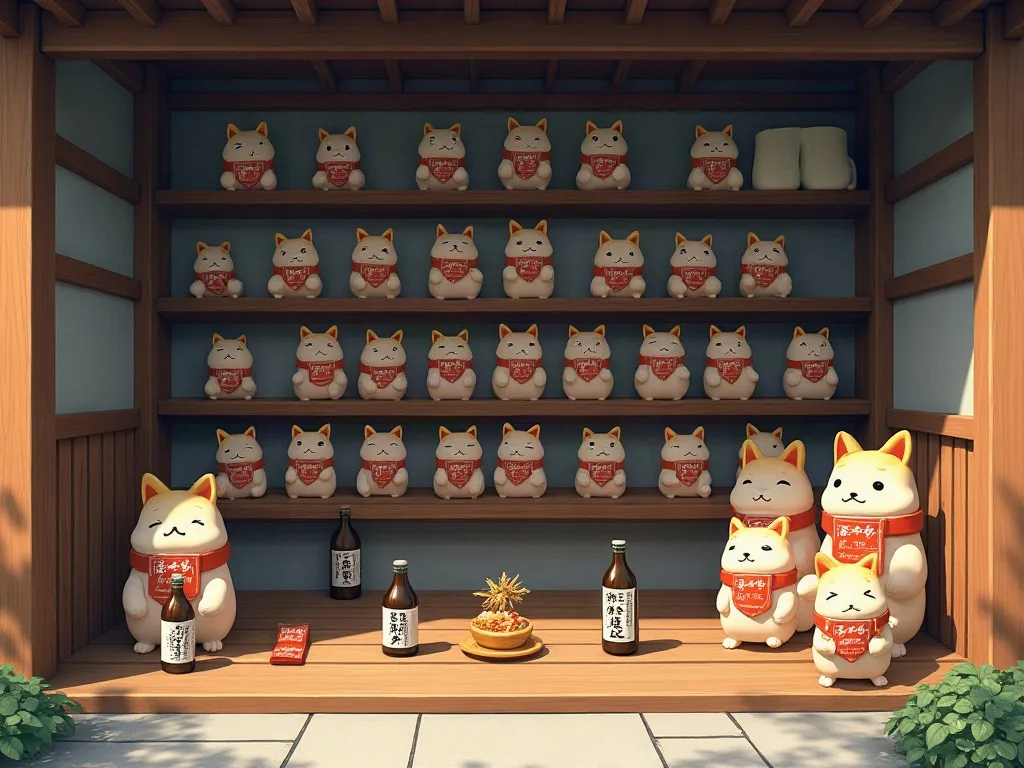
One foundational shift occurred when Shinto practice began to formalize the tanuki's place in the sacred landscape. Rather than treating tanuki purely as tricksters, rural shrine keepers began to install inari-zuka (shrine markers) dedicated to tanuki spirits, recognizing that certain powerful individual tanuki could bless or curse a location. This reflected a broader Shinto principle: that any powerful, long-lived animal could accumulate enough spiritual force to warrant reverence and offerings. The tanuki's longevity, intelligence, and territorial attachment made it a natural candidate for this elevation.
By the Edo period (1603-1868), when Japanese folklore entered a golden age of documentation and artistic expression, the tanuki had fully integrated into both high and low religious culture. Shrines dedicated to tanuki kami operated alongside those for fox spirits, and merchants began commissioning tanuki netsuke (small carved toggles worn on the waist) as talismans of prosperity. The creature had moved from being simply a wild animal that sometimes caused trouble to being a recognized spiritual entity worthy of respect, fear, and negotiation.
Shapeshifting: Method, Motive, and Mythology
The tanuki's power to change form is central to its identity, yet Japanese sources treat it with fascinating specificity. Unlike Western shapeshifters who may transform instantly and completely, the tanuki in folklore typically requires effort, preparation, and focus. The creature must study its target carefully, observing not just physical appearance but mannerisms, voice, and bearing. A tanuki might spend weeks watching a woman at a well before attempting to impersonate her convincingly. This labor-intensive approach makes tanuki transformations feel distinctly earned, almost sympathetic.
The psychological mechanics fascinate Japanese storytellers. A tanuki attempting to pass as human must not only look the part but sustain the illusion through conversation and action. This is where tanuki tales often turn comedic: the disguise breaks down in small ways. The creature forgets the human need to sit, standing for hours instead. It reacts to a dog's bark with an animal's fear rather than human curiosity. In one classic tale, a tanuki disguised as a beautiful woman is discovered when, during a feast, it cannot resist eating a fish whole, bones and all, rather than picking it apart as a refined human would.
These failures matter morally and narratively. They suggest that beneath every successful illusion lies an animal nature that cannot be fully suppressed, no matter how intelligent the tanuki. This echoes a deeper Japanese philosophical point: that transformation is always incomplete, that identity has layers that cannot be entirely discarded. The tanuki's inability to perfectly pass as human, no matter how hard it tries, becomes a kind of tragic flaw, but one played for comedy rather than pathos.
The motives for shapeshifting vary widely. Hunger drives many tanuki transformations: a creature disguises itself to gain access to food, often with comic results when its disguise leads it into situations where food appears but proves inedible or trapped. Loneliness appears in other tales: a tanuki takes human form to spend time with a village, to experience human society, to court a lover. Revenge or defense occasionally emerges; a tanuki wounded by hunters might disguise itself to gain proximity to its attackers. But most commonly, tanuki shapeshift simply because they can, because the act itself brings joy and mischief. The bakemono transformation is play, sport, the expression of an intelligence that cannot be contained within a single form.
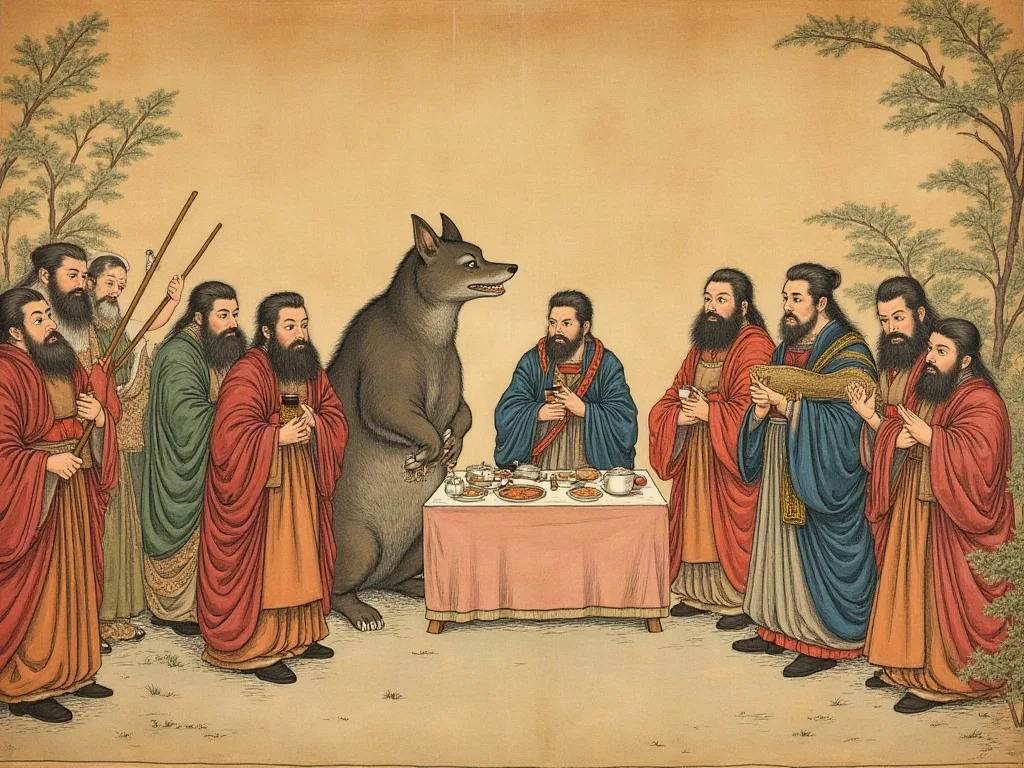
One famous cycle of tanuki tales involves creatures disguising themselves as Buddhist monks. A tanuki in monk's robes can move freely through villages, accept alms, and speak with authority about dharma. The irony is sharp: these creatures, which embody animal desire and trickery, masquerade as renunciates vowed to transcend such impulses. Some tales suggest the tanuki genuinely believes in the teachings it recites while disguised, creating a strange spiritual confusion. Is the tanuki's preaching false if it feels sincere in the moment of speaking?
The Tanuki and the Kitsune: Parallels and Distinctions
Japan's two greatest shapeshifters, the tanuki and the kitsune, are often conflated in Western understanding. Both are intelligent animals with long lifespans, both can transform into human form, both have become integrated into Shinto practice. Yet Japanese folklore maintains sharp distinctions between them, and these differences reveal much about how Japanese culture conceptualizes trickery, spirituality, and animal nature.
Tanuki
Tanuki characteristics:
- Earthier, more grounded; associated with forests and hills rather than spiritual mountains
- Typically morally neutral; mischievous rather than malevolent
- Less ambitious; rarely seeks to dominate or seduce permanently
- Humor-driven; tanuki tales often end in laughter rather than harm
- Transform with visible effort and occasional failure
- Prefer to remain close to their home territories
- Associated with merchants, fortune, and prosperity in urban worship
Kitsune
Kitsune characteristics:
- More ethereal, mystical; associated with sacred mountains and spiritual sites
- Often morally ambiguous or actively malevolent; seduction carries real danger
- May pursue long-term schemes of revenge, influence, or domination
- Tragedy-driven; kitsune tales frequently end in death or sorrow
- Transform flawlessly and can maintain illusions indefinitely
- Tend toward isolation or movement between worlds
- Associated with shrines, spiritual power, and divine intermediation
The earliest Japanese sources, particularly medieval Buddhist texts, made these distinctions clear through narrative pattern. A tanuki's deception causes embarrassment or minor harm; a kitsune's deception causes genuine suffering. A tanuki might trick a man into embracing a log thinking it a woman; he recovers and the tale becomes a joke told in taverns. A kitsune might seduce a man into marriage, drain his life force, and vanish, leaving him a hollow shell. The tanuki operates in the register of satire; the kitsune, in the register of tragedy.
This distinction reflects different spiritual positions. The kitsune is believed to pursue enlightenment through its own practices; its shapeshifting is a discipline, a technique of spiritual advancement. The tanuki shapeshifts from hunger, curiosity, or whimsy. It is not seeking transcendence but rather the pleasures and freedoms that human form (momentarily) allows. Where kitsune tales often culminate in the creature's ascension to divine status or its vanquishment by a holy man, tanuki tales most often end with the creature's return to its animal form, sated and grinning.
Yet this hierarchy works both ways. Because the kitsune is so powerful and its intentions so potentially dangerous, it requires constant surveillance and propitiation. The tanuki, less threatening, becomes more accessible and more beloved. Tanuki statues crowd gardens and shops; kitsune statues guard shrines with solemn intensity. The friendly tanuki of modern Japanese popular culture, the figure that inspired the Studio Ghibli film "Pom Poko," descends directly from this medieval understanding: the tanuki as a creature of appetite and humor rather than cosmic ambition.
The Medieval Tanuki: Tales of Mischief and Moral Instruction
During Japan's medieval period, roughly from the 12th through the 16th centuries, tanuki folklore entered its classical phase. Monks wrote down stories, artists drew emakimono (illustrated scrolls) featuring tanuki adventures, and the creatures became fixed characters in the oral tradition. One collection stands out: the Tanuki Kaidanshu, a cycle of tanuki stories preserved in various forms and retold countless times. These tales establish patterns and themes that persist to the present day.
A recurring motif involves the tanuki's belly, or kitsune-no-kitsunewaka. In some traditions, the tanuki's stomach is said to be peculiarly vulnerable or peculiarly powerful, the seat of its shapeshifting ability. Stories describe travelers being tricked into striking or kicking a tanuki's belly, with the disguise instantly collapsing. Other tales suggest the tanuki can store immense quantities of food in its belly without it showing, a practical advantage when transforming into human form. This image, both comic and slightly grotesque, has persisted into modern representations.
One famous medieval tale, repeated in various collections, involves a tanuki disguised as a beautiful woman who tricks an old monk into sheltering her. Over several nights, the monk begins to suspect her true nature. He arranges for hunters to visit; when they arrive, the tanuki flees, revealing its true form as it runs. The monk is left uncertain whether he encountered a genuine supernatural spirit or simply his own imagination and desire. The tale's ambiguity is the point: how does one truly know the difference between illusion and reality? Has the tanuki actually transformed, or has the monk's longing created the woman in his mind?
Another cycle of medieval tales presents the tanuki as a merchant or vendor. Disguised as a human, it sells goods in a marketplace, often with surprising success. The goods themselves are sometimes revealed to be magical or worthless, depending on the tale's moral. In one version, a tanuki sells rice that tastes wonderful but turns to leaves in the buyer's stomach days later. In another, it sells firewood that burns impossibly hot and long, blessing the household that receives it. These tales often carry embedded lessons about the nature of value, desire, and transaction. What seems too good to be true, in a tanuki's trade, always is.
Buddhist monks who recorded these tales often framed them as illustrations of karma. A man who cheats a tanuki will himself be cheated by another tanuki. A person who shows compassion to a tanuki will receive unexpected kindness. The tanuki becomes a cosmic trickster figure, an agent through which moral law operates in the physical world. This frame allowed Buddhist teachers to integrate folk belief into their doctrine: the tanuki is not a supernatural anomaly but rather a natural part of the karmic system that governs all existence.
From Edo-Period Entertainment to Modern Reverence
The Edo period (1603-1868) saw a flourishing of Japanese urban culture, literacy, and artistic production. Tanuki, once creatures of rural folklore, became stars of popular entertainment. Woodblock prints featured them in increasingly comic situations. Kabuki plays included tanuki characters. Most significantly, the tanuki zukiai (tanuki sitting together), a humorous poem form, became wildly popular. These satirical verses imagined tanuki gathering to gossip, argue, and plot, using the creatures as masks through which to critique human society.
The most famous artifact of this period is the Tanuki Jinmon, a long comic narrative scroll that presents tanuki as a complete parallel society, with politics, hierarchies, and internal disputes. The work, created in the 18th century, uses tanuki to satirize contemporary Japanese politics and human folly. It's simultaneously affectionate and cutting: the tanuki are portrayed as ridiculous, yes, but also as fundamentally human in their desires and failings.
This period also saw the formalization of tanuki worship. The inari shrines, originally dedicated to rice agriculture spirits, increasingly incorporated tanuki kami. Some regions developed specific tanuki shrine practices: visitors would leave offerings of rice wine, miso, or bean cakes, seeking the tanuki's blessing for business or domestic prosperity. A tanuki kami, properly respected and fed, might bring customers to a shop or fertility to a household.
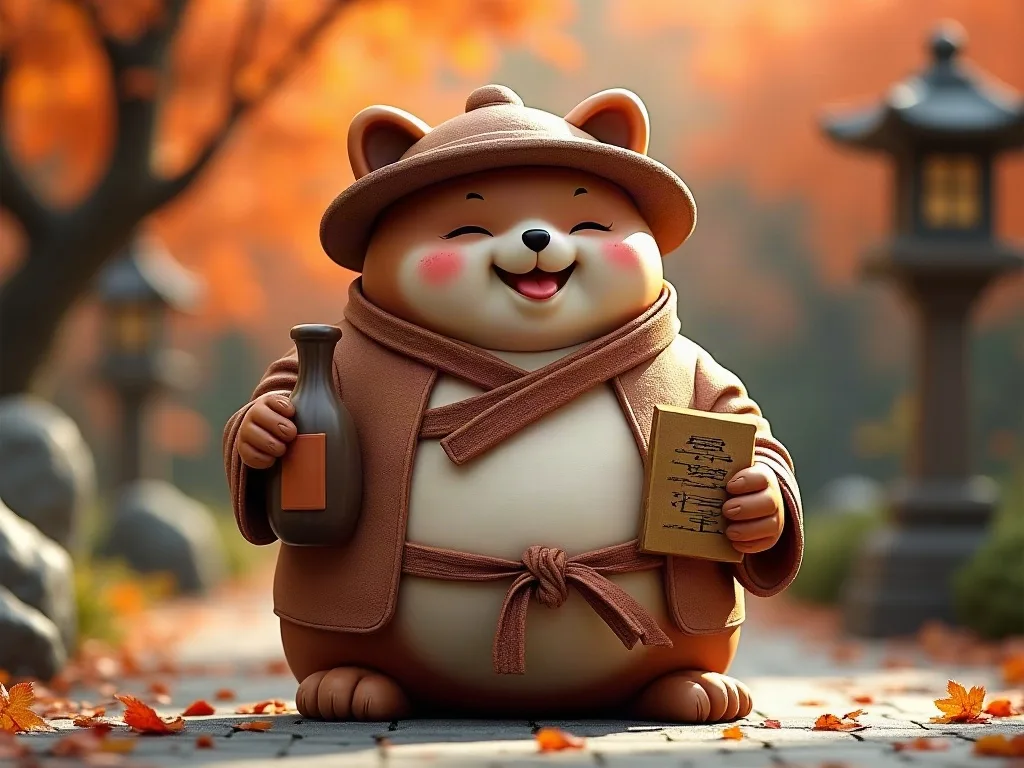
By the Edo period, the tanuki statue as we know it had emerged. The characteristic figure, called a tanuki-zuka in shrine contexts or simply a tanuki-doll in domestic settings, features a portly raccoon dog with a pleasant expression, often wearing a merchant's hat or holding a sake bottle and a ledger. The meaning of the items is layered: the sake bottle represents abundance and good cheer; the ledger represents honest commerce; the rotund belly suggests satisfaction and contentment. These statues, crafted by thousands of artisans, spread throughout Japan and eventually across the world, becoming the visual definition of the tanuki in global pop culture.
The Tanuki in Japanese Shrine Practice and Modern Spirituality
Unlike many figures in Japanese folklore, which have become purely literary or theatrical, the tanuki maintains an active presence in contemporary Shinto practice. Tanuki shrines operate across Japan, and the creature appears in the grounds of thousands of larger shrines as a protective or blessing figure. This continuation of practice, over more than a thousand years, distinguishes the tanuki from the purely mythological.
The theological position of the tanuki kami is interesting. Unlike Inari, the rice kami that achieved status as a major Shinto deity, or Amaterasu, the supreme kami of the Shinto pantheon, the tanuki generally occupies a localized, domestic position. A tanuki kami protects a specific village, a particular shop, or a neighborhood. Its power is real but limited in scope. This makes it feel more intimate, more accessible, than the vast impersonal kami of major shrines.
Modern Japanese religious practice treats the tanuki with genuine reverence while maintaining affectionate humor. A shopkeeper might place a tanuki statue in their doorway with sincere faith that it brings good business, while also enjoying the figure's comic appearance. A family might leave offerings at a local tanuki shrine without irony, understanding both that the tanuki is a real spirit worthy of respect and that it is fundamentally a creature of mischief and appetite. This duality is not seen as contradictory in Japanese spirituality; rather, it reflects an integrated worldview where the sacred and the playful, the animal and the spiritual, coexist naturally.
Contemporary tanuki shrines across Japan report steady visitation. Visitors leave written wishes (ema) requesting the tanuki's help with business ventures, romantic prospects, or health. Major tanuki shrines, such as the Fushimi Inari subsidiary shrines dedicated to tanuki kami, maintain active priesthoods and hold seasonal festivals. The creatures, nearly invisible in Western encounters with Japanese culture, remain woven into the daily spiritual lives of millions of Japanese people.
The Tanuki's Transformation into Global Pop Culture
The late 20th century saw the tanuki's greatest migration: from local Japanese folklore into global entertainment and visual culture. This movement was not natural or inevitable but rather the result of specific artistic choices by filmmakers, game designers, and storytellers who recognized the creature's power.
The most significant moment came in 1990 with Studio Ghibli's "Pom Poko," directed by Isao Takahata. The film reimagines a cycle of traditional tanuki folklore tales as an environmental allegory. Tanuki, facing habitat destruction from urban development, gather their magical powers to mount a coordinated shapeshifting campaign against the construction company threatening their forest. The film blends classical tanuki tales (the failed transformations, the belly-drum, the comic disguises) with pathos and genuine tragedy. It was a revelation to audiences who had never encountered the tanuki outside of anime or toy figures: the creature could be simultaneously funny and profound, comic and heartbreaking.
Earlier, the tanuki had appeared in the Super Mario Bros. video game franchise, where the "Tanooki Suit" allowed the player character Mario to grow a raccoon tail and fly. The name and design were explicitly drawn from Japanese folklore, though the gameplay mechanics had little to do with traditional tanuki mythology. Nonetheless, the image of a cute, round, furry creature with a striped tail became iconic globally through gaming culture.
In contemporary Japanese animation and manga, the tanuki has become a stock supernatural character: mischievous, often comic relief, sometimes serving as a guide or mentor figure. Tanuki appear in everything from mainstream anime to underground manga, usually with recognizable elements borrowed from classical folklore: the shapeshifting, the appetite, the moral ambiguity. Unlike the kitsune, which has maintained a more consistently serious, mysterious presence in modern Japanese media, the tanuki has embraced its comedic legacy.
This global dispersal has, paradoxically, reinforced the tanuki's position in contemporary Japanese culture. Young Japanese people encounter the tanuki first through anime or Ghibli films, then discover the classical folklore behind it. The creature's presence in global pop culture has given Japanese folklore itself new prestige and visibility.
The Tanuki's Belly and Other Symbolic Dimensions
Japanese folklore attaches particular symbolic weight to the tanuki's belly, or kitsune-no-kitsunewaka. This is partly anatomical: tanuki in the wild have rounded bodies and can store fat for winter. But in folklore, the belly becomes something more. It is the seat of appetite, the engine of the tanuki's desires and deceptions. Some tales suggest that a tanuki's shapeshifting power emanates from the belly, making it at once the creature's greatest strength and greatest vulnerability.
The visual prominence of the belly in tanuki statuary underscores this symbolism. The characteristic tanuki statue, with its rotund, prominent abdomen, makes the belly the figure's visual and compositional center. In some interpretations, the round belly represents the contained abundance of commerce: the tanuki who brings prosperity must have a belly filled with good fortune, which it then distributes. In others, the belly symbolizes base appetite and physicality: the tanuki's animal nature, which no amount of human disguise can fully overcome.
Tanuki are also frequently associated with drums, particularly in Edo-period folk poetry and visual arts. A tanuki's belly, when struck, supposedly produces a sound like a drum. This image appears in countless artworks, where tanuki are shown drumming on their own bellies, creating a percussive accompaniment to their own schemes and pleasures. The drum-belly image carries associations with festivity, celebration, and the rhythms of natural pleasure. It also reinforces the tanuki's connection to entertainment and performance: like a drummer, the tanuki creates an auditory spectacle, demands attention, and draws listeners in.
The tanuki's association with merchants and commerce is another key symbolic dimension. The merchant tanuki, disguised as a human vendor or shopkeeper, appears in countless tales and visual representations. This may reflect a historical reality: tanuki were common in markets and settlements, where food scraps and human activity concentrated. But it also suggests something deeper about the tanuki's place in human civilization. The tanuki is not purely wild; it operates in the liminal spaces between forest and village, between animal and human. It is drawn to human economic activity and both preys on it and participates in it. The tanuki as merchant embodies this perfect ambiguity: it wants what humans want (profit, status, goods), yet it cannot help revealing its animal nature, its appetite, its fundamental difference.
Frequently asked questions about Tanuki the shapeshifting raccoon dog
Frequently asked questions
Is a tanuki the same as a kitsune?
No, though both are intelligent Japanese shapeshifters. Kitsune are generally more powerful, more dangerous, and more spiritually ambitious; they pursue enlightenment and can cause lasting harm. Tanuki are earthier, more playful, and typically morally neutral. Tanuki tales end in laughter; kitsune tales often end in tragedy. Both have been integrated into Shinto practice, but the kitsune holds higher spiritual rank in most traditions.
What is the real animal the tanuki is based on?
The tanuki is based on the raccoon dog, Nyctereutes procyonoides, a canid native to East Asia. It's not a raccoon (which is North American) or a dog, but rather a member of the canine family with physical traits reminiscent of both. The real animal is smaller than a tanuki is portrayed in folklore and lacks any supernatural abilities, but its intelligence, nocturnal nature, and rounded body made it a natural subject for magical storytelling.
Why do tanuki statues have round bellies?
The round belly symbolizes appetite, abundance, and the tanuki's base animal nature that persists beneath its human disguises. In folklore, the belly is the seat of the tanuki's shapeshifting power. The belly also represents the fullness of commerce and prosperity; a tanuki that brings good fortune must be visibly well-fed and satisfied. The image is both comic and meaningful, embodying the tanuki's role as a creature of appetite who nonetheless brings blessing.
Are tanuki still worshipped in Japan today?
Yes, tanuki shrines and shrine spirits remain active throughout Japan. While the tanuki is no longer as central to Shinto theology as major kami, local tanuki spirits continue to receive offerings and prayers from visitors seeking business success, domestic blessing, and protection. The creature occupies a role between high religious theology and intimate household spirituality.
What did the tanuki represent in medieval Japanese Buddhism?
Buddhist monks recorded tanuki tales as illustrations of karma: the tanuki's deceptions teach moral lessons, and its eventual exposure or transformation serves as a teaching moment about the impermanence of illusion. The tanuki became a cosmic trickster figure through which moral law operates. Some tales suggest that the tanuki's shapeshifting itself is a kind of karmic consequence, a punishment or test for past actions.
The Tanuki in Unresolved Scholarly Debate: Folklore, Spirituality, and Historical Reality
Serious questions remain about the relationship between the tanuki as folklore figure and the tanuki as a localized kami genuinely believed in by Japanese communities. Did rural Japanese shrine keepers genuinely believe that specific tanuki spirits inhabited local areas, or were they codifying folklore into a convenient ritual framework? The historical record offers no definitive answer, and both possibilities may be simultaneously true.
Some scholars argue for a gradual naturalization of folklore: over centuries, repeated stories about tanuki deceptions and transformations sank so deeply into Japanese consciousness that people came to believe in the creatures' reality, even in regions where tanuki were rare or absent. Shrine keepers, recognizing a profitable and socially coherent practice, formalized this belief into ritual structures. In this reading, the tanuki kami is a cultural creation, a belief system rather than a report of genuine supernatural interaction.
Other scholars propose the reverse: that observed behaviors of real tanuki, combined with their intelligence and nocturnal activity, created a genuine gap in knowledge that folklore rushed to fill. Farmers and hunters encountered tanuki that seemed uncannily clever, that appeared and disappeared inexplicably, that seemed to mock human attempts at capture. Rather than creating folklore from nothing, Japanese communities were interpreting real animal behavior through the categories available to them, which included magical and spiritual explanations. In this reading, the tanuki kami is a reasonable hypothesis, given the evidence available to premodern Japanese observers.
The truth likely sits in both directions: folklore shapes belief, and genuine mystery of animal behavior feeds folklore. The tanuki's persistent presence in both contemporary ritual practice and contemporary storytelling suggests that whatever its historical origins, the figure now operates as a genuinely meaningful category in Japanese spirituality, whether or not we as external observers believe in its literal supernatural reality. This ambiguity itself may be the most Japanese aspect of the tanuki: a figure that exists comfortably between certainty and uncertainty, between the animal and the spiritual, between the historical and the timeless.
The tanuki's survival across more than a thousand years of Japanese history, from medieval monastery manuscripts to contemporary anime, testifies to its power as a cultural symbol. It represents something unchanging in the Japanese imagination: the intelligence of animals, the permeability of boundaries between human and nonhuman, the redemptive power of humor and appetite in a world that often demands their suppression. To encounter the tanuki is to encounter a part of Japan that remains fundamentally itself: reverent and irreverent at once, sacred and playful, wise and foolish in the same breath.
Free 25-page sample
Want the whole story?
Take the first 25 pages free. If it pulls you in, the full edition is yours as an instant PDF download, with a paperback on Amazon for selected titles.

Mythology
The World Mythology Book: The Gods, Heroes and Myths of Every Culture
The Gods, Heroes and Myths of Every Culture, in One Volume
The whole of world mythology in a single volume: Greek, Norse, Egyptian, Japanese, Hindu, Celtic, Slavic, Mesoamerican and African myths gathered side by side, each drawn from the primary sources.