
The Fates: The Moirai, Weavers of Destiny in Greek Mythology
The Moirai held every mortal and immortal life between their fingers. Here is what Greek mythology, Homer, and Hesiod actually say about the three Fates who spun, measured, and cut the thread of existence.
Contents
Clotho spins. She draws raw fiber from a distaff and twists it into thread with practiced, unhurried fingers. Beside her, Lachesis measures the length with a rod, deciding how much thread one life deserves. At the far end of the bench sits Atropos, the smallest and most terrible of the three. Her shears are already open. When she closes them, a life ends, and not even Zeus himself can demand she reopen them.
This is the image that lodged itself in Greek imagination for over a thousand years: three old women, spinning in a room no poet ever fully described, deciding the fates of gods and heroes alike. The Greeks called them the Moirai (Moirai, singular Moira), a word rooted in the verb meiromai, meaning "to receive one's portion." Every being received a portion. None escaped. That simple, brutal symmetry gave the Moirai a kind of authority no Olympian quite matched.
Who Were the Moirai: Names, Roles, and the Thread They Shared
The Fates the Moirai were three sisters, each governing a distinct phase of a human life.
- Clotho (Klotho, "the Spinner") drew the thread of life from her distaff and set its quality: coarse or fine, strong or brittle.
- Lachesis (Lakhesis, "the Allotter") measured the thread against her rod, fixing the span of each life. Her name echoes lanchano, to obtain by lot.
- Atropos (Atropos, "the Inflexible" or "She Who Cannot Be Turned") cut the thread. Her name gave English the word atropine, named after the belladonna plant once used to dilate eyes before surgery, itself named for its lethal potential.
Each name is a complete cosmological statement. Together, the three covered birth, the arc of living, and death, leaving no phase of existence outside their reach.

Two Genealogies, One Authority
Hesiod gives the Moirai two different parentages, and the tension between them matters. In the Theogony (around 700 BCE), he first presents them as daughters of Nyx (Night), born without a father alongside Nemesis, the Keres, and the other dark necessities of existence. Later in the same poem, he names them daughters of Zeus and Themis (Divine Law), sisters to the Horai (the Seasons) and the goddesses of order.
These two genealogies are not a scribal error. They reflect a genuine theological argument the Greeks lived with for centuries. If the Moirai were daughters of Nyx, they predated the Olympian order and answered to nothing. If they were daughters of Zeus and Themis, destiny was something the king of the gods had fathered and could, in principle, influence.
Homer sits on the side of ambiguity. In the Iliad, Zeus holds up his golden scales to weigh the fates of Achilles and Hector. He appears to be checking, not overriding, what the Moirai have decreed. When Zeus considers saving his son Sarpedon from death at Patroclus's hands, Hera sharply reminds him that Sarpedon is mortal, that his fate is already fixed, and that intervening would break a precedent every other god has accepted. Zeus weeps, lets Sarpedon die, and sends Sleep and Death to carry the body home to Lycia. The scene is one of the most emotionally precise in all of ancient literature: even paternal grief cannot bend the shears of Atropos.
The Moirai in Hesiod and Homer: Primary Sources Unpacked
Hesiod's Works and Days expands on the Moirai's function in everyday life. When a child is born, the Moirai attend and fix its moira, its portion. That portion includes the kind of life it will lead, the sufferings assigned to it, and the moment of death. A farmer praying for a good harvest, a soldier before battle, a mother in labor: all were understood to be in some partial relationship to this fixed allotment. You could pray to the Moirai to receive a generous portion, but you could not pray for no portion at all.
Homer uses moira and aisa (portion, fate) interchangeably throughout the Iliad and Odyssey, treating fate less as a trio of persons and more as a structural property of the cosmos. The Moirai as distinct named figures appear more explicitly in later poets. Pindar (5th century BCE) invokes Lachesis by name in several victory odes, treating her as a divine presence who oversees athletic achievement. The tragedians Aeschylus, Sophocles, and Euripides engage repeatedly with the question of whether a hero can outpace his moira, and repeatedly the answer is no. Oedipus runs from Corinth toward Thebes and runs directly into the fate he was fleeing.
The Homeric Hymns and the Orphic Hymns both contain invocations to the Moirai, describing them as carrying "the unbreakable threads of the gods" and ruling "mortal men and immortal gods alike." The Orphic Hymn to the Moirai asks them for a gentle portion, for old age rather than violent death, for a life long enough to be worth living.

Family Tree: How the Moirai Fit the Greek Cosmos
The Moirai's position within the Greek family of divine powers depends on which genealogy you accept, but either way they occupy a node of exceptional authority.
| Genealogy | Parents | Siblings | Relationship to Olympus |
|---|---|---|---|
| Theogony (1st account) | Nyx (Night), no father | Nemesis, the Keres, Thanatos, Hypnos | Pre-Olympian, independent |
| Theogony (2nd account) | Zeus + Themis | Horai (Eunomia, Dike, Eirene), Tyche | Olympian offspring, tied to justice |
| Pindar's account | Zeus + Themis | Horai | Active within the cosmic order Zeus maintains |
Themis as mother is significant. Themis personifies divine law, the structure that holds the cosmos together. If the Moirai are her children, then fate is not chaos but law made temporal: the proper unfolding of what must be. Alongside Nemesis, goddess of righteous retribution, Themis and her daughters form the ethical backbone of the Greek universe.
The Moirai also intersected with Tyche (Fortune), sometimes listed as a sister, sometimes as a rival principle. Tyche governed chance within a life; the Moirai governed its outer limits. A lucky man could still be cut short by Atropos. An unlucky man could live the full span Lachesis measured and simply suffer it.
Symbols, Attributes, and Iconography of the Three Fates
Ancient Greek visual art and literary description assigned the Moirai a consistent set of symbols that reinforced their cosmic function.
- The spindle and distaff: Clotho's instrument, linking fate to the domestic craft most familiar to Greek women. The spin of the spindle mirrored the spin of the celestial spheres. Plato, in the Republic (Book X), depicts the Moirai sitting on thrones around the Spindle of Necessity, each turning a whorl that keeps the heavens rotating.
- The measuring rod: Lachesis's attribute, sometimes depicted as a staff or a scroll on which the lifespan is written.
- The shears or scissors: Atropos's instrument. In some depictions she holds a scroll or a sundial, measuring time against its allotted end.
- White robes and garlands: the Moirai were occasionally shown in festival dress, underscoring that fate was not merely grim, it was the order that made celebration possible.
- Stars and the night sky: in the Orphic tradition, the Moirai had celestial associations. The stars were sometimes understood as the fixed threads they had laid out.
Plato's Republic contains the most elaborate cosmological treatment of the Moirai outside of Hesiod. In the Myth of Er, a soldier named Er dies in battle, travels to the afterlife, and witnesses souls choosing their next lives. The Moirai preside over this process. Lachesis speaks first, telling the assembled souls that virtue is not assigned; it is chosen. Clotho then ratifies each choice by spinning it into the thread. Atropos makes it irrevocable. The myth is striking because it introduces the concept of chosen fate: the Moirai enforce the soul's own decision, making them judges of self-determination as much as impersonal forces of necessity.
The Moirai Versus the Gods: Could Zeus Override Fate?
This question preoccupied Greek religious thought from Homer onward. Several passages suggest different answers.
In Iliad Book XVI, Zeus "weighs the fates" on his golden scales, a gesture that looks like agency: he appears to be determining which fate will prevail. But other readers, ancient and modern, interpret the scales as a form of divination: Zeus consults fate, he does not set it.
Aeschylus, in the Prometheus Bound, gives the question sharper theological edges. Prometheus claims to know the secret that will eventually topple Zeus, and that knowledge is tied to fate itself. The chained Titan presents himself as knowing the Moirai's decrees better than Zeus does. Whether this is boast or truth, the play dramatizes the anxiety that even the king of the gods moves within a frame he did not build.
The Stoic philosophers, writing centuries after Hesiod, resolved the tension philosophically. For the Stoics, Zeus was fate: the rational principle (logos) that structured the universe was identical to divine providence. The Moirai, on this reading, were not separate from Zeus but expressions of the rational order he embodied. This is a significant reinterpretation, shifting the Moirai from autonomous powers into something closer to divine instruments.
Daughters of Nyx
Pre-Olympian Moirai. Born from Night before the gods took power. Independent of Zeus. Their decrees are older than Olympus and cannot be revoked or altered by any divine will. This version supports tragic inevitability: no prayer changes the thread, no god intervenes.
Daughters of Zeus and Themis
Olympian Moirai. Born of divine law (Themis) and sovereign will (Zeus). Fate is the expression of cosmic justice, not blind necessity. This version allows for a theology in which right action aligns with one's portion, and the Moirai enforce what is proper rather than simply what is random.
Cross-Cultural Parallels: The Thread Runs Everywhere
The Fates the Moirai did not emerge in a vacuum. Their closest structural kin appear across the full Indo-European spectrum.
The Norse Norns spin, measure, and cut at the roots of Yggdrasil, the world tree. Urd ("What Was"), Verdandi ("What Is"), and Skuld ("What Shall Be") govern time as much as fate. They carve runes into the trunk of the world tree rather than spinning thread, but the tripartite structure and the inevitability of their decrees match the Moirai precisely. Both traditions share a proto-Indo-European ancestor, and comparative linguists have traced the "three fate-women" archetype back at least 4,000 years.
The Roman Parcae, also called Fatae, were a direct Latin translation: Nona (who spun on the ninth month of pregnancy), Decuma (who measured), and Morta (who cut). Roman poets, especially Ovid and Virgil, used them interchangeably with the Greek Moirai. Virgil's Aeneid has the Parcae guarantee the founding of Rome, threading destiny into nationhood.
The Vedic tradition does not have three fate-women in the same form, but the concept of Ṛita (cosmic order, truth, right) and its later elaboration as Dharma perform a similar function: the structuring of the cosmos according to principles no god can simply override. The Vedic pantheon operates within Ṛita much as the Olympians operate within the Moirai's decrees.
The Baltic Laima, a goddess of fate in Lithuanian and Latvian folk religion, appears as a cuckoo whose calls count out the years of a person's life. She operates alone rather than in a triad, but shares the Moirai's characteristic of fixing fate at birth and resisting human petition.
The Celtic world contributed the Irish three sisters of fate who appear at births in certain mythological narratives, and the Slavic Rozhanitsy (birth-fate women) who visit newborns and assign their destinies. The thread-spinning metaphor appears with particular consistency across these traditions, suggesting it is not a borrowing but a convergent development from shared cosmological intuitions about time, craft, and necessity.

The Moirai in Greek Tragedy and Later Antiquity
If Homer gives the Moirai their authority, it is the tragic poets who give them their emotional charge.
Sophocles builds Oedipus Rex entirely around the gap between human knowledge and the Moirai's certainty. Oedipus is told his fate by the Delphic Oracle, which was understood to be channeling the Moirai's knowledge. He attempts to evade it. Every evasive action tightens the noose. The play does not argue that trying to evade fate is wicked; it argues that the attempt is simply impossible. Fate is structural, not punitive.
Euripides is more skeptical. Several of his characters challenge the justice of fixed fate. In Alcestis, Admetus has been granted an extension of his life if someone will die in his place; his wife Alcestis volunteers. Heracles ultimately wrestles Death (Thanatos) to retrieve her. The myth raises the sharpest possible question: if fate can be negotiated, what is it? Euripides does not answer cleanly, and that ambiguity is part of the play's power.
Pindar invokes Lachesis in his victory odes as a divine patron of athletic excellence. For Pindar, a great athletic victory is not won against fate; it is the realization of the moira the athlete was given. The champion has fulfilled his thread, not broken it.
By the Hellenistic period (roughly 323-31 BCE), philosophical schools had absorbed the Moirai into systematic thought. The Stoics equated them with heimarmene (cosmic fate), a rational chain of causation running through all events. The Epicureans rejected determinism and assigned more weight to random atomic swerve, making them implicit opponents of the Moirai's absolute authority. The Neoplatonists of late antiquity, especially Plotinus and Proclus, integrated the Moirai into elaborate hierarchies of divine emanation, treating them as instruments of the One's unfolding.
The Moirai's Cult: Shrines, Rituals, and Offerings
The Moirai received active religious worship in ancient Greece, not merely literary treatment.
At Sicyon, a small city in the northeastern Peloponnese, Pausanias (the 2nd-century CE travel writer) records a sanctuary where the Moirai were worshipped alongside Zeus Moiragetes ("Zeus, Leader of the Fates"), a cult title that neatly embodies the theological tension between divine will and necessity. At Delphi, the Moirai shared a sanctuary with Zeus and Athena, and were given preliminary honors before major oracular consultations.
At Sparta, the Moirai were worshipped near the tomb of Orestes, reflecting the belief that fate and heroic death were bound together. The Athenians included the Moirai in the genealogy of Aphrodite in some cult traditions, connecting fate to love's compulsions.
Offerings to the Moirai tended toward the solemn: libations of water or honey rather than wine (wine was for joyful Olympian worship), garlands of white wool, and sometimes bloodless sacrifices. The avoidance of blood reflects the Moirai's position outside ordinary Olympian categories. They were not exactly chthonic (underworld) deities, but they were not purely celestial either. They occupied the space between, which is exactly the position of fate itself.
How Modern Culture Remade the Three Fates
The Moirai never really left. They migrated into visual art, literature, and eventually into 20th and 21st century popular culture with their core image intact: three women, a thread, an irreversible cut.
Shakespeare's Weird Sisters in Macbeth (1606) are partly descended from the Moirai by way of the Norse Norns and British folklore. Their prophecies, like the Moirai's decrees, are true but not transparent; Macbeth hears what he wants to hear and walks into his fate thinking he is evading it. The structural logic is Sophoclean.
The Pre-Raphaelite painters, particularly John Melhuish Strudwick (1885, "The Golden Thread") and Gustave Moreau, returned to the Moirai as subjects of intense aesthetic interest. Moreau's treatments made them dreamlike and threatening, while the Pre-Raphaelite tradition emphasized the domestic and the melancholy: old women bent over thread in lamplight.
In Disney's Hercules (1997), the Fates appear as a single three-bodied creature sharing one eye, played broadly for comedy. The shared-eye detail comes from a confusion with the Graeae, three sisters in Greek myth who shared a single eye and a single tooth, and who appear in the Perseus myth. The Moirai and the Graeae are distinct figures; the conflation is a pop-culture error, but a persistent one.
Rick Riordan's Percy Jackson series brings the Moirai into young adult fiction as Mrs. Dodds and related figures, keeping the sense of implacable authority while making it accessible to teenage readers. The broader cultural pattern is consistent: whenever storytellers want a force that outranks conventional divine power, they reach for three women with a thread.
The metaphor's staying power has something to do with its honesty. The thread is visual, tactile, and mortal. Everyone who has ever held thread knows it can be cut. The Moirai took that knowledge and built a cosmology around it.
Frequently Asked Questions about the Fates the Moirai
Frequently asked questions
Did the Moirai have power over the gods as well as mortals?
Most Greek sources affirm that the Moirai's authority extended to the gods. Hesiod's Theogony calls them dispensers of good and evil to both mortals and immortals. The Orphic Hymn to the Moirai explicitly states they rule over gods and men alike. Zeus, in the Iliad, appears to operate within their framework even when he considers overriding it. The one consistent exception in some late traditions is Zeus himself, who as father of the Olympian Moirai might stand above them, though even there Homer treats his power as consultative rather than sovereign over fate.
What is the difference between the Moirai and the Erinyes?
The Moirai (Fates) and the Erinyes (Furies) are distinct but allied powers. The Moirai fix the allotted course of a life; the Erinyes enforce the consequences when that course is violated, particularly through crimes of blood such as killing a family member. If someone died before their thread was fully measured, the Erinyes could pursue the murderer. In Aeschylus's Oresteia, the Erinyes act as avengers of Clytemnestra after Orestes kills her; they operate within the moral framework the Moirai have established.
Why did Greeks sometimes pray to the Moirai if fate could not be changed?
Greek religion was not strictly determinist in practice. Praying to the Moirai was a way of asking for a generous portion, not for fate to be annulled. You could not ask Lachesis to measure more thread than was ever intended, but you could ask for the portion you were given to contain more ease and less suffering. The Orphic Hymn to the Moirai requests a "gentle fate" and a long old age rather than violent death. There was also a hope that right ritual action placed you in a favorable relationship to the cosmic order the Moirai embodied.
Are the Moirai the same as the Roman Parcae?
Functionally, yes. The Parcae were the Roman equivalent of the Moirai, absorbed into Roman religion after the deep cultural contact of the 3rd and 2nd centuries BCE. Their names (Nona, Decuma, Morta) reflect Roman calendar and birth customs: Nona referenced the ninth month of pregnancy, Decuma the tenth. Ovid and Virgil used Parcae in contexts where a Greek poet would have used Moirai. There were minor differences in emphasis, particularly the Roman association of Nona and Decuma with pregnancy stages, but the core theology of spinning, measuring, and cutting is identical.
What is the 'Spindle of Necessity' in Plato's Republic?
In the Myth of Er (Book X of Plato's Republic), the Spindle of Necessity is a cosmic mechanism around which the heavenly spheres rotate. The Moirai sit on thrones arrayed around it. Lachesis sings of the past, Clotho of the present, and Atropos of the future. Each turns a whorl of the spindle, keeping the celestial order in motion. Plato uses the Moirai here to link personal fate with cosmic structure: the same principle that fixes a human life also keeps the stars on their paths.
Is Moira a single goddess as well as a trio?
Yes. Moira as a singular concept, a divine personification of one's allotted portion, appears throughout the Iliad and Odyssey as a kind of impersonal force. The tripartite Moirai developed as mythology became more elaborate and narrative, perhaps because splitting the single concept of fate into birth-life-death stages made it easier to dramatize. Both usages coexisted without theological contradiction: the Greeks were comfortable with the divine appearing in both singular and plural form, as they also did with the Erinyes (collective) and individual Furies.
The Unresolved Question: Did the Greeks Believe in Free Will?
The Moirai pose this question directly, and ancient Greeks argued over it as intensely as modern philosophers. The tragic poets suggest that character is destiny: Oedipus's relentless need to know the truth is itself the vehicle of his ruin. The Stoics said all apparent freedom was actually the willing acceptance of a rationally ordered fate. The Epicureans introduced atomic swerve as a physical mechanism for genuine randomness, and by extension, genuine choice.
Plato's Myth of Er offers the most nuanced position: souls choose their lives before birth, and the Moirai enforce those choices. The hero Odysseus, at the end of the myth, chooses the quietest life available, the life of an ordinary man with no great deeds. Having suffered everything heroism demanded, he wants nothing more than to be ordinary. The Moirai spin that thread, measure it, and cut it in due time. The choice was his. The enforcement was theirs.
This is not quite free will in the modern philosophical sense. It is something more unsettling: the idea that what you are inclined to choose is already a property of what you are, and what you are was shaped before you arrived. The Moirai did not prevent self-determination. They simply revealed that self-determination runs deeper than any single lifetime.
For Greek figures bound by similar cosmic contracts, from Prometheus chained by necessity to Persephone divided between worlds, the Moirai's thread is always present, sometimes visible, always binding. Understanding the Moirai is understanding why the Greeks built tragedy as a form, and why they built it so well.
Read the full book
Want the whole story?
The complete edition is an instant PDF download here, with a paperback on Amazon for selected titles.
Mythology
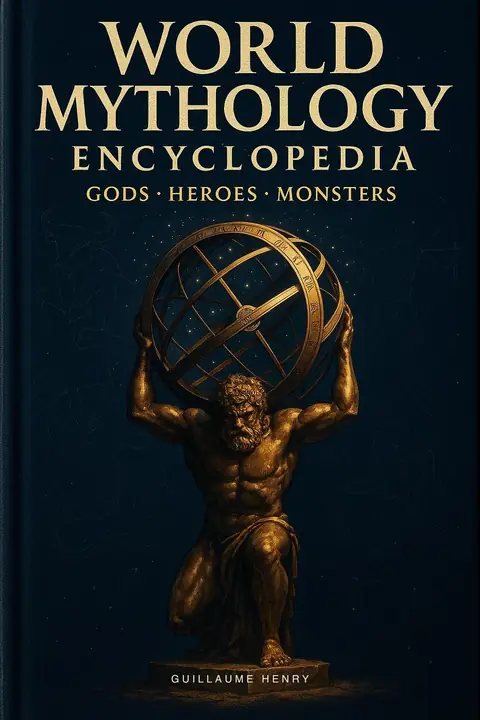
The World Mythology Book: The Gods, Heroes and Myths of Every Culture
The Gods, Heroes and Myths of Every Culture, in One Volume
The whole of world mythology in a single volume: Greek, Norse, Egyptian, Japanese, Hindu, Celtic, Slavic, Mesoamerican and African myths gathered side by side, each drawn from the primary sources.