
Thor's Fishing Trip for Jormungandr: The Myth of the World Serpent
Thor the thunder god sets out to fish for Jormungandr, the cosmic serpent destined to end the world. Discover how this ancient Norse story reveals the gods' defiance of fate, the price of heroism, and the boundaries between mortality and the divine.
Contents
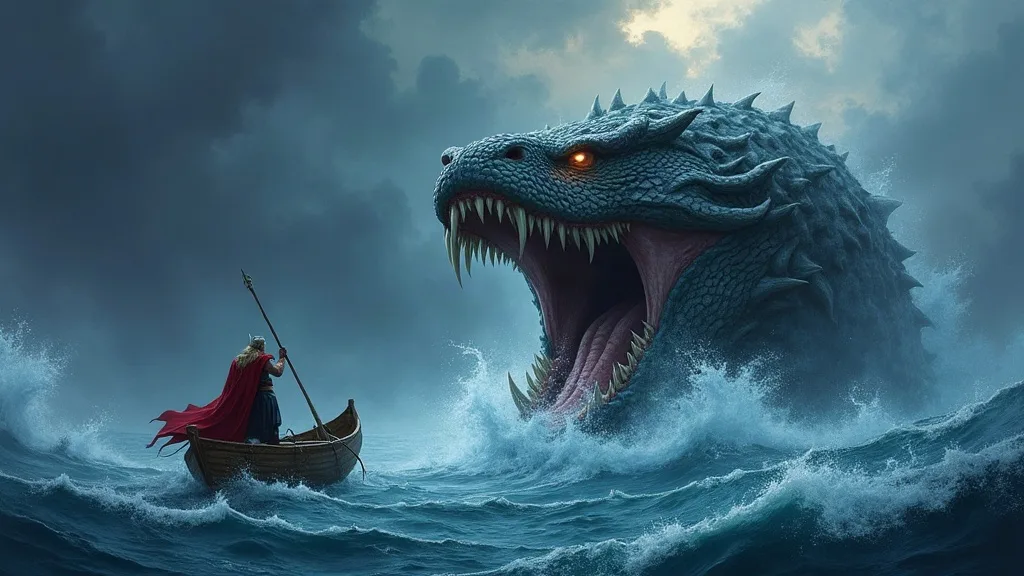
The giant's head rolls down the mountainside like a boulder, and Thor stands at the edge of a cliff with a fishing line in his hands. The sea churns below. He has just cut the head from the ox, knotted a rope around its skull, and cast it far into the waters. He is not hunting for food. Thor is fishing for Jormungandr, the world serpent, the creature so vast that it circles the entire earth with its tail in its mouth.
This is one of the oldest and most audacious scenes in Norse mythology. Thor knows what waits below the waves. He has encountered Jormungandr before, and he will meet it again at Ragnarok, the end of all things. Yet he chooses to fish for it anyway. Not out of conquest. Not out of necessity. Out of something far more complex: the Norse hero's refusal to accept a fate written in stone.
The story survives in two texts written down in Iceland in the 13th century, centuries after the Viking age had ended, by scribes who preserved the oral traditions of their ancestors. In the Prose Edda, a handbook of Norse mythology compiled by Snorri Sturluson around 1220, the tale appears with vivid detail. In the Poetic Edda, an older collection of verse poems whose exact date remains debated, fragments of the same myth emerge from the cryptic language of skaldic poetry. What these texts give us is not a single "correct" version, but a living myth that Norse poets shaped and reshaped to suit their art.
The Setup: Thor's Hubris and the Serpent's Hunger
Snorri tells us that Thor travels in a boat with a giant named Hymir, whose name means "the one with the swirling sea." Hymir is no friend to the gods; giants stand opposed to them in Norse cosmology, locked in an eternal struggle that will culminate at the world's end. Yet Thor and Hymir go fishing together. This is the Norse world in miniature: enemies sharing a boat, bound by ancient custom and the rules of hospitality that even gods and giants respect.
Hymir has warned Thor not to venture far north in the boat. But Thor the thunder god ignores the warning. He rows deeper into the sea, farther than mortals or even wise giants dare travel. The boat cuts through waters that few have seen. Thor is looking for something specific. He wants to find Jormungandr.
Jormungandr, also called the Midgard Serpent, is one of the three monstrous children born to Loki, the trickster god, and the giantess Angrboda. The other two are Fenrir, a wolf so vast it will swallow the sun at Ragnarok, and Hel, goddess of the dead, whose body is half-living flesh and half-corpse. When the Aesir gods discovered these three were born in Jotunheim, the realm of giants, they seized them in fear. They cast Jormungandr into the ocean that circles Midgard, the world of humans. The serpent grew so large in the waters that it encircled the entire earth, holding its own tail in its mouth. It became part of the structure of the cosmos itself, as fundamental as the roots of Yggdrasil, the world tree.
But Jormungandr is also conscious. It seethes with rage. The poison drips from its fangs and foams across the sea. It is hungry, and its hunger is apocalyptic in scope. When Ragnarok arrives and the world begins to end, Jormungandr will release its tail, thrash from the ocean, and swim toward Asgard, the realm of the gods, with such violence that the entire earth will sink beneath the waves.
The Fishing Trip: Bait and Hook
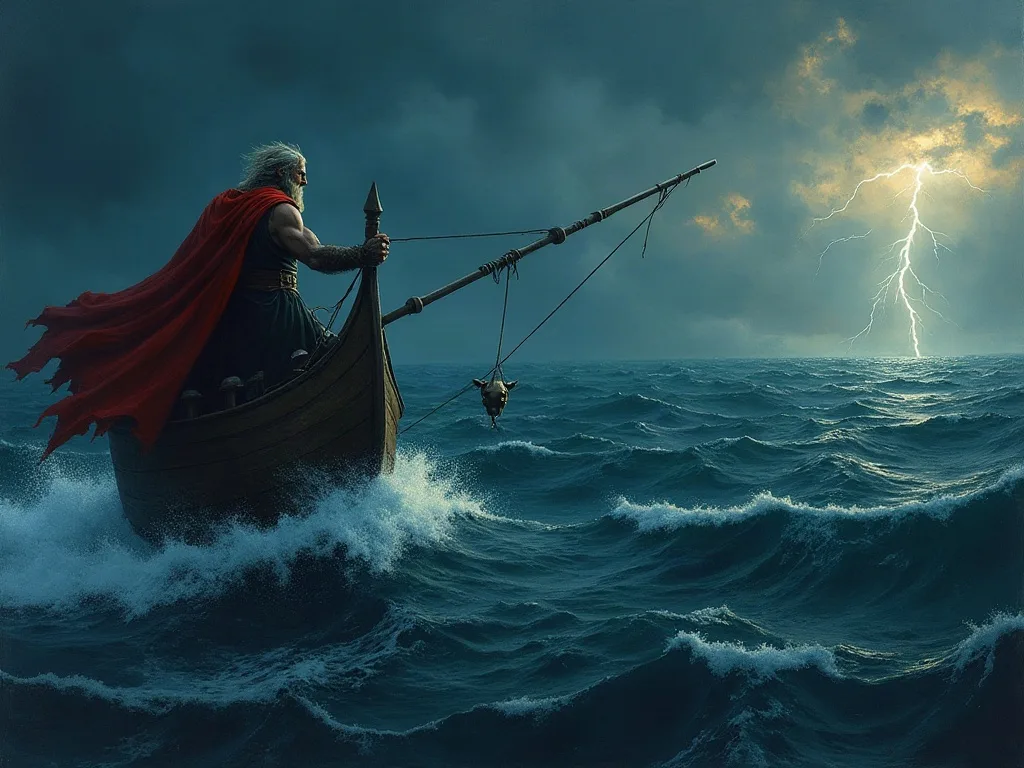
Thor reaches into Hymir's sea-chest and finds an enormous ox head. He cuts it loose from the skull and uses it as bait. This detail matters. The ox head is no small morsel. It is the head of a massive animal, yet Thor knows it will barely interest the creature he is hunting. Jormungandr does not eat normal food. It feeds on sea life so vast that to a human mind they seem like minor planets drifting through dark water.
Thor knotts a fishing hook to his line and impales the ox head upon it. Then he casts the line far into the sea. The line sinks and sinks. It goes deeper than ordinary fishing lines should go. Thor is not fishing in the familiar ocean where humans catch cod and herring. He is fishing in the cosmic deep, where the boundaries between the world of humans and the world of monsters blur and thin.
Then something hits.
The pull is so violent that Thor is yanked forward in the boat. His feet break through the deck planking. The line strains. This is no ordinary catch. This is Jormungandr, responding to the bait, drawn upward from the depths by hunger or perhaps by fate itself. The serpent rises toward the surface.
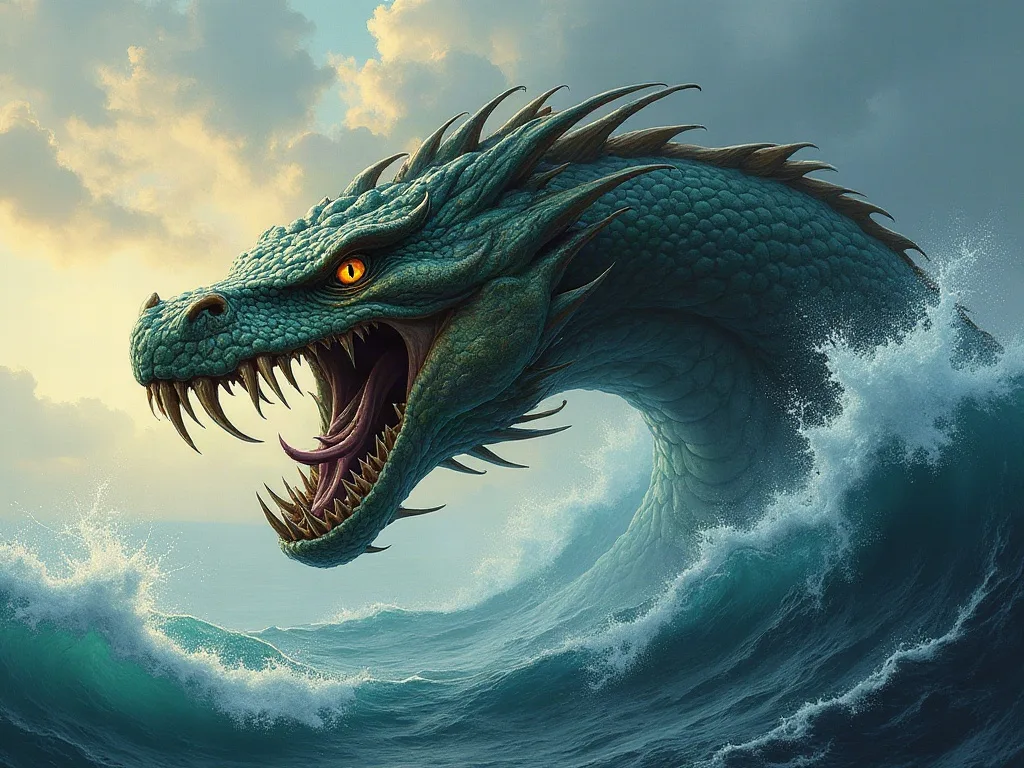
Snorri describes what happens next with almost clinical precision. Jormungandr's jaws break the surface of the sea. The serpent opens its mouth so wide that its upper jaw touches the sky and its lower jaw scrapes the seafloor. Poison pours from its fangs. The ocean convulses. This is not mythology reduced to symbol or metaphor. This is Norse cosmology made literal: a creature large enough that the fabric of reality itself bends around it.
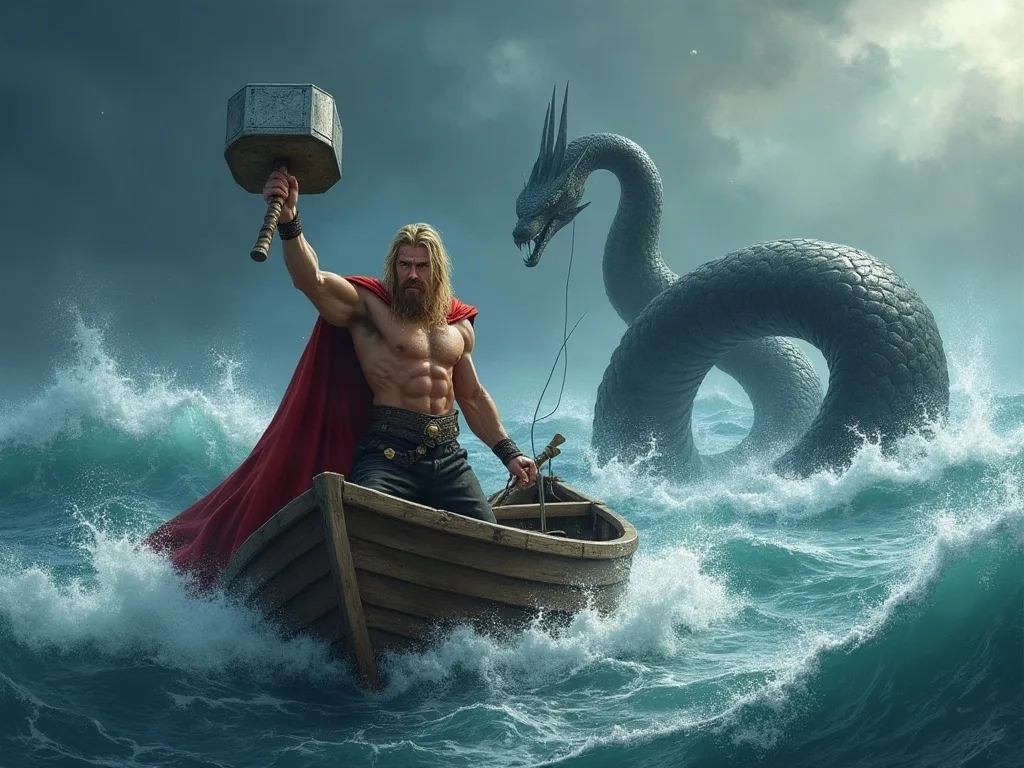
Thor grabs his hammer, Mjolnir. He raises it above his head. Every muscle in his divine body coils with power. He prepares to strike the killing blow. But in that moment, in the instant before Thor can bring Mjolnir down upon Jormungandr's skull, the serpent does something unexpected. It either breaks free or Hymir cuts the fishing line in terror. The accounts differ slightly depending on which version of the myth is consulted, but the outcome is the same.
Jormungandr descends. It sinks back into the depths. Thor's killing blow never lands. The serpent escapes. Hymir's face grows pale. The giant has seen something that few mortals or gods ever see and live to speak of. He has seen Jormungandr with his own eyes, and the experience has filled him with such terror that he refuses to fish any longer.
Two Versions of a Single Truth
The Poetic Edda preserves an older, more cryptic account of this event in a poem called Hymiskvaoia, "The Lay of Hymir." The verse is dense with Old Norse vocabulary and metaphor, written in the complex meters that skaldic poets perfected. But even through the veil of antique language, the essential story remains recognizable. Thor rows out into dangerous waters. He uses an ox head as bait. Jormungandr rises. The serpent breaks free or the line is cut.
But the Poetic Edda adds layers of meaning that the Prose Edda handles more straightforwardly. In the verses, Thor's action is framed as almost inevitable, as though he and Jormungandr were always meant to meet in this moment, as though the fishing trip were a rehearsal for the final battle to come. The ancient poets seem to be saying something deeper than mere narrative: they are saying that Thor's defiance of fate is itself fated. He will chase Jormungandr across time and space, in life and in death, as long as the cosmos endures.
The Prose Edda, by contrast, treats the fishing trip with a tone closer to adventure narrative. Snorri Sturluson, writing in the 13th century as a Christian scholar, was in some ways more interested in entertainment than his pagan ancestors might have been. He elaborates the details, adds theatrical language, and frames the myth as a story to be appreciated for its drama and its imagery rather than primarily as a cosmological teaching.
Yet both versions preserve the core truth: Thor confronts Jormungandr in the deep sea. He comes close to slaying the serpent. He fails, but not through lack of courage or strength. He fails because fate has written it otherwise. Jormungandr is destined to survive until Ragnarok. The serpent and the thunder god will meet one final time, at the end of all things.
The Mythological Context: Why Jormungandr Matters
To understand the gravity of Thor's fishing trip, it is necessary to understand what Jormungandr represents in Norse cosmology. The world serpent is not merely a monster. It is a living boundary, a cosmic force that separates and defines.
The ancient Norse understood the ocean differently than modern people do. To them, the sea was not simply a body of water to be crossed or exploited. The ocean was a boundary between worlds, a place where the normal rules of the earth no longer applied. Jormungandr, circling the earth with its tail in its mouth, was the literal embodiment of that boundary. It held the world together and held it separate from the chaos beyond.
The serpent's name, Jormungandr, comes from Old Norse roots meaning "the great beast" or "the vast serpent." In some texts, it is also called Midgard's Serpent because it dwells in the waters surrounding Midgard, the realm of humans. The mortals who lived in Norse lands knew the sea intimately. They were a seafaring people, and the ocean's power over their lives was absolute. Ships sank. Storms rose without warning. The sea could provide great abundance or terrible death. In this context, Jormungandr is not a fictional creature invented for entertainment. It is a mythological embodiment of a real, lived danger: the unpredictable, overwhelming power of the ocean itself.
Jormungandr's size and presence define the shape of reality. The creature is so vast that the Norse imagined it supporting the structure of the world. It is not separate from the cosmos. It is part of what holds the cosmos together, even as it constantly strains against that role, poisoning the sea with venom that drips from its jaws, waiting for the day when it can finally break free.
Ragnarok: The Fishing Trip and the End of All Things
The fishing trip for Jormungandr is not a standalone episode in Norse mythology. It is a foreshadowing, a rehearsal of the final confrontation that will occur at Ragnarok, the end of the world.
Ragnarok is one of the most distinctive features of Norse mythology. Unlike many other mythological traditions, which envision a stable cosmos maintained by divine powers, Norse cosmology predicts an ending. The gods know that the world will end. They know that they themselves will die. The Prose Edda preserves a prophecy spoken by a völva, a seeress, who describes the events of Ragnarok in vivid, apocalyptic language. This prophecy, called the Voluspa in the Poetic Edda, is one of the most important texts in Norse literature.
In that final day, according to the prophecy, Ragnarok will unfold in stages. First, a great winter called Fimbulwinter will grip the earth. Snow will fall from every direction. The sun will provide no warmth. Ice will cover the sea. In the chaos, kinship bonds will break. Fathers will turn against sons. Mothers against daughters. All the moral order that holds civilization together will collapse.
As Fimbulwinter deepens and the world falls toward destruction, Jormungandr will break free. The serpent will release its tail. It will thrash so violently in the ocean that waves will wash over the land, drowning everything. Jormungandr will swim toward Asgard, the realm of the gods, riding these world-destroying floods.
And Thor will be waiting.
When Jormungandr rises from the sea at Ragnarok, Thor will rush to meet the serpent. This time, the thunder god will strike with Mjolnir, and his blow will find its mark. Thor will slay Jormungandr. But the victory will come at a terrible cost. The serpent's death will trigger a chain of further catastrophes. The venom that pours from Jormungandr's jaws as it dies will spill across the sky and the earth, burning everything. Thor himself will stagger back nine steps from the poison, then fall dead.
The fishing trip, then, is a kind of symbolic rehearsal of this final meeting. Thor and Jormungandr have already confronted each other once. They will confront each other again. The first encounter ends in a draw. The second will end in mutual death. This is the Norse understanding of heroism and fate: not the triumph of good over evil, not the establishment of a permanent peace, but the heroic defiance of an inevitable, terrible ending.
The Hammer and the Serpent: Symbols of Power and Resistance
The image of Thor wielding Mjolnir against Jormungandr carries symbolic weight that goes far beyond the literal narrative. Mjolnir, the hammer, is not simply a weapon. It is the embodiment of Thor's power and authority as the protector of Midgard, the human world.
Mjolnir was forged by dwarven craftsmen, the sons of Ivaldi, according to some versions of the myth, or by other smith-dwarves in other tellings. The hammer's construction itself is a feat of cosmic importance. It cannot be broken or bent. It will always return to Thor's hand after it is thrown. It is small enough to carry and large enough to level mountains. It is the most powerful weapon in existence.
But Mjolnir's power is not absolute. It cannot slay Jormungandr, not in the fishing trip. The serpent breaks free. The encounter ends without a victor. This is deeply significant. In Norse mythology, power is always relative. Even the greatest gods face limitations. Even the strongest weapons have their limits. The universe does not bend to the will of the powerful; rather, all beings, gods and giants alike, are bound by the same cosmic law that determines their fates.
The serpent, in turn, is not merely a destructive force. Jormungandr is a living being, vast and conscious and possessed of its own will. The creature did not ask to be cast into the ocean by the gods. It did not choose to be bound by fate to cause the world's destruction. In this sense, Jormungandr can be seen as a victim as much as a threat. The Norse poets seem to have understood this complexity. They did not present the serpent as a simple villain to be destroyed. They presented it as a necessary force, bound up in the structure of reality itself, and ultimately tragic.
The Hymir Episode: Giants and the Boundaries of the Cosmos
Hymir, the giant who accompanies Thor on the fishing boat, deserves more attention than he often receives in modern retellings of the myth. Hymir is not a simple antagonist. He is a figure who dwells in the liminal spaces where different worlds touch.
Giants in Norse mythology are not evil by nature, though they are often opposed to the gods. Giants represent the forces of chaos, the raw power of the natural world that civilization must resist and define itself against. They dwell in Jotunheim, a realm separate from Asgard and from Midgard. Yet the boundaries between these realms are porous. Travel between them is possible. Trade occurs. Sometimes, there is even cooperation, though it is always uneasy.
Hymir is old, powerful, and knowledgeable about the sea. He knows dangers that Thor does not. He warns the thunder god not to row north. This warning is not mere cowardice; it is the wisdom of someone who understands the limits of even divine power. Yet Thor ignores the warning. This is characteristic of Thor in Norse mythology. He is brave to the point of recklessness, confident in his power, sometimes disdainful of counsel.
When Jormungandr rises and Hymir sees the serpent's jaws open to touch sky and earth, the giant is seized with terror. Some versions say Hymir cuts the fishing line. Others suggest the line simply snaps under the strain. Either way, Hymir's action (or his inability to act) results in the serpent's escape. In this moment, we see the limits of giant-power as well as divine power. Neither Hymir nor Thor can control Jormungandr. The serpent is subject to forces far greater than individual beings.
The Eddic Sources: Voices from the Viking Age
The two primary sources for the fishing trip myth deserve closer examination. The Prose Edda and the Poetic Edda are not equal in age or in origin. The Poetic Edda is a collection of anonymous Old Norse poems, some of which may date back to the pre-Christian Viking age (roughly 800-1066 CE), though the manuscript itself was written down in Iceland in the 13th century. The Prose Edda was composed by Snorri Sturluson around 1220 CE, more than a century and a half after the Viking age had ended.
Snorri was a Christian scholar, a politician, and a poet. He had learned the techniques of skaldic poetry, the formal, highly complex style that Norse poets used. To preserve this tradition and to ensure that future poets could understand the mythological references embedded in the old poems, Snorri compiled the Prose Edda as a kind of handbook. He gathered information from older sources, from oral tradition, and from his own knowledge, and he organized it into prose narratives that explained the myths in clear, straightforward language.
The Poetic Edda, by contrast, preserves the myths in their original verse form. The language is archaic, often cryptic, packed with metaphor and allusion. A single line of Old Norse verse can contain multiple layers of meaning. The poems are not straightforward narratives; they are works of art, meant to be heard aloud and appreciated for their music and their linguistic complexity as much as for their content.
Because of these differences, the two sources sometimes present variations or additional details. The Poetic Edda's account of the fishing trip appears in Hymiskvaoia, "The Lay of Hymir," which also includes other adventures involving Thor and the giant. The poem emphasizes the mythic and cosmic dimensions of the story. Snorri's version in the Prose Edda is more narrative, more concerned with telling a story that modern readers can follow and enjoy.
Both versions, however, preserve the core story. Both agree that Thor goes fishing for Jormungandr. Both agree that the serpent is huge, that the encounter is momentous, and that the serpent escapes. These are not accidental agreements. They reflect a myth that was stable and deeply rooted in Norse tradition, a story that was told and retold for centuries before being written down.
Why The Fishing Trip Matters: Fate, Heroism, and Acceptance
Modern readers sometimes find the Norse myths alien or depressing. Unlike many mythological traditions, Norse mythology does not end with the triumph of order over chaos or the establishment of a permanent golden age. It ends with the destruction of the cosmos and the death of the gods. This can seem like a cosmology born of despair.
Yet the Norse understanding was more subtle. Yes, the world will end. Yes, the gods will die. But this knowledge does not paralyze them. They act anyway. They build. They fight. They pursue great deeds. Thor goes fishing for Jormungandr not because he expects to win forever, but because it is what he does. It is who he is.
This is the source of the appeal of Norse mythology to the Norse people themselves and to readers today. The heroes in these stories are not guaranteed victory. They know they will fail in the end. But they choose to act with courage and dignity anyway. They choose to fish for serpents and fight giants and march toward Ragnarok with their eyes open.
The fishing trip for Jormungandr exemplifies this attitude. Thor is not fighting for a permanent victory. He is not seeking to permanently imprison or destroy the serpent, at least not yet. He is confronting a cosmic power, measuring his strength against it, and accepting the result when the serpent breaks free. He will fish for it again at Ragnarok, and that time he will slay it, but only at the cost of his own life.
This is not fatalism. It is not resignation. It is a form of heroism peculiar to Norse culture: the willingness to act fully and bravely in the face of inevitable loss.
Echoes in Later Literature and Culture
The story of Thor's fishing trip has echoed through Norse culture and beyond for more than a thousand years. Medieval Icelandic writers, Christian scribes preserving pagan material, saw in the myth a story worth preserving. Later, when interest in Norse mythology was revived in the 18th and 19th centuries, scholars and poets drew on the Eddic sources to reclaim the Norse past.
Richard Wagner, the 19th-century German composer, drew on Norse mythology for his vast operatic cycle, the Ring of the Nibelung. While Wagner's sources and his artistic choices were complex and not always historically accurate, the mythology he was engaging with included the myths of Thor, Jormungandr, and Ragnarok.
Modern fantasy literature, from J.R.R. Tolkien onward, has drawn heavily on Norse mythology. The fishing trip story, with its combination of cosmic scope and intimate drama, has inspired modern creators. The conflict between Thor and Jormungandr has become archetypal: it represents the confrontation between order and chaos, between individual power and cosmic forces, between the will to resist and the fact of inevitable change.
In contemporary popular culture, from Marvel Comics to television and film adaptations, Thor appears frequently. The character's presentation sometimes diverges from the Norse sources, but the essential appeal remains: Thor is a god who faces impossible odds with courage and humor, who wields enormous power yet accepts his own limitations, who fights for values he believes in even though he knows the fight will ultimately be lost.
How Did the Norse Explain Jormungandr's Size and Power?
Frequently asked questions
How did the ancient Norse understand Jormungandr's connection to the earth itself?
In Norse cosmology, Jormungandr was not merely a creature that lived in the sea. The serpent's body formed part of the structure that held the world together. By holding its tail in its mouth, the serpent created a boundary that defined the edge of Midgard, the human world. This is why the serpent's release at Ragnarok is so catastrophic; the world loses its defining boundary and collapses into chaos. The Norse saw the serpent as deeply embedded in the fabric of reality itself.
What made the fishing trip significant if Thor didn't slay Jormungandr?
The significance lies not in victory but in the encounter itself. Thor's willingness to seek out the world serpent and face it directly demonstrates the Norse heroic ideal: confronting overwhelming forces with courage, even when victory is impossible. The fishing trip is also a foreshadowing or rehearsal of Ragnarok, where Thor will finally meet Jormungandr in a battle that will end both their lives. The myth teaches that heroism is not about permanent triumph but about how one faces inevitable challenges.
Why did Hymir cut the fishing line or why did it break?
Different versions of the myth give different explanations. In Snorri's Prose Edda account, it is sometimes suggested that Hymir cut the line out of fear when he saw Jormungandr's jaws open to the sky. In other tellings, the line simply snaps under the strain of the serpent's weight and power. Either way, the result is the same: the serpent escapes. This variation reflects the fluid nature of oral mythology; different storytellers might emphasize different elements depending on what they wanted to highlight about the myth.
How does the fishing trip connect to the broader story of Ragnarok?
The fishing trip is essentially a preliminary encounter with Jormungandr before the final, apocalyptic meeting at Ragnarok. At Ragnarok, the serpent will break free from the sea, and Thor will slay it with Mjolnir. But the victory will kill Thor as well; the venom from the dying serpent will poison the air and the god will stagger back nine steps before falling dead. The fishing trip shows Thor and Jormungandr locked in an eternal struggle that spans from the present age into the destruction of the world itself. Each encounter brings them closer to the final, fated meeting.
Did the Norse believe the fishing trip actually happened in the past?
For the Norse, the distinction between myth and history was not always sharp. The Eddic sources present the fishing trip as part of the mythological present, an event that occurred in the age of the gods but not in human historical time. The Norse understood their myths as true in a different way than modern people think of factual truth. They encoded theological and philosophical truths, cosmological realities, and cultural values in the form of stories about gods and giants. The fishing trip was "true" in that it revealed something essential about the structure of the cosmos and the nature of heroism.
How do the Poetic Edda and Prose Edda versions of the story differ?
The Poetic Edda presents the myth in ancient verse form, cryptic and dense with poetic language and imagery. The Prose Edda, written by Snorri Sturluson in the 13th century, translates the myth into prose narrative that is easier for modern readers to follow. Snorri sometimes adds explanatory details and elaborates on scenes. However, the core story remains consistent across both sources: Thor fishes for Jormungandr with an ox head as bait, the serpent rises and nearly breaks free, and the encounter ends without resolution. The differences are more in tone and emphasis than in substance.
The Fishing Trip and Modern Understandings of Mythology
The story of Thor's fishing trip has become more widely known in recent decades, as popular culture has drawn increasingly on Norse mythology. Yet with this increased exposure comes the risk of misunderstanding. Modern adaptations often simplify the myth, stripping away its philosophical and cosmological dimensions and focusing only on the action and spectacle.
The true power of the fishing trip lies in its combination of immediacy and cosmic significance. Thor rows out into the sea with a fishing line and an ox head. These are concrete, vivid details. But the creature he is fishing for is not a normal monster. It is the serpent that holds the world together, the creature destined to consume the earth at the end of time. The fishing trip is simultaneously a small, human-scale adventure and a confrontation with the fundamental forces that govern reality.
This combination of scales, the intimate and the cosmic, is one of the things that makes Norse mythology endure. The myths feel real and immediate even as they operate on a scale that surpasses ordinary human comprehension. Thor is relatable as a character; he is brave and strong-willed and sometimes rash. But he is also a god, and his actions have consequences that ripple through the cosmos itself.
Modern readers, living in a time of unprecedented technological power and unprecedented environmental uncertainty, find something resonant in the Norse understanding of heroism. The Norse did not imagine that human power could reshape the world permanently or that civilization could guarantee itself against all challenges. They accepted limits. They accepted endings. But they insisted on acting courageously and with dignity regardless. This is perhaps the deepest lesson of Thor's fishing trip for Jormungandr: in the face of inevitable limits and ultimate loss, act anyway. Fish for serpents. Raise your hammer. Face what comes.
Free 25-page sample
Want the whole story?
Take the first 25 pages free. If it pulls you in, the full edition is yours as an instant PDF download, with a paperback on Amazon for selected titles.

Mythology
The World Mythology Book: The Gods, Heroes and Myths of Every Culture
The Gods, Heroes and Myths of Every Culture, in One Volume
The whole of world mythology in a single volume: Greek, Norse, Egyptian, Japanese, Hindu, Celtic, Slavic, Mesoamerican and African myths gathered side by side, each drawn from the primary sources.