
Thor's Hammer Symbol History: From Norse Myth to Modern Meaning
Mjolnir, the hammer of Thor, shaped Norse cosmology for a thousand years. Explore the weapon's mythic origins, its ritual power across cultures, and why it endures from Viking amulets to modern tattoos.
Contents
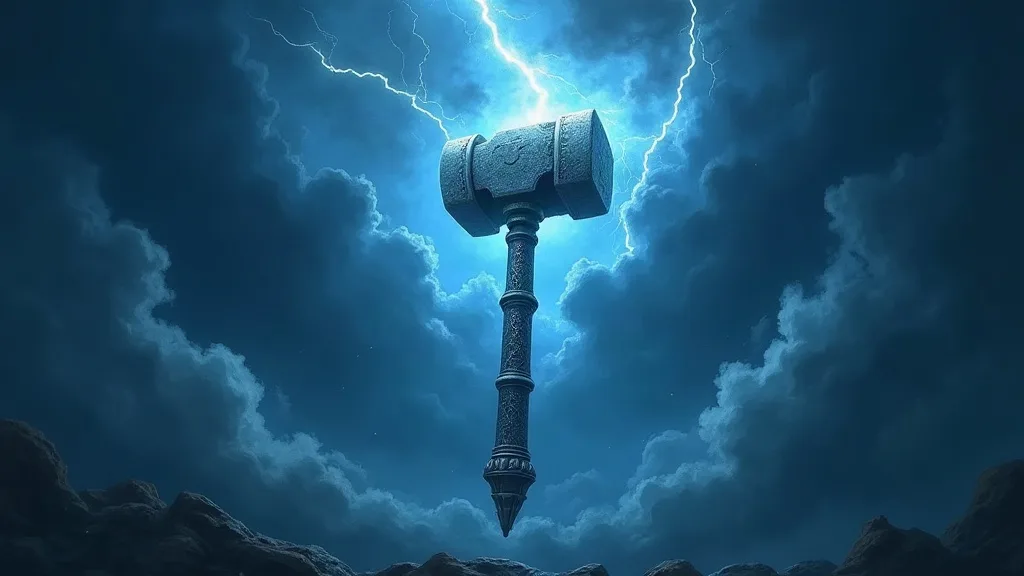
Mjolnir hangs in the sky. The thunder rumbles across Asgard as Thor, the red-bearded god of storms, grips its handle and summons lightning to strike giants at the edge of creation. This hammer is not merely a tool of war. It is the axis of Norse spiritual life: a sign of blessing at weddings, a protective amulet worn around necks, a symbol carved into stones to mark sacred ground. The history of Thor's hammer symbol stretches from the forges of the dwarves who first crafted it, through the pagan rituals of Viking warriors, into the tattoo parlors and pendant shops of the modern world.
The hammer's power rested not in its size or heft alone, but in what it meant. When a Viking wore a hammer amulet, they were not declaring their love of metalwork. They were calling on the protection of the god whose name meant "thunder," whose presence guaranteed fertility, law, and the safe passage of journeys. Understanding Mjolnir symbol meaning requires stepping into the Norse cosmology where the hammer held the world together, quite literally.
The Forging of Mjolnir: A Cosmic Weapon Born from Trickery
In the Norse sources, Mjolnir did not exist from the beginning of time. The Aesir, the family of gods who ruled from Asgard, had to commission it. The story, preserved in the Prose Edda, a medieval Icelandic manuscript written around 1220 CE by Snorri Sturluson, begins with an act of mischief.
Loki, the trickster god, cut off the golden hair of Sif, the wife of Thor. This was no trivial prank. Sif's hair represented fertility and prosperity, and its theft threatened the well-being of the entire realm. To make amends, Loki sought out the sons of Ivaldi, dwarven craftsmen who worked in caves beneath the earth. These dwarves forged three magical treasures: a ship that could fold into a pocket, a spear that never missed, and golden hair for Sif that would grow like real hair.
But Loki, ever competitive, wagered his own head that the dwarves Sindri and Brokkr could not create something equally splendid. Sindri accepted the wager. In his forge, he and his brother worked through the night, creating three more treasures. The first was Gullinbursti, a golden boar whose mane shone like sunlight. The second was Draupnir, a ring from which eight new gold rings dripped every ninth night, a symbol of endless abundance. The third was Mjolnir.
Sindri's forge work was interrupted three times. Loki, desperate to win, transformed into a fly and stung the dwarves' hands and foreheads. Despite the pain and blood, Sindri did not falter. Mjolnir emerged from the flames, though its handle came out slightly short. The dwarves won the wager. Loki lost the bet but kept his life, though his lips were stitched shut for a time as punishment.
What mattered to the Norse cosmos was that Mjolnir now existed. The hammer bore an essential flaw: its handle was stunted, which is why Thor had to grip it so tightly and why, in some traditions, it could only be wielded by Thor himself, who possessed the strength to control it. The short handle became part of the symbol's identity. It made the hammer recognizable, distinct, a tool shaped by compromise and cosmic consequence rather than perfection.

The Sacred Properties of Mjolnir in Norse Cosmology
Mjolnir was far more than a weapon. In Norse mythology, it served as the foundation of sacred law and social order. When disputes arose between gods and giants, when treaties needed to be sworn, when the cosmos itself was in jeopardy, Mjolnir was invoked.
The hammer sanctified marriages. When a Viking couple wed, a hammer was placed in the bride's lap to bless the union with fertility and Thor's protective power. The Thrymskvida, a poem in the Poetic Edda, tells of a giant named Thrym who stole Mjolnir and demanded the goddess Freyja as ransom. The only way to retrieve the hammer was to dress Thor as a bride, complete with veil and bridal gown. When the hammer was placed in the "bride's" lap as part of the ceremony, Thor's true identity was revealed. He seized Mjolnir and used it to slaughter Thrym and his court.
This story reveals something essential about the symbol: the hammer's legitimacy lay not in brute force alone, but in its integration into ritual, law, and social structure. A hammer in a lap. A hammer invoked at a boundary. A hammer held aloft by a god who maintained the cosmic order against chaos.
The hammer also symbolized Thor's role as a protector of the common people, the farmers and traders. Unlike Odin, whose wisdom came through sacrifice and ecstasy, Thor's power was direct and tangible. When storms threatened crops, when roads became unsafe, when giants encroached on human lands, Thor was the god who stood firm. Mjolnir was the visible proof of that commitment.
Mjolnir Amulets: Viking Spiritual Practice and Archaeological Reality
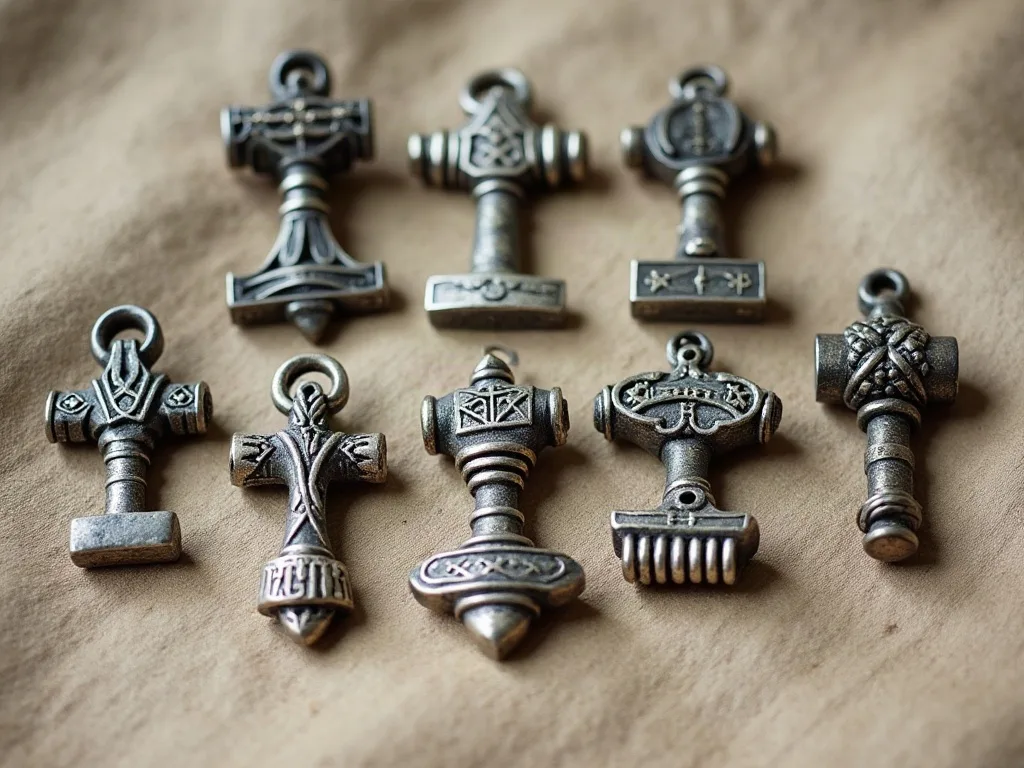
By the Viking Age, roughly 793 to 1066 CE, the hammer amulet had become widespread across Scandinavia. Archeologists have recovered hundreds of small hammer pendants from graves, settlements, and ritual sites. Most are made of silver, bronze, or iron, small enough to hang from a cord or leather strap around the neck. Some are simple and utilitarian. Others are elaborately decorated, their handles twisted or braided, their heads inlaid with precious metals.
These amulets were not merely decorative. They served a spiritual function. A person wearing a hammer pendant was calling on Thor's protection and invoking the values he represented: strength, reliability, the protection of community. In a world where travel was dangerous, winters harsh, and life uncertain, the hammer offered both practical reassurance and spiritual grounding.
Interestingly, the adoption of Mjolnir amulets accelerated precisely as Christianity began to spread into Scandinavia in the late Viking Age. From around the 10th century onward, we see evidence that some Norse people began wearing both Christian crosses and hammer pendants simultaneously, as though trying to hedge their spiritual bets or maintain a connection to ancestral protection even as they adopted the new faith. This suggests the hammer had become more than a pagan religious symbol. It was a marker of identity, of belonging to a community with shared values and history.
The Eddic poems, preserved in oral tradition for centuries before being written down, describe Thor as a god who rides his chariot pulled by goats, who fishes for serpents, who protects humans from giants and chaos. The hammer amulet made that protection portable and personal. It was a way for ordinary people to access divine power.
Symbolism Across the Norse World: Regional and Social Variations
Mjolnir was never a monolithic symbol. Different regions and social classes interpreted it through different lenses.
In Sweden and the wealthy merchant centers, hammer amulets were often finely crafted, made of materials that demonstrated wealth and access to trade networks. These elaborate hammers may have signaled not just piety but status. A farmer might wear a simple iron hammer. A chieftain might wear one of silver or gold, adorned with runes or intricate knotwork.
In Iceland, where settlement was more recent and communities more isolated, the hammer took on particular importance as a symbol of lawfulness and order. The Icelandic Commonwealth (930-1262 CE) did not have a king. Instead, power rested with local chieftains and a central assembly called the Althing. Thor, as a god associated with justice and the protection of community, embodied the values that the Commonwealth claimed to represent. To wear his hammer was to affirm allegiance to that system, however imperfectly it functioned.
Among the Norse warrior elite, Mjolnir may have carried additional meanings tied to martial prowess. Thor was, after all, the hammer-wielding warrior god par excellence. Yet the surviving textual evidence does not suggest that the hammer was primarily a military symbol. More often, it appears in contexts of blessing, blessing, protection, and the affirmation of cosmic and social order.
The transition from pagan to Christian practice complicated the hammer's meaning. Some scholars argue that the hammer symbol persisted not because Christians adopted it, but because it sank so deeply into folk practice that it survived as a cultural artifact even as its explicitly pagan meaning receded. Others contend that the hammer never disappeared entirely, that it lingered in folk traditions and regional memory throughout the medieval period, waiting for the romantic movement of the 19th century to resurrect it.
The Hammer's Reinvention: From Folk Symbol to National Icon
The modern history of Thor's hammer symbolism is inseparable from 19th-century Romanticism and the rise of nationalist movements in Scandinavia. As industrialization and political change transformed Northern Europe, intellectuals and artists looked back to the Viking Age and the Norse pantheon as sources of authentic national identity.
The Eddas, largely forgotten in Latin-speaking medieval Europe, were rediscovered and republished. Composers like Richard Wagner drew on Norse mythology for operatic grandeur. Scholars began to systematically study Norse language, mythology, and history. In this ferment, Mjolnir was rehabilitated as a symbol of Viking heritage and Northern cultural pride.
This romanticized version of the hammer was, in many ways, a modern invention. The Romantic movement emphasized the hammer as a symbol of strength, freedom, and resistance to aristocratic and ecclesiastical authority. It was linked to labor movements in Scandinavia, to socialism and left-wing politics, to the ideal of the hardy, self-reliant Norse farmer-warrior who had no need for kings or priests.
By the late 19th century, as racial pseudoscience began to permeate European thought, the hammer was appropriated by racial nationalist movements. In the 1930s and 1940s, Nordic and Norse symbols, including Mjolnir, were co-opted by fascist regimes and white supremacist groups seeking to claim a mythic Aryan past. This remains one of the darkest chapters in the hammer's modern history, and it casts a long shadow. Even today, the symbol is occasionally used by hate groups, creating a tragic tension between its genuine historical and spiritual significance and its modern misappropriation.

Modern Interpretations: Tattoos, Spirituality, and Contested Meanings
In the contemporary world, Mjolnir tattoo symbolism encompasses a vast spectrum of intentions and meanings. For many, the hammer represents a connection to Norse heritage, to Viking ancestry, or to the aesthetic and mythology of the North. Tattoo culture has democratized the symbol, making it accessible to anyone who feels drawn to it, regardless of ethnic background.
For practitioners of Heathenry (modern Norse paganism), the hammer is a religious symbol with genuine spiritual weight. These communities work to reclaim the hammer from its misappropriation by extremists, situating it within contexts of community, honor, inclusivity, and respect for nature. Many Heathen organizations explicitly reject racism and xenophobia, making clear that the hammer's meaning in their spiritual practice is fundamentally opposed to the hateful ideologies that have sometimes claimed it.
In mainstream tattoo culture, a person might choose a hammer design for reasons as varied as personal strength, a sense of cosmic order and balance, admiration for Norse culture, or simply aesthetic preference. The symbol carries less weight than it once did, operating more as a design element than a binding declaration of identity. This diffusion of meaning is both a loss (the hammer no longer functions as a marker of community identity with the same force) and a gain (it is no longer tied exclusively to any one movement or ideology).
Some modern interpretations emphasize the hammer's role as a tool of creation and blessing rather than destruction. This reads the symbol through the lens of the goddess Freyja and the Skalds (Norse poets) who understood power as something generative and transformative, not merely violent. A hammer used to forge metals, to build, to maintain structures. This emphasis on construction and creation offers a counterweight to readings that foreground only the weapon aspect.
The debate over appropriate uses of the hammer continues in Heathen communities and among Scandinavian intellectuals. Who has the right to claim it? What commitments come with wearing it? These questions remain unresolved and contested.
Cross-Cultural Hammer Symbolism: Thunder Gods and Cosmic Tools
Mjolnir is not unique. Across cultures, thunder gods wield hammers or hammer-like implements. This suggests something deeper than cultural borrowing: a archetypal association between the hammer as a tool of creation and destruction, and divine authority over weather, lightning, and the maintenance of cosmic order.
Taranis, the Celtic thunder god, is often depicted wielding a hammer. Perkun, the Baltic thunder deity, also carries a hammer. In Hindu mythology, Indra wields a thunderbolt weapon called a vajra, which, while not identical to a hammer, serves the same cosmic function: it is the tool through which divine order is imposed on chaos, and it is the weapon that secures the fertility and well-being of the world.
This cross-cultural consistency suggests that the hammer-thunder god motif taps into something fundamental about how ancient peoples understood power, weather, and the divine. Thunder is visible, audible, and terrifying. A hammer is tangible and practical. Together, they create a compelling symbol of authority grounded in both the cosmic and the everyday.
The comparison is illuminating not because it proves cultural diffusion, but because it shows how different traditions arrived at similar symbolic solutions to represent similar concepts. The Norse Mjolnir and the Celtic hammer of Taranis are not copies of each other. They are parallel developments reflecting parallel cosmologies and social structures.
From Shield-Maiden to Scholar: How the Hammer Meaning Shifted with Archaeological Discovery
Until relatively recently, most Western knowledge of the hammer came from the written Eddas and Sagas, texts written down centuries after the Viking Age and filtered through Christian scribes' understanding and agenda. This created a distorted picture. The texts emphasized the spectacular and the mythic: battles with giants, the fates of gods, the architecture of the cosmos.
Archaeological evidence from the last fifty years has complicated and enriched this picture. Hammer amulets in excavated graves tell stories not found in the Eddas. They show that the symbol was widespread, worn by men and women across different social classes. They reveal regional variations in design and material. They provide evidence of the actual beliefs and practices of ordinary people, not just the myths and ideals preserved in texts.
Modern scholarship has also been forced to confront the symbol's modern misappropriation. This has led to deeper reflection on how symbols acquire meaning, how they can be reclaimed, and what responsibility comes with using them. Some scholars argue that Mjolnir cannot be "reclaimed" from its abuse because the symbol itself is not the problem; the problem is ideology and intent. Others maintain that context and community matter profoundly.
The hammer's meaning in the 21st century is neither fixed nor unified. It exists in a state of productive contestation, claimed by different communities for different reasons, its interpretation shaped by historical circumstance, personal conviction, and ongoing dialogue about what it means to honor the past without reproducing its hierarchies or hatreds.
Why the Hammer Endures: Durability, Portability, and the Aesthetics of Power
From a design perspective, the hammer is ideal as a symbol. It is simple enough to be carved, cast, or drawn quickly, yet distinctive enough to be immediately recognizable. It is portable: it can hang from a neck, be carved into stone, painted onto a shield, or tattooed onto skin. It reads clearly at a distance and at close range.
More importantly, the hammer carries semantic richness. It evokes strength, but also craft and creation. It suggests Thor, but also work, labor, and the forging of community. A circle or a rune might also serve as a symbol, but they carry less narrative weight. The hammer tells a story: a god, a weapon, an act of protection, a cosmology.
This combination of simplicity and depth explains its longevity. In an age of Instagram and emoji, symbols that are easy to recognize but difficult to reduce to a single meaning have particular power. The hammer survives because it can mean different things to different people, yet it always carries the weight of its historical and mythic significance.
Frequently Asked Questions About Thor's Hammer Symbol History
Frequently asked questions
What exactly is Mjolnir in Norse mythology?
Mjolnir is the hammer wielded by Thor, the Norse god of thunder. According to the Prose Edda, it was forged by the dwarven brothers Sindri and Brokkr and is the most powerful weapon in the Norse cosmos. The hammer was used to maintain cosmic order, sanctify marriages, and protect humanity from giants and chaos. It is described as unbreakable and as returning to Thor's hand after being thrown.
Did Vikings actually wear hammer amulets as religious symbols?
Yes. Archaeological excavations across Scandinavia have uncovered hundreds of small hammer pendants in graves and settlements dating to the Viking Age (roughly 793-1066 CE). These were worn as protective amulets and spiritual markers, often made of silver, bronze, or iron. The practice accelerated in the late Viking Age, sometimes alongside Christian symbols, suggesting both spiritual hedging and the symbol's deep cultural significance.
Is the hammer symbol used by white supremacists today?
Yes, unfortunately. In the 1930s-1940s, Mjolnir was co-opted by fascist and Nazi movements seeking to claim a mythic Aryan past. Some white supremacist groups continue to use Norse symbols, including the hammer, today. However, most modern Heathen communities and Scandinavian heritage organizations explicitly reject these appropriations and work to reclaim the symbol within contexts of inclusivity and honor. The symbol's potential misuse does not erase its genuine historical and spiritual meaning.
What does the hammer symbol mean as a modern tattoo?
Hammer tattoos are chosen for varied reasons: connection to Norse heritage or ancestry, admiration for Viking history, spiritual practice within modern Heathenry, interest in the symbol's aesthetic power, or identification with values like strength, reliability, and community protection. The meaning is personal and context-dependent, shaped by the wearer's intention and community. In mainstream tattoo culture, it often carries less weight as a binding declaration than it did in the Viking Age, though for some practitioners it remains a serious spiritual commitment.
Are hammer symbols used in other cultures?
Yes. Thunder gods in Celtic, Baltic, and Hindu traditions wield hammers or hammer-like implements. Taranis (Celtic), Perkun (Baltic), and Indra (Hindu, via the vajra) all use hammer-like weapons to maintain cosmic order and fertility. This cross-cultural pattern suggests that the association between hammers, thunder, and divine authority reflects a deeper archetype about how ancient peoples understood power and the sacred.
When did the modern idea of the Viking hammer symbol develop?
The hammer was largely forgotten in medieval and early modern Europe, surviving mainly in folk traditions. Its major revival came during the 19th-century Romantic movement, when Norse mythology was rediscovered and romanticized as a source of authentic national and cultural identity. It was subsequently appropriated by nationalist, socialist, and (tragically) fascist movements seeking symbolic authority in a mythic past. Modern spiritual and cultural recovery of the symbol began in the late 20th century and continues today.
The Hammer in Contested Memory: How a Symbol Survives Its Misuse
The future of Thor's hammer symbol is neither predetermined nor simple. Unlike some historical symbols that lose their power through overuse or drift into oblivion, Mjolnir persists because it is rooted in a living tradition of mythology, seasonal practice, and spiritual community. People continue to study the Eddas, to practice Heathenry, to wear the hammer with intention and respect.
Yet the symbol will never return to the simplicity it had in the Viking Age. It will always carry the weight of its modern misappropriation, the knowledge that it has been claimed by ideologies antithetical to the values of protection and community that it originally represented. This tension is uncomfortable, but it is not fatal to the symbol's meaning.
What matters now is how communities choose to use it. When a scholar writes about the hammer, when a Heathen practitioner wears it as a spiritual marker, when a person of Scandinavian heritage chooses it as a tattoo to honor an ancestral connection, when an artist depicts it in contemporary work, they are making a choice about what the symbol means in their hands. The hammer's power rests not with any single authority but with the accumulated choices of those who claim it. The symbol survives by being used thoughtfully, by being studied seriously, by being defended against misuse not through exclusion but through clarity of purpose and commitment to the values it represents.
Mjolnir remains, as it has always been, a tool of creation and protection, a symbol that binds individuals to community and community to the sacred order that holds the cosmos together.
Free 25-page sample
Want the whole story?
Take the first 25 pages free. If it pulls you in, the full edition is yours as an instant PDF download, with a paperback on Amazon for selected titles.

Mythology
The World Mythology Book: The Gods, Heroes and Myths of Every Culture
The Gods, Heroes and Myths of Every Culture, in One Volume
The whole of world mythology in a single volume: Greek, Norse, Egyptian, Japanese, Hindu, Celtic, Slavic, Mesoamerican and African myths gathered side by side, each drawn from the primary sources.