
Tsukuyomi: The Moon God Who Split from Heaven
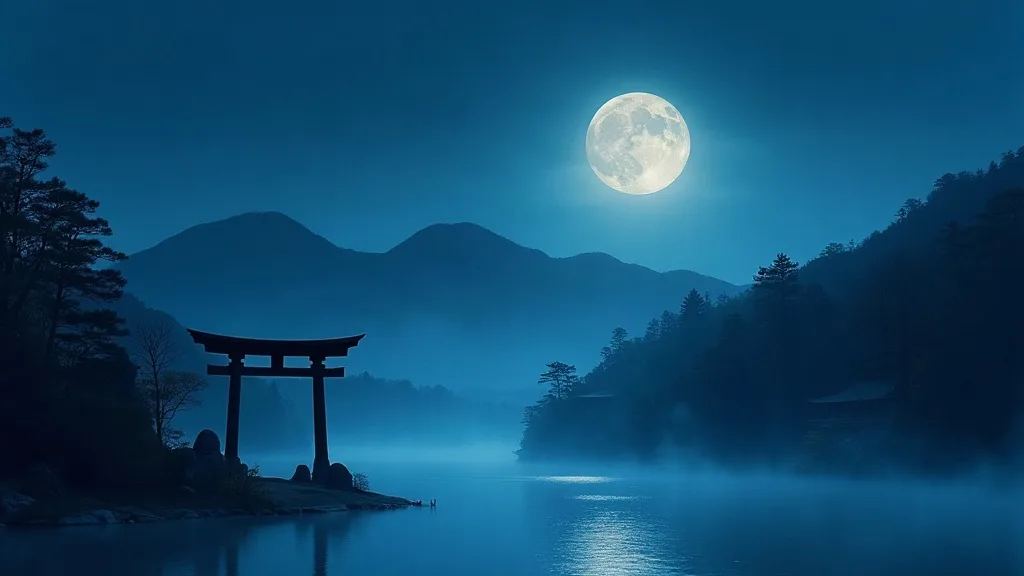
Tsukuyomi is the Japanese moon god born from the tears of Izanagi, ruler of the night sky and one of the oldest kami in Shinto. Discover his cosmic role, his violent separation from the sun goddess Amaterasu, and why he remains a shadowy figure in Shinto myth.
Contents
The story of Tsukuyomi begins in the primordial waters. Izanagi, the male creator god, had just finished bathing in a river to purify himself after witnessing death. Water ran down his body. From his left eye came the sun goddess Amaterasu; from his right eye came Tsukuyomi, the moon god. Two cosmic siblings born in the same breath, one bright, one silver, one praised for eternity, one fated to dwell in shadow.
This moment appears in the Kojiki, Japan's oldest written collection of myths, compiled in 712 CE. The Kojiki records the creation of Japan itself, the origin of the imperial line, and the birth of the kami (spirits or gods) that animate the Shinto worldview. Tsukuyomi's birth is matter-of-fact, compressed into a few lines. Yet those lines contain an entire cosmos: the moon god was never meant to be marginal. Yet something went terribly wrong.
The two siblings received their assignments. Amaterasu was given dominion over the heavens and the sun. Tsukuyomi received the night and the moon. They should have governed together, a perfect cosmic pair. But the Kojiki tells us they became estranged, and this estrangement would split Shinto mythology in two.
The Breaking of the Heavens
The rupture between Amaterasu and Tsukuyomi is told in the Kojiki with brutal simplicity. Amaterasu invited her brother to a meal. This was meant to be an act of unity, a sharing of divine sustenance. But when Tsukuyomi arrived, he defiled the meal through an act of impurity. He vomited into the food. Some versions say he excreted directly onto the dining room floor. The specific act differs slightly between tellings, but the meaning is constant: Tsukuyomi contaminated what was sacred.
Amaterasu was enraged. Her anger was not a tantrum. It was the fury of a supreme being betrayed by a peer. She severed all relations with her brother and declared they would never again share a space. From that moment onward, Amaterasu ruled the day and Tsukuyomi ruled the night. The two would never meet.
This story explains why the sun and moon never appear in the same sky.
Yet this rupture meant something else: it meant Tsukuyomi god of the moon was effectively banished from the central narrative of Shinto. The Kojiki and Nihon Shoki (the second great collection of Japanese myths, compiled in 720 CE) barely mention him again. He has no temples of major significance, no annual festivals that rival Amaterasu's. In Amaterasu's shrine at Ise, the holiest site in Shinto, Tsukuyomi is present but secondary. The moon god became a peripheral figure in his own religion.

Why Tsukuyomi Faded from Memory
This marginalization did not happen by accident. The imperial cult of Japan placed Amaterasu at its center. The emperor was said to descend from Amaterasu's grandson, Ninigi no Mikoto, who came down from heaven to rule Japan. Every emperor had divine bloodline through this line. The Kojiki was essentially a state document, written partly to justify imperial rule. Amaterasu had to be supreme. Tsukuyomi could not compete for that role.
But there is something else at work: Shinto's ancient focus on purity and purification. Tsukuyomi's defiling act was not forgiven in the myths. He remains stained by that impurity. Japanese Shinto practice developed elaborate protocols for cleansing: salt, water, ritual objects. To be impure was to be separated, quarantined. Tsukuyomi was placed in the quarantine of night, eternally distant from the sun's purifying rays.
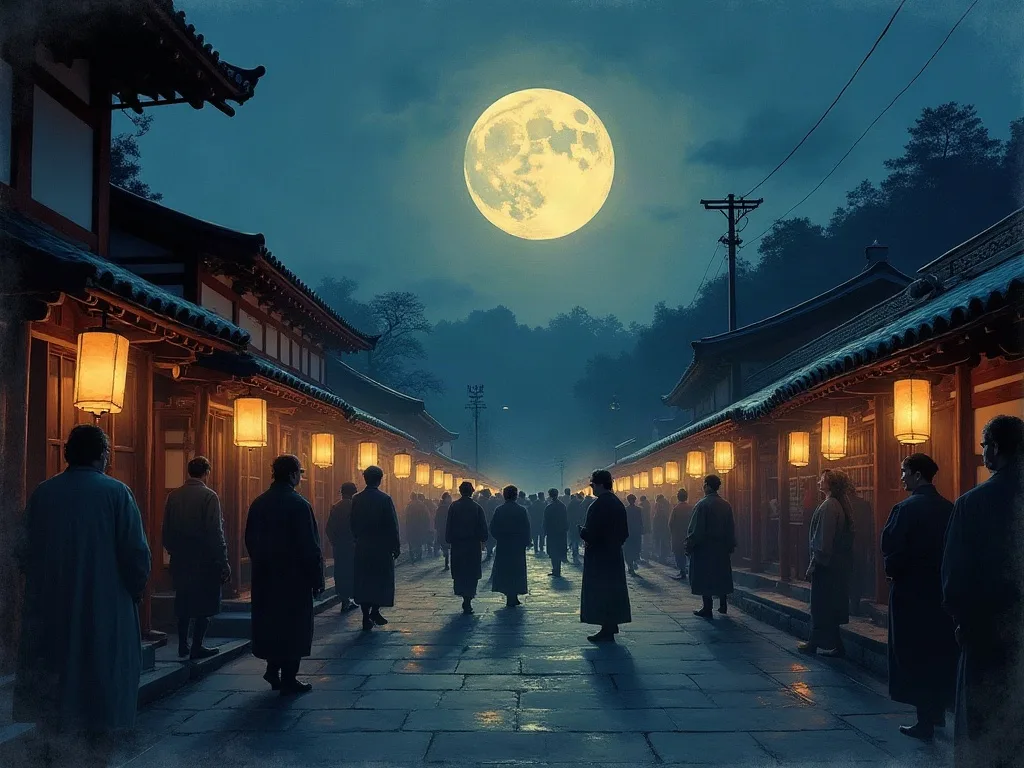
The moon itself acquired a complicated symbolic weight in Japanese culture. The moon was beautiful, yes. Poets wrote countless verses celebrating the autumn moon, the harvest moon, the moon reflecting in still water. But moonlight was also associated with haunting, with ghostly encounters, with the liminal spaces where normal rules dissolved. Tsukuyomi's realm became the realm of the supernatural, the liminal, the dangerous.
Tsukuyomi in Japanese Folklore and Modern Culture
While Tsukuyomi faded from central Shinto practice, he persisted in the broader landscape of Japanese folklore. Yokai, the supernatural beings that populate Japanese stories, often emerge under moonlight. These are not necessarily evil spirits; they are beings that exist at the boundary between the human and divine, the visible and invisible. Many are said to be active under Tsukuyomi's watch. Some folklore suggests yokai are born from the moon's rays, shaped by Tsukuyomi's distant gaze.
The tradition of moon-viewing in Japan, particularly during autumn, became one of the nation's most refined aesthetic practices. Moon-viewing parties (tsukimi) became occasions for poetry, music, and contemplation. Yet Tsukuyomi himself remained absent from these gatherings. The moon was celebrated; its god was not invoked.
In modern Japanese anime, manga, and video games, Tsukuyomi has experienced a kind of resurrection. Anime like "Demon Slayer" feature references to Tsukuyomi's fractured relationship with Amaterasu. The visual media of contemporary Japan, unbound by the constraints of formal Shinto doctrine, have reanimated the moon god as a complex figure: sometimes distant, sometimes menacing, sometimes tragic. Studio Ghibli's works occasionally reference lunar mythology without naming Tsukuyomi directly, but the atmosphere of his realm, quiet, strange, melancholic, pervades scenes set under the moon.
The Moon God and the Underworld
One aspect of Tsukuyomi that appears in some Japanese texts and interpretations connects him indirectly to Yomi, the underworld or land of the dead. Yomi is described in the Kojiki as a dark, decaying realm where the dead dwell. Izanami, the female creator god and Izanagi's partner, fell ill and went to Yomi after a childbirth accident. Izanagi followed her there but was horrified by what he found: his beloved partner had rotted, her body crawling with maggots and other horrors.
The name Yomi shares etymological roots with the word for darkness and shadow. Tsukuyomi's name can be read as "moon reader" or "moon counter," derived from "tsuki" (moon) and "yomi" (reading, counting, or darkness). While Tsukuyomi is not directly associated with Yomi in the central mythological texts, folk interpretations sometimes blur the lines. The moon's association with darkness, death, and the liminal spaces between worlds gave Tsukuyomi an indirect kinship with underworld themes.
This connection, while not explicit in the Kojiki, enriched Tsukuyomi's symbolic resonance in Japanese culture. The moon became a metaphor not just for beauty but for transience, for things hidden, for the knowledge of mortality that the moon's faithful rising and falling reminds us of each night.
Comparing Tsukuyomi to Other Moon Deities
Tsukuyomi god of the moon stands apart from moon deities in other cultures, not because his powers are different, but because of how his culture treats him. In Greek mythology, Selene is the moon goddess, and while she fades from prominence after the classical period, she is never actively erased or defiled. In Mesoamerican cosmology, the moon is often portrayed as a female deity, but she maintains her dignity and significance. In Hindu mythology, the moon god Chandra (or Soma) is celebrated in rituals and holds a place of honor in the cosmic order.
Tsukuyomi, by contrast, is cosmic yet othered. He is both creator and outcast, given immense responsibility and then removed from the conversation. This paradox is distinctly Japanese, a reflection of how Shinto balanced cosmic order with the need to center the imperial cult on Amaterasu. The brother who should have shared the sky became the brother locked in perpetual exile.
The Lingering Question of Reconciliation
The Kojiki does not record any reconciliation between Amaterasu and Tsukuyomi. Their separation is final. Yet in Japanese folk and literary tradition, there are hints of ambiguity. Some stories suggest Tsukuyomi rules with quiet competence, maintaining the night without complaint. Others suggest his separation from Amaterasu creates a cosmic tension that the natural world must constantly navigate.
One interpretation suggests that the relationship between sun and moon, visible in nature, reflects this mythological estrangement. The sun always chases the moon across the sky; they pursue but never meet. Eclipses, those rare moments when the two heavenly bodies align, become catastrophic events, cosmic mistakes that invert the proper order.
In this reading, Tsukuyomi is not a minor god but a cosmic force whose very nature requires his separation from Amaterasu. Their estrangement is not a story with a resolution; it is the foundation of how day and night, light and dark, visible and hidden, are meant to function.

Tsukuyomi in Contemporary Shinto and Global Mythology
Today, Tsukuyomi has few dedicated temples and no major national shrine. Yet he is not forgotten. Smaller shrines throughout Japan do honor him, and some folk practitioners still call upon the moon god for specific purposes: protection during night journeys, blessings during moonlit ceremonies, or invocation when seeking connection to the hidden and liminal realms.
The surge of interest in Japanese mythology globally, driven partly by anime, manga, and video games, has brought Tsukuyomi back into conversation. International audiences encountering Japanese mythology often find Tsukuyomi puzzling: why is the moon god so absent? The question itself becomes interesting. It reveals how mythology is not neutral history but a reflection of a culture's values, hierarchies, and power structures. The Kojiki was a tool of imperial propaganda. Amaterasu had to dominate. Tsukuyomi had to recede.
Yet in that receding, Tsukuyomi acquired something else: mystery. The gods who are most present in daily life become familiar, their stories worn smooth by repetition. The gods who are absent, marginal, hidden, take on uncanny power. Tsukuyomi rules a realm we cannot see while the sun is up. He governs the realm of dreams, reflection, and the strange beauty of night. In Japanese aesthetics, the unseen often carries more weight than the seen.
Frequently Asked Questions About Tsukuyomi
Frequently asked questions
What does the name Tsukuyomi mean?
Tsukuyomi's name derives from "tsuki" (moon) and "yomi" (counting, reading, or darkness). It can be translated as "moon reader" or "moon counter." The name suggests an observing, measuring deity, one who marks time through the moon's phases. Some scholars connect "yomi" to Yomi, the underworld, suggesting a deeper darkness embedded in the name itself.
Why does the Kojiki barely mention Tsukuyomi after his birth?
The Kojiki was written to legitimize imperial rule by making Amaterasu the supreme deity and the emperor her direct descendant. Tsukuyomi's continuing presence in the narrative would have undermined this hierarchy. By sidelining him after the conflict with Amaterasu, the writers ensured she occupied the cosmological center. This was not myth reflecting nature; it was myth shaped to serve politics.
Are there any Shinto festivals dedicated to Tsukuyomi?
Unlike Amaterasu, who has major festivals across Japan, Tsukuyomi has no nationally significant festival. Some local shrines dedicated to him hold modest observances, and moon-viewing ceremonies (tsukimi) occur during autumn, but these typically celebrate the moon's beauty rather than invoke Tsukuyomi specifically. This absence mirrors his marginalization in the mythological texts.
How is Tsukuyomi portrayed in modern anime and manga?
Contemporary Japanese media often depicts Tsukuyomi as a complex figure: sometimes melancholic or isolated, sometimes menacing or otherworldly, sometimes tragic. Works like "Demon Slayer" and various anime inspired by Shinto cosmology treat him as a being worthy of serious treatment, recovering some of the cosmic significance the classical texts denied him. These depictions offer a kind of modern reconciliation with the god the Kojiki sidelined.
Is Tsukuyomi the same as other moon deities in world mythology?
Tsukuyomi is uniquely positioned among world moon gods. While other traditions (Greek, Hindu, Mesoamerican) also feature moon deities, few are as explicitly rejected or marginalized by their own mythological canon. Tsukuyomi's estrangement from his sister and his removal from central religious practice reflect specific features of Japanese imperial Shinto and the politics of the Kojiki's composition.
The Silent Watcher of the Night
Tsukuyomi remains one of mythology's most compelling paradoxes. He is a supreme being, ruler of half the cosmos, born from the very eyes of the creator. Yet he is peripheral, rarely invoked, quickly forgotten in favor of his sister. His story asks why some gods command devotion and temples while others fade into the background, and it reveals the answer: not all myths are neutral records of belief. They are arguments, reflections of power, tools of politics.
In the centuries since the Kojiki fixed Tsukuyomi's story in writing, the moon god has become a figure of Japanese aesthetic tradition. The moon he rules inspired centuries of poetry, art, and contemplation. Yokai and supernatural beings are said to emerge under his watch. In the liminal spaces of Japanese folklore, in the ghostly beauty of autumn moonlight, in the dreams that come under his silent gaze, Tsukuyomi persists. He is less a presence than an absence, less a force invoked than a force felt. And perhaps that is exactly as the cosmos is meant to work: the moon does not demand worship; it simply rises, marks time, and reminds us that not everything visible in the day can be seen under the stars.
Free 25-page sample
Want the whole story?
Take the first 25 pages free. If it pulls you in, the full edition is yours as an instant PDF download, with a paperback on Amazon for selected titles.

Mythology
The World Mythology Book: The Gods, Heroes and Myths of Every Culture
The Gods, Heroes and Myths of Every Culture, in One Volume
The whole of world mythology in a single volume: Greek, Norse, Egyptian, Japanese, Hindu, Celtic, Slavic, Mesoamerican and African myths gathered side by side, each drawn from the primary sources.