

Typhon, Father of Monsters: Origin, Myths, and Monstrous Offspring
Typhon was the last great challenge to Zeus and the progenitor of nearly every monster in Greek myth. His story reveals what ancient Greeks feared most: chaos that could swallow the sky itself.
Contents
The mountain shook before anyone could name what was beneath it. Fire shot from a hundred serpent heads, each one speaking a different animal voice: lion, bull, hound, hiss. The gods of Olympus fled. Even Zeus, lord of thunder, hesitated before the thing rising from the earth. That thing was Typhon, and ancient Greek cosmology had saved its most terrifying figure for last.
He did not arrive in the tidy early chapters of creation. Typhon came after the Titans were already chained in Tartarus, after the Olympians had divided sky, sea, and underworld among themselves. He was a final, furious argument against divine order - a creature so vast that his head scraped the stars and his outspread hands could simultaneously touch the eastern and western horizons. Every monster that would ever terrorize a Greek hero traced a line of descent back to him and his mate Echidna. He is, without contest, the most generative figure in the Greek bestiary.
His story is also stranger, more layered, and more geographically mobile than most retellings admit. Multiple authors - Hesiod, Apollodorus, Pindar, Nonnus of Panopolis - each gave him a different face, a different birthplace, a different outcome. The myth kept growing because what Typhon represented never went away.
Who Fathered the Father: Typhon's Own Origins
The question of parentage shapes everything in Greek myth, and Typhon's parentage is itself contested across sources.
Hesiod, writing in the Theogony around 700 BCE, names Gaia (Earth) and Tartarus (the abyss beneath the underworld) as Typhon's parents. This pairing is remarkable. Gaia mated with the deepest, darkest pit in existence and produced a child that embodied both the unruly earth and the void below it. In Hesiod's telling, Gaia did this deliberately, as an act of revenge: the Olympians had imprisoned her children, the Titans, and she wanted one final champion capable of undoing the victory of Zeus.
Later sources complicate the picture. In some traditions, Typhon is the son of Hera alone, conceived without a male partner as a furious response to Zeus producing Athena from his own head without Hera's involvement. This version appears in the Homeric Hymn to Apollo and frames Typhon less as a cosmic force and more as a product of divine domestic rage. Hera, feeling humiliated, strikes the ground with her palm and calls on Gaia, Ouranos, and the Titans to give her a child mightier than Zeus. She sends the infant to the serpent Python at Delphi to be raised.
Still other sources - particularly Apollodorus in the Bibliotheca (written around the 1st-2nd century CE) - synthesize these strands without fully resolving them. Apollodorus keeps Gaia as the mother but gives Typhon the most elaborate physical description: from the thighs down, massive coiling vipers; a torso so broad it touched both horizons; a hundred serpent heads where a neck should be, each head speaking the voices of every beast.
What all versions agree on: Typhon arrived late, arrived angry, and arrived as the direct consequence of divine overreach. He is the universe pushing back.

The Body of the Storm: What Typhon Actually Looked Like
Greek authors competed to describe Typhon's form, and each account amplifies the horror.
Hesiod writes that fire flared from his eyes. His hundred heads - all dragon or serpent - produced sounds that ran the entire range of the animal world: sometimes the speech of gods, sometimes the bellow of a bull, sometimes the roar of a lion, sometimes the bark of a dog, sometimes a hiss so high it echoed through the mountains. The implication is that Typhon contained all of nature's vocal violence simultaneously.
Apollodorus places wings on his shoulders broad enough to blot out the sun when spread. His lower body is pure serpent, his upper body partly humanoid but superhuman in scale. His hands end in a hundred dragon heads instead of fingers - Apollodorus and Hesiod diverge here, but the effect is the same: Typhon is not a creature with a monstrous addition, he is monstrousness, structured into a body.
Nonnus of Panopolis, writing his epic Dionysiaca in the 5th century CE, gives the most baroque account. He describes Typhon as a kind of walking mountain range, armored with scales, radiating such heat that the sea boiled wherever he waded through it. Nonnus also preserves an unusual episode in which Typhon briefly defeats Zeus, steals his thunderbolts, and hides Zeus's sinews - a detail that speaks to genuine divine vulnerability.
The serpent imagery is not arbitrary. In ancient Greek thought, serpents belonged to chthonic (underworld, earth-deep) powers: they moved without limbs, lived underground, shed their skin, and were linked to both death and oracular wisdom. By making Typhon serpentine from the thighs down and serpentine in his many heads, the mythmakers placed him firmly in the category of things that precede human order and refuse to be domesticated.
His very name may derive from the Greek typho, meaning "to smoke" or "to smoulder." The word typhon also gave ancient Greek its term for a whirlwind or violent storm. When Homer uses the word in the Iliad to describe the wind Zeus sends against ships, the atmospheric and mythological meanings bleed together. Typhon is the storm before the storm has a name.
The Battle for the Sky: Zeus Against Typhon

The confrontation between Zeus and Typhon is one of the few moments in Greek myth when the outcome is genuinely in doubt. Most of the Olympian conflicts - the Titanomachy, the Gigantomachy - end with divine order triumphant and tidy. The Typhon episode is messier.
In Apollodorus's account, the approach of Typhon caused a mass flight among the Olympians. The gods transformed themselves into animals and fled to Egypt to hide - a detail that Greek authors used to explain why Egyptian gods took animal forms. Zeus alone stood firm, hurling thunderbolts at Typhon from a distance. Typhon closed the gap, grabbed Zeus, and - crucially - cut the sinews from Zeus's hands and feet, rendering the king of the gods helpless. He hid the sinews in a bearskin in Corycian Cave in Cilicia (southern modern Turkey), leaving Zeus a puppet without the ability to move.
Hermes and Pan recovered the sinews - or in some versions, the trickster Aegipan stole them back. Restored, Zeus resumed the battle from a chariot pulled by winged horses, hurling his bolts relentlessly. The fight carried across continents. Mountains were hurled. The Haimos range (modern Balkans) got its name, according to some traditions, from the blood (haima) Typhon shed there. The island of Sicily was placed over Typhon's finally defeated body - a geological explanation for the volcanic activity of Mount Etna.
Pindar's Pythian Ode 1 (written around 470 BCE) gives this Sicilian ending particular weight, describing Typhon as lying beneath Etna, his chest pressing against the earth, his outbreathing rising as smoke from the volcano's summit. The mountain becomes both a prison and a monument. Etna's eruptions are Typhon's breath; its lava flows are his blood finding cracks in the rock.
This geographical anchoring matters. The myth does not end with Typhon simply destroyed. He is contained, suppressed, but still present. The earth remains restless because what it contains is restless.
Echidna: The Other Half of the Monstrous Dynasty
No account of Typhon as father of monsters is complete without his mate. Echidna - whose name likely connects to the Greek word for viper - was herself a being of mixed natures: beautiful woman from the waist up, enormous serpent from the waist down. She was daughter of two possible lineages depending on the source: either the sea deities Phorcys and Ceto, or the chthonic pair Chrysaor and the Oceanid Callirhoe.
Hesiod calls her agauos, meaning "glorious" or "illustrious," which is jarring when applied to a half-serpent cave-dweller. The word choice signals that Echidna was not simply monstrous in the pejorative sense - she carried a terrible dignity. She lived in a cave beneath the earth, ate raw flesh, and was, according to Hesiod, immortal and ageless. The gods chose not to kill her. That detail is worth sitting with: even after Typhon's defeat, Echidna continued.
Together, Typhon and Echidna produced a roster of children that reads like a catalog of Greek heroic adventure:
- The Lernaean Hydra: the multi-headed water serpent slain by Heracles as his Second Labor. Each head severed produced two more unless the stump was immediately cauterized.
- The Nemean Lion: its hide was impervious to weapons. Heracles strangled it bare-handed and wore its skin.
- Cerberus: the three-headed dog guarding the entrance to the underworld. Heracles dragged him briefly into daylight as his Twelfth Labor.
- The Sphinx: posted at the gates of Thebes, she devoured travelers who could not answer her riddle. Oedipus answered correctly and she destroyed herself.
- The Chimera: lion in front, goat in the middle, serpent behind, breathing fire. Killed by Bellerophon riding Pegasus.
- Ladon: the serpent coiled around the tree bearing the golden apples in the garden of the Hesperides.
- Orthus: a two-headed dog, brother to Cerberus, who guarded the cattle of Geryon.
- The Colchian Dragon: sleepless guardian of the Golden Fleece.
- The Caucasian Eagle: the bird that ate Prometheus's liver each day. Some sources list this among Typhon's offspring; others do not.
The pattern is unmistakable. Every creature that a Greek hero was sent to overcome had roots in the same soil: the union of storm and serpent that predated Zeus's stable world. Killing a Typhon-child was, in symbolic terms, a re-enactment of Zeus's original battle. Each hero who succeeded was doing what the king of the gods had done - pushing back the chaos that never fully disappeared.
The Myth's Geography: From Cilicia to Sicily
Greek myth rarely happened in a vacuum. Typhon's story moved across the ancient world as trade routes, colonial settlements, and cultural contacts shifted the myth's audience.
His earliest associations are with Cilicia, the coastal region of what is now southern Turkey. Corycian Cave - a massive cavern near modern Cennet-Cehennem - was identified as the location where Typhon hid Zeus's sinews. The cave is genuinely enormous and geologically striking, which explains why it attracted mythological significance. Greek settlers in the region would have encountered local storm-deity traditions, and the Typhon myth almost certainly absorbed some of them.
The Hittite Song of Ullikummi and the Illuyanka myth, both documented centuries before Hesiod, follow similar patterns: a stone or serpent monster challenges the storm god, the storm god is initially defeated or incapacitated, divine allies intervene, order is restored. Scholars including Martin West (The East Face of Helicon, 1997) have traced direct transmission lines between these Near Eastern traditions and the Greek Typhon cycle. The detail of Zeus's severed sinews has a near-perfect parallel in the Hittite Kingship in Heaven texts, where the storm god Teshub is similarly incapacitated.
The myth then traveled west. When Greek colonies spread to Sicily in the 8th-6th centuries BCE, Etna became the obvious candidate for Typhon's prison. The volcano had been erupting visibly throughout historical memory; the myth gave the eruptions a narrative explanation. Pindar - a Theban poet writing for Sicilian patrons - cemented this association in Pythian Ode 1, calling Etna "the pillar of heaven" pressing down on a creature whose fire-breath makes the rivers run with lava.
Some ancient sources also connected Typhon to Egypt via the figure of Set - the Egyptian god of storms, desert, and chaos who murdered Osiris. Greek authors living in or writing about Egypt (notably Plutarch in De Iside et Osiride) explicitly identified Typhon with Set. Both were disorder personified; both were antithetical to divine kingship; both were ultimately contained rather than annihilated. The identification tells us something about how the ancient Mediterranean processed anxiety about violence that could not be permanently removed - only displaced.

Typhon in the Heroic Age: When the Children Carry the Father's Work
After his imprisonment beneath Etna, Typhon himself vanishes from active myth. But his work continues through his children, each one a fresh test for a new generation of mortals.
The Twelve Labors of Heracles are inseparable from Typhon's legacy. The Hydra, the Nemean Lion, Cerberus, and arguably Ladon represent four of the twelve. Heracles was not simply completing tasks for Eurystheus - he was systematically dismantling the Typhon-line, monster by monster, renegotiating the terms of the world's order. The fact that Hera (who in some sources was linked to Typhon's own birth) also persecuted Heracles adds a recursive dimension to the symbolism.
The Sphinx episode occupies its own mythic register. Unlike the Hydra, which could be subdued by muscle and fire, the Sphinx required language. She posed a riddle: what walks on four legs in the morning, two at noon, three in the evening? Oedipus answered "man," and the Sphinx threw herself from her rock. This detail suggests that Typhon's children were not all simply overcome by strength - some of them required human intelligence, the capacity for self-knowledge. Oedipus defeated the Sphinx by understanding what human beings are. The irony of Oedipus's later blindness to his own history makes the Sphinx episode even more resonant.
Bellerophon's destruction of the Chimera points in yet another direction. He required Pegasus, the winged horse, to maintain aerial distance while attacking. The Chimera breathed fire - the same substance Typhon himself radiated from his heads. Bellerophon killed her with a lead-tipped spear, the lead melting from the Chimera's own fire breath and choking her. The weapon that kills her is forged from her killing ability, turned against itself.
Jason's quest for the Golden Fleece brought him to Colchis and to Ladon's cousin, the sleepless Colchian Dragon. Medea, with her deep knowledge of chthonic chemistry, put the dragon to sleep with herbs and song - a solution that neither brute force nor martial courage could have achieved. Typhon's last guardian at Colchis required a woman who knew the older magic that predated Zeus's dispensation.
Symbolism and Deep Structure: What Typhon Actually Means
Greek mythology is not allegory in any simple sense, but its figures carry recognizable symbolic weight that scholars have unpacked across multiple interpretive frameworks.
At the most basic level, Typhon represents the disorder that precedes and underlies all order. He is what Gaia produced when she was sufficiently provoked - not a random monster but a structured answer to a structural problem. Zeus had imprisoned her children; she generated something that could not be imprisoned. The fact that he ultimately is imprisoned (under Etna) does not negate this - it confirms that the tension between order and chaos is permanent, not resolved.
The storm symbolism is also precise. Typhon's name connects to atmospheric violence; his children include creatures associated with unpredictable natural forces (the lion of the drought, the serpent of poisoned water, the hound at the threshold of death). He is what weather was before meteorology: inexplicable, violent, and almost alive in its apparent intention.
Walter Burkert, in Structure and History in Greek Mythology and Ritual (1979), situates the Typhon myth within a cross-cultural pattern of the "monster-hero combat myth" that appears across Indo-European and Near Eastern traditions. The combat produces order, but it also reveals that order is won, not given. The Olympian world is not natural - it was built on top of something older and remains vulnerable to it.
There is also a reading rooted in political theology. Typhon challenges divine kingship directly. He steals the sinews of Zeus - the physical basis of Zeus's power - and hides them. This episode reads almost like a coup: the king is immobilized, his instruments of power removed, his legitimacy suspended. The gods scatter. Only when the instruments are returned (by Hermes, god of thieves and travelers, of all people) can the king be restored. The myth encodes a real anxiety: that sovereignty is never absolute, that it depends on instruments, allies, and luck.
Cross-Cultural Parallels: Typhon Beyond Greece
The storm-serpent who challenges the sky god appears in traditions far beyond the Mediterranean, and the structural similarities are close enough to warrant serious comparison.
The Babylonian Enuma Elish features Tiamat, the salt-water dragon of primordial chaos, who assembles a monster army and challenges the younger gods. Marduk kills her, splits her body, and uses it to build the cosmos. The defeated chaos monster literally becomes the world's material - a transformation Typhon does not undergo, though Mount Etna as his body comes close to the same logic.
The Vedic tradition offers Vritra, the serpent or dragon of drought, who swallows the cosmic waters and blocks the rivers. Indra kills Vritra with the thunderbolt (vajra), releasing the waters and restoring fertility. Both Zeus's thunderbolt and Indra's vajra function identically as instruments of storm-god sovereignty against serpentine chaos.
The Norse tradition has Jormungandr, the Midgard Serpent encircling the world, who is Thor's destined adversary at Ragnarok. Like Typhon, Jormungandr is contained (beneath the sea rather than beneath a volcano); like Typhon, he is not destroyed until the world-ending battle. The containment is temporary, the threat permanent.
What separates Typhon from most of these parallels is his productivity. Tiamat fights but does not parent the next generation of monsters systematically. Vritra is a single figure. Jormungandr is one of three Loki-children. Only Typhon presides over an entire bestiary. He is not just the enemy of order - he is its supplier of antagonists. Every hero who came after the Typhon battle needed Typhon's children to have something worth fighting. There is almost a collaborative logic buried in the structure: the gods of order need the monsters of chaos to produce the heroes who justify both.
Typhon in Modernity: From Renaissance Maps to Video Games
Typhon left the ancient world and entered Western culture through the Renaissance recovery of Greek texts. The word typhoon (from Greek via Arabic tufan and possibly Chinese tai fung) preserves the ancient association between the mythological figure and violent atmospheric events. Every meteorological typhoon carries the faint memory of the hundred-headed storm beneath Etna.
In literature, Typhon appears in Milton's Paradise Lost as one of the analogies for Satan's fall - Milton knew his classical sources well enough to reach for the most extreme figure in the Greek bestiary when he needed a parallel for the rebel against divine authority. Spenser's Faerie Queene and Rabelais's Gargantua both allude to the Typhon tradition in their own monster catalogs.
The 19th century brought Romantic and Gothic appropriations. Mary Shelley's creature in Frankenstein echoes several Typhon-lineage themes: a being created from existing parts, rejected by its creator, turned against the order that produced it. The creature even quotes Milton, who borrowed Typhon. The chain of allusion runs deep.
In contemporary popular culture, Typhon appears with varying degrees of mythological accuracy. The 2017 video game Prey (Arkane Studios) features a species of alien predators called the Typhon, drawing on the creature's identity as something fundamentally other to human order. God of War (2018) places Typhon as a Titan chained within a mountain, from whom Kratos steals the Typhon's Bane weapon. The game collapses several mythological traditions but preserves the volcanic imprisonment detail correctly.
Rick Riordan's Percy Jackson series introduces Typhon (and Echidna with the Chimera) to a generation of young readers. Riordan's Typhon is visually spectacular - a walking natural disaster - though stripped of the sophisticated theological implications that Hesiod and Apollodorus packed into the figure.
The figure continues to work precisely because the underlying symbolism never became obsolete. Volcanic eruptions still need explaining. Order still feels precarious. The idea that beneath civilization's structure there remains something enormous, serpentine, and only barely suppressed resonates as readily in 2026 as it did in 700 BCE.
Frequently Asked Questions About Typhon, Father of Monsters
Frequently asked questions
Is Typhon the strongest monster in Greek mythology?
Typhon is consistently described as the most powerful monster Zeus ever faced, more dangerous than the Titans and the Giants combined. Hesiod calls him the "strength of the gods," and the episode in Apollodorus where Zeus is physically incapacitated and stripped of his thunderbolts is unique in Olympian myth. No other single figure came so close to overturning divine rule. Whether "strongest" applies depends on the metric: the Gigantes required all the Olympians plus a mortal hero (Heracles) to defeat, while Typhon was ultimately overcome by Zeus alone after regaining his sinews.
What is the difference between Typhon and the Giants (Gigantes)?
The Gigantes and Typhon belong to separate mythological events. The Gigantomachy (battle against the Giants) preceded the Typhon episode and involved the entire Olympian pantheon fighting a war against the children of Gaia and Ouranos's blood. Typhon came after, as Gaia's final act of resistance. The Giants were many; Typhon was singular. The Giants required Heracles's mortal participation to be killed; Typhon was eventually defeated by Zeus alone. They represent different types of threat: the Giants are a military rebellion; Typhon is a cosmological crisis.
Why did the other gods flee when Typhon appeared?
According to Apollodorus, the sight of Typhon caused the Olympian gods to transform into animals and flee to Egypt. This detail served a specific explanatory purpose for Greek authors trying to account for Egyptian animal-headed deities: the gods took animal forms as disguises while hiding from Typhon and the forms became permanent in Egypt's religious tradition. The flight also served a narrative function, isolating Zeus as the sole defender of Olympus and heightening the stakes of the final confrontation.
Is Echidna immortal? What happened to her after Typhon was defeated?
Hesiod states explicitly that Echidna was immortal and ageless (athanaton kai ageron). After Typhon's imprisonment, the gods chose not to pursue or destroy her - a deliberate choice, not an oversight. She continued to dwell in her cave and, according to some traditions, was eventually killed while sleeping by Argus Panoptes, the hundred-eyed giant set by Hera to guard Io. This death sits awkwardly with Hesiod's claim of immortality, which is why scholars treat it as a later addition grafted onto the tradition. In the earliest stratum of the myth, Echidna simply persists.
How does Typhon relate to the Egyptian god Set?
Greek and Roman authors, particularly Plutarch in De Iside et Osiride (circa 100 CE), explicitly identified Typhon with the Egyptian Set. Both were chaos figures opposed to legitimate divine kingship; both were associated with storms and the desert; both murdered or incapacitated the ruling deity (Osiris in Set's case, Zeus temporarily in Typhon's). The identification was not casual - it reflected a genuine interpretive tradition in which Mediterranean cultures mapped their own chaos-gods onto one another. Modern scholarship treats this as religious syncretism rather than literal equivalence, since the two traditions developed independently before contact.
Where did Typhon come from before Greek mythology? Are there older versions?
Strong comparative evidence points to Anatolian and Near Eastern antecedents. The Hittite myth of Illuyanka (a dragon who defeats the storm god Teshub, temporarily incapacitating him) shares the core structure of the Zeus-Typhon conflict. The Hittite Song of Ullikummi features a stone monster who grows to threaten the gods from below. Martin West's The East Face of Helicon (1997) documents these parallels carefully and argues for direct transmission via Cilicia, where Greek and Hittite cultural zones overlapped. The Typhon myth, in this reading, is a Greek adaptation of a very old Near Eastern storm-combat tradition rather than a purely indigenous Greek invention.
The Unresolved God: Why Typhon Could Not Simply Be Killed
Something deliberate runs through every ancient treatment of Typhon: the gods choose containment over annihilation. Zeus hurls enough thunderbolts to reshape geography, pins Typhon under an entire mountain range, imprisons him specifically under a live volcano whose eruptions are Typhon's continuing respiration. But Zeus does not destroy him.
Echidna is allowed to keep living after her mate's defeat. The children - Cerberus, Ladon, the Colchian Dragon - continue to exist, employed as guardians by the gods themselves. Hades uses Cerberus. The Hesperides' garden requires Ladon. The very institutions of divine order need what Typhon produced.
This points to something the Greeks understood with unusual clarity: disorder is not optional. A cosmos from which all chaos had been permanently removed would not be a better cosmos - it would be a static one, incapable of generating heroes, incapable of change. Typhon's imprisonment is careful rather than terminal because his destruction would deprive the world of its friction. The Labors of Heracles need the Hydra. The glory of Thebes needs the Sphinx. The Golden Fleece needs its dragon.
Modern readers sometimes assume that myths work toward endings: monster killed, order restored, curtain down. The Typhon cycle resists that reading at every point. Etna still erupts. The earth still moves. Whatever lies beneath the oldest layer of Greek religious imagination continues to breathe, and the whole structure of Olympian civilization rests on the thin rock above it.
That, perhaps, is Typhon's deepest meaning. He is not what civilization defeated. He is what civilization is built on top of.
Read the full book
Want the whole story?
The complete edition is an instant PDF download here, with a paperback on Amazon for selected titles.
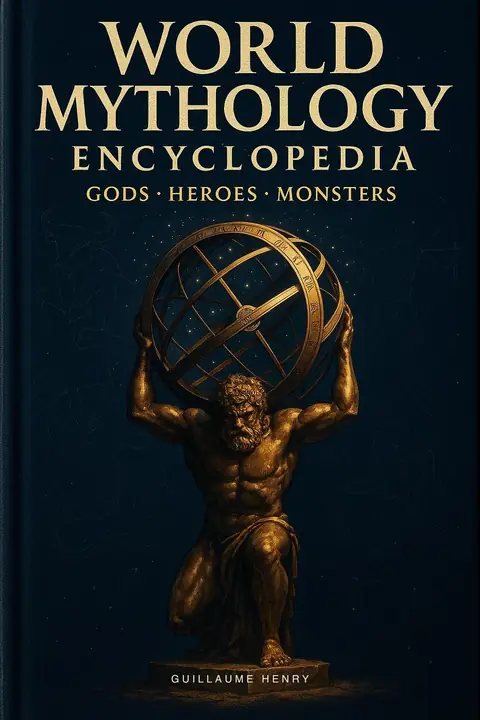
Mythology
The World Mythology Book: The Gods, Heroes and Myths of Every Culture
The Gods, Heroes and Myths of Every Culture, in One Volume
The whole of world mythology in a single volume: Greek, Norse, Egyptian, Japanese, Hindu, Celtic, Slavic, Mesoamerican and African myths gathered side by side, each drawn from the primary sources.