
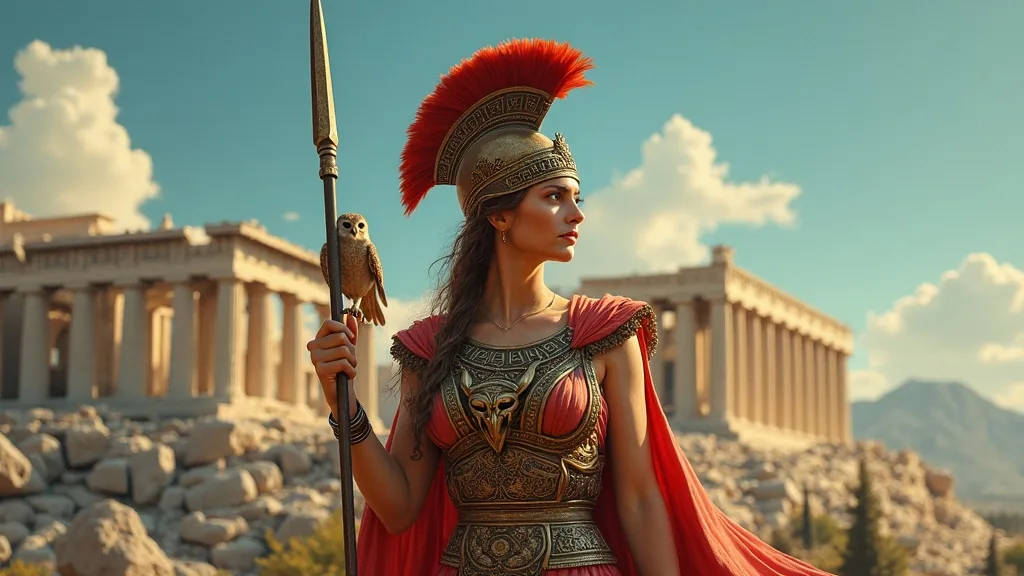
Athena: Goddess of Wisdom, War, and the Crafts of Civilization
Born fully armed from the skull of Zeus, Athena presided over wisdom, strategy, and the arts that make civilization possible. Meet the Olympian who shaped the ancient Greek world.
Contents
Athena stands apart among the twelve Olympians. Other gods chase mortals, spark wars out of wounded pride, or succumb to fits of rage. Athena plans. She calculates. She appears at the shoulder of heroes not to do the fighting for them but to sharpen the mind behind the spear. The ancient Greeks did not simply worship her as an abstract principle of intellect; they built her the most famous temple on earth and named their greatest city in her honor. That devotion tells us something essential: in the Greek imagination, wisdom was not passive. It was a force that won wars, raised cities, and kept chaos at bay.
The Birth That Shook Olympus

The origin of Athena is one of the most arresting images in all of Greek mythology. Zeus had swallowed his first wife, the Titaness Metis, after receiving a prophecy that any child born of her would surpass the father in power. Metis, goddess of cunning thought, was already pregnant. Inside the body of Zeus she fashioned armor and a helmet for the child she carried. The hammering caused Zeus such monstrous headaches that he called for Hephaestus (or, in some traditions, Prometheus) to split his skull open with an axe. From that wound Athena leapt out, fully grown, fully armed, and shouting a war cry that made the heavens tremble and the sea surge.
The myth is layered with meaning. By consuming Metis and giving birth through his own head, Zeus effectively absorbed cunning intelligence into himself and produced a daughter who embodied it entirely. Athena carries both her father's authority and her mother's craftiness. She is, in a real sense, the wisdom of Zeus made visible and independent.
Names and Epithets
Ancient sources give Athena a rich vocabulary of epithets that map the breadth of her domain:
- Pallas Athena: the most common compound name, possibly derived from a childhood companion she accidentally killed, or from the Greek word for "maiden" (pallax).
- Athena Polias: protector of the city (polis), honored on the Acropolis as guardian of Athens itself.
- Athena Promachos: "she who fights in the front rank," the warrior aspect, celebrated in a colossal bronze statue by Pheidias that stood on the Acropolis plateau.
- Athena Ergane: patroness of craftsmen and weavers, worshipped by potters, metalworkers, and textile workers throughout the Greek world.
- Glaukopis: "bright-eyed" or "owl-eyed," the epithet Homer uses most consistently in the Iliad and the Odyssey.
Athena the Warrior: Strategy Over Slaughter
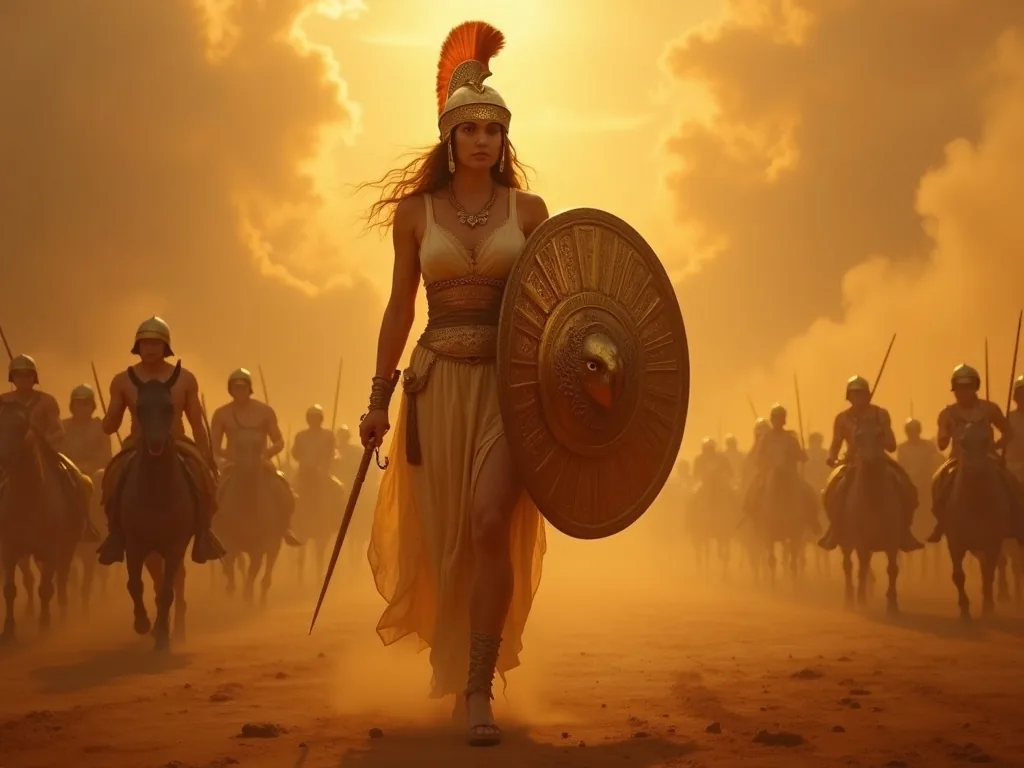
Athena is emphatically a goddess of war, yet she occupies a different register than Ares, the god of bloodlust and brute conflict. Where Ares delights in carnage for its own sake, Athena represents the disciplined intelligence that wins campaigns. Homer makes this contrast explicit: Ares fights on the Trojan side, furious and reckless, while Athena supports the Greeks with counsel, disguise, and precision intervention.
In the Iliad, she physically deflects a spear meant for Menelaos, whispers tactics into the ears of Diomedes, and famously strikes Ares himself to the ground when he rages too freely on the battlefield. She does not shrink from violence, but violence in her hands is always purposeful.
Her relationship with Odysseus in the Odyssey reveals another dimension of the warrior aspect. Odysseus survives not through superior strength but through intelligence, disguise, and patient endurance. Athena is his divine patron precisely because his mode of heroism mirrors her own. She tells him openly in Book 13 of the Odyssey: "We are both alike in this: among all mortal men you are by far the most eloquent and resourceful, and among all the gods I am famed for my cunning and resource." The goddess recognizes a kindred spirit.
Goddess of Wisdom and the Crafts of Civilization
Athena's wisdom is not confined to philosophy or strategy. In the ancient Greek conception, wisdom was thoroughly practical. It was the knowledge of how to do things well: how to weave cloth, fire a pot, navigate by the stars, govern a city, or resolve a dispute without bloodshed.
The Gift of the Olive Tree
The founding myth of Athens captures this practical wisdom perfectly. Poseidon and Athena both desired the patronage of the great city of Attica, and the citizens (or, in some versions, the Olympian gods) agreed to judge them by the usefulness of their gifts. Poseidon struck his trident against the Acropolis rock and produced a saltwater spring, or in some traditions a horse, symbol of warfare and speed. Athena drove her spear into the earth and a gray-green olive tree burst upward.
The olive was not merely a tree. It provided oil for cooking, for light, for medicine, for anointing athletes and the dead. Its wood could be worked into tools and furniture. Its fruit sustained communities through lean seasons. The judges awarded Athena the patronage of the city, and Athens took her name. The sacred olive tree on the Acropolis, supposedly the original one sprung from her spear, was venerated for centuries. Even after Persian forces burned it during the invasion of 480 BCE, ancient writers record that new shoots appeared from the stump the very next day, a sign the goddess had not abandoned her city.
Athena and Arachne
One of the most psychologically rich myths attached to Athena is her contest with Arachne, the mortal weaver from Lydia. Arachne was supernaturally gifted at the loom and boasted she could match or surpass Athena herself. The goddess appeared in disguise as an old woman and urged the girl to moderate her pride. Arachne refused. Athena revealed herself and the contest began.
Both weavings were technically perfect. Athena depicted the gods in their glory, including the contest for Athens. Arachne wove a tapestry showing the gods in their most scandalous moments: the deceits of Zeus, the seductions of Poseidon, the humiliations inflicted on mortals. Athena, enraged by the impiety rather than by any inferiority in craftsmanship, destroyed the tapestry. Arachne, in despair, hanged herself. Athena, moved by some mixture of guilt and pity, transformed her into the first spider, condemning and preserving her in one gesture. The spider, Arachne's descendant, still weaves perpetual webs, still labors with extraordinary precision, forever locked in the same compulsion.
The myth says something uncomfortable about Athena: her wisdom has its limits. Pride can override even the most rational of gods.
The Panathenaia and the Parthenon

No goddess in antiquity received a more spectacular civic cult than Athena in Athens. The Panathenaia, held annually with a grand version every four years (the Great Panathenaia), was the city's most important festival. Citizens, resident foreigners, and representatives from allied states processed up the Acropolis in a vast procession carrying a new woven robe, the peplos, to dress the ancient olive-wood cult statue of Athena Polias housed in the Erechtheion. The procession is famously depicted on the Parthenon frieze, carved around 438 BCE under the direction of Pheidias.
The Parthenon itself, built between 447 and 432 BCE at the initiative of Pericles, housed one of the ancient world's most celebrated artworks: the chryselephantine statue of Athena Parthenos (Athena the Virgin) by Pheidias. Standing approximately twelve meters tall, it was constructed of gold and ivory over a wooden core. The goddess stood holding a small winged Nike in her outstretched right hand and a great shield in her left. A serpent coiled at her feet. The crest of her helmet was formed by a sphinx flanked by griffins. Ancient visitors traveled from across the Mediterranean world to see it.
The temple's name, "Parthenon," draws from "parthenos," meaning virgin or maiden. Athena's status as a virgin goddess was central to her identity. Unlike Aphrodite or Hera, she stood outside the cycles of desire and reproduction. Her clarity of mind, the ancient Greeks implied, was connected to this freedom from erotic entanglement. She was whole unto herself.
Athena and the Roman Minerva
When Roman religion absorbed Greek mythology, Athena was identified with Minerva, the Italic goddess of crafts and wisdom who had been worshipped at Rome since early times. Minerva held a place in the Capitoline Triad alongside Jupiter and Juno, and her festival, the Quinquatria, was celebrated by craftsmen, teachers, and students. The identification was close but not perfect: Minerva's martial dimension was less prominent than Athena's, and her connection to healing arts was somewhat stronger. Roman poets, particularly Ovid in the Metamorphoses, largely treated the two as interchangeable, giving Athena's stories to Minerva with minimal alteration.
The Owl, the Serpent, and the Aegis
Athena's symbolic world is dense with meaning. The little owl (Athena noctua, still scientifically named for her) became the emblem of Athens and appeared on Athenian silver coins for centuries. Owls see in the dark; their gaze is calm and penetrating, attributes that mapped perfectly onto a goddess of clear-sighted wisdom.
The serpent is equally important. A great snake, variously interpreted as the spirit of the Athenian hero Erichthonios (whom Athena raised from infancy) or as a general symbol of chthonic guardianship, was kept in the Erechtheion and fed honey cakes. When the snake refused to eat before the Persian invasion, Athenians took it as a sign that the goddess herself had abandoned the city, however temporarily.
The aegis, the terrifying divine shield or breastplate bearing the head of the Gorgon Medusa, belonged originally to Zeus but was frequently wielded or worn by Athena. Perseus, who beheaded Medusa with Athena's guidance and a mirrored shield, gave the severed head to the goddess as tribute. She fixed it to her aegis, turning her divine armor into a weapon that could petrify enemies with a glance. The Gorgon's face, which had been a source of mortal terror, became in Athena's hands a tool of protection and sovereignty.
Athena in the Modern Imagination
The figure of Athena has never gone quiet. She persists in the name of Athens itself, the most culturally resonant city of classical antiquity. The owl of Minerva, which the philosopher Hegel made famous by observing that it "takes flight only at the falling of the dusk," became a symbol for the philosophical tradition: wisdom arrives after the fact, once the day's events have settled into comprehensible form. The image of Athena decorates law courts, libraries, and universities across the Western world, a testament to how deeply the ancient Greek vision of disciplined intelligence embedded itself in later civilizations.
She endures because the questions she embodies remain urgent. What is wisdom, exactly? Is it knowledge, strategy, craft, or judgment? Is it compatible with violence? Can a mind be so sharp that it loses sight of mercy? Athena does not answer these questions cleanly. She raised Erichthonios with tenderness. She helped Perseus and guided Odysseus with patience. She also turned Arachne into a spider and blinded Teiresias for seeing her bathe. She rewards brilliance and punishes hubris, often in the same breath.
That tension, between luminous clarity and cold severity, is precisely what makes Athena the most intellectually compelling deity in the Greek pantheon.
Free 25-page sample
Want the whole story?
Take the first 25 pages free. If it pulls you in, the full edition is yours as an instant PDF download, with a paperback on Amazon for selected titles.
Greek
The Greek Mythology Book: Zeus, the Olympians, the Heroes, and the Sacred Stories of Ancient Greece
Zeus, the Olympians, the Heroes, and the Sacred Stories of Ancient Greece
The complete guide to Greek mythology from Hesiod's Theogony to Homer's epics. Every Olympian, every hero, every descent to the underworld.
More from Greek
All articles
Greek
The Trojan War Origins: Discord, Desire, and the Apple That Broke the World
Before a single spear was thrown at Troy, a golden apple rolled across a banquet table and three goddesses made demands of a mortal shepherd. The seeds of the Trojan War were sown in divine vanity, a stolen bride, and a promise no one could keep.

Greek
Medusa the Gorgon: Monster, Martyr, and Mirror of Greek Fear
Medusa the Gorgon turns stone every eye that meets hers, yet her own story is one of transformation, divine violence, and enduring power. Here is the full myth, from serpent hair to severed head.

Greek
Apollo, God of Light: Sun, Prophecy, and the Radiant Mind
Apollo blazes at the center of Greek religion as the god of light, music, prophecy, and healing. His myths illuminate the ancient Greek vision of a world governed by reason, beauty, and divine order.

Greek
How the Greek Gods of Time Invented the Clock
How Chronos, Kairos, and the Horai shaped Greek timekeeping, from divine personification to the water clocks of Ctesibius and Plato's alarm.