

Urashima Tarō: The Fisherman's Tale and Japan's Eternal Time
A young fisherman rescues a turtle, joins a princess in an undersea palace, and returns to find centuries have passed. Urashima Tarō's journey through the Dragon King's realm reveals how Japanese folklore moves between worlds, bends time itself, and binds mortals to consequences. The tale sits at the heart of Shinto imagination.
Contents
A young fisherman cast his line into the sea off the coast of Tango Province. His name was Urashima Tarō. The year was sometime long ago; the story never promises certainty about time. He caught what he thought was a strange turtle, shimmering and old. Instead of harming it, he cut it loose.
The turtle vanished beneath the waves. Three days later, a beautiful woman arrived at his hut, saying she was the turtle he had saved, transformed into human form. She invited him to the Palace of the Dragon King under the sea. Tarō followed her down.
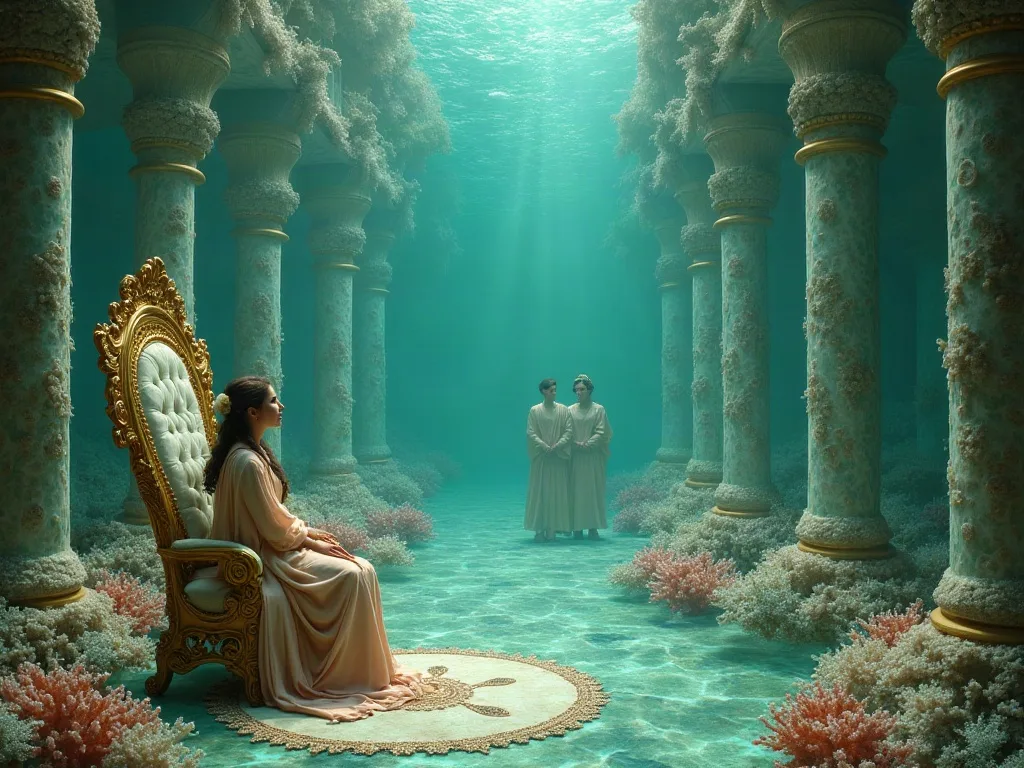
He spent what felt like three days in that palace, feasting with the princess, walking through gardens that bloomed with coral flowers and trees that bore jeweled fruit. The Dragon King himself welcomed him as a guest. When Tarō finally asked to return to his village, the princess gave him a gift: a small wooden box. "Do not open it," she warned. "It holds your promise to return to me."
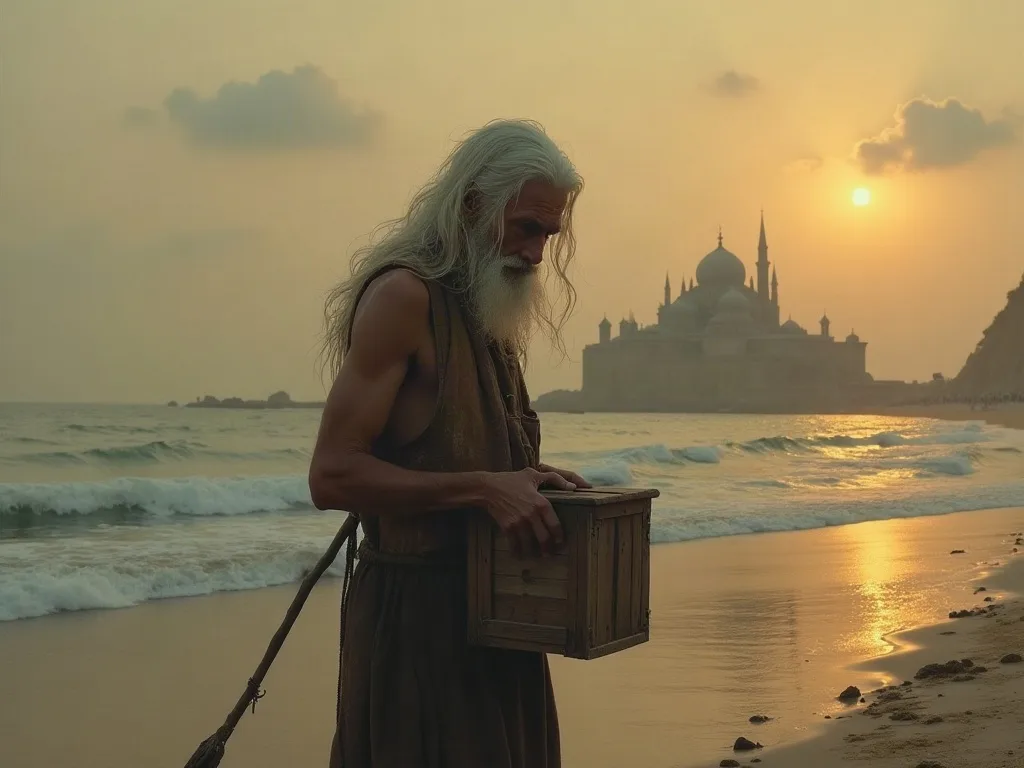
Tarō surfaced. He walked up the beach toward his village. Nothing was as he left it. The houses were different. The people he knew were gone. He asked an old man where his parents lived. The stranger looked puzzled. "Your parents? Boy, they died three hundred years ago. You're speaking of the time of the Emperor Yūryaku." Tarō had been gone for three centuries.
Desperate and alone, he opened the box the princess had forbidden him to touch. A purple mist rose from it. His hair turned white instantly. His skin withered. His bones became frail. He aged three hundred years in the time it takes to breathe. The punishment for breaking faith was to become what he had been all along: a mortal man, finally caught by time.
The Story's Deep Roots in Japanese Literature
This tale first appears in written form in the early 8th century collection called the Tango Fudoki, a record of the Tango Province (in modern Kyoto Prefecture). It describes local geography, customs, and legends. Most of the Tango Fudoki is lost, but later compilations preserve Urashima Tarō's story. By the medieval period, it had migrated into the Otogizōshi, a genre of popular illustrated storybooks that spread across Japan from the 15th century onward.
What makes Urashima Tarō different from a simple fairy tale is how it reflects the core anxieties of Japanese cosmology. The story does not ask whether the underwater realm exists. It assumes it does. The question is whether a mortal can stay there without being transformed by time itself.
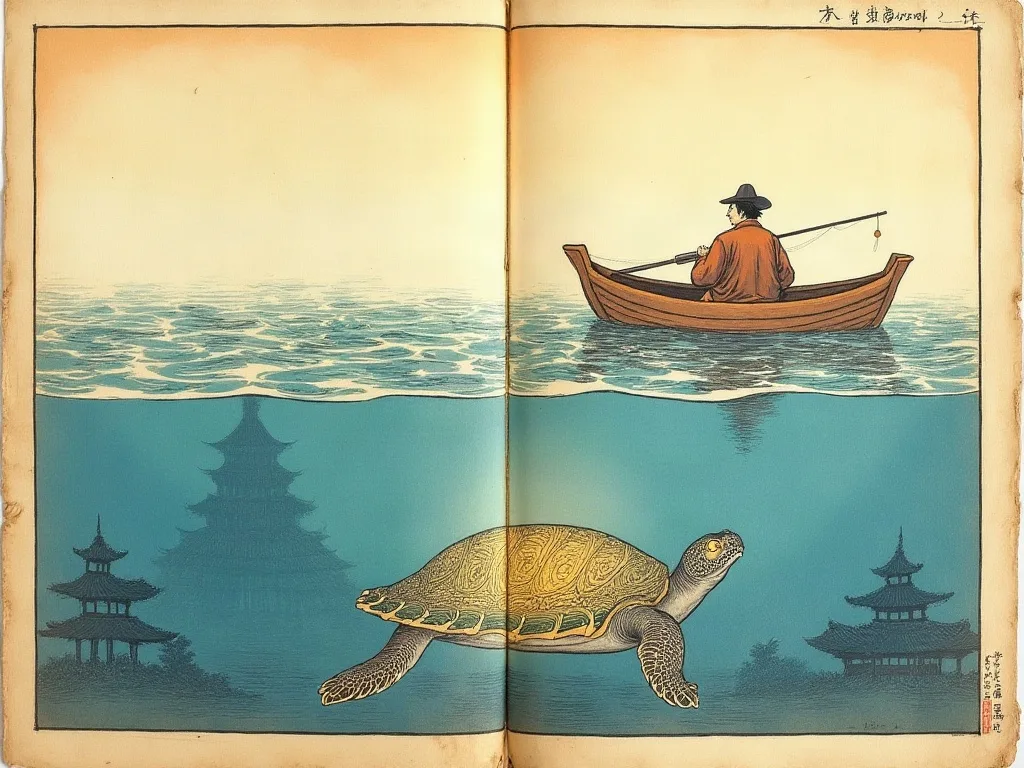
The Kojiki, Japan's oldest written chronicle (compiled 712 CE), establishes that the universe contains multiple realms: the realm of heaven where the kami dwell, the realm of the earth where humans live, and the realm of the dead (Yomi), a place of corruption and darkness. The sea, in Shinto cosmology, is not empty. It is inhabited by the Dragon King (Ryūjin in Japanese), a kami of immense power who controls tides, weather, and the boundary between the visible and invisible worlds.
Urashima Tarō's journey is not a flight to fantasy. It is a descent into a realm governed by different laws of time and mortality. In the Dragon King's palace, he experiences kaibyaku, a concept meaning "in the space between worlds." Time does not move normally there. What feels like three days is actually three centuries in the human realm.
The Princess and the Kami of Transformation
The princess who appears to Tarō is herself a kami, or at minimum a being of non-human origin. In Japanese folklore, the line between human and kami is permeable. A turtle of sufficient age and virtue could acquire a soul and the ability to transform. This is not reincarnation in the Buddhist sense. It is metamorphosis: the turtle's spirit assumes a more complex form.
The princess represents a maternal or nurturing kami presence. She offers Tarō food, shelter, celebration, and genuine affection. She asks only one thing: that he keep faith with the gift she gives him. Her warning about the box is not a test. It is a covenant. The box holds his oath, his yakusoku, his binding promise to return.
When Tarō opens it, he breaks that covenant. In Shinto ethics, such a break has immediate spiritual consequence. He cannot simply ignore what he has sworn. The universe itself corrects him. The princess, for all her gentleness, is still a kami, and kami enforce the conditions they set. The mist that ages him is not punishment in a moral sense. It is the natural result of severing his link to a place where time moves differently. He returns fully to the human world and is caught by human time: three hundred years of aging happening at once.
The Dragon King's Realm and Shinto Cosmography
The Dragon King's palace appears in multiple Japanese narratives. In the Nihon Shoki (Chronicles of Japan, compiled 720 CE), the Dragon King is described as a kami dwelling in the sea, capable of bringing drought or abundance. In the Otogizōshi, his underwater palace is often depicted as a place of infinite wealth, gardens that never wither, and food that never spoils.
This realm is not heaven in the Christian sense. It is a parallel world where different rules apply. Time moves at a different rate. Aging does not occur. Hunger and sorrow are unknown. Yet it is not paradise, either. It is a gilded cage. To remain there forever, a human must become something other than human. Tarō cannot.
The coral gardens and jeweled trees are not mere decoration. They represent the sea's abundance translated into forms the human eye can recognize. A kami dwelling underwater might perceive their realm as entirely natural. To a human visitor, it appears alien and wondrous. The Shinto tradition recognizes that perception is real; what one sees depends on what one is.
The Dragon King himself accepts Tarō as a guest because Tarō performed an act of compassion. In Shinto ethics, kindness to animals, particularly to creatures associated with water and fertility, generates virtue (toku). This virtue creates a bond. The Dragon King honors that bond by granting access to his realm. But the access comes with a condition: Tarō must accept the realm's terms or face the consequences of his own nature.
Time, Memory, and the Mortal Condition
The cruelest element of Urashima Tarō's story is not the aging itself. It is the loss of continuity. He returns to a world where everyone he knew is dead. His house is gone. His name has no meaning. He has become a stranger in his own land. The gift of the princess, which seemed like a blessing, has become a curse.
This reflects a Japanese philosophical concern that runs deep: the awareness that time moves forward, that the past cannot be recovered, and that even love cannot stop the wheel. The mono no aware, or "pathos of things," is an aesthetic concept describing the bittersweet sorrow of impermanence. Urashima Tarō embodies it completely. He has touched immortality, lived in a realm outside time, and because of that, he cannot belong anywhere.
Some versions of the tale end differently. In certain retellings, Tarō does not age into death. Instead, he dissolves into mist, returns to the sea, or becomes a spirit himself. These variations suggest that once a mortal has crossed into the kami realm and broken faith with it, they cannot fully return to humanity. They are caught between worlds.
The Box as Covenant and Consequence
The box is the story's greatest symbol. It is called the tamatebako (ball-shaped box) in most versions. The princess describes it as holding "time" or "his promise." The box is sealed. Tarō is told not to open it. His desire to open it is not portrayed as evil curiosity. It is portrayed as inevitable human weakness.
In Shinto tradition, sealed objects are sacred. A sealed shrine contains kami. A sealed jar contains a spirit. To open what has been sealed is to release what was contained and to break a bond. Tarō's opening of the box is not a moment of stupidity. It is a moment of profound humanity. He wants to know. He wants to understand what he has lost. He cannot bear not knowing.
The consequence is swift and metaphysically logical. He becomes visible proof that time works differently in the two realms. His body, denied aging for three hundred years, must now account for all of it at once. His hair whitens. His skin wrinkles. His strength fades. In minutes, he experiences what a human would experience across three centuries.
How Urashima Tarō Shaped Japanese Folklore
By the Edo period (1603-1868), Urashima Tarō had become a cultural touchstone. He appears in woodblock prints, puppet plays, kabuki theater, and folk art. The story was told and retold, adapted and transformed. Some versions added more details. Some streamlined it. The core always remained: a mortal enters the kami realm, time moves differently there, and breaking faith brings consequence.
The tale influenced how Japanese storytellers understood the relationship between the human world and the spirit world. It established a template. A descent into the supernatural is not inherently harmful, but it comes with conditions. Those conditions must be honored. Breaking them is not merely disobedience; it is a metaphysical rupture that cannot be undone.
In modern retellings, Urashima Tarō appears in anime, manga, and film. Isao Takahata's film The Tale of Princess Kaguya (2013) echoes its structure: a being from another realm cannot fully belong to the human world, and the attempt to bridge the two creates sorrow. The logic of Urashima Tarō runs through these works like an underground current.
The story also shaped how Japanese culture thinks about the sea. The sea is not empty. It is not merely a barrier between islands. It is a boundary, a threshold, a space where different laws apply. The sea is where kami dwell. It is beautiful and dangerous. To cross it or descend into it is to accept the possibility of transformation.
Yokai, Kami, and the Spectrum of Non-Human Beings
The turtle that rescues Tarō occupies an important place in the Japanese taxonomy of supernatural beings. It is not quite a yokai, though it displays yokai characteristics. A yokai is a being of ambiguous nature, neither fully spirit nor fully physical, often mischievous or dangerous. A kami is typically a spirit with a domain (a mountain, a river, a shrine) and is capable of being worshipped or appeased.
The turtle in Urashima Tarō's story falls between these categories. It is old enough and virtuous enough to possess a spirit. It can transform into human form. It has intelligence and intention. It demonstrates gratitude for kindness. Yet it is not described as a kami who demands worship. The princess it becomes is a kami associated with the Dragon King's realm, but she is not represented as having a shrine on land.
This ambiguity is central to Shinto thought. The boundary between categories is permeable. A being can be a turtle and a princess. A realm can be underwater yet possess palaces and gardens. A time period can last centuries and feel like days. Logic operates differently in the spirit world. Japanese folklore does not try to resolve these contradictions. It accepts them.
Many Japanese creatures occupy this middle ground. The kitsune, a fox spirit, can transform into human form and live in both worlds. The tanuki, a raccoon-like spirit, engages directly with humans. The yuki-onna, a woman made of snow, embodies contradiction: beautiful yet deadly, human-seeming yet inhuman.
Urashima Tarō's story was influential in establishing how these beings were understood. It showed that contact between humans and non-human beings could be civil, even affectionate. It also showed that such contact always carried the risk of incompatibility. The two worlds could meet briefly. They could not merge permanently.
The Tale in the Shinto Cosmological Framework
The Shinto worldview, as encoded in texts like the Kojiki and the Nihon Shoki, does not separate the spiritual from the physical. It operates on the principle of kami-ness: the presence of spirit in all things. A rock, a tree, a mountain, the sea, a old turtle, a person of exceptional virtue or power: all of these can house a kami.
The undersea palace of the Dragon King is not a metaphor. In Shinto cosmology, it is a real place, existing in a realm adjacent to the human world. It operates according to rules that differ from the human world, but it is not less real. The time that passes there is real time. The aging that Tarō avoids while in the palace is real aging.
When Tarō returns and opens the box, he does not magically age. He becomes visible proof that the different time systems are incompatible. His body, which has experienced zero aging in the kami realm, cannot suddenly age three hundred years without physical consequence. The mist represents the violation of the boundary between the two time systems.
This reflects a deeper Shinto principle: boundaries exist for a reason. The boundary between heaven and earth, between the living world and Yomi (the realm of the dead), between the human world and the kami realm: all of these are sacred boundaries. Crossing them is possible but dangerous. Breaking faith while in the other realm is particularly perilous because it indicates a rejection of the other realm's sovereignty.
Comparative Echoes: Other Tales of Descent and Return
Urashima Tarō's structure appears in stories across the world. In Celtic mythology, Oisín travels to Tír na Nóg, a land where time moves differently, and returns to find centuries have passed. In Germanic tradition, certain heroes who enter fairy mounds experience similar temporal displacement.
What distinguishes Urashima Tarō is its explicit focus on covenant and consequence. The princess does not trick Tarō. She warns him. The box does not curse him. It simply cannot be opened without consequence. The story assumes a universe in which actions have metaphysical weight. Breaking faith is not merely wrong; it is impossible to do without triggering a response from the fabric of reality itself.
This differs from, say, Orpheus descending to retrieve Eurydice. Orpheus is given a conditional command: do not look back. He breaks it and loses Eurydice. The consequence is loss. In Urashima Tarō, the consequence is the acceleration of time. Both stories involve breaking a covenant, but the price is different because the two cultures' understanding of reality is different.
The tale also echoes stories of mortals who visit the realm of the gods and return changed. In the Mahabharata, heroes visit the court of Indra and experience time dilation. In Greek mythology, Persephone spends time in Hades and returns to a changed world. Urashima Tarō belongs to this family of myths about the cost of crossing into the divine realm.
Modern Interpretations and the Tale's Continued Power
In contemporary Japanese media, Urashima Tarō remains a reference point. Manga and anime draw on its imagery: the undersea palace, the turtle, the princess, the aging, the broken covenant. The story works because it touches on perennial human anxieties: the loss of the past, the impossibility of returning home, the price of forbidden knowledge, the conflict between desire and duty.
Ghibli's influence on how Japanese myth is globally perceived cannot be overstated. While The Tale of Princess Kaguya is not directly based on Urashima Tarō, it carries the same philosophical weight. A being from another realm cannot belong to the human world. Love cannot overcome that fundamental incompatibility. The attempt to bridge the gap creates beauty and sorrow in equal measure.
In contemporary retellings, some writers emphasize Tarō's tragedy. He sacrificed his humanity to enter the kami realm, then sacrificed the kami realm to return to his humanity. He ends up in neither place. Other writers focus on the princess's perspective: she gave her heart to a mortal who could not stay faithful to her terms. Still others read the story as a meditation on time itself: the tale asks whether chronology is absolute or whether it can be bent by entering a different realm.
The story's flexibility is its strength. It can support multiple interpretations without losing its core power. The reason is that its core is not a plot twist. It is a metaphysical principle: actions have consequences that operate according to rules deeper than human preference.
When Did This Story Originate, and What Changed Over Time?
The Tango Fudoki version is the earliest known written source, dating to the early 8th century. Yet oral tradition certainly predates it. The story may have been circulating for centuries before being recorded. Local guides in Tango Province were likely telling versions of the tale long before any scribes documented it.
By the medieval period, the story had acquired new details. Some versions described the princess as the Dragon King's daughter explicitly. Some added the detail that Tarō's village had a shrine dedicated to his memory. Some expanded the description of the undersea palace into fantastical detail: gardens of coral and jade, buildings made of pearl, servants who were themselves kami.
The Otogizōshi versions (15th-17th centuries) standardized many elements. The sealed box became prominent. The specific warning "do not open it" was emphasized. The woodblock illustrations that accompanied these texts shaped how people visualized the tale. A princess with long black hair, robes of silk, the glow of the undersea palace rendered in blues and greens.
By the Edo period, the tale had become so familiar that it could be referenced and assumed. A writer or artist could evoke "Urashima" and rely on the audience to understand the allusion: a mortal in the kami realm, time distorted, a breaking of faith, the return to a world that has forgotten the traveler.
The Geography of Enchantment: Why Tango?
The tale is specifically set in Tango Province. Modern readers might ask: why Tango? Why not elsewhere in Japan?
Tango is a coastal region of what is now Kyoto Prefecture. The sea has always been central to its culture. Fishing is an ancient practice there. The cliffs meet the water dramatically. Local legend and oral tradition associated the sea with the Dragon King's realm. It was natural that a story about descent into the underwater kami realm would be anchored to a place where the boundary between land and sea felt palpable.
The Tango Fudoki was part of an official project in which provincial authorities compiled local histories and legends. The Urashima Tarō entry was likely based on local stories circulating among fishermen and coastal communities. The tale had deep roots in Tango's oral culture before being committed to writing.
This grounding in a specific place gives the story weight. It is not a generic fairy tale. It is a local legend, preserved in an official record, which suggests that it was considered significant enough to warrant documentation. This lent it authority. Over centuries, that authority spread the tale across Japan until it became understood as a national story, even though its origins were local.
Frequently asked questions about Urashima Taro the fisherman's tale?
Frequently asked questions
What is the tamatebako box, and what does it really represent?
The tamatebako (or "ball-shaped box") is the princess's gift to Tarō. She tells him it contains time or his promise. When he opens it despite her warning, a purple mist emerges and ages him three hundred years instantly. The box represents covenant and consequence: it is a physical embodiment of his sworn oath to return to the princess. Opening it breaks the oath, and breaking an oath in the kami realm has metaphysical weight. The mist is not punishment. It is the result of severing his link to a realm where time moves differently. He cannot pretend the covenant never existed; the universe corrects him.
Is Urashima Taro based on a historical person?
Scholars debate whether the tale preserves memories of a real person or is entirely mythological. The earliest written source is the Tango Fudoki from the early 8th century, which treats it as a local legend of Tango Province. No historical record clearly identifies an actual fisherman named Tarō. The story is better understood as a folktale that may have drawn inspiration from local geography and the lives of fishermen, but transformed through storytelling into a narrative about the kami realm and the nature of time.
How does Urashima Taro fit into Shinto cosmology?
In Shinto, multiple realms exist: the heavenly realm of the kami, the human world, and Yomi (the realm of the dead). Urashima Tarō's descent into the Dragon King's undersea palace is a descent into one of these spirit realms. The tale illustrates core Shinto principles: the boundary between realms is real and sacred; crossing it is possible but costly; actions have metaphysical consequences; and time operates differently in the kami realm than in the human world. The Dragon King is himself a kami of immense power, and his realm operates according to kami logic, not human logic.
Why does the princess give Taro the box if she knows he might open it?
The princess does not trick Tarō. She gives him the box as a token of her love and as a test of faith. She warns him explicitly: do not open it. In Shinto thought, such a warning is not a riddle to be overcome. It is a boundary to be respected. By giving him the box, she is trusting him to honor the covenant. The fact that he opens it does not make her cruel; it reveals his inability to remain true to the kami realm's demands. Some interpretations suggest the princess knows that mortals cannot permanently stay in the kami realm and that breaking faith is inevitable, making the box a tool of merciful separation rather than cruelty.
What do other cultures' myths tell us about Urashima Taro's meaning?
Comparative mythology reveals that Urashima Tarō belongs to a family of stories found across many traditions: Celtic tales of Tír na Nóg, Germanic fairy mounds, Hindu accounts of time dilation in the courts of Indra. What these stories share is an exploration of time's relativity and the impossibility of permanently crossing between worlds. What makes Urashima Tarō distinctive is its emphasis on covenant: the breaking of faith is not a tragic mistake but a metaphysical rupture. The tale teaches that the two worlds cannot merge, and the boundary between them must be honored. This reflects Shinto's particular concerns with boundaries and the sacred nature of oaths.
The Tale's Unfinished Echo in Modern Japan
Urashima Tarō remains unresolved. No later story reconciles him with the princess. No sequel brings him back to the undersea palace. He ages and dies, his promise unfulfilled. Some versions end with his death. Others suggest he becomes a spirit himself, caught between worlds.
This irresolution is intentional. The tale does not ask for a happy ending. It asks whether a mortal can cross into the kami realm and remain intact. The answer is no. The tale accepts this with sadness but without bitterness. Tarō's tragedy is not that he was betrayed. It is that he was mortal, and the kami realm requires a different kind of being to dwell there permanently.
In contemporary Japan, the tale continues to resonate because it speaks to the experience of living in a world that changes faster than we can adjust to. Tarō returns to find his world unrecognizable. Modern readers understand that feeling. Technology, urban development, and social change transform the landscape of home. We too can feel like Tarō, aging into a world we no longer recognize, holding onto promises made in a place that no longer exists.
The genius of the story is that it does not resolve this tension. It simply shows us a man holding a sealed box, warned not to open it, opening it anyway, and paying the price. In the opening, we see ourselves.
Free 25-page sample
Want the whole story?
Take the first 25 pages free. If it pulls you in, the full edition is yours as an instant PDF download, with a paperback on Amazon for selected titles.

Mythology
The World Mythology Book: The Gods, Heroes and Myths of Every Culture
The Gods, Heroes and Myths of Every Culture, in One Volume
The whole of world mythology in a single volume: Greek, Norse, Egyptian, Japanese, Hindu, Celtic, Slavic, Mesoamerican and African myths gathered side by side, each drawn from the primary sources.