
The Weighing of the Heart Ceremony: Egypt's Test of the Soul
In ancient Egypt's most sacred moment of judgment, the dead stood before a cosmic scale where their heart was weighed against the feather of truth. Discover how this ritual shaped Egyptian morality, art, and the path to eternal life.
Contents
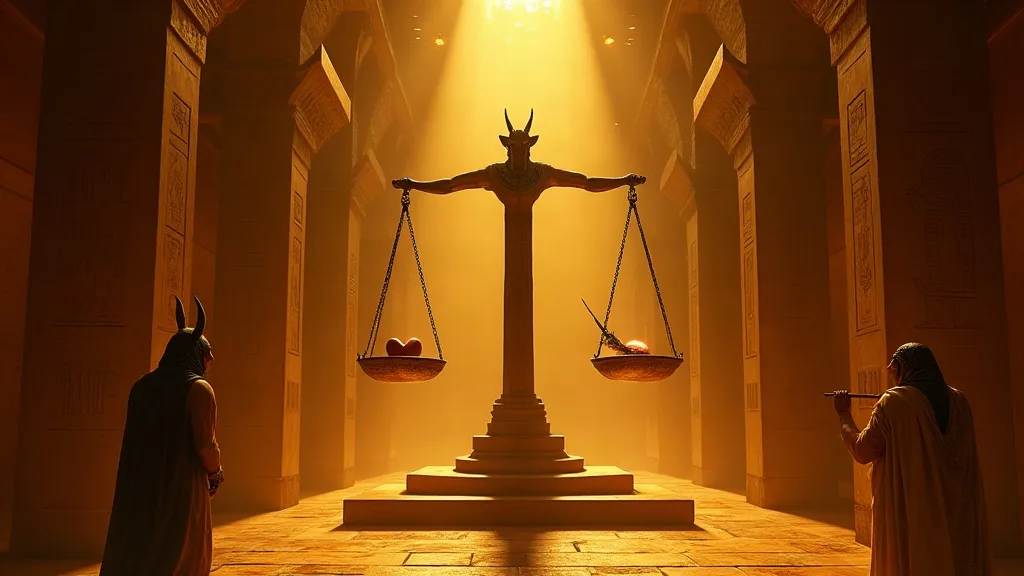
Imagine standing in the Hall of Two Truths, your body long buried, your ka (life force) and ba (personality, what we might call the soul) having journeyed through the Duat, the Egyptian underworld. Before you rises a massive stone balance. On one side sits your own heart, removed and offered as the only true measure of who you were. On the other side sits a single feather, impossibly light, impossibly heavy. The weighing of the heart ceremony is about to unfold.
This moment, captured in countless papyri and tomb paintings, was not fiction to the ancient Egyptians. It was the most consequential event of existence. Your entire eternal afterlife depended on this scale. If your heart was lighter than the feather of truth, you could join the gods in the Field of Reeds. If it was heavier, weighed down by sin, it would be devoured by Ammit, a creature part crocodile, part lion, part hippopotamus, and you would be annihilated from existence. There was no hell that offered punishment; there was only obliteration.
The ceremony represents perhaps the oldest written moral code in human history. It is older than the Ten Commandments by at least a thousand years. Yet it emerged not from divine revelation on a mountain, but from the deep Egyptian conviction that how you lived was written into your very flesh.
The Mythology of the Heavenly Courtroom
The stage for the weighing was the Hall of Two Truths, a concept that merged the real and the cosmic. It existed in the Duat, the underworld, yet it was also a celestial court where the great gods assembled. The presiding judge was Osiris, god of the dead, the afterlife, and the annual flooding of the Nile. He sat on a throne, often depicted wearing the white crown of Upper Egypt and holding the crook and flail, symbols of kingship and judgment. Beside him stood forty-two divine assessors, each representing a different province of Egypt or a different aspect of truth and morality.
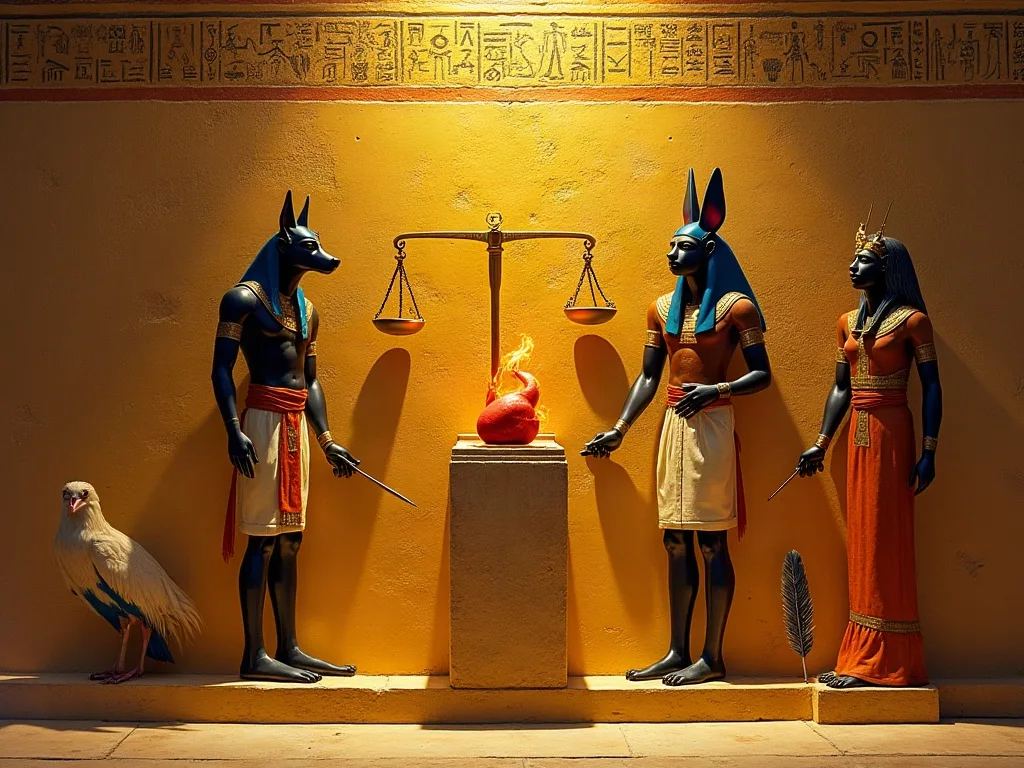
The key figure actually performing the weighing was Anubis, god of embalming, mummification, and the cemetery. He was the oldest god of the dead in Egyptian belief, predating Osiris by centuries. Black-skinned, jackal-headed, Anubis stood at the balance itself, the custodian of the scales. It was his role to ensure the ceremony was performed correctly, with absolute precision. The Egyptians believed Anubis had first embalmed Osiris after his murder by Set, and so he became the guardian of all mummified bodies and the ritual expert of death itself.
Recording the verdict was Thoth, the ibis-headed god of writing, wisdom, and knowledge. He held the sacred palette and stylus, and he would mark down the result of the weighing in his eternal ledger. In some depictions, Thoth himself appeared as a baboon, a form sacred to him, perched on the balance or nearby. Every verdict had to be official. It had to be written down by the god of writing himself.
The feather against which your heart was weighed belonged to Maat, goddess of truth, justice, order, and cosmic balance. Maat was not merely a personification of an ideal; she was the principle that held creation itself together. Without Maat, the universe would dissolve into chaos, isfet. The feather of Maat was weightless because truth itself is light; it is honest speech, honest action, honest living. The Egyptians called this Ma'at, and it was the foundation of all virtues: justice, balance, harmony, and righteous conduct.
The Journey to the Scales: The Book of Going Forth by Day
To understand the weighing, you must understand how the Egyptians believed the dead reached this moment. The journey began at death, but not in darkness. It began with the funeral itself.
When a person died, their body was taken to the ibu, the place of embalming. For seventy days, the body was treated with natron, a natural salt that preserved it. The organs were removed, and the brain was extracted through the nose and discarded; the Egyptians believed the heart, not the brain, was the seat of consciousness and memory. The heart was left inside the body because it would be needed for the judgment. The preserved body was then wrapped in linen, encased in a coffin, and buried with grave goods: food, furniture, figurines, and most importantly, sacred texts.
These texts were collectively called the Book of the Dead, or more accurately, the Book of Going Forth by Day (Pert em Hru). Unlike a single fixed scripture, it was a collection of spells, hymns, maps, and instructions that different Egyptians chose for their tombs. Some copies had dozens of spells; others had only a few. But across all versions, certain sections appear repeatedly: spells to transform the deceased into a spirit, to navigate the dangers of the Duat, and crucially, the "Declaration of Innocence" or the "Negative Confession."
The Negative Confession is one of the most profound moral documents ever inscribed. It was a list of forty-two sins the deceased needed to deny before the forty-two assessors:
"I have not killed. I have not stolen. I have not uttered lies. I have not been angry without cause. I have not slain cattle for sacrificial purposes. I have not deprived anyone of their property. I have not caused pain."
And so on, through virtues and prohibitions covering theft, robbery, violence, greed, lust, fraud, and disrespect to the gods. What made this extraordinary was that the deceased had to make this declaration while lying in the tomb, before death even fully took hold, and then repeat it in the Hall of Two Truths.
The idea was not that the gods would be fooled by false words. The Egyptians believed that the heart itself contained the truth of how you had lived. Your deeds were written into your very flesh, your very heart. The scales would not lie.
How the Ceremony Worked: The Scales, the Feather, the Devouring
The actual weighing followed a specific sequence, repeated in tomb paintings across centuries and recorded most vividly in the papyri of the New Kingdom (roughly 1550-1070 BC).
The deceased, now in spirit form, was led into the Hall of Two Truths by Anubis. The heart was presented separately from the body. In some depictions, the ba of the deceased holds the heart in its hands, offering it. In others, the heart floats on its own, as if weightless already. The heart was placed on the left side of the balance.
On the right side went the feather of Maat. In some images, it appears as a single feather. In others, it is shown as the full figure of Maat herself, or sometimes as multiple feathers, one for each of the forty-two judges.
Anubis turned the mechanism. The balance tilted.
If the heart was lighter than the feather, a cheer went up. Thoth recorded the verdict. The deceased was declared Akhu - blessed, justified, one who had spoken truth - and was allowed to proceed to the Field of Reeds, the Egyptian paradise.
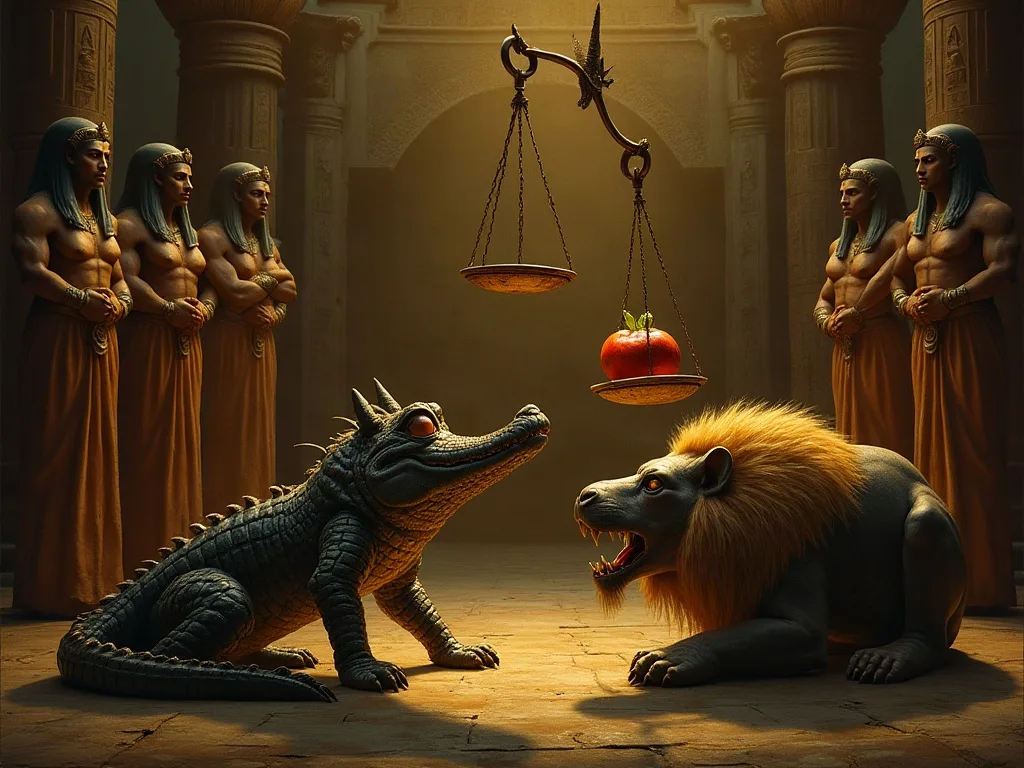
If the heart was heavier, laden with sin, Anubis called out to a creature waiting in the darkness: Ammit the Devourer. Ammit was a hybrid, a grotesque collision of animal forms. Part crocodile (representing the power of death), part lion (representing strength and predatory hunger), part hippopotamus (representing huge, unstoppable force). Some depictions show her with a human head. She crouched beneath the scales, hungry.
The creature seized the heart and consumed it. The name given to this fate was sekhet-sechem-aru, "the lake of fire," or more commonly, the "second death." The Egyptians believed this was annihilation. Not torment in an underworld, not reincarnation, but utter cessation. You would no longer exist anywhere, not in the memory of the living, not in the realm of the dead.
This was the terror that shaped Egyptian morality for thousands of years.
The Gods Who Judged: Maat, Thoth, Anubis, and Osiris
To understand the weighing of the heart ceremony fully, you must know the gods who made it happen. Each had a distinct role.
Maat (also spelled Ma'at) was not conceived as a goddess in the way that, say, Sekhmet was the goddess of plague and violence. Maat was more fundamental: she was the concept of cosmic order itself. She was depicted as a woman wearing a single ostrich feather on her head. The feather became her symbol, and her symbol became the measure by which all souls were judged. In temple reliefs, pharaohs are shown offering Maat to the gods, presenting truth and order as their greatest gift. She represented what the Egyptians called the fundamental laws of nature and morality.
Thoth was the scribe of the gods, the inventor of writing itself. He was depicted as a man with the head of an ibis, a long-beaked bird the Egyptians associated with ibis. Other times he appeared as a baboon, an animal sacred to him and found in the deserts around Egypt. Thoth was not merely a recorder; he was the god of wisdom, of mathematics, of medicine, of the calendar. The Egyptians credited him with inventing the 365-day year. In the context of the weighing, Thoth held the role of official witness and clerk. His record was unchallengeable.
Anubis, whose Egyptian name was Inpu, was the oldest god of the dead. He predated the rise of Osiris by centuries in the Egyptian religious tradition. He was black-skinned, which in Egyptian symbolism represented both the color of decay and the color of fertile soil, the paradox of death and renewal. He was jackal-headed because jackals haunted the cemeteries and devoured the bodies of the unburied poor. By making Anubis a jackal-god, the Egyptians transformed the desecration of the dead into a sacred act of transformation. Anubis was the protector of the tomb, the guardian of the embalming process, and the judge at the scales.
Osiris presided over everything. He was the god who had himself died and been resurrected. According to myth, he was murdered by his jealous brother Set, but his devoted wife Isis retrieved his scattered remains and, with the help of Anubis, mummified him and magically restored his life long enough to conceive their son Horus. Because Osiris had died and returned, he became the model for all the dead. He understood death. He ruled the Duat. He sat in judgment not as a distant authority but as one who had walked the same path. The dead were, in a sense, identified with Osiris. They too would hope to be resurrected into eternal life.
Maat (Truth)
Cosmic order and balance. Every deed recorded in the heart. Lightness, honesty, justice, harmony with nature and society.
Isfet (Chaos)
Disorder and dissolution. Violence, theft, lies, betrayal, disrespect to gods and the dead. Heaviness, dishonor, the weight of misdeeds.
The Forty-Two Judges: Accountability to Many
The weighing of the heart did not occur in isolation with a single judge passing verdict. Instead, the deceased faced a panel of forty-two divine assessors, each representing a different region of Egypt or a different aspect of divine law. Their names were recorded in the Book of the Dead, and their presence meant accountability on a massive scale.
Some of the judges included:
- Seizer of Shadows (judge of theft and stealing)
- Eater of Shadows (judge of theft and covetousness)
- Long Strider (judge of murder and violence)
- Swallower of Excrement (judge of gluttony and excess)
- Fire Embracer (judge of arson and harm)
- Bone Breaker (judge of violence and cruelty)
Each name was literal and direct. The Egyptians did not obscure judgment in abstraction. A judge of stealing was literally someone who seized shadows - the invisible traces of your crimes. The names themselves taught morality.
The deceased was required to address each judge by name and to deny specific transgressions. This is the structure of the Negative Confession. It was not a generic apology; it was a line-by-line accounting, a commitment to each separate virtue.
Some scholars have noted that these forty-two judges may correspond to the forty-two administrative districts of Egypt, or the forty-two nomes. If so, then the judgment was also a statement of Egyptian political theology: every province of the kingdom was represented in the cosmos, and every person was ultimately judged by the whole nation, both earthly and divine.
The Heart as the Seat of Everything
Why the heart? Why not the soul, or the mind, or some other part?
The ancient Egyptians did not share the Western notion that the brain was the center of thought and consciousness. They believed the heart was the seat of intellect, memory, emotion, will, and moral capacity. When you thought, you thought with your heart. When you made a decision, your heart decided. When you lied, your heart knew the lie.
The word for heart in Egyptian was ib, and it was used as a metaphor for consciousness itself. To say someone had a "good heart" was to say they were virtuous. To have a "heavy heart" was to be weighed down by guilt. To have a "light heart" was to be free of wrongdoing.
This explains why, during the embalming process, the heart was the one organ left inside the mummy. The brain was removed through the nose and discarded. The lungs, liver, stomach, and intestines were removed and placed in canopic jars. But the heart stayed. It was needed for the afterlife. It had to be there for the weighing. You could survive without your brain in the afterlife, the Egyptians believed, but you could not face judgment without your heart.
In one sense, this was practical. The heart is the physical center of the body, roughly in the middle of the chest. In another sense, it was deeply metaphorical. The heart contained who you really were. A mummified body without a heart was incomplete, helpless in the afterlife.
The Field of Reeds: The Promise
If your heart passed the test, if it proved lighter than the feather of Maat, you were declared Akhu - justified, one of the blessed dead. You were then granted entry to the Aaru, or Field of Reeds, the Egyptian paradise.
The Field of Reeds was not a transcendent, abstract heaven. It was a place that closely resembled the world you had left behind - but perfected. It had fields where crops grew endlessly without drought. It had water that never ran dry. It had a sun that rose and set in perfect rhythm, never burning too harshly, never disappearing into endless night. It had companions, family members you had loved, your favorite possessions, even servants and laborers who would help you with work.
But here is the crucial point: even in the Field of Reeds, you would have work to do. You would need to tend fields, harvest crops, perform labor. This was not laziness avoided; it was continuity of purpose. The Egyptians did not want an eternity of pure leisure. They wanted an eternity of meaningful living, without suffering, without premature death, without injustice.
The pharaohs, as intermediaries between the gods and humanity, were believed to have a special place in this paradise. But the concept of the Field of Reeds was available to anyone who lived according to Maat - king, noble, or peasant. By the New Kingdom, even common people could be buried with texts and images that promised them entry to the Field of Reeds if they passed the weighing.
This represented a radical democratization of the afterlife. Death and resurrection were not privileges reserved for kings. They were universal. Everyone faced the scales.

Evidence From the Tombs: What We Know
The source of our knowledge about the weighing of the heart ceremony comes primarily from the tombs of ancient Egypt. The most complete version of the ceremony is found in the papyrus of Ani, a high-ranking official who lived during the nineteenth dynasty, around 1250 BC.
The papyrus of Ani contains a full Book of the Dead with seventy-eight spells and a beautiful colored illustration of the weighing itself. In the image, Anubis stands at the scales. Ani's heart is on one side, the feather of Maat on the other. Thoth records the verdict. The forty-two judges sit or stand in rows. And in the background, the beast Ammit waits.
Other papyri show variations. The papyrus of Hunifer, from around the same period, shows a similar scene but with slightly different arrangements of the gods. The tomb walls of wealthy Egyptians from the New Kingdom (1550-1077 BC) contain painted versions of the weighing, so vivid and detailed that we can see the expressions on the gods' faces and the precise way the scales were balanced.
The Negative Confession, the declaration of innocence the deceased was required to make, survives in at least a dozen different tomb texts. Not all versions include all forty-two transgressions, but the core list is consistent across centuries. This suggests a standardized teaching that persisted throughout the New Kingdom.
Scholars have found earlier references to judgment in the Pyramid Texts, the oldest religious writings of Egypt, which date to around 2400-2300 BC. These texts mention offerings to gods and divine assistance in the afterlife, but the detailed concept of the weighing of the heart as we know it seems to have developed more fully during the Middle Kingdom (2055-1650 BC) and reached its classical form in the New Kingdom.
The Moral Weight: What the Ceremony Reveals
The weighing of the heart ceremony encoded a profound moral philosophy. To the Egyptians, justice was not something imposed by external authority; it was something you carried inside you. Your deeds literally weighed on your heart. You could not deceive the gods because the gods could read your heart.
This had several implications for Egyptian society. First, it made individual morality everyone's concern. You were not virtuous to please the pharaoh or to impress neighbors. You were virtuous because your eternal life depended on it. This created a powerful incentive for ethical living.
Second, it recognized that humans were capable of moral judgment without revealed law. Unlike later ethical systems that depended on sacred texts dictating rules, the Egyptians believed that the human heart naturally understood right from wrong. The Negative Confession reminded you, but it did not create morality; it revealed morality that was already in you.
Third, it treated all human actions as significant. There was no action too small, no theft too minor, no lie too inconsequential to matter. Your entire moral record would be weighed. A slave's heart could be lighter than a pharaoh's. A laborer could be justified. A king could be condemned.
Fourth, it made the afterlife conditional on morality in this life. There was no atonement ritual, no priestly absolution, no last-minute redemption. How you lived determined your eternal fate. The weighing could not be bargained with or bribed.
Cross-Cultural Echoes: The Weighing Beyond Egypt
The idea of the weighing of the heart did not originate with the Egyptians, nor did it die with them. Similar concepts appear across human civilizations, suggesting that the impulse to imagine moral judgment in the afterlife is nearly universal.
In Zoroastrianism, the ancient Persian religion that profoundly influenced later Judaism, Christianity, and Islam, the dead face judgment by a divine being. The soul is weighed, though not always explicitly against an object. There is a clear parallel to the Egyptian concept.
In Hinduism and Buddhism, the concept of karma - the moral law of cause and effect - performs a similar function. Your deeds in this life determine your circumstances in the next. Yama, the Hindu god of death, judges the departed. The cosmic law is inexorable. You cannot appeal it or escape it.
In Plato's Republic, Socrates describes a myth in which the dead are judged by divine judges, and their souls are sent to reward or punishment based on the lives they lived. Scholars have noted that Plato may have encountered Egyptian ideas, either directly or through Greek travelers and scholars who visited Egypt.
In early Christianity, the concept of the Last Judgment echoes the Egyptian weighing. The dead are brought before a divine judge (Christ or God), and their deeds are weighed or accounted for. The final destiny - heaven or hell - depends on the moral weight of their life.
What makes the Egyptian version unique is its specificity and its accessibility. The Egyptians did not write about judgment in abstract theological terms. They painted it, detailed it, made it vivid. They gave it names, faces, and animals. And they believed that anyone, not just the priestly class, could access this knowledge through the texts placed in their tomb.
The Ceremony in Art and Papyri: Visual Theology
The weighing of the heart was not merely a belief; it was a central theme of Egyptian art for over a thousand years. Tomb paintings, papyri, coffin texts, and temple reliefs all depicted the ceremony.
The standard artistic convention showed a symmetrical arrangement. At the center was the balance, usually depicted as a massive scale with a fulcrum, tilting slightly to show the judgment. On the left stood the deceased or their heart. On the right was the feather or Maat herself. Around them were ranged the assembled gods and judges, each recognizable by their distinctive iconography.
Anubis, in his black jackal form, was typically shown directly at the scales, as the operator. Thoth, in his ibis-headed form, stood nearby with his palette and stylus, ready to record. Osiris, wearing his distinctive crown and regalia, often sat in judgment above. The other judges were arranged in rows or groups, sometimes labeled with their names in hieroglyphic text.
The papyri were even more elaborate. The papyrus of Ani, for instance, is a masterpiece of color and precision. The blues of the Egyptian lapis lazuli dye, the gold leaf, the red ochre, the blacks and whites - all combine to create a vivid, almost luminous image of the ceremony. And all around the main image are hieroglyphic texts: spells to aid the deceased, prayers to the gods, statements of innocence.
What is remarkable is the consistency of these images across centuries and across different tombs. Whether a wealthy official in the New Kingdom or a provincial administrator, the same scene appears, the same gods, the same arrangement. This speaks to the power of the concept and its centrality to Egyptian religion.
The Ceremony and the Pharaoh: Divine Royalty Under Judgment
One might assume that the pharaoh, as a divine being and the intermediary between gods and humans, would be exempt from the weighing of the heart. But evidence from the tombs and texts suggests otherwise.
In the Pyramid Texts, which were inscribed in the tombs of Old Kingdom pharaohs, there are passages that describe the deceased pharaoh ascending to the heavens, being greeted by the gods, and eventually settling into a place of honor among them. But even these royal texts suggest accountability. The pharaoh must prove worthy.
By the New Kingdom, explicit depictions of the weighing appear in the tombs of pharaohs and high officials alike. The famous tomb of Thutmose III includes scenes of the weighing. The tomb of Ramesses VI contains a detailed version.
This may seem like a demotion of the pharaoh's divine status, but it is actually a refinement. The idea was that the pharaoh, precisely because of his divine role on earth, had even greater responsibility to live according to Maat. His judgment might be different - he might have more judges, more elaborate ceremonies - but he could not escape judgment.
This created a theological check on pharaonic power. No pharaoh, no matter how mighty on earth, could guarantee himself paradise. His eternal fate depended on his moral record. This would have been a powerful statement to courtiers and officials watching their pharaoh, and it would have reinforced the idea that even absolute power was subject to cosmic law.
Decline and Transformation: When the Weighing Lost Power
By the late Ptolemaic period (after 332 BC, when Greek rule began), and certainly by the Roman period (30 BC onward), the traditional Egyptian beliefs in the weighing of the heart began to fade. This was not a sudden collapse but a gradual shift.
Several factors contributed. First, Greek and Roman religious concepts, with their emphasis on an Olympian pantheon and different ideas about the afterlife, began to mix with and eventually overshadow traditional Egyptian beliefs. Second, the priesthood's power declined as foreign rulers took control of Egypt. Third, new religions, especially Christianity and later Islam, introduced competing afterlife concepts.
Yet the image and idea did not vanish entirely. Some late-Ptolemaic and Roman-period tombs still include versions of the weighing. And the concept itself - that the afterlife is determined by moral conduct in life - became a template that other religions adopted and adapted.
The weighing of the heart is, in many ways, the ancestor of every moral judgment scene in Western and Middle Eastern religion that came after it.
Frequently asked questions about the weighing of the heart ceremony
Frequently asked questions
What happened to souls that failed the weighing of the heart?
Souls that failed the weighing were devoured by Ammit, the Devourer, a hybrid creature part crocodile, lion, and hippopotamus. This was believed to be the "second death," a complete annihilation from existence. Unlike later concepts of hell or punishment, the Egyptians offered no torment or redemption; there was simply obliteration. The soul would cease to exist in any form - not in the Field of Reeds, not in memory, nowhere.
Was the weighing of the heart ceremony actually performed at funerals?
The weighing of the heart was not a ritual performed by living priests at a funeral. Rather, the Egyptians believed it occurred in the Duat (the underworld) after death, in the presence of the gods. However, the ceremony was commemorated, rehearsed, and invoked through spells, prayers, and images placed in tombs and painted on coffins. These texts were meant to help the deceased successfully navigate the ceremony in the afterlife. In a real sense, the living made the ceremony present for the dead through their own ritual actions and sacred art.
Could anyone achieve paradise through the weighing of the heart, or only kings?
By the New Kingdom (roughly 1550-1070 BC), the concept of the weighing and the possibility of reaching the Field of Reeds had become available to anyone with the means to purchase the proper texts and tomb equipment. A wealthy official, a merchant, even a skilled laborer could have a version of the Book of the Dead placed in their tomb and could be depicted in the weighing of the heart ceremony. This represented a significant democratization of the afterlife, breaking the monopoly on eternal life that had previously been reserved for pharaohs and the highest nobility.
What was Maat, and why did her feather weigh the heart?
Maat was the goddess and concept of cosmic truth, justice, order, and balance. She represented the fundamental laws that held the universe together. Her feather became the symbol of truth itself because truth is light - it does not weigh us down. The feather was weightless in Egyptian belief. By weighing your heart against Maat's feather, the gods were asking whether you had lived in accordance with truth, justice, and cosmic order. A heart burdened by lies, theft, violence, and injustice would be heavy by comparison.
Why was the heart the organ that was judged instead of the head or the soul?
The ancient Egyptians believed the heart, not the brain, was the seat of consciousness, memory, emotion, will, and morality. They had no concept of the brain as the center of thought. The heart was the organ that understood right from wrong, that made moral choices, and that retained a record of every deed. This is why, during mummification, the heart was left inside the body while the brain was removed. The heart had to be present for the afterlife and for the weighing of the heart ceremony.
What was the Negative Confession, and did the deceased actually recite it aloud?
The Negative Confession was a list of forty-two sins or transgressions that the deceased formally denied before the forty-two divine judges. It was a declaration of innocence, addressing each vice individually: "I have not killed. I have not stolen. I have not uttered lies." These confessions were inscribed in the Book of the Dead and other tomb texts. Whether the deceased was believed to recite them aloud in the afterlife or whether their presence in the tomb text was enough for the gods to know is debated by scholars, but the Egyptians clearly believed the words carried power and truth.
The Weighing in Modern Thought: Enduring Questions
The weighing of the heart ceremony continues to exert a fascination on modern readers and thinkers. It appears in novels, films, and philosophical discussions about justice, morality, and the afterlife. But what makes it so compelling?
One reason is its radical simplicity. No intermediaries, no institutions, no appeal. You are weighed by what you did. No excuse, no bargaining, no reprieve. This stark accountability speaks to something in human consciousness that craves absolute justice.
Another reason is its moral egalitarianism. The pharaoh and the peasant face the same scales. Kings cannot bribe their way to paradise. The poor are not condemned to an eternal underworld. The feather of truth is the same weight for all. This touches a deep human hunger for a justice system that is fair and impartial.
The ceremony also resonates because it treats the body, the heart, the physical self, as the container of your moral truth. It does not separate the soul from the flesh in a Platonic or Christian sense. Your heart, the organ that beat in your chest while you lived, is what is judged. You cannot escape yourself. You cannot shed your deeds like a skin.
The weighing of the heart ceremony reveals an ancient civilization wrestling with the deepest human question: What happens to us when we die, and does how we live matter? The Egyptians answered that question with stunning clarity. How you live is written in your heart. And that heart will be weighed.
Free 25-page sample
Want the whole story?
Take the first 25 pages free. If it pulls you in, the full edition is yours as an instant PDF download, with a paperback on Amazon for selected titles.

Mythology
The World Mythology Book: The Gods, Heroes and Myths of Every Culture
The Gods, Heroes and Myths of Every Culture, in One Volume
The whole of world mythology in a single volume: Greek, Norse, Egyptian, Japanese, Hindu, Celtic, Slavic, Mesoamerican and African myths gathered side by side, each drawn from the primary sources.