
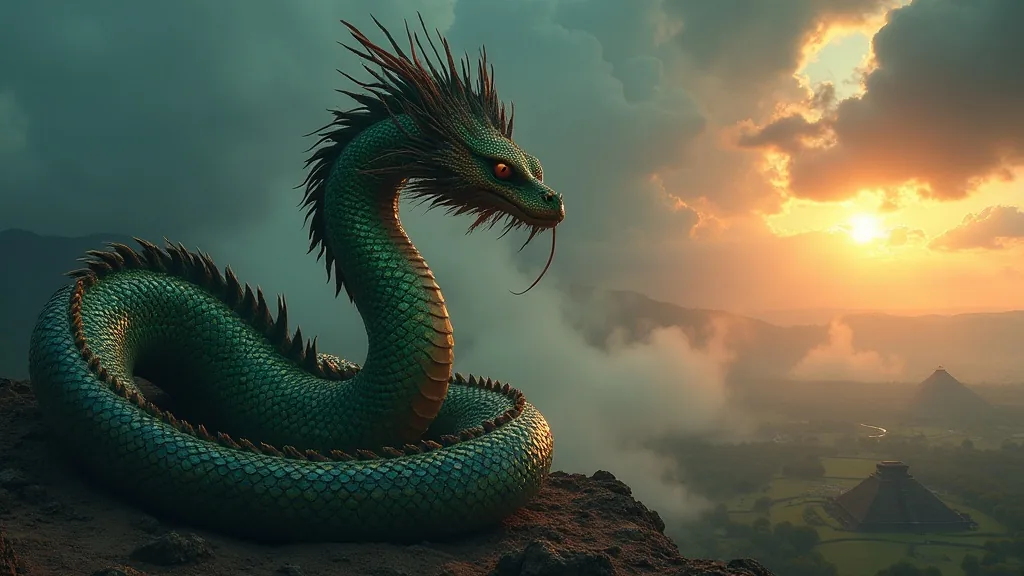
Quetzalcoatl: The Feathered Serpent Who Shaped the World
Quetzalcoatl, the Feathered Serpent of Aztec myth, was creator, culture-bringer, and fallen king rolled into one luminous, contradictory deity whose story still resonates across Mesoamerica.
Contents
The Name That Contains a World
The Nahuatl word Quetzalcoatl is itself a small cosmology compressed into sound. Quetzal refers to the resplendent quetzal bird (Pharomachrus mocinno), whose tail feathers were among the most precious objects in all of Mesoamerica, reserved for royalty and the divine. Coatl means serpent. Put them together and you have a creature that joins sky to earth, the soaring to the earthbound, the brilliant to the ancient. That tension is not accidental. It is the whole point.
Quetzalcoatl stands at the center of Aztec religious thought not merely as one deity among hundreds, but as a principle: the idea that opposites can fuse into something generative rather than destructive. He is wind and breath, the morning star and the evening star, a god who becomes a man and a man who becomes a god again.
Origins Older Than the Aztecs
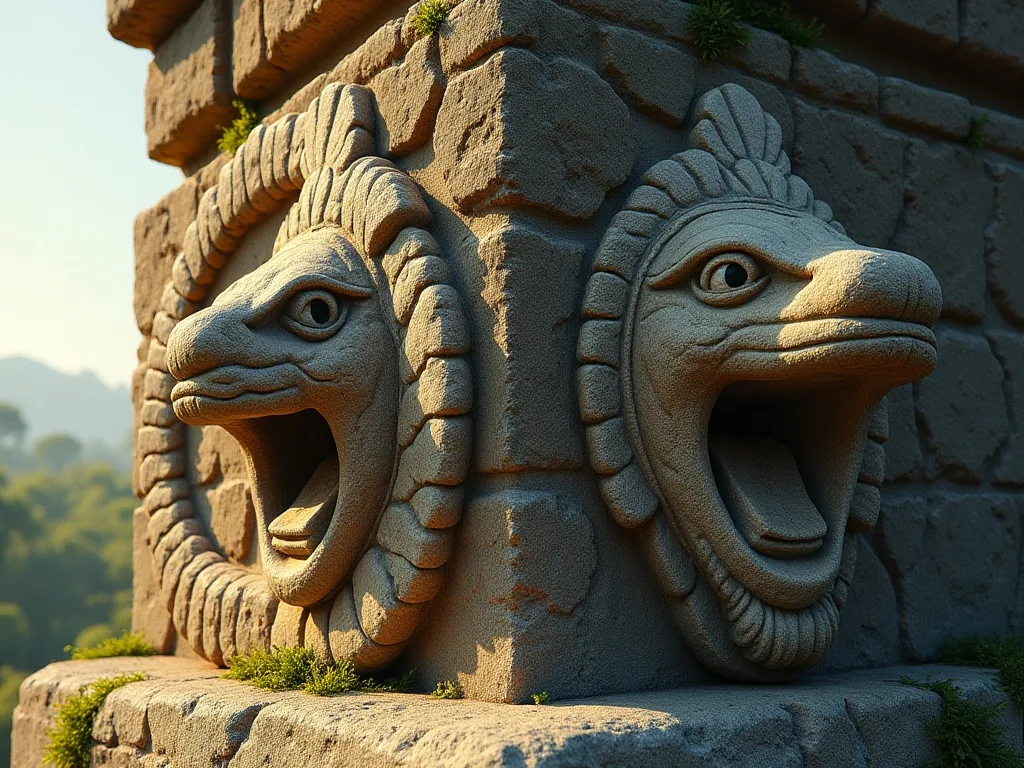
The Feathered Serpent did not originate with the Mexica people who built Tenochtitlan. Imagery of a plumed or feathered serpent deity appears as early as the Preclassic period at sites such as Chalcatzingo (c. 700 BCE) and reaches monumental expression at Teotihuacan, the great city northeast of modern Mexico City. The Temple of the Feathered Serpent at Teotihuacan, constructed around 200 CE, is encrusted with carved serpent heads alternating with goggle-eyed figures, demonstrating that by the Early Classic period this deity already commanded lavish state devotion.
The Maya recognized a cognate figure in Kukulkan, whose name carries exactly the same meaning in Yucatec Maya. The late Postclassic city of Chichen Itza dedicated its great pyramid, El Castillo, in part to Kukulkan, and twice a year at the equinoxes a shadow shaped like an undulating serpent descends its northern staircase, suggesting that the architecture itself was designed to embody the god's movement.
The Toltecs of Tula (Tollan in Nahuatl sources) shaped the myth into something more personal. Their semi-legendary ruler Ce Acatl Topiltzin was identified so completely with Quetzalcoatl that the two identities merged. Aztec mythology received this fused figure and elaborated it into one of the most complex divine narratives in the ancient world.
Lord of the Fifth Sun and Creator of Humanity
Within the grand Aztec cosmological framework of the Five Suns, each successive age of the world is associated with a presiding deity and a catastrophic end. Quetzalcoatl rules the Second Sun, the age of Ehecatl (wind), which was destroyed when a great hurricane swept humanity away, transforming survivors into monkeys.
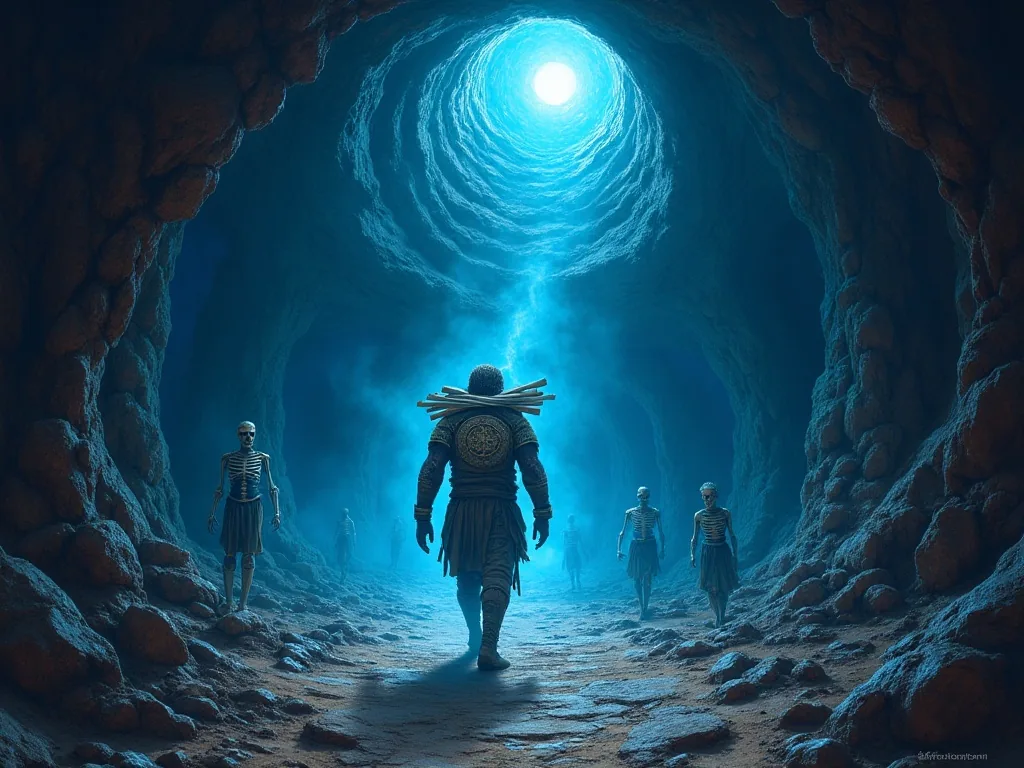
His most celebrated creative act, however, concerns the present age. After the gods gathered at Teotihuacan to sacrifice themselves and set the Fifth Sun in motion, humanity still lacked the means to sustain life. Quetzalcoatl descended to Mictlan, the nine-layered underworld, to retrieve the bones of those who had lived in previous ages. The lord of the dead, Mictlantecuhtli, agreed to release the bones only after Quetzalcoatl passed a series of trials, then attempted to trick him and shatter the sacred cargo.
Quetzalcoatl gathered the broken fragments, carried them to the earth goddess Cihuacoatl, who ground them into a paste, and the gods bled onto that paste to animate it. From those reconstituted, imperfect fragments came human beings, which is why, some sources suggest, people are mortal and incomplete by nature.
This story, preserved in the Leyenda de los Soles and the Historia de los Mexicanos por sus Pinturas, positions Quetzalcoatl not merely as a benefactor but as an agent who risks annihilation to give humanity its very substance.
Ehecatl: The Wind Aspect
Among Quetzalcoatl's most important manifestations is Ehecatl, god of wind. As Ehecatl-Quetzalcoatl he wears a distinctive buccal mask shaped like a duck's beak, the wind blowing through its open mouth. Round temples were dedicated to him because corners catch wind and slow it; circular structures allowed the breath of the god to flow unimpeded.
Wind in Aztec thought was not mere meteorology. It was the precursor of rain, the force that swept the sky clean to make space for the rain clouds sent by Tlaloc. Ehecatl blew the newly created sun and moon into motion after the gods sacrificed themselves at Teotihuacan, a moment narrated in the Leyenda de los Soles. Without wind, the celestial machinery would have stalled in the sky, frozen and useless.
His breath was also identified with the animating principle of life itself: ehecatl is the wind-breath that fills a newborn's lungs. To worship Quetzalcoatl in his Ehecatl aspect was, in a sense, to honor the very act of breathing.
The Fallen King of Tollan
The most emotionally powerful strand of Quetzalcoatl's mythology concerns his time as the priest-king of Tollan, the mythic Toltec capital. Under his rule, Tollan is described in sources like the Anales de Cuauhtitlan and Fray Bernardino de Sahagún's Florentine Codex as a paradise: corn grew enormous, cotton bloomed in natural colors, cacao trees were magnificent, and birds of brilliant plumage filled the air.
Quetzalcoatl reigned as a model of priestly restraint. He prohibited human sacrifice, offering only butterflies, serpents, and his own blood drawn by autosacrifice. He was a patron of arts, crafts, and learning, credited with inventing the calendar alongside the god Mayahuel and teaching humans the cultivation of maize.
His fall came through the machinations of Tezcatlipoca, the Smoking Mirror, lord of darkness, sorcery, and conflict. Tezcatlipoca is Quetzalcoatl's eternal adversary and cosmic twin, representing everything his brother opposes. In some versions of the myth, Tezcatlipoca held up a black obsidian mirror in which Quetzalcoatl saw his own aged, haggard face and became filled with shame and self-loathing. In others, Tezcatlipoca tricked the god-king into drinking pulque (fermented agave sap), causing him to break his vows of celibacy. Some accounts layer both deceptions together.
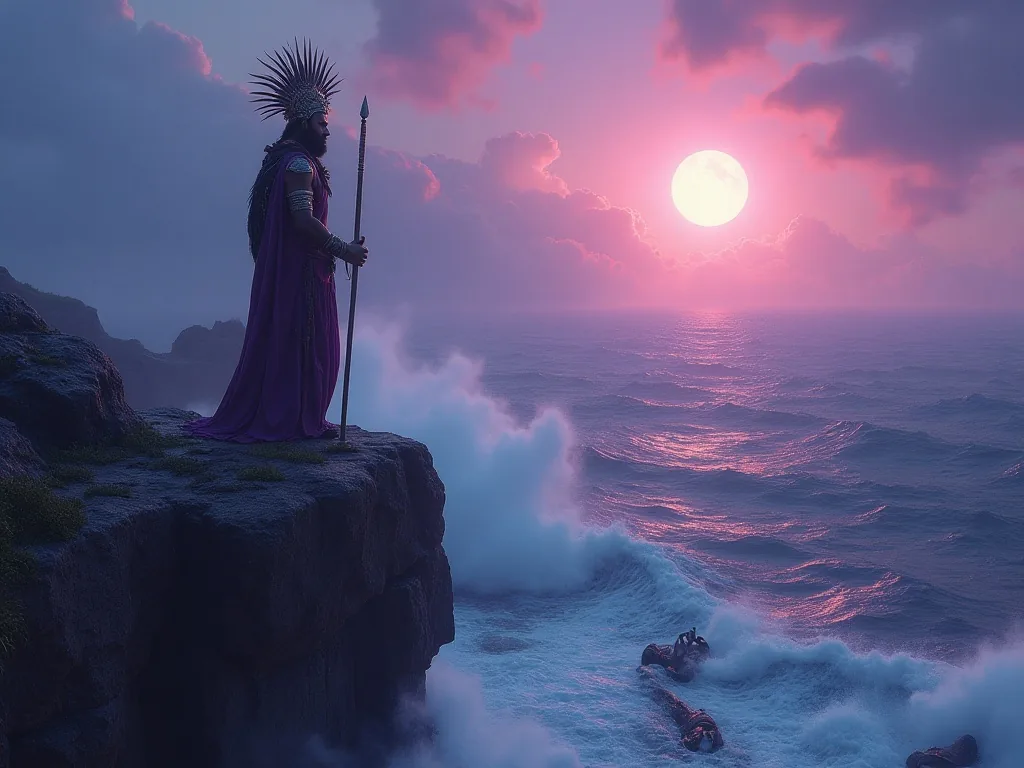
Overcome with shame, Quetzalcoatl abandoned Tollan. His departure was a procession of grief: the paradise collapsed behind him, the brilliant birds flew away, and the craftsmen who loved him wept. He traveled eastward to the coast, burned himself on a pyre, and was transformed. His heart became the planet Venus, specifically the morning star, Tlahuizcalpantecuhtli, the Lord of the House of Dawn.
Other accounts say he did not burn but instead sailed east on a raft of serpents, promising to return.
The Question of Return
That promise became politically charged in the early sixteenth century when Hernán Cortés arrived from the east in the Aztec year One Reed (Ce Acatl), which was also Quetzalcoatl's calendar name. Later Spanish and some Indigenous sources suggested that the Aztec emperor Motecuhzoma II initially interpreted Cortés as the returning Quetzalcoatl. Modern historians treat this narrative with considerable skepticism. Scholars including Camilla Townsend and Matthew Restall have argued that the "Quetzalcoatl prophecy" was largely constructed after the conquest to make the Spanish victory seem inevitable and cosmically ordained. The sources that assert it most strongly were written decades after the fall of Tenochtitlan in 1521, filtered through Indigenous and Spanish writers who each had reasons to impose a providential framework on events.
Patron of Priests, Scribes, and the Calendar
Beyond cosmology and kingship, Quetzalcoatl served highly practical religious functions in everyday Aztec life. As Ce Acatl (One Reed), he presided over the ritual calendar's corresponding day-sign and its associated trecena (thirteen-day period), a time considered fortunate for skilled craftsmanship.
The priestly class, tlamacazque, honored him as their special patron. The high priests of the Aztec state bore the title Quetzalcoatl as a formal honorific, divided between the two chief priests of Huitzilopochtli and Tlaloc: one was called Quetzalcoatl Totec Tlamacazqui, the other Quetzalcoatl Tlaloc Tlamacazqui. The god's name thus became an office, a living institution woven into the fabric of theocratic governance.
He was also closely linked to the Mesoamerican knowledge system more broadly. The tonalpohualli, the 260-day sacred calendar, and the arts of reading and writing were attributed to his invention or patronage. Scribes who painted the accordion-folded books called amoxtli worked under his protection. In this sense Quetzalcoatl was the guardian of memory itself, of the accumulated knowledge that distinguished civilization from chaos.
The Feathered Serpent as Living Symbol
The iconography of Quetzalcoatl across the centuries is immediately recognizable even to modern eyes. His serpent body, scaled and massive, emerges from or is crowned with the iridescent green-blue plumage of the quetzal. Stone versions appear at Teotihuacan with obsidian eyes that would have caught torchlight, making them seem alive in temple processions. The rattlesnake's rattle sometimes appears at the tail, anchoring the creature to the earth even as feathers lift it toward heaven.
This visual fusion encodes a philosophical claim: that divinity does not reside in one realm alone. The serpent crawls on the earth and lives close to the dead, shedding its skin in an act long associated with renewal and cyclical time. The quetzal inhabits the cloud forests of the highlands, nearly inaccessible, its tail feathers shimmering green and gold in filtered light. To join these two beings is to insist that the sacred lives in the full span between underworld and sky.
The Feathered Serpent in the Modern World
Quetzalcoatl has never fully retired. His image appears on the coat of arms of Mexico City, embedded in the national consciousness. Archaeologists continue excavating tunnels beneath the Temple of the Feathered Serpent at Teotihuacan, and discoveries made since 2010 by Sergio Gómez Chávez and his team, including ritual offerings, pyrite mirrors, and carved wooden objects deep in a flooded tunnel, have renewed debate about the temple's function and the god's role in Teotihuacan statecraft.
In literature and popular culture he has inspired figures from D.H. Lawrence's novel The Plumed Serpent (1926) to countless video games and fantasy epics. Each retelling carries some residue of the original: the sense of a being caught between its own grandeur and its own failure, a creator who descended into darkness to retrieve the bones of the past and offer them, imperfectly reassembled, to the living.
That image, a god carrying broken bones through nine layers of the underworld so that humans might exist at all, contains more concentrated mythological meaning than most traditions manage in entire pantheons. The Feathered Serpent endures because the questions it embodies are permanent: how do sky and earth speak to each other, what do rulers owe their people, what is lost when pride is shattered, and what rises, like Venus at dawn, from the ashes of that loss.
Quetzalcoatl and the Cosmic Duality of Mesoamerican Thought
No account of Quetzalcoatl is complete without acknowledging that Mesoamerican religion was built on paired, complementary opposites rather than on a simple axis of good and evil. Quetzalcoatl and Tezcatlipoca are not analogues of a Western Satan and Christ. They are two necessary poles of a single cosmic reality. Creation requires both ordering and disruption. The world built in the Third Age by Tezcatlipoca was ended by Quetzalcoatl; the world built in the Fourth Age by Quetzalcoatl was ended by Tezcatlipoca. Neither can permanently dominate because the universe requires both their natures to keep turning.
This duality extends downward into human society. The priest and the warrior, the artist and the soldier, the planting season and the harvest, the living and the dead: all of these pairs were understood through the lens of these two great gods circling each other through time. Quetzalcoatl, the Feathered Serpent, is luminous and generative, a being of wind and breath and cultivation. But he is luminous precisely because darkness exists, and the morning star is brilliant precisely because it rises before the sun into a sky that is not yet fully light.
Read the full book
Want the whole story?
The complete edition is an instant PDF download here, with a paperback on Amazon for selected titles.
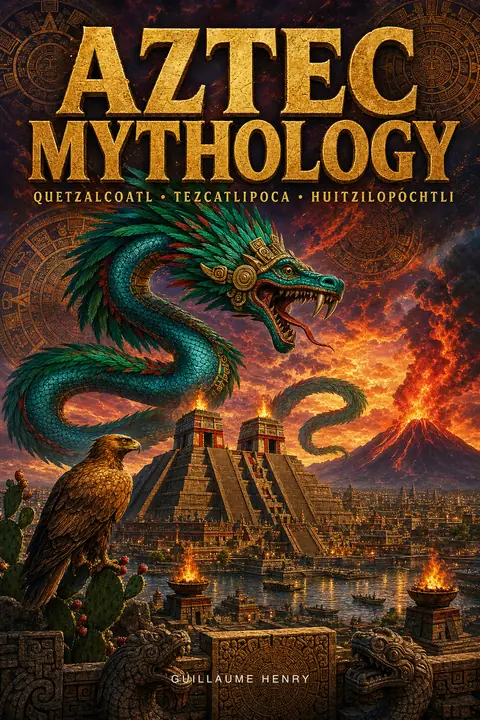
Aztec
The Aztec Mythology Book: Quetzalcoatl, Huitzilopochtli, Tezcatlipoca, and the Five Suns of the Mexica
Blood, Feathered Serpents, and the Cosmic Engine of Tenochtitlan
The gods, heroes, and sacred calendar of the Mexica civilization. From the feathered serpent Quetzalcoatl to the five world ages, the complete mythology of Tenochtitlan.