
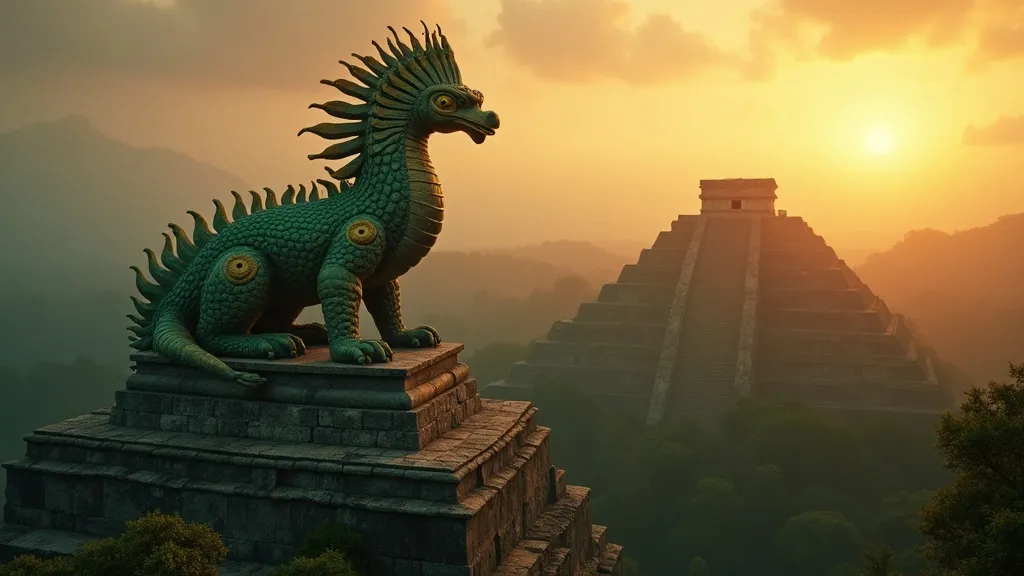
Quetzalcoatl: The Feathered Serpent God of Ancient Mexico
Half bird, half serpent, entirely extraordinary: Quetzalcoatl shaped Aztec cosmology, priesthood, and calendar. Here is the full story of the god who promised to return.
Contents
A wind rises before dawn over the Valley of Mexico. Priests watching from the summit of Teotihuacan's Pyramid of the Feathered Serpent feel it first on their skin, then hear it move through the obsidian grass below. That breath, cold and purposeful, belongs to Quetzalcoatl: the Feathered Serpent God, lord of wind, morning star, and the civilising arts that separate human beings from the dark chaos that surrounds them.
He is not a comfortable god. He gave humanity maize by drilling into a mountain. He invented the ritual calendar that mapped every human life onto cosmic time. He descended into the underworld, gathered the bones of the dead, and bled on them until people breathed again. Then, defeated by a rival's sorcery, he burned his own body and rose as the planet Venus. Few figures anywhere in pre-Columbian religion carry that weight.
Origins Older Than the Aztecs
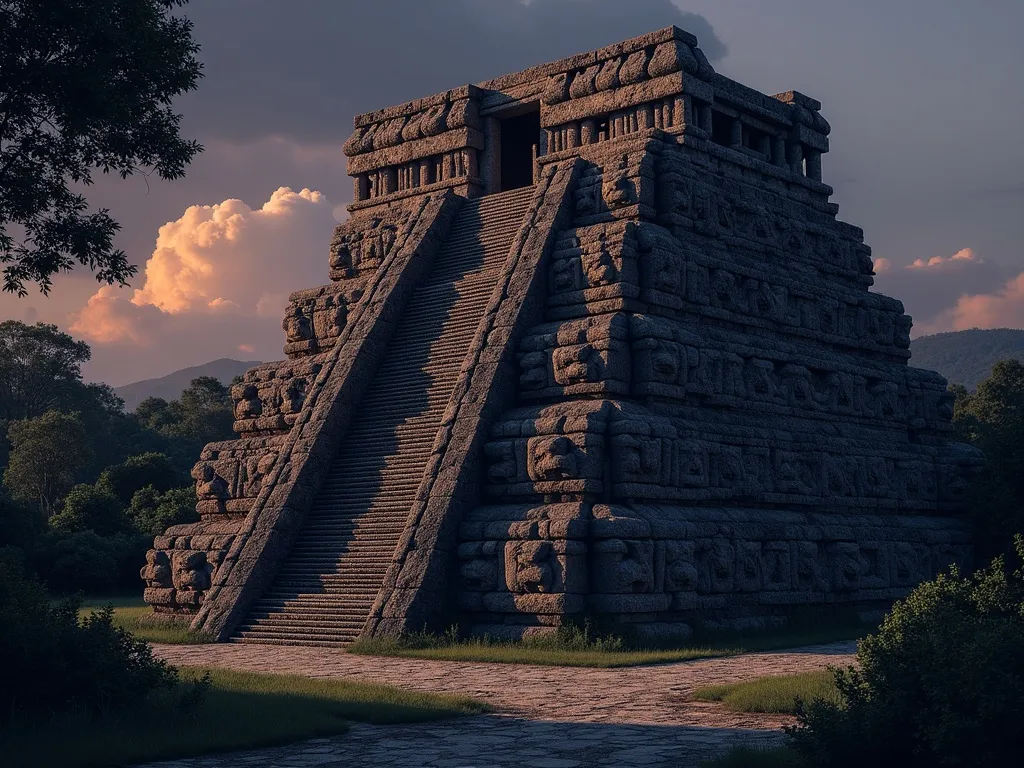
The image of a feathered serpent appears at Teotihuacan no later than the third century CE, carved in high relief on the temple that still bears the god's name. That city flourished a full millennium before the Mexica arrived in the Valley of Mexico, which means Quetzalcoatl was ancient even to the Aztecs. Iconographic traces stretch back further still, to Olmec reliefs on the Gulf Coast dating to roughly 900 BCE, where a serpent entwined with feathers decorates ceremonial axes and altarpieces.
The Toltec city of Tula (Tollan in Nahuatl) added a human layer to the myth. There, between roughly 900 and 1150 CE, the feathered serpent became identified with a priest-king named Ce Acatl Topiltzin Quetzalcoatl, a historical or semi-historical ruler credited with founding Toltec civilisation. Later Aztec sources, including the chronicles compiled by Fray Bernardino de Sahagún in the Florentine Codex, describe this figure as a reformer who banned human sacrifice and taught his people goldsmithing, featherwork, and astronomy. His rival, the sorcerer-god Tezcatlipoca, destroyed him through trickery, and Topiltzin Quetzalcoatl sailed east on a raft of serpents, vowing to return in the year One Reed (Ce Acatl) of the Aztec calendar.
That promise matters enormously. Every 52 years the calendar cycled back to One Reed, and every cycle triggered anxiety about when the god might reappear. When Hernán Cortés landed in 1519, that year happened to correspond to One Reed, a coincidence that later Spanish and mestizo writers amplified into the claim that the Mexica mistook Cortés for Quetzalcoatl himself. Modern scholars, including Camilla Townsend in her 2019 book Fifth Sun, have dismantled this story convincingly. The confusion was largely a colonial-era construction. But the mythos of a returning god was real, and it shaped how the catastrophe of conquest was remembered and narrated.
The Cosmic Role: Wind, Venus, and the Fifth Sun
Quetzalcoatl held at least three distinct cosmic offices that the Aztecs kept conceptually separate yet braided together in practice.
As Ehecatl, the wind god, he wore a conical cap and a buccal mask shaped like a duck's bill through which the wind emerged. Round temples were built for Ehecatl precisely because corners would catch and disrupt the flow of wind. The Aztec capital Tenochtitlan contained one such circular shrine, visible to every priest and market-goer. Wind was not mere weather: it was Quetzalcoatl clearing the paths along which rain gods would walk, sweeping the sky before the agricultural rains arrived.
As the planet Venus, Quetzalcoatl governed the terrifying heliacal rise of the morning star. Venus disappears below the horizon for roughly eight days between its evening and morning apparitions, a period the Aztecs compared to a descent into Mictlan, the nine-layered underworld ruled by Mictlantecuhtli. Its reappearance was cause for alarm: priests covered wells and sealed chimneys because the morning star's first rays were thought to carry pestilence. Venus-as-Quetzalcoatl shot arrows at specific categories of people during specific calendar positions. This was a god of celestial power, not comfort.
As a creator deity, Quetzalcoatl worked alongside his twin brother Xolotl (the dog-headed lightning god and psychopomp) to retrieve bones from Mictlan after the fourth world was destroyed. Mictlantecuhtli agreed to release the bones, then tried to trap Quetzalcoatl in a pit. Quetzalcoatl fell, the bones shattered into different sizes, explaining why humans differ in height. He bled on the fragments anyway, and the blood of the gods animated them. The current age, the Fifth Sun, runs on that debt.
The Calendar, Maize, and the Gifts of Civilisation
Few myths in world religion are as concrete about what a god actually did as the Nahuatl accounts of Quetzalcoatl's civilising work.
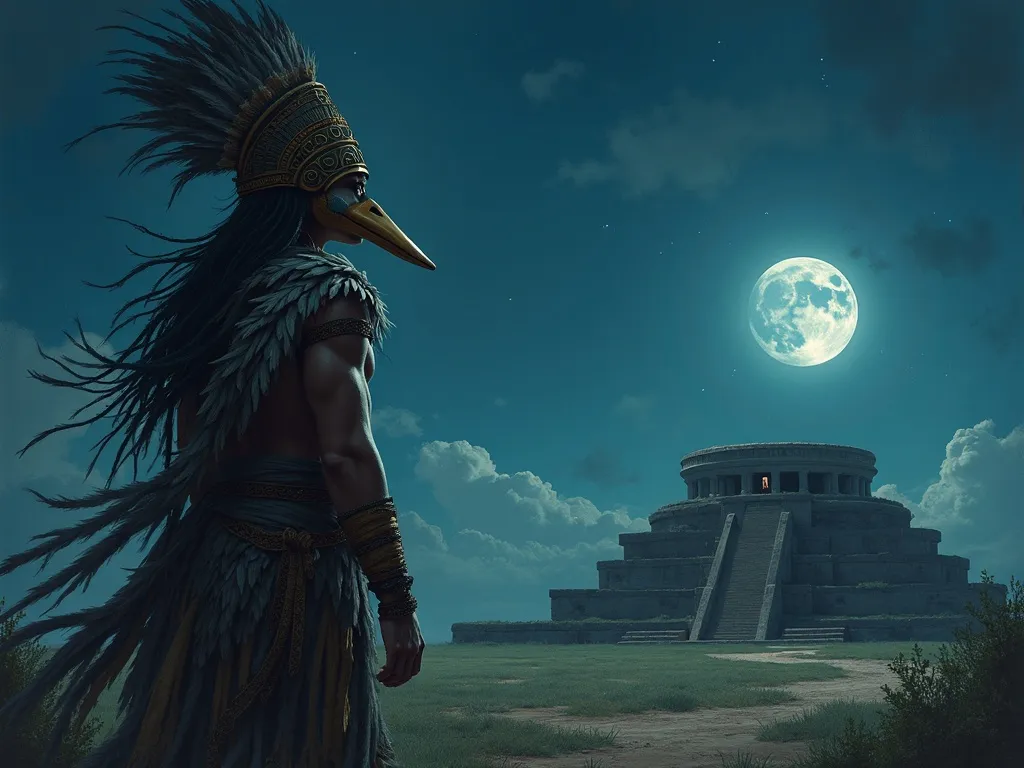
The sacred calendar, the tonalpohualli, a 260-day cycle meshed with the 365-day solar year to form a 52-year Calendar Round, is attributed in several sources to Quetzalcoatl's invention. The Leyenda de los Soles (Legend of the Suns), preserved in the Codex Chimalpopoca, credits him with designing the interlocking mechanism that let priests calculate propitious days for planting, warfare, and birth. Every child born received a name derived from the calendar sign of its birth date, a name tied directly to Quetzalcoatl's ordering of time.
Maize required a different kind of labour. The Aztec version has Quetzalcoatl transforming himself into a black ant to infiltrate Tonacatepetl, the Mountain of Sustenance, where the first corn kernels were hidden. He carried a single grain back to the gods, and when Tlaloc, the rain god, split the mountain open with lightning, the stored maize cascaded out for humanity. Quetzalcoatl's role here is characteristically indirect: not brute force but cunning transformation, a pattern repeated throughout his mythology.
He also taught the crafts that defined high Mesoamerican culture: the cutting and polishing of jade, the weaving of cotton in brilliant dyes, the cultivation of cacao, and the art of reading and writing codices. The Toltec reputation as supreme craftspeople rested explicitly on Quetzalcoatl's tutelage. When later Aztec rulers claimed Toltec descent or lineage, they were invoking this creative legacy.
The Fall of Topiltzin: Trickery, Drunkenness, and Exile
The most dramatically charged episode in the Quetzalcoatl cycle is his defeat at Tula, and it reads less like theology than like tragedy.
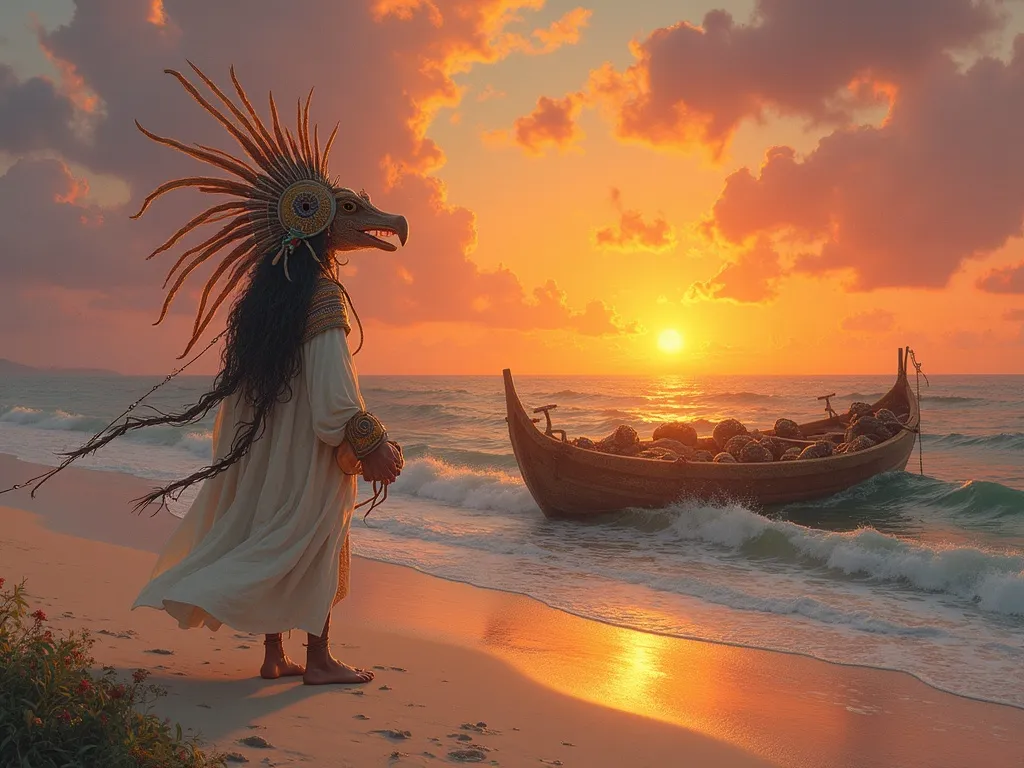
Tezcatlipoca, the Smoking Mirror, wanted to break the priest-king's hold on Toltec society. According to the Florentine Codex, he approached Topiltzin Quetzalcoatl disguised as an old man bearing a gift of pulque, the fermented maguey sap that the god's own priestly code forbade. Topiltzin tasted it, found it intoxicating, drank more, and that night slept with his sister Quetzalpetlatl. The morning brought shame and collapse. He ordered his ritual objects buried, his aviaries of quetzal birds and cotingas released, and his golden and jade ornaments hidden in rivers and mountains. The Toltec golden age ended with a hangover.
He walked east to the Gulf Coast. Sources differ on what followed: some say he immolated himself on a pyre and his heart rose as the morning star, others that he departed on a raft of woven serpents promising return. The Anales de Cuauhtitlan specifies the year of departure as One Reed and the direction as the eastern sea. Both endings carry the same structural function: Quetzalcoatl was not destroyed but deferred, his power intact, his return a permanent possibility lodged in the calendar.
This is the narrative architecture Tezcatlipoca exploits so brilliantly. He does not kill Quetzalcoatl. He makes him leave. The Smoking Mirror's genius lies in using the god's own moral code as a trap. The scene of intoxication and incest appears in later Mesoamerican contexts as well, suggesting a very old symbolic vocabulary about priestly purity and its betrayal.
Quetzalcoatl in Ritual and the Aztec Priestly Order
Inside Tenochtitlan's sacred precinct, two of the highest priestly offices bore Quetzalcoatl's name directly: the Quetzalcoatl Totec Tlamacazqui (priest of Huitzilopochtli) and the Quetzalcoatl Tlaloc Tlamacazqui (priest of Tlaloc). These dual offices, documented by Sahagún, governed the main temple's ceremonies. Holding Quetzalcoatl's name was not an honorific: it was a claim to embody the god's priestly authority.
The quincunx, a symbol of five points arranged like a die's face, was associated with Ehecatl-Quetzalcoatl and stamped onto censers and offering bowls. Conch shells cut in cross-section, which reveal a spiral matching the wind god's breath pattern, appeared constantly in ritual contexts: worn as pectorals by priests, deposited in temple offerings, and depicted in stone at sites from Chichen Itza to Monte Alban. The cross-section of the conch was called ehecacozcatl, the wind jewel, and it served as one of the most recognisable emblems of Quetzalcoatl: the Feathered Serpent God across cultures that spoke no Nahuatl at all.
The 20-day month of Ce Acatl (One Reed) in the tonalpohualli was his special province, and births on that date carried the god's direct patronage. People born under the sign received their character shaped by Quetzalcoatl: skilled in craft, inclined toward learning, prone to moral anxiety about impurity.
Cross-Cultural Parallels: The Feathered Serpent Beyond Mexico
The feathered or plumed serpent appears in traditions far beyond Nahuatl-speaking Mexico, and the distribution raises genuine scholarly questions about contact, diffusion, or independent parallel invention.
At Chichen Itza in northern Yucatan, the Maya deity Kukulkan (a direct translation of "feathered serpent" in Yucatec Maya) dominated the city's political and sacred iconography from roughly 900 CE onward. The famous Castillo pyramid at Chichen Itza is aligned so that at the spring and autumn equinoxes, a shadow serpent undulates down its northern staircase toward a carved serpent head at the base. Whether Kukulkan and Quetzalcoatl represent the same tradition migrating south, a parallel invention responding to similar astronomical observations, or a convergence facilitated by actual Toltec political expansion into Maya territory remains debated.
Among the Quiche Maya, the Popol Vuh features Gucumatz, again a direct translation of "quetzal-serpent," as one of the creator gods who shaped humanity from maize in the dark before the first sunrise. The shared maize-and-serpent imagery suggests a very deep Mesoamerican root, pre-dating the Aztec synthesis.
Comparative mythologists have also noted structural similarities with the Vedic Ahi Vritra, the serpent who hoards the cosmic waters until slain by Indra, and with the Egyptian Apep who threatens the solar barque. These parallels are structural rather than genealogical: the serpent that controls rain, sky, and life-force is a pattern the human imagination returns to independently. Quetzalcoatl is its most fully elaborated expression in the Americas.
Quetzalcoatl After the Conquest: Survival and Transformation
Spanish missionaries in the sixteenth century faced a theological problem: a creator god who gave humanity maize, invented the sacred calendar, and taught ethical conduct sat uncomfortably close to Christian notions of a civilising divinity. Some friars, most notably the Dominican Diego Durán, entertained the idea that Quetzalcoatl might have been an apostle, perhaps Saint Thomas, who had preached in America before Columbus. The logic was tortured but revealing: the god's moral prestige was too powerful to simply dismiss.
Aztec nobles and later indigenous chroniclers negotiated the god's memory carefully. In the writings of Fernando de Alva Ixtlilxochitl, a mestizo historian writing in the early seventeenth century, Topiltzin Quetzalcoatl becomes a nearly Christlike reformer whose legacy was corrupted by later priestly excess. These texts were not neutral: they were survival documents, written by people threading between colonial suppression and the need to preserve cultural memory.
In the nineteenth and twentieth centuries, Quetzalcoatl became a symbol of Mexican national identity, invoked by muralists like Diego Rivera and poets like Octavio Paz as evidence of a pre-Hispanic intellectual tradition equal to any European inheritance. The god appears on the facade of the National Museum of Anthropology in Mexico City, where he watches over the collection that contains his own stone effigies.
Contemporary writers from D.H. Lawrence (The Plumed Serpent, 1926) to N.K. Jemisin have used the Feathered Serpent as a lens for thinking about the relationship between human civilisation and the natural forces it alternately masters and destroys. The morning star keeps rising.
Frequently Asked Questions About Quetzalcoatl
Frequently asked questions
What exactly did Quetzalcoatl create or give to humanity?
According to the Florentine Codex and the Leyenda de los Soles, Quetzalcoatl is credited with retrieving maize from the Mountain of Sustenance, inventing the 260-day ritual calendar (tonalpohualli), teaching the crafts of jade-cutting, featherwork, and cacao cultivation, and stealing fire for human use in some variants. His most fundamental act may be the one recorded in the Historia de los Mexicanos por sus Pinturas: bleeding on the bones of the dead to create the people of the Fifth Sun.
Is there a historical person behind the myth of Quetzalcoatl?
Possibly. The Florentine Codex and the Anales de Cuauhtitlan describe a priest-king called Ce Acatl Topiltzin Quetzalcoatl who ruled at Tula (Tollan) around 925-950 CE, established a golden age, and was driven into exile by rivals. Whether this figure was a real ruler whose story was later mythologised, or a purely legendary construct built onto the older deity, remains an open question. Most Mesoamerican scholars treat the divine and historical layers as intentionally merged rather than separable.
Did the Aztecs really think Hernán Cortés was Quetzalcoatl?
The evidence that Moctezuma II genuinely believed Cortés was the returning Quetzalcoatl is thin and largely post-conquest in origin. Historian Camilla Townsend's research in Fifth Sun (2019) shows that the earliest indigenous accounts of the conquest written in Nahuatl make no mention of this identification. The story appears to have grown in Spanish accounts and in later indigenous narratives shaped by colonial circumstances. The calendar coincidence (1519 as a One Reed year) was real; the identification of Cortés with the god was a later narrative addition.
What is the connection between Quetzalcoatl and the planet Venus?
The Aztecs tracked Venus with extraordinary precision, recording its 584-day synodic cycle in the Codex Borgia and the Dresden Codex. The planet's disappearance and reappearance mapped directly onto the myth of Quetzalcoatl's death and transformation: eight days underground in Mictlan, then rebirth as the morning star. Venus's heliacal rising was considered dangerous, capable of bringing disease, and priests performed protective rituals at each new appearance. The Annals of Cuauhtitlan explicitly link the planet's positions to Quetzalcoatl's exile narrative.
How does Quetzalcoatl relate to Kukulkan and Gucumatz?
Kukulkan (Yucatec Maya) and Gucumatz (Quiche Maya) are both direct translations of "feathered serpent" in their respective languages, suggesting the concept predates any single culture and may have spread across Mesoamerica through trade, migration, or political expansion. The alignment of Chichen Itza's Castillo pyramid to produce a shadow-serpent at the equinoxes shows the same astronomical awareness present in Aztec Quetzalcoatl worship. Whether this represents Toltec political influence on Maya cities after 900 CE or a much older shared tradition is still actively debated by archaeologists.
The Unresolved Debate: One God or Many, One Myth or a Network?
Scholars of Mesoamerican religion have argued for decades about whether Quetzalcoatl: the Feathered Serpent God is best understood as a single coherent deity with a stable theology, or as a network of related but distinct figures who happen to share a name and an image.
The case for coherence: from Teotihuacan to Tula to Tenochtitlan, the feathered serpent appears in iconographically similar forms, consistently associated with wind, Venus, and cultural invention. The 260-day calendar, the conch-shell wind jewel, the round temples: these recur across centuries and cultures with a consistency that suggests transmission of a specific religious idea, not mere parallel development.
The case for multiplicity: the Aztecs themselves distinguished Ehecatl (wind), Ce Acatl Topiltzin (the priest-king), and Quetzalcoatl the creator deity as conceptually separate, even if they used the same name. The Maya Kukulkan carried political authority that the Aztec Quetzalcoatl explicitly did not (Quetzalcoatl lost political power to Tezcatlipoca; that tension is structural to his myth). The wind god who sweeps rain paths and the Venus deity who shoots pestilent arrows are different cosmic agents despite sharing a body.
The most productive current position, represented in the scholarship of Cecelia Klein, Alfredo López Austin, and David Carrasco, treats Quetzalcoatl as a theological complex: a cluster of related attributes, narratives, and offices that different cultures assembled differently depending on political and agricultural need. No single codex gives a complete account because no such complete account existed. The god was not a fixed text but a living argument about what human civilisation owed to the sky.
That argument is still being made. Every time an archaeologist uncovers a new serpent column at a Gulf Coast site, or a epigrapher reads a previously undeciphered calendar correlation, the Feathered Serpent adds another scale to its body.
Read the full book
Want the whole story?
The complete edition is an instant PDF download here, with a paperback on Amazon for selected titles.

Aztec
The Aztec Mythology Book: Quetzalcoatl, Huitzilopochtli, Tezcatlipoca, and the Five Suns of the Mexica
Blood, Feathered Serpents, and the Cosmic Engine of Tenochtitlan
The gods, heroes, and sacred calendar of the Mexica civilization. From the feathered serpent Quetzalcoatl to the five world ages, the complete mythology of Tenochtitlan.