
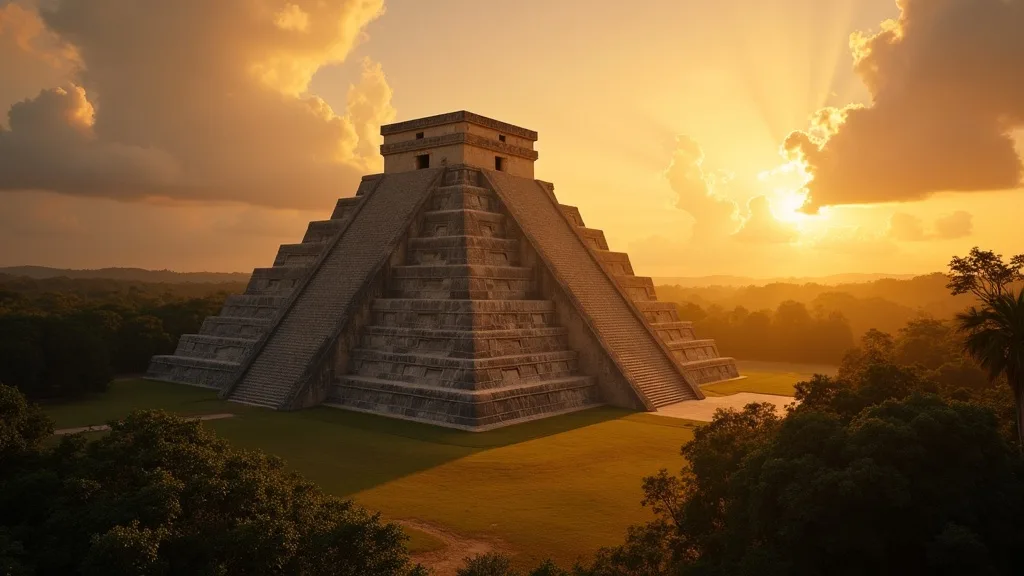
Chichen Itza Pyramid Temple: The Sacred Mountain at the Heart of Maya Cosmology
El Castillo rises from the Yucatan plain like a stone calendar made permanent. The Chichen Itza pyramid temple is not merely architecture; it is a cosmological argument carved in limestone.
Contents
At the spring equinox, just before sunset, shadows fall across the northern staircase of El Castillo in a precise sequence. Seven isosceles triangles of light and dark appear along the balustrade, resolving into the silhouette of a serpent descending toward the earth. The crowd goes quiet. The stone speaks.
That image has drawn millions of visitors to the Yucatan plain. But the spectacle is only the outermost layer of what stands here. The chichen itza pyramid temple known as El Castillo, or more formally as the Temple of Kukulcan, is a monument calibrated to the Maya understanding of time, sky, and the living architecture of the cosmos. Every measurement was a decision. Every staircase carries a number that means something.
The city around it, Chichen Itza, thrived roughly between 600 and 1200 CE, though its sacred well had drawn pilgrims far longer. At its height it governed trade networks stretching from the Gulf Coast to the highlands of Guatemala. The pyramid sat at the centre of all that weight.
El Castillo: Dimensions, Orientation, and Hidden Architecture
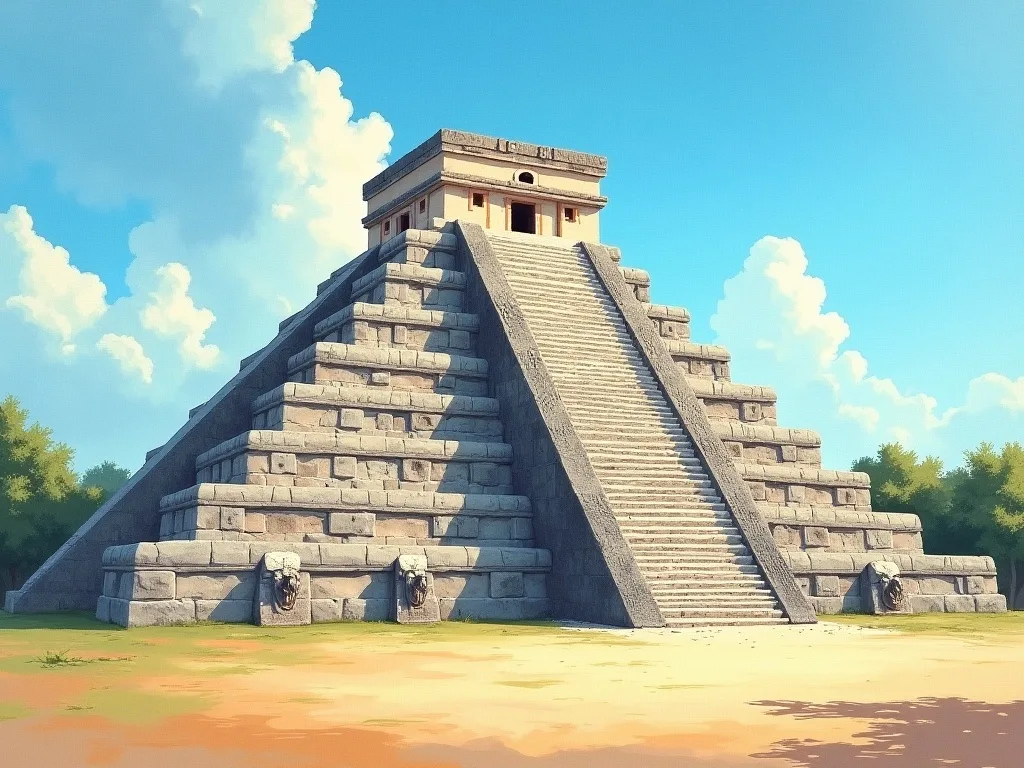
The pyramid stands roughly 30 metres above the plaza floor on a base measuring approximately 55 metres per side. Nine terraced platforms, stacked and tapering, form the body of the structure. Nine is not an arbitrary count. In Maya cosmology the underworld, Xibalba, was organised into nine levels, each governed by a lord of death. The nine platforms mirror that descent, making the pyramid simultaneously a mountain rising toward the heavens and a map of the world below.
Each of the four faces holds a broad staircase of 91 steps. The four times ninety-one equals 364, and the top platform adds one more: 365. The Maya solar calendar, the haab, ran on exactly that count. The orientation of the structure aligns the northern staircase with true north with an accuracy that required systematic astronomical observation over multiple generations.
Inside El Castillo, excavations conducted in the 1930s by Mexican archaeologists revealed an older pyramid entirely enclosed within the current shell. That inner structure, now called the Sub-temple, contains a throne room holding a red-painted jaguar effigy with jade-inlaid spots and a chac mool reclining figure. The jaguar throne echoes across Maya iconography as the seat of legitimate rulership: the Balam, or jaguar, was both warrior and king. Visitors no longer enter this inner chamber; the structural risk to the outer pyramid is too great.
A second, deeper sub-structure was confirmed by non-invasive scanning studies completed between 2015 and 2018. Ground-penetrating radar and electrical resistance tomography identified what researchers from the National Autonomous University of Mexico (UNAM) described as a possible third pyramid and a large underground cenote (sinkhole) directly beneath the foundations. The pyramid may have been built deliberately over that water source, linking sacred geography to sacred architecture in a literal, geological way.
Kukulcan, the Feathered Serpent: Who Descends the Stairs
The name of the temple points directly to its divine tenant. Kukulcan is the Yucatec Maya name for the feathered serpent deity known in Nahuatl as Quetzalcoatl. The name breaks into its components plainly: kukul means feathered or quetzal-feathered, and can means serpent. A sky-serpent who carries wind, rain, and the power of creation.
The serpent heads carved at the base of the northern staircase are not decorative. They are the terminal points of the balustrade, the place where the descending shadow-serpent's body reconnects with its stone skull at the autumn and spring equinoxes. Kukulcan was understood as a force of renewal, a bringer of the rains that made maize possible, a mediator between the celestial vault and the agricultural earth.
Later Postclassic traditions, recorded in sources like the Books of Chilam Balam, describe Kukulcan as a historical figure as well: a ruler or priest-king who arrived at Chichen Itza from the west, reformed the city's religion, and then departed, promising to return. This blending of divine archetype and political biography is common across Mesoamerican myth. Whether a real leader adopted the Kukulcan identity as a legitimating costume, or whether the myth crystallised around an earlier oral tradition, remains debated by scholars including Davíd Carrasco and Anthony Aveni.
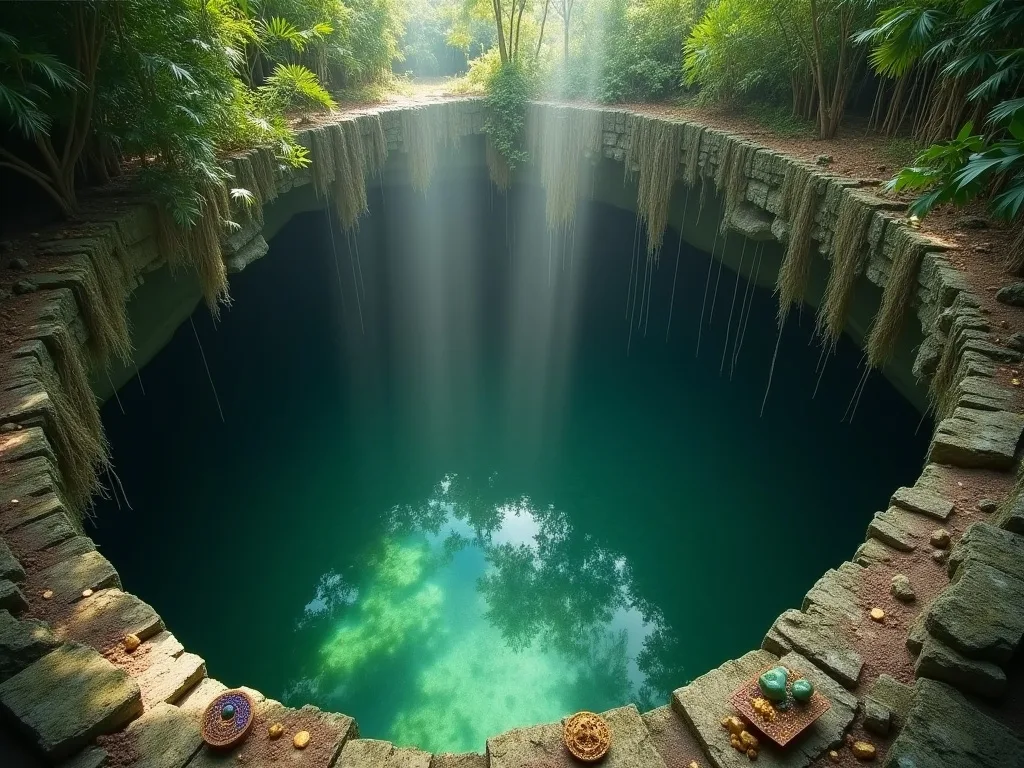
The Sacred Cenote: Where the Earth Drinks
A sacbe, a raised white limestone causeway roughly 300 metres long, runs north from El Castillo to the Sacred Cenote of Chichen Itza. The cenote is a natural sinkhole roughly 60 metres in diameter, its surface sitting about 20 metres below the surrounding plain. The water at the bottom glows green from algae. For the ancient Maya, cenotes were mouths of the earth, direct passages to Xibalba.
Dredging operations conducted by Edward Herbert Thompson between 1904 and 1910 pulled gold discs, jade ornaments, copal incense, carved rubber, and human skeletal remains from the murky water. The offerings were not random. Gold discs bear scenes of sacrifice; jade celts, the symbol of maize and fertility, are among the most recurrent finds. Osteological analysis of the bones has shown individuals of varying ages and both sexes, suggesting that the nature of sacrifice here was more complex than the simplistic narrative of "young virgins" that colonial-era Spanish accounts promoted.
The Sacred Cenote functioned as an oracle site as well as a place of offering. Rain petitions were central to its ritual life. Chichen Itza sits in a region with no rivers; the cenotes beneath the Yucatan limestone shelf were the only reliable water sources. The entire sacred geography of the site, from the pyramid to the causeway to the cenote, was organised around water: its absence, its return, and the divine negotiation required to secure it.
The Great Ball Court: Myth Enacted in Rubber and Stone
The largest Mesoamerican ball court ever built lies 150 metres northwest of El Castillo. Its playing field stretches 168 metres in length and 70 metres in width, flanked by vertical walls 8 metres high, each bearing a stone ring set 6 metres above the ground. The acoustic properties of the space are extraordinary: a whisper at one end is audible at the other, a feature that was almost certainly not accidental.
The game played here, pitz in Classic Maya, carried cosmological stakes encoded in the Popol Vuh, the K'iche' Maya creation epic. The Hero Twins, Hunahpu and Xbalanque, defeat the lords of Xibalba in a ball game after a sequence of trials, bringing their father Hun Hunahpu back from the dead and securing the conditions for the creation of humanity from maize dough. The ball court was not a stadium in the modern sense. It was a theatre of cosmic repetition, where the contest between life and death was re-enacted with real stakes.
Stone panels carved along the lower walls of the Great Ball Court at Chichen Itza show processions of ball players and a decapitation scene. The kneeling figure loses its head; from the neck springs a flowering serpent, blood transformed into vegetation. Death yields life. The iconography maps directly onto the Popol Vuh narrative, even though the Popol Vuh as a written text was only transcribed in the K'iche' Guatemalan highlands in the 16th century. The underlying myth clearly predates the text by centuries.
Astronomical Precision: How the Maya Read the Sky from Stone
The chichen itza pyramid temple is the most famous example of Maya archaeoastronomy, but it is not alone on this site. The circular tower known as El Caracol, interpreted by most researchers as an observatory, has window alignments oriented to Venus risings. Venus was the planet the Maya tracked most obsessively; its 584-day synodic cycle governed the timing of warfare and sacrifice. The Dresden Codex, one of only four surviving pre-Columbian Maya books, contains Venus tables accurate to within two hours over a span of 481 years.
Anthony Aveni of Colgate University, whose field work at Chichen Itza in the 1970s established the foundational archaeoastronomical map of the site, demonstrated that the diagonal of El Caracol's base platform aligns with the northernmost setting point of Venus on the western horizon. This was not an accident requiring single-generation observation. Tracking Venus to that precision demanded institutional memory: priests whose entire lives were dedicated to watching the sky and comparing their records with those of predecessors.
El Castillo itself encodes the 52-year Calendar Round, the unit formed when the 260-day ritual calendar (tzolkin) and the 365-day solar calendar (haab) returned to the same alignment. Fifty-two years times 365 equals 18,980 days, and 52 times 260 also equals 18,980 days. The Maya considered the end of a Calendar Round existentially dangerous: fires were extinguished, pottery broken, the sky watched through the night for the dawn that would confirm the world continued. El Castillo, calibrated to both cycles, stood as permanent evidence that the cosmic machinery was still running.
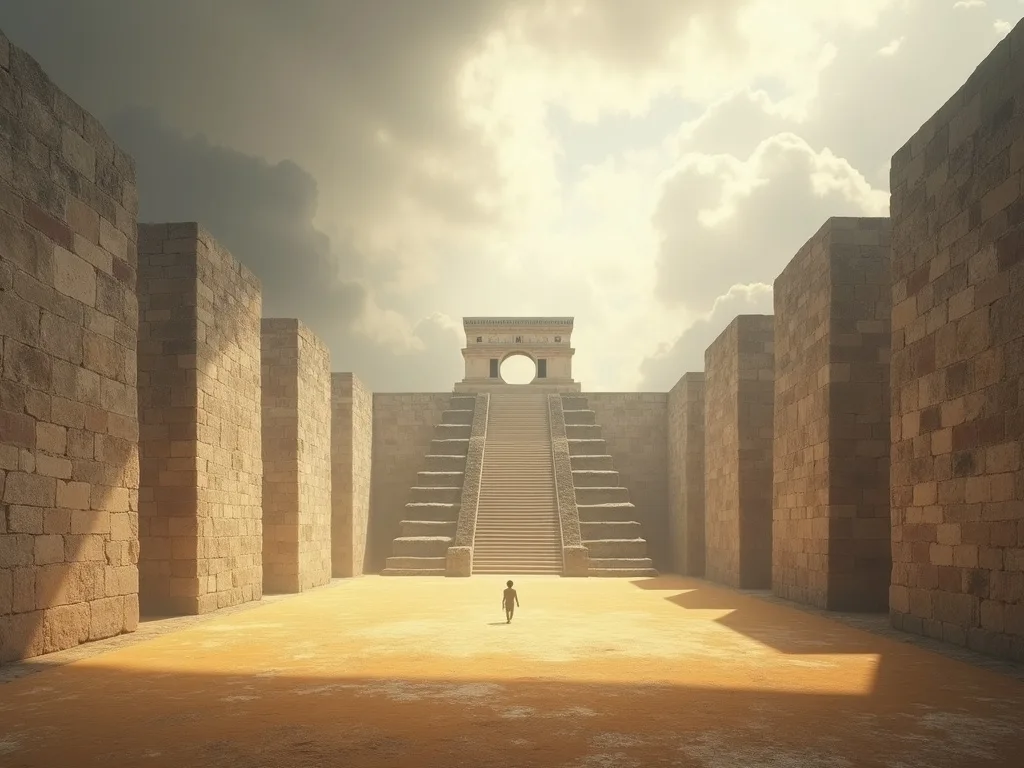
Chichen Itza in the Postclassic Political World
The city's name, in Yucatec Maya, means roughly "at the mouth of the well of the Itza." The Itza were a Maya group whose origins remain contested; some researchers have proposed Chontal Maya or Gulf Coast connections, while others argue for a largely local Yucatec development. What is certain is that Chichen Itza in the Terminal Classic and Early Postclassic periods (roughly 800-1200 CE) showed strong formal similarities with Tula, the Toltec capital in central Mexico.
Toltec-style warrior columns, chac mool figures, feathered-serpent imagery, and skull-rack platforms (tzompantli) appear at both sites. The nature of the connection, whether it was direct military or dynastic contact, long-distance trade and artistic exchange, or parallel development from shared Mesoamerican templates, has generated one of the most lively debates in Maya studies. Scholars like Jeff Karl Kowalski and Cynthia Kristan-Graham have argued for genuine political entanglement between Tula and Chichen Itza. Others, including David Webster, urge caution about reading architectural similarity as evidence of conquest or colonisation.
What is clear is that Chichen Itza functioned as a regional capital of exceptional power. The site controlled access to obsidian, salt, and trade goods moving through the Yucatan. Its rulers projected authority through the cosmological grammar of the pyramid, the ball court, and the cenote offering. Political legitimacy and sacred geography were inseparable here, as they were across the ancient Maya world visible in cities like Palenque and Tikal.
The Temple of the Warriors and the Platform of Eagles and Jaguars
El Castillo dominates the skyline, but the eastern sector of the site holds structures no less ambitious. The Temple of the Warriors rises on a stepped pyramid base and was approached through a forest of carved columns, each depicting armed figures: warriors in feathered regalia, sacrificial victims, and presiding deities. The columns once supported a roof, now collapsed, and their sheer number, over two hundred, implies ritual gatherings on a scale the pyramid's summit could never accommodate.
At the pyramid's summit, a chac mool reclines before the temple doorway. The Chac Mool figure appears at multiple Postclassic sites: a reclining human with head turned to the side, a bowl or disc resting on the abdomen. The bowl received offerings, possibly the hearts removed in sacrifice. The specific name "Chac Mool" was coined by the 19th-century explorer Augustus Le Plongeon, a sensationalist who invented theories about Atlantis and Mu; the term stuck in popular usage even as his interpretations were discarded.
The Platform of Eagles and Jaguars, a low platform near El Castillo, carries carved panels showing eagles and jaguars consuming human hearts. These are the emblems of Mesoamerican warrior orders, groups whose ritual and military functions were intertwined. The platform may have been used for performances or ceremonies visible to large audiences gathered in the central plaza.
Chichen Itza After Abandonment: Pilgrimage, Conquest, and Recovery
Chichen Itza was largely abandoned as a political capital by around 1200 CE. The reasons are not fully known. Regional warfare, drought cycles, shifting trade routes, and internal political fragmentation have all been proposed. The nearby city of Mayapan rose to prominence afterward and incorporated Chichen Itza's cosmological symbolism into its own buildings, a sign that even a depopulated Chichen Itza retained prestige.
Crucially, the site was never forgotten by the Maya themselves. The Sacred Cenote continued to receive offerings through the Postclassic period and into the Spanish colonial era. When the Spanish conquistador Francisco de Montejo arrived in the Yucatan in the 1520s and 1530s, Chichen Itza was already a ruin by European standards, but it remained a living sacred site in Maya memory and practice. Diego de Landa, the Franciscan friar whose Relacion de las cosas de Yucatan (c. 1566) is a primary source for later Maya religious life despite the violence he also inflicted on it, recorded ongoing veneration of the cenote.
Edward Thompson's dredging operations at the turn of the 20th century removed thousands of objects to Harvard's Peabody Museum. Many were returned to Mexico under a 1970s agreement. The repatriation of Maya heritage objects from international collections remains an active legal and ethical conversation, one with no clean ending as yet.
UNESCO inscribed Chichen Itza as a World Heritage Site in 1988. In 2007 it was voted one of the New Seven Wonders of the World in a popular global poll. Both recognitions brought mass tourism that has reshaped the site physically: the climbing of El Castillo, once permitted, was banned permanently in 2006 after a fatal fall, and visitor numbers now require managed crowd flow to limit erosion of the plaza surfaces.
What the Equinox Serpent Actually Tells Us
Returning to that shadow: scholars have debated whether the equinox serpent effect was deliberately engineered or a fortunate by-product of the building's orientation to the cardinal directions. Jeff Kowalski, Edwin Barnhart, and others working in archaeoastronomy have argued the alignment is too precise to be accidental. The effect is visible for several days around both equinoxes, not only on the exact date, which some have used to argue it lacks the precision that intentional design would require.
The counterargument is practical. An ancient builder working without digital calculation but with generations of sky-watching records could achieve equinoctial alignment through iterative observation. The shadow play is most dramatic at the spring equinox, when agricultural cycles were beginning in Yucatan and rain petitions were most urgent. Connecting the descent of Kukulcan to that specific moment of the farming year is exactly the kind of statement a state-level religious institution would want to make permanent in stone.
Whether or not every detail was engineered with the equinox specifically in mind, the chichen itza pyramid temple achieves something unusual in world architecture: it makes astronomical time visible to the naked eye, on schedule, twice a year, for anyone standing in the plaza. That is cosmology as public spectacle, as political theology, as renewable proof that the rulers who built this place understood the machinery of the heavens well enough to house it in limestone.
Frequently Asked Questions About the Chichen Itza Pyramid Temple
Frequently asked questions
Why does the chichen itza pyramid temple have exactly 365 steps?
The four staircases of El Castillo each have 91 steps, and the top platform counts as one more, totalling 365. This matches the Maya solar calendar, the haab, which ran on a 365-day year. The number was not coincidental: the building was calibrated to encode the solar cycle structurally, making it a three-dimensional calendar readable without any text.
Who was Kukulcan, and how does he differ from Quetzalcoatl?
Kukulcan is the Yucatec Maya name for the feathered-serpent deity; Quetzalcoatl is the Nahuatl name used by Aztec and Toltec traditions. Both names translate roughly the same way: "feathered serpent" or "quetzal-serpent." They share core iconography and functions as wind and rain bringers, but developed through distinct regional traditions. Whether they descend from a single Proto-Mesoamerican archetype or converged through contact remains an open question in scholarship.
What was actually found in the Sacred Cenote?
Dredging by Edward Thompson between 1904 and 1910 recovered gold discs, jade ornaments, carved rubber balls, copal incense lumps, pottery, and human skeletal remains. Later analysis confirmed both male and female individuals across a range of ages. Offerings date from multiple periods, suggesting centuries of continuous ritual use. Many objects were shipped to Harvard's Peabody Museum; a portion was repatriated to Mexico under a 1970s agreement.
Is the equinox serpent shadow effect intentional?
Most archaeoastronomers working at the site, including Anthony Aveni and Edwin Barnhart, argue the alignment is intentional given the building's precise cardinal orientation and the cultural importance of the spring equinox in Maya agricultural ritual. The effect is visible for several days around each equinox, not only on the exact date, but this is consistent with the practical limits of ancient construction rather than evidence against intentionality.
Why was El Castillo built over an older pyramid?
Layered construction was standard practice at Maya sites. Rulers built new temple-pyramids over existing ones to claim the accumulated sacred power of the structure and to mark new dynastic or calendrical cycles. The inner pyramid at El Castillo, with its jaguar throne, likely belonged to an earlier phase of the site's religious life. Each new outer shell amplified rather than erased what lay inside.
Can visitors still climb El Castillo today?
No. Climbing El Castillo has been prohibited since 2006, following a fatal fall, and the ban was made permanent to protect both visitors and the structure. The steps, while broad and regular, are steep by modern safety standards and had already suffered surface erosion from decades of high-volume foot traffic. The prohibition applies to all pyramids at the site.
The Pyramid as Living Document in Contemporary Maya Culture
The descendants of the builders are still here. An estimated six to seven million Maya people live across Mexico, Guatemala, Belize, Honduras, and El Salvador today. Many Yucatec Maya communities maintain oral traditions, calendrical practices, and ceremonial forms that connect, however transformed by colonial rupture, to the world that produced El Castillo. The question of who speaks for Chichen Itza, UNESCO, the Mexican federal government (INAH), the state of Yucatan, or Maya communities themselves, is genuinely unresolved.
Contemporary Maya scholars and activists have increasingly challenged the framing of Chichen Itza as a "lost" or "mysterious" civilisation, a framing that erases living continuity. The site is not a ruin in the sense of something finished. Marakame ceremonial specialists in the Yucatan still orient certain rituals to the solar calendar encoded in El Castillo's geometry. The Hanal Pixan (Day of the Dead) observances in Yucatan, while syncretic with Spanish Catholic forms, carry older structural bones.
The UNAM scanning project that identified a possible third pyramid and an underlying cenote is ongoing as of 2025. Non-invasive archaeology has transformed what researchers can claim about the site without a single shovelful of earth disturbed. Future imaging may resolve whether the innermost structure is truly a third pyramid or a natural limestone formation that the first builders incorporated deliberately. Either answer would say something significant about the relationship between natural geography and sacred architecture at Chichen Itza.
The chichen itza pyramid temple holds multiple simultaneous identities: it is a UNESCO monument drawing 2.5 million annual visitors, a contested heritage object, an astronomical instrument that still works twice a year, and a living node in a cosmological system that the Maya never fully stopped using. That is a rare combination for any structure built before the year 1000 CE. The limestone endures. The calendar it encodes keeps running.
Read the full book
Want the whole story?
The complete edition is an instant PDF download here, with a paperback on Amazon for selected titles.

Mayan
The Mayan Mythology Book: Hunahpu, Xbalanque, Kukulkan and the Sacred Stories of the Rainforest Mathematicians
The Popol Vuh, Xibalba, and the Cosmos Calculated in 13s and 20s
The Hero Twins descend to Xibalba. Kukulkan returns at equinox. Itzamna writes the first books. The complete mythology of the Maya who calculated the cosmos and left us the Popol Vuh.