
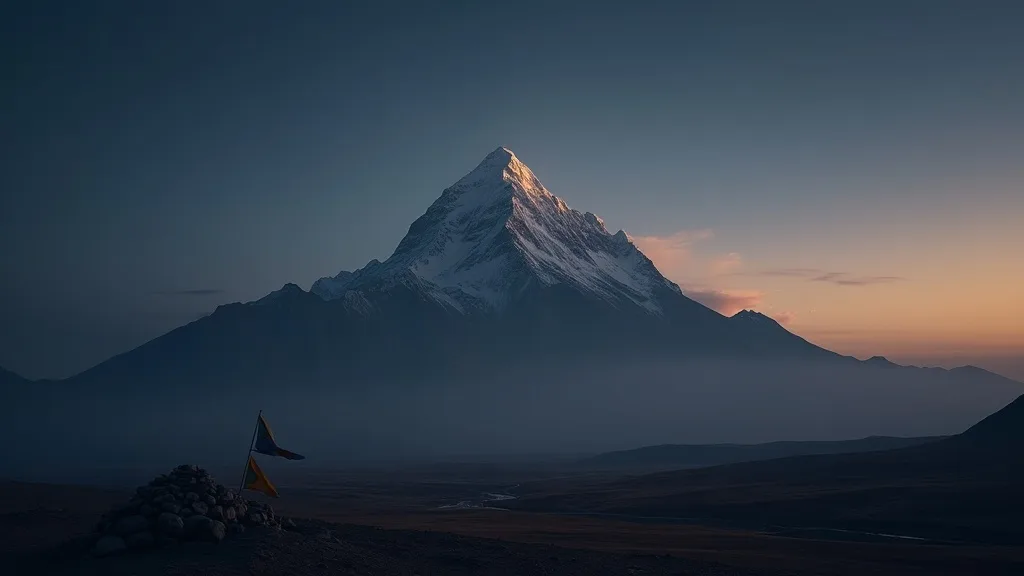
Mount Kailash: Sacred Mountain in Bön Cosmology
Rising 6,638 metres above the Tibetan plateau, Mount Kailash anchors the Bön cosmos as the axis of all existence. No peak on earth carries a heavier freight of myth, ritual, and cosmic geography.
Contents
The wind coming off the Tibetan plateau hits Mount Kailash before it hits anything else. The mountain stands alone, a near-perfect black pyramid of ice and metamorphic rock, unconnected to any major range, unclimbed by any human being in recorded history. Four of Asia's greatest rivers, the Indus, the Brahmaputra, the Karnali, and the Sutlej, spill outward from its base in four cardinal directions, as though the peak were pressing them away. From a purely physical standpoint that radial drainage pattern is remarkable. From a Bön cosmological standpoint, it is proof.
Bön, Tibet's pre-Buddhist indigenous religion, identified this mountain as Tise long before Hinduism called it Kailash or Buddhism borrowed it for its own symbolic vocabulary. The Bön cosmographers did not merely place a deity on the summit. They built the entire structure of the universe around it.
The story of Kailash inside Bön thought is a story about the shape of reality itself: where the sky meets the earth, where the living touch the dead, and where a single axis holds all of it together.
Tise: The Mountain Before the Mountain Had a Name
Bön texts use the name Tise (sometimes rendered Ti-se or Tisé) rather than the Sanskrit Kailash. The distinction matters. Kailash arrives in the record through Hindu and later Buddhist transmission; Tise is the mountain as Bön cosmographers understood it before those traditions reached the plateau.
The earliest Bön textual references to Tise appear in the Zhang Zhung Nyan Gyud, a transmission cycle tied to the ancient kingdom of Zhang Zhung, whose heartland sat in western Tibet precisely where the mountain rises. Zhang Zhung civilisation is now dated, through a combination of archaeology and linguistic analysis, to at least the first millennium BCE. Its language, Zhang Zhung nyengyü, is not Tibetan proper but a related archaic tongue, and it preserved a cosmographic vocabulary that Bön scholars regard as their oldest stratum.
In that vocabulary, Tise was the lha ri, the "god mountain," the vertical pin that holds heaven to earth. The concept mirrors what historians of religion call the axis mundi, but the Bön model is more architecturally precise than any loose metaphor about "centres." The mountain is not like an axis; it is the axis, the single structural member without which the nine-storey cosmological building collapses.
The numeral nine is not incidental. Bön cosmology is built around triadic and nonad structures. Nine heavens above, nine underworld registers below, with the human realm sandwiched at the midpoint. Kailash pierces all of them.
The Nine-Storey Swastika Mountain and Its Structural Logic
The Bön name Yungdrung Gutseg translates literally as "Swastika Stacked Nine Times" or "Nine-Storeyed Swastika." Each word repays attention.
Yungdrung is the Bön swastika, the left-facing hook cross that predates any Indic usage on the plateau. It rotates counterclockwise, opposite to the Hindu and Buddhist svastika. For Bön, the yungdrung represents indestructibility and eternal recurrence: the turning of existence that has no first revolution and will have no last. This symbol, carved into rock shelters across western Tibet, appears at Kailash shrines in the same counterclockwise orientation that Bön pilgrims walk the kora, the circumambulation circuit. Buddhist pilgrims walk it clockwise. The mountain hosts both processions simultaneously, on the same path, in opposite directions.
Gutseg means "stacked" or "piled." The nine storeys do not refer to a literal stepped structure visible to the eye. They describe ontological levels, strata of existence layered one above the other along the vertical axis the mountain embodies. Each storey is populated by specific classes of beings: lha (gods), klu (serpent spirits), gnyan (mountain spirits), btsan (warrior spirits), and others whose names and functions the Bön canon catalogues in exhaustive detail.
The structural logic is this: because reality has multiple strata and those strata need a fixed reference point, the physical mountain is the point where that reference becomes visible in stone and ice. Remove the mountain and the strata drift. The axis makes the cosmos navigable.
This is why, in Bön cosmography, the four sacred lakes surrounding Kailash (Lake Manasarovar, Lake Rakshastal, and two smaller bodies in the region) are not decorative features but structural nodes. They mark the horizontal plane that the vertical axis intersects, the cosmological equivalent of the horizon line in a technical drawing.
Shenrab Miwo and the Descent onto Kailash
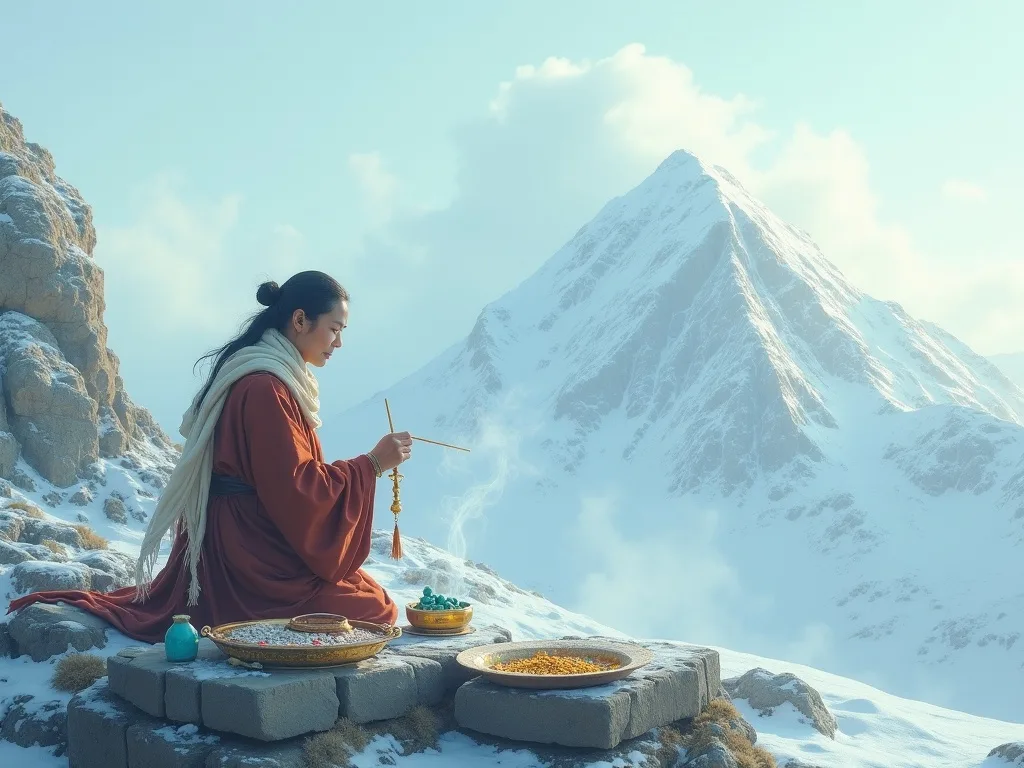
The figure central to Bön's founding narrative is Shenrab Miwo, the "Supreme Man of the Shen Clan," a semi-divine teacher whom Bön regards as the primordial revealer of its teachings. The tradition describes Shenrab not as a historical reformer (as Buddhism describes Shakyamuni) but as a being who existed before ordinary time and who descended from the divine planes to transmit wisdom to the human realm.
His descent, according to several Bön canonical texts including the Zermig and the Gzer Mig, was marked by a direct relationship with Kailash. One prominent narrative positions the mountain as the site where Shenrab first made contact with the earthly plane, effectively treating Kailash as the terminal point of his axis-crossing. The mountain is thus a landing site for vertical cosmic travel, not merely a backdrop.
The texts describe Shenrab's passage through the nine celestial planes and his arrival at Tise in language that is simultaneously cosmographic and biographical. He does not simply appear on earth; he arrives at the axis, at the only point where a being crossing vertical planes could correctly enter the horizontal world. This is a precise metaphysical claim dressed in narrative form.
Shenrab's connection to the mountain also explains the particular Bön practice of kora. Circumambulation of Kailash for a Bön practitioner reenacts not a general pilgrimage but a specific cosmological circuit: it traces the path Shenrab's teachings took as they radiated outward from the axis into the four directions. Each step around the mountain is a step along the trajectory of revelation.
Warrior Spirits, Mountain Deities, and the Animate Peak
Bön cosmology does not treat mountains as inert geology. Every peak of significance houses a gnyan, a mountain spirit, and every gnyan has a rank, a temperament, and a specific relationship with the human communities in its territory.
Kailash is home to Chakrasamvara in Buddhist Tantric tradition, but the Bön occupant is distinct. Classical Bön sources name the resident deity of Tise as Gekhö (sometimes spelled dGe-khod or Kye'u Chung Kha Ra), a nine-headed gnyan of supreme rank. Gekhö is not a personification of the mountain in the way that Greek oreads personify hills. Gekhö is the mountain's permanent divine resident, a specific being with specific attributes: he holds a crystal stupa, rides a snow lion, and presides over the weather systems that circle the peak.
Bön ritual texts prescribe precise offering sequences for Gekhö. The offerings are not optional ceremonies of devotion; they are functional maintenance of a cosmological structure. If the mountain is the axis, and the axis is inhabited by Gekhö, then neglecting Gekhö is equivalent to letting the axle of the world rust. The ritual economy of Bön regarding Kailash is therefore less about piety than about structural engineering at a cosmic scale.
Flanking Gekhö are hierarchies of btsan (warrior spirits) and klu (serpent beings associated with underground water), whose domains correspond to the mountain's visible features: cliffs, glaciers, streams, and rock formations each carry their own resident consciousness. Walking the kora means passing through a densely populated spirit landscape, and the traditional Bön traveller carries specific knowledge of which spirits occupy which landmarks.
The Kora: Circumambulation as Cosmological Act
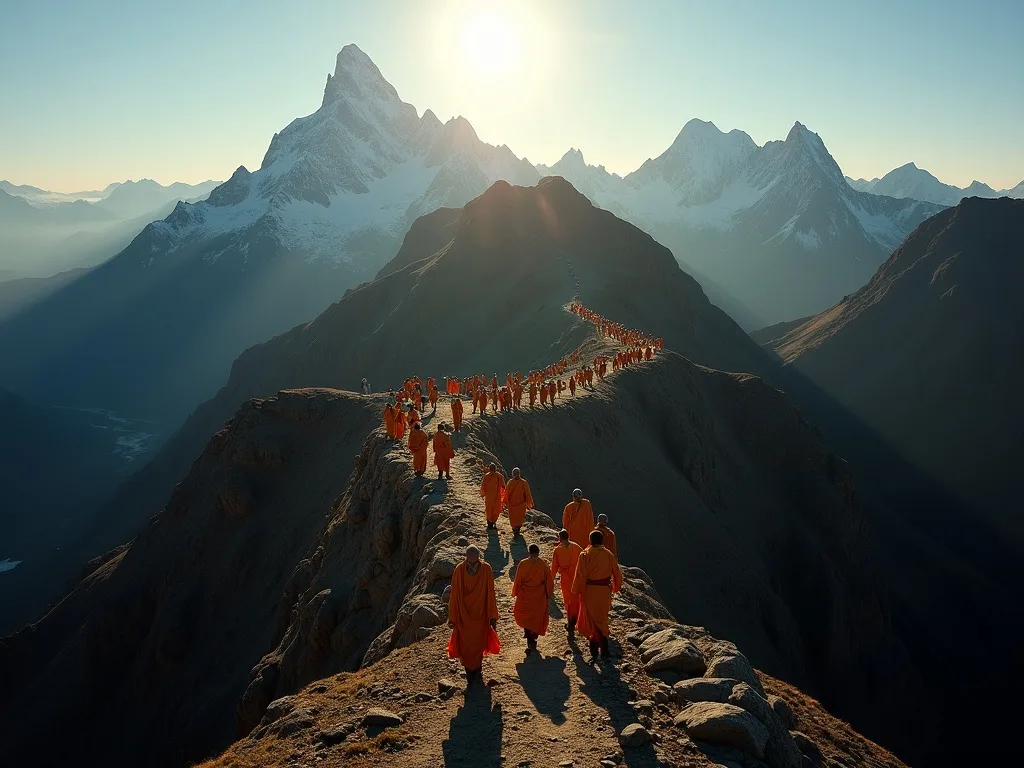
The kora (Tibetan: skor ra) circuit around Mount Kailash covers roughly 52 kilometres and crosses the Drolma La pass at 5,630 metres. Most pilgrims complete it in three days on foot. Bön practitioners cover it in the opposite direction from Buddhist pilgrims, counterclockwise, matching the left-facing yungdrung symbol's rotation.
But the circuit is not simply a direction of travel. Each segment of the path corresponds to a distinct cosmological register. Bön pilgrimage manuals, preserved in monasteries at Menri (the main Bön monastery, founded in 1405 in the Tsang region) and at Yungdrung Ling, describe the kora in terms of which plane of existence the pilgrim symbolically passes through at each geographical marker.
The western face of the mountain corresponds to the realm of lha, the upper divine beings. The northern face, the most forbidding, corresponds to the underworld registers. The eastern and southern faces carry intermediate cosmological designations. A single circuit of the mountain is therefore a complete traversal of the nine-storey cosmos, accomplished horizontally at ground level. Thirteen circuits, an auspicious Bön number, are held to produce liberation.
The Drolma La pass, the high point of the circuit, carries particular weight. Its name in the Buddhist tradition honours the goddess Tara (sgrol ma). In Bön interpretation, the same pass marks the boundary between the middle human realm and the upper divine registers. Crossing it on the kora is a literal ascent through cosmological layers, compressed into a physical climb over a mountain pass.
Zhang Zhung, Cosmic Geography, and the Rivers of Eden
The kingdom of Zhang Zhung deserves more than a footnote here. Archaeological surveys in western Tibet, particularly work conducted in the Sutlej valley and around the Kailash region since the 1990s, have uncovered burial complexes, rock carvings, and architectural remains consistent with a sophisticated pre-Buddhist culture. The Zhang Zhung nyengyü language, still partially decipherable through comparison with modern Tibetan dialects and the Burushaski language of northern Pakistan, contains cosmographic terms that predate Tibetan Buddhism by centuries.
Zhang Zhung's geographic heart, the area Bön sources call Tazig Olmo Lungring (a mythic western land also translated as the place of origin of Shenrab's teachings), may or may not map onto a physical location, but Tise itself is consistently described in Zhang Zhung cosmographic sources as the centre of the physical world. This is not metaphor borrowed from Buddhism. The textual record predates the Tibetan Buddhist synthesis.
The four rivers that flow from Kailash's base give the Zhang Zhung cosmographic model its most memorable image. The Indus flows north-northwest (the "lion river," senge khabab). The Brahmaputra/Tsangpo flows east (the "horse river," tamchok khabab). The Karnali flows south (the "peacock river," mayum khabab). The Sutlej flows west (the "elephant river," langchen khabab). The animals are not decorative; they correspond to the four great animal-headed guardians of the cardinal directions in Bön cosmology, each protecting one quarter of the world from its respective corner.
Four rivers flowing from a single sacred mountain toward the four corners of the known world is a pattern that appears independently in Genesis (the four rivers of Eden), in Hindu cosmography (the four rivers from Mount Meru), and in pre-Islamic Iranian tradition. The parallel is striking. Whether this represents genuine cultural diffusion through the Silk Road corridors, convergent cosmological logic, or something more ancient is an open question in comparative religion. What is certain is that the Bön model, tied to the physical reality of that radial drainage system at Kailash, has a geographic specificity the others lack.
Kailash in the Wider Tibetan Sacred Landscape
Kailash does not sit alone in the Bön sacred geography. It is the apex of a network of sacred mountains, lakes, and ritual sites that Bön cosmographers mapped across the Tibetan plateau. Lake Manasarovar, the freshwater lake lying directly south of the mountain, plays its counterpart role as the cosmic lake (sman mtsho) whose horizontal expanse mirrors the mountain's vertical reach.
In Bön cosmography, the paired mountain-lake structure appears repeatedly across the plateau. A lha ri (god mountain) always has its paired sman mtsho (spirit lake) in proximity. The mountain is yang, upward-reaching, associated with the lha above. The lake is yin, still and downward-reflecting, associated with the klu below. Together they embody the full vertical axis: the mountain reaches up, the lake reaches down, and the world of the living sits between them.
This structural pairing also explains why control of Kailash and Manasarovar has been so fiercely contested in the history of Bön-Buddhist relations on the plateau. The famous contest between the Bön master Naro Bönchung and the Buddhist saint Milarepa for possession of the mountain, described in later Tibetan hagiographic literature, is more than a competition between two religious figures. It is a narrative about which cosmological system would define the mountain's meaning for the culture going forward. When Milarepa wins by racing to the summit on a ray of sunlight, the Buddhist tradition effectively takes the mountain into its own symbolic vocabulary, though Bön never conceded the underlying cosmological claim.
Milarepa's contest with Naro Bönchung remains one of the most analysed episodes in Tibetan religious history, partly because it encodes the actual historical tension between Bön and Buddhism across the 8th to 12th centuries CE, when Buddhism was actively absorbing and displacing the older tradition.
The Unclimbed Summit and Its Ritual Significance
Kailash has never been climbed. This is not because it is technically impossible: at 6,638 metres it is shorter than dozens of Himalayan peaks that mountaineers regularly summit. It has not been climbed because every Tibetan, Nepali, and Indian government administration responsible for the region has declined to issue permits, consistently citing the mountain's religious significance to Bön, Hindu, Buddhist, and Jain traditions simultaneously.
For Bön practitioners, the unclimbed state of the summit is not a legal accident but a cosmological necessity. The summit of Yungdrung Gutseg is the top of the ninth storey, the uppermost register of the cosmos, the residence of the highest lha. Human feet on that surface would be as categorically wrong as a person walking across the face of the moon would have seemed to a medieval European: a categorical violation of the order of things.
The prohibition is not sentimental. It follows directly from the mountain's cosmological function. The axis must remain intact. The summit must remain untouched. The structure of reality requires it.
Reinhold Messner, who had both the technical ability and the permits to attempt the peak in the 1980s, declined to climb it on what he described as grounds of respect. That a figure from an entirely different cultural tradition recognised the weight of the prohibition says something about how the mountain communicates its significance to anyone who stands at its base.
Bön and Buddhism: Competing Cosmologies, Shared Axis
The relationship between Bön cosmology and Tibetan Buddhist cosmology at Kailash is neither simple absorption nor simple opposition. It is a long, layered negotiation that is still visible in the landscape today.
Buddhist Vajrayana tradition identifies Kailash as the abode of Chakrasamvara (Khorlo Demchok in Tibetan), a tantric deity of supreme bliss, and his consort Vajravarahi. The mountain becomes, in this reading, a mandala palace: its four faces are the four gates of the mandala, its summit the central deity. This is a sophisticated tantric reinterpretation that does not simply overlay Bön but engages with the existing idea of a cosmic mountain and translates it into a Buddhist symbolic register.
Hinduism, meanwhile, places Shiva on the summit with his consort Parvati, identifying the mountain with Mount Meru, the cosmic axis of the Hindu universe. The Jain tradition places the liberation of Rishabhanatha, its first tirthankara, in proximity to Kailash.
Four traditions. One mountain. Each with a cosmological claim that is internally coherent and externally exclusive. The mountain holds them all without collapsing, which may itself be the most remarkable thing about it.
Bön Cosmology
Kailash is Yungdrung Gutseg, the Nine-Storey Swastika Mountain. It is the axis mundi of a nine-tiered cosmos. The resident deity is Gekhö, a nine-headed mountain spirit of the gnyan class. Pilgrims walk counterclockwise (yungdrung rotation). The mountain belongs first to Zhang Zhung sacred geography and the teachings of Shenrab Miwo.
Buddhist Tantra
Kailash is the palace of Chakrasamvara (Khorlo Demchog), a tantric deity of the Unexcelled Yoga class. The mountain's four faces correspond to the four gates of a three-dimensional mandala. Pilgrims walk clockwise. The identification was consolidated in Tibetan Buddhist sources from the 11th century onward, drawing partly on the older Bön sacred geography.
Frequently Asked Questions About Mount Kailash in Bön Cosmology
Frequently asked questions
Why do Bön pilgrims walk the kora counterclockwise while Buddhists walk it clockwise?
The direction follows each tradition's primary symbol. Bön's sacred emblem is the yungdrung, a left-facing swastika that rotates counterclockwise. Walking the mountain's circuit in that direction enacts the symbol physically. Buddhist pilgrims follow the clockwise pradakshina tradition, consistent with Indian and Tibetan Buddhist circumambulation norms. Both groups share the same 52-kilometre path around the mountain, moving in opposite directions, sometimes passing each other on the trail.
What is the difference between Bön and Tibetan Buddhism in their understanding of Kailash?
Bön's claim to Kailash is older and tied to the Zhang Zhung civilisation that preceded Tibetan Buddhism on the plateau by centuries. Bön identifies the mountain as Tise, the axis of a nine-tiered cosmos, and associates it primarily with the teachings of Shenrab Miwo and the resident deity Gekhö. Buddhist Vajrayana tradition maps Chakrasamvara's mandala palace onto the same peak, a reinterpretation that absorbed and transformed the earlier sacred geography rather than erasing it. The 11th-century contest between Milarepa and Naro Bönchung marks the narrative moment when Buddhist symbolic authority over the mountain was asserted.
Has anyone ever climbed Mount Kailash, and why is it prohibited?
No climber has ever reached the summit of Kailash. The prohibition is not technical but religious and political: all administrations governing the region have refused permits in recognition of the mountain's significance to Bön, Hindu, Buddhist, and Jain traditions. For Bön practitioners, the theological reason is precise: the summit is the uppermost tier of the nine-storey cosmos, the realm of the highest lha, and human ascent would constitute a categorical violation of cosmological order. Reinhold Messner, capable of the climb, publicly declined to attempt it out of respect for this prohibition.
Who is Shenrab Miwo and what is his connection to Kailash?
Shenrab Miwo is the primordial teacher of Bön, a semi-divine figure who revealed the Bön teachings before ordinary historical time. Bön canonical texts, including the Zermig and Gzer Mig, describe his descent from the divine planes as occurring at Kailash: the mountain is the point where his vertical cosmic journey intersected the earthly horizontal plane. This makes Kailash not merely a sacred site in Bön but the original contact point between the divine realm and the human world. The kora circumambulation reenacts the outward radiation of Shenrab's teachings from this axial origin.
Why do four major rivers flow from the base of Kailash, and what does Bön cosmology make of them?
The Indus, Brahmaputra (Tsangpo), Karnali, and Sutlej all originate within roughly 100 kilometres of Kailash's base, a radial drainage pattern unique among the world's mountains at that altitude. Bön cosmology assigns each river to one of the four cardinal directions and identifies each with a sacred animal: the lion (north-west, Indus), the horse (east, Tsangpo), the peacock (south, Karnali), and the elephant (west, Sutlej). These animals correspond to the four great directional guardians in the Bön cosmic scheme. The physical fact of the rivers confirms, for the tradition, that Kailash is genuinely the point from which the world radiates outward.
What is the Zhang Zhung civilisation and why does it matter for understanding Kailash?
Zhang Zhung was an ancient kingdom centred in western Tibet, culturally and linguistically distinct from the Tibetan civilisation that later emerged to its east. Its exact dates are debated, but archaeological and linguistic evidence places it in the first millennium BCE at minimum. Zhang Zhung is crucial to understanding Kailash because it is the civilisation that produced the earliest attested sacred geography of the mountain under the name Tise. Bön tradition regards Zhang Zhung as the original homeland of its teachings, and the Zhang Zhung Nyan Gyud transmission cycle is considered the oldest layer of Bön scripture. Without Zhang Zhung, the Bön cosmological claim to Kailash has no historical foundation; with it, the claim predates every other tradition's engagement with the mountain.
The Living Mountain: Kailash in the 21st Century
The cosmological claims around Mount Kailash are not museum pieces. Bön is a living tradition. Menri Monastery in Dolanji, India, where the Bön community relocated after 1959, actively trains monks in the same ritual and cosmographic texts that describe Tise as the world axis. The kora receives tens of thousands of pilgrims every year, across all four traditions that claim the mountain. Chinese administrative control of the Tibet Autonomous Region since 1950 has complicated access but not ended it; pilgrimage seasons continue.
A sharper tension has emerged around the question of scholarly access versus religious preservation. Geologists who have studied the Kailash region have confirmed the exceptional radial drainage pattern and noted that the mountain's rock composition, a mixture of metamorphic schist and granite, is consistent with its surrounding geology rather than a geological anomaly. This matters to those who want to understand how a purely physical mountain became a cosmic axis: the answer lies not in hidden geological superpowers but in the meeting of a visually extraordinary, isolated peak with a civilisation that had already developed a sophisticated cosmographic vocabulary and simply found, in Tise, the perfect embodiment of what it already knew.
That convergence, between a landscape that genuinely behaves like a cosmic centre (four rivers, four cardinal directions, a solitary pyramid of ice visible for days in every direction) and a tradition that already needed a cosmic centre, is more interesting than any supernatural claim. It suggests that the Bön cosmographers were not hallucinating. They were reading the landscape with extraordinary precision, using categories that the modern geological survey cannot quite reach.
The mountain remains unclimbed. The rivers keep flowing outward. The pilgrims, walking in both directions at once around its base, continue their counterclockwise and clockwise circuits, each group certain that they are going the right way.
Free 25-page sample
Want the whole story?
Take the first 25 pages free. If it pulls you in, the full edition is yours as an instant PDF download, with a paperback on Amazon for selected titles.

Mythology
The World Mythology Book: The Gods, Heroes and Myths of Every Culture
The Gods, Heroes and Myths of Every Culture, in One Volume
The whole of world mythology in a single volume: Greek, Norse, Egyptian, Japanese, Hindu, Celtic, Slavic, Mesoamerican and African myths gathered side by side, each drawn from the primary sources.