

The Abduction of Persephone: The Myth That Gave the World Its Seasons
Hades seized Persephone in a sunlit meadow, and the earth fell silent. The abduction of Persephone is the Greek myth behind every winter, every harvest, and every hope of return.
Contents
The abduction of Persephone begins on an ordinary day, under an open sky, with a young goddess picking flowers. That ordinary moment is about to crack the world in half.
She reaches for a narcissus. The ground shudders. A chasm splits the earth, and from it comes a black chariot pulled by immortal horses, driven by a god who has never seen the sun and who has decided, today, that he wants what lives in the light. Persephone is dragged below before a single cry can echo far enough for anyone to hear. Above her, the earth seals shut. The meadow goes quiet. The flowers keep blooming, briefly, as if nothing happened.
That silence is where the myth truly starts. What follows is a story of grief so enormous it stops crops from growing, a divine negotiation with consequences still playing out every November, and a girl who becomes something no one expected: the sovereign of the dead.
The Meadow at Nysa: Where the Story Breaks Open
The Homeric Hymn to Demeter places the abduction at a meadow called Nysa, a name that appears in several Greek myths and likely refers to a symbolic "nowhere" rather than a real geography. Persephone is there with the daughters of Okeanos, gathering flowers: crocuses, violets, irises, hyacinths. Then comes the narcissus.
The hymn makes clear that the narcissus was no accident. Gaia, the earth itself, grew it "as a snare for the rose-cheeked maiden, a marvelous, radiant flower." It had a hundred blooms on a single stem. Its scent reached the heavens and the sea. When Persephone stretched out both hands to pick it, the earth opened.
Hades rose from below, seized her in his golden chariot, and carried her down into his realm, the sunless kingdom the Greeks called Erebus or simply the Underworld. She cried out for her father, Zeus. She cried out for her mother, Demeter. No mortal heard her. No god stepped forward. Only Hecate, the goddess of thresholds, heard the cry from her cave. Only Helios, the sun, saw with his all-seeing eye what had happened.
The complicity in this myth deserves a close look. Zeus had agreed to the marriage. He had not told Demeter. Gaia had grown the trap on request. The abduction was not a rogue act by a rogue god. It was arranged, top-down, by the ruler of Olympus, which is part of what makes the myth so uncomfortable and so rich.

Demeter's Grief: When a God Refuses the World
Demeter searched for nine days without stopping. She carried torches. She asked no one, received no answer, and neither ate nor drank. This detail matters in Greek religious thinking: gods sustain themselves on ambrosia and nektar (the food and drink of immortality), but Demeter in her grief abstains from both, aligning herself with mortal suffering.
On the tenth day, Hecate met her and told her she had heard the cry, but not the name of the abductor. Together they went to Helios. The sun god, unwilling to keep the secret from a grieving mother, told Demeter everything: Zeus had given Persephone to his brother Hades as a wife, and Hades, after all, was not an unworthy match. He was a king.
Demeter did not find consolation in that assessment. She disguised herself as an old woman and descended to the mortal world, to the city of Eleusis, just outside Athens. There she sat at a well called Parthenion, where the daughters of a local king named Keleos found her weeping. They brought her home. Demeter became the nurse of their infant son, Demophon, and in a scene that unfolds like a mystery inside the larger myth, she began feeding the child ambrosia in secret and holding him over a flame each night to burn away his mortality, to make him a god.
His mother Metaneira discovered this, screamed in horror, and broke the ritual. Demeter, furious, revealed herself as a goddess, and announced that Demophon would never now become immortal. What she left behind instead was the founding instruction for the Eleusinian Mysteries, the most important religious rite in ancient Greece: "Build me a great temple and altar, and I will teach you my rites."
Meanwhile, the earth stopped producing food. The grain withered. The soil hardened. The Homeric Hymn describes human beings dying, and the gods receiving no sacrifices, no burnt offerings, nothing. Zeus began to worry, not for the humans, but for the silence from his altars. He sent Iris, then every Olympian in turn, with gifts and arguments. Demeter refused them all. She said one thing: she would not return to Olympus, and the earth would not grow again, until she saw her daughter.

Hades and Persephone: A Kingdom Below the World
While Demeter raged and mourned above, what was happening below? The Homeric Hymn says very little about Persephone's inner life in the Underworld, which has made her one of the most reinterpreted figures in all of classical myth. But later sources, including Ovid's Metamorphoses (completed around 8 AD) and various Orphic texts, fill in more detail.
Hades is a peculiar figure among the Olympians. He rules the largest kingdom of all, but he is almost never shown acting capriciously or cruelly to the dead. He is stern, fair, and deeply alone. In some readings of the myth, his desire for Persephone is not simple predation but a profound and impossible longing for warmth in a place that has none.
The Underworld he rules is described with stunning precision across Greek literature. The dead cross the river Styx (or sometimes Acheron), guided by the ferryman Charon. They arrive in a realm of pale grasses, the Asphodel Meadows, where ordinary souls wander without memory or ambition. The wicked are sent to Tartarus, the deep pit below the Underworld proper, for punishment. The virtuous few reach the Elysian Fields, a paradise of perpetual green. Persephone, according to the Homeric Hymn, was "secretly weeping and longing for her mother" and "the fruitful earth," but she was already, by the structure of the myth, a queen.
Persephone Above
Kore, meaning "the Maiden," daughter of Demeter and Zeus. Associated with spring flowers, grain, and youth. She gathers blossoms in sunlit meadows with the Okeanides. Innocent, unformed, not yet herself.
Persephone Below
Queen of the Underworld, wife of Hades. Known as "the Dread Persephone" in Homer's Odyssey. She judges the dead alongside her husband, commands Hecate, and holds power over the fate of souls. Fully herself.
That transformation is the hidden spine of the myth. Persephone does not simply return from the Underworld unchanged. She arrives above as someone different. The name Kore belongs to the girl in the meadow. Persephone, Queen of the Dead, is who comes back.
The Pomegranate: Six Seeds and Their Consequences
Zeus, under pressure from Demeter's refusal to restore fertility, sent Hermes into the Underworld with a direct order: return Persephone to her mother. Hades agreed, but before Hermes could take her, he offered Persephone food: pomegranate seeds, sweet and red, the fruit of the dead.
She ate six. Or four. Or three, depending on the source.
The Homeric Hymn says she ate "secretly," which matters: she was not tricked, she ate. Ovid's Metamorphoses says Ascalaphus, a garden-keeper of the Underworld, saw her eat and reported it. In later Orphic traditions, the number of seeds determines the number of months she must return below each year. Most accounts settle on six seeds: six months below, six months above.
This is the pivot of the whole myth. The eating of the pomegranate binds Persephone to the Underworld by the rule of xenia, ancient Greek guest-friendship: once you have eaten at someone's table, you belong there, at least partially. The law applies even to gods, even under duress. Even Hermes cannot override it.
Zeus brokered a compromise, the kind of settlement that characterises Greek divine politics: Persephone would spend part of the year with Hades below, and part with Demeter above. Hermes returned her to the surface. The Homeric Hymn describes Demeter's joy as the earth immediately responding: grain shoots up, the whole wide earth blooms with flowers. Then Hecate embraces Persephone, and from that day forward, Hecate becomes Persephone's minister and attendant in both worlds.
Demeter, now reconciled, did two things. She taught the princes of Eleusis her rites, the secret ceremonies that became the Eleusinian Mysteries. And she restored the world's fertility, which had been held hostage for the duration of her grief.
The Eleusinian Mysteries: A Myth That Became a Religion
No myth in the ancient world was more directly embedded in live religious practice than the abduction of Persephone. The Eleusinian Mysteries, held at Eleusis twice a year (the Lesser Mysteries in early spring, the Greater Mysteries in autumn), were observed for at least 2,000 years, from roughly the 7th century BC until the Roman emperor Theodosius I banned pagan rites in 392 AD.
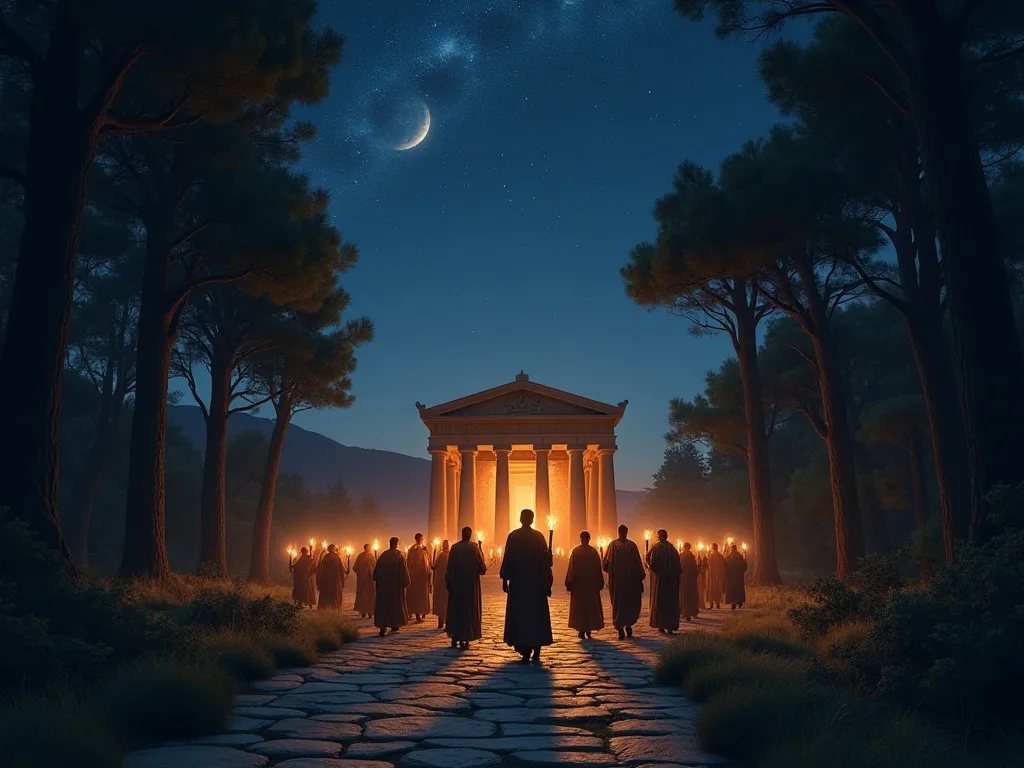
What happened inside the Telesterion, the great Hall of Initiation at Eleusis, was kept rigorously secret. Initiates (mystai) were forbidden to speak of what they witnessed. Virtually no direct account survives. What we know comes from critics, church fathers (who found the rites scandalous), and the archaeological record. Scholars including Walter Burkert, in his 1983 study Homo Necans, and more recently Hugh Bowden in Mystery Cults of the Ancient World (2010), have pieced together a probable structure: a ritual procession along the Sacred Way from Athens to Eleusis, torchlit searches re-enacting Demeter's wandering, and at the climax, some kind of revelation connected to grain, death, and rebirth.
What the initiation promised was described by Pindar and Sophocles in guarded terms: the initiates would know something after death that the uninitiated would not. In a world without a unified doctrine of afterlife, this was extraordinarily powerful. Cicero, writing in the 1st century BC, said that Athens had given the world many fine things, but the Mysteries were the greatest: "By them we have been brought from a barbarous and savage life to the state of humanity."
The myth of Persephone's descent, in other words, was not just a story about seasons. It was a promise about death.
Sources, Variants, and What They Disagree On
The primary source, the Homeric Hymn to Demeter, was probably composed in the 7th or early 6th century BC, though scholars debate this. It was rediscovered in 1777 in a Moscow stable and is preserved in a single manuscript. Given how central the myth is, the thinness of the manuscript tradition is striking.
Hesiod, writing around the same era in his Theogony, gives only a brief reference to Persephone as the daughter of Zeus and Demeter and as Hades' queen. He does not narrate the abduction.
Ovid's Metamorphoses (Book V) reworks the myth with Roman names: Proserpina for Persephone, Ceres for Demeter, Dis or Pluto for Hades. His version is more dramatic, more focused on sensory detail (the specific flowers, Proserpina's screaming, Cyane the nymph who tries to block the chariot and is transformed into a pool), and less focused on the religious dimension. Ovid writes to entertain; the Homeric Hymn writes to instruct.
The Orphic tradition, preserved in the Orphic Hymns and fragments of Orphic poetry, offers a very different Persephone. She is the daughter not of Demeter but, in one strand, of Demeter-Rhea together with Zeus in his serpent form. She is also the mother, in the Orphic cosmogony, of Dionysus Zagreus. This Persephone is less a victim of abduction and more a cosmic pivot between worlds, a figure of genuine metaphysical power.
Claudian, a poet writing in Latin around 395-400 AD, composed an unfinished epic called De Raptu Proserpinae ("On the Abduction of Proserpina"). It is the last great ancient version of the myth and the most sympathetic to Hades, portraying him as genuinely lovestruck rather than simply violent.
The Cross-Cultural Pattern: Descent, Loss, Return
The abduction of Persephone belongs to a family of myths found across the ancient world. The pattern runs: a beloved figure descends to the realm of death, the world above mourns and withers, a negotiation or rescue follows, and partial return restores life. The structure is almost too clean to be coincidence.
In Sumerian myth, Inanna descends to the Great Below, ruled by her sister Ereshkigal. The earth's fertility fails during her absence. She returns, but only by sending her husband Dumuzi in her place for half the year. The structural parallel with Persephone and the six-month division is striking. Inanna's descent is recorded on clay tablets from around 1900-1600 BC, making it far older than the Homeric Hymn.
In Norse myth, Baldr is the beloved god who dies and descends to Hel. Frigg asks every creature in the world to weep for him. The world does weep, and it does not restore him, which makes the Norse version a tragedy rather than a seasonal cycle. The grief-structure is identical; the resolution is not.
In Egyptian myth, Osiris is killed by Set, and his wife Isis mourns him so completely that the land dries and sickens. Isis reassembles him, and though Osiris cannot return to the living world permanently, the reassembly restores the Nile's cycle. Again: loss, mourning, partial restoration.
These parallels suggest that the myth of the abducted or descended deity is one of the oldest mental structures humans have for explaining seasonal change, agricultural dependence, and the necessity of death within life. The specific Greek form, with its legal complexity (the pomegranate, the negotiation, the partial return), is sophisticated in ways that reflect the Greek cultural obsession with contracts, xenia, and the orderly governance of the cosmos.
Timeline of the Myth's Transmission
| Era | Source | Key contribution |
|---|---|---|
| c. 1900-1600 BC | Sumerian Descent of Inanna | Earliest parallel: descent, absence, partial return |
| c. 700-600 BC | Homeric Hymn to Demeter | Primary Greek narrative, 495 lines |
| c. 700 BC | Hesiod, Theogony | Brief genealogical reference |
| c. 5th century BC | Orphic texts | Cosmological Persephone, mother of Zagreus |
| c. 490-480 BC | Pindar, Odes | Allusions to Mysteries and afterlife |
| c. 8 AD | Ovid, Metamorphoses Book V | Roman retelling, sensory and dramatic |
| c. 395-400 AD | Claudian, De Raptu Proserpinae | Final ancient epic version |
| 392 AD | Theodosius I bans pagan rites | End of Eleusinian Mysteries |
| 1777 | Moscow manuscript rediscovered | Modern recovery of Homeric Hymn |
Persephone in Modernity: The Myth Keeps Moving
The myth has never stopped being rewritten. What shifts with each era is which character the writer finds most interesting.
For the Romantic poets, it was the meadow and the loss. Tennyson's "Demeter and Persephone" (1889) gives voice to a mother who will not fully grieve because she knows the return is coming. Swinburne wrote "The Garden of Proserpine" as a meditation on weariness and rest, using the Underworld as a place not of horror but of relief.
The 20th century shifted focus to Persephone herself. Edith Hamilton's Mythology (1942), still widely assigned in American schools, presents the story primarily as a tale of loss and reunion. But the feminist rereading gained force from the 1970s onward. Charlene Spretnak's Lost Goddesses of Early Greece (1978) argued that the abduction narrative overlaid a much older tradition in which Persephone descended voluntarily, a goddess of sovereignty rather than a victim. This argument has archaeological support in some pre-Hellenic cult sites but remains contested.
Natalie Haynes, in Stone Blind (2022), does not retell the Persephone myth directly, but her approach to female mythological figures has shaped how contemporary readers approach it. Rick Riordan's Percy Jackson series, which has introduced Greek myth to tens of millions of young readers since 2005, portrays Persephone and Hades as a functional, even affectionate, couple. In the webcomic Lore Olympus by Rachel Smythe, Persephone's arc runs across hundreds of episodes and explicitly interrogates the consent issues in the original myth, making her choices central rather than peripheral.
The myth's durability comes from exactly the feature that makes it uncomfortable: the ambiguity at its core. Was Persephone a victim? An unwilling bride who became a willing queen? A figure whose transformation into something powerful required the rupture of the meadow? The ancient texts do not answer this cleanly, and that open space has made the story available to every generation that needed it.
Demeter, the grieving mother who stopped the world, is increasingly the figure readers revisit. Her refusal is radical by any standard: a god who holds the world's food supply hostage for justice. She loses the argument in a purely legal sense (Persephone ate the pomegranate, a fact no one can undo), but she wins something real. She forces Zeus to acknowledge a wrong. She gets her daughter back, partially. She founds a religious tradition that promises something to mortals that Olympian religion rarely offered: a meaningful relationship with death. That is not nothing. By the standards of Greek divine politics, it may be everything.
Frequently Asked Questions About the Abduction of Persephone
Frequently asked questions
Why did Hades abduct Persephone instead of asking for her hand?
The Homeric Hymn to Demeter implies that Hades knew Demeter would refuse, so Zeus agreed to the abduction in secret rather than arranging a proper courtship. The myth reflects a real tension in Greek marriage customs, where a father held legal authority over a daughter's marriage and a mother held none. Zeus exercised that authority; Demeter was excluded entirely. This is part of why Demeter's grief reads as both maternal loss and political fury.
How many pomegranate seeds did Persephone eat, and does the number matter?
The Homeric Hymn says only that she ate "secretly," without specifying a number. Ovid does not give a number. Later Orphic and mythographic traditions settled on different counts (three, four, or six) to explain different seasonal divisions. Six seeds became dominant, corresponding to six months below and six months above. The number is a later rationalisation, not part of the original canonical text, but it has been repeated so often it now feels original.
What were the Eleusinian Mysteries, and what did they have to do with Persephone?
The Eleusinian Mysteries were the most important religious rites in ancient Greece, practised at the city of Eleusis for at least 2,000 years. They were directly founded, according to the Homeric Hymn, by Demeter herself after the abduction. Initiates re-enacted Demeter's search and witnessed a secret revelation connected to grain, death, and rebirth. What exactly happened inside the initiation hall remains unknown because the penalty for revealing it was death. Scholars like Walter Burkert and Hugh Bowden have reconstructed a probable ritual sequence, but the core mystery was never written down.
Is the abduction of Persephone really the Greek explanation for the seasons?
Yes, explicitly. The Homeric Hymn to Demeter states that when Persephone is below, Demeter withholds fertility from the earth, and when Persephone returns, Demeter allows the grain to grow. This maps onto Greek agricultural cycles: the dry, dead summer (when grain does not grow in Mediterranean climates) corresponds to Persephone's time in the Underworld, and the autumn planting and spring harvest correspond to her presence above. The myth functions as a narrative explanation for why the earth is not always productive.
How does the abduction of Persephone compare to other ancient descent myths?
The closest parallel is the Sumerian myth of Inanna's Descent, recorded on clay tablets from around 1900-1600 BC, which predates the Homeric Hymn by over a thousand years. In it, Inanna descends to the Underworld, the earth wilts, and she returns by sending her husband Dumuzi below for part of the year. The structural similarity (descent, mourning, partial return, seasonal division) is striking enough that some scholars, including Thorkild Jacobsen, have argued for a common ancient Near Eastern template behind both myths.
Did Persephone have any power in the Underworld, or was she only a captive?
She held real power. In Homer's Odyssey, she is called "dread Persephone" and is shown commanding the shades of the dead, including sending the ghost of the Gorgon to drive Odysseus away. Odysseus explicitly must gain her permission, indirectly, to speak with the dead. In the Orphic tradition she is even more powerful, a cosmic queen who judges souls alongside Hades. The image of Persephone as a passive captive belongs more to modern sentimentality than to the ancient sources.
The Unresolved Question: Was There an Older Persephone?
Behind the abduction narrative lies a scholarly debate that has not closed. Several researchers, including the archaeologist Martin Nilsson and, more recently, Günther Zuntz in his 1971 study Persephone, have argued that Persephone was originally an independent chthonic deity, a goddess of the earth's depths worshipped in pre-Hellenic Southern Italy and Sicily, where her cult was especially strong at Locri Epizephyrii. Her temple complex there included thousands of terracotta votive offerings showing her enthroned, not abducted, not weeping, but ruling.
The argument runs like this: when the Olympian system was consolidated and Zeus was made the supreme god, older goddess traditions were narratively subordinated. The abduction is the literary mechanism by which an autonomous queen of the dead becomes the daughter of an Olympian and the wife of another. She does not lose her power, but she loses her independence and her priority.
This reading is speculative, because the pre-Hellenic cult evidence does not come with explanatory texts. But the cult of Persephone in Sicily and Magna Graecia was notoriously powerful, more so than in mainland Greece, and the votive evidence consistently shows her as a mature queen rather than a kidnapped girl.
Whether or not that older Persephone existed, the tension is built into the myth itself. The girl in the meadow is called Kore, the Maiden. The being who returns is called Persephone, and she is called dread. The myth gives her an origin story, but the story also gives her a crown. Every retelling since has had to decide which of those two things is the point.
The pomegranate seeds, red in the hand of a god who offered them in the dark, may be the most precise image the Greeks ever made for the way transformation works. You do not plan it. You do not always understand it while it is happening. But afterward, you cannot go back to the meadow and pretend you are still only gathering flowers.
Free 25-page sample
Want the whole story?
Take the first 25 pages free. If it pulls you in, the full edition is yours as an instant PDF download, with a paperback on Amazon for selected titles.

Mythology
The World Mythology Book: The Gods, Heroes and Myths of Every Culture
The Gods, Heroes and Myths of Every Culture, in One Volume
The whole of world mythology in a single volume: Greek, Norse, Egyptian, Japanese, Hindu, Celtic, Slavic, Mesoamerican and African myths gathered side by side, each drawn from the primary sources.