
Hades: Lord of the Underworld
Hades rules the Greek underworld with quiet, absolute authority. Neither villain nor demon, he is the god who keeps the cosmic balance that Zeus and Poseidon could never maintain alone.
Contents
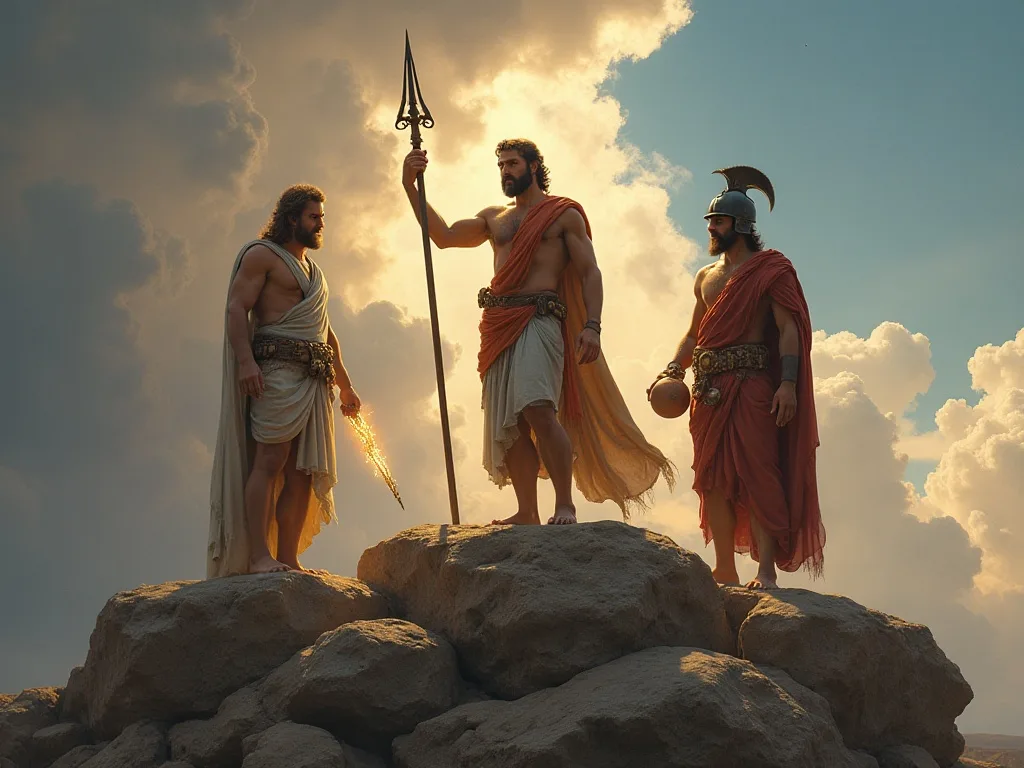
The lottery happened only once, and it decided everything. After the Olympians overthrew the Titans, three brothers stood before a common pot and drew lots. Zeus pulled the sky. Poseidon pulled the sea. The third brother drew the underworld, the realm beneath all things, and walked into it without argument. His name was Hades: Lord of the Underworld, and he never came back up.
That single detail shapes every myth about him. Hades is not a visitor in the land of the dead. He is its permanent sovereign, its architect, its judge of last resort. The ancient Greeks called him Aidoneus ("the unseen one") more often than they said his name aloud, because naming him directly felt unwise, the way you avoid catching the eye of someone who already knows where you will end up.
He is not the Greek Satan. He is something older and stranger: a god who accepted an unglamorous portion of the cosmic inheritance and ran it with perfect, cold competence.
The Birth of Hades and the War Against the Titans
Hades was the eldest son of the Titan Cronus and his sister Rhea. Cronus had heard a prophecy that a child of his would overthrow him, the same fate he had dealt to his own father Ouranos. His solution was direct: he swallowed each child at birth. Hades went down first. Then came Poseidon, Demeter, Hera, Hestia. All five lived inside their father's stomach, frozen in time, neither dead nor free.
Rhea saved the sixth child, Zeus, by wrapping a stone in swaddling cloth and handing it to Cronus. She hid the infant on Crete. When Zeus grew, he forced his father to vomit up the five siblings, fully formed and radiating fury.
The Titanomachy, the ten-year war between Olympians and Titans, came next. Hesiod tells the story in the Theogony, written around 700 BC, one of the earliest surviving attempts to map the Greek cosmos. The Olympians freed the Cyclopes from Tartarus, the deepest pit of the underworld, and the Cyclopes gave them weapons in return: thunder and lightning for Zeus, a trident for Poseidon, and for Hades something subtler. A helmet of invisibility, forged from the hide of a dog killed for that purpose. The Greeks called it the kynee, the dog-skin cap. It let Hades move unseen through enemy lines, stealing Titan weapons before a blow could be struck.
The Titans lost. Cronus and his brothers were cast into Tartarus, imprisoned there for eternity, with the Hecatoncheires, the hundred-handed giants, standing guard. The cosmos was split. The lot fell as it fell. Hades took his kingdom.
The Geography of His Kingdom
The underworld Hades inherited was not a single dark room. It was a structured realm with distinct regions, rivers, gatekeepers, and bureaucratic logic that would impress any civil administrator.
At the border stood the River Styx (Styx in Greek, meaning "hateful"), the oath-river that even gods could not violate without consequence. Souls arrived at the near bank and waited for Charon, the ferryman, a grey and wordless figure who poled his boat across the water. Charon required payment: a coin, an obol, placed in the mouth or on the eyes of the dead by their families at burial. Those without coins waited on the far bank for a hundred years before Charon would carry them across without charge.
Beyond the Styx lay five rivers in total:
- Styx (hatred), the boundary and the great oath
- Acheron (woe), often described as the main crossing point
- Lethe (oblivion), whose water erased all memory of life
- Phlegethon (fire), the river that burned without consuming
- Cocytus (wailing), the river of lamentation
Past the rivers stood the gates of the underworld. Cerberus, the three-headed dog Hades kept as his gatekeeper, stood watch. Cerberus let everyone in and no one out. The Greek poet Hesiod says Cerberus had fifty heads; later tradition settled on three. Either number makes the point.
Souls who arrived were judged by three figures: Minos, Rhadamanthus, and Aeacus, former mortal kings famous for their wisdom and justice in life. They weighed each soul's deeds and sent it to one of three destinations.
The virtuous went to Elysium, or the Elysian Fields, a place of permanent sunlight and perfect ease. Some accounts, including later Platonic texts, describe a final Elysium called the Isles of the Blessed, reserved for those reborn three times and judged virtuous each time.
The wicked went to Tartarus, the abyss beneath the underworld where the Titans were already imprisoned. Specific sinners received specific, famous punishments: Sisyphus rolled his boulder uphill forever. Tantalus stood in a pool of water that receded when he stooped to drink, beneath branches of fruit that rose when he reached. Ixion was bound to a spinning wheel of fire.
Most souls went to the Asphodel Meadows, a grey middle ground for those who were neither particularly good nor particularly bad. They wandered, drank from the Lethe, and forgot.
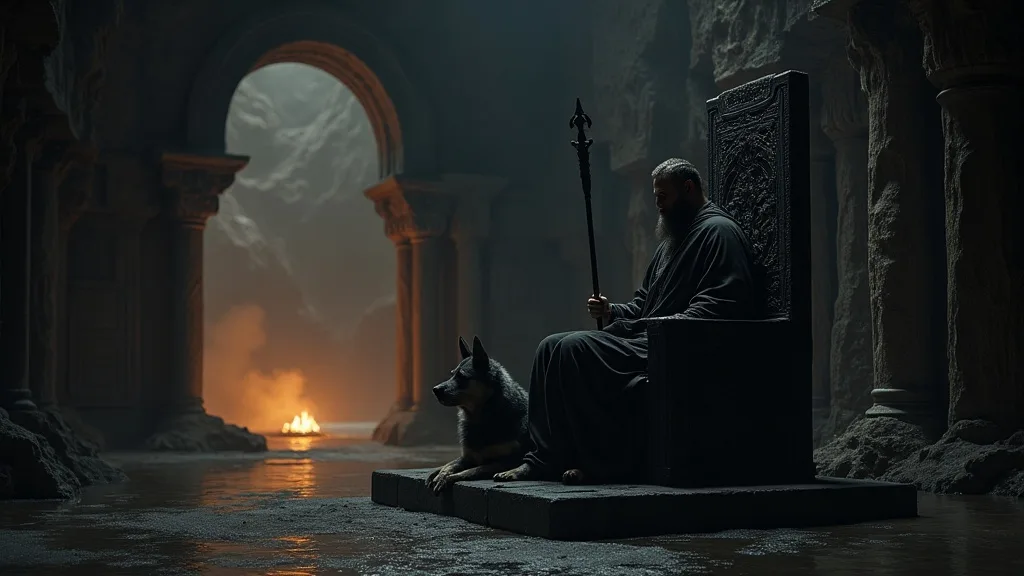
Hades presided over all of it from his palace, seated on an ebony throne, holding a staff of office, wearing no crown.
Hades and Persephone: The Myth That Explains the Seasons
No myth defined Hades more than his abduction of Persephone. The fullest version comes from the Homeric Hymn to Demeter, composed around the 7th century BC, one of the most moving pieces in all of Greek literature.
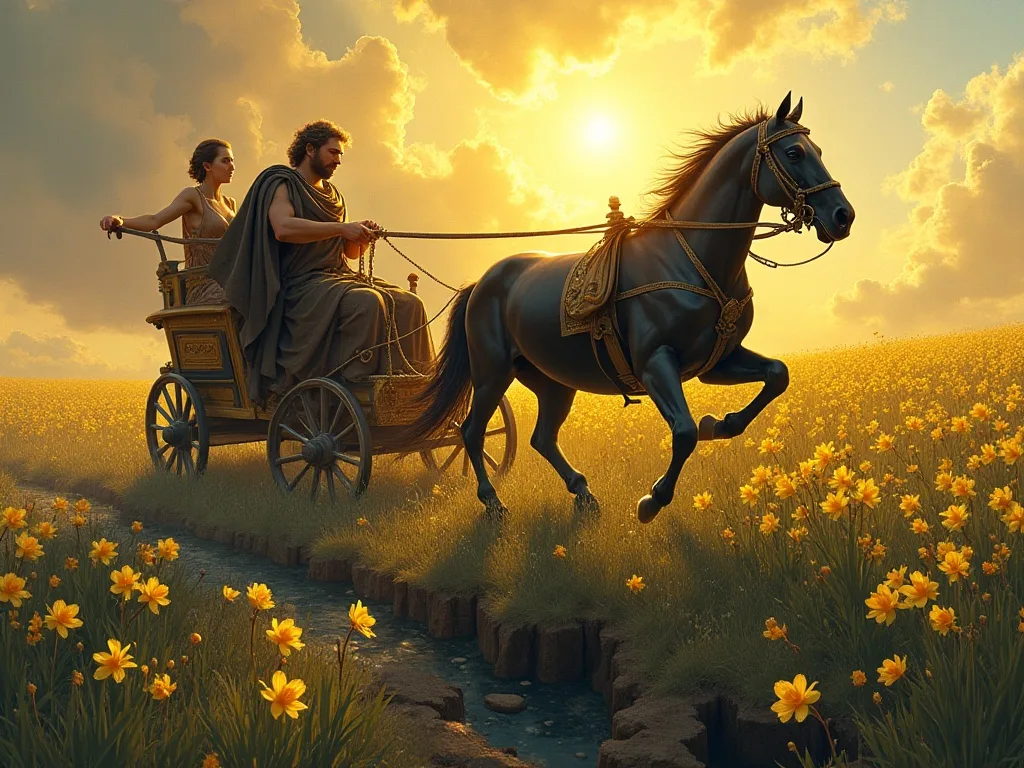
Persephone, daughter of Demeter (goddess of grain and harvest) and Zeus, was gathering flowers in a meadow with companions. The Homeric Hymn names the spot as the Nysian plain. She reached for a narcissus, possibly planted as a trap by Gaia at Zeus's request, when the earth split open and Hades rode up on a golden chariot drawn by black horses, seized Persephone, and drove back down before anyone could intervene.
Demeter's grief was total. She abandoned her divine duties and wandered the earth for nine days, holding torches, eating nothing, searching. The grain stopped growing. Animals starved. Humans stopped sending offerings to the gods. Zeus, facing a theological and agricultural crisis simultaneously, finally intervened. He sent Hermes down to Hades with a command: release Persephone.
Hades agreed. But before she left, Persephone ate pomegranate seeds. Accounts vary: some say three seeds, some say seven. The number matters less than the rule. Anyone who eats in the underworld must return to it. Hades had either tricked her or she had eaten knowingly; the hymn leaves that deliberately ambiguous.
The compromise brokered by Zeus split the year. Persephone would spend a portion with Hades as his queen, and the rest on Olympus with her mother. When she returned each spring, Demeter's grief lifted and the grain grew. When she descended each autumn, the earth went cold and barren.
This myth is ancient etiological storytelling at its most elegant: it explains why seasons exist by mapping them onto a mother's grief and a daughter's divided life. It also makes Persephone something almost unique in Greek mythology, a figure with genuine power in the underworld. She is not a prisoner after the initial abduction. She is its queen, and the dead address petitions to her as often as to Hades.
Scholars like Walter Burkert, in his landmark 1985 study Greek Religion, note that Persephone's dual role connects to ancient grain rituals where seeds were buried and waited underground before spring germination. The myth made a natural process sacred.
Hades the Reluctant Guest: Myths Where He Appears Above Ground
Hades: Lord of the Underworld almost never left his domain. The Greeks told only a handful of stories where he appeared above ground, and every one of them involved an exceptional challenge to his authority.
Heracles and Cerberus. The twelfth and final labor of Heracles required him to bring Cerberus up from the underworld alive. Hades permitted it, on one condition: Heracles could use no weapons. He wrestled Cerberus with his bare hands, using only the lion-skin cloak as armor against the dog's snapping mouths. Hades watched, apparently impressed. Heracles brought Cerberus to King Eurystheus (who fainted on sight), then returned the dog to its post.
Orpheus and Eurydice. The poet and musician Orpheus descended to retrieve his dead wife Eurydice. His lyre-playing moved Persephone to tears and softened even Hades, who allowed Eurydice to follow Orpheus back to the living world on a single condition: he must not look back until they both stood in sunlight. He looked back on the last step. Eurydice dissolved back into shadow. Hades granted no second appeals.
Sisyphus. The king of Ephyra, notorious for cheating death twice, once managed to chain up Hades himself during a visit to the upper world. While Hades was bound, no one could die. Ares, god of war, complained that his battles had no stakes. Hades was freed, and Sisyphus was eventually dragged to the underworld by Hermes and given his famous eternal punishment.
The wounding of Hades. In the Iliad, Homer records something astonishing: Hades himself was wounded by an arrow shot by Heracles during a battle at the city of Pylos. Hades climbed to Olympus to be healed by the physician god Paeon. The scene is brief and strange, a reminder that even the lord of the dead could bleed.
Why the Greeks Feared His Name
Most Greek gods welcomed prayers and received frequent offerings at busy temples. Hades was different. His temples were rare. The Elis sanctuary in the Peloponnese was reportedly unlocked only once a year, and only the priest could enter it. Most Greeks performed a ritual aversion when his name was spoken, looking away or tapping the ground to send the word downward and keep it from lingering in the air.
Euphemisms multiplied. Plouton, meaning "the wealthy one," became the most common substitute. The Romans took Plouton and translated it to Pluto, the name that stuck in Latin tradition and eventually in English astronomy. The wealth reference was not ironic: everything buried in the earth belongs to the underworld, including mineral ore, roots, and the seeds of next year's grain. Hades was, by extension, the lord of all subterranean wealth.
Another common euphemism was Klymenos, "the renowned." Speakers of Greek were expert at naming a god by his attributes rather than his person, the way a medieval peasant might refer to the Devil as "the old gentleman" rather than by his name.
This avoidance shaped his cult in practical ways. Instead of burning offerings upward in smoke, as Olympian rites demanded, offerings to Hades were poured directly into the earth, facing downward. Black animals were sacrificed. Worshippers averted their eyes during the rite.
The Symbols and Iconography of Hades
Greek vase painters and sculptors gave Hades a consistent visual vocabulary that distinguishes him instantly.
His most personal attribute is the kynee, the helmet of invisibility the Cyclopes made for him. He is also shown holding a bident, a two-pronged staff, though some sources give him a scepter or key symbolizing his lock on the underworld's gates. His throne is black or ebony in every account.
Cerberus appears beside him almost without exception, the three heads often depicted mid-snarl, tails made of snakes in some versions. The narcissus flower connects him to the abduction of Persephone: it was the blossom that opened the earth. The pomegranate is Persephone's attribute but bleeds into Hades's iconography by association.
On the famous Eleusis relief, now in the National Museum in Athens (dated around 440 BC), Hades appears seated beside Persephone with the gravity of a legitimate king, not a tyrant, not a monster. His posture mirrors Zeus's standard iconography, the parallel intentional.
Hermes served as psychopomp, the guide of souls to the underworld's gates, the one god who could move freely between the realms without needing special permission. This made Hermes the practical intermediary between Hades's domain and the world above.

Hades in the Eleusinian Mysteries
The Eleusinian Mysteries were the most important religious rites in ancient Greece, held annually at Eleusis near Athens from at least the 7th century BC until the 4th century AD. They were secret. Initiates were forbidden to describe what they experienced inside the Telesterion, the initiation hall, on pain of death.
What we can reconstruct from fragments, including passages in Cicero's De Legibus and allusions in Pindar's odes, suggests the rites dramatized the myth of Demeter, Persephone, and Hades. Initiates who underwent the experience, and hundreds of thousands did over a thousand years, reported a profound change in their attitude toward death. Cicero wrote that the Mysteries had given him "a reason not just to live with joy but to die with better hope."
Hades was not worshipped in the Mysteries by name, but his domain was the dramatic setting of the revelation. The promise of the Mysteries was essentially an upgrade: initiates would not wander the grey Asphodel Meadows after death. They would reach Elysium.
This made the Eleusinian rites one of the few places in Greek religion where the terror of Hades: Lord of the Underworld was reframed as something navigable, even hopeful, provided you knew the right things.
Cross-Cultural Parallels: Other Rulers of the Dead
Hades occupies a structural position found in mythologies worldwide: the sovereign of a bounded underworld realm, separate from the sky god, who governs the dead by fixed rules rather than whim.
Osiris in Egyptian mythology is his closest analogue. Like Hades, Osiris presides over judgment. Like Hades, he was originally a figure connected to fertility and grain before mythology reoriented him underground. Both gods sit enthroned while others do the active work of escorting souls.
The Mesopotamian goddess Ereshkigal, queen of the Kur (the Sumerian underworld), parallels Persephone more than Hades, but the structure of the Kur itself, with its seven gates, its rivers, its permanent divine sovereign, maps directly onto the Greek underworld's architecture.
In Hindu tradition, Yama rules the realm of the dead with two four-eyed dogs as gatekeepers, a detail that echoes Cerberus with striking precision. Yama too was once mortal, the first human to die, and became sovereign of the afterlife by virtue of being first to arrive.
These parallels are not coincidental borrowing in every case. They suggest that certain problems, what happens to the dead, who rules them, how is justice assigned, generate similar imaginative solutions across cultures that never met.
Hades in Modern Culture and Scholarship
The modern image of Hades as a scheming villain owes almost nothing to ancient sources. The Disney film Hercules (1997) cast him as a comic antagonist. Rick Riordan's Percy Jackson series made him brooding and bitter. Video games, from Hades (Supergiant Games, 2020) to the God of War franchise, treat him as an obstacle or an enemy.
None of this matches the Greek sources. Ancient Hades was just, impartial, and entirely lacking in the desire to expand his power or harm the living. When Sisyphus claimed Hades had wrongfully imprisoned him, Hades released him temporarily to prove a point and then had him returned. When Heracles asked for Cerberus, Hades gave permission. He ran a law-based kingdom, not a torture chamber.
Plato pushed further. In dialogues like the Phaedo and the Republic, Socrates treats the underworld with philosophical seriousness, describing the judgment of souls in terms that owe as much to Greek religious tradition as to Plato's own ethics. In the Cratylus, Plato suggests that Haides derives from the Greek word for "knowing" (eidenai), making him not the unseen god but the all-knowing one, a figure whose invisibility is a form of total perception rather than hiddenness.
Scholarly attention has grown significantly since the 1970s. Christiane Sourvinou-Inwood's Reading Greek Death (1995) traced how Athenian attitudes toward the underworld shifted between the Archaic and Classical periods, with Hades becoming gradually less terrifying and more morally ordered as democratic ideals shaped religious imagination. The underworld came to mirror the polis: judges, rules, proportional punishment, and the theoretical possibility of a good outcome.
That transformation is Hades's real legacy. He began as the cold brother who drew the wrong lot. He became the principle that death has structure, that chaos ends at the bank of the Styx, and that every soul receives exactly what it earned.
Frequently Asked Questions About Hades: Lord of the Underworld
Frequently asked questions
Was Hades considered an Olympian god?
Technically yes, Hades was one of the twelve children of Cronus and Rhea and a sibling to Zeus and Poseidon. However, ancient Greeks rarely included him in the canonical list of the twelve Olympians, since he resided permanently in the underworld rather than on Mount Olympus. He occupied a category of his own: a major first-generation god who ruled a separate cosmic domain.
Did Hades ever leave the underworld in Greek myth?
Almost never, which is part of what made him so distinct among major Greek gods. The recorded exceptions include his journey to Olympus after being wounded by Heracles at Pylos (mentioned in Homer's Iliad), and the abduction of Persephone, during which he briefly crossed into the upper world. By contrast, gods like Hermes, Apollo, and Artemis moved freely between realms.
What is the difference between Hades and Tartarus?
Hades is the name of both the god and the overall realm of the dead. Tartarus is a specific sub-region within that realm: the deepest abyss, originally used to imprison the Titans after the Titanomachy. In later tradition, Tartarus became the place of punishment for mortals who committed the worst offenses. The two are distinct: Hades encompasses all regions of the underworld, while Tartarus is specifically its lowest, most punitive level.
Why was Persephone eating pomegranate seeds so significant?
The pomegranate rule reflects a widespread ancient belief that consuming food in a supernatural realm binds you to it. Similar logic appears in fairy-tale traditions across Europe and in the Mesopotamian myth of Inanna's descent, where specific rules govern who may leave the underworld and under what conditions. By eating the seeds, whether willingly or not, Persephone created a permanent bond to Hades's realm that no divine command could fully sever. The Homeric Hymn to Demeter leaves her motivation deliberately ambiguous, which later poets and scholars have read as either victimhood or a quiet act of agency.
Were there actual temples to Hades in ancient Greece?
Yes, but very few compared to other major gods. The most notable was at Elis in the Peloponnese, which ancient sources say opened only once a year and admitted only its priest. There was also a sanctuary at Pylos associated with the myth of Heracles wounding Hades, and a cave near Eleusis where tradition placed the entrance to the underworld. The rarity of Hades's temples reflects the Greek discomfort with naming or approaching him directly.
How did Roman mythology adapt the figure of Hades?
The Romans identified Hades with their own underworld god Pluto, a name derived from the Greek euphemism Plouton (the wealthy one). Pluto was closely connected to Dis Pater, another Roman god of the dead and subterranean wealth. Roman poets, especially Virgil in the Aeneid (written around 20 BC), elaborated the underworld mythology substantially: Virgil's Elysium is richer, more philosophically detailed, and his Tartarus more explicitly moral than most Greek accounts. The Roman tradition also connected Pluto to agricultural abundance in ways that further solidified the link between the underworld and the fertility of the earth.
The Invisible King and What His Silence Still Means
There is something almost philosophical about the way Hades: Lord of the Underworld behaves across every myth he appears in. He does not pursue glory. He does not compete with Zeus or Poseidon for worshippers or influence. He runs the system he was given, enforces the rules he inherited, and waits. Every living thing comes to him eventually. He has no need to campaign.
Ancient Greeks found this quality more unsettling than a monster could ever be. A god who wants nothing from you, who sends no plagues to compel offerings, who simply sits on his ebony throne and keeps the accounts of the dead, that god cannot be appeased or bargained with in the way you bargain with Poseidon before a sea voyage or Apollo before a plague.
Modern readers often misread this impartiality as cruelty. The ancient Greeks read it as justice, which they considered a more frightening thing. Hades does not hate Sisyphus. He simply applies the rule Sisyphus broke. He does not love Persephone in the way that makes for a romantic story. He recognizes a queen when he sees one, and the underworld has never lacked for that need.
The Stoic philosophers, writing in the centuries after the great myths were codified, found in Hades a kind of ideal: the administrator who performs his function without complaint, accepts his allotted portion, and does not confuse his personal preferences with the law. Whether or not that reading is historically accurate, it suggests why the myth survived so long and still circulates. The underworld needs a king who will not be moved. And every cosmos, mythological or otherwise, eventually has to reckon with what happens to everything it produces.
Hades received the worst lot and ran it better than anyone else could have.
Free 25-page sample
Want the whole story?
Take the first 25 pages free. If it pulls you in, the full edition is yours as an instant PDF download, with a paperback on Amazon for selected titles.
Greek
The Greek Mythology Book: Zeus, the Olympians, the Heroes, and the Sacred Stories of Ancient Greece
Zeus, the Olympians, the Heroes, and the Sacred Stories of Ancient Greece
The complete guide to Greek mythology from Hesiod's Theogony to Homer's epics. Every Olympian, every hero, every descent to the underworld.
More from Greek
All articles
Greek
The Labyrinth and the Minotaur: Crete's Most Dangerous Secret
Beneath the palace of Knossos, a king hid his shame in stone. The story of the Labyrinth and the Minotaur is a myth about power, sacrifice, and the monsters we create.

Greek
The Eleusinian Mysteries: Sacred Rites of Demeter
For nearly two thousand years, thousands of Greeks walked a sacred road to Eleusis and returned changed. The Eleusinian Mysteries promised something no other ritual could: a glimpse of what waited after death.

Greek
Odysseus: Hero of the Odyssey
Cunning, restless, and indestructible in will, Odysseus spent ten years trying to reach home. His story is not just about survival. It is about what it costs a man to remain himself.
Greek
Heracles: The Greatest Greek Hero
Born of a god and a mortal woman, punished by a jealous goddess, and forced to perform twelve impossible labors, Heracles became the defining hero of ancient Greece and a symbol of human endurance that still resonates today.