
Amun the Hidden One: Egypt's Invisible Creator God and Universal King
Amun the Hidden One emerged from silence to become Egypt's most powerful god, merging with the sun to create a cosmic force that ruled the entire universe. Discover how an invisible deity shaped three millennia of worship, royal power, and the Egyptian soul itself.
Contents
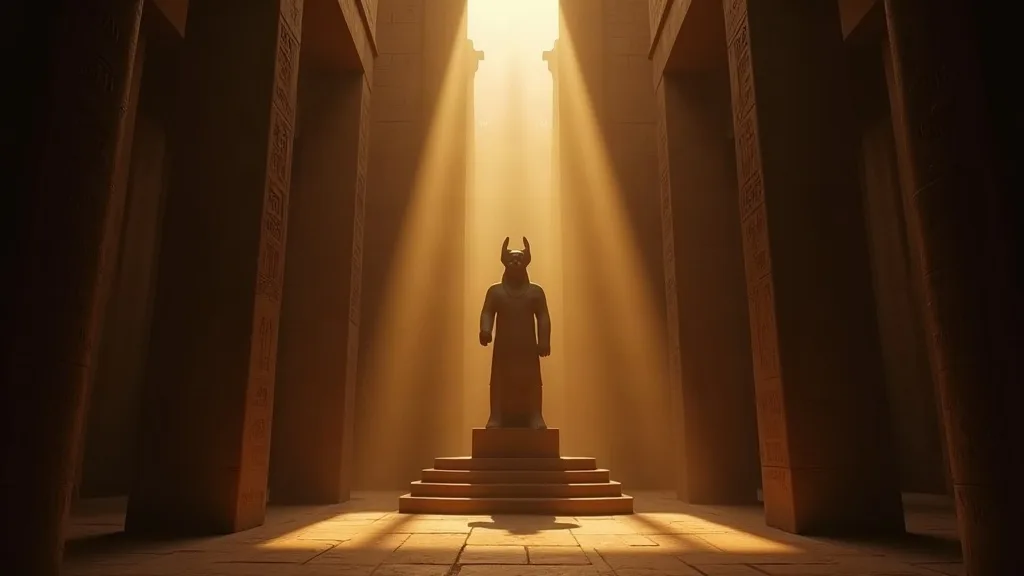
In the beginning there was only Nun, the infinite ocean of chaos. From that dark water rose a single mound. On that mound stood Amun, the one who had not yet taken form, breathing himself into existence through the sound of his own name. No one had made him. No god birthed him. He simply was, utterly alone, utterly self-created. Then, through an act of pure will, this invisible creator god brought all other gods into being and shaped the world itself.
This is the origin of Amun the Hidden One, the deity who would eventually tower above all of Egypt's pantheon. He was not always supreme. He did not always carry his most famous names. But by the time Egyptian civilization reached its height during the New Kingdom, roughly 1550 to 1070 BC, Amun had become something unprecedented: a hidden god so absolute in power that pharaohs themselves were called his incarnations, his temples held wealth rivaling kingdoms, and priests wielded political authority that could challenge the throne itself.
His story is not one of thunder and sea battles like Greek gods, nor of cosmic struggle like the Norse Aesir. It is subtler, more mysterious, and in many ways more profound. It is the story of how invisibility became synonymous with ultimate power.
The Invisible Breath: Amun's Origins and Names
Amun was not one of Egypt's oldest gods. He entered the religious consciousness relatively late, perhaps around 2000 BC, during Egypt's Middle Kingdom. His birthplace was Thebes, the sprawling city in Upper Egypt that would eventually become Egypt's greatest cultural and religious center. Before his rise, he was a minor fertility deity, sometimes shown as a man with his body dyed blue, sometimes as a ram with curved horns. Local Theban priests quietly honored him. The wider world took little notice.
His name itself holds the key to his nature. Amun comes from the Egyptian root meaning "to hide" or "to conceal." Variants of his name included Amen, Amon, and Amoun. He was the god who could not be seen, the force that moved behind all visible creation. Other gods had clear domains: Hathor ruled love and beauty, Thoth oversaw wisdom and writing, Sekhmet embodied plague and healing. But Amun was something different. He was the hidden principle itself, the breath behind all breath, the name behind all names.
Early Egyptian theologians understood him through a process called interpretatio theologica, a way of seeing one god as multiple aspects of a single cosmic principle. In the beginning, Amun was alone in the dark. Through an act he performed upon himself that later writers found delicate to describe (creation through masturbation, divine self-generation), he brought the first generation of gods into being. The Ennead, a group of nine great deities, emerged from his power. He was father to them all, though he remained unseen, a presence felt but never directly perceived.
The most profound of Amun's attributes was heka, often translated as "magic." But heka was not magic in the sense of spells or illusions. It was the fundamental cosmic force that sustained creation itself. Amun possessed infinite heka. He was heka, the animating principle that kept the universe in motion. Without his hidden presence, all existence would collapse back into the primordial chaos from which he had risen.
The Merger with Ra: Amun-Ra and Cosmic Supremacy
By the New Kingdom, Egypt's priesthood achieved something remarkable. They took two of the mightiest gods and merged them into a single entity. Amun, the hidden creator, and Ra, the visible sun god who sailed across the sky each day, became Amun-Ra, a deity of unprecedented power. Ra represented the visible cosmos, the order and light that ruled by day. Amun represented the invisible force behind that order. Together, they represented totality itself.
This merger was not hasty theology. It took centuries to solidify, and it happened through careful priestly argument and integration of mythic stories. The Egyptians were comfortable with paradox in ways Greek philosophers never were. A god could be one and many, visible and invisible, creator and sustainer, simultaneously. Amun-Ra embodied all contradictions because the universe itself is paradoxical.
In this merged form, Amun-Ra was said to travel through the night sky as well, passing through the Duat (the underworld) in a sacred barque, or boat, encountering the chaos serpent Apophis each night and defeating it anew. By day, he was the blazing sun that gave life to Egypt. By night, he was the hidden force renewing all things in darkness. He was the pharaoh's divine father, the source of royal legitimacy, the reason the king could claim to speak with divine authority.
The merging of Amun with Ra also absorbed attributes from other solar deities. Amun-Ra could manifest as Khepri, the scarab beetle-headed god of rebirth and the morning sun. He could appear as Atum, the self-creating elder god of the evening. The boundaries between these identities were fluid, a reflection of Egyptian thought itself: not compartmentalized but interpenetrating, each aspect revealing different faces of a single underlying reality.
The Rise of Thebes and Priestly Power
Amun's hidden nature gave him an unexpected advantage. Because he could not be directly depicted or fully described, priestly interpretation of his will became paramount. Priests could claim to speak for Amun, to know his hidden desires. This proved extraordinarily powerful politically.
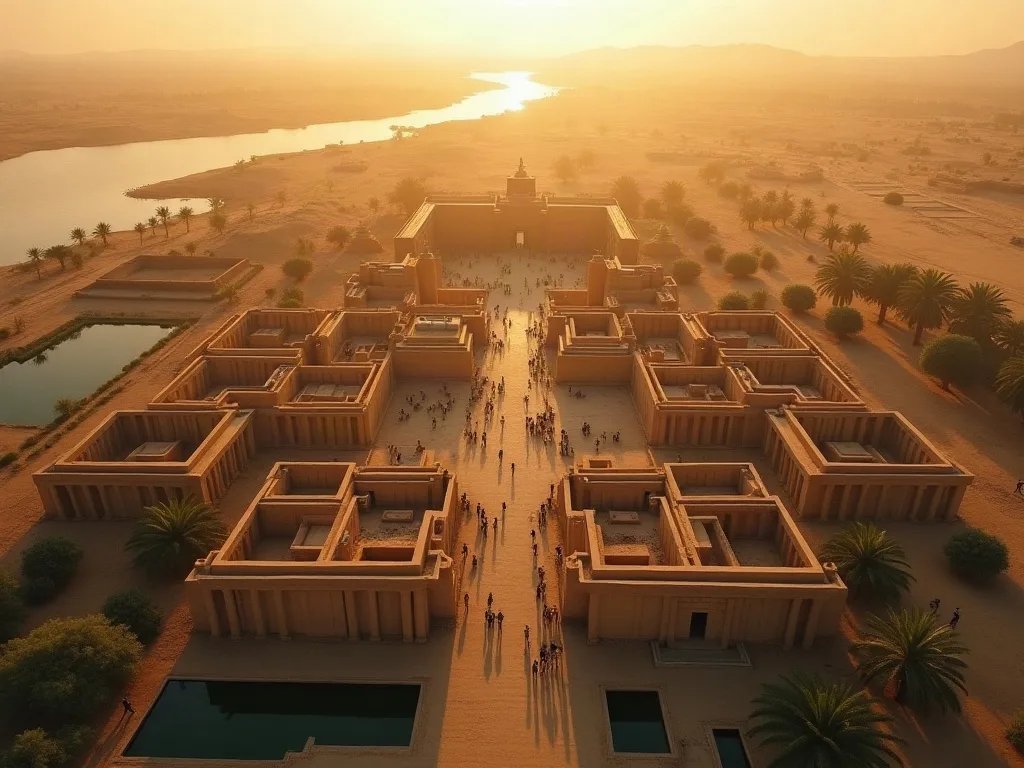
Thebes rose from a provincial town to become Egypt's greatest city, and Amun rose with it. During the Eighteenth Dynasty (roughly 1550 to 1290 BC), when Egypt's power reached its height under pharaohs like Thutmose III and Amenhotep III, Amun's temple at Karnak grew into one of the ancient world's largest and wealthiest structures. It sprawled across 30 acres. Its central sanctuary housed a sacred barque for Amun's nocturnal journey through the underworld. Its walls were covered with hieroglyphic accounts of Amun's power and the pharaoh's devotion to him.
The priesthood of Amun accumulated staggering wealth. Pharaohs donated land, livestock, gold, and slaves to Amun's temples as gifts to secure divine favor. By the later New Kingdom, the Amun priesthood controlled nearly one-third of Egypt's wealth. Priests of the god became advisors to kings, generals commanding armies, and eventually (during the Twenty-first Dynasty) effective rulers of Upper Egypt, governing as high priests of Amun almost as autonomous kings.
This accumulation of power created an interesting paradox. Amun, the invisible god, became the visible seat of political authority. The god who could not be seen became the reason the pharaoh could be seen as divine. The priesthood that served the Hidden One became increasingly visible, wealthy, and influential. Temples to Amun proliferated throughout Egypt. Every major city had an Amun sanctuary. Even foreign rulers, when they conquered Egyptian lands, made offerings to Amun to legitimize their rule.
Amun's Cosmology: Creation, Order, and the Renewal of Time
The mythology surrounding Amun centered on creation and renewal. Unlike Greek creation myths, which typically involve gods born from older gods in succession, the Egyptian creation account is cyclical. The world is not created once and then abandoned. It must be continuously recreated, maintained, renewed. Without constant divine intervention, chaos would return. Amun was the force ensuring that renewal happened every single day.
In the creation account preserved in Egyptian texts like the Pyramid Texts and Coffin Texts (compilations of spells and mythology carved into tombs and coffins from roughly 2400 BC onward), Amun creates by knowing the true names of things. In Egyptian theology, to know a name was to possess power over that thing. Amun, the one who existed before names, spoke the names of all creation into being. He named the sky, the earth, the gods, the pharaohs, and all the animals and plants. Through naming, through the utterance of divine speech called hu, creation took form.
The daily journey of Amun-Ra through the Duat was a cosmic necessity. Each night, the sun died. Apophis, the chaos serpent, attacked the sacred barque. But each night, Amun-Ra defeated Apophis anew, ensuring that morning would come, that order would be restored, that the cycle would continue. The Egyptians did not experience time as an arrow moving toward a distant end. They experienced it as a circle, constantly renewed, requiring constant divine vigilance.
Amun was also associated with the concept of Ma'at, divine order and justice. Though Thoth and Maat herself were the primary guardians of order, Amun was understood as the source from which Ma'at flowed. He embodied the principle of cosmic harmony. The pharaoh's entire role was to maintain Ma'at on earth, to rule justly, and to honor the gods so that the universe would not collapse into chaos.
The Theology of the Hidden: What Amun Meant to His Worshippers
To modern ears, Amun's invisibility might sound distant or abstract. But to ancient Egyptians, it meant something intimate and present. Amun was not hidden because he was absent. He was hidden because he was everywhere, permeating all things. You could not see him because he was the very air you breathed, the heartbeat in your chest, the movement of your thoughts.
Prayers to Amun survive in papyri and tomb inscriptions. They reveal a god approached not with fear but with a kind of awestruck intimacy. "Praise to you, Amun-Ra, lord of the gods," one prayer begins. "You are hidden but your power is felt in the rising sun, in the prosperity of the harvest, in the safety of the pharaoh's reign." Worshippers did not seek to see Amun. They sought to know him through his effects in the world.
Amun the Hidden
The invisible principle behind all creation, present but unknowable, accessed through interpretation and intuition, the source of priestly authority and cosmic mystery.
Ra the Visible
The visible sun god traversing the sky, directly observed, bringing heat and light, the manifestation of divine order, easily depicted and universally recognized.
Amun was also a god of fertility and regeneration, which connects to his origin as a Theban deity of the inundation (the annual flooding of the Nile). The flood brought black, fertile mud that made Egypt's agriculture possible. It came from the south, from Nubia, and was associated with the watery chaos from which Amun had first emerged. In this sense, each inundation was a renewal of creation, a return to primordial chaos that brought life. Amun governed this cycle. Farmers prayed to him for abundant harvests. Kings made offerings to ensure that the Nile would flood properly.
Over time, Amun became a god to whom common people could appeal. Unlike many Egyptian deities who were primarily concerns of the priesthood and elite, Amun was accessible. You did not need to be a priest to pray to him. You could approach his statue in the temple (though only priests could enter the inner sanctum) and lay your petition before him. The notion that Amun knew all hidden things, saw all things, made him an appealing judge of human conduct. In some later texts, Amun is invoked as the weigher of the heart, the god who judges whether you lived a just life.
Amun in Art and Worship: Symbols and Ritual
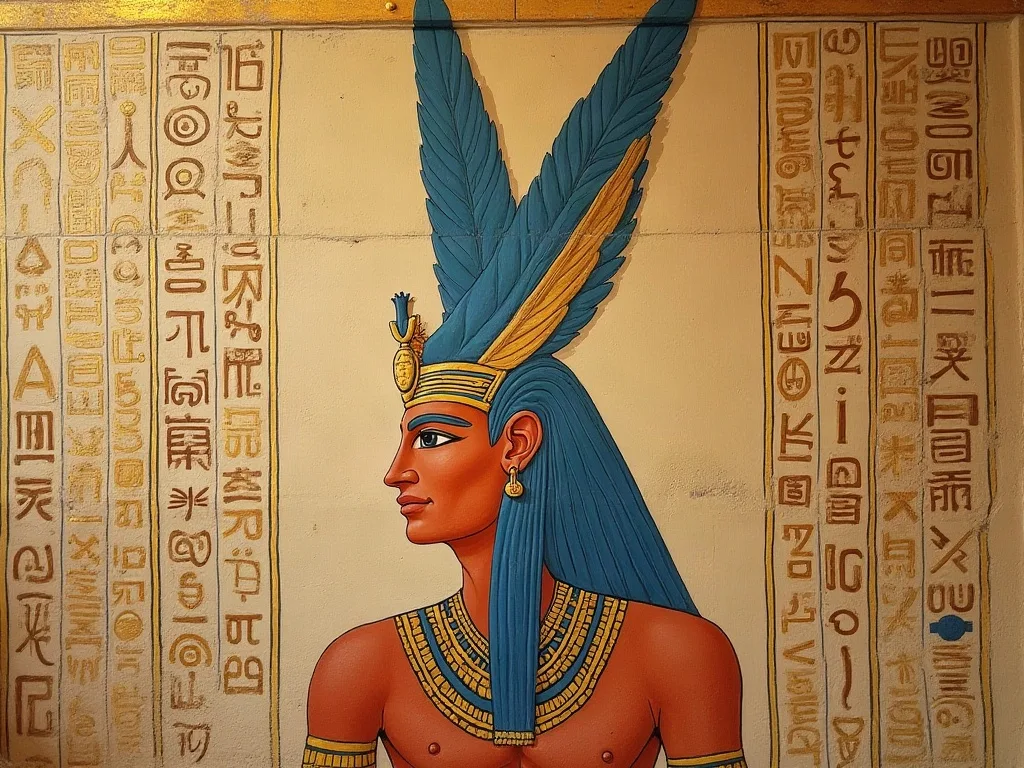
Amun's most recognizable form was as a man wearing the double plume crown, a tall headdress adorned with two feathers standing upright. He was often shown wearing a kilt and holding a staff topped with divine symbols. His skin could be painted various colors, most commonly blue or black, both associated with the Nile's fertile mud and with the cosmos itself. In his ram form, he appeared as a creature with curving horns, massive and powerful, sometimes depicted pulling the pharaoh's chariot.
One of his sacred animals was the goose, specifically the white goose or the divine goose (bennu), which laid the egg from which creation emerged. Geese were kept in temples and were considered sacred. Killing one was an act of impiety. The goose represented the creative force itself, the bringing forth of new life.
His primary temple stood at Karnak, on the east bank of the Nile near modern Luxor. The temple complex was vast enough to contain multiple sanctuaries, a lake for sacred purification rituals, and administrative buildings. Pharaohs added to it over centuries. Thutmose III built great pylons (monumental gateways). Amenhotep III added a southern temple dedicated to Amun's consort. The temple was not merely a place of prayer; it was Egypt's political and economic heart.
Worship of Amun followed a daily rhythm paralleling the sun's journey. At dawn, priests would wake Amun's statue in the inner sanctum, wash it, dress it in fresh linens, and present offerings of food and flowers. During these rituals, which the general public could not witness, the priests performed actions believed to sustain Amun and, through him, the entire universe. At certain festivals, the statue would be carried in procession through the streets, and crowds could see it, carried on the shoulders of priests, emerging from the temple's sanctuary in all its mysterious glory.
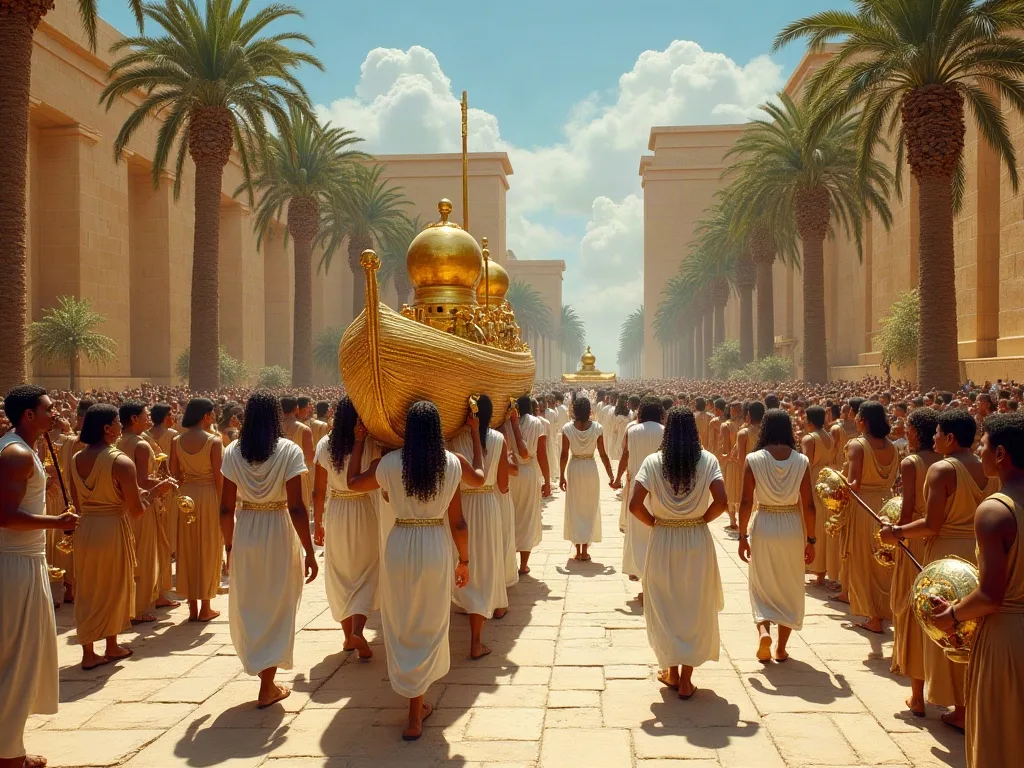
The Festival of Opet, celebrated annually during the inundation season, was one of Egypt's most important religious events. Amun, along with his consort Mut and their son Khonsu (the moon god), would be taken in ceremonial boats from Karnak to Luxor Temple and back. The procession took several days. Crowds lined the streets. Musicians played. Dancers moved in ritual patterns. It was a celebration of the god's power to renew the universe and of the pharaoh's role in maintaining that renewal.
Amun and the Pharaoh: Divine Kingship and Earthly Rule
The relationship between Amun and the pharaoh was unlike any relationship between a god and a human in other ancient religions. The pharaoh was not merely the god's servant or representative. The pharaoh was Amun-Ra on earth, a living manifestation of the god himself. This was not metaphor. It was literal theology.
When a pharaoh died, he would be mummified and interred with spells and images designed to help him journey through the Duat just as Amun-Ra did each night. The pharaoh would become Osiris, the god of the afterlife and renewal. He would merge with the eternal order. Conversely, while living, the pharaoh was believed to carry Amun's divine essence. He made offerings to Amun, he prayed to Amun, but he also was Amun in his capacity as ruler.
This theological understanding justified absolute monarchical power. If the pharaoh was Amun incarnate, then obedience to the pharaoh was obedience to the god himself. Any rebellion against the pharaoh was cosmic impiety. Conversely, the pharaoh had a sacred duty to maintain Ma'at, to honor the gods, and to ensure Egypt's prosperity. If the pharaoh failed in this duty, if harvests failed or enemies invaded, it was a sign that the pharaoh had lost Amun's favor.
Inscriptions in tombs and temples repeatedly state that such-and-such pharaoh was "the son of Amun-Ra," begotten by the god upon the queen. This was a spiritual claim, not a biological one. It meant that the pharaoh had been chosen by Amun, appointed by him to rule. Some pharaohs took this theology further, claiming to have been physically fathered by Amun's ka (life force). Images in temples showed Amun appearing to the queen, fathering the pharaoh within her womb, legitimizing the succession through divine rather than purely human means.
The Decline and Transformation: Amun Beyond Egypt's Fall
By the Third Intermediate Period (roughly 1070 to 664 BC), Egypt's political power was fragmenting. The priesthood of Amun had grown so wealthy and politically powerful that it effectively ruled Upper Egypt independently. Kings ruled from the north. Priests of Amun ruled from Thebes in the south. It was an uneasy dualism that reflected Amun's paradoxical nature: the visible priest serving the invisible god, power held in check, authority distributed between earthly and divine realms.
When Persia conquered Egypt, and later when Alexander the Great arrived, these foreign rulers made a striking move. They entered the temple at Siwa, in the Western Desert, where there was a famous oracle of Amun-Ra. They sought Amun's blessing. Alexander was said to have been declared by the oracle to be Amun's son, the pharaoh chosen by the god himself. Even foreign conquerors needed Amun's invisible endorsement to rule Egypt legitimately.
Under Greek rule (the Ptolemaic period, after 305 BC), Amun merged with the Greek god Zeus. Amun-Zeus represented a bridge between Egyptian and Greek theology. The Romans, when they conquered Egypt, also made offerings to Amun, recognizing in him a power older and deeper than their own pantheon.
When Egypt converted to Christianity in the early centuries of the common era, Amun's temples fell silent. His statues were destroyed or forgotten. Yet his influence did not vanish entirely. Some scholars have traced echoes of Amun's theology in early Christian mysticism and in the later Hermetic tradition, which claimed to transmit ancient Egyptian wisdom. The notion of a hidden god, a divine principle underlying all visible creation, found new expression in different religions.
Today, Amun's legacy endures in archaeology and Egyptology. His statues have been excavated and restored. His hieroglyphic names appear on temple walls that tourists visit. But something irreplaceable was lost when his priesthood fell silent. We can read descriptions of his rituals. We can see his images. But we cannot hear the prayers, cannot feel the presence that Egyptians felt when they stood before his statue, knowing that an invisible god watched over them, that the hidden principle of creation was present in that stone, alive in that moment.
Frequently asked questions about Amun the Hidden One?
Frequently asked questions
Why was Amun considered invisible if he had statues and images?
Amun was invisible in his true essence, his fundamental nature. His statues were dwelling places, conduits through which the invisible god could receive prayers and offerings. Egyptians believed the god's true self transcended physical form. The statue made the invisible accessible without revealing the hidden principle itself. It was a paradox they were comfortable with: Amun was both everywhere present and nowhere visible.
How did Amun become more powerful than older gods like Ra and Osiris?
Amun's rise was gradual, tied to Thebes' political ascendancy during the New Kingdom. Rather than replacing older gods, Egyptian priests integrated them through a process called syncretism. Amun-Ra merged visible and invisible power. Amun-Osiris merged creation with the afterlife. By absorbing these deities' attributes while retaining his own universal principle, Amun became supreme. His priesthood's political power reinforced theological authority.
What is the difference between Amun and Aten, the god Akhenaten worshipped?
Pharaoh Akhenaten (roughly 1353 to 1336 BC) attempted a religious revolution by promoting Aten, the sun disk itself, as the supreme god, reducing Amun's prominence. Aten was visible, the actual sun; Amun was invisible principle. Akhenaten's monotheism threatened priestly power and did not survive him. After his death, Amun's supremacy was restored, and Aten faded from worship. Amun's invisibility made him less vulnerable to challenge than the visible Aten.
Did ordinary Egyptians worship Amun, or was he a god only for priests and pharaohs?
Both. While the inner sanctum at Karnak was restricted to priests, common people could pray to Amun before his public statues, leave offerings, and invoke his name for protection, healing, and justice. Amun was accessible to all Egyptians, making him beloved across social classes. His appeal as a hidden judge of human conduct resonated with ordinary people seeking divine justice outside pharaonic authority.
What is the connection between Amun and other Egyptian creator gods like Atum and Ptah?
Egyptian theology was theological layering rather than replacement. Amun, Atum, and Ptah were seen as different aspects of creation. Atum was the self-created elder god who emerged from Nun. Ptah was the craftsman who thought creation into being through his mind and speech. Amun was the hidden principle underlying all creation. Later theology merged these into unified visions: Amun-Atum-Ra or Ptah-Amun-Ra, reflecting the idea that all creative power flowed from one cosmic source expressed through multiple divine faces.
Amun's Afterlife in Modern Spirituality and Scholarship
The rediscovery of Amun in the 19th and 20th centuries through archaeological excavations at Karnak, Luxor, and other temple sites sparked new fascination with Egyptian theology. Modern Egyptologists debated what Amun truly represented. Was he a philosophical principle, an early monotheistic god, a cosmological abstraction? Some argued that Amun's theology anticipated later monotheistic religions. Others saw in his invisibility a kind of proto-mysticism, an understanding of divinity that transcended physical form in ways not dissimilar to Hindu Brahman or the Islamic Allah.
In modern spirituality and neopaganism, Amun has become a figure of renewed interest. Practitioners of Kemetic (Egyptian) spirituality invoke Amun in meditation and prayer, seeking connection with the hidden creative force. His name appears in contemporary books on goddess religion and ancient wisdom traditions. The notion of a god simultaneously transcendent and immanent, hidden yet intimately present, speaks to modern spiritual seekers seeking alternatives to institutional religion.
What remains constant across all these reinterpretations is recognition of Amun's fundamental genius: the idea that true power lies not in what is visible and obvious, but in what is hidden, pervasive, and utterly essential. Amun taught ancient Egypt that invisibility is not weakness. It is the signature of ultimate strength. The most important forces in the universe are those we cannot see but upon which everything depends. That insight, crystallized in the figure of the Hidden One, has endured for forty centuries and still resonates today.
Free 25-page sample
Want the whole story?
Take the first 25 pages free. If it pulls you in, the full edition is yours as an instant PDF download, with a paperback on Amazon for selected titles.

Mythology
The World Mythology Book: The Gods, Heroes and Myths of Every Culture
The Gods, Heroes and Myths of Every Culture, in One Volume
The whole of world mythology in a single volume: Greek, Norse, Egyptian, Japanese, Hindu, Celtic, Slavic, Mesoamerican and African myths gathered side by side, each drawn from the primary sources.