
Ra the Sun God: Egypt's Supreme Ruler of Light and Creation
Ra, the ancient Egyptian sun god, blazed at the very heart of a civilization that worshipped light as the pulse of creation itself. Discover his origins, his many forms, and the sacred journey he took across the sky and through the underworld every single day.
Contents
The God Who Was the Sun
In ancient Egypt, the sun was not merely a star. It was a living deity whose daily rising and setting gave form to every concept the Egyptians held sacred: time, kingship, truth, and the boundary between life and death. Ra (also written Re) stood at the summit of that theology for most of pharaonic history, a figure so vast that other gods were absorbed into him rather than rivaling him.
His name almost certainly derives from the ancient Egyptian word for "sun," and his presence pervades Egyptian culture from the Predynastic period through the Greco-Roman era, a span of more than three thousand years. Few divine figures anywhere in the ancient world achieved that kind of sustained, civilization-wide reverence.
Ra was not simply worshipped as a sun deity in the way one might venerate a single atmospheric force. He was understood as the creative intelligence behind existence itself, the one whose first appearance brought light, order (Maat), and the possibility of life out of the primordial dark waters of Nun.

Origins and the Theology of Heliopolis
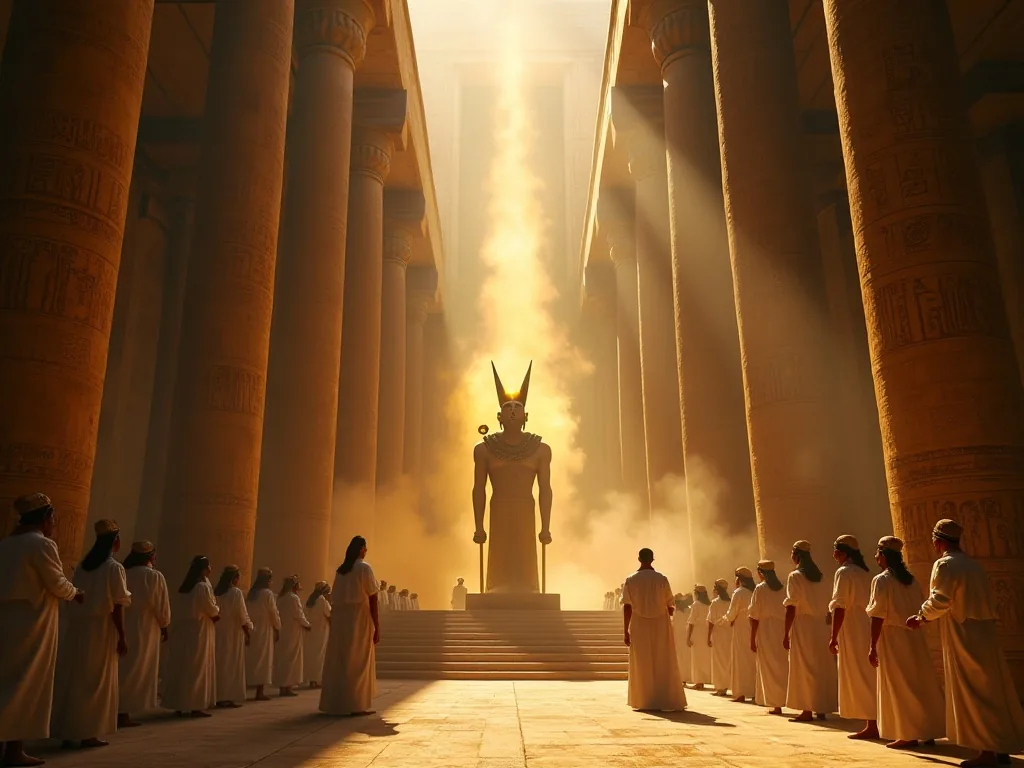
The earliest systematic theology surrounding Ra crystallized at Iunu, the city the Greeks called Heliopolis, meaning "City of the Sun," located near modern Cairo. The priests of Heliopolis developed the Ennead, a grouping of nine deities with Ra (or his variant Atum) at its origin point. In this cosmology, a primordial mound rose from the waters of Nun, and upon it Ra-Atum emerged, self-created, speaking or willing the first gods into existence.
From himself, Atum produced Shu (air) and Tefnut (moisture). They in turn generated Geb (earth) and Nut (sky). Geb and Nut bore Osiris, Isis, Set, and Nephthys, completing the nine. This genealogy was not merely a family tree; it was a map of how the cosmos unfolded from a single, self-sustaining point of divine energy.
The Pyramid Texts, inscribed in royal burial chambers from the Fifth Dynasty onward (roughly 2400 BCE), are among the oldest religious writings ever discovered, and they are saturated with Ra's presence. The deceased pharaoh was described as ascending to the sun barque to travel alongside Ra, cementing the link between solar theology and royal immortality that would define Egyptian religion for millennia.
Ra and the Pharaoh
The political dimension of Ra's cult was immense. From the Fourth Dynasty onward, pharaohs bore the title "Son of Ra" as part of their official royal titulary. This was not poetic metaphor; it was constitutional theology. The king was the earthly manifestation of Horus during his life and was reunited with Ra and Osiris upon death. Sun temples, most famously those built by the Fifth Dynasty pharaohs at Abu Gurab and Abusir, were dedicated specifically to Ra and featured open-air courts with a large squat obelisk (the benben stone) as the focal point, symbolizing the primordial mound and the first ray of sunlight.
The Many Forms of Ra
One of the most striking features of Egyptian theology is its comfort with multiplicity. A single deity could inhabit many forms simultaneously, each expressing a different aspect of divine power. Ra was no exception.
Khepri, Ra, and Atum: The Sun's Three Faces
Egyptian theologians mapped Ra's three great forms onto the arc of the sun across the sky:
- Khepri, the scarab beetle, represented the rising sun and the concept of self-creation and renewal. The scarab rolling its dung ball was understood as an image of the solar disc rolling across the horizon.
- Ra in his full, noon-day aspect appeared as a falcon-headed man crowned with the solar disc encircled by the uraeus cobra. This was the god at the height of his power.
- Atum, the aged god, represented the setting sun, the completion of the daily cycle, the god descending into the western horizon to begin his nocturnal journey.
This tripartite structure was not a contradiction but a deliberate theological statement: divinity transcends the fixity of a single form.
Ra-Horakhty and Amun-Ra
Two of the most significant divine fusions involving Ra deserve particular attention. Ra-Horakhty, meaning "Ra who is Horus of the Two Horizons," merged Ra with the horizon-god Horus, symbolizing the sun's sovereignty over both the eastern and western edges of the world. The composite deity was typically depicted as a falcon-headed man with the solar disc, and worship of this form was especially prominent at Heliopolis and later at Abu Simbel, where Ramesses II built his great temple in honor of Ra-Horakhty, Amun, Ptah, and himself as a deified king.
Amun-Ra was the fusion that perhaps had the greatest historical consequence. When Theban political power rose to national dominance during the New Kingdom (circa 1550 to 1070 BCE), the local god Amun was elevated to supreme status. Rather than displacing Ra, Amun merged with him to produce Amun-Ra, "King of the Gods." This synthesis allowed Theban theological ambition to harness the ancient solar prestige of Ra while elevating Amun to cosmic primacy. The result was the richest and most politically influential religious institution Egypt ever produced, centered on the vast temple complex at Karnak.
The Solar Barque and the Nightly Battle
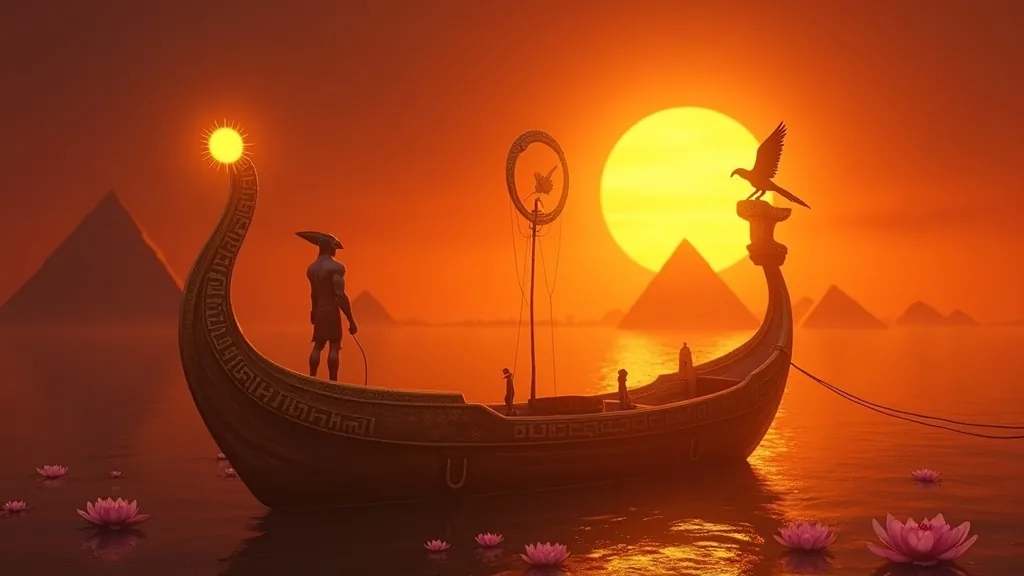
Ra's daily journey was not a passive drift. According to sacred texts including the Amduat ("That Which Is in the Underworld"), the Book of Gates, and the Book of Caverns, Ra traveled the sky in his day barque, the Mandjet, from sunrise to sunset. At dusk, he transferred to the night barque, the Mesektet, and descended into the Duat, the Egyptian underworld, to journey through its twelve hours of darkness.
This nightly passage was the most dangerous portion of Ra's existence. The Duat was populated with hostile forces, demons, and the souls of the dead. In the fifth hour of the night, Ra's barque passed through the realm of Sokar, the god of death, a passage so treacherous the barque had to be dragged across a dry, sandy stretch. In the seventh hour came the crisis that defined the entire mythology.
Apep: The Serpent of Chaos
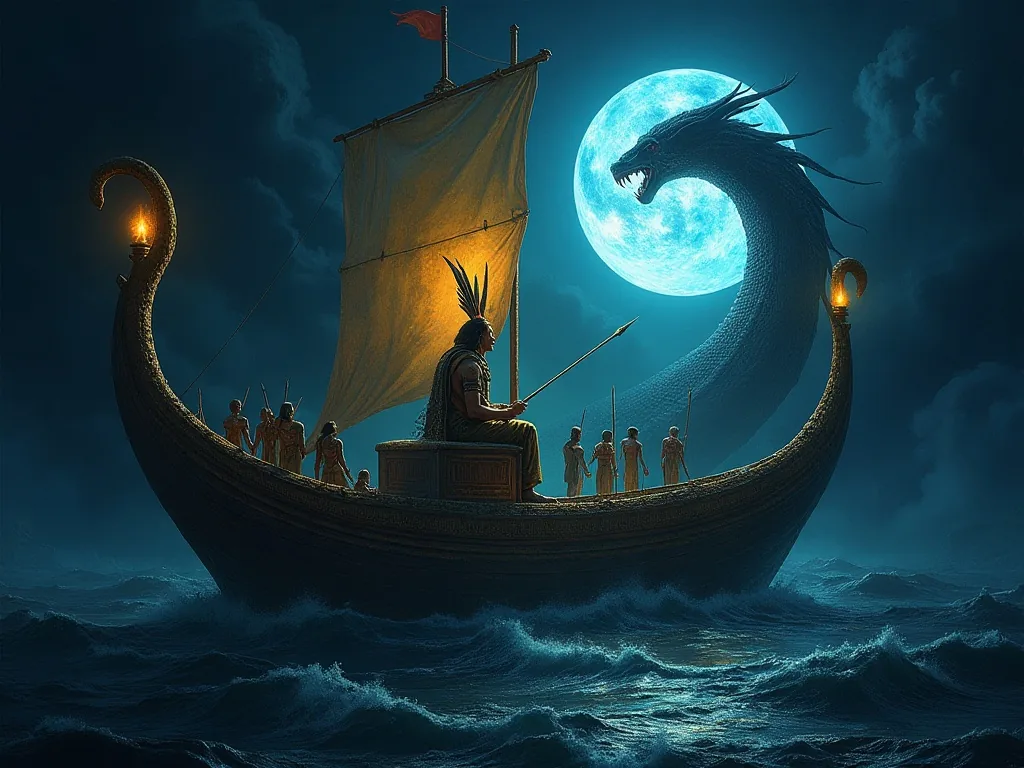
Apep (also spelled Apophis) was Ra's eternal adversary: a colossal serpent of chaos who waited in the deepest darkness to coil around the solar barque and prevent the sun from rising again. The confrontation between Ra and Apep was not a historical event but a nightly recurrence, a cosmic drama that had to be re-enacted and won before every dawn.
The gods aboard the barque, most notably Set (who in this mythological role was a protector rather than a villain), battled Apep with spears and the power of ritual incantation. The god Mehen, a protective serpent deity, coiled around Ra to shield him. On earth, priests at Heliopolis performed rituals known as "The Repelling of Apep" in which they would curse, spit upon, trample, and burn effigies of the serpent, their earthly ritual harmonizing with and empowering the divine battle taking place in the Duat.
When Ra emerged from the eastern horizon at dawn, it was understood as a genuine victory, a triumph over dissolution that could never be taken for granted.
The Myth of Ra and Humanity
Ra was not a remote or indifferent deity. One of the most psychologically rich myths involving him is the "Destruction of Mankind," preserved most completely in the Book of the Heavenly Cow, inscribed in the tombs of several New Kingdom pharaohs.
In this story, Ra grows old and frail, and humanity begins to mock him and plot against his authority. Furious, Ra summons the divine assembly and sends his eye (manifested as the goddess Hathor, or in her more fearsome aspect as Sekhmet) to punish the rebellious humans. Sekhmet falls upon mankind with terrifying ferocity, and Ra, having second thoughts about the total annihilation of his creation, tricks her into stopping by flooding the fields with red-dyed beer, which she mistakes for blood and drinks herself into a stupor.
The myth does not end with triumphant order restored. Ra, weary and disillusioned, withdraws from the earth and ascends to the back of Nut, transformed into the sky itself. The god Shu supports Nut's body to hold Ra aloft, and the world takes the form familiar to human experience: the sky arching overhead, distant and luminous, the sun no longer walking among men but traversing the heavens far above them.
This is one of the most genuinely moving narratives in all of ancient mythology. It captures not omnipotent invincibility but divine exhaustion, a god who has loved and been betrayed by his creation and who retreats not in anger but in sorrow.
Ra's Legacy Across Cultures and Time
Ra's influence did not evaporate when pharaonic civilization ended. Hellenistic Greeks identified him with their own Helios and later with Apollo, recognizing the same solar sovereignty in different cultural clothing. In the Greco-Roman period, the syncretic deity Serapis incorporated solar qualities alongside aspects of Osiris, and worship of Egyptian solar theology spread to Rome, Gaul, and beyond.
In the modern era, Ra's iconography and mythology have proved remarkably durable. The solar disc, the falcon head, and the serpentine uraeus remain among the most instantly recognizable symbols of ancient civilization globally. Scholars of comparative religion regularly return to Ra when examining how human cultures conceptualize light as divinity, order, and consciousness.
More importantly, the theological architecture built around Ra, the idea that creation is an ongoing act requiring daily renewal, that chaos is never finally defeated but only held at bay through ritual and righteousness, that even gods can know grief and exhaustion, offers a portrait of divinity that is neither naively optimistic nor bleakly fatalistic. It is something rarer: a theology of perpetual effort, of a universe sustained not by effortless omnipotence but by the daily, hard-won return of the light.
The Eye of Ra and Sacred Feminine Power
No account of Ra would be complete without attention to the Eye of Ra, one of the most theologically complex concepts in the entire Egyptian system. The Eye was understood simultaneously as Ra's daughter, his instrument of destruction, his solar disc, and an independent divine force that could be sent out into the world and retrieved.
The Eye was identified variously with Hathor, Sekhmet, Bastet, Wadjet, and Mut depending on context, each goddess embodying a different valence of solar power: nurturing warmth, consuming fire, protective fury, and royal authority. When Ra sent his Eye to retrieve his children Shu and Tefnut after they wandered in the primordial waters, the Eye returned to find Ra had replaced it with another. In the myth, the Eye wept with rage, and from those tears (the Egyptian word for tears, "remyt," was linked etymologically to the word for humans, "remetj") humanity was created.
The Eye of Ra is therefore not a minor accessory to the solar myth but one of its generative centers, a feminine divine power so integral to Ra's nature that it cannot be separated from him without the myth collapsing entirely.
When the Sun God Traveled Through Death
The deepest theological contribution of Ra's mythology may be this: the sun god himself is mortal, in a sense. Each night, as Ra travels through the Duat, he encounters the god Osiris, ruler of the dead. In that profound midnight meeting, the two gods merge briefly into a single being, described in the Amduat as "the dual soul." Ra gives the dead renewed life with his light; Osiris gives Ra renewed will to rise again. Neither can complete the cycle alone.
This interdependence between the solar and the chthonic, between the living light above and the regenerative darkness below, is among the most sophisticated ideas the ancient world ever produced about the nature of existence. The sun god is not exempt from death; he passes through it every night and emerges transfigured every morning, and in doing so, he models for every human soul the path that awaits them beyond the western horizon.
Free 25-page sample
Want the whole story?
Take the first 25 pages free. If it pulls you in, the full edition is yours as an instant PDF download, with a paperback on Amazon for selected titles.
Egyptian
The Egyptian Mythology Book: Ra, Osiris, Isis, Anubis, and the Sacred Stories of the Pharaohs
Ra, Osiris, Isis, Anubis, and the Sacred Stories of the Pharaohs
Three thousand years of Egyptian sacred stories. The Duat, the weighing of the heart, the cult of Osiris, and the daily voyage of the sun.
More from Egyptian
All articles
Egyptian
Eye of Horus: The Protective Amulet That Watched Over the Living and the Dead
Worn by pharaohs and fishermen alike, the Eye of Horus is one of antiquity's most potent protective symbols, carrying the weight of cosmic battle, divine healing, and eternal vigilance.
Egyptian
The Ankh: Egypt's Eternal Symbol of Life
The ankh is ancient Egypt's most recognizable hieroglyph, a looped cross carried by gods and pharaohs alike as the very key to immortal life. Discover its origins, meanings, and sacred legacy.
Egyptian
Anubis: God of the Dead, Guardian of the Scales
Anubis, the jackal-headed deity of ancient Egypt, presided over embalming, the underworld, and the judgment of souls. His is one of the oldest and most enduring divine figures in human history.
Egyptian
Egyptian Gods: Divine Powers and Sacred Authority
How Egyptian gods wielded power through cult, kingship, and cosmic order. Grounded in Pyramid Texts, temple inscriptions, and ritual practice.