
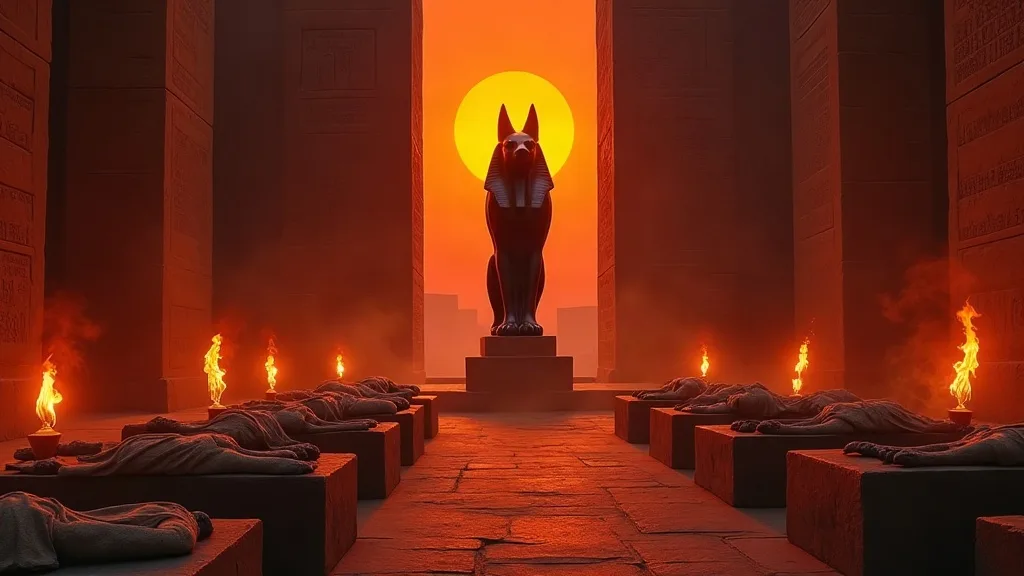
Anubis: The God of Mummification and Guardian of the Dead
Anubis, god of mummification and the dead, was ancient Egypt's oldest funerary deity. Learn how priests invoked his power to preserve souls, why he wore the jackal's form, and what his cult reveals about Egyptian immortality beliefs.
Contents
A priest stands in the darkness of a tomb chamber, hands raised. Before him lies a body wrapped in linen, awaiting transformation. He speaks the name: Inpu, called Anubis by the Greeks. In that moment, the jackal-headed god descends. The mummification begins.
For over three thousand years, Anubis held dominion over death in the Egyptian imagination. He was not a distant threat but a guardian, a technician of the afterlife, a protector whose rituals turned a corpse into an eternal being. No god in Egypt's pantheon was closer to the ordinary dead, and none was more essential to survival after death. To understand Anubis is to understand how the ancient Egyptians transformed their deepest fear into their greatest hope.
The Birth of a Funerary God: Origins and Early Worship
Anubis emerges into the Egyptian historical record around 3100 BCE, during the First Dynasty. His name in hieroglyphics appears as Inpu or Anpu, carved into tomb walls and funerary texts. But his roots reach deeper. Archaeological evidence suggests he was an old god, perhaps a local deity of the desert who came to embody death itself.
The Egyptians called the desert Deshret, the Red Land. It was hostile, inhospitable, where bodies decomposed naturally in the heat. Wild dogs and jackals roamed there, scavenging the dead. Rather than see this as desecration, the Egyptians reframed it: the jackal was not a grave robber but a guardian, a divine protector. By the Old Kingdom (around 2686-2181 BCE), Anubis had become the paramount god of cemeteries and embalming. He was Khenti-Amentiu, "the foremost of the westerners", the god who ruled the necropolis on the west bank of the Nile, where the dead resided.
His earliest temples and shrines flourished at Abydos, an ancient center of pilgrimage where the god Osiris had his sanctuary. Anubis did not replace Osiris; instead, he became Osiris' right hand. While Osiris represented the promise of resurrection and renewal, Anubis embodied the technical means of achieving it. He was the method; Osiris was the hope.
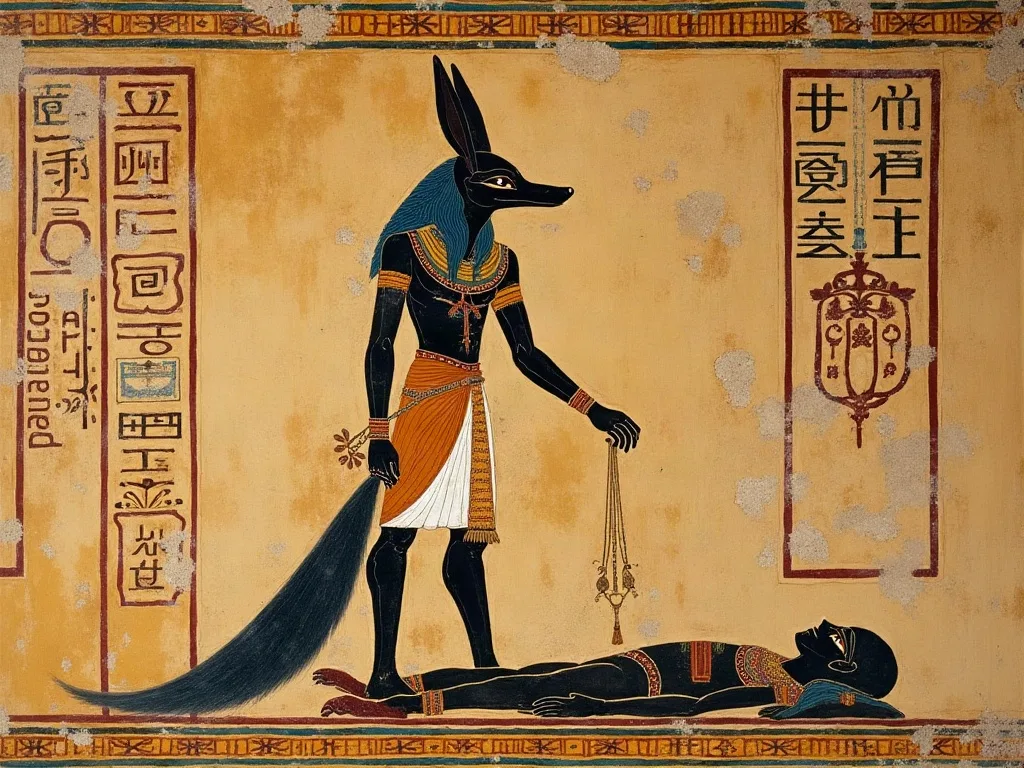
During the First Dynasty, the high priests of Anubis bore the title Imy-ut, meaning "he who is in the place of embalming." They wore a jackal mask during ceremonies, literally becoming Anubis as they worked. This was not mere costume play. Egyptian theology held that ritual performance made the god present. When a priest donned the jackal head and spoke the incantations, he channeled Anubis' power into the corpse below.
The Mythology of Anubis: Death, Dismemberment, and Devotion
The most powerful myth of Anubis centers on his origin as a god of mummification. In the classic tale, recorded in texts like the Coffin Texts and the Book of the Dead, Osiris is murdered by his jealous brother Set. Osiris' body is dismembered and scattered across Egypt. His widow, Isis, grieves in anguish. She searches for every piece of her husband's body, a desperate pilgrimage across the land. When she finally gathers the fragments, she calls upon Anubis for help.
Anubis, moved by Isis' devotion, works magic. He anoints Osiris' broken body with oils and unguents. He wraps it in linen strips. He speaks the words of restoration. In some versions of the myth, Anubis literally invents mummification in that moment, creating the practice to save Osiris. Through Anubis' ritual, Osiris is made whole again, his body preserved forever, his soul freed to rule the afterlife.
This story was not marginal theology. It appeared in royal temples and humble tombs alike. Every mummy in Egypt was, in a sense, a reenactment of Osiris' mummification. Every dead person became Osiris, and every priest who performed the rituals became Anubis. The myth collapsed the distance between god and human, ritual and reality.
Anubis' role as Osiris' devoted assistant reveals something crucial about Egyptian values. He is not jealous. He does not seek supremacy. He serves a larger cause: the continuation of order, the preservation of life beyond death. In a culture where family loyalty was sacred, Anubis' unwavering support for Osiris would have resonated deeply with the living. The god modeled what the living owed their dead.
The Ritual Practice: How Priests Invoked Anubis in the Mortuary Temple
The mummification process was inseparable from Anubis worship. The practice took seventy days and involved meticulous steps: removal of the organs, treatment of the body with natron salt, wrapping in linen, and the placement of amulets and talismans. But mummification was not merely technical. It was saturated with prayer, invocation, and ritual theater.
In the mortuary temples of Thebes and other major cities, the high priest would begin the ritual by calling upon Anubis. "O Anubis, lord of the dead, come forth," the prayer might run. "Guard this body. Preserve this soul. Let no harm befall this one in the afterlife." The priests would anoint the mummy with oils scented with myrrh and frankincense. Each gesture mirrored the mythological Anubis tending Osiris.
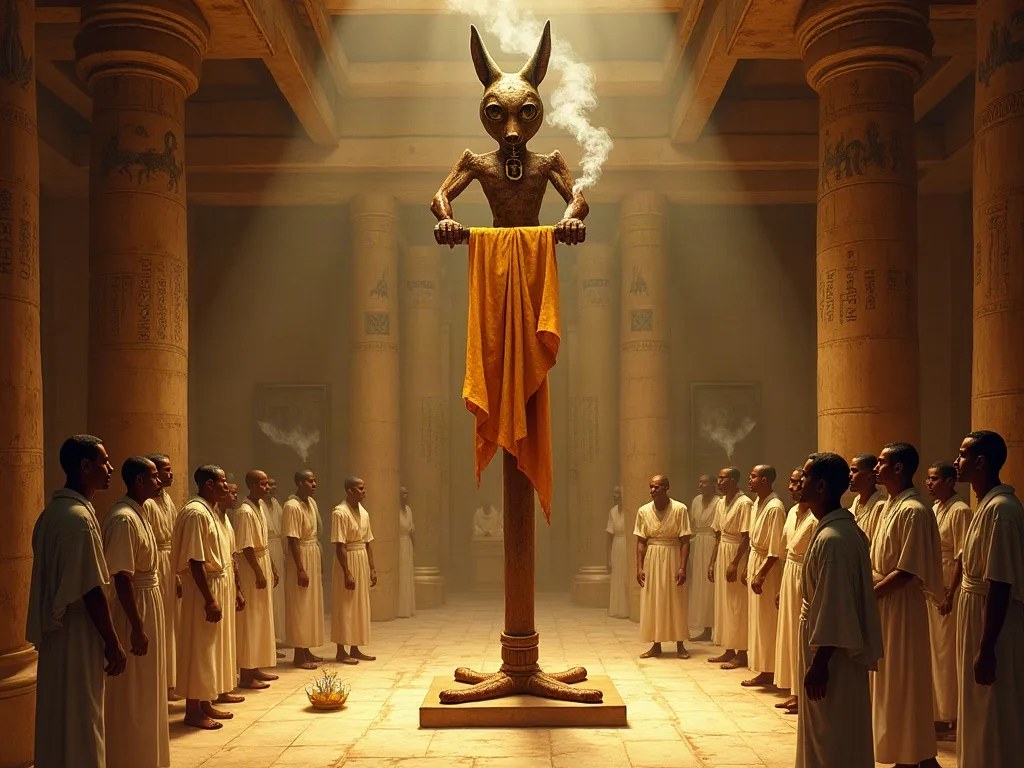
The Egyptians used an object called the imiut fetish, a symbol consisting of a jackal skin hanging from a pole, to represent Anubis' presence in the mortuary temple. During ceremonies, this fetish was carried in procession, held aloft by a priest, embodying the god's protective watch over the dead. The fetish appeared in tomb inscriptions and painted on coffins, a reminder that Anubis was near.
The most elaborate rituals occurred during royal funerals. The dead pharaoh was not merely mummified; he was deified, merged with Osiris and placed under Anubis' eternal protection. The Opening of the Mouth ceremony, performed on the mummy before burial, was believed to restore the deceased's senses and faculties. A priest wielding a ceremonial adze touched the mummy's mouth, eyes, and ears while intoning: "Your mouth is opened by Ptah. Anubis has opened your mouth." The dead person was reanimated by divine power.
Common people could not afford the elaborate royal ceremonies, but they could afford modest mummification. Even a poorer burial might include a small figurine of Anubis, a painted coffin bearing his image, or a simple amulet inscribed with his name. The god's protection was available to all who sought it. This democratization of funerary religion was distinctive to Egypt and made Anubis a god intimately connected to the hopes of ordinary people.
Anubis and the Weighing of the Heart: Judge of the Dead's Character
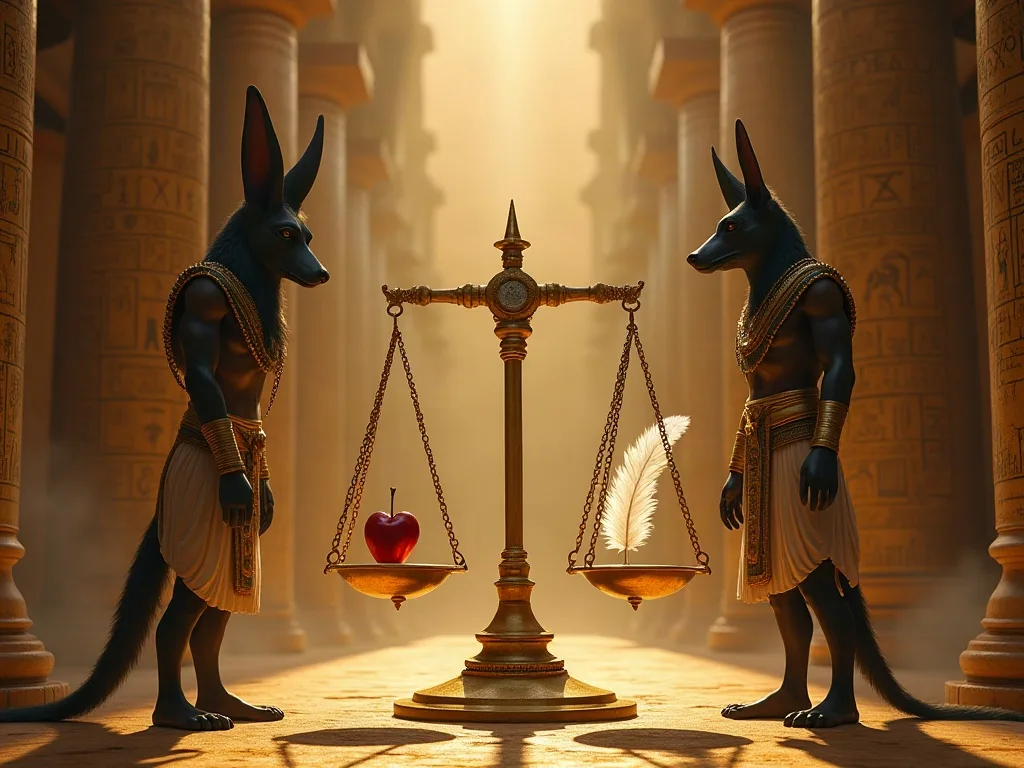
While Anubis oversaw the body's preservation, another great trial awaited the soul. In the Hall of Two Truths, depicted vividly in papyri like the Book of the Dead, the deceased's heart would be weighed against the feather of Maat, representing truth and cosmic order. This judgment decided whether the soul would enter paradise or face annihilation.
Anubis presided over this ceremony. He stood beside the great scales, jackal-headed and vigilant, ensuring the balance was true. The god Thoth, depicted as an ibis or baboon, recorded the verdict. If the deceased had lived a good life, the scales would balance and the soul would pass into the Field of Reeds. If the heart was heavy with sin, a demon called Ammit, part crocodile and part lion, would devour it, erasing the person from existence.
Anubis did not judge; he witnessed and protected. He ensured that the scales did not tip unfairly, that the dead received justice commensurate with their deeds. This role made him a god of moral order as well as preservation. To the Egyptians, immortality was not automatic. It had to be earned through a life of integrity, and Anubis was the guardian who confirmed that truth.
Comparison: Anubis and Other Death Deities Across Cultures
Anubis (Egypt)
Anubis presides over mummification, the physical preservation of the body. He is a technician of death who makes eternal life possible through ritual. He works in partnership with Osiris to achieve resurrection. The dead do not flee from him; they seek his protection actively.
Hades (Greece)
Hades rules the underworld as a sovereign keeper of the dead. He does not facilitate ritual preservation but simply houses souls in a shadowy realm. Mortals fear him and avoid his domain. The dead obey him not from devotion but from necessity. He is a lord, not a guardian or technician.
Anubis stands apart from many death deities worldwide. Unlike Hades, the Greek king of the dead, Anubis is not a distant sovereign but a present healer and protector. Unlike Yama in Hindu mythology, who comes as death's messenger to claim the dying, Anubis tends the already-dead with reverence and skill. Unlike the Grim Reaper of medieval Europe, a cold figure of inevitable doom, Anubis is a benevolent technician offering a pathway to hope.
The difference reflects Egyptian theology itself. For the Greeks, death was an ending, a transition to an inferior existence in shadowy Hades. For Egyptians, death was a challenge to be overcome through proper ritual and knowledge. Anubis embodied that optimism. His presence promised that with the right procedures, the right words, and the right offerings, the dead would not fade but transform into something eternal.
Worship and Priesthood: The Temples and Cults of Anubis
Major temples dedicated to Anubis stood throughout Egypt. At Abydos, his sanctuary rivaled that of Osiris in grandeur. At Memphis, during the New Kingdom (1550-1070 BCE), a vast necropolis called the Serapeum housed the mummified remains of sacred bulls. Priests of Anubis maintained these sites for centuries, passing down rituals and knowledge across generations.
The priesthood of Anubis held enormous social power. High priests were often among the wealthiest landowners in their regions, controlling vast estates that funded the mortuary temples. They also served as physicians and embalmers, roles that elevated them in the community's regard. The ability to preserve a body, to speak the correct incantations, to ensure the soul's safe passage: these were forms of power that transcended mere administrative authority.
Private devotion to Anubis was equally important. Wealthy Egyptians commissioned elaborate tomb autobiographies describing their piety toward the god. They invested in amulets shaped like Anubis' head or the imiut fetish. They purchased Books of the Dead, rolled papyri containing spells and maps of the afterlife, many of which invoked Anubis specifically. Even the poorest household might possess a small shabti figurine meant to represent Anubis, a token of hope.
During the Ptolemaic period (305-30 BCE), after Alexander the Great conquered Egypt, Anubis' cult merged with Greek religion. He became identified with Hermes, the Greek god of boundaries and transitions, creating the hybrid deity Hermanubis. This syncretism did not diminish Anubis' power; it extended it, allowing his influence to reach Greek and later Roman populations who adopted his protective role.
The Weighing of Evidence: What Scholars Debate About Anubis
Modern Egyptologists continue to uncover new insights into Anubis' cult and significance. One ongoing debate concerns his relationship to actual jackals and wild dogs. Were the canines roaming the cemeteries seen as manifestations of the god, or was Anubis' jackal form purely symbolic, chosen to evoke the desert's dangers and the god's protective presence? Evidence suggests both elements were at play: the god's form was inspired by real animals, but those animals were also understood as divine agents.
Another area of scholarly inquiry involves the regional variations in Anubis worship. While his role as god of mummification was universal, some areas emphasized different aspects of his portfolio. In parts of Upper Egypt, he was venerated primarily as a protector against tomb robbery. In the north, he received offerings related to fertility and the renewal of the annual inundation. These variations reveal how a universal god could be adapted to local needs and concerns.
The timeline of Anubis' rise also invites scrutiny. Some scholars argue that the god's prominence increased significantly during the Middle Kingdom (2055-1650 BCE), as centralized pharaonic power waned and individuals sought personal spiritual insurance. The proliferation of private tomb autobiographies invoking Anubis supports this theory. If true, it suggests that democratization of religion was partly driven by changing political structures and economic opportunities for the non-elite.
Anubis in Art and Iconography: The Jackal-Headed Lord
Anubis' visual representation was remarkably consistent across three millennia of Egyptian art. He always wore the head of a jackal, depicted in black, the color of both the night sky and the body's post-mummification state. He typically appeared in human form from the shoulders down, standing or seated, sometimes holding the crook and flail, symbols of royal or divine authority. His body was often painted black, emphasizing his association with death, decay, and the fertile black mud of the Nile.
In tomb paintings, Anubis appeared in several characteristic poses. One showed him bent over a mummy, performing the rituals of preservation. Another depicted him standing guard at the entrance to the tomb, protecting the deceased. A third showed him presiding over the weighing of the heart ceremony, his jackal eyes watching the scales with divine impartiality.
The imiut fetish, Anubis' most distinctive cult object, appeared on countless temple walls and tomb inscriptions. This symbol, consisting of a flayed jackal skin strung from a pole, may have originated as a shamanic talisman predating Anubis himself. By the Old Kingdom, however, it had become exclusively associated with the god, serving as a permanent invocation of his presence in sacred spaces.
Amulets shaped like Anubis were worn by the living and placed on the dead. A common amulet showed the god seated, his powerful form conveying protection and stability. Another, called the sa, was a simple cord loop meant to bind spiritual power around the wearer. The ubiquity of these amulets in excavated tombs testifies to Anubis' intimate relationship with Egypt's population across all social classes.
The Afterlife in Ancient Egypt: Anubis' Central Purpose
To understand Anubis' role fully, one must grasp what the ancient Egyptians believed about the afterlife. They did not imagine a paradise separated from earth by a vast divide. Instead, they envisioned the afterlife as a continuation and idealization of earthly life. The dead would need food, tools, servants, and shelter in the beyond. They would need their bodies intact so their souls had an anchor in reality.
This belief system made mummification not a luxury but a necessity. Without a preserved body, the soul had nowhere to dwell. Decay meant spiritual obliteration. Anubis solved this existential crisis through knowledge and technique. He knew the secrets of preservation. He could arrest decay, hold back the forces of dissolution. By invoking his name and performing his rituals, the living could ensure their own continued existence beyond death.
The Egyptians called this eternal existence djet, or everlastingness. But everlastingness required maintenance. The dead needed regular offerings of food and beer, which relatives or temple priests provided. They needed prayers spoken in their names. Anubis' role extended into this ongoing relationship between the living and the dead. He stood as guarantor that the dead, if properly honored, would remain powerful and present, able to bless their living descendants.
This vision of the afterlife was profoundly different from the underworld depicted in Greek and Roman sources, where the dead were essentially warehoused in a subterranean realm, cut off from the living world. The Egyptian afterlife was continuous with life, and Anubis was the god who made that continuity real.
Anubis' Decline and the Rise of Osiris: Theological Shifts in the New Kingdom
By the New Kingdom (1550-1070 BCE), Anubis' prominence began to shift. Osiris, the king of the dead and god of resurrection, accumulated more of the theology that Anubis had previously dominated. This was not a sudden displacement but a gradual merger and reordering of the divine hierarchy.
Several factors contributed to this change. The New Kingdom saw the rise of monumental royal funerary temples at places like the Valley of the Kings. These temples required a pharaonic theology suited to divine kingship, and Osiris' role as the resurrected king fit that narrative better than Anubis' role as technician. Additionally, as centralized temple administrations grew more powerful, they standardized religious practice. Anubis' local variations and regional priesthoods were gradually incorporated into larger state-sanctioned cults.
Yet Anubis never disappeared. He remained essential in everyday funerary practice. The common mummification process still invoked his name. Amulets bearing his image continued to be manufactured and worn. He simply moved from the forefront of theological discourse to a more specialized but no less vital role. In a sense, he became even more important precisely because he was embedded in routine practice rather than confined to royal ideology.
Anubis in Modernity: From Ancient Cult to Contemporary Culture
Today, Anubis survives in popular culture as one of Egypt's most recognizable deities. His image appears in modern literature, films, video games, and museum exhibitions worldwide. Yet this modern Anubis is often distorted, reduced to a mummy-guard or mystical talisman, stripped of the theological sophistication and moral weight he carried in ancient Egypt.
The god of mummification has become almost synonymous with mummies themselves in the Western imagination. Museums market Anubis as a symbol of ancient mystery and macabre fascination. The jackal-headed figure triggers associations with danger and the unknown. This commodification, while economically valuable for cultural institutions, obscures the original meaning. Anubis was not primarily a figure of horror but of hope and technical mastery. He represented humanity's refusal to accept the finality of death.
Archaeological discoveries continue to illuminate Anubis' historical reality. Recent excavations at Abydos and the Serapeum have revealed new temples and artifacts devoted to the god. DNA analysis of mummified remains has provided evidence about the actual techniques used in preservation, confirming that the ritualistic descriptions in ancient texts corresponded to genuine practice. These findings ground Anubis in historical reality, moving him beyond the realm of pure mythology into the category of verified religious history.
For contemporary scholars and seekers interested in ancient Egypt, Anubis offers a window into how a civilization attempted to overcome death through knowledge, ritual, and faith. His cult endured for over three thousand years because it addressed a universal human fear and offered a tangible path to transcendence. In that sense, Anubis remains relevant: he embodies the impulse to preserve, protect, and perpetuate beyond the mortal span.
Frequently asked questions about Anubis, god of mummification
Frequently asked questions
Was Anubis the only god associated with mummification?
No, but Anubis held the central role. Osiris represented resurrection and renewal, while Thoth recorded divine knowledge related to the afterlife. However, Anubis was specifically the god who invented and presided over the mummification process itself. Every major mummy was placed under his protection, and priests wore his mask during embalming rituals.
Why did Anubis have a jackal's head instead of a human face?
Jackals roamed the deserts where cemeteries were located, and they scavenged bodies. Rather than view this as desecration, the Egyptians reframed the jackal as a guardian figure. By giving Anubis the jackal's form, they transformed a symbol of death and decay into a symbol of protection and divine oversight. The jackal was also associated with the dark and with boundaries, both fitting for a god of the afterlife.
What was the relationship between Anubis and Osiris?
Anubis and Osiris worked in partnership. Osiris represented the promise of eternal life and resurrection; Anubis provided the technical means to achieve it through mummification and ritual. In the central myth, Anubis preserves Osiris' dismembered body and performs the first mummification, enabling Osiris' resurrection. Anubis was the devoted servant who made his master's immortality possible.
Did ordinary Egyptians worship Anubis, or only the elite?
Anubis' cult was genuinely democratic. While pharaohs and wealthy nobles received elaborate mummification and grand tomb ceremonies, commoners could also be mummified and could purchase amulets and talismans bearing Anubis' image. The god's protection was theoretically available to all who sought it and could afford basic ritual practices. Even a simple shabti figurine or painted coffin invoked his presence.
How long did worship of Anubis continue after Egypt became Roman?
Anubis worship continued well into the Roman period and beyond. Under the Ptolemies (Greek rulers after Alexander), Anubis merged with the Greek god Hermes to create Hermanubis, a hybrid deity. This syncretism allowed the god to reach new populations. Mummification practices persisted until the rise of Christianity in Egypt, though they eventually declined as Christian burial practices replaced them. Yet Anubis never entirely vanished from the collective memory.
What evidence do archaeologists have that mummification practices matched the descriptions in ancient texts?
Extensive evidence from excavated mummies confirms the ritual descriptions. Analysis of preserved bodies reveals natron salt residue, linen wrappings, resin and oil applications, and the removal and separate storage of organs in canopic jars, exactly as documented in texts like the Book of the Dead and inscriptions in mortuary temples. Tomb paintings depicting the mummification process match the physical evidence found in actual mummies.
Anubis' Shadow and Modern Scholarly Debate: What Remains Unresolved
The study of Anubis is far from complete. Scholars continue to debate the origins of mummification itself. Did the practice arise from practical observations about natural preservation in the desert, then become theologized through the Anubis cult? Or did ritual ideology drive the practice, with priests deliberately imitating divine precedent? The answer likely involves both, but the exact relationship remains contested.
Another unresolved question concerns the relationship between Anubis worship and earlier animistic beliefs. Did the god emerge from shamanic practices involving actual jackal skins and animal intermediaries? The imiut fetish suggests continuity with pre-historical religion, but the evidence is fragmentary. Modern Egyptology increasingly recognizes that the sophisticated theology of the New Kingdom pharaohs built upon far older, sometimes discontinuous, layers of religious practice.
The role of secrecy in Anubis' priesthood also invites scholarly attention. The mortuary temples maintained esoteric knowledge about mummification techniques, knowledge that was jealously guarded and transmitted only to initiated priests. This secrecy served practical purposes, protecting expensive procedures and the high priest's monopoly on essential services. But it also had theological significance: the mysteries of death and resurrection were sacred, not to be revealed to the uninitiated. Modern scholars are only now piecing together what the ancients knew but kept hidden.
Anubis remains, in many ways, a god of mystery. His image is immediately recognizable, his role in Egyptian religion well documented, yet the full depth of his theology and influence continues to unfold through ongoing research and reinterpretation of ancient sources. Each newly excavated tomb, each re-examined papyrus, each genetic analysis of a mummified remains adds another thread to our understanding of this oldest and most devoted of death deities.
Free 25-page sample
Want the whole story?
Take the first 25 pages free. If it pulls you in, the full edition is yours as an instant PDF download, with a paperback on Amazon for selected titles.

Mythology
The World Mythology Book: The Gods, Heroes and Myths of Every Culture
The Gods, Heroes and Myths of Every Culture, in One Volume
The whole of world mythology in a single volume: Greek, Norse, Egyptian, Japanese, Hindu, Celtic, Slavic, Mesoamerican and African myths gathered side by side, each drawn from the primary sources.