
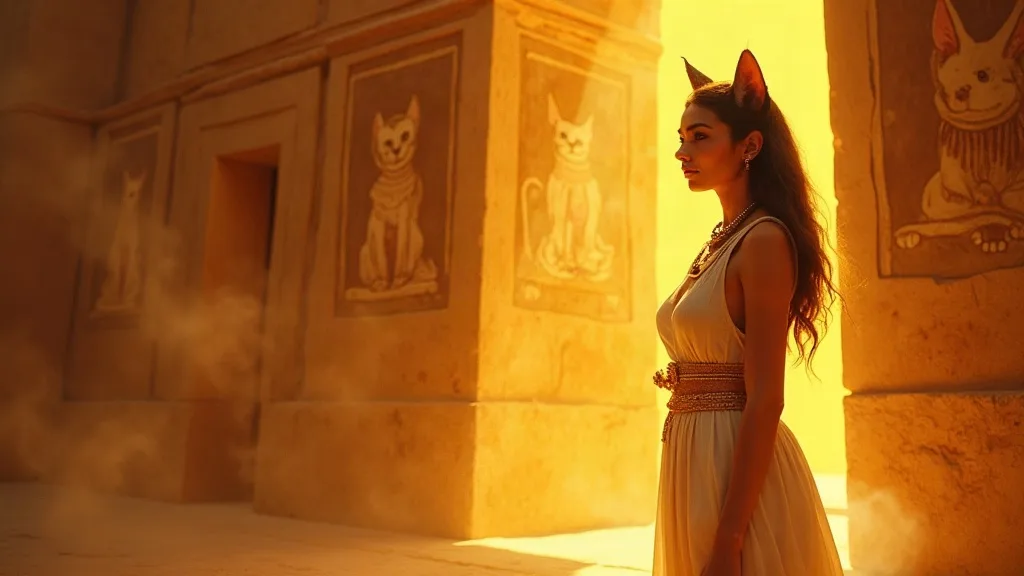
Bastet the Cat Goddess: Egypt's Protector of Home and Fertility
Bastet, the Egyptian cat goddess, evolved from a fierce lioness warrior into a symbol of domestic protection, music, and fertility. Discover how her worship shaped ancient Egypt and why her image still captivates the world today.
Contents
The ancient Egyptians loved cats. They kept them as companions, revered them as sacred animals, and built entire temples to honor them. At the heart of this reverence stood Bastet the cat goddess, a deity who embodied both the gentle warmth of the home and the fierce power of the lioness. For over three thousand years, Egyptians called upon her for protection, fertility, and the blessings of motherhood.
Bastet's story is not one of a single unchanging god. She shifted and transformed across Egypt's long history, reflecting how a society's beliefs evolve. She began as a warrior, dangerous and untamed. Over centuries, she became gentler, more loving, yet never lost her edge. This journey from ferocity to nurturing care mirrors something deeply human: the way we grow and change, yet carry our past within us.
Her worship reveals what mattered most to ordinary Egyptians. While pharaohs built monuments to Ra and Osiris, regular families brought offerings to Bastet, asking for healthy children, protection from harm, and the blessings of music and joy. In her, we see the daily spiritual life of the ancient world.
The Lioness Warrior: Bastet's Fierce Origins
In Egypt's earliest dynasties, around 3000 BC, Bastet was not primarily a cat goddess at all. She was Bast, a fierce lioness deity associated with the desert sun and royal power. The ancient Egyptians saw the lioness as the embodiment of raw strength; she hunted to feed her cubs, she defended her territory fiercely, and she answered to no one. This was Bastet's first nature.
The name itself may come from the word "bastet," meaning "female of the ointment jar," though scholars debate this. What is clearer is her role: she was a warrior protector, aligned closely with Sekhmet, the lioness goddess of plague and divine wrath. In some texts, Bastet and Sekhmet were treated as one being, or as two aspects of the same cosmic power. The difference, roughly, was that Sekhmet embodied uncontrolled rage and destruction, while Bastet represented protective anger: the mother defending her young.
Early depictions show her with a lion's head on a human body, wearing the uraeus, the sacred cobra that symbolized royal authority. She carries the ankh, the symbol of eternal life. In inscriptions from the Old Kingdom (around 2686-2181 BC), she appears as a protector of the king and the kingdom itself. Pharaohs invoked her strength before battle.
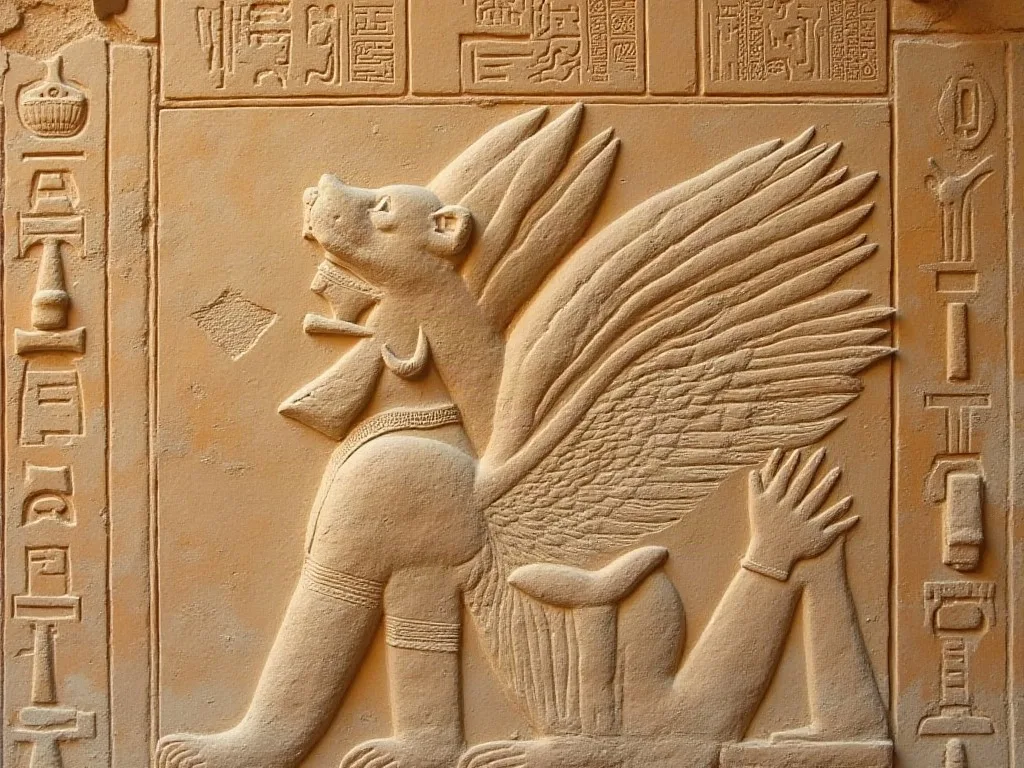
Around the Middle Kingdom (2055-1650 BC), something remarkable happened. Bastet began to transform. She became increasingly associated with the domestic cat, the smaller, more manageable relative of the lion. This shift reflects a real change in Egyptian society: as the Nile Valley became more densely settled, cats became more valuable as hunters of rats and mice in grain storage areas. They moved from the wild into the home. And Bastet moved with them.
By the New Kingdom (1550-1077 BC), the transformation was nearly complete. Bastet was now iconographically a cat goddess, depicted with a cat's head rather than a lion's. But she never fully shed her warrior past. The change was not degradation; it was expansion. She became protector of the home the way the lion protects the pride.
The Gentle Protector: Bastet's Domestic Transformation
In her later form, Bastet embodied qualities that made her beloved across Egypt. She was the goddess of the home and hearth, protecting families from disease, evil spirits, and misfortune. Mothers prayed to her for safe childbirth. Families kept cats as living representatives of her blessing in their houses. To harm a cat was not just cruel; it was sacrilege.
Bastet was also the goddess of fertility and motherhood. This was not abstract; Egyptian mothers genuinely believed Bastet watched over their pregnancies and their children's early years. She was depicted nursing kittens or surrounded by them, an image that reinforced her association with nurturing care. The ancient text known as the Book of the Dead mentions her as a protector of the deceased in the afterlife, guiding souls safely through the dangers of the underworld.
But perhaps her most surprising domain was music and dance. Bastet the cat goddess became a patron of joy, celebration, and sensual pleasure. She carried the sistrum, a percussion instrument used in temple rituals and festival dances. Egyptians celebrated her feast day (the 18th of Bast, roughly April in the modern calendar) with processions, music, and what ancient sources describe as wild, joyful crowds. Women danced in her honor. Singers performed. The celebration had an ecstatic quality that surprised Greek travelers who visited Egypt; they reported that Bastet's festival was the most well-attended religious celebration in the entire country.
This combination of fierceness, motherhood, and joy may seem contradictory to modern ears. But to the ancient Egyptian mind, it was coherent. A mother cat is fierce in protecting her kittens but also gentle and playful. She can purr and strike. Bastet held all of these states at once.
Worship and Sacred Spaces: The Cult of Bastet

The epicenter of Bastet's worship was the city of Bubastis, located in the Nile Delta in Lower Egypt. The main temple, constructed in the New Kingdom and expanded over centuries, was one of the most important religious centers in Egypt. The Greek historian Herodotus visited Bubastis in the 5th century BC and left a vivid account of the temple and its festival.
According to Herodotus, the temple sat on an island surrounded by a moat. Palm trees and gardens enclosed the sacred space. Inside, statues of Bastet stood in the inner sanctuary. What amazed Herodotus most was the sheer number of pilgrims: he reported that 700,000 people came to the festival of Bastet in a single year, making it more heavily attended than any other Egyptian festival. Archaeological evidence suggests this figure may be exaggerated, but the scale was undoubtedly vast.
People made pilgrimages to Bubastis on boats, singing and dancing as they traveled down the Nile. Women played music; men banged on drums. The atmosphere was celebratory, almost carnival-like. Once they arrived, they offered gifts at the temple: amulets, figurines, and especially mummified cats. Thousands of cat mummies have been recovered from tombs and ritual deposits near Bubastis, suggesting that devoted followers purchased these as offerings to the goddess.
The practice of mummifying cats was unique to Bastet worship. Cats were killed humanely, wrapped in linen, and preserved with the same care given to human mummies. Some were buried in individual tombs; others in vast communal catacombs. A single cat cemetery discovered near Bubastis contained the remains of approximately 300,000 mummified cats. For Egyptians, this was not disrespectful; it was the highest honor. They believed the mummified cat carried the worshipper's prayers directly to the goddess.
Other temples to Bastet existed across Egypt, in cities like Memphis, Thebes, and Alexandria. Household shrines were even more common. An ordinary family might keep a small statue of Bastet in their home, make daily offerings of milk or bread, and appeal to her in times of illness or danger. Unlike the grand state religion centered on the pharaoh and cosmic gods like Ra, Bastet's worship was intensely personal and domestic.
The Symbolism and Mythology of Bastet
Bastet the cat goddess carried multiple symbolic meanings in Egyptian thought. The cat itself represented:
- Vigilance and protection: Cats were known to stay awake at night, hunting. Bastet became a guardian against darkness and unseen threats.
- Fertility and abundance: Cats bore large litters; this made them symbols of procreation and the renewal of life.
- Cleanliness and purity: Cats are meticulous groomers. Bastet represented spiritual and physical cleanliness, important in Egyptian religious practice.
- Swiftness and grace: The movements of a cat embody elegance. Bastet was invoked in contexts requiring quick action or smooth outcomes.
- Independence: Unlike dogs, cats cannot be fully tamed. They choose their relationships. Bastet represented a kind of divine autonomy, the power to decide one's own path.
In mythological narratives, Bastet appears most often as a helper or ally to other deities. She assisted her father Ra in his eternal struggle against the serpent of chaos, Apophis. In one famous myth, when Ra grew old and humanity began to rebel against his rule, he sent Sekhmet (or sometimes Bastet) as the Eye of Ra to punish humanity. The myth describes how the goddess became so intoxicated with slaughter that Ra had to trick her into drinking blood-colored beer to stop the killing. This story, preserved in multiple versions, shows Bastet's connection to divine wrath and its necessity, even as it explores the dangers of unchecked violence.
Bastet was also said to be the mother of Khonsu, the moon god, or sometimes his protector. Different regional traditions gave her different family relationships, reflecting how Egyptian mythology allowed for multiple versions of divine genealogy.
Bastet and Sekhmet: Two Faces of Power
The relationship between Bastet and Sekhmet is one of the most important in understanding Egyptian divine symbolism. Sekhmet, the lioness of plague and divine retribution, represented power in its raw, destructive form. She was invoked by pharaohs for military victory. She could not be reasoned with; she had to be appeased or controlled.
Bastet, by contrast, represented controlled, purposeful power. Her fierceness was directed. Her anger protected rather than destroyed. Where Sekhmet was the eye of Ra that brought plagues and devastation, Bastet was the eye of Ra that brought justice with mercy.
In many texts, they are described as aspects of the same deity, much like how a single person can be fierce in one moment and gentle in the next. Some scholars argue that Bastet and Sekhmet represented the two poles of the divine feminine in Egyptian thought: the awesome, terrible, and necessary power of destruction (Sekhmet) and the more intimate, accessible power of protection and nurturing (Bastet).
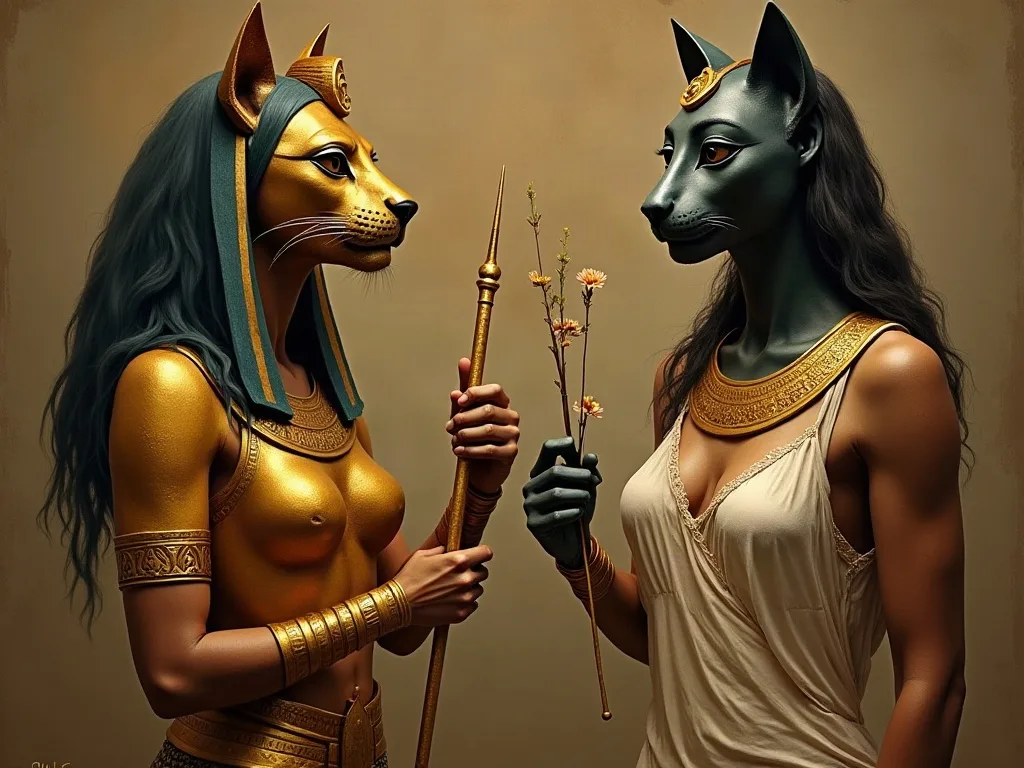
But Bastet was never truly domesticated or weakened by this association with gentleness. She retained the capacity for violence. The Egyptians understood power in a more nuanced way than a simple good-versus-evil binary. They knew that protection sometimes requires fierceness, and that love can carry claws.
Bastet in Later Periods: Syncretism and Evolution
When Greeks conquered Egypt under Alexander the Great in 332 BC, they encountered Bastet and found her fascinating. The Greeks, who had their own cat-associated deities (though cats were less important in Greek religion), began to identify Bastet with Artemis, their goddess of the hunt, wild animals, and protection. As Egypt became a Greek kingdom under the Ptolemies, Bastet's worship expanded to include Greek-speaking populations.
Later, when Rome incorporated Egypt into its empire, Bastet's worship continued but began to merge with other goddesses. The Romans were pragmatic about Egyptian religion; they allowed it to continue but sometimes reinterpreted gods through their own lens. Bastet's association with fertility made her comparable to Roman goddesses like Venus or Diana.
By the time Christianity arrived in Egypt around the 1st century AD, Bastet's worship began to decline, though it persisted in folk practice for centuries. Cat reverence in Egypt never entirely disappeared, though. For many Egyptians, the deep respect for cats that Bastet symbolized remained embedded in the culture.
The Physical Manifestation: Bastet Iconography and Hieroglyphics
In temple reliefs and tomb paintings, Bastet was depicted in consistent ways that evolved over time. In her earliest form, she wore the nemes headdress (the striped royal cloth) and a lion's head. She carried the ankh in one hand and a was staff (a staff topped with the head of Set, a symbol of power) in the other. These were the symbols of deific authority.
In her later cat-headed form, Bastet typically wore a simple linen dress and a broad collar called a wesekh, decorated with geometric patterns and semi-precious stones. She held a sistrum in one hand, the rattle-like instrument used in temple music. Sometimes she wore a solar disk on her head, the circular representation of Ra's sun, linking her to the sun god and reinforcing her role as a protective eye.
Her hieroglyphic name was written with three signs: a representation of a cat or lioness, the seated woman sign (representing femininity), and a symbol indicating divinity. The hieroglyphic name could be read as "Bastet" or "Bast," with variations depending on the time period and region.
Amulets of Bastet were extremely popular. Small figurines of a cat or a cat-headed woman, carved from faience (a blue or green ceramic material) or stone, were worn as protective charms. Families kept them in homes. Soldiers carried them into battle. Mothers placed them in birthing rooms. These were not mere decorative objects; they were believed to carry the goddess's protection into daily life.
Spiritual and Cultural Legacy: Why Bastet Still Matters
The reverence for Bastet tells us something profound about ancient Egyptian values. While the great temples were devoted to cosmic deities and royal ideology, the hearts of ordinary people turned toward a goddess who cared about home, family, and the small joys of daily life. Bastet was not distant or demanding; she was accessible, present in every cat, honored in every household.
This democratization of the divine was unusual in the ancient world. While other Mediterranean religions often reserved sacred knowledge for priests and the elite, Bastet's worship was open to everyone. A slave could make an offering to Bastet with the same sincerity as a pharaoh. This may explain her extraordinary popularity and the vast crowds at her festivals.
The association between Bastet and cats also reveals how the Egyptians observed and valued the animals around them. They did not see cats as merely useful pest-control; they saw divinity in them. The cat's independence, its ability to move silently and strike swiftly, its gentleness with its young and its ferocity toward threats, all seemed to embody divine qualities worth honoring.
In modern times, Bastet the cat goddess has become something of a cultural icon. New age spirituality has claimed her as a symbol of feminine power and independence. Pop culture references her regularly. Tattoos of Bastet are common. While these modern interpretations may not reflect historical accuracy, they suggest that something about Bastet continues to resonate: the idea of a power that is both fierce and nurturing, both ancient and eternally present.
Frequently asked questions about Bastet the cat goddess?
Frequently asked questions
Was Bastet originally a lioness or a cat?
Bastet began as a lioness goddess in Egypt's earliest periods (around 3000 BC) and was associated with desert power and royal protection. Over time, especially from the Middle Kingdom onward, she became increasingly depicted as a domestic cat. This was not a replacement but an expansion: she retained her fierce protective qualities while becoming accessible in homes and hearts across Egypt. Both forms coexisted in Egyptian belief.
Why did the Egyptians mummify cats?
Cats were sacred to Bastet, and mummifying them was considered the highest form of offering to the goddess. Devotees believed that a mummified cat carried their prayers directly to Bastet. It was an act of piety, not cruelty. Thousands of cat mummies have been discovered in tombs and ritual caches near Bastet's temples, showing how widespread the practice was.
Did ordinary Egyptians really worship Bastet more than state gods?
There is strong evidence that Bastet's festival was the most heavily attended religious celebration in Egypt, according to the Greek historian Herodotus. While pharaohs maintained elaborate cults to Ra, Osiris, and other cosmic deities, ordinary people's spiritual lives were deeply centered on Bastet. She offered protection and blessing in the domestic sphere, where most people lived. This suggests a rich two-tier religious culture in ancient Egypt.
How long was Bastet worshipped?
Bastet was venerated for over 3,000 years, from the Old Kingdom (around 2700 BC) through the Ptolemaic and Roman periods. Her worship began to fade with the rise of Christianity in Egypt around the 1st century AD, but cat reverence in Egyptian culture never entirely disappeared. The deep respect for cats that Bastet symbolized remained embedded in local traditions for centuries.
Is there a difference between Bastet and Sekhmet?
Bastet and Sekhmet represent two expressions of divine feminine power in Egyptian mythology. Sekhmet embodied raw, destructive wrath and divine retribution. Bastet embodied focused, protective strength and nurturing care. While they are sometimes described as aspects of the same deity, Bastet was more accessible and beloved, while Sekhmet was feared and formally appeased. Both were necessary: destruction and protection, severity and mercy.
What happened to Bastet worship after Rome conquered Egypt?
When Rome incorporated Egypt into its empire, Bastet's worship continued but gradually merged with other goddesses, particularly Roman deities associated with fertility and protection. Her worship slowly declined with the spread of Christianity but never entirely disappeared from Egyptian folk practice. The cultural reverence for cats that Bastet represented persisted in Egypt for centuries after formal temple worship ended.
The Enduring Mystery of Bastet's Evolution
One of the most intriguing questions about Bastet is whether her transformation from lioness to cat reflects a genuine theological shift or simply changing artistic convention. Did Egyptian theologians actively reinterpret her meaning, or did her image gradually evolve as artists and devotees adapted her to new cultural contexts?
The honest answer is that we cannot know with certainty. The Egyptians did not write detailed theological essays explaining their reasoning. But what we can observe is this: the shift from lioness to cat happened during a period when Egypt was urbanizing, when cats were becoming more present in daily life, and when common people's spiritual needs were becoming more prominent in the religious conversation. Perhaps Bastet did not change so much as become more present in the spaces where people actually lived.
This flexibility, this ability to honor ancient forms while adapting to contemporary reality, may be part of why Bastet endured so long. She was not locked into a single image or role. She could be fierce and gentle, wild and domestic, ancient and eternally alive in the bodies of cats.
The cat that sits on a windowsill in Cairo today carries within it thousands of years of sacred history. Not through any magical continuity, but because the Egyptians saw divinity in the creature's grace, independence, and capacity to both protect and comfort. That vision, expressed through Bastet, changed how humanity has understood the relationship between the sacred and the everyday.
Free 25-page sample
Want the whole story?
Take the first 25 pages free. If it pulls you in, the full edition is yours as an instant PDF download, with a paperback on Amazon for selected titles.

Mythology
The World Mythology Book: The Gods, Heroes and Myths of Every Culture
The Gods, Heroes and Myths of Every Culture, in One Volume
The whole of world mythology in a single volume: Greek, Norse, Egyptian, Japanese, Hindu, Celtic, Slavic, Mesoamerican and African myths gathered side by side, each drawn from the primary sources.