
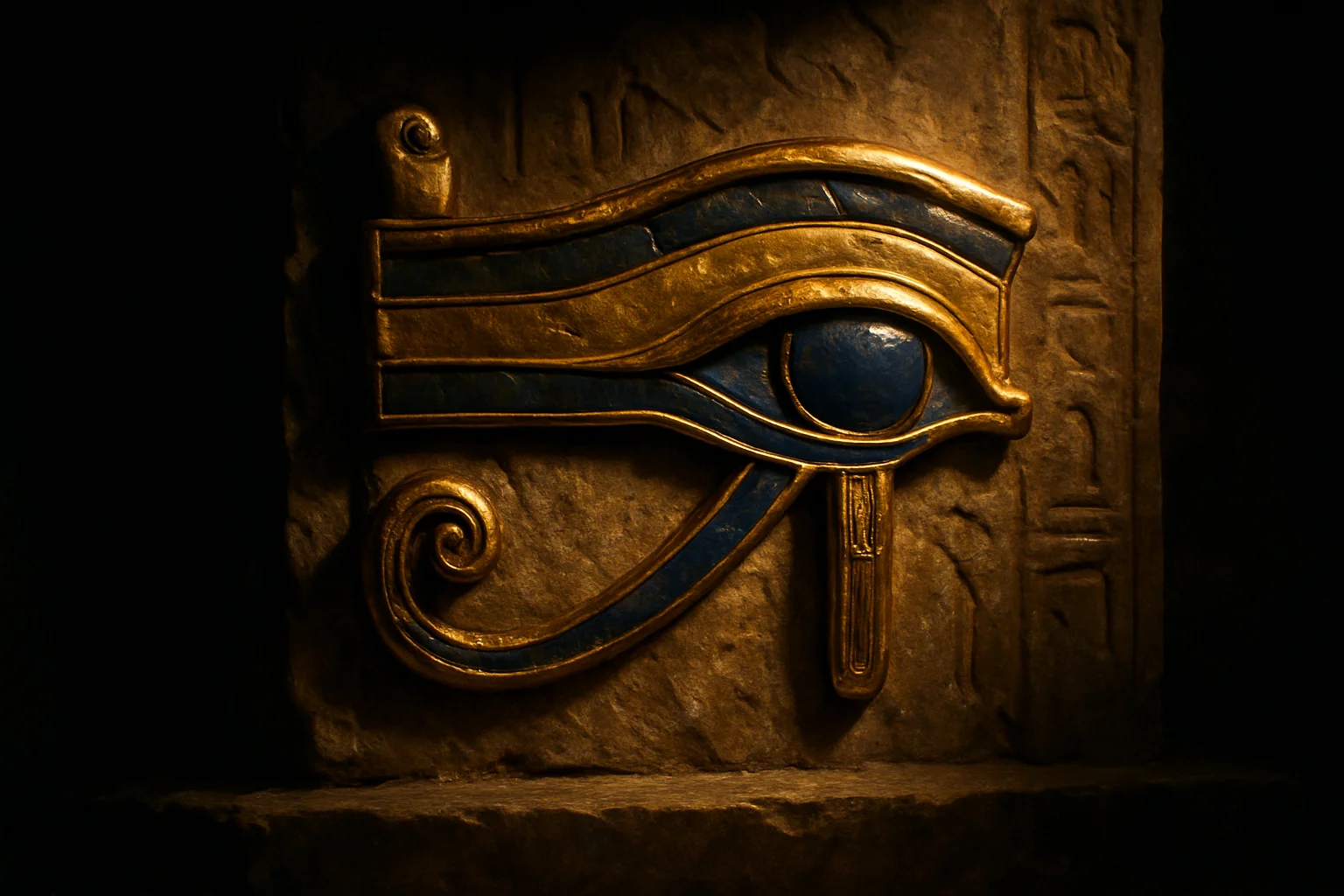
The Eye of Ra: A Symbol of Strength and Prosperity
The Eye of Ra is not a passive emblem. It is the sun god's weapon, his daughter, and his fury. Primary sources, temple art, and ritual use.
Contents
The Eye of Ra is a solar symbol in ancient Egyptian religion representing the sun god's power as a destructive, protective, and life-giving force, typically personified as a fierce goddess who acts as Ra's weapon against enemies and cosmic disorder. Temple reliefs at Dendera and Edfu, along with the Pyramid Texts (Utterances 273-274), depict the Eye as both an independent feminine entity and an extension of Ra's will. The symbol embodies royal authority, divine retribution, and the cyclical renewal of order, distinguishing it sharply from the lunar and restorative associations of the Eye of Horus.
The confusion between these two symbols persists in popular literature, but the primary sources draw clear lines. The Eye of Ra is solar, aggressive, and female. It burns, it strikes, it returns. Understanding this distinction opens a window into how the Egyptians conceived divine power: not as a single, static attribute, but as a force that could detach, transform, and be called back.
What the Eye of Ra Actually Is
The Eye of Ra functions as both a body part and a separate entity. In the cosmology recorded in the Pyramid Texts and later temple inscriptions, the Eye can leave Ra's face, take independent action, and return. This is not metaphor in the modern sense. The texts treat the Eye as a divine agent with its own will and capacity for violence.
Coffin Text Spell 316 addresses the Eye directly, calling it "the one who goes forth from Ra" and "the one who subdues the enemies of the sun." The Eye acts as Ra's enforcer, burning those who threaten cosmic order. It is simultaneously part of Ra and distinct from him, a paradox that Egyptian theology does not resolve so much as inhabit.
The Eye appears in multiple forms across the corpus of Egyptian gods. It can be the uraeus serpent on the king's crown, the lioness Sekhmet unleashed against rebels, or the cow-eared Hathor returning from the desert. Each manifestation carries the same core identity: solar, feminine, and dangerous.
Unlike other Egyptian symbols such as the ankh or scarab, the Eye of Ra is not a static emblem. It moves through myth and ritual as an actor, not an icon.
The Eye as Solar Weapon and Extension of Ra
Ra's Eye serves as his primary weapon against the forces of chaos, particularly the serpent Apophis who threatens the solar barque each night. The Papyrus Leiden I 344, a hymn to the sun from the New Kingdom, describes the Eye as "the flame which overthrows your enemies" and "she who makes the rebels fall."
The weapon metaphor is precise. The Eye strikes with fire, with light, with the searing heat of the desert sun. Temple reliefs show it as a rearing cobra, hood flared, positioned at the brow of Ra or the pharaoh. This is the uraeus, the physical manifestation of the Eye's protective and destructive capacity.
The Eye's independence matters. When Ra sends forth his Eye, he does not merely look or glare. He dispatches a goddess who acts according to her nature. The relationship mirrors the way Egyptian kingship functioned: the pharaoh delegates authority to officials who carry out his will, but those officials possess their own agency within defined boundaries.
This theological structure appears throughout the cosmology explored in ancient Egyptian astronomy, where celestial bodies are not inert objects but divine actors with roles and temperaments.
The Eye as Goddess: Sekhmet, Hathor, and the Distant Goddess
Sekhmet, the lioness-headed goddess, is the most explicit personification of the Eye in its wrathful aspect. Her name means "the Powerful One," and temple texts identify her directly as the Eye of Ra sent to punish humanity. She embodies solar heat at its most lethal: drought, plague, the killing wind of the desert.
Hathor, by contrast, appears as the Eye in its pacified form. She is no less the Eye of Ra, but she represents the moment after rage, when the goddess has been soothed and returns bearing gifts of fertility and joy. The same entity, two states.
The Destruction of Mankind
The myth preserved in the Book of the Heavenly Cow, inscribed on the walls of several New Kingdom royal tombs, tells how Ra grew weary of human rebellion. He convened a council of gods who advised him to send his Eye against the conspirators. The Eye took the form of Hathor, who descended to earth and began slaughtering humans with such enthusiasm that Ra feared she would exterminate the species.
She waded in their blood as far as Herakleopolis. Book of the Heavenly Cow, New Kingdom temple reliefs
Ra intervened by flooding the fields with beer dyed red to resemble blood. Hathor drank, became intoxicated, and forgot her mission. Humanity survived, but the myth encodes a permanent tension: the Eye of Ra can be unleashed but not easily controlled. The goddess must be tricked, appeased, or distracted.
This narrative appears across multiple versions in Egyptian mythology stories, each emphasizing the precarious balance between divine wrath and cosmic order.
The Return of the Distant Goddess
A related cycle of myths describes the Eye as a goddess who flees to Nubia or the distant desert, taking with her the blessings of moisture and fertility. Egypt dries up. Ra sends Thoth or Shu to retrieve her, often through persuasion, music, or trickery. She returns, and the land flourishes again.
The Distant Goddess motif appears in temple rituals at Dendera and Philae, where priestesses enact the goddess's return during festivals. The myth encodes the annual Nilotic cycle: the river's retreat and return, the alternation of drought and flood. The Eye's departure and homecoming mirror the environmental rhythms that governed Egyptian agriculture.
The goddess returns not as a defeated enemy but as a bride. She is welcomed, celebrated, and reintegrated into the divine order. Her rage becomes her dowry. This transformation is central to how the Egyptians understood divine power: it must be honored, not suppressed.
Eye of Ra versus Eye of Horus: Why the Confusion Persists
Modern sources routinely conflate the Eye of Ra with the Eye of Horus, treating both as generic symbols of protection. The primary sources do not support this. The two eyes belong to different gods, carry different mythic histories, and serve different ritual functions.
Eye of Ra
Solar, feminine, aggressive. Associated with fire, the uraeus, and goddesses like Sekhmet and Hathor. Represents the sun's destructive and protective power. Active agent in myths of divine retribution.
Eye of Horus
Lunar, masculine, restorative. Associated with healing, completeness, and the myth of Horus's battle with Set. Represents the restored eye torn out and reassembled. Passive symbol of wholeness and offering.
The confusion likely stems from visual similarity. Both eyes appear in profile, stylized in the same artistic conventions. Both carry protective connotations. But the theological and mythic contexts diverge sharply. The Eye of Horus is torn out, healed, and offered. The Eye of Ra is sent forth, rages, and returns.
Pyramid Text Utterance 274 addresses the Eye of Ra as "she who is on the brow of Ra," while Utterance 335 speaks of the Eye of Horus as "that which was injured" and "that which was made whole." The language distinguishes them consistently.
The distinction matters for understanding Egyptian theology. The Eye of Ra embodies divine power as an extension of the god's will, capable of independent action. The Eye of Horus embodies the restoration of order after violence, the healing of what was broken. One is a weapon. The other is a wound made whole.
Iconography and Visual Representation
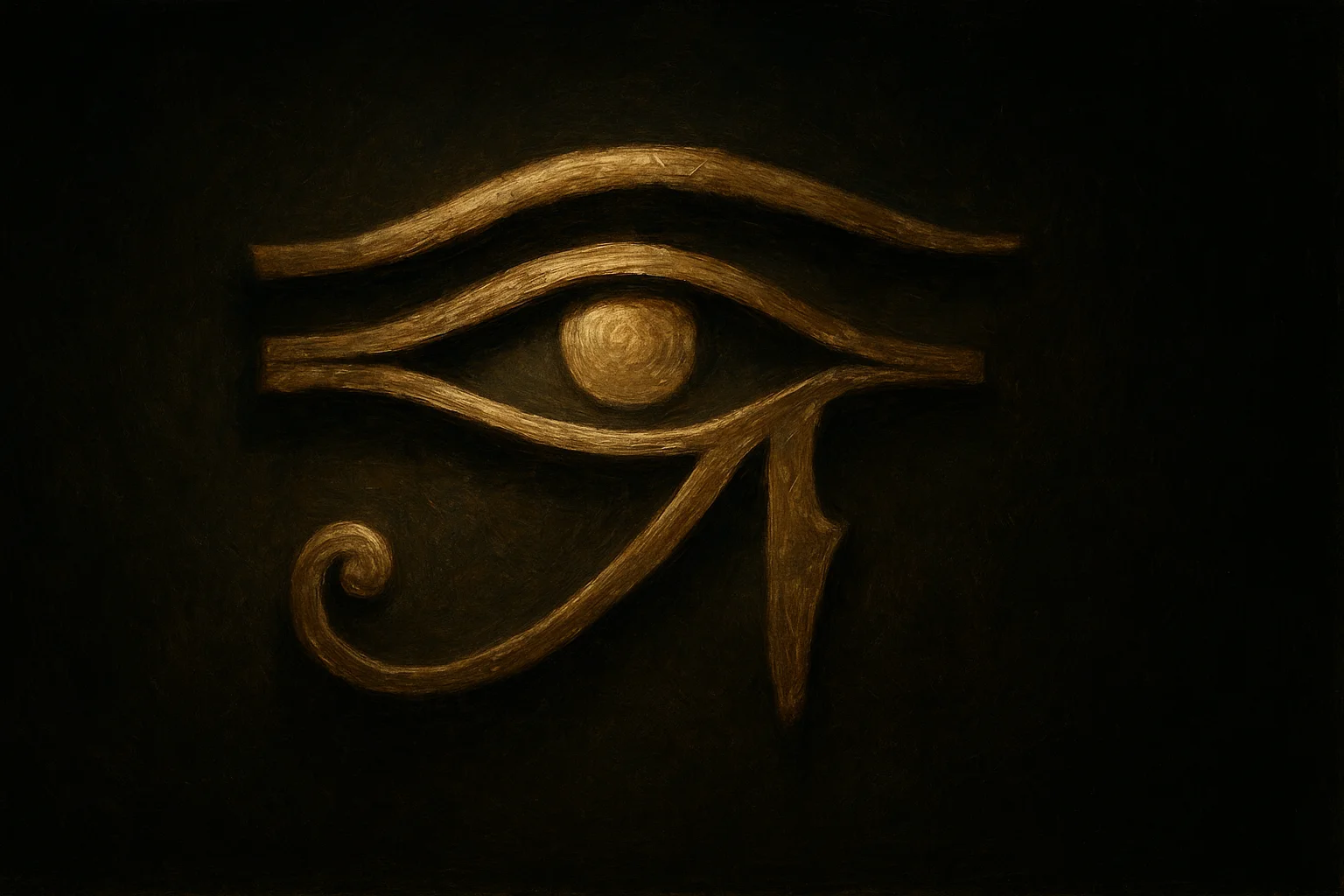
The Eye of Ra appears most commonly as the uraeus serpent, coiled or rearing, positioned on the brow of gods and kings. This is not decorative. The serpent is the Eye made visible, a constant reminder that the wearer commands solar fire.
Temple reliefs depict the Eye as a sun disc with a cobra emerging from it, or as a lioness with a solar disc balanced on her head. At Dendera, the goddess appears with the disc and horns of Hathor, marking her dual nature as both destroyer and nurturer. The iconography encodes theological complexity in visual shorthand.
The Eye also appears as a winged disc, particularly in protective contexts over doorways and on the prows of sacred barques. The wings suggest mobility, the disc suggests the sun, and the whole composition suggests the Eye's role as guardian and destroyer of enemies.
Unlike the Eye of Horus, which is often rendered in isolation as an amulet or offering symbol, the Eye of Ra is almost always attached to a divine or royal figure. It does not stand alone. It belongs to someone, acts for someone, and returns to someone. The visual grammar reflects the theological structure.
Depictions in temple reliefs and royal costume consistently place the uraeus at the center of the king's headdress, directly above the forehead. This positioning is deliberate: the Eye sees what the king sees, strikes what the king commands.
The Eye in Royal Ideology and Temple Ritual
The pharaoh wore the uraeus as a statement of divine delegation. The Eye of Ra on his brow signaled that he ruled with the sun god's authority and could unleash the same destructive power against Egypt's enemies. Royal inscriptions describe the king as "the one before whom the uraeus spits fire" and "he whom the Eye of Ra protects."
Temple rituals at Edfu and Dendera included offerings to the Eye as a distinct divine recipient. Priests presented incense, beer, and meat to Sekhmet or Hathor in her aspect as the Eye, seeking to maintain her favor and prevent her wrath from turning against Egypt itself. The rituals acknowledged the Eye's autonomy: she could be honored, but not commanded.
The New Year festival, particularly the Wepet Renpet, celebrated the return of the Distant Goddess and the renewal of the Eye's protective presence. Processions carried the statue of Hathor from her sanctuary, reenacting her homecoming. Music, dance, and intoxication featured prominently, echoing the myth of her pacification through beer.
Royal titulary often included epithets linking the king to the Eye. Akhenaten, despite his radical religious reforms, retained the uraeus on his crown, unable to dispense with the symbol's association with legitimate rule. Even a king who rejected the traditional pantheon could not rule without the Eye of Ra.
The Eye's role in royal ideology extended to military contexts. Campaign inscriptions describe the king's enemies as "those whom the Eye of Ra has burned" or "those whom the uraeus has struck down." The Eye legitimized violence, transforming human warfare into divine enforcement of cosmic order.
Modern Interpretations and Popular Misreadings
Contemporary treatments of the Eye of Ra often reduce it to a generic protection amulet, stripping away the theological complexity and the goddess's agency. Online retailers sell "Eye of Ra" jewelry with descriptions that could apply equally to the Eye of Horus, the evil eye, or any other apotropaic symbol. The specificity is lost.
New Age interpretations frequently emphasize the Eye's "positive energy" while downplaying or ignoring its role as a weapon of divine wrath. This sanitization misses the point. The Egyptians did not worship the Eye despite its violence but because of it. The capacity to destroy was inseparable from the capacity to protect.
Some modern readings attempt to psychologize the myth, interpreting the Distant Goddess as a metaphor for repressed anger or the "shadow self." While such readings may offer personal insight, they impose a modern therapeutic framework onto a cosmology that operated by different logic. The Egyptians were not concerned with integrating the shadow. They were concerned with appeasing a goddess who could end the world.
The conflation with the Eye of Horus remains the most persistent error. Even otherwise reliable sources on animals in ancient Egypt sometimes treat the two eyes as interchangeable, ignoring the distinct mythic and ritual contexts that the primary sources make explicit.
Scholarly work by Erik Hornung and Geraldine Pinch has clarified these distinctions, but popular discourse has been slow to catch up. The Eye of Ra deserves to be understood on its own terms: as a solar weapon, a feminine extension of divine will, and a force that must be honored, feared, and welcomed home.
Frequently asked questions
What is the difference between the Eye of Ra and the Eye of Horus?
The Eye of Ra is a solar, feminine symbol representing the sun god's destructive and protective power, typically personified as goddesses like Sekhmet or Hathor who act as Ra's weapon against enemies and cosmic disorder. The Eye of Horus, by contrast, is a lunar, masculine symbol associated with healing and restoration, representing the eye that was torn out during Horus's battle with Set and later reassembled. The Eye of Ra is an active agent sent forth to destroy, while the Eye of Horus is a passive symbol of wholeness and offering. Temple texts and myths treat them as distinct entities with different ritual functions.
Why is the Eye of Ra depicted as a goddess?
The Eye of Ra is depicted as a goddess because Egyptian theology conceived it as a feminine extension of the sun god's power, capable of independent action and possessing its own will and temperament. The Eye takes the form of goddesses like Sekhmet, Hathor, or the uraeus serpent, each embodying different aspects of solar force: destruction, fertility, or protection. This personification as female divinity allowed the Egyptians to express the Eye's autonomy and volatility within their cosmological framework. The goddess could be sent forth, could rage beyond Ra's initial intent, and had to be appeased or tricked into returning.
What does the Destruction of Mankind myth reveal about the Eye of Ra?
The Destruction of Mankind myth, preserved in the Book of the Heavenly Cow, reveals that the Eye of Ra possesses dangerous autonomy and can act beyond the sun god's control once unleashed. When Ra sends his Eye as Hathor to punish rebellious humans, she becomes so consumed by bloodlust that Ra must trick her with beer dyed to resemble blood to prevent humanity's extinction. The myth encodes a theological tension: divine wrath is necessary to maintain cosmic order, but it cannot be easily restrained once deployed. The Eye must be honored, appeased, and carefully managed through ritual to prevent it from turning destructive power against Egypt itself.
How was the Eye of Ra used in Egyptian royal ideology?
The Eye of Ra served as the primary symbol of the pharaoh's divine authority and military power, worn as the uraeus serpent on the royal crown to signal that the king ruled with the sun god's delegated violence. Royal inscriptions describe the king as protected and empowered by the Eye, which would strike down Egypt's enemies with solar fire. Temple rituals reinforced this connection through offerings to the Eye as a distinct divine entity whose favor legitimized the king's rule. Even radical reformers like Akhenaten retained the uraeus, unable to dispense with its association with legitimate sovereignty and cosmic order.
What role did the Eye of Ra play in temple rituals?
Temple rituals treated the Eye of Ra as a distinct divine recipient requiring regular offerings of incense, beer, and meat to maintain her favor and prevent her wrath from threatening Egypt. Festivals like the New Year celebration reenacted the return of the Distant Goddess, with processions, music, and ritual intoxication echoing the myth of the Eye's pacification. Priests at Dendera and Edfu performed daily rites to honor the Eye in her manifestations as Sekhmet or Hathor, acknowledging her autonomy and volatile temperament. These rituals were not merely symbolic but understood as necessary maintenance of cosmic order, managing the relationship between divine power and human community.
Why do modern sources confuse the Eye of Ra with the Eye of Horus?
Modern sources confuse the Eye of Ra with the Eye of Horus primarily because both symbols share similar visual conventions in Egyptian art and both carry protective associations, leading to superficial conflation in popular literature and commercial contexts. The confusion is compounded by the tendency to reduce complex Egyptian symbols to generic apotropaic meanings without attention to their distinct mythic narratives and ritual functions. Primary sources like the Pyramid Texts and temple inscriptions consistently distinguish the two eyes by their theological roles, gender associations, and mythic contexts, but these distinctions have not penetrated popular discourse. Scholarly work has clarified the differences, but online retailers, New Age interpretations, and casual references continue to treat them as interchangeable.
Further reading on Mythologis
Free 25-page sample
Want the whole story?
Take the first 25 pages free. If it pulls you in, the full edition is yours as an instant PDF download, with a paperback on Amazon for selected titles.
Egyptian
The Egyptian Mythology Book: Ra, Osiris, Isis, Anubis, and the Sacred Stories of the Pharaohs
Ra, Osiris, Isis, Anubis, and the Sacred Stories of the Pharaohs
Three thousand years of Egyptian sacred stories. The Duat, the weighing of the heart, the cult of Osiris, and the daily voyage of the sun.
More from Egyptian
All articles
Egyptian
The Book of the Dead: Egypt's Guide to Eternity
Ancient Egypt's most sacred funerary text was not a single book but a living archive of spells, maps, and prayers that guided the dead through the perils between death and eternal life.
Egyptian
Eye of Horus: The Protective Amulet That Watched Over the Living and the Dead
Worn by pharaohs and fishermen alike, the Eye of Horus is one of antiquity's most potent protective symbols, carrying the weight of cosmic battle, divine healing, and eternal vigilance.

Egyptian
Ra the Sun God: Egypt's Supreme Ruler of Light and Creation
Ra, the ancient Egyptian sun god, blazed at the very heart of a civilization that worshipped light as the pulse of creation itself. Discover his origins, his many forms, and the sacred journey he took across the sky and through the underworld every single day.
Egyptian
The Ankh: Egypt's Eternal Symbol of Life
The ankh is ancient Egypt's most recognizable hieroglyph, a looped cross carried by gods and pharaohs alike as the very key to immortal life. Discover its origins, meanings, and sacred legacy.