
The Binding of Fenrir: How the Gods Chained the Doomsday Wolf
The Aesir gods face an impossible task: bind a wolf whose jaws span earth and sky. The binding of Fenrir is one of Norse mythology's most ingenious tales of cunning, sacrifice, and the battle against fate itself.
Contents
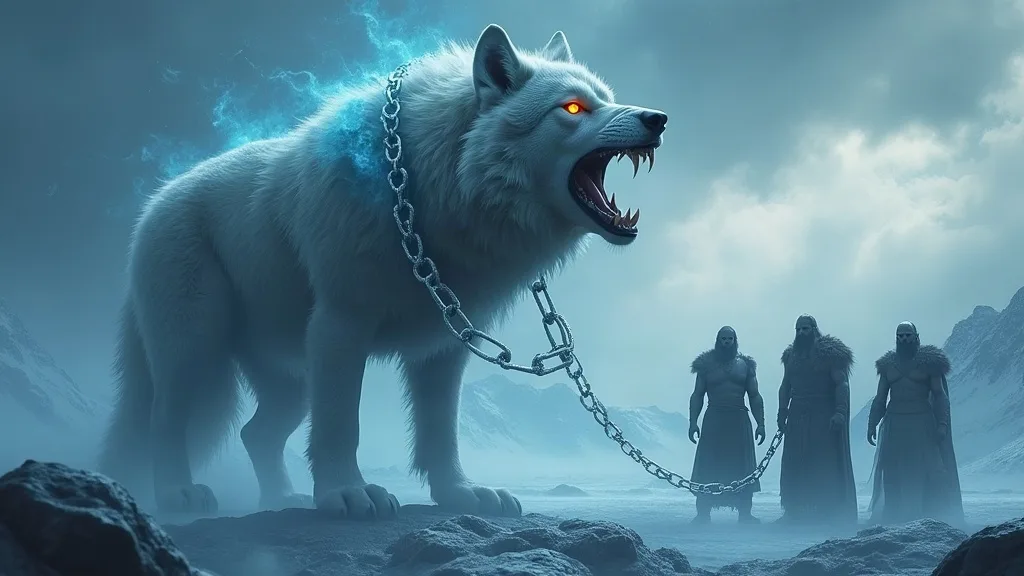
The gods see trouble coming. A massive wolf named Fenrir grows larger with each passing day in the realm of Muspelheim, the land of fire and chaos. He is not an ordinary beast. His father is Loki, the trickster god, and his siblings are the serpent Jormungandr and Hel, the keeper of the dead. As Fenrir feeds on the meat from Midgard (the human realm), his jaws grow so wide that his upper jaw touches the sky and his lower jaw scrapes the earth. The Aesir gods know what the seer Volva has foretold: at Ragnarok, the end of all things, Fenrir will break free and swallow Odin himself.
They cannot kill him. Prophecy is fate in the Norse worldview, and the Norns (goddesses of destiny) have already woven his doom into the fabric of reality. But the gods are clever. They devise a plan to bind him with a magical chain. What unfolds is one of Norse mythology's most intricate tales of cunning versus raw power, sacrifice versus survival, and the knowledge that even the gods cannot escape what has been written.
Who Is Fenrir and Why Do the Gods Fear Him?
Fenrir first appears in the Poetic Edda, a collection of Old Norse poems written down around 1270 CE (though the stories themselves are far older). He is one of three children born to Loki, the trickster god, and Angrboda, a giantess. His siblings are Jormungandr, the Midgard Serpent who encircles the world, and Hel, who rules over the dead in her underworld realm.
Fenrir is not born evil or dangerous. He begins as a wolf pup, and the Aesir actually bring him to Asgard (the realm of the gods) to raise him. This might seem reckless, but the gods believe they can control him. They are wrong. Fenrir grows at an impossible rate. His size becomes so immense that only Tyr, the one-handed god of war and justice, is brave enough to feed him. Every day, Fenrir's hunger deepens, his strength multiplies, and his teeth grow sharper.
The Volva, a seer who tells Odin of the future in the Voluspa (another core Edda poem), reveals the wolf's fate. At Ragnarok, the end of the world, Fenrir will break free from his chains. His jaws will gape so wide that his upper jaw will touch the sky and his lower jaw will scrape the earth. He will devour Odin himself, the All-Father, leader of the Aesir. The grim prophecy leaves no room for hope: this event is written into the cosmos's destiny.
Yet the gods refuse to accept passive doom. They decide to bind the wolf before he grows strong enough to shatter any ordinary chain. But how do you chain an unchainable creature?
The First Attempt: Leyding
The first binding chain is called Leyding. The Aesir smiths forge it from iron, using methods unknown to mortal men. It is massive, heavy, and seems unbreakable. They bring it to Fenrir and propose a game. "Try to break this chain," they say. "If you cannot, we will release you at once."
Fenrir agrees, curious and confident. The gods wrap Leyding around his body. The wolf flexes his muscles, shakes his massive frame, and the chain shatters. Pieces of iron scatter across Asgard. Fenrir is pleased with his own strength and allows himself to be released. The gods now know that brute force will not work.
A second chain, named Dromi, is forged, even heavier than Leyding. Again, the same test is proposed. Again, Fenrir breaks free, and the fragments of the chain fly further than before. The wolf's reputation grows. The gods are running out of options.
The Magical Binding: Gleipnir
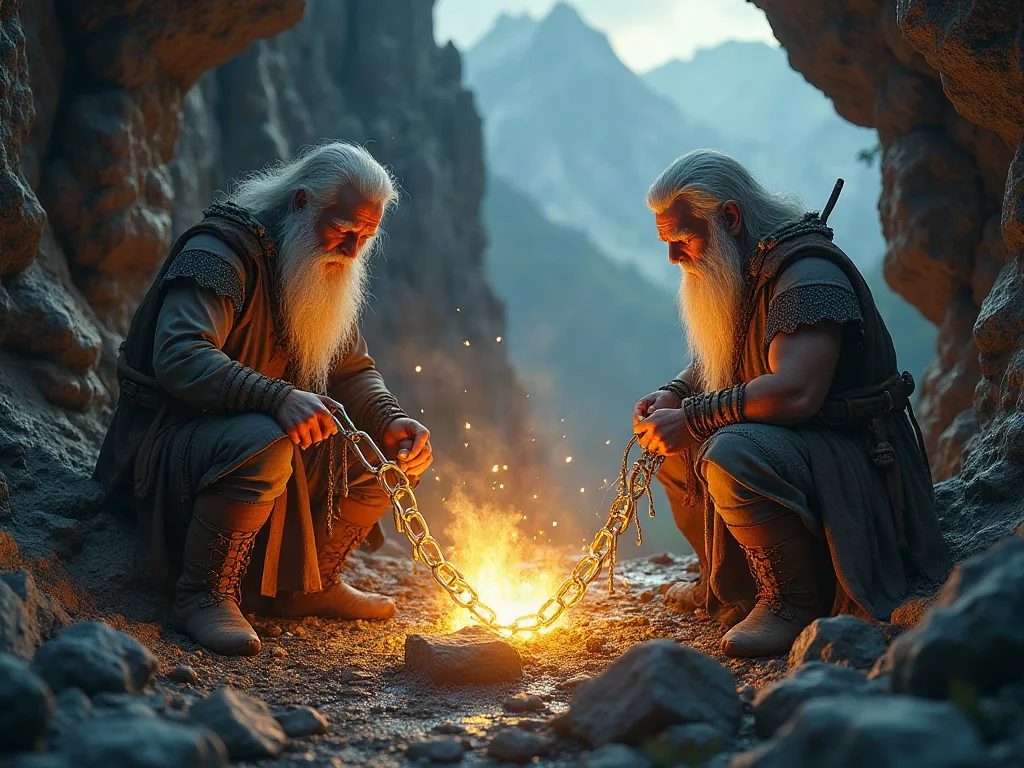
The gods realize they need something beyond iron and strength. They seek out the dwarves, the master craftsmen who live beneath the mountains in Niflheim. The dwarves are famous for creating magical items. They forged the spear Gungnir (which always hits its target), the hammer Mjolnir (wielded by Thor), and the ship Skidbladnir (which can travel anywhere). The Aesir ask the dwarves to create a chain so strong that no force in the Nine Realms can break it.
The dwarves accept the challenge, but the materials they gather are not what one might expect. The chain Gleipnir is woven from six seemingly impossible things:
- The sound of a cat's footstep
- The beard of a woman
- The roots of a mountain
- The sinews of a bear
- The breath of a fish
- The spit of a bird
These items do not exist in any normal sense. Yet the dwarves possess ancient knowledge that allows them to weave the strands of reality itself into a binding thread. Gleipnir becomes as thin as silk thread, smooth and supple, yet infinitely strong. It is a chain made not of brute matter but of the fundamental forces of existence.
Fenrir's Final Challenge
The gods present Gleipnir to Fenrir with a proposal. The wolf has become so confident from breaking Leyding and Dromi that he is willing to test any new chain. But this time, the gods make a subtle change to their offer. They suggest that if Gleipnir is truly as strong as they claim, Fenrir should not fear it.
Fenrir is clever. He suspects a trick. The wolf demands a guarantee: if he cannot break Gleipnir and the gods refuse to release him, he will be trapped forever. He asks for an "iron pledge" from the gods: one of them must place their hand in his mouth as a sign of good faith, a promise that they will free him if he cannot escape.
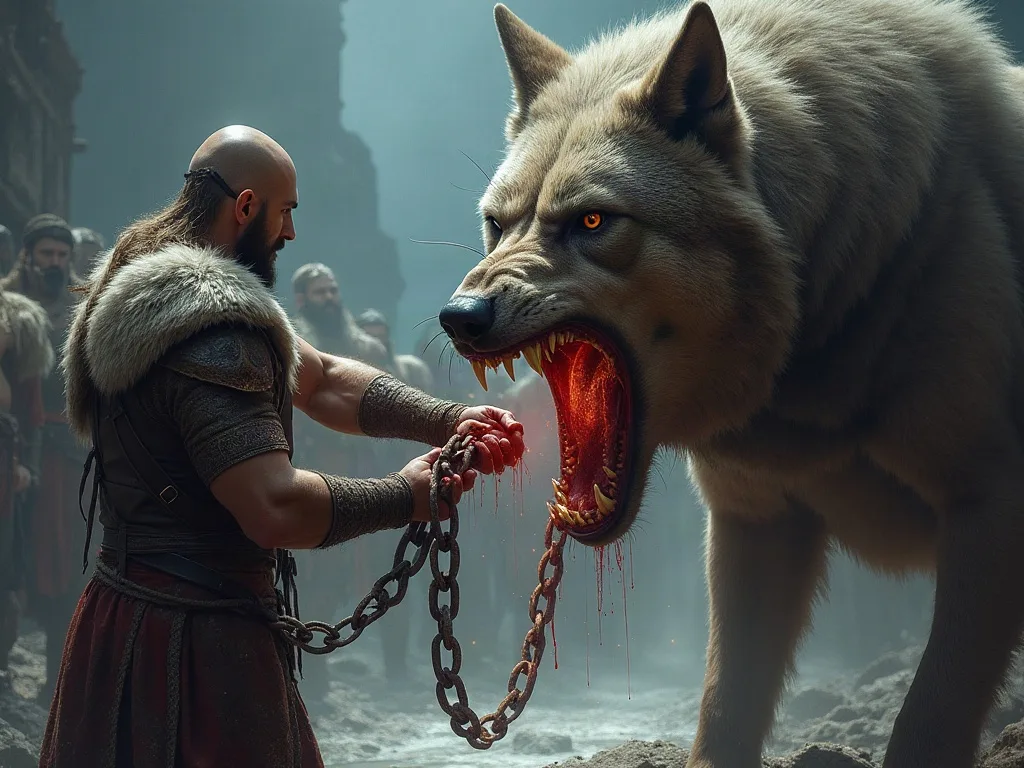
The gods look at one another. Releasing Fenrir when he grows to full strength at Ragnarok would mean the end of all things. Yet they must honor the wolf's terms, or he will refuse to be bound at all. Tyr, the god of war and justice, steps forward. He has always been the one brave enough to face Fenrir directly. He places his right hand into the wolf's mouth.
The gods wrap Gleipnir around Fenrir's body. The moment the magical chain touches him, it begins to tighten. The wolf realizes he cannot break free. In his rage and betrayal, Fenrir bites down on the hand in his mouth. Tyr's hand is severed at the wrist. He loses his arm but saves the world from premature doom.
Fenrir Bound: The Cost of Prophecy
With Gleipnir firmly around him, Fenrir is dragged to an island called Lyngvi (in some versions, it is the island Garmis). The gods hammer one end of the chain to a rock called Gioll, and another end to the boulder Thviti. Fenrir writhes and struggles, his jaws gaping open, but Gleipnir holds firm. In his fury, the wolf's mouth opens so wide that his upper jaw touches the sky and his lower jaw scrapes the earth. From his mouth, a river of saliva and venom flows, creating the river Van.
This is Fenrir's prison for the ages that follow, until the end of time. He is bound but not broken, chained but never tamed. The Aesir have bought themselves time.
The Price Paid: Tyr's Sacrifice
Tyr is a god of war, justice, and honor. By losing his hand, he becomes a permanent symbol of sacrifice for the greater good. In the Aesir, he is celebrated as a god of law and binding oaths, precisely because he understands the cost of keeping the world in order.
The loss of Tyr's hand also foreshadows the greater sacrifices to come at Ragnarok. When the end times arrive, Tyr will face the hound Garmr (the guardian of Hel's realm) in single combat. Both will kill one another in that final battle. Tyr's sacrifice begins here, at the binding of Fenrir, and it does not end until the world burns.
The Binding of Fenrir in the Eddas: The Primary Sources
The Poetic Edda, also called the Elder Edda, is the earliest and most direct source for this tale. It consists of Old Norse poems, the oldest of which date to around the 10th century, though they were not written down until the 13th century. Two poems in particular contain the binding story:
The Voluspa presents the seer Volva's prophecy to Odin. She foretells Fenrir's growth and his role in Ragnarok, setting the cosmic context for why the binding matters.
The Gylfaginning (found in the Prose Edda, written by Snorri Sturluson in 1220 CE) gives the most detailed narrative account of the binding. Snorri collected and organized the scattered Edda poems and added his own prose explanations, preserving much of Norse mythology that might otherwise have been lost after Iceland's conversion to Christianity in the year 1000.
Both texts emphasize the same theme: the gods act not from a position of confidence but from knowledge of doom. They know they cannot prevent Ragnarok. They can only prepare, sacrifice, and face it with dignity.
Why This Story Matters: Fate Versus Choice
The binding of Fenrir reveals something fundamental about Norse mythology. It is not a worldview of gods who are all-powerful or all-knowing in the way that, say, the Abrahamic God is portrayed. The Norse gods know their fate and act anyway. Odin knows he will be devoured by Fenrir. He prepares for it, he sacrifices (giving his eye to gain wisdom about the future), and he accepts it.
This is a culture that valued courage not as the absence of fear, but as facing danger despite certainty of loss. The gods do not defeat Fenrir; they bind him. They do not escape Ragnarok; they acknowledge it and spend their days doing what they can in the present.
The binding also illustrates the Norse concept of wyrd, often translated as "fate," but closer in meaning to "that which has become." Wyrd is not imposed by an external god but woven by the Norns (Urd, Verdandi, and Skuld: the past, the present, and the future). It is the fabric of reality itself, and no being, god or mortal, can truly escape it.
Fenrir in Modern Retellings and Popular Culture
The image of Fenrir and his binding has echoed through modern literature and media. In contemporary Norse paganism (Asatru and Heathenry), Fenrir is sometimes interpreted as a symbol of primal chaos that must be contained but never destroyed. Other modern retellings, particularly in fantasy and metal music, celebrate Fenrir as a symbol of freedom and resistance against divine control.
Neil Gaiman's Norse Mythology (2017) presents the binding as a moment of tragedy and deception, emphasizing Tyr's willingness to sacrifice himself for a cause he knows is doomed. Marvel's Thor films have reimagined Fenrir as a character with agency and pathos, though far removed from the source material.
The name Fenrir itself has become shorthand in gaming and fantasy for a "doomsday wolf" archetype. But the original story is far richer than simple apocalyptic imagery. It is a meditation on knowledge, sacrifice, and the dignity found in acting despite certainty of failure.
The Binding's Place in Ragnarok
The binding of Fenrir is not an endpoint; it is an interval. The prophecies preserved in the Voluspa foretell that at Ragnarok, the wolf will break free. When that day comes:
Fenrir will snap Gleipnir. His jaws will gape open so wide that his upper jaw will touch the sky and his lower jaw the earth. He will set his eyes and ears aflame and devour Odin the All-Father. But Odin's son Vidar will step into Fenrir's mouth, place one foot on the wolf's lower jaw, and tear the beast apart, avenging his father.
This is the Norse answer to the problem of evil, suffering, and cosmic disorder. The gods do not win permanently. They do not prevent the end. But they face it head-on, and they ensure that even in destruction, there is meaning and defiance.
Fenrir and Other Bound Creatures of Norse Myth
Fenrir is not alone in being bound. His brother, Jormungandr the Midgard Serpent, is also restrained. Jormungandr was cast into the sea by Odin and is bound there by his own size and the nature of the ocean itself. At Ragnarok, Jormungandr will also break free, thrashing so violently that the sea rises and floods Midgard. Thor will face this serpent and kill it, though he will himself be poisoned by the creature's venom.
Another connection appears in the binding of Loki himself. After Loki engineers the death of Baldur (the most beautiful and beloved of the Aesir), he too is captured and bound. Three serpents drip venom onto his face as punishment, though unlike Fenrir, Loki's binding is not cosmically preordained but rather a response to a specific crime.
These parallel stories show that in Norse mythology, binding is a form of justice and containment, not ultimate victory. The gods use binding to maintain order in the face of chaos, but they harbor no illusions that this order is permanent or absolute.
Frequently asked questions about the binding of Fenrir?
Frequently asked questions
Why couldn't the gods just kill Fenrir instead of binding him?
The Norse gods understood that prophecy and fate, woven by the Norns, could not be changed or avoided. Killing Fenrir would not alter the cosmic order; it would only defy it. The gods chose to bind him as a way of postponing the inevitable while maintaining their honor and the order of the Nine Realms until Ragnarok arrived.
What is Gleipnir made of, and why were those materials chosen?
Gleipnir is woven from six impossible things: the sound of a cat's footstep, the beard of a woman, the roots of a mountain, the sinews of a bear, the breath of a fish, and the spit of a bird. These items represent the boundaries of reality itself. By using materials that exist only in the liminal spaces of existence, the dwarves created a chain that binds not through brute strength but through fundamental cosmic law.
Did Tyr ever regret his sacrifice?
The Eddas do not record Tyr expressing regret, but they emphasize his role as a god of justice and lawful order. His sacrifice of his hand became inseparable from his identity as the god who upholds binding oaths and sacred pacts. In Norse culture, such sacrifice would have been seen not as a loss but as the price of honor.
Is the binding of Fenrir a historical religious practice, or purely mythological?
The binding narrative is recorded in the Eddas and in Snorri Sturluson's Prose Edda, which were the religious texts of pre-Christian Norse peoples. While we have no evidence of rituals specifically mimicking Fenrir's binding, the mythology was central to Norse cosmology and worldview. Modern Norse paganism draws on these stories as spiritual and philosophical foundations.
Fenrir and the Limits of Divine Knowledge
One final layer of meaning emerges when we consider what the binding of Fenrir reveals about the Norse understanding of the gods themselves. The Aesir are not omnipotent. They are powerful, immortal, and wise, but they are bound by the same wyrd (fate) that binds all creatures. Odin sacrifices his eye to gain wisdom about the future, but that knowledge does not grant him power to change it. He learns that he will be devoured, and he accepts this knowledge as part of the price of being a god.
This is radically different from many other mythologies. In Hindu tradition, Brahma creates the universe, but he too will be reborn and re-creation will occur. In Greek tradition, Zeus rules the cosmos but cannot escape the broader order of moira (fate). Yet the Norse take this further: they make the certainty of divine defeat central to their religious and philosophical identity.
The binding of Fenrir endures through the ages because it speaks to something universally human. It asks: what do we do when we know that we cannot ultimately win? The Norse answer is simple and terrible: we act with honor anyway. We sacrifice. We prepare. We face what comes without illusions or false hope. And in that facing, in that refusal to surrender despite certainty of loss, we find dignity and meaning.
Free 25-page sample
Want the whole story?
Take the first 25 pages free. If it pulls you in, the full edition is yours as an instant PDF download, with a paperback on Amazon for selected titles.

Mythology
The World Mythology Book: The Gods, Heroes and Myths of Every Culture
The Gods, Heroes and Myths of Every Culture, in One Volume
The whole of world mythology in a single volume: Greek, Norse, Egyptian, Japanese, Hindu, Celtic, Slavic, Mesoamerican and African myths gathered side by side, each drawn from the primary sources.