
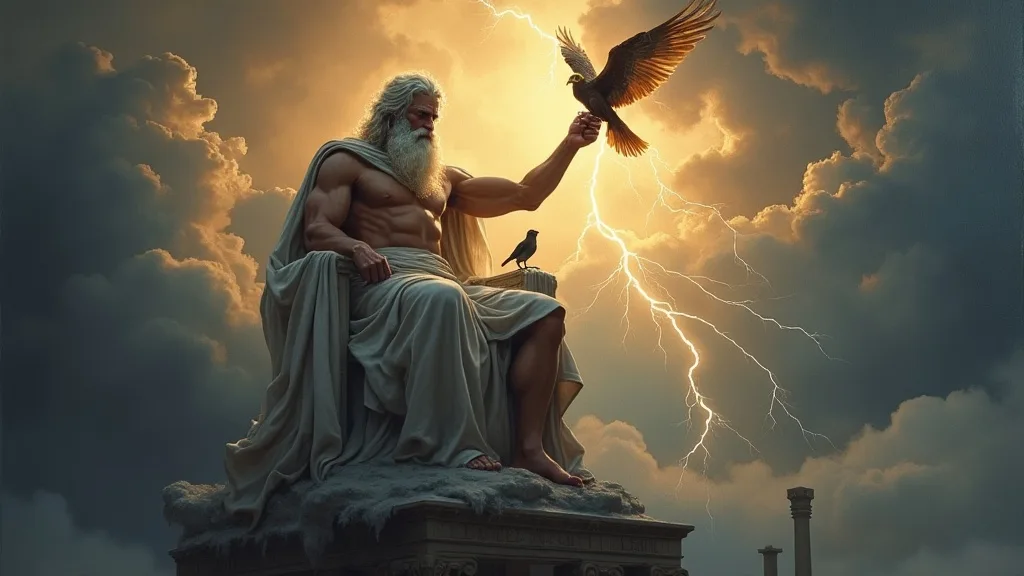
Zeus: King of the Olympian Gods
Zeus rules the sky, commands thunder, and sits above every god on Olympus. This is how he rose, what he represents, and why ancient Greeks built their entire moral cosmos around him.
Contents
The bolt strikes before you hear it coming. One moment the sky is clear; the next, the earth splits open and the air smells of iron. For the ancient Greeks, that gap between silence and thunder was not a meteorological event. It was a signature. Zeus, the King of the Olympian Gods, was announcing himself.
He sits at the peak of the Greek pantheon, not because he was the strongest from the beginning, but because he earned his throne through cunning, alliance, and raw endurance. His story begins in darkness, inside the belly of his own father, and ends with a cosmic order that the Greeks used to make sense of justice, weather, kingship, and the unpredictable weight of fate.
No single figure in Greek religion touches as many lives, myths, and moral questions as Zeus. He is the sky father, the oath-keeper, the stranger-protector, the husband who strays and the judge who binds even other gods. To understand him is to understand the backbone of Greek religion itself.
From Kronos to the Cradle: The Birth of Zeus
The creation story in Hesiod's Theogony, a Greek poem composed around 700 BC that tells where the gods come from, frames Zeus's birth as an act of survival. His father was Kronos, the Titan who had overthrown his own father Ouranos by castrating him with an adamantine sickle. The prize was the rule of heaven. The curse was a prophecy: one of Kronos's own children would do to him exactly what he had done.
Kronos's solution was to swallow each child his wife Rhea delivered. Hestia first, then Demeter, Hera, Hades, Poseidon: all went down. Rhea, grieving and furious, turned to her parents Gaia and Ouranos for a plan. They told her to go to Crete. When the time came to deliver her sixth child, she wrapped a stone in swaddling cloth and handed it to Kronos. He swallowed it without looking. The baby, Zeus, was carried to a cave on Mount Ida, or in some versions to the cave of Psychro on the Dikti plateau, where the nymphs fed him and the Kouretes, armed young men, clashed their spears against their shields to drown out the infant's cries.
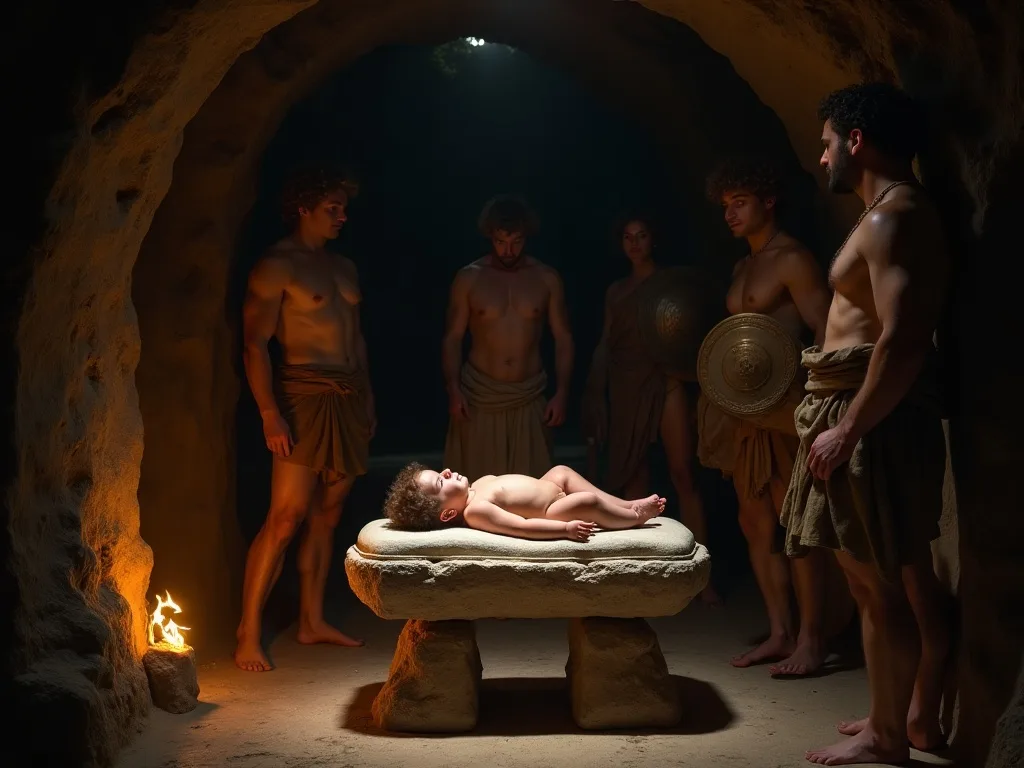
This origin sets the tone. Zeus is not born into safety. He is born into exile, nourished in secret, shaped by danger from his first breath. The Greeks understood that kind of origin. It matched their experience of human kingship: authority that is truly earned always carries the scar of the struggle to reach it.
The Titanomachy: A Ten-Year War for the Sky
When Zeus reached maturity, he returned. The Titaness Metis, whose name means "cunning thought," gave Kronos a drug that forced him to vomit up the swallowed children, first the stone, then the five siblings. They emerged unharmed. The war that followed, called the Titanomachy, lasted ten years according to Hesiod, with the Olympian gods holding Mount Olympus and the Titans occupying Mount Othrys.
The turning point came when Zeus descended to Tartaros, the deepest pit beneath the earth, and freed the Cyclopes and the Hundred-Handers (the Hekatoncheires), creatures Kronos had imprisoned. In gratitude, the Cyclopes forged the thunderbolt for Zeus, a trident for Poseidon, and a helmet of invisibility for Hades. Armed, the three brothers were unstoppable. The Hundred-Handers sealed the victory by hurling three hundred boulders at the Titans simultaneously. Kronos and his allies were cast into Tartaros, where the Hundred-Handers stood permanent guard.
The three brothers then drew lots for their domains. Zeus took the sky. Poseidon took the sea. Hades took the underworld. The earth and Olympus itself were shared ground. That division of the cosmos, drawn by chance yet overseen by Zeus as the eldest claimant, established the Greek picture of reality: three realms, one overarching authority.
The Giants, Typhon, and the Limits of Power
Winning the Titanomachy did not end the challenges. The Gigantomachy, the war against the Giants, came next. Giants were sons of Gaia, who had grown furious that her Titan children were imprisoned. They hurled whole mountains at Olympus and attempted to pile peak on peak to reach the gods. The Olympians fought back, but an oracle warned that the Giants could only be fully defeated with the help of a mortal. Zeus fathered Heracles precisely for this purpose, and together god and hero brought the Giants down.
Then came Typhon, the last and greatest monster challenge. Hesiod describes him in the Theogony as a creature with a hundred serpent heads, each with a different voice: lion, bull, hound, and hissing snake. He nearly defeated Zeus, at one point seizing the divine sinews from his hands and feet, leaving the king of the gods temporarily helpless. Other gods fled to Egypt in animal form to escape. But Zeus recovered, retrieved his sinews with the help of Hermes and Pan, reclaimed his thunderbolts, and buried Typhon beneath Mount Etna. The mountain's volcanic eruptions were understood by Greek audiences as Typhon still writhing underneath.
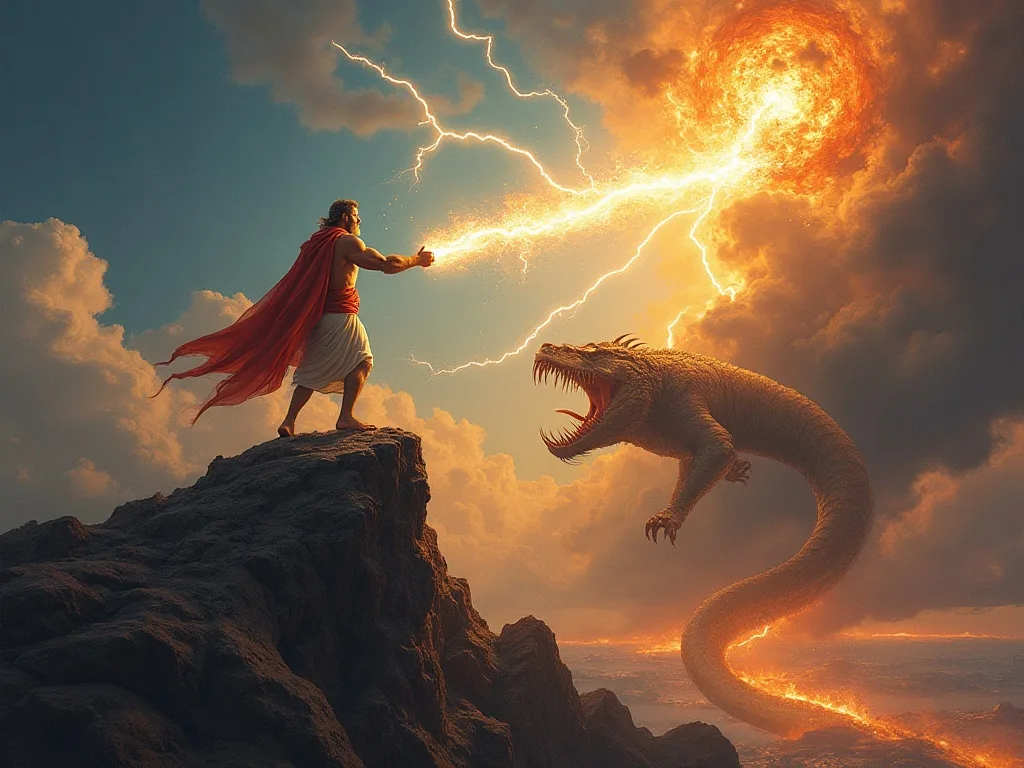
These battles are not mere adventure stories. They are a theology. Each enemy represents the chaos that existed before cosmic order was established. Zeus prevails not because he is invulnerable, but because he is committed: to order, to justice, and to the permanence of the arrangement the gods now maintain.
Zeus as Cosmic Legislator: Justice, Fate, and the Moral Order
The most significant aspect of Zeus that separates him from a simple war-chief is his role as the guarantor of Dike, the Greek word for justice, and Themis, divine law. He fathered the Horai (the Seasons) and the Moirai (the Fates) with Themis herself. He fathered the three Charites (Graces) with Eurynome. By having children who personify abstract moral and natural forces, Zeus is shown as the active source of those forces, not merely their beneficiary.
Homer's Iliad, composed probably in the 8th century BC, shows this most clearly. Zeus holds the golden scales of fate above the battlefield at Troy to weigh the fates of warriors before deciding who must die. He does not always like what the scales tell him. When his own son Sarpedon is fated to fall, Zeus considers saving him, but Hera and other gods remind him that breaking fate would unravel the order he himself sustains. He lets Sarpedon die, and weeps tears of blood as the body falls. That moment is extraordinary: it shows a god bound by the very structure he commands.
His titles in cult practice reinforce this legislative character. Zeus Xenios protected strangers and guests: violating the laws of hospitality (xenia) was an offense against Zeus personally. Zeus Horkios oversaw oaths: breaking a sworn oath invited divine punishment. Zeus Polieus protected the city. Zeus Soter was the savior invoked in moments of crisis. Each epithet describes a specific jurisdiction, a specific category of human life that Zeus supervised from Olympus.
The Many Loves of Zeus: Myth, Power, and Theological Complexity
No part of Zeus's mythology generates more modern discomfort or requires more careful reading than his numerous unions. He married Hera, sister and queen, with whom he fathered Ares, Hebe, and Eileithyia. Before that, he had swallowed Metis, the mother of Athena, after receiving a prophecy that Metis's second child would overthrow him: so Athena was born directly from his head, fully armed. With Mnemosyne (Memory) he fathered the nine Muses. With Leto he fathered Apollo and Artemis. With Semele he fathered Dionysus. With Alcmene he fathered Heracles.
These unions span mortals, Titans, Oceanids, and other divine beings. Ancient Greeks read them differently than we might today. Many scholars, including Walter Burkert in his landmark 1985 study Greek Religion, argue that these myths encode historical processes: the absorption of local cults into the broader Olympian framework, marriages between tribal groups, the political unification of regions under a single divine patron. When Zeus "fathers" a god or hero in a particular city, that city's special connection to that deity is being explained and legitimized.
The conflicts these unions create with Hera are equally important. Hera pursues Heracles, delays the birth of Apollo and Artemis, and torments many of Zeus's mortal children. That conflict is not simple jealousy. It reflects a genuine theological tension within Greek religion between different divine spheres, different cult traditions, and different understandings of cosmic authority. Hera is not subordinate to Zeus in Greek worship: she has her own major sanctuaries, at Samos and Argos in particular, and her own priesthoods. Their divine marriage is a relationship between equals who do not always agree.
Zeus Across the Greek World: Cult Sites and Religious Practice
Greeks worshipped Zeus at hundreds of locations, but three stand out as the most significant.
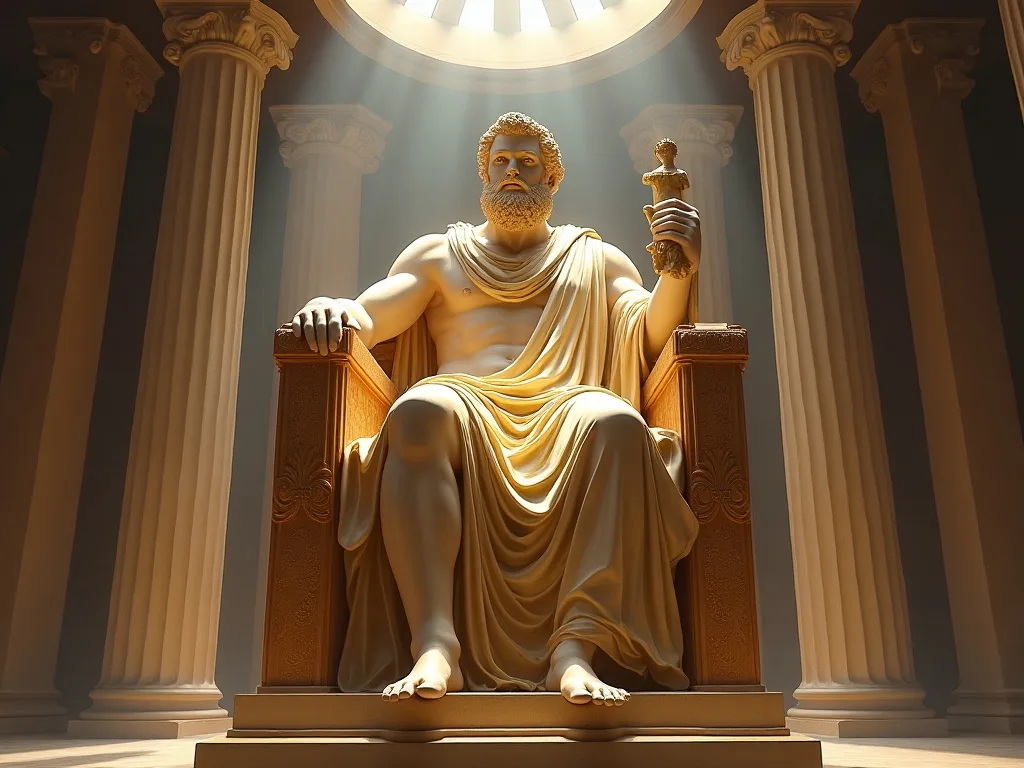
Olympia, in the western Peloponnese, housed the great Temple of Zeus, built in the 5th century BC and containing one of the Seven Wonders of the Ancient World: the chryselephantine (gold and ivory) cult statue created by the sculptor Pheidias around 435 BC. Ancient sources describe the seated Zeus as so imposing that viewers felt the god himself was present. The Olympic Games, held every four years from at least 776 BC, were a religious festival in Zeus's honor as much as an athletic contest.
Dodona, in the northwest region of Epirus, was the oldest oracle in Greece, predating Delphi according to Herodotus. Here Zeus spoke not through a human prophet but through the rustling of oak leaves, the cooing of doves, and the sound of bronze cauldrons struck by chains. Priests called Selloi slept on the bare earth without washing their feet, maintaining a state of close contact with the earth from which Zeus's voice seemed to emerge.
Mount Olympus itself, at 2,917 meters the highest peak in Greece, was understood as Zeus's actual home in early Greek thought, its summit perpetually hidden in cloud. Homer describes the gods feasting there, watching mortal events below as though on a stage.
These three sites represent three different aspects of Zeus: the powerful king honored with spectacle and competition at Olympia, the ancient oracular deity speaking through nature at Dodona, and the sky father literally dwelling at the mountaintop.
Zeus and Prometheus: The Myth That Defines Divine Authority
No myth tests Zeus as king more sharply than the one involving Prometheus, the Titan who stole fire from the gods and gave it to humanity. Hesiod tells the story in both the Theogony and the Works and Days, composed around the same period. Prometheus had already tricked Zeus into accepting the worse portion at animal sacrifices: the bones and fat wrapped in glistening animal skin, leaving humans the actual meat. Furious, Zeus withheld fire from humanity. Prometheus stole it back, hiding a coal inside a fennel stalk.
Zeus's punishment was precise and lasting. Prometheus was chained to a rock in the Caucasus Mountains, where an eagle ate his liver each day; because Prometheus was immortal, the liver regenerated each night. This continued until Heracles eventually freed him. For humanity, Zeus sent Pandora, the first woman, carrying a sealed jar (not a box: the "box" tradition comes from a 16th-century mistranslation by Erasmus) that contained all the world's evils.
This myth is not a simple story of divine cruelty. Greek audiences understood it as a story about the structure of existence: why humans labor, why they suffer disease and old age, why they rely on fire and sacrifice to maintain a relationship with the gods. Zeus's anger is proportionate to the scale of what was taken. He is not arbitrary; he is a ruler whose orders, when violated, have cosmic consequences.
Zeus in the Wider Indo-European Family
Zeus does not stand alone in the ancient world. His name comes directly from the Proto-Indo-European root Dyeus, meaning "sky" or "the shining one," also the root of the Latin Deus (god), the Sanskrit Dyaus Pita (sky father), the Roman Jupiter, the Norse Tyr, and others. This shared ancestry means that sky-father worship, with its emphasis on oaths, justice, and solar/atmospheric phenomena, goes back at least to the third millennium BC among the peoples who would later separate into Greek, Latin, Germanic, and Vedic traditions.
The comparison with Jupiter is especially instructive. Both rule the sky, both oversee oaths and hospitality laws, both are king of the gods. But Jupiter never accumulates the same narrative complexity as Zeus. He does not fight Titans, does not weep over Sarpedon, does not himself negotiate with fate. The Greek version of the sky-father myth gained extraordinary psychological depth through the literary traditions of Homer and Hesiod, a depth that made Zeus the most narratively rich king-deity in all ancient religion.
Zeus (Greek)
- Narrative complexity built through Homer and Hesiod
- Bound by fate (Moirai), sometimes visibly against his will
- Multiple cult titles reflecting different civic and moral functions
- Origin myth involving overthrow of Kronos and Titanomachy
- Weeps for mortal sons; emotionally present in myth
Jupiter (Roman)
- More austere, civic, and political in Roman cult
- Strong identification with Roman law and state authority
- Celebrated at the Capitoline Hill as head of the Capitoline Triad
- Fewer personal narrative myths in Roman literature
- Virgil's Aeneid portrays him as calmer, more sovereign
The Legacy of Zeus: From Antiquity to Modern Culture
Zeus did not vanish when the old temples closed. He moved.
Early Christian theology borrowed the vocabulary of omnipotence and cosmic sovereignty directly from the Zeus tradition, sometimes deliberately, sometimes by cultural osmosis. The Stoic philosophers, active from the 3rd century BC onward, redefined Zeus as the rational principle underlying the entire universe: not a personal deity but a cosmic fire-breath that gives order to all things. In Stoic hands, Zeus became the logos, the rational word that structures reality, a concept later taken up by early Christian writers in describing Christ.
In art, the seated Zeus of Pheidias became the template for every subsequent image of divine majesty: the seated, bearded, powerful figure that runs from Roman imperial portraits through medieval images of God the Father to Michelangelo's Sistine ceiling. The visual grammar of divine authority in Western art is, in large part, Zeus's visual grammar.
In literature, Zeus reappears under thinly altered names in Milton's God, in Shakespeare's Jove, in countless Renaissance allegories where "Jupiter" names the principle of benevolent authority. In the 21st century, he appears in Rick Riordan's Percy Jackson series as a recognizable king-figure, and in Hades games as a named character. What survives is not worship but archetype: the sky-king who holds the balance, who can be moved but not easily swayed, who answers to something larger than himself even while commanding everyone around him.
Frequently asked questions about Zeus, King of the Olympian Gods
Frequently asked questions
What exactly did Zeus rule over, and why was he considered the most powerful god?
Zeus ruled the sky and the atmosphere, which in ancient Greek thought meant rain, thunder, lightning, and the weather that determined whether crops grew or failed. Beyond the physical sky, he was the chief enforcer of cosmic order: he oversaw oaths, protected strangers and guests, punished violations of divine law, and held the scales of fate. His power came not just from the thunderbolt but from his role as the principle that holds the entire structure of the gods in place. Hesiod's Theogony and Homer's Iliad and Odyssey both treat him as the final authority, even when other gods resist him.
Why did Zeus swallow Metis, and how was Athena born from his head?
Metis, a Titan whose name means "cunning" or "practical wisdom," was Zeus's first wife. A prophecy warned Zeus that Metis's second child, a son, would be even more powerful than Zeus himself and would overthrow him, just as Zeus had overthrown Kronos. To prevent this, Zeus swallowed Metis when she was already pregnant with their first child. He later developed a tremendous headache; Hephaestus (or Prometheus in some versions) split his skull open with an axe, and Athena emerged fully grown and fully armed. Metis remained inside Zeus, continuing to counsel him from within, which is why Zeus is associated with wisdom as well as power.
What is the difference between Zeus and Jupiter?
Both descend from the same Proto-Indo-European sky-father deity (Dyeus Piter, meaning "sky father"). Their core functions are closely parallel: sky sovereignty, oath protection, rulership of the gods. The difference is largely in narrative depth. Greek literary tradition, particularly Homer and Hesiod, gave Zeus a rich emotional and moral inner life: he struggles with fate, grieves for mortal sons, and negotiates with other gods. Jupiter in Roman cult was more austere, more directly linked to the Roman state and its legal structures, and appears in fewer personal myths. The two are often treated as equivalent but are distinct enough that Greek and Roman authors sometimes acknowledged the gap between them.
Was Zeus actually bound by fate, or was he all-powerful?
This is one of the most genuinely debated questions in Greek theology. The texts suggest that Zeus is bound by the Moirai (the three Fates: Clotho, Lachesis, and Atropos), who determine the thread of each mortal's life. In Homer's Iliad, Zeus holds the golden scales of fate and weighs destinies rather than simply dictating them, suggesting he reads fate rather than sets it. However, some philosophers and later mythographers argued that Zeus and fate were identical: Zeus was the will that expressed itself as fate. The tension was never fully resolved, which is part of what makes Greek religion theologically interesting rather than a simple hierarchy of power.
Where did Greeks actually worship Zeus, and what did that worship look like?
Worship happened at hundreds of sites. The most prominent were the sanctuary at Olympia (home of the Olympic Games, held from 776 BC), the oracle at Dodona in Epirus (where Zeus communicated through oak leaves and sacred doves), and the Athenian Olympieion, a massive temple to Zeus Olympios completed under the Roman emperor Hadrian in 131 AD. Worship involved animal sacrifice, libations, prayer, and the recitation of hymns. Votive offerings, small clay or bronze figures of animals or human limbs, have been found in large numbers at Olympia and Dodona. The Panhellenic Games at Olympia were simultaneously athletic contests and religious festivals: victory honored Zeus, and victors received olive crowns cut from a sacred tree near Zeus's temple.
How does the myth of Prometheus and the theft of fire relate to Zeus's character?
The Prometheus myth is essentially a story about what happens when the cosmic order is violated. Prometheus was a benefactor of humanity, but his theft of fire from the gods broke the boundary between mortal and divine. Hesiod frames Zeus's punishment not as random cruelty but as the re-assertion of limits: humans are not gods, and the technology that brings them closer to divine power carries costs. The myth explains why humans suffer, why sacrifice is necessary to maintain the relationship with the gods, and why existence involves toil. Zeus in this story is harsh but not irrational; he is the force that keeps the structure of reality stable.
Zeus Between the Ancient and the Modern: The Unresolved Debate About His Morality
Scholars have argued for over two centuries about whether Zeus is a moral deity or simply a powerful one. The 19th-century German classicist Ulrich von Wilamowitz-Moellendorff saw Zeus as genuinely evolving toward monotheism in Greek thought, becoming more just and universal as the tradition developed. Walter Burkert, writing in the 20th century, was more skeptical: he saw Zeus primarily as a social and political construct, a divine mirror of human kingship with all its inconsistencies.
The text that sharpens this argument most is Aeschylus's Prometheus Bound, written in the 5th century BC. In it, Prometheus accuses Zeus outright of tyranny: the new king is capricious, self-interested, and unjust. Many modern readers take Prometheus's side. But ancient audiences knew what Aeschylus's lost sequels apparently showed: Prometheus eventually reconciling with Zeus, acknowledging that the king's authority, however uncomfortable, was the necessary foundation of an ordered universe.
This is the tension that gives Zeus lasting relevance. He is not a comfortable deity. He weeps for Sarpedon and still lets him die. He punishes Prometheus for a gift that helped humanity survive. He breaks his own marriage vows repeatedly. But he also holds the scales of fate steady. He protects the wandering stranger when no one else will. He binds every god to the permanence of the oaths sworn in Styx's name. The question of whether those qualities add up to justice, or simply to power, was never settled in antiquity. It is not settled now. That is why people are still writing about him.
Free 25-page sample
Want the whole story?
Take the first 25 pages free. If it pulls you in, the full edition is yours as an instant PDF download, with a paperback on Amazon for selected titles.
Greek
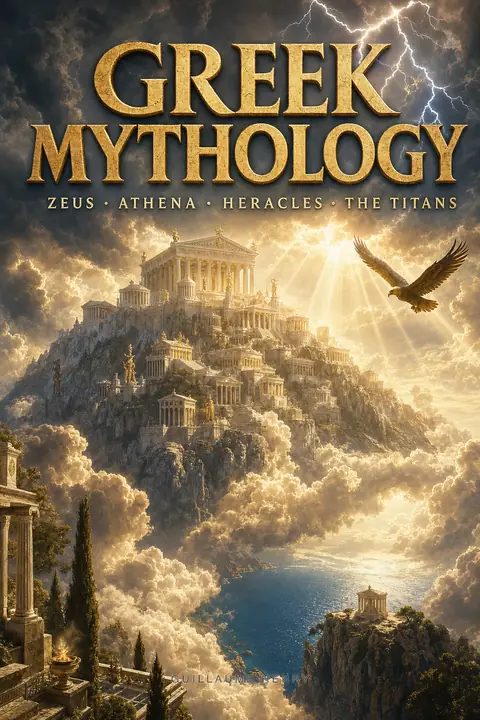
The Greek Mythology Book: Zeus, the Olympians, the Heroes, and the Sacred Stories of Ancient Greece
Zeus, the Olympians, the Heroes, and the Sacred Stories of Ancient Greece
The complete guide to Greek mythology from Hesiod's Theogony to Homer's epics. Every Olympian, every hero, every descent to the underworld.
More from Greek
All articles
Greek
The Labyrinth and the Minotaur: Crete's Most Dangerous Secret
Beneath the palace of Knossos, a king hid his shame in stone. The story of the Labyrinth and the Minotaur is a myth about power, sacrifice, and the monsters we create.

Greek
The Eleusinian Mysteries: Sacred Rites of Demeter
For nearly two thousand years, thousands of Greeks walked a sacred road to Eleusis and returned changed. The Eleusinian Mysteries promised something no other ritual could: a glimpse of what waited after death.

Greek
Odysseus: Hero of the Odyssey
Cunning, restless, and indestructible in will, Odysseus spent ten years trying to reach home. His story is not just about survival. It is about what it costs a man to remain himself.
Greek
Hades: Lord of the Underworld
Hades rules the Greek underworld with quiet, absolute authority. Neither villain nor demon, he is the god who keeps the cosmic balance that Zeus and Poseidon could never maintain alone.