
Daedalus and the Labyrinth: The Complete Myth, Its Sources, and Its Lasting Shadow
The craftsman who built the prison of the Minotaur, gave wings to his son, and outwitted a king. The full story of Daedalus, from Athens to Crete to Sicily, told with every ancient source intact.
Contents
The king had a problem. His wife had given birth to something that could not be explained away, could not be hidden for long, and could not be killed without angering the god who had sent it. So Minos of Crete called for the only man alive who could solve an impossible problem: Daedalus, the greatest craftsman in the Greek world.
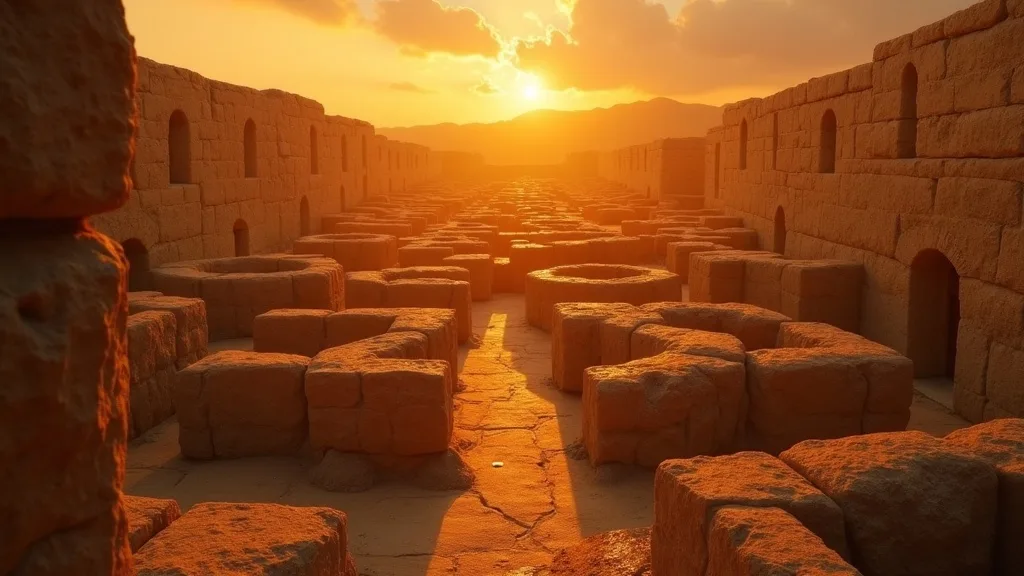
What Daedalus built in answer to that summons would consume him for the rest of his life. A prison with no walls visible from the outside. A maze so perfectly confused that the thing living at its center could never find the exit, and the people sent inside to feed it could never find the way out. The Labyrinth. Its name survives in a dozen languages. Its shape still appears on coins, coins you can hold in your hand today.
This is not simply the story of an architect and a monster. It is the story of a man who made beautiful things for dangerous people, who paid for his genius with his freedom, and who, when he finally escaped, lost the one thing that mattered more than craft. Every figure in the myth gets what they asked for and suffers for it anyway. That is how Greek tragedy works.
Who Was Daedalus Before Crete
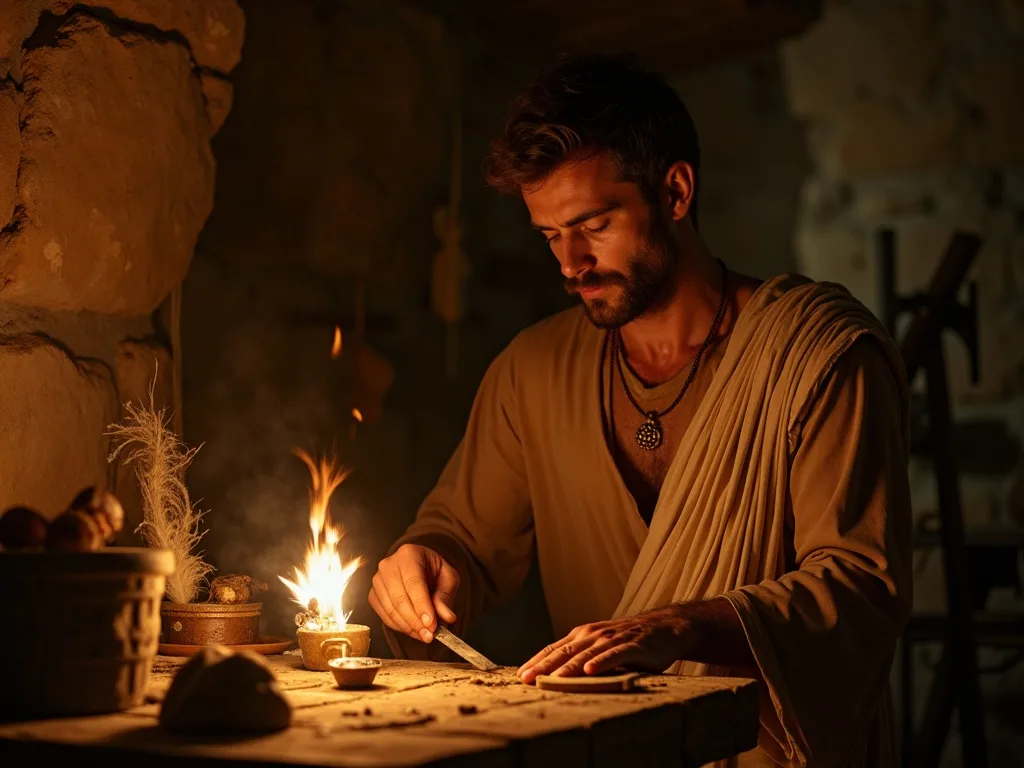
Daedalus (Greek: Daidalos, meaning "cunning craftsman" or "ingeniously wrought") comes from Athens. His family line, in most ancient accounts, runs back to the god Hephaestus, the divine blacksmith. The 5th-century BC mythographer Apollodorus, writing in his Bibliotheca, names Daedalus as the son of Metion, son of Erechtheus, king of Athens. Other sources give slightly different genealogies, but they all anchor him to the royal house of Attica and to a tradition of extraordinary making.
From his very first appearance in myth, Daedalus is defined by two things: his skill and his capacity for violence.
He had a nephew, a boy named Perdix (sometimes called Talos or Calos in different tellings). The boy was apprenticed to his uncle and proved, almost immediately, to be more than gifted. The Roman poet Ovid, writing in the Metamorphoses around 8 AD, tells the story with brutal clarity: the boy picked up a fish spine off the ground and used it as a template to cut the first serrated blade. He invented the compass for drawing circles by watching two sticks pivot. He was twelve years old.
Daedalus looked at his nephew and saw, not a prodigy to nurture, but a rival he could not afford. He threw the boy from the top of the Acropolis.
The goddess Athena, who protects clever inventors, caught Perdix before he hit the ground and transformed him into a bird called the perdix, the partridge. Ovid notes that the partridge, to this day, never nests in tall trees or high places. It builds close to the ground, in hedges and low bushes. It remembers the fall.
Daedalus fled the murder charge to Crete, where King Minos welcomed him. The most talented craftsman alive, now stateless, now dependent on royal protection. Minos had just acquired a very useful tool.
The Bull, the Queen, and the Wooden Cow
To understand what Daedalus was asked to build first, you need the story that made the Labyrinth necessary.
Minos wanted to be king. He told the Cretans that the gods themselves had given him sovereignty, and to prove it, he promised that whatever he prayed for would come true. He prayed to Poseidon (god of the sea, who shook the earth, who was tied to bulls and horses in Greek worship) to send a white bull from the waves. Poseidon sent it. The Cretans were persuaded. Minos became king.
The arrangement had one condition: Minos was to sacrifice the bull back to Poseidon.
He did not. The bull was too magnificent. He kept it and sacrificed an ordinary animal instead.
Poseidon's revenge was indirect and precise. He caused Minos's queen, Pasiphae (daughter of the sun god Helios), to fall into an obsessive desire for the white bull. The 1st-century BC historian Diodorus Siculus treats this as straightforward divine punishment. Pasiphae, tormented by a passion she could neither explain nor control, eventually turned to the one man on the island capable of solving the unsolvable.
She went to Daedalus.
Daedalus built her a hollow wooden cow, covered in genuine cowhide, mounted on wheels so it could be positioned in the meadow where the bull grazed. The device worked. The result of that union was the Minotaur: a child with the body of a man and the head of a bull. His name in most ancient texts is Asterion or Asterius, "the starry one," though the creature Theseus faces is usually just called the Minotaur, "the bull of Minos."
Minos, confronted with living proof of his wife's punishment and his own shame, did not kill the creature. He locked it away. That required Daedalus.
Building the Prison: The Labyrinth's Architecture in Ancient Sources
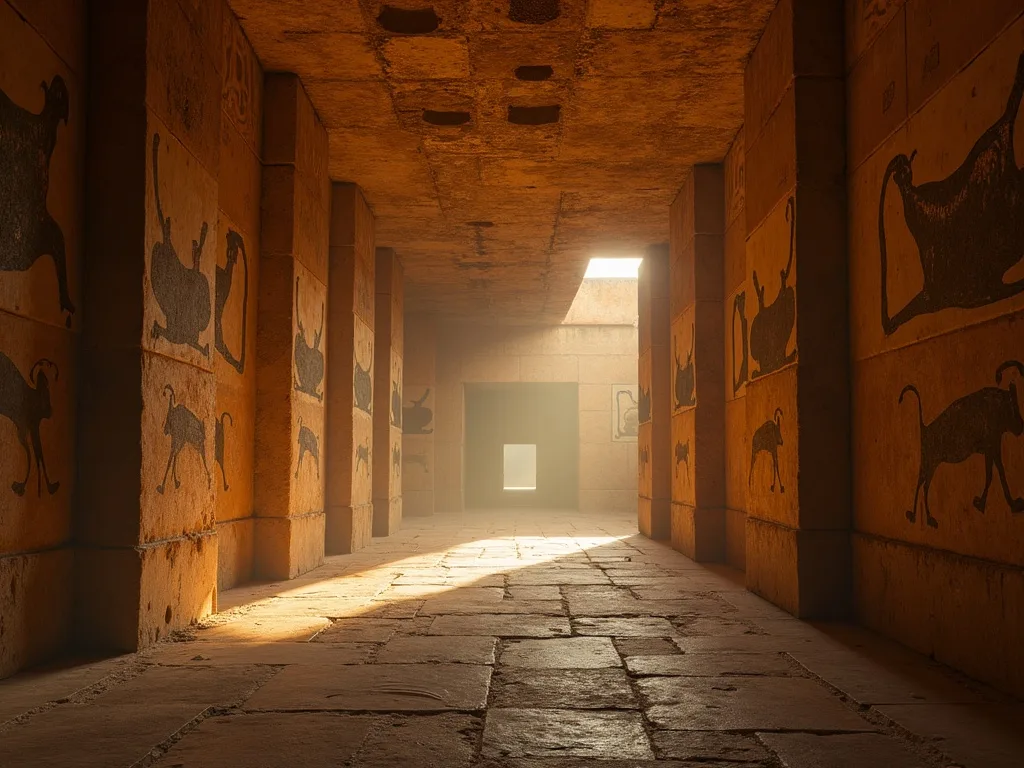
Ancient writers describe the Labyrinth in ways that seem almost deliberately contradictory, and that contradiction is itself meaningful.
Homer, in the Iliad, mentions a dancing floor that Daedalus built for Ariadne in Knossos, not a prison, not a maze. This reference, in Book 18, is one of the oldest we have, and it gives no suggestion of a monster or imprisonment. The labyrinthine prison develops later in the tradition.
By the time Apollodorus is writing his Bibliotheca (roughly 1st or 2nd century AD, though drawing on much older sources), the Labyrinth is a building with winding passages "from which it was impossible to find the way out." He does not give measurements or materials. The impossibility is the point.
The geographer Pliny the Elder, in his Naturalis Historia from around 77 AD, takes a more architectural view. He lists four famous labyrinths of the ancient world: the Egyptian one at Lake Moeris, the Lemnian one, the Italian one at Clusium, and the Cretan one. He says the Cretan Labyrinth was built of "quarried stone" and describes how its passages doubled back on themselves. He considers the Egyptian labyrinth far more impressive.
The poet Virgil, writing in the Aeneid around 19 BC, describes Daedalus carving the Labyrinth's story onto the doors of a temple at Cumae in Italy, depicting the "inextricable maze" (labyrinthus inextricabilis) and the confusion of the passages. He uses the image of a building that conceals its logic entirely.
What strikes modern archaeologists is how much the physical palace at Knossos, excavated by Arthur Evans beginning in 1900, resembles the myth's demands. The palace covers roughly 13,000 square meters. It has multiple stories, hundreds of rooms, corridors that do not run straight, storage magazines that open into other rooms, lightwell shafts that confuse spatial orientation. A visitor who did not know the plan would be genuinely disoriented. The myth may have preserved a real folk memory of the Bronze Age palace, or the palace may have seemed, to later Greeks who glimpsed its ruins, like exactly the kind of place where something monstrous would be hidden.
Theseus, Ariadne, and the Thread
Every year, Athens sent a tribute to Crete: seven young men and seven young women, fed to the Minotaur in the Labyrinth. This tribute was either the terms of a war-debt (Athens had lost a conflict with Minos) or a direct divine demand. Ancient sources vary. What they agree on is that the tribute was real and that it had happened multiple times before the myth's decisive moment.
Theseus, son of the Athenian king Aegeus, volunteered to go as one of the fourteen. He intended to kill the Minotaur.
When the Athenian ship arrived at Crete, Ariadne, daughter of Minos and Pasiphae, saw Theseus and made a decision. She went to Daedalus and asked how someone could survive the Labyrinth. Daedalus told her: take a ball of thread, tie one end to the entrance, unwind it as you go, follow it back when you are done. He gave her the thread. She gave it to Theseus.
This is worth pausing on. Daedalus, the man who built the prison, told a princess how to defeat it. He did not do it out of carelessness. He knew exactly what he was doing. Several scholars, including the classicist Mary Beard in her work on Greek myth, have pointed to this moment as evidence that Daedalus was already trying to undermine Minos from within, already planning something for himself.
Theseus went into the Labyrinth, found the Minotaur sleeping or drowsy (the accounts differ), and killed it with his bare hands, or with a club, or with a sword he had hidden. He followed Ariadne's thread back to the entrance. He took her and the Athenian survivors and fled on their ship. On the island of Naxos, he abandoned Ariadne. On the approach to Athens, he forgot to change the ship's sails from black to white, the signal to his father that he had survived. Aegeus, watching from a cliff, saw the black sails and threw himself into the sea. The sea was named the Aegean after him.
The Minotaur dies. The labyrinth becomes empty. And Minos turns his anger on the only person who could have helped Theseus and Ariadne escape.
Daedalus Imprisoned: Minos Closes the Island
Minos could not let Daedalus leave. He knew that the craftsman had helped Ariadne. He also knew, more practically, that Daedalus was too valuable to execute and too dangerous to release. He kept him on Crete as a prisoner, locking him and his son Icarus in the Labyrinth itself, or in a tower, depending on the source. Apollodorus says the tower. Later Roman writers prefer the Labyrinth, which has a satisfying irony to it: the builder imprisoned in his own construction.
Minos went further. He declared to every kingdom and island that the man who could solve a certain puzzle would receive a great reward. The puzzle: thread a spiral shell, like the kind you find on a beach, passing the thread all the way through without breaking it. He knew that only one man alive could solve it. He knew that man would not be able to resist the challenge.
Daedalus, by this point, had already escaped. He had built wings.
The Wings of Daedalus and Icarus: Full Text of the Flight

Ovid's Metamorphoses, Book 8, is the fullest and most vivid account of the construction of the wings and the flight. It is one of the passages most continuously read in Western literature, still taught in Latin classrooms across the world, still appearing in art, film, and poetry.
Daedalus, imprisoned, looked at what was available to him. He could not leave by sea: Minos controlled every port. He looked up.
He began collecting feathers. He arranged them by size, smallest to largest, building a graduated surface that mimicked the structure of a bird's wing. He bound the smaller feathers with wax, the larger ones with thread. He curved the completed structures at one end to give them lift, the way a real bird's wing curves. He built two pairs: one for himself, one for Icarus.
Before they flew, he gave his son careful instructions. Do not fly too low: the sea spray will wet the feathers and make them heavy. Do not fly too high: the sun's heat will melt the wax. Stay in the middle of the sky, between the sea and the sun, following my course.
Icarus said he understood.
Ovid writes the moment of takeoff with unusual tenderness. Daedalus watches his son rise into the air and feels something close to terror. He is a craftsman. He built the wings. He knows exactly how they work and exactly how they fail. He calls out to Icarus to stay close and then leads the way north, over the islands of the Aegean.
They passed the islands of Samos, Delos, and Paros. Fishermen on the shore looked up and thought they were seeing gods.
Then Icarus, feeling the air beneath him and the openness above, began to climb. He went higher. The warmth increased. The wax at the quills began to soften. The feathers came loose one by one, tumbling downward. Icarus beat his arms in empty air and fell.
Daedalus heard him call out once and circled back. He found feathers on the water. No son. He carried the body to the nearest island and buried it. The island was named Icaria after him. The sea nearby became the Icarian Sea, to Ikaraion pelagos. Both names persist on modern maps.
This is not a story about hubris in the way readers usually assume. Icarus does not fall because he was arrogant. He falls because he was young, and the sky felt real, and he forgot. Daedalus, by contrast, does not fall. He lands safely in Sicily, dedicates his wings at the temple of Apollo, and spends the rest of his life building things for a new king named Cocalus. He never goes home.
The Spiral Shell: Minos Hunts His Craftsman
Minos's puzzle trap worked almost perfectly.
The great craftsman King Cocalus of Sicily, having taken Daedalus in and prizing him, could not resist showing off the solution to Minos's messengers when they arrived at his court with the riddle. He gave the shell to Daedalus to solve. Daedalus drilled a hole at the apex, tied a thread to an ant, and let the ant walk through the spiral to the other end, carrying the thread the whole way.
When the answer came back to Minos, he knew. Only one man would have thought of the ant. He sailed to Sicily with his fleet, demanding that Cocalus surrender Daedalus.
Cocalus pretended to agree. He invited Minos into his palace, offered him a bath to rest after his voyage. Then the daughters of Cocalus, who adored Daedalus and the things he had made for them, poured boiling water through the pipes into the bath and scalded Minos to death.
Daedalus did not pour the water. But it was poured because of him.
Apollodorus records the death of Minos this way, matter-of-factly. Later sources sometimes say it was boiling oil or pitch rather than water. The mechanism varies. The structure of the story is the same: the king who thought he had cornered the craftsman is destroyed by the craftsman's protectors, using the craftsman's knowledge of pipes and enclosed spaces.
The hunter becomes the prey in the trap he tried to build around someone else.
Daedalus Across Traditions: What the Myth Echoes
Daedalus and the Labyrinth does not exist in isolation. It connects to a pattern that appears in mythologies far beyond Greece.
The craftsman-prisoner who must use his skill to escape is a figure who shows up repeatedly. Hephaestus, the Greek god of the forge, was thrown from Olympus in one version and used his craft to take revenge on the gods who rejected him. He built a golden throne that trapped the goddess Hera when she sat in it, releasing her only when Dionysus persuaded him to return. The craftsman builds the cage; the craftsman is the only one who can open it.
In Norse myth, Loki shares a similar structure. He too is a creator who makes wonders for rulers who cannot fully control him, who eventually uses his ingenuity to escape impossible situations, and who, like Daedalus, cannot stop himself from making things that cause more destruction than he intended. Both figures exist between worlds: not quite gods, not quite men, too smart to be safe, too skilled to be discarded.
The Vedic craftsman-god Vishvakarman (sometimes spelled Vishvakarma), the architect of the gods in Hindu tradition, built palaces and weapons for divine rulers who then feared what he had made. In the Mahabharata, the palace he constructed for the Pandavas at Indraprastha was so perfect and so full of illusions (floors that looked like water, water that looked like solid floor) that it became a direct cause of the war between the Pandavas and Kauravas, when Duryodhana was humiliated by being tricked by its surfaces. Beautiful objects, made by a brilliant hand, that ruin everyone who touches them.
The Daedalus archetype is not Greek. It is human: the artist trapped by his own talent, serving power that will never let him go, building his escape on wings that may or may not hold.
The Labyrinth as Symbol: Ancient Coins and Modern Psychology
Long before Carl Jung was writing about archetypes, the labyrinth had accumulated symbolic weight that had nothing to do with Minos or the Minotaur.
Cretan coins from the 5th and 4th centuries BC show labyrinth patterns on their reverse side. Not maze-like patterns with dead ends, but the classical "single-path" labyrinth: one continuous route that spirals inward, turning seven times, ending at the center. You cannot get lost in it. You walk it all the way in, you turn, you walk all the way out. The same pattern carved on rock faces in Galicia, Spain, in the Ligurian Alps in Italy, on Bronze Age cup-marked stones in Scotland. All roughly contemporary with the Minoan period, all using the same design.
This raises an important question that the myth ignores: a labyrinth with one path cannot trap anyone. A real maze has choices, dead ends, wrong turns. The classical labyrinth has none of these things. It is a journey inward and then a journey back out, guaranteed.
The philosopher and classicist W.H. Matthews, in his 1922 study Mazes and Labyrinths, was the first to draw this distinction sharply: the labyrinth of the myth is a maze with wrong turns, the labyrinth on the coins is a meditation symbol. Both are called by the same Greek name. Both are named for the same building. The ambiguity was built in from the start.
Medieval Christian builders adopted the single-path labyrinth for their cathedral floors. The 13th-century labyrinth at Chartres Cathedral in France, still intact on the floor of the nave, follows the same seven-circuit pattern as the Cretan coins. Pilgrims walked it on their knees as a substitute for the journey to Jerusalem. The Minotaur had been replaced by a cross at the center.
A Timeline of the Daedalus Myth in Ancient Sources
Understanding the myth requires knowing where each piece of it comes from. Ancient writers did not record the same story. They recorded different layers of a tradition that grew over roughly a thousand years.
- c. 1400 BC: Linear B tablets at Knossos record a word cognate with "Labyrinth." No myth recorded, just an administrative reference.
- c. 800 BC: Homer's Iliad, Book 18. Daedalus named as builder of a dancing floor at Knossos for Ariadne. No Minotaur, no prison.
- c. 700 BC: Hesiod's Theogony and Works and Days do not name Daedalus directly but contain the lineage of divine craftsmen that contextualizes him.
- c. 500 BC: The lyric poet Bacchylides, in Dithyramb 17, tells the Theseus-Minos encounter at sea. The labyrinth context is implied.
- c. 440 BC: Sophocles wrote plays called Daedalus and Camici (dealing with the Sicilian exile). Both are lost; only fragments survive.
- c. 400 BC: The playwright Euripides wrote a Theseus that likely included the Labyrinth. Also lost.
- c. 46 BC - 120 AD: Plutarch's Life of Theseus gives one of the fullest prose accounts of Theseus in the Labyrinth, the thread, and the escape.
- 8 AD: Ovid's Metamorphoses, Book 8. The flight of Daedalus and Icarus. The most vivid and influential account.
- c. 100 AD: Apollodorus's Bibliotheca. The fullest systematic account of the whole story cycle, from the wooden cow through the death of Minos.
- c. 77 AD: Pliny's Naturalis Historia. The Labyrinth compared to real architectural structures.
Every writer added or changed something. Ovid gave us Icarus as a fully felt human. Apollodorus gave us the complete chain of cause and effect. Plutarch gave us Theseus as a political hero rather than just a monster-slayer. The myth we know is a composite, assembled across a thousand years.
Daedalus After Antiquity: Art, Literature, and the Modern Craftsman
The fall of Icarus became one of the most painted subjects in Western art. Pieter Bruegel the Elder painted Landscape with the Fall of Icarus around 1560, now in Brussels. The painting is famous for what it does with the myth: Icarus is almost invisible. Two white legs disappear into the water in the lower right corner. A plowman plows. A shepherd watches his sheep. A fisherman fishes. The world continues while a boy drowns. W.H. Auden wrote a poem about the painting in 1938, "Musée des Beaux Arts," noting how suffering happens while someone else is eating or opening a window.
Salvador Dali painted Daedalus in his 1962 Landscape of Butterflies. James Joyce gave the name Stephen Dedalus to the artist-hero of A Portrait of the Artist as a Young Man (1916) and Ulysses (1922). Joyce was explicit about the parallel: his Stephen, like Daedalus, is a young man who must escape the labyrinth of his country, his family, and his religion using only his mind. The novel opens with the epigraph from Ovid: Et ignotas animum dimittit in artes, "And he set his mind to unknown arts."
Jorge Luis Borges returned obsessively to the labyrinth throughout his career. His 1941 story "The Garden of Forking Paths" creates a labyrinth made of time, not space. His essay "The House of Asterion" (1947) retells the myth from the Minotaur's point of view: Asterion is lonely, not monstrous, waiting for his "redeemer" to arrive. Borges did not sentimentalize the myth. He turned it inside out.
Frequently Asked Questions About Daedalus and the Labyrinth
Frequently asked questions
Did the Labyrinth of Daedalus really exist?
No confirmed physical labyrinth has been found, but the Bronze Age palace at Knossos on Crete, excavated by Arthur Evans from 1900 onward, is the strongest candidate for the myth's origin. The palace has over 1,300 rooms on multiple levels, connected by irregular corridors and staircases that genuinely disorient visitors. Linear B tablets at Knossos dating to around 1400 BC contain a word likely connected to the name "Labyrinth." Most scholars treat the myth as a cultural memory of the palace, overlaid with later storytelling.
Why did Daedalus help Ariadne give the thread to Theseus?
Ancient sources do not give Daedalus a clear motive, and that silence is significant. Apollodorus records the fact without explanation. Later commentators suggest Daedalus was acting against Minos's interests deliberately, either out of sympathy for the Athenian tributes, or because he already planned his own escape and weakening Minos served him. Some readings see it as the craftsman's natural instinct: he built a puzzle, and puzzles should be solvable. The ambiguity is part of what makes Daedalus one of the richest figures in Greek myth.
Is the fall of Icarus really about hubris?
The hubris reading is popular but not quite what the ancient sources say. Ovid, our fullest source, frames Icarus's fall as a failure of a young person to hold fear in mind when joy takes over, not as pride or ambition toward divinity. The contrast is with Daedalus, who succeeds not because he is more virtuous but because he is older and more frightened. The myth is closer to a story about experience and caution than about overreach. The "don't fly too high" reading is real, but Ovid's text shows far more pathos and tenderness than a simple moral fable.
How did Minos die, and what does it have to do with Daedalus?
According to Apollodorus, Minos died in Sicily while hunting for Daedalus. He arrived at the court of King Cocalus, who had sheltered Daedalus, and was welcomed with apparent hospitality. The daughters of Cocalus, devoted to Daedalus for the toys and devices he had made them, drowned Minos in his bath by pouring boiling water or pitch through the pipes. Daedalus built the plumbing. He may not have given the order, but the method of the killing points directly to his engineering.
What is the difference between a labyrinth and a maze?
In modern usage, the two words are often interchangeable, but classicists and historians of garden design draw a firm distinction. A labyrinth has a single path: you follow it inward and then outward with no choices to make. A maze has branching paths, dead ends, and multiple choices, so you can genuinely get lost. The classical labyrinth found on Cretan coins and cathedral floors is the single-path kind. The labyrinth of the Daedalus myth, where the Minotaur cannot escape and tributes die inside, functions as a maze. Both are called labyrinthos in Greek.
Who was Icarus's mother?
Ancient sources are not consistent on this. Apollodorus names a slave woman called Naucrate, a servant in the household of Minos, as Icarus's mother. Some later sources leave her unnamed. She plays no role in the story beyond her son's parentage. The emphasis in every account falls on Daedalus as both father and maker: he created the wings, he gave the instructions, and he bears the loss.
The Craftsman Who Could Not Stop Making Things
The last detail ancient sources give about Daedalus is that he spent his years in Sicily building wonders for Cocalus: a reservoir for the local river, a fortified cliff city, a steam bath at the thermal springs of Selinus. He kept working. He could not stop. That, perhaps more than any labyrinth or wing, is the truest thing the myth says about him.
He did not mourn Icarus by stopping. He mourned him by continuing. The hands that made the wings made new things the next morning. There is something in that which feels less like a moral and more like a portrait: the artist who survives his own catastrophes because the work is always the next thing, and the next thing can still be made perfectly.
Hephaestus shares this quality in Greek myth. So does Prometheus, who gave fire to humanity not for gratitude but because the gift was possible and he could see it. The craftsman-figure in Greek tradition is always slightly apart from the social order of gods and men, always serving someone else's needs, always building the thing that will cause the next catastrophe.
The Labyrinth itself is the perfect image for this: a structure so effective that it imprisoned not only the monster but eventually its maker. Daedalus built a machine that swallowed him, and then he built wings to get out, and those wings cost him his son, and then he built pipes in Sicily that killed his pursuer, and none of it was planned, and none of it was reckless.
He just kept solving the next problem. The myth remembers him for that.
Free 25-page sample
Want the whole story?
Take the first 25 pages free. If it pulls you in, the full edition is yours as an instant PDF download, with a paperback on Amazon for selected titles.

Mythology
The World Mythology Book: The Gods, Heroes and Myths of Every Culture
The Gods, Heroes and Myths of Every Culture, in One Volume
The whole of world mythology in a single volume: Greek, Norse, Egyptian, Japanese, Hindu, Celtic, Slavic, Mesoamerican and African myths gathered side by side, each drawn from the primary sources.