
Demeter and the Seasons: The Myth That Explains Winter
When Persephone vanished into the underworld, Demeter let the earth go cold. The Greek myth of the seasons is a story of grief, power, and a bargain that still shapes the calendar.
Contents
The barley was almost ready. Golden heads leaned in the Sicilian wind, and the air smelled of warm soil and thyme. Then a crack opened in the ground near Enna, and everything changed.
Demeter and the seasons is not simply a story about why winter exists. It is a story about what a mother does when she loses her child, what gods do when one of their own refuses to stop grieving, and how the natural world bends to divine emotion. The ancient Greeks understood that seasons were not mechanical; they were the aftermath of a catastrophe that happened long ago, one that is still not entirely over.
The myth is older than Athens. It appears in its richest surviving form in the Homeric Hymn to Demeter, a Greek poem scholars date to roughly 650 BC, though some argue for the seventh century or even earlier. That hymn, 495 lines long, reads more like a novel than a religious text. It has scene changes, dialogue, deception, humor, and real grief. It is the primary source for everything that follows here.
The Abduction at Enna: How Persephone Was Taken
Persephone, daughter of Demeter and Zeus, was gathering flowers on the plain of Enna in Sicily when the earth split open. The Homeric Hymn names the flowers: narcissus, crocus, violets, irises, hyacinth. The narcissus is singled out as especially beautiful, with a hundred blooms on one stem, grown specifically by Gaia at Hades' request to distract the girl.
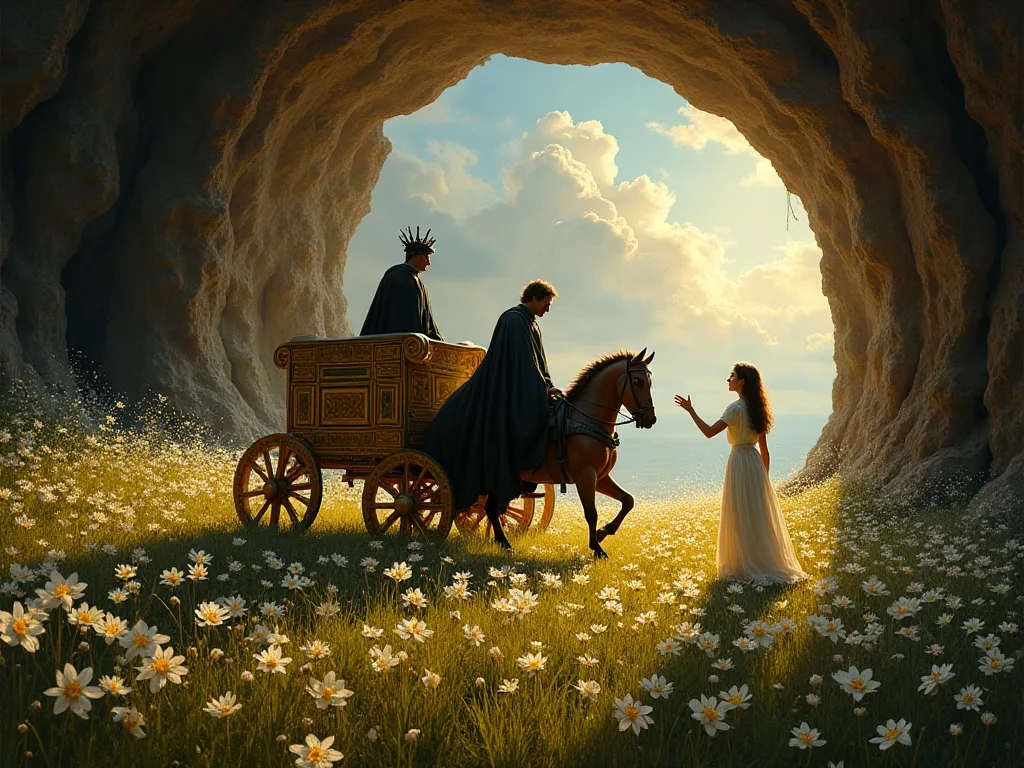
When Persephone reached for the narcissus, the ground broke. Hades, lord of the dead, drove up in a golden chariot, seized her, and pulled her underground. She screamed for her father Zeus. She screamed for her mother. The hymn is explicit: nobody heard her except Hecate, the goddess of crossroads and night magic, who heard the cry from inside her cave but never saw the abductor.
The sea nymph Cyane also witnessed the abduction. Ovid, writing in his Metamorphoses around 8 AD, adds that Cyane physically tried to block Hades' path. Hades drove his chariot straight through her, and Cyane dissolved into her own pool in grief, a detail that underlines how total the violence of the abduction was: even those who tried to resist were destroyed by it.
Zeus, who had agreed to the match in secret, said nothing. This is the first fracture in the myth. The king of the gods gave away his daughter to his brother without telling the girl or her mother, and when the earth cracked open, he was sitting on a mountain receiving sacrifices and hearing nothing.
Demeter's Rage: When the Earth Stopped Growing
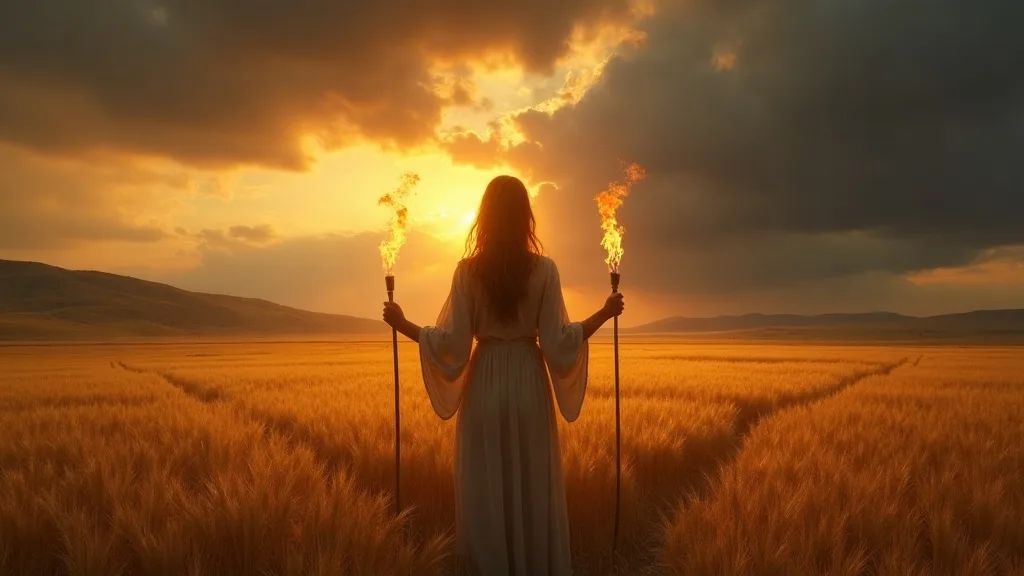
For nine days, Demeter walked across the earth with torches in both hands, searching. She neither ate the divine food ambrosia nor drank nectar, the drink of the gods. She did not bathe. The Homeric Hymn describes her as wild with grief, wandering without sleep, lighting the torches from the sun at dawn and refusing to put them down until darkness.
On the tenth day, Hecate met her. "I heard a voice," Hecate said, "but I did not see the face." Together they went to Helios, the sun, who sees everything from his daily track across the sky. Helios told Demeter the truth: Hades took Persephone, and Zeus agreed to it. His advice was notably cold: accept it, Demeter. Hades is a worthy husband. A third of all dominion is not a bad prize for a daughter.
Demeter was not interested in Helios' opinion. She turned away from Olympus. She wrapped herself in a dark cloak and walked among mortals, unrecognized, a old woman with grief in her face. She came eventually to Eleusis, a town northwest of Athens, and sat down by a well called Parthenion, the Well of the Maiden.
The daughters of the local king, Celeus, found her there. They brought her home. The queen of Eleusis, Metaneira, offered her wine mixed with honey. Demeter refused wine, saying it was not fitting for her. She asked instead for kykeon, a barley drink mixed with water and mint. This detail is not incidental: the kykeon was the sacred drink of the Eleusinian Mysteries, and its origin is here, in Demeter's refusal of wine while she mourned.
She became the nursemaid of Demophoön, Metaneira's infant son. And during her time at Eleusis, out of grief and out of rage, she let the earth die.
Demeter Mourning
The earth produces nothing. Plows break dry ground. Seed rots underground or refuses to sprout. Oxen pull through hard clods and get no yield. Hesiod and the Homeric Hymn both describe a near-extinction: the gods would have received no more grain sacrifices, and the human race would have perished. Zeus begins to fear the silence of empty altars.
Demeter Rejoicing
The earth erupts. The Homeric Hymn says the whole wide earth immediately broke into flower when Demeter released her hold. Wheat and barley shot up, the meadows went green, and the roads of the world filled with blossoms. This instant abundance is the Greek image of spring as miracle, not process.
The crops failed. Animals starved. Farmers turned their plows on frozen ground and got nothing. The Homeric Hymn says that if Zeus had not intervened, the human race would have been destroyed. No grain, no offerings, no smoke rising from altars. The gods would have lost their worshippers entirely.
The Disguise at Eleusis and the Secret Fire
While the world starved, Demeter was at Eleusis trying something else with grief. She was nursing the infant Demophoön, and she was making him immortal in secret.
Each night she held the boy in the fire. She was burning away his mortality, feeding him ambrosia, breathing on him with her own divine breath. The child was growing up like a god, never aging, never touched by death. The hymn makes clear she intended to give him immortality as a private gift, a small act of creation against all the loss she was enduring.
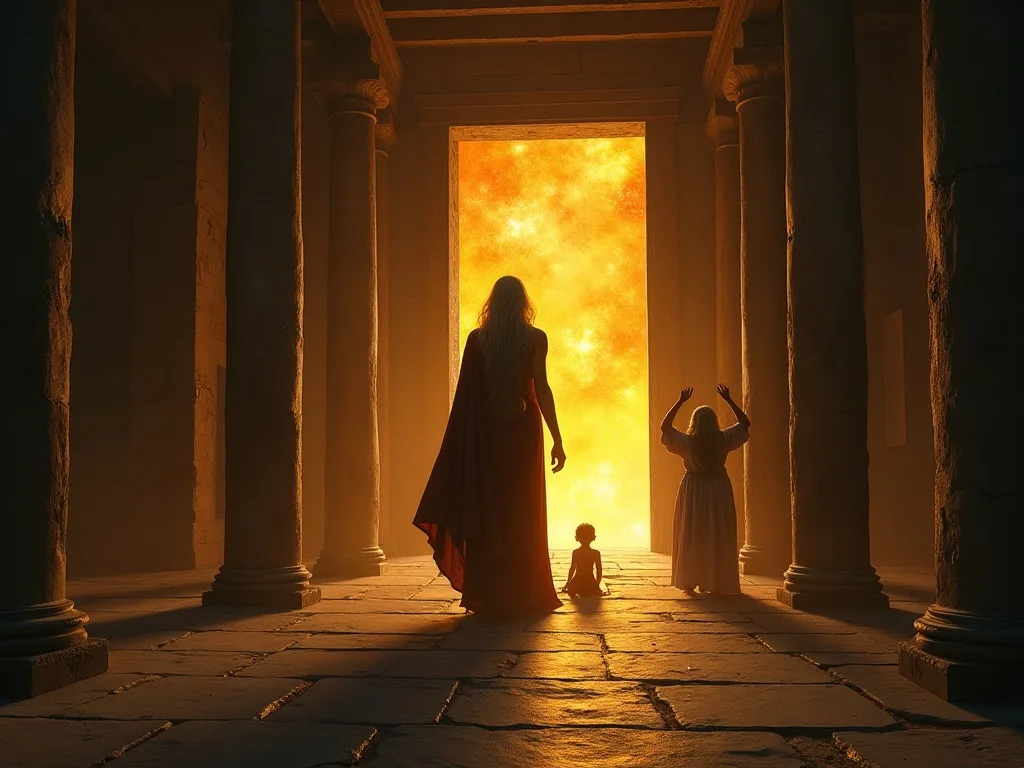
Then Metaneira looked in at night and saw her baby in the flames. She screamed. Demeter dropped the child and let the transformation fail. In her fury, she revealed herself: tall, radiant, golden-haired, her divine light filling the great hall. "Foolish woman," she said. "You have wrecked what I was making." Demophoön would be mortal now like all the rest. But because he had been held in Demeter's fire, he would be honored above other men. Eleusis would become a sacred site.
She told Celeus to build her a great temple on the hill above the well. Then she went inside and stopped doing anything at all.
Zeus Blinks First: The Negotiations Begin
The silence from Eleusis spread outward. The whole world was going dry. Zeus sent Iris, the goddess of the rainbow, to beg Demeter to come back to Olympus. Demeter refused. He sent other gods, one by one, carrying gifts and honors. She refused them all. She would not return, she said, until she saw her daughter's face.
Zeus had no choice. He sent Hermes, messenger of the gods, down to the underworld with a direct order: bring Persephone back.
Hades listened. He told Persephone she was free to go. But first, while Hermes looked the other way, he pressed a pomegranate seed into her mouth. Some versions say he convinced her to eat it willingly. The Homeric Hymn is somewhat evasive here, saying only that she ate it "secretly," which later scholars have read as an act of possible coercion. Either way, she swallowed the seed.
This mattered because of an ancient rule: anyone who had eaten food in the underworld could not leave it permanently.
Hermes drove a chariot up through the earth. Demeter ran to her daughter. The hymn describes the reunion with unusual physical intimacy: they held each other, they checked each other's faces for signs of suffering, they held on and would not let go. Then Demeter asked the question she feared: "Did you eat anything while you were there?"
Persephone told her the truth. One pomegranate seed.
The negotiation that followed was essentially legal. Zeus ruled that because Persephone had eaten underground, she must spend one third of each year there, returning to Hades as queen of the dead when the earth calls her back. For two thirds of the year, she lives above ground with her mother.
Later writers adjusted the proportion: Ovid's version gives her six months underground and six months above. Modern retellings often follow Ovid. The Homeric Hymn says one third below, two thirds above, which makes the underground time a roughly four-month stretch, perhaps from late autumn through late winter.
The Eleusinian Mysteries: When This Myth Became a Religion
The myth did not simply explain the calendar. It powered the most widely practiced and longest-lasting religious rites in the ancient Greek world.
The Eleusinian Mysteries were celebrated at Eleusis, the town where Demeter stopped to grieve, for approximately 2,000 years. They ran from roughly 1500 BC to 396 AD, when the Visigoth king Alaric sacked the sanctuary. Initiates traveled from all over the Greek-speaking world, and later from Rome. Participation was open to anyone who spoke Greek and had not committed murder, regardless of gender or social status, which was unusual by ancient standards.
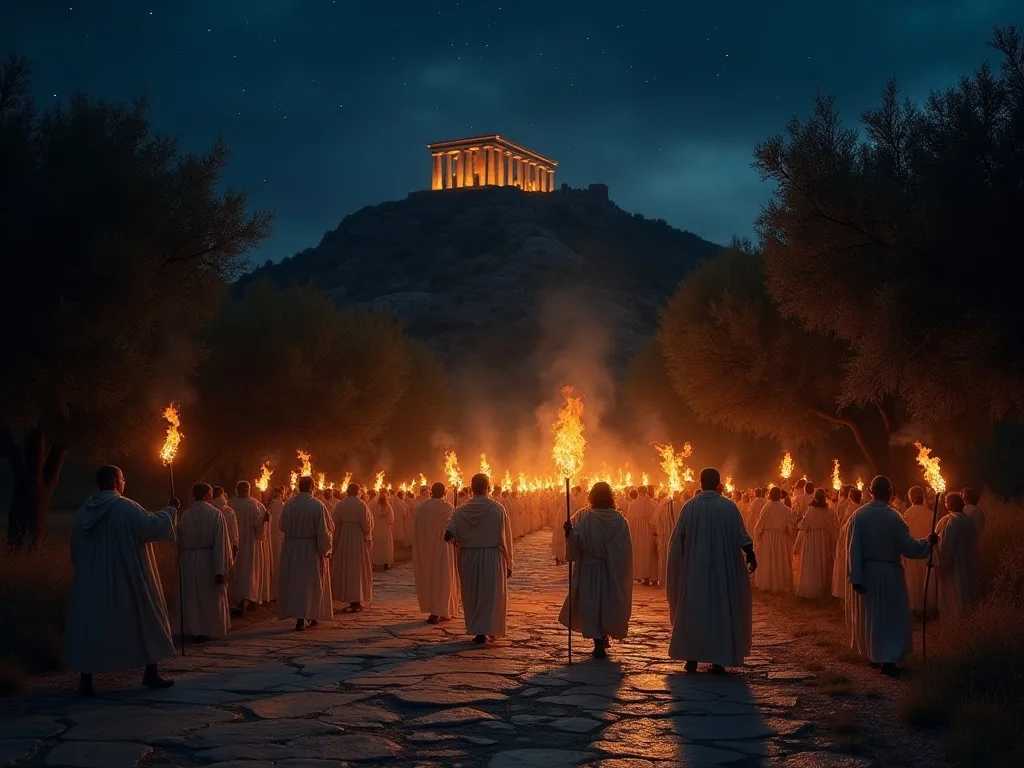
The rites had two phases. The Lesser Mysteries were held in Athens in early spring. The Greater Mysteries happened in September at Eleusis itself, lasting nine days to mirror Demeter's nine days of searching. Participants fasted, drank kykeon, walked the Sacred Way from Athens to Eleusis at night carrying torches (echoing Demeter's torchlit search), and then entered the great hall called the Telesterion for a secret ceremony that was never written down.
No initiate ever violated the oath of secrecy. Scholars know what happened outside the Telesterion from many sources, including Cicero, Plutarch, and the Christian writer Clement of Alexandria, who was trying to expose the rites. But the central revelation inside the hall remains genuinely unknown. The three words sometimes quoted from initiation formulas ("I fasted, I drank the kykeon, I took from the chest...") tell us almost nothing about the climax of the ceremony.
What is clear is that initiates came out changed. Pindar, the poet, writing in the fifth century BC, said that initiates "know the end of life and know its god-given beginning." Cicero wrote that Eleusis gave him "a reason to live and a way to die with greater hope." For a rite that existed only to remember a grain goddess and her missing daughter, those are extraordinary claims.
Seasonal Myth Across Cultures: Demeter Is Not Alone
The idea that seasons are caused by a divine being's grief or absence is not unique to Greece. Comparing these traditions shows how broadly this pattern runs across ancient cultures.
The Sumerian myth of Inanna and her descent to the underworld, recorded on clay tablets from around 1900 BC, tells a structurally parallel story. Inanna, goddess of love and fertility, descends to the realm of her sister Ereshkigal and dies there. While she is gone, no animal mates and no plant grows. The vizier Papsukkal begs the other gods to bring her back. She returns, but the laws of the underworld demand a substitute, and she sends her husband Dumuzi down in her place. Some scholars read Dumuzi's annual descent as an early Near Eastern attempt to explain the hot, dry summer that kills crops in Mesopotamia.
In Norse tradition, Baldr's death plunges the cosmos into a kind of permanent grief. Frigg goes to every substance in the world and extracts a promise not to harm her son. Mistletoe refuses. Loki exploits that gap. When Baldr falls, Hel (keeper of the dead) agrees to release him only if all things weep for him. One giantess, almost certainly Loki in disguise, refuses to weep. The world stays cold. This is not an agricultural myth in quite the same way, but the structure holds: divine death creates a winter that will not yield, and the cosmos waits for a return that has not come yet.
The Hindu tradition gives us Sita's time in Lanka during the Ramayana, composed in Sanskrit sometime between 500 and 100 BC. Sita, goddess of the harvest (her name means "furrow"), is held underground by Ravana while her husband Rama organizes a war to retrieve her. The parallel to Persephone is not perfect, but the underlying imagery of the earth's abundance held captive and awaiting rescue is recognizable.
In Aztec cosmology, Xipe Totec, the Flayed Lord, cycles through a death and renewal that tracks the agricultural year directly. The corn dies underground as seed, and its return to the surface is framed as resurrection. The Aztec gods of the agricultural calendar held the season in their hands with the same literalness that Demeter held it in hers.
These parallels do not mean the myths share a common origin. They suggest instead that agricultural societies, watching the same annual cycle of growth and death, reached for similar explanations: a divine figure suffers, withdraws, or dies; the world responds with cold and barrenness; some form of negotiation or rescue brings warmth back. The universal is the emotional logic, not the specific narrative.
What the Pomegranate Seed Actually Means
Ancient Greeks and later scholars have argued about the pomegranate for a long time.
The most straightforward reading is legal: underworld food creates underworld ties. The seed is a trap, deliberately given by Hades to retain his queen. This reading casts Hades as a manipulator and Persephone as a victim, which is how most popular retellings frame it.
A second reading, found in later neo-Platonic interpretations and picked up by some modern classicists, argues the seed is an act of partial will. Persephone chose, or at least accepted, a life that included death as well as spring. The queen of the dead is not only a captive; she is also an authority, and the Homeric Hymn itself eventually calls her "dread Persephone" with a respect the text does not extend to every deity.
A third reading focuses on the pomegranate as a symbol rather than a legal mechanism. The pomegranate was associated with blood, fertility, and the dead across the ancient Mediterranean. Pomegranates appear in Egyptian tomb offerings and in Hittite mythology as vehicles for seasonal renewal. Some scholars, including Walter Burkert in Homo Necans (1972), have connected the fruit's red juice and numerous seeds to both menstruation and the scatter-seeding of grain, drawing a line between Persephone's eating and the whole agricultural cycle of burial and return.
None of these readings cancel the others. Greek myth is layered that way: the story works as a legal narrative, as an emotional truth, and as a symbolic system all at once.
Demeter in the Ancient Sources: What the Texts Actually Say
The primary sources for Demeter and the seasons are more varied than most readers realize.
The Homeric Hymn to Demeter is the center. But Hesiod's Theogony, a Greek poem from around 700 BC that describes the genealogy of the gods, establishes that Demeter is a daughter of Cronus and Rhea, making her a first-generation Olympian who predates Zeus's rule. Hesiod lists her children with Zeus as Persephone alone, which underlines how singular that relationship was for Demeter's identity.
Ovid's Metamorphoses, Book 5, retells the myth with considerable expansion, adding Cyane's dissolution into water and giving Ascalaphus (an underworld figure who witnessed Persephone eating) the detail of being turned into an owl as punishment. Ovid was writing in Latin around 8 AD, working from Greek sources while adding Roman theatrical energy.
The geographer Pausanias, writing around 170 AD in his Description of Greece, records local variants of the myth. At Phigalia in Arcadia, he describes a cave sanctuary where Demeter was worshipped not with a torch in hand but with a serpent, a torch, and a poppy, suggesting regional traditions that diverged from the Homeric Hymn's version substantially.
The Sicilian historian Diodorus Siculus, writing in the first century BC, places the abduction firmly at Enna in Sicily and notes that the Sicilians maintained local shrines and ceremonies tied to the myth's geography. He also reports that Demeter invented agriculture at Eleusis and gave the first grain seed to the Athenians, who then spread it to the rest of humanity, which is a different and older layer of her mythology.
The Rite of the Thesmophoria: Women and the Grain
The Eleusinian Mysteries were famous, but they were not the only ritual that Demeter commanded. The Thesmophoria was arguably more widely practiced, spread across every Greek city with a Demeter cult, and it was exclusively for women.
Held in late October at the time of the autumn sowing, the Thesmophoria lasted three days. Women left their households entirely, camped on a hillside, and performed rites that included carrying the decayed remains of piglets that had been thrown into pits months earlier. These remains were mixed with grain seed and scattered on the fields to promote fertility. The three days of the festival mirrored the myth's structure: the first day was a descent (women going underground, away from normal life), the second was fasting and mourning (Demeter's grief), and the third was a celebration of return.
Aristophanes wrote a comedy, the Thesmophoriazusae, in 411 BC, staging a comic version of men infiltrating the women's rites. That play tells us almost nothing about what the women actually did, since Aristophanes was deliberately kept outside, but it confirms the exclusivity and seriousness of the festival.
The Thesmophoria connected Demeter and the seasons to real agricultural work in a direct way. The timing at the autumn sowing meant the ritual and the farming calendar were synchronized. Women who performed the rite were not simply commemorating a myth; they were, in the logic of the religion, repeating Demeter's actions to make the seed grow.
Frequently Asked Questions About Demeter and the Seasons
Frequently asked questions
Why does Demeter cause winter in Greek mythology?
When her daughter Persephone was taken to the underworld by Hades, Demeter refused to let anything grow. The Homeric Hymn to Demeter, written around 650 BC, describes her wandering the earth in grief for nine days, then withdrawing to Eleusis and letting the crops fail entirely. The winter, in Greek religious understanding, is not a natural phenomenon with a mechanical cause. It is the annual return of Demeter's grief each time Persephone goes back underground. The seasons are personal, not astronomical.
How many pomegranate seeds did Persephone eat?
The Homeric Hymn to Demeter says one seed. Later writers varied the number: Ovid's Metamorphoses (8 AD) does not specify a count but names the act clearly. Some Roman-era sources give the number as six, which would explain a six-month absence. The single-seed version from the Homeric Hymn is the oldest surviving account, and many scholars treat it as the canonical form. The number matters theologically because one seed corresponds to roughly one third of the year underground, matching the Hymn's ruling of four months below and eight months above.
What were the Eleusinian Mysteries and what did they have to do with Demeter?
The Eleusinian Mysteries were secret religious rites held at Eleusis, the town where Demeter stopped during her search for Persephone, for roughly 2,000 years (from around 1500 BC to 396 AD). Initiates re-enacted elements of Demeter's grief and Persephone's return through fasting, a torchlit procession, and a ceremony inside the Telesterion hall whose central revelation was never recorded. Ancient writers including Cicero and Pindar say initiates left with a changed understanding of death. The rites were open to any Greek speaker who had not committed murder, regardless of gender or status.
Is the Demeter and Persephone myth similar to myths in other cultures?
Yes, and the parallels are striking. The Sumerian myth of Inanna's descent to the underworld, dated to around 1900 BC, follows the same pattern: a goddess of fertility disappears underground, life stops on earth, and a negotiated return restores growth. Norse mythology shows the world going cold after Baldr's death in a parallel emotional structure. Aztec agricultural mythology frames the death and return of the corn god in comparable terms. These parallels are not evidence of a single shared origin, but rather of agricultural cultures across different regions reaching for the same emotional logic: when the divine source of life withdraws, the world starves.
Did the ancient Greeks believe Demeter literally caused the seasons?
Within the framework of their religion, yes. The Homeric Hymn to Demeter is a theological document, not a metaphor. The rites at Eleusis and the Thesmophoria were performed to maintain the actual fertility of the soil. Farmers sowing in autumn were doing so in the belief that Demeter's grief and return were real events, currently ongoing, and that ritual participation (fasting, offerings, sacred drink) maintained the goddess's willingness to keep the grain coming. The myth was not separate from agricultural practice; it was the explanation that made the practice intelligible.
Where did Persephone's abduction take place according to Greek sources?
The Homeric Hymn to Demeter is deliberately vague about the location, placing it on a plain near a deep-meadowed site. Diodorus Siculus, writing in the first century BC, names the plain of Enna in Sicily as the site, and that identification became dominant in Roman times. Ovid's Metamorphoses follows the Sicilian location. Within Sicily, the city of Enna maintained a sanctuary and claimed the myth as part of its local history. Other Greek traditions placed the abduction in Arcadia or Attica, reflecting the way different communities adapted the central myth to their own geography.
Demeter After Antiquity: The Myth That Refuses to Stay Underground
The story of Demeter and the seasons has traveled further than most Greek myths. It has reshaped itself in every century since the Eleusinian Mysteries ended.
In the Renaissance, scholars like Marsilio Ficino, translating Platonic texts in fifteenth-century Florence, read the Persephone myth as an allegory for the soul's descent into matter and its longing for the divine world above. This neo-Platonic reading detached the myth from agriculture entirely and turned it into a philosophy of spiritual return.
In the nineteenth century, the scholars Johann Jakob Bachofen and later James Frazer (in The Golden Bough, 1890) placed Demeter at the center of a theory about ancient matriarchal religion. Bachofen argued that Demeter represented an older, earth-centered religious order that was displaced by Olympian patriarchy when Zeus gave Persephone away without consulting her mother. Frazer catalogued the myth alongside dozens of dying-and-rising vegetation deities from other cultures, treating them all as variations on the same seasonal template. Frazer's framework is now considered overly schematic by most classical scholars, but his influence on how the twentieth century thought about seasonal myth was enormous.
The feminist recovery of the myth in the 1970s and 1980s, led by writers like Charlene Spretnak and the archaeologist Marija Gimbutas, reframed the abduction as an act of patriarchal violence against a pre-existing mother-daughter religion. This reading has found its way into literature, therapy, and environmental thought, where Demeter's grief has become a metaphor for industrial destruction of the earth.
In contemporary fiction, the myth has been retold from Persephone's point of view dozens of times, most popularly in Lore Olympus (2018 onwards), the webcomic that has introduced the myth to a new generation. These retellings tend to rehabilitate Persephone as an agent, not a victim, and to frame her time in the underworld as a form of growth rather than captivity.
What makes Demeter and the seasons so durable is exactly what made it powerful in 650 BC: the emotional premise is unbreakable. A mother loses her daughter. The world responds to that loss with cold and darkness. That is not a metaphor most readers need explained.
Free 25-page sample
Want the whole story?
Take the first 25 pages free. If it pulls you in, the full edition is yours as an instant PDF download, with a paperback on Amazon for selected titles.

Mythology
The World Mythology Book: The Gods, Heroes and Myths of Every Culture
The Gods, Heroes and Myths of Every Culture, in One Volume
The whole of world mythology in a single volume: Greek, Norse, Egyptian, Japanese, Hindu, Celtic, Slavic, Mesoamerican and African myths gathered side by side, each drawn from the primary sources.