

Dionysus, God of Wine: Ecstasy, Madness, and the Twice-Born God
Born twice, worshipped and feared across the ancient world, Dionysus reshaped Greek religion from the inside out. His cup held wine, yes, but also madness, liberation, and a theology that outlasted the Olympians.
Contents
The torch is already lit when the women leave the city. They climb barefoot, ivy in their hair, drums beating a pulse that loosens something in the chest. By the time they reach the mountain slope, the wine has done its slower work, and the boundary between the worshipper and the god begins, deliberately, to dissolve. This is not metaphor. For those who kept the rites of Dionysus, the dissolution was the point.
No Olympian provoked more dread, more legislative panic, or more genuine popular love than the Dionysus god of wine. Roman senators banned his Italian equivalent's rites in 186 BCE after a bacchanalian scandal that reportedly touched seven thousand initiates. Plato wrestled with his festivals in the Laws. Euripides built an entire tragedy around the catastrophic cost of refusing him. And yet city after city, century after century, kept welcoming him back.
He was never a simple deity of drunkenness. That reduction misses everything. Dionysus held the grape, yes, but also the mask, the theatrical stage, the vine that cracks stone walls, the leopard that kills silently, and the promise that the self, suffocating inside its own skin, could, for one night, be shed.
The Family Tree: A God Born Twice From Fire
Dionysus enters the mythological record through a double birth that is among the most violent in Greek tradition. His mother was Semele, daughter of the Theban king Cadmus. His father was Zeus, who came to her in disguise as a mortal lover.
Hera, jealous with the precision she always brought to jealousy, whispered doubt into Semele's ear. If he is truly Zeus, she suggested, let him appear to you as he appears to Hera. Semele extracted a sworn oath from Zeus before asking the question. Zeus, bound by the River Styx, could not refuse. He appeared in his full divine form, lightning and all, and Semele was incinerated.
Zeus salvaged the unborn child from the ashes, sewing the fetus into his own thigh, where Dionysus gestated until he was ready. This is the first birth from fire, the second from the thigh of a god. The Greeks recorded two competing versions of where exactly this second gestation happened: Hesiod's Theogony (line 940) places it straightforwardly in Zeus's thigh, while other sources suggested the island of Naxos or the care of the nymphs of Nysa as the site of his infancy. Pindar, in his Olympian Odes, called him "ivy-crowned Dionysus born of fire."
The Titans complicate the family tree further. An older strand of myth, preserved by the Neoplatonist Olympiodorus and attributed to Orphic tradition, holds that Dionysus in his infant form (called Zagreus in this telling) was lured by the Titans with toys and a mirror, torn apart, boiled in a cauldron, and eaten. Zeus struck the Titans with his thunderbolt, and from their ashes, humanity was formed, carrying within it a spark of the divine Dionysus. This Orphic cosmogony gave Greek philosophers an entire theology of the soul's liberation, the soul straining to recover the divine component buried inside Titanic matter.

The family tree in its clearest form:
- Father: Zeus
- Mother: Semele (mortal, daughter of Cadmus of Thebes)
- Half-siblings: Athena, Apollo, Artemis, Hermes, Ares, Hephaestus, among the major Olympians
- Wife: Ariadne, whom he found weeping on Naxos after Theseus abandoned her
- Notable children: the Charites (some accounts), Priapus (by Aphrodite in some sources), Oenopion, Staphylus
Homer mentions Dionysus only briefly in the Iliad and the Odyssey, treating him as an established god but not yet the full theological force he would become. By the time Euripides wrote the Bacchae around 405 BCE, something had shifted profoundly. The god had arrived, fully formed, demanding recognition.
The Symbols of Dionysus: What He Carried and Why It Mattered
The symbols of Dionysus are not decorative. Each one is a condensed argument about what he represented.
The thyrsus was a fennel staff topped with a pine cone, wound about with ivy. It was both weapon and instrument of blessing. Euripides describes the maenads (his female devotees) using it to split rocks and draw water, milk, and wine from the earth. The pine cone, loaded with seeds, pointed at fertility and the regenerative power lurking inside destruction.
The ivy and the vine were his most constant plant companions. Ivy, which stays green through winter, suggested the god's association with undying vitality, the green force that persists after the cold kills everything else. The grapevine required pruning, near-destruction, to produce the best fruit. Many scholars read this as the mythological logic behind the god himself: he must be cut back, must descend, before he can return with something worth giving.
The leopard or panther appears consistently in his iconography, sometimes beneath his feet, sometimes draped across his shoulders. Wild, unpredictable, beautiful, the big cat externalized what the wine itself did to a person. Greek vase painting from the sixth century BCE shows Dionysus draped in a leopard skin (nebris) or riding a panther across the sea, a scene from his capture by Tyrrhenian pirates recounted in the Homeric Hymn 7.
The mask is perhaps the deepest symbol. Ancient theaters kept a mask of Dionysus as the formal presence of the god during performances. The mask is the face that is not your face, the self you adopt when your ordinary self is suspended. That the entire institution of Greek drama grew from his festivals is not incidental. Theater, for the Greeks, was a Dionysian technology.
Wine itself operated on multiple levels. In the Bacchae, Tiresias the blind prophet delivers a speech defending Dionysus to the skeptical king Pentheus, arguing that wine gives humans relief from grief and sleep, that without it life would be unendurable. The god did not offer escape from reality; he offered a temporary dissolution of the boundary that made humans feel sealed off from everything else.

The Myths That Define Him: Pirates, Madness, and the Return of Semele
Three myths above all others fix the character of the Dionysus god of wine.
The Tyrrhenian Pirates (Homeric Hymn 7)
A group of Etruscan pirates spotted a beautiful young man standing on a headland. Assuming he was a wealthy prince worth ransoming, they seized him and tried to bind him with rope. The ropes fell away as fast as they were tied. The helmsman recognized something wrong and urged his crew to release the stranger and pray. The captain ignored him.
What followed was spectacular. Vines and ivy erupted from the ship's mast and oarlocks. Wine ran across the deck in rivers. A bear appeared. A lion appeared. The crew threw themselves into the sea and were transformed into dolphins. The helmsman, the one who had seen clearly, was left untouched. Dionysus revealed himself and sailed on.
The myth encodes a consistent theological message: recognition matters. Those who see the god clearly, even without fully understanding him, are spared. Those who see only profit are transformed, not destroyed exactly, but permanently changed in nature.
The Madness of the Daughters of Minyas
In Ovid's Metamorphoses (Book 4) and in earlier Greek accounts, the daughters of Minyas, king of Orchomenus, refused to join the Dionysian rites. They stayed home and wove, piously working while the city reveled. As punishment, the god sent creeping vines around their looms, and the darkness filled with sounds of wild beasts. The women were overtaken by a sudden madness, one of them tearing apart her own son in a rite that mirrored the Titanic dismemberment of Zagreus. They were eventually transformed into bats.
The myth is disturbing because the punishment appears to exceed the offense. But Greek theology did not operate by proportional justice. Dionysus was not offended because the women skipped a party. He was refused recognition, and the refusal, in Dionysian logic, produces a worse madness than the god himself would have given them. The wildness they tried to avoid erupted from within rather than being channeled safely through the rite.
The Bacchae and Pentheus
Euripides' Bacchae is the defining Dionysian text, written at the very end of the fifth century BCE when Athens was losing the Peloponnesian War and certainties about culture, reason, and the gods were fracturing.
Pentheus, king of Thebes, imprisons a stranger who is clearly the god in disguise and refuses to accept Dionysus as divine. His mother Agave leads the maenads on Mount Cithaeron. In a scene of almost unbearable dramatic tension, Dionysus persuades Pentheus to dress as a woman and spy on the rites. The maenads, including Agave, discover him and tear him apart, Agave carrying her son's head back to Thebes believing it is a lion she has hunted.
Scholars from E.R. Dodds onward have read the Bacchae as a tragedy not about the triumph of irrationality over reason but about the destruction that follows when either extreme is pursued without acknowledging the other. Pentheus is not wrong to value order. Dionysus is not wrong to demand recognition. The catastrophe is their collision without mediation.
Dionysus Across Borders: The Foreign God Who Was Always Greek
Ancient sources were strikingly candid about the foreign feel of Dionysus. Herodotus (Book 2.49) claimed that Melampus, a mythic seer, introduced the name and rites of Dionysus to Greece from Egypt, where he identified him with Osiris. The Bacchae itself opens with Dionysus arriving from the East, from Phrygia and Lydia and Persia, bringing his ecstatic rites to Thebes.
Modern scholarship pushed this outward origin story in several directions. Martin Nilsson in the twentieth century argued for Minoan-Mycenaean roots, noting that Linear B tablets from Mycenae (dated to roughly 1200 BCE) contain the name di-wo-nu-so-jo in a list of divine recipients of grain and wine offerings. This pushed the god's Greek presence back well before Homer. The "foreign arrival" in myth may reflect a later assimilation of different regional cults under a single name rather than a literal importation from the Near East.
The parallels with other traditions are real regardless of historical origin. Osiris is dismembered, mourned, and resurrected. The Phrygian god Sabazios shares attributes, rites, and iconography with Dionysus so thoroughly that the Romans often conflated them. The Vedic Soma, the ritual drink of divine power described in the Rigveda, operates within a theology of dissolution and access to divine energy that rhymes structurally with Dionysus, even if the cultural contexts are entirely distinct. In Mesopotamia, the goddess Ninkasi is the divine brewer, and beer served a sacramental function in temple rituals from the third millennium BCE onward.
What made Dionysus specifically Greek was not his wine or his wildness in isolation, but the way Greek culture metabolized those elements into drama, philosophy, civic festivals, and a sustained argument about the relationship between control and surrender.
The Cult of Dionysus: What the Festivals Actually Were
The civic festivals of Dionysus in Athens were among the most important events in the Greek calendar. Three major ones structured the year.
The Lenaia, held in the month Gamelion (roughly January-February), was the winter festival, more intimate, less attended by foreigners, focused on comedy. It took place when the wine was maturing in its jars.
The Anthesteria, held in Anthesterion (February-March), was three days long and marked the opening of the previous year's wine. The first day, Pithoigia, opened the storage jars. The second, Choes, involved a drinking race from individual jugs, and somewhere in this festival was the ritual marriage of the god to the wife of the archon basileus, the city's religious magistrate, taking place in the Boukoleion building. The third day, Chytroi, was for the dead: the spirits of the departed were believed to wander the city during Anthesteria, and pots of grain were set out for them.
The City Dionysia, held in the spring month Elaphebolion, was the grand festival, the one that hosted the dramatic competitions from which tragedy and comedy grew. Playwrights submitted tetralogies (three tragedies plus a satyr play) to compete for prizes. It was at this festival that Aeschylus, Sophocles, and Euripides premiered their plays. The entire Athenian democratic assembly, foreign dignitaries, and allied states attended. Honoring Dionysus was, by the fifth century BCE, indistinguishable from celebrating Athenian cultural identity.
The Maenads, also called Thyiades or Bacchae, were the god's female devotees in myth. Whether historical women actually engaged in the mountain rites described in the Bacchae, complete with hunting and sparagmos (the tearing of raw flesh), has been debated for two centuries. The evidence is ambiguous. Inscriptions from Delphi confirm that Thyiades from Athens traveled to Mount Parnassus every two years to perform rites alongside the Delphians. What precisely happened on that mountain remains unknown, though the Delphi connection is itself significant: Apollo and Dionysus shared the sanctuary, Apollo's rational oracle and Dionysus's ecstatic rite occupying the same sacred space, each needing the other.

The Orphic Dionysus: Wine Into Philosophy
The Orphic tradition took the raw material of the Dionysus myth and refined it into one of antiquity's most sophisticated theologies. The Orphic poems, fragments of which survive in gold tablets found in graves across Magna Graecia and Thessaly from the fourth century BCE onward, described a cosmos in which the soul was divine (Dionysian) but imprisoned in the body (Titanic).
Death, for the Orphic initiate, was not an ending but a moment requiring precise navigation. The gold tablets contain instructions: the soul must avoid the spring of Lethe (forgetfulness) and drink instead from the spring of Memory. It must announce to the judges of the dead that it is "a child of Earth and starry Heaven." Over multiple reincarnations, the Dionysian spark would gradually purify itself free of Titanic matter and return to its divine origin.
Plato absorbed this. His dialogues, especially the Phaedo and the Phaedrus, use the language and imagery of Orphic theology to argue for the immortality and divine origin of the soul. The philosopher's task, in the Phaedo, is explicitly described in terms that echo the Dionysian rite: the soul must be loosened from its attachment to the body, not through physical ecstasy but through philosophical practice. Nietzsche, in The Birth of Tragedy (1872), drew the line between Dionysian ecstasy and Apollonian order as the generative tension behind all great art, an argument that oversimplified but also genuinely illuminated something the Greeks already knew.
Dionysus and Ariadne: The God Who Chose a Mortal
The marriage of Dionysus and Ariadne is one of the few genuinely tender stories in the Greek divine repertoire. Ariadne had saved Theseus from the Labyrinth with her thread, followed him to Naxos, and was abandoned there while she slept. The abandonment varies by source: some say Theseus simply forgot her, some say the god Dionysus instructed him to leave, having already chosen her himself.
What all versions agree on is that Dionysus found her grieving on the beach and took her as his wife. He gave her a crown of stars (corona Ariadne) that became the constellation Corona Borealis. Hesiod in the Theogony records the marriage explicitly (line 947). Catullus in Poem 64 painted the abandonment scene with an anguish so specific, Ariadne's hair unpinned, her robe slipping from one shoulder as she watches Theseus's ship disappear, that the moment became a reference point for Roman erotic poetry.
The pairing is theologically resonant. Ariadne, who navigated a labyrinth, who gave others the thread to find their way back out of darkness, became the companion of a god who also crossed between the worlds of the living and the dead. Dionysus descended to Hades to retrieve Semele, his mother, and bring her to Olympus. He was the traveler between states: life and death, sanity and madness, self and other.
Dionysus in Modernity: Theater, Wine Culture, and the Unfinished God
The Dionysus god of wine never fully left. He migrated.
In the Italian Renaissance, painters returned obsessively to his figure. Caravaggio's Bacchus (1596-1597, Uffizi) shows the god as a fleshy adolescent, slightly drunk, offering the viewer a glass of wine that is already beginning to go bad, the surface filmed with fruit flies. The detail is precise and anti-heroic. This is not Olympian power but something more human, more mortal-feeling, which is, of course, exactly the god's point.
Friedrich Nietzsche made the Dionysian principle the hinge of his early philosophy. In The Birth of Tragedy, he argued that the highest art emerges from the tension between the Apollonian (form, boundary, individual identity) and the Dionysian (ecstatic dissolution, collective unity, the abyss beneath the ordered surface). He later identified himself with Dionysus against the Crucified in his final letters before his mental collapse in 1889, a comparison that tells us less about Christianity than about how completely the god had become, for Nietzsche, a symbol of life-affirmation against renunciation.
In contemporary culture, Dionysus appears in Rick Riordan's Percy Jackson series as the reluctant, sardonic camp director Mr. D, stripped of his wine and forced to drink Diet Coke. The joke works because it inverts the mythology cleanly: a god of dissolution stuck in the most structured possible environment, a summer camp with rules. Riordan's portrait, while comic, preserves the god's essential quality: he is always slightly out of place in any ordered system, always the pressure that the structure must contain or rupture.
Wine culture itself, in its modern form, carries residual Dionysian theology. The language of terroir, of wine expressing the particular life-force of a specific place, soil, and season, is a secularized version of the Greek argument that wine is not just a drink but a medium through which something non-human speaks. Winemakers in Burgundy and Priorat who speak of "letting the vineyard express itself" are, knowingly or not, still operating inside the conceptual space Dionysus opened.
The Greek theatrical tradition he generated never stopped. Every time a performer puts on a mask or a costume and temporarily becomes someone else, the Dionysian mechanism is running. The audience's willingness to believe, to collectively surrender their grip on ordinary reality for the duration of a performance, is what he always asked for. Greek theater was not a metaphor for his rites. It was his rites, transformed into a form the whole city could share.
Frequently Asked Questions About Dionysus
Frequently asked questions
What is Dionysus the god of, beyond wine?
Dionysus governed theater, ecstatic ritual, fertility, religious frenzy, vegetation, and the boundary between the living and the dead. The Greeks associated him with the vine specifically but also with any fruit that fermented and transformed, including the fig. His domain extended to every experience in which the ordinary self was temporarily suspended, including grief, joy, and creative performance. The term enthousiasmos (being filled with the god) was originally a Dionysian concept.
Why was Dionysus called the Twice-Born?
Because he was born twice: first from his mother Semele, who was incinerated by Zeus's lightning before the birth was complete, and second from the thigh of Zeus, where the unborn child was sewn until he was ready to emerge. Hesiod records the second birth in the Theogony. The Orphic tradition added a third dimension, the child Zagreus torn apart by the Titans and reconstructed, making the "twice-born" epithet resonate with themes of death and rebirth central to his mystery cult.
What is the relationship between Dionysus and Osiris?
Herodotus in Histories Book 2 directly equated the two, arguing that the Greeks learned the Dionysian rites from Egypt. Both gods are dismembered and reassembled, both are associated with agricultural fertility (the vine, the grain), and both preside over resurrection narratives. Modern scholars treat the equation with more caution, noting that the cults developed independently and that Herodotus was working with a Greek interpretive framework (interpretatio graeca) that mapped Greek gods onto foreign ones. The structural parallels are real; the historical borrowing is harder to establish.
What primary sources describe the myths of Dionysus?
The main ancient sources are: the Homeric Hymn 7 (pirates and the sea voyage), Hesiod's Theogony (birth narrative), Euripides' Bacchae (the Pentheus myth, the fullest dramatic treatment), Ovid's Metamorphoses Book 3-4 (Semele, the Minyads, Pentheus), Apollodorus's Library (3.4-5, genealogy and birth), Pindar's Olympian Odes (isolated references), and the Orphic hymns (theogonic material). Herodotus Histories Book 2.49 is the primary source for the Egyptian connection theory.
Is Dionysus the same god as Bacchus?
Yes and no. Bacchus was the Roman name, derived from a Greek epithet Bakchos, already in use in Greece by the classical period. The Roman cult that the Senate banned in 186 BCE had absorbed elements from southern Italian (Oscan and Sabellian) traditions and possibly Orphic influence, making it more secretive and initiation-based than the civic Athenian festivals. Livy's account of the 186 BCE ban (Ab Urbe Condita 39.8-19) describes nocturnal rites, mixed-gender initiations, and claims of criminal conspiracy, a portrait shaped by Roman political anxiety as much as by religious reality. The theological core, the ecstatic wine god born of a mortal woman, remained continuous.
Did Dionysus actually descend to the underworld?
According to several sources, yes. The myth, preserved in Apollodorus Library 3.5.3 and referenced in Aristophanes' comedy The Frogs, holds that Dionysus descended to Hades to retrieve his mother Semele after she had been killed. He reportedly traded a myrtle branch (symbolic of the underworld) for permission to take her back. Semele was brought to Olympus and given divine status under the name Thyone. The descent-and-return pattern made Dionysus one of the few Olympians to have crossed the boundary of death and returned, which fed directly into his role in mystery religion as a model for the soul's own potential return.
The Unresolved God: Why Dionysus Still Resists Easy Categories
Two and a half millennia of interpretation and Dionysus remains the most contested figure in the Greek pantheon. Apollo is legible: light, reason, form, prophecy. Athena is legible: civic wisdom, craft, strategic intelligence. Dionysus is the god who refuses to be fixed.
Walter Otto's 1933 study Dionysus: Myth and Cult made the case that the god's paradoxes are not a problem to be solved but the content of the theology itself. Dionysus is simultaneously the gentlest of the Olympians (he gives wine that dissolves grief) and the most terrible (his rites, at their extreme, produce sparagmos, the ritual tearing of flesh). He is a god of community (the theater where the whole polis gathered) and of absolute solitude (the maenad alone on the mountain, past language). He is mortal by birth and immortal by paternity. He dies and returns.
What no ancient Greek writer quite said, but what the cumulative tradition implies, is that Dionysus represents the part of human experience that does not submit to logos, to ordered rational speech. Not because it is irrational exactly, but because it is pre-rational, older than the categories, closer to the animal and the divine simultaneously. The vine splits stone because growth does not ask permission. The mask liberates because identity is, under sufficient pressure, a costume.
E.R. Dodds, in The Greeks and the Irrational (1951), argued that the Dionysian tradition represented the Greeks' acknowledgment of the unconscious, their honest confrontation with the parts of the psyche that Apollonian culture could suppress but not eliminate. Every generation that builds a very clean, very rational, very orderly world tends to produce, somewhere in its margins, a Dionysian pressure point. The god keeps arriving from the east.
His presence in the contemporary world is not nostalgia. It is the same argument the ancient myth always made: that the boundary between self and world is constructed, that the vine knows something the mason does not, and that the cup held out by the twice-born god offers either communion or catastrophe depending entirely on whether you are willing to look him in the face.
Read the full book
Want the whole story?
The complete edition is an instant PDF download here, with a paperback on Amazon for selected titles.
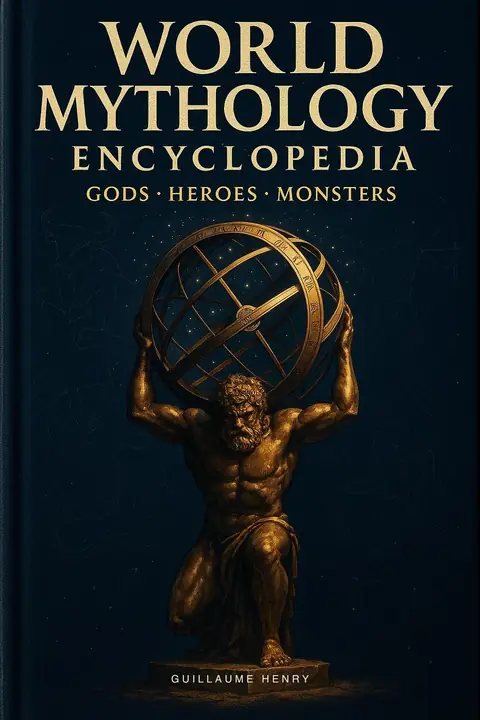
Mythology
The World Mythology Book: The Gods, Heroes and Myths of Every Culture
The Gods, Heroes and Myths of Every Culture, in One Volume
The whole of world mythology in a single volume: Greek, Norse, Egyptian, Japanese, Hindu, Celtic, Slavic, Mesoamerican and African myths gathered side by side, each drawn from the primary sources.