
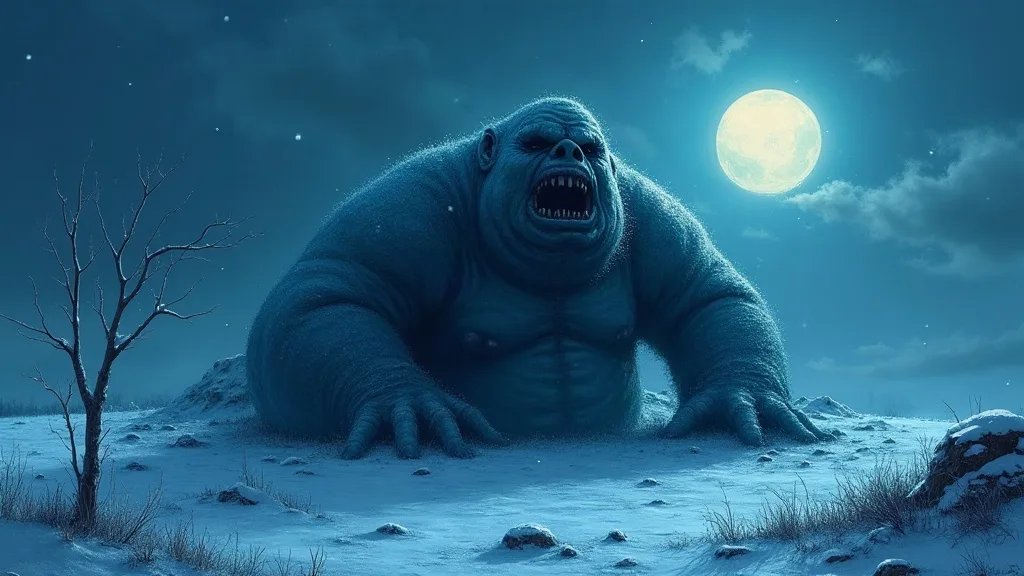
Draugr: The Norse Undead Warrior and the Grave's Curse
The Draugr stalks the cold nights of Norse belief: a corpse that refuses to stay dead, hoarding gold in its barrow and attacking the living with superhuman strength. Discover the Viking dread of this undead revenant and what modern sagas reveal about death, honor, and the violation of the grave.
Contents
A chieftain dies and his body is buried with weapons, gold, and treasures meant to sustain him in the world to come. But something goes wrong. The corpse does not rest. It claws its way out of the grave, bloated and blue-black, dragging the weight of the earth with it. The local villagers hear it on winter nights: the scrape of fingernails on buried oak, the heavy breath of something that should not breathe at all. This is the Draugr, the undead corpse-walker of Norse mythology, and its hunger for the living world is as real to medieval Scandinavians as the ice under their boots.
The Draugr is not a ghost. It is not a spirit that has left the body. It is the body itself, animated by a kind of hunger that defies Christian reason and pagan law alike. The creature returns because of unfinished business, foul death, or the simple refusal to let go of earthly treasure. It emerges in the sagas and the local folk-legends of Iceland, Norway, and Sweden, not as myth alone but as something people genuinely feared and fought. Medieval Icelandic storytellers recorded accounts of these encounters with a tone that mixes legend with lived warning, the way someone might tell you about a dangerous animal they know to exist.
What makes the Draugr different from other undead in world mythology is its specificity. It is not merely reanimated; it is the grave-warrior, the mound-dweller, bound to a particular place and treasure hoard. The creature embodies Norse anxieties about death, wealth, honor, and the violation of sacred burial ground. To understand the Draugr is to understand how medieval Norse people grappled with mortality, greed, and the borderland between the living and the dead.
The Corpse That Refuses to Die: What a Draugr Actually Is
The word draugr likely derives from the Old Norse draugr, related to Old English dræg (to carry or drag), suggesting something that drags itself along. In some etymologies, it connects to the idea of burden or weight, which fits perfectly: the Draugr is heavy, corporeal, and dragging with it all the weight of the grave.
A Draugr is fundamentally a reanimated corpse, but not in the Hollywood sense. It is not mindless. Medieval Norse sources describe it as conscious, intelligent, often greedy, and capable of cunning. The creature retains memory of its living self, its grudges, and its desire for the treasures buried with it. Many Draugr are warriors or powerful men in life, and death intensifies their hunger and violence rather than diminishing it.
The physical appearance is consistent across the sagas: the corpse is bloated and discolored, its skin blue-black or greenish-grey, sometimes described as having the pallor of a corpse that has been in the earth for months, though it moves with horrifying vigor. Some accounts describe a smell of rot and grave-earth that clings to the creature. Despite this decay, the Draugr possesses supernatural strength, often described as matching or exceeding that of ten living men. It cannot move quickly in the way a living person runs, but its strength in grappling and its resistance to harm make it formidable.
The creature's motivation is simple and terrifying: greed. The Draugr hoards its grave-goods obsessively. A living chieftain might have buried treasure to display status or to provide for an afterlife; the Draugr does not spend that wealth, it sits on it like a dragon, and any theft from the barrow triggers rage. Some Draugr are described as carrying out vengeance killings against kinfolk who failed to properly honor the burial, or against enemies from life who come too near the mound.
The Sagas Speak: Draugr in the Medieval Norse Text
The Draugr appears most vividly in the Icelandic sagas, particularly in the Egil's Saga and the Grettir's Saga, both written in the 13th century but recording oral traditions that reach back centuries. These texts treat the Draugr not as exotic fancy but as a known danger, the way a modern writer might describe a bear that lives in the forest beyond the village.
In Egil's Saga, a Draugr named Ljot-Hrani haunts his burial mound after death. The creature is so powerful and so determined to keep intruders away that travelers avoid the area entirely. When a man finally confronts it, the battle is described as a wrestling match between two beings of inhuman strength. The saga narrator does not signal this as impossible or even unusual; it is recorded as the kind of trial a powerful man must face.
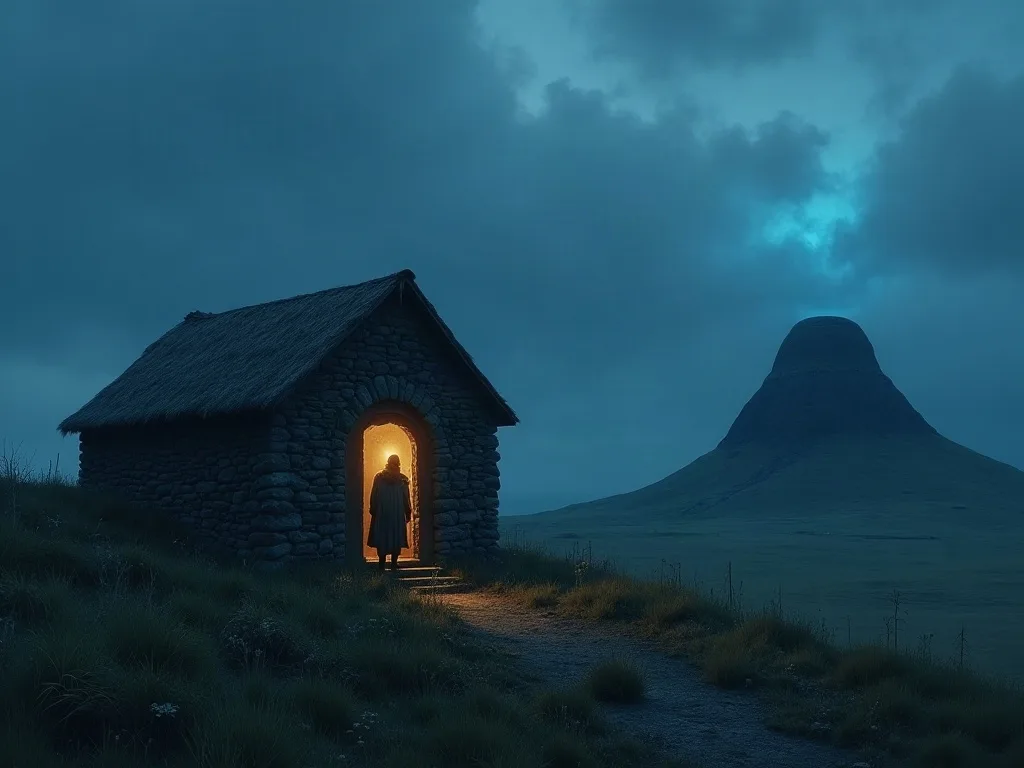
The most famous Draugr encounter appears in Grettir's Saga, involving the warrior Grettir. Grettir encounters a Draugr in a burial mound and must wrestle it. The fight is long and brutal, and though Grettir is described as one of the strongest men in Iceland, he barely defeats the creature. The saga emphasizes that the Draugr seemed to grow stronger as the night went on, drawing power from the darkness and the grave-mound itself. Only by dragging the corpse out of the barrow and into daylight does Grettir's companion manage to burn it. The implication is clear: the Draugr is weakened by sunlight and by separation from its grave-hoard.
These sagas blur the line between legend and history. Modern scholars debate whether these accounts preserve real encounters exaggerated over time, or whether they are entirely fictional. What is certain is that the medieval Icelandic authors who recorded them believed their audiences would take them seriously. The Draugr is not treated as a folktale for children; it is treated as a known supernatural threat that a warrior of exceptional strength might face.
The Making of a Draugr: When and Why the Dead Return
The Norse world-view held that the dead normally went to one of two places. The good and honorable went to Hel's hall or to the halls of the gods. The dishonorable or the restless might linger in the burial mound, but they did not typically return as a Draugr unless something had gone very wrong.
Several conditions could trigger Draugr-ness. The most common was a violent or shameful death: a murder victim buried without proper rites, a man killed in treachery, or a warrior who died at the hands of a family enemy. Unfinished vendettas kept the dead restless. If a man's killer walked free, or if his death was disrespected, the corpse might refuse to remain in the grave.
Greed could also bind a man to the earth. If a chieftain had been exceptionally miserly in life, or if he had stolen treasure and buried it with him, the weight of that hoarded wealth sometimes pulled him back. The Draugr was, in this sense, a manifestation of an unresolved sin: the Norse did not believe in hell in the Christian sense, but they understood that some debts do not disappear with death.
Improper burial was another trigger. If a body was exposed to the elements, or if grave-goods were inadequate, or if a rival had deliberately desecrated the burial site, the corpse might claw its way out seeking recompense. The Draugr was, in some accounts, the dead demanding that the living do their duty.
A few sagas suggest that some men were simply so powerful in life, or so unwilling to accept mortality, that they could not be kept down by earth and stone. These Draugr were not cursed so much as they were determined. The warrior's will to live and to dominate extended beyond the grave itself.
The Draugr's Arsenal: Strength, Magic, and the Power of the Grave
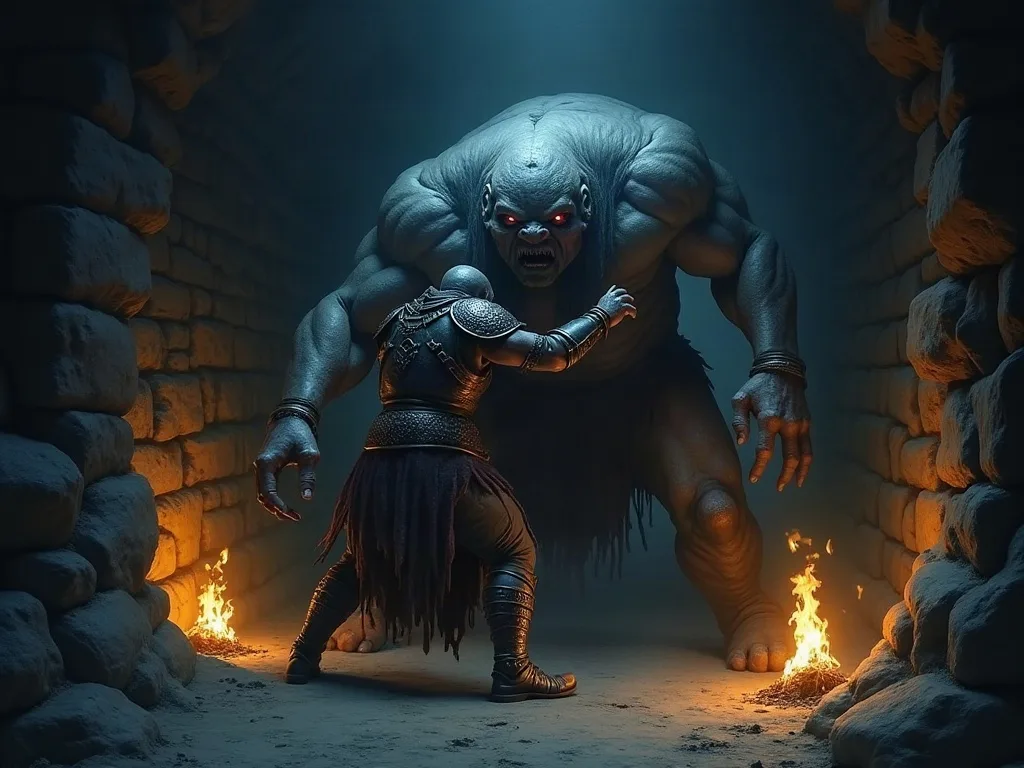
A Draugr is dangerous because it combines the strength of a giant with the near-invulnerability of something already dead. You cannot kill it by conventional means because it is already a corpse. A sword-wound that would fell a living man merely tears its burial shroud. Some sagas suggest that weapons pass through a Draugr without slowing it. The creature's power seems to increase in darkness, particularly at night or in the depths of the burial mound.
The sagas hint at magical power beyond mere strength. A Draugr can sometimes summon animals or command the darkness. Some accounts suggest it can shape-shift, taking the form of a seal, a wolf, or a great bird to move unseen from its barrow. Others describe a Draugr as capable of appearing in dreams, driving the living mad with terror before ever meeting them face-to-face.
The Grettir's Saga describes a Draugr so powerful that it could cause a sickness in the neighborhood: livestock would die, crops would fail, and people would sicken simply from living near its barrow. The creature's very presence corrupted the land. This suggests a cosmic principle: a Draugr is a violation of natural law, and nature itself recoils from it.
The only reliable method of destroying a Draugr involves separating it from its grave-mound and its treasure. Sunlight weakens it. Fire destroys it. Beheading the corpse and burning the head separately, then scattering the ashes, is the standard prescription in the sagas. Some accounts emphasize that the Draugr must be caught far from the barrow, where its power is diminished. If you can drag it into sunlight, you have a chance. If you must face it in the darkness of the mound or on a winter's night, even a strong warrior is in mortal danger.
The Living Face the Undead: Combat and Confrontation
The sagas present Draugr-fighting as a specialized skill, something only the strongest and bravest men attempt. The standard encounter follows a pattern: a Draugr is causing trouble (livestock deaths, mysterious illnesses, attacks on nighttime travelers), and someone of heroic stature finally confronts it. The battle is usually a wrestling match rather than a sword-fight, because conventional weapons are useless against a corpse.
Grettir's battle with the Draugr Glambr in Grettir's Saga is the template. The two grapple in the darkness. The Draugr is immensely strong, and it drags Grettir toward the barrow, seeking to pull him inside where its power is greatest. Grettir resists, literally fighting to keep himself outside the mound. The struggle continues through the night, and only as dawn breaks does Grettir gain the upper hand. The Draugr weakens visibly as the sun rises. Grettir's companion beheads the corpse at last, and the threat is ended.
Not all encounters end in the Draugr's destruction. Some sagas describe settlements that reach an uneasy truce with a nearby Draugr: they do not disturb its barrow, and it does not actively hunt them. The creature sits in its mound, hoarding gold, and the village lives around it as one lives with a dangerous predator in the forest.
Other sagas describe Draugr who are killed by men who outsmart them. Cunning matters. A Draugr is not unintelligent, but it is driven by simple motives. A warrior who can trick it, or lure it away from its source of power, or trap it somewhere it cannot endure, can win without a direct test of strength.
The Grave-Goods and the Obsession with Wealth
What separates the Norse Draugr from the undead of other cultures is the creature's relationship with treasure. A Draugr does not feed on human flesh or blood, at least not in the sagas. It does not seek to multiply itself or build an army of undead. It seeks to keep and control the wealth buried with it.
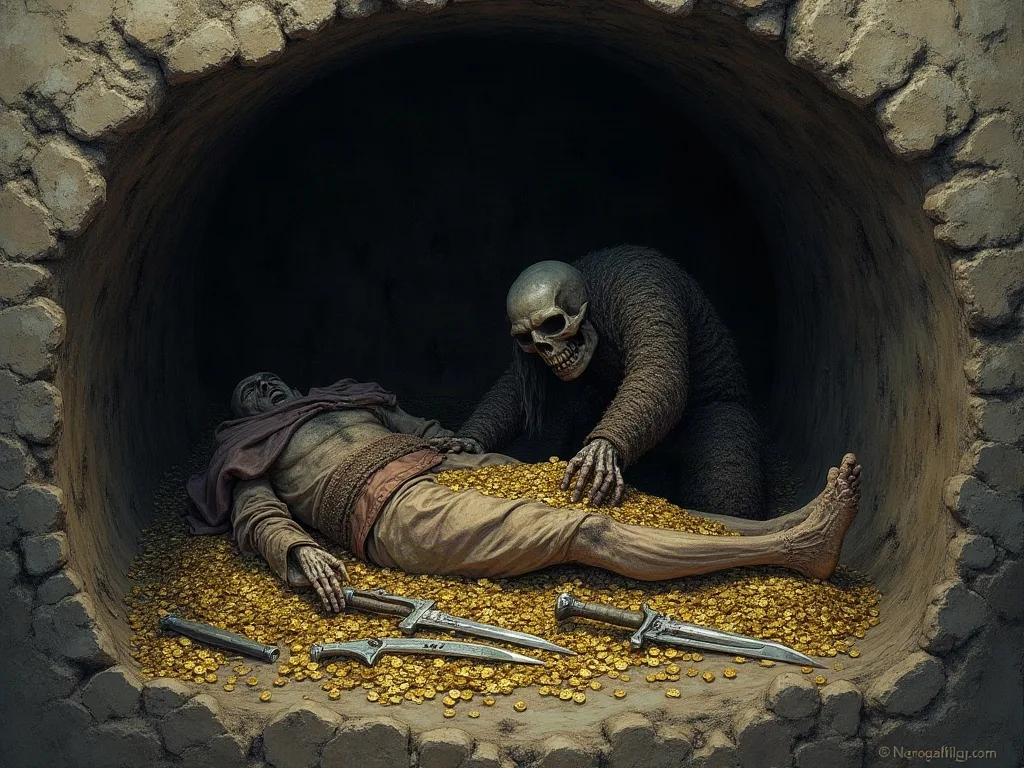
In Norse culture, a man's wealth defined him. A chieftain's barrow was meant to display his status eternally, filled with silver, weapons, fine cloth, and sometimes gold. The living expected that the dead took this wealth with them to the afterlife. But a Draugr refuses to let go. It lies atop the hoard, bloated and watchful, and kills anyone who tries to take what it considers its possession.
This detail reveals something deep about Norse anxieties. The Draugr is not simply a dangerous ghost; it is a warning about the dangers of greed and the refusal to part with earthly goods. In Christian terms (and medieval Iceland was Christian when these sagas were recorded), the Draugr embodies the sin of avarice. But in older, pagan terms, it embodies the principle that some attachments to the material world are so strong they persist beyond death itself.
Some scholars suggest that the Draugr legends preserve a folk-memory of grave-robbing. Early medieval Scandinavia saw frequent desecration of burial mounds by raiders seeking treasure. Perhaps the Draugr is the living's guilty conscience made flesh: the fear that the dead we have wronged, or whose graves we have plundered, might return to exact vengeance.
The Draugr and Christian Thought: Negotiating the Undead in Medieval Iceland
When Christian missionaries arrived in Scandinavia in the 10th and 11th centuries, the Draugr presented a theological problem. The Church taught that the dead, once dead, did not return. Yet the people of Iceland and Norway insisted that Draugr were real. Medieval Icelandic bishops and priests eventually developed a framework: yes, the Draugr existed, but it was a demon in the corpse, not the soul of the dead man. The soul had gone to Christ's judgment; what remained in the grave was a lesser spirit, a huldufolk (hidden one), or outright demonic possession.
This theological accommodation allowed the Church to accept Draugr accounts without admitting that Christian doctrine was wrong. The creature became not an undead revenant but a corpse possessed by evil. Yet in the sagas themselves, written by Christian monks and scholars, the distinction is often blurred. The Draugr seems to have the memory, will, and personality of the dead man himself. The creature is not simply a demon wearing a corpse; it is the dead man, transformed and bound to the grave.
This tension is never fully resolved in the medieval texts. Modern readers encounter both layers: the old pagan understanding of the Draugr as the dead man returned, and the Christian reframing that tries to make it something else. The Draugr that emerges from this collision is uniquely medieval and uniquely Scandinavian.
The Draugr's Legacy: From Saga to Modern Imagination
The medieval sagas were written down in the 13th and 14th centuries, but their power has never faded. Modern Scandinavian literature, from 19th-century Romantic revivalism to contemporary horror and fantasy, has drawn on the Draugr repeatedly. The creature appears in Bram Stoker's circle of influences, in H.P. Lovecraft's cosmic horror, and in modern Viking-themed fiction. The 2018 video game God of War features a Draugr as a standard undead enemy, using designs and abilities clearly derived from the sagas.
What makes the Draugr enduringly powerful is its groundedness. Unlike the ghost that walks in moonlight or the demon that emerges in a pillar of flame, the Draugr is material, specific, and local. It lives in a particular barrow, hoards particular treasures, and has a name. It is not generic evil; it is the corrupted corpse of a person you might have known. This concreteness made it terrifying to medieval people, and it makes it effective in modern storytelling.
The creature also resonates across cultures in unexpected ways. The Draugr shares characteristics with the lich of later medieval European folklore, the Jewish dybbuk, and the living dead of folklore worldwide. Yet it remains distinctly Norse: bound to place, driven by greed, defeated only by fire and separation from the grave.
Modern archaeology has shown that some Norse burial practices might have contributed to the Draugr legends. Bodies buried in certain geological conditions can remain relatively preserved; a family checking on the grave after some years might find the corpse less decomposed than expected, or might observe gases escaping in ways they interpreted as signs of reanimation. These mundane explanations do not diminish the power of the legends they may have inspired. The Draugr is real in the way that matters: real in the minds of the people who feared it, real in the stories they told to warn their children, real in the cultural imagination that has never let it rest.
Frequently asked questions about the Draugr
Frequently asked questions
Is the Draugr the same as a vampire?
No, though they are sometimes conflated. A Draugr does not drink blood, is not afraid of sunlight in the way a vampire is (though sunlight weakens it), and is not created by a bite. The Draugr is specific to Norse mythology and is always reanimated corpse, while vampires in European folklore are often portrayed as aristocratic beings that prey on the living. The conflation came later, when 19th-century Romantic authors mixed Norse and Eastern European sources.
What primary sources describe the Draugr?
The Draugr appears most prominently in the Egil's Saga and Grettir's Saga, both Icelandic sagas written in the 13th century. The Landnamabok (Book of Settlements) and the Vatnsdaela Saga also contain Draugr accounts. These are not ancient texts, but they record oral traditions that likely reach back to pre-Christian times, filtered through medieval Christian authorship. The medieval bishop Jón of Iceland wrote an account of a Draugr encounter that he seemed to believe had happened in his own era.
Could the Draugr legends be based on real phenomena?
Possibly. Medieval Scandinavians may have observed bodies that appeared less decomposed than expected, or that moved due to decomposition gases, and interpreted these as reanimation. Peat bogs in Scandinavia preserve bodies for centuries in conditions that can seem lifelike. Grave-robbing, which was common in early medieval Scandinavia, might have created stories of corpses "fighting back" against desecration. Yet even if these mundane explanations sparked the legends, the Draugr that emerged in the sagas is a fully developed supernatural being, not a simple misunderstanding.
How does the Draugr fit into Norse cosmology?
The Norse believed in multiple afterlives: Hel's realm for ordinary people, Valhalla for warriors who died in battle, and other fates for other kinds of death. A Draugr is a being that has fallen outside these categories, typically because of an improper death, unfinished business, or a willful refusal to accept mortality. It represents a failure of the normal order, which is why it must be destroyed or contained.
What weaknesses did medieval Norse people believe a Draugr had?
According to the sagas, Draugr are weakened or destroyed by sunlight, fire, and separation from their burial mound. Beheading and burning the corpse is the most reliable method. Some accounts suggest iron or blessed weapons might injure a Draugr, though physical weapons alone are rarely sufficient. Trickery and cunning can also work: a Draugr can be trapped far from its barrow, where its power fades.
The Draugr's Refusal: What the Undead Teach About Death and Memory
The Draugr is a creature of refusal. It refuses to stay dead, refuses to rest, refuses to let go of the earth and its treasures. In this refusal lies the creature's power and its tragedy. The Draugr is not evil in the Christian sense; it is simply unable to accept the boundary between life and death that the living take for granted.
Medieval Norse people, and the storytellers who preserved their legends, used the Draugr to explore what happens when that boundary breaks. What happens when greed is so strong it persists beyond death? What happens when a wrong is so grave that the corpse cannot rest? What happens when a man loved his treasures, his weapons, his land so much that he cannot bear to leave them?
These questions remain real. The Draugr has outlasted the pagan Norse religion by a thousand years. It appears in contemporary fiction, in historical reenactment communities, in the imagination of people who have never read a saga but feel the creature's pull. This is because the Draugr speaks to something universal: the fear of death, the weight of the past, the things we cannot let go of. In the barrow on a winter night, the Draugr digs at its prison, not trying to escape the grave, but refusing to truly inhabit it. It is undead not because it chose immortality, but because it could not accept finality.
That is why the Draugr endures. Not as a monster to be slain, but as a mirror for the living, showing us the price of greed, the danger of unfinished business, and the necessity of letting go.
Free 25-page sample
Want the whole story?
Take the first 25 pages free. If it pulls you in, the full edition is yours as an instant PDF download, with a paperback on Amazon for selected titles.

Mythology
The World Mythology Book: The Gods, Heroes and Myths of Every Culture
The Gods, Heroes and Myths of Every Culture, in One Volume
The whole of world mythology in a single volume: Greek, Norse, Egyptian, Japanese, Hindu, Celtic, Slavic, Mesoamerican and African myths gathered side by side, each drawn from the primary sources.