

The Fields of Aaru: Ancient Egypt's Eternal Afterlife
Aaru, the "Fields of Reeds," was ancient Egypt's vision of eternal paradise. Discover what the Egyptians believed awaited the righteous dead, the journey through the underworld, and the gods who guarded the threshold between life and eternity.
Contents
The ancient Egyptians were obsessed with death. Not in darkness or despair, but with precision and hope. They believed that if you lived righteously and underwent the proper rituals, you could spend eternity in Aaru (𓂀𓆙𓆙), a lush paradise of fields, waterways, and abundance. This vision shaped every mummy, every tomb painting, every spell inscribed on papyrus scrolls. The afterlife was not distant mythology. It was the ultimate destination, planned for, paid for, and feared or welcomed with the same attention Egyptians gave to the flooding Nile.
To reach Aaru, you had to survive a perilous underworld journey overseen by terrifying judges, prove your moral worth against the weight of your own heart, and navigate trials designed to test whether you had earned eternal rest. The fields themselves were not passive retreats. They demanded work, obedience, and the continuation of the rituals that had sustained you in life. Paradise, in ancient Egypt, was both gift and responsibility.
The Geography of the Underworld: Duat and Its Paths
The ancient Egyptians called the underworld Duat (𓇿𓇿𓇿), a realm that existed beneath the earth and within the body of Nut, the sky goddess. Unlike the Underworld of Greek myth, Duat was not simply a place of shades. It was a complex geography with regions, gates, and trials. The sun god Ra (𓇍) traveled through Duat every night, battling the serpent of chaos Apophis (𓊖𓏤), to be reborn at dawn. The dead followed a similar path, though theirs had no sunrise. Instead, they navigated toward the eternal Fields of Aaru.
The journey began in the tomb. The body, preserved through mummification, served as an anchor for the ka (life force) and ba (personality, or something close to what we might call the soul). The akh (the transfigured spirit) rose to begin the underworld passage. Ancient Egyptian texts, particularly the Book of the Dead (a collection of spells and instructions written on tomb walls and papyri starting around 1550 BCE), describe twelve regions or "hours" of Duat. Each hour presented obstacles: lakes of fire, gates guarded by demons with names like "Swallower of Filth" and "Eater of the Rotten," and tunnels that tested the dead's knowledge of sacred names and passwords.
The dead were not helpless. The Book of the Dead equipped them with spells and formulas. Knowing the true name of a gatekeeper granted passage. Reciting the correct incantation opened sealed doors. A well-prepared tomb, stocked with amulets, food, and sacred texts, gave the deceased tools for the journey.

The Hall of Two Truths: Judgment of the Heart
No gate in Duat was more consequential than the Hall of Two Truths. Here, in the presence of the great god Osiris (𓂀𓆙𓆙), the dead faced the ultimate test: the weighing of the heart against the feather of truth. This scene, painted on thousands of tomb walls and papyri, captures the core of Egyptian morality and justice.
The dead stood before a set of scales. On one side rested their heart (ib), the seat of consciousness, intention, and moral weight. On the other lay a single ostrich feather, the emblem of Maat (𓂀𓏤𓂋𓂋𓂋), the goddess of truth, order, and justice. Forty-two divine judges surrounded the scale, each representing a different sin or transgression. The dead had to declare what they had not done: "I have not killed. I have not stolen. I have not caused pain. I have not spoken lies."
This was not punishment theater. It was an accounting. The Egyptian vision of morality centered on ma'at, a concept wider than our word "truth." Maat meant cosmic harmony, proper behavior, balance, and living according to divine order. To live according to Maat was to live well. To violate it brought disorder into the cosmos.
If the heart balanced the feather, the dead entered Aaru. If the heart was heavy with sin, a composite demon called Ammit (𓂀𓇇𓂋), "the Devourer of the Dead," consumed it. The heart was destroyed, the ba scattered. There was no second life, no underworld wandering. Annihilation. This terror kept the Egyptian conscience sharp across millennia.

Aaru: The Paradise of Eternal Abundance
Aaru, also spelled Ialou or Yaru, appears in Egyptian texts as a mirror of the best of earthly life, but perfected and eternal. The name itself means "reeds" or "fields", the fertile floodplain the Nile created each year. For an agrarian civilization dependent on that inundation, what could paradise be but more of this abundance, forever?
The Fields of Aaru overflowed with grain. The waters flowed clear and constant. Trees bore fruit. The sun rose and set in proper order, bringing neither scorching heat nor destructive storm. The dead lived there in settlement communities, tending plots, harvesting, and enjoying meals and fellowship. They were reunited with family members who had died before them, recognized by the akh and ba that retained their personality and memory.
Yet Aaru demanded labor. The dead were expected to work the fields, maintain irrigation, and present offerings to the gods. Wealthy families, anticipating this, filled tombs with shabtis, small figurines inscribed with the owner's name and a spell. The spell commanded: "If the deceased is called upon to do work in Aaru, the shabti shall rise and perform that labor in his place." A person of means could, literally, purchase a workforce of magical servants for the afterlife. The poor did their own work. Neither option was escape. Aaru was a continuation of life's rhythms, harmonized and eternal.
The Egyptians also understood Aaru to be a place where the dead could interact with the living through memory and ritual. Family members left offerings at tombs: bread, beer, flowers, incense. They spoke the names of the dead aloud, because to be forgotten was a form of death. The dead, sustained by these offerings and these words, remained present, beneficent, watching over their descendants.
The Role of Osiris: Lord of the Underworld and Resurrection
Osiris (𓂀𓆙𓆙) was not the god of death in the way Hades governed the Greek Underworld. Osiris was the god of resurrection, fertility, and the cyclic return of life. His myth was central to Egyptian understanding of the afterlife.
Osiris was once a living king who brought civilization to Egypt, teaching agriculture and law. His jealous brother Set (𓂀𓇍𓇍) murdered him, dismembering his body and scattering the pieces. Osiris's wife Isis (𓂀𓏤𓂋), the greatest magician in the Egyptian pantheon, gathered the pieces, reassembled them, and through her magic brought Osiris back to life long enough to conceive a child: Horus (𓇍𓇍), who would avenge his father. Osiris then descended to rule the underworld, becoming the eternal judge and guardian of the dead.
Every deceased person, upon successful judgment, became an "Osiris", identified with the god, adopting his path of transformation and renewal. Tomb inscriptions routinely refer to the dead as "Osiris [Name]." The identification was not ego inflation. It was a profound spiritual claim: you had undergone death and transformation, just as Osiris had, and emerged renewed.
The cult of Osiris centered on his death and resurrection, celebrated in annual festivals. Priests reenacted his murder and restoration. Pilgrims traveled to his sacred sites. The entire Egyptian religious calendar was structured around the rhythm of death and rebirth that Osiris embodied, the same rhythm as the Nile flood, the growing season, and the sun's nightly journey through Duat.
Other Guardians and Guides: Thoth, Anubis, and the Divine Bureaucracy
Osiris did not manage Aaru alone. A vast pantheon of deities and demons administered the underworld, each with specific responsibilities.
Anubis (𓇼𓇼𓇼), god of mummification and guardian of tombs, was the first deity the dead encountered. He presided over the transformation of the body, ensuring the rituals were performed correctly. In the Hall of Two Truths, Anubis typically oversaw the weighing of the heart, holding the scales steady as Thoth recorded the result.
Thoth (𓇿𓇿𓇿), god of wisdom, writing, and magic, stood as the scribe and judge. He recorded every word spoken during judgment, documenting the names of all sins the dead denied and all virtues they claimed. Thoth embodied knowledge and truth, the rational order underlying the cosmos. His presence meant the judgment was not arbitrary. It was recorded, witnessed, and final.
Nephthys (𓂀𓏤𓂋), sister to both Osiris and Set, guarded the western boundary of Aaru. Though born of chaos (her father was Geb, earth, and her mother Nut, sky), she chose the side of order and protection. She was a mourner and a guardian, often depicted at the head and foot of mummies in temple reliefs.
Sekhmet (𓇰𓇰𓇰), the fierce lioness goddess of plague and healing, patrolled Duat as a guardian of divine law. When the dead violated the sacred prohibitions, Sekhmet's wrath was swift. Yet she was also a healer, capable of restoring balance after chaos threatened. The Egyptians understood her duality: destruction and restoration were not opposites but complementary forces within Maat.
Sobek (𓇱𓇱𓇱), the crocodile god, also guarded certain regions of Duat. Feared and respected, Sobek embodied primal power and the untamed forces of the Nile. Some texts suggest Sobek ferried souls across the waters of Duat. Others depict him as a threat, a devourer of the unprepared. The Egyptians held Sobek in simultaneous terror and reverence.
The Spells, Passwords, and Sacred Knowledge
The Book of the Dead was not a unified text but a collection of spells (called Prt m Hru, "Going Forth by Day") assembled over centuries. Families chose which spells to include in their tomb, depending on their means and theological preferences. A wealthy burial might have dozens. A poor burial, none at all, relying on oral tradition and the family's prayers.
These spells served multiple purposes. Some transformed the dead into birds or boats, allowing them to traverse difficult regions. Some granted invisibility or the ability to shapeshift. Others simply supplied the correct name of a gatekeeper or the password to a sealed door.
Spell 125 is the most famous, a confession of moral virtue. The dead recited negative statements: "I have not killed," "I have not stolen," "I have not borne false witness." This was not done in the Hall of Two Truths alone. Many tombs included copies so the dead could rehearse, ensuring they spoke the right words at the right moment.
The Egyptians believed that utterance had power. To speak the name of something was to give it existence. To speak a spell was to make it true, to compel reality to conform to the words. This was not superstition in the Egyptian view. It was the fundamental mechanism by which the cosmos worked. The gods themselves created through utterance. Ptah, the creator god of Memphis, thought the world into existence through speech.
The Architecture of Eternal Life: Tombs as Gateways
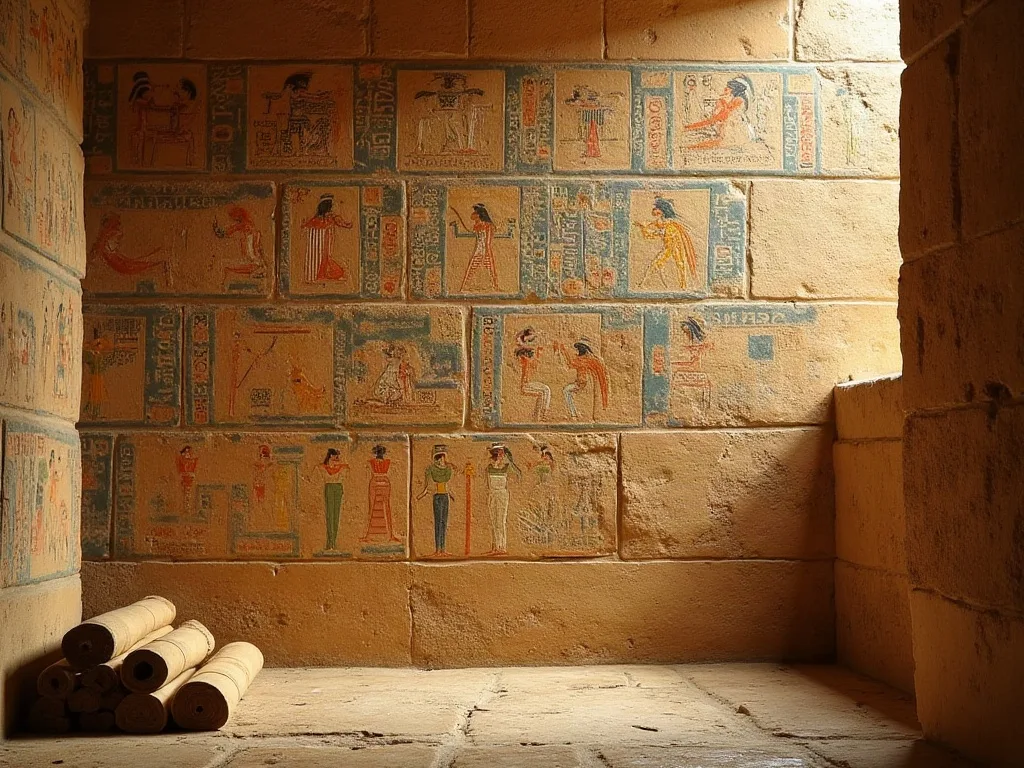
The tomb was not merely a burial vault. It was an architecture of resurrection, a machine designed to propel the dead toward Aaru. The pyramids, the great mastabas, and the rock-cut tombs of the Valley of the Kings were not monuments to ego alone. They were instructions in stone.
The interior walls of royal tombs were covered with maps of Duat, painted scenes of judgment, and spells to guide the journey. The sarcophagus was positioned to face west, toward the setting sun and the entrance to the underworld. Offerings left in the tomb's chapel sustained the dead's ka, ensuring they had the spiritual energy to navigate trials.
The layout itself was theological. Descending passages represented the journey downward into Duat. Antechambers corresponded to specific hours or regions of the underworld. The burial chamber itself was positioned as a point of transformation, a threshold where the dead left the earthly body behind and stepped into the akh's realm.
Tombs of later periods (from around 1550 BCE onward) became less grand but more text-dense. The walls of non-royal tombs in the New Kingdom often carried scenes of judgment, maps of Duat, and spells, compressed into smaller spaces but just as spiritually dense. A modest tomb owner could have access to the same magical knowledge and protection as royalty, a democratization of the afterlife that transformed Egyptian religion.
The Living and the Dead: Continuity of Care
The Egyptian afterlife was not a solitary ascent. The dead remained in communion with the living through ritual, offering, and memory. A family's prosperity in Aaru depended on their descendants' willingness to perform regular offerings and speak their names.
This gave the living immense power. Neglect a dead relative, and their akh would wither. Fail to maintain a tomb, and the magic within it would fail. The living could also curse the dead by erasing their names, damnatio memoriae, or by vandalizing their images. Conversely, the dead could bless and protect the living. Prayers to deceased ancestors were common, especially appeals for healing, protection in childbirth, or success in business.
This was not ancestor worship in the sense of deification, though it bordered on it. The Egyptians understood the dead as existing in a different state, possessing knowledge and power the living lacked, yet still emotionally and materially bound to their families. The relationship was reciprocal. Feed the dead with offerings; they feed you with their blessing. Forget them; they haunt you.
Some of the most touching surviving texts are letters to the dead written on pottery, asking deceased relatives to solve problems or come to the aid of the living. A widow might write: "O my brother, I need your help. Make my son successful in his trade." These letters were deposited in tombs, carried by the living's hope and the dead's presumed power.
Death as a Conditional Promise: Class, Wealth, and Justice
The Egyptian vision of Aaru was egalitarian in principle but aristocratic in practice. Every soul deserved judgment. Every heart could be weighed. But only those who could afford a proper mummification, a tomb, and the spells to navigate Duat had much chance of reaching Aaru.
A laborer with no tomb, no mummification, no written spells was at severe disadvantage. They might still reach Aaru if they had lived virtuously enough, relying on oral tradition and family prayers. But the odds were worse. This created a hierarchy of afterlife security that mirrored earthly class divisions.
By the New Kingdom (roughly 1550-1070 BCE), this inequality began to soften. Cheaper funerary texts became available. Poorer families could purchase shortened versions of the Book of the Dead, or even have spells written on linen wrappings instead of papyrus. Shabtis multiplied, becoming mass-produced clay figurines affordable to the middle class. The journey to Aaru became less exclusively a privilege of pharaohs and nobles.
Yet the fundamental principle held: the afterlife was a purchased good. Those with resources could engineer their resurrection more confidently than those without. This reflects a deeper Egyptian anxiety: the afterlife was not granted by divine grace alone. It was earned through correct living, sustained through ritual, and secured through property and preparation. Even the gods could not bypass Maat's judgment. Neither could the dead.
How the Egyptians Imagined Eternity
The Egyptian vision of eternal life was strikingly concrete. Aaru was not an abstract heaven of pure spirit. The dead would farm, eat, drink, and gather with loved ones. They would need clothes, tools, boats, and entertainers. They would continue the rituals that had defined their earthly lives. They would enjoy music, games, and the company of friends.
At the same time, the afterlife was understood as fundamentally different from life. The dead did not age. They did not hunger or thirst, though they could still receive and enjoy offerings. They could appear and disappear, shapeshift, and move instantaneously. They inhabited a body that was no longer subject to disease or decay. They lived in a landscape that mirrored the best of the Nile valley but was perpetually fertile, perpetually peaceful.
This vision reveals something profound about Egyptian religion: they were not escaping the world. They were refining it. The afterlife was not a rejection of earthly pleasures but their perfection. The dead would experience everything good about life, community, work, beauty, nourishment, without suffering, without death, without disorder. It was the Nile flood without the destructive overflow, the harvest without the hunger of the lean months, the family reunion without grief.
Modern Echoes: The Afterlife That Shaped the Mediterranean World
The Egyptian concept of afterlife judgment profoundly influenced later Mediterranean religions. Greek and Roman mystery cults, particularly the Eleusinian Mysteries dedicated to Demeter, seem to have borrowed Egyptian ideas about underworld geography and the judgment of souls. Early Christianity absorbed Egyptian imagery of resurrection and judgment, though reframed through the lens of Christ as a replacement for Osiris.
Dante Alighieri's Divine Comedy, written in medieval Italy, maps Duat's structure onto the Christian Inferno and Purgatorio, complete with levels of punishment and eventual ascent. The weighing of the heart became the Last Judgment. Aaru became Paradise. The psychological and spiritual geography was fundamentally Egyptian, even after two thousand years and multiple theological revolutions.
Modern occult and spiritual traditions continue to draw from Egyptian funerary texts, reinterpreting the Book of the Dead as a manual for spiritual development rather than a guide for the deceased. The Tarot, the Hermetic Order of the Golden Dawn, and contemporary paganism all claim lineage to ancient Egypt, whether or not that lineage is historically sound. The Fields of Aaru remain compelling because they embody a vision many still find beautiful: an afterlife that honors both the continuity of love and the transformation of death.
Frequently asked questions about the Egyptian afterlife and Fields of Aaru
Frequently asked questions
What happens if someone fails the judgment in the Hall of Two Truths?
If the heart weighs heavier than Maat's feather, the demon Ammit consumes it, destroying the ba and akh entirely. This was annihilation, a complete end to existence. There was no second chance, no purgatorial period, no eternal punishment. Obliteration was the consequence.
Did all Egyptians believe in the same version of the afterlife?
Beliefs varied across time and region. Royal tombs emphasized the pharaoh's identification with Ra and Osiris, focusing on cosmic renewal. Commoners' tombs stressed simpler visions of reunion with family in Aaru. Some texts suggest multiple afterlife destinies: pharaohs joined the gods in the sky, while others inhabited Aaru. By the Late Period, concepts blended and diversified, influenced by Greek and other foreign ideas.
Why did the Egyptians mummify bodies if the soul went to the underworld?
The ka (life force) needed an anchor. Mummification preserved the body so the ka could return to it, inhabit it, and be sustained by offerings left at the tomb. Without the body, the ka was homeless. The ba and akh could exist in Aaru, but their link to the living and to material sustenance depended on the preserved corpse remaining intact.
Could the dead communicate with the living, or was the separation complete?
Communication was possible but challenging. The dead could receive messages left at tombs and could potentially influence the living through dreams or spiritual presence. Letters to the dead, written on pottery and deposited in tombs, asked for intercession. The boundary between worlds was porous but required ritual mediation to cross.
Is there any evidence that ordinary Egyptians actually believed in Aaru, or was it just elite ideology?
Tomb art from non-royal burials, letters to the dead, and popular amulets suggest widespread belief. The concepts were taught to all levels of society, incorporated into religious instruction, and practiced in daily ritual. However, interpretation surely varied. An illiterate farmer's understanding of Aaru may have been simpler and more focused on family reunion than a scribe's sophisticated theological vision. Belief was shared but not uniform.
How does the Egyptian afterlife compare to other ancient religions like Greek or Mesopotamian concepts?
The Greek Underworld (Hades) was generally bleak, a dim realm of shades lacking the vitality of the living. The Egyptian Aaru, by contrast, was an idealized continuation of earthly life. Mesopotamian concepts were even grimmer, the afterlife was a pale reflection with little hope of reward. The Egyptians stood alone in envisioning the afterlife as genuinely desirable, achievable through virtue and preparation rather than fate or divine whim.
The Eternal Fields: A Vision That Endured Three Millennia
The Egyptian concept of Aaru survived longer than almost any other religious idea in Western civilization. From its earliest formulation in the Pyramid Texts (around 2400 BCE) through the Late Period (332 BCE) and beyond, the vision of the Fields of Reeds remained central to Egyptian spiritual life. Even after the conquest by Greeks and Romans, after the rise of Christianity, the imagery persisted in the Coptic Christian tradition and in the dreams and art of Egypt's descendants.
What made Aaru so durable was its psychological realism. It was not so transcendent as to be incomprehensible, nor so earthly as to be unambitious. It promised continuity with all that was good in life while ensuring transformation and liberation from suffering. The dead farmer would farm eternal fields. The dead scribe would write. The dead mother would know her children. But none would age, starve, or die again. It was a vision that married hope with anxiety, aspiration with responsibility, the concrete with the sacred.
The Fields of Aaru represent one of humanity's most sustained attempts to answer the question every culture asks: what happens when we die? The Egyptians did not shy from the question. They built temples, wrote books, created art, and shaped law around their answer. They believed that death was a transition, not an end. That the moral life mattered in this world and the next. That memory and ritual could bridge the gap between living and dead. That paradise was not a reward handed down by capricious gods, but a state earned through virtue, purchased through preparation, and sustained through love.
In a world of constant change, that vision offered certainty. In a cosmos threatened by chaos, it offered order. In the face of death, it offered hope, not blind, but grounded in ritual, reason, and an intricate architecture of belief that still, after four thousand years, invites reflection.
Free 25-page sample
Want the whole story?
Take the first 25 pages free. If it pulls you in, the full edition is yours as an instant PDF download, with a paperback on Amazon for selected titles.

Mythology
The World Mythology Book: The Gods, Heroes and Myths of Every Culture
The Gods, Heroes and Myths of Every Culture, in One Volume
The whole of world mythology in a single volume: Greek, Norse, Egyptian, Japanese, Hindu, Celtic, Slavic, Mesoamerican and African myths gathered side by side, each drawn from the primary sources.