
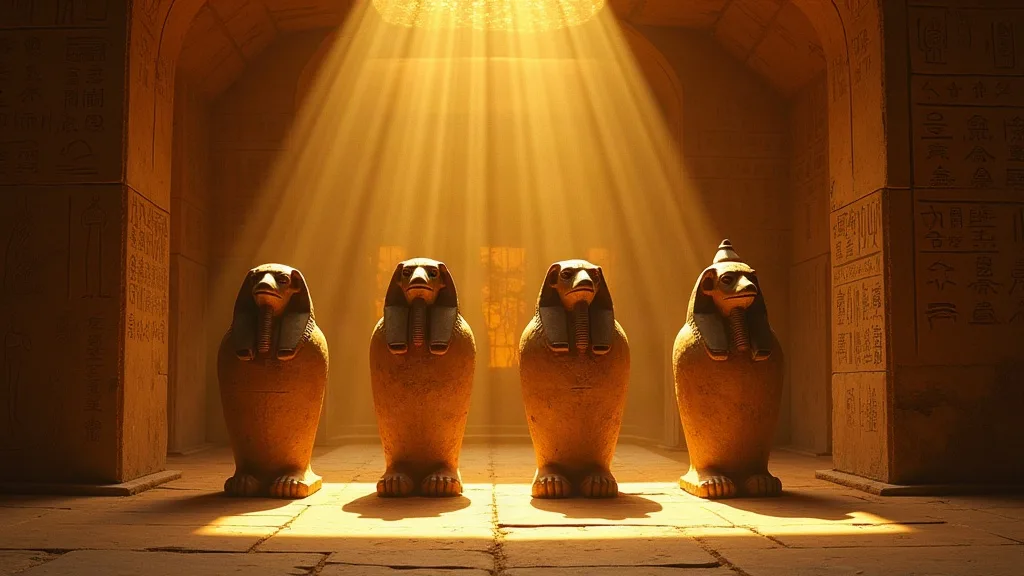
Canopic Jars and Their Guardians: The Four Sons of Horus and Egyptian Afterlife Protection
The four sons of Horus stood watch over Egyptian tombs for 3,000 years. Each canopic jar held a mummified organ under divine protection. Learn who guarded them, what they protected, and why ancient Egypt built an entire afterlife system around these stone sentinels.
Contents
A mummy wrapped in linen lies in the dark. Around it, four stone jars carved with human heads. Each one watches over a preserved organ. Each one has a name, a face, a divine purpose. The ancient Egyptians did not leave their dead unprotected. They placed guardians in the tomb, carved in stone, powered by ritual.
These are the canopic jars. Four vessels that held the mummified organs of the dead. And the guardians carved into their lids were the sons of Horus, divine beings tasked with preserving life beyond death for all eternity.
The Four Sons of Horus: Guardians of the Organs
The four sons of Horus were not born in the usual way. According to Egyptian belief, Horus, the falcon-headed son of Osiris and Isis, generated four divine beings to serve specific functions in the afterlife. Each son had a distinct name, a distinct appearance, and a distinct responsibility.
The names of these guardians varied slightly depending on the source texts and the region of Egypt, but by the New Kingdom (around 1550 to 1070 BC), a standardized list emerged. The tradition was so deeply rooted that it lasted three thousand years without major alteration.
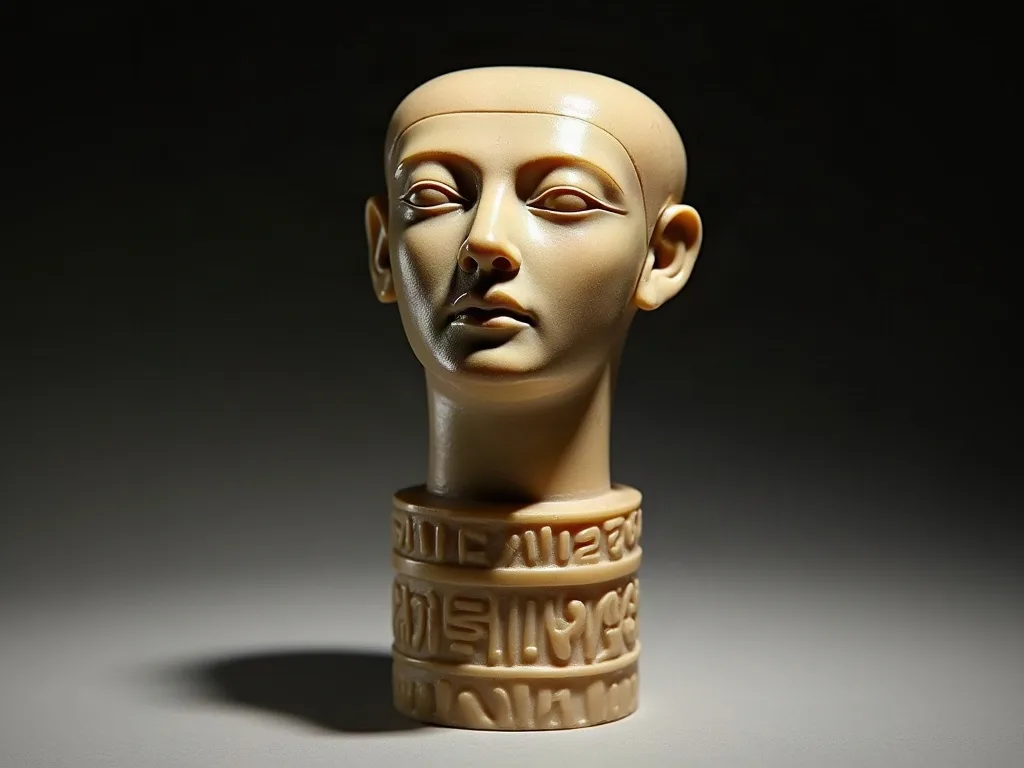
Imsety (also spelled Amset) had a human head. He guarded the liver. In Egyptian thought, the liver was the seat of emotion and conscience, the organ where moral choices lived. Without it properly preserved, the dead could not survive the judgment of the afterlife. Imsety was often depicted as peaceful and contemplative, fitting his role as keeper of the heart's choices.
Duamutef (also Tuamutef) had the head of a jackal or wild dog. He protected the stomach and upper intestines. This was the organ of hunger and appetite, the physical need that had driven the living. In death, Duamutef ensured that these base needs were contained and controlled, so the soul could ascend without earthly longings pulling it back.
Kebechenuwef (also Qebehsenuf) had the head of a falcon, like his father Horus. He watched over the small intestines and lower bowels. The final digestive organs, they represented the last stage of breaking down earthly sustenance. Kebechenuwef ensured this transformation was complete.
Hapy (not to be confused with the Nile flood god of the same name) had the head of a baboon or ape. He guarded the lungs. The lungs were the seat of breath, and breath was life itself. Hapy's task was sacred: he preserved the very air that had animated the living being.
Each guardian was invoked by name in the Book of the Dead, the funerary texts that guided souls through the afterlife. Each was painted on tomb walls. Each had statues erected in temples. And each had a physical manifestation in stone, carved as the stopper of a canopic jar, watching over the organ beneath.
The Origin of Canopic Jars in Egyptian Practice
The practice emerged around the Fourth Dynasty of the Old Kingdom, roughly 2600 BC. The earliest canopic jars were simple containers, often without lids carved as guardian heads. The jars themselves were functional: containers for the organs removed during the mummification process.
But function merged with faith. By the Middle Kingdom (around 2055 to 1650 BC), the jars had transformed. The lids began to take the shape of divine guardians. The practice became standardized: four jars, four guardians, four organs. No variation. This uniformity across a vast empire and many centuries suggests something more than mere utility. This was a religious obligation, a law written in stone.
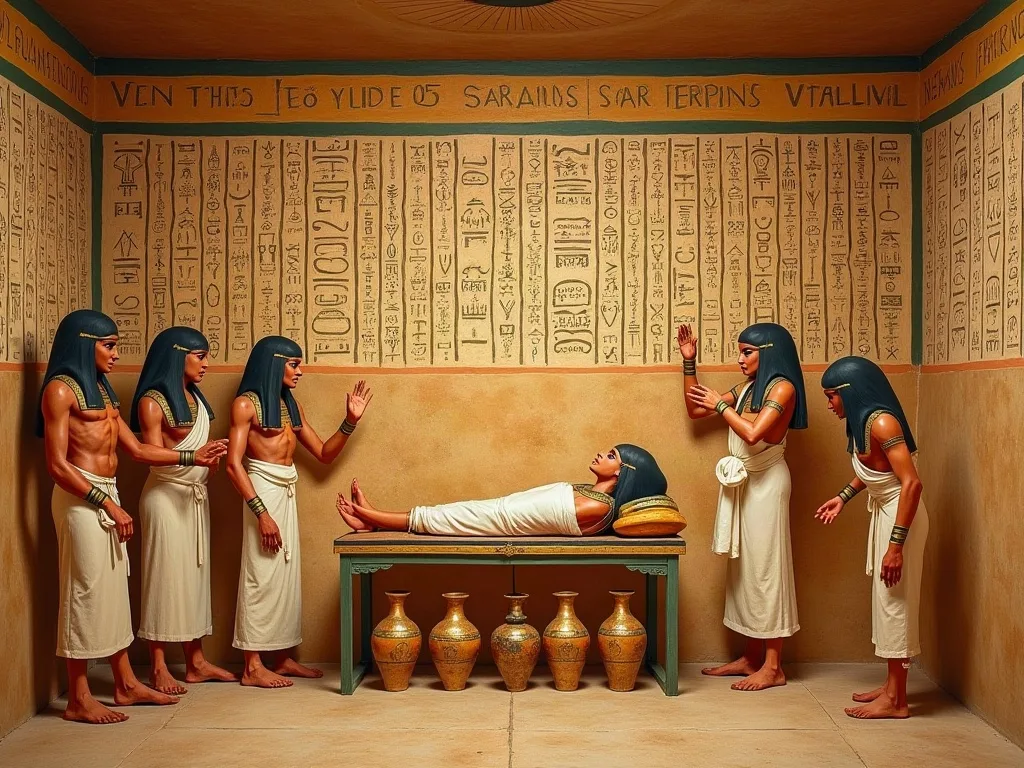
The Egyptians understood mummification as a technological act. But they also understood it as a spiritual one. The organs were not simply preserved by natron and linen. They were placed under divine guardianship. The god's image carved into the jar lid was believed to activate the god's presence. The name spoken aloud during the burial ritual was believed to summon the god's attention. The organ below was believed to be watched, protected, and blessed by an eternal divine sentinel.
Some canopic jars were made of limestone or alabaster. Others were carved from granite or basalt. The finest jars, those for pharaohs and the wealthy elite, were masterpieces: the heads perfectly proportioned, the expressions serene or fierce depending on the god's nature, the inscriptions in hieroglyphs covering every surface.
Poorer burials used cheaper containers. But the form remained the same. Four jars. Four heads. Four names. The architecture of divine protection was available to anyone who could afford mummification, and in Egypt's view of the afterlife, you needed all the protection you could get.
What Each Jar Protected: The Organs and Their Spiritual Significance
Egyptian anatomy and Egyptian spirituality were not separate. The ancient physicians understood the body as a network of vessels carrying blood, air, and spirit. They identified organs not just by physical function but by spiritual essence.
The liver, guarded by Imsety, was the largest internal organ. In life, the ancient Egyptians believed, it was the seat of judgment. It was where a person's choices accumulated. A sinful liver was considered heavy; a virtuous one, light. This belief shaped the whole afterlife system. When the dead reached the hall of judgment, the heart (often conflated with the liver in Egyptian thought) was weighed against the feather of truth. If the liver was heavy with sin, it would sink. Imsety's job was to ensure this organ was preserved in its truest state, ready for that final weighing.
The stomach, under Duamutef's care, represented physical appetites. Hunger. Thirst. The drive to eat, to consume. In life, these drives were necessary. A hungry person eats. But in the afterlife, such earthly needs were considered obstacles. A soul still hungry for earthly things was still bound to earth. Duamutef's preservation of the stomach symbolized the containment of these desires, their sealing away so they could not corrupt the journey to eternal peace.
The intestines, split between Duamutef and Kebechenuwef, were the final stage of transformation. Food became waste. The useful was separated from the useless. This process was spiritual as well as physical. The intestines represented the final breaking down of earthly identity, the last stripping away of what was temporary and mortal.
The lungs, guarded by Hapy, were pure breath. The ancient Egyptians called the life force akh, often translated as "spirit" or "glory." The lungs held this force in life. In death, they held the potential for it to be preserved. Hapy's protection ensured that even if the body decayed to dust, the breath that had once animated it would not be forgotten.
Mummification and the Placement of Organs
When an Egyptian died, the mummification process began almost immediately. The body was taken to a special building called the ibu, the place of purification. There, priests and technicians began the work that would preserve the body for eternity.
The first step was the removal of the internal organs. A priest, often wearing a jackal mask (representing Anubis, the god of mummification), made an incision in the left side of the body. The liver, stomach, intestines, and lungs were carefully extracted. The brain was removed through the nose, leaving no trace. The heart, however, was always left in the body. The heart was the seat of intelligence and memory, and it would be needed in the afterlife.
The extracted organs were then treated. They were washed, dried, wrapped in linen, and sometimes placed in smaller containers called packages inside the main canopic jars. Then they were ceremonially placed into the four jars, each organ into the jar guarded by the appropriate son of Horus.
This was not a casual act. Spells were recited. The priest called out the name of the guardian: "Imsety, protect this liver." "Duamutef, contain this stomach." Each name summoned the god. Each incantation activated divine protection.
The jars were then placed in the tomb, usually standing in a row at the foot of the mummy or in a separate chamber. They would remain there for thousands of years, watching over the organs, ensuring that the dead person's afterlife was secure.
Variations Across Time and Region
The system of four sons of Horus was remarkably consistent, but not absolutely fixed. In some regions of Egypt, variations occurred.
In the Ptolemaic period (332 to 30 BC), when Greek rulers controlled Egypt, some burials began to show hybrid practices. Greek influences appeared in the art and inscriptions. But even then, the core system remained: four jars, four guardians, four organs.
Some royal tombs and elite burials included additional jars, sometimes up to seven or eight, with different guardians or even duplicate guardians. But the standard remained four.
The names of the guardians were sometimes spelled differently depending on the period and the region. The head shapes varied slightly. In the Old Kingdom, the heads were simpler. By the New Kingdom, they were masterpieces of sculptural precision. But the fundamental concept never changed.
One interesting variation occurred in some burials where the jars had no heads at all, just stoppers with hieroglyphic inscriptions naming the guardians. This suggests that the word-form of the name was believed to summon the god just as powerfully as the carved image. The god's name was the god's presence.
The Sons of Horus in Temple Worship and Magic
The four sons of Horus were not confined to tombs. They were part of living religious practice. Temples throughout Egypt had shrines dedicated to them. Priests performed rituals invoking their protection. Amulets carved with their images were worn by the living, believed to offer protection in this life and the next.
In the magical papyri, spells were recorded that called upon the sons of Horus for healing, protection, and aid in childbirth. Mothers wore amulets with Hapy's image, believing his role in preserving breath extended to protecting newborns. The sons of Horus were not distant heavenly beings. They were practical, accessible divine powers.
The Book of the Dead, the funerary text found in many New Kingdom tombs, included specific spells for "knowing" the sons of Horus. To "know" a god in Egyptian religious thought meant to understand their true nature, their secret name, their essential power. A soul who could speak the true names of the sons of Horus would be protected by them in the afterlife. This knowledge was power.
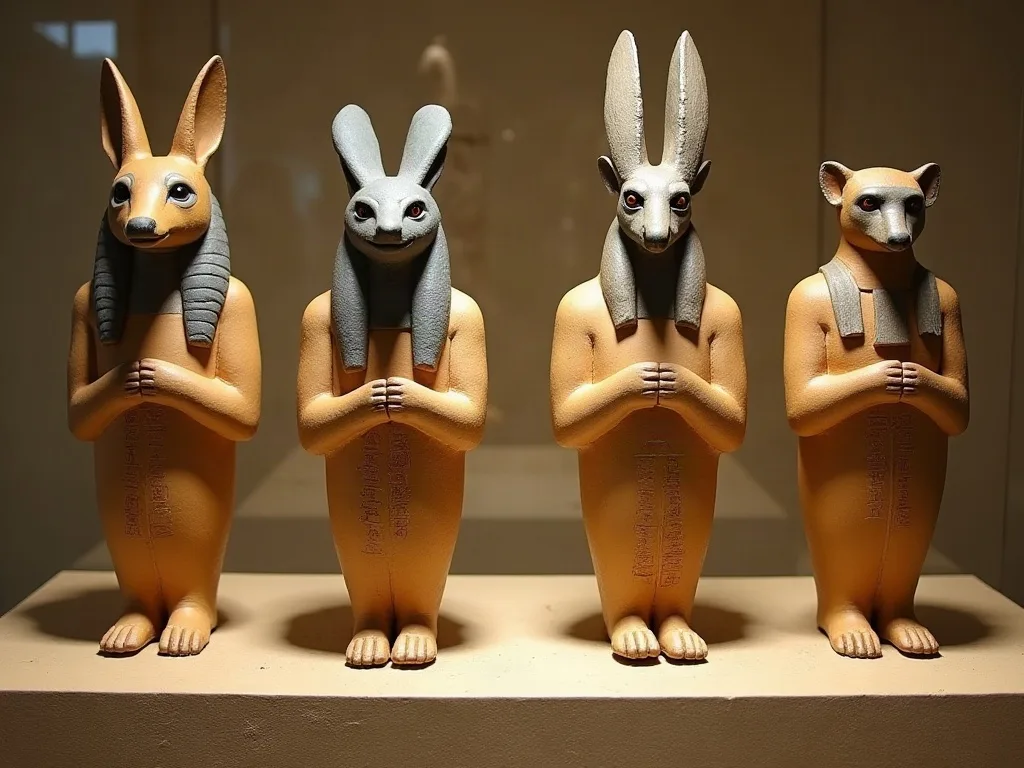
Many tomb walls bore inscriptions that were essentially contracts with the guardians. "Imsety, I invoke you by your true name. Guard my liver. Let no demon consume it. Let no decay touch it. I am under your protection." These were not requests. They were claims, declarations, activations of divine law.
The Four Guardians in Comparison: Divine Specialization
Each son of Horus had a distinct personality and domain, and these distinctions reveal how Egyptian religion organized cosmic functions.
Imsety (Liver)
Imsety was the human-headed guardian, the most human in appearance. His role centered on judgment and virtue. He was often depicted as introspective, calm, and wise. His protection was spiritual: ensuring the seat of conscience remained pure for the final weighing of the heart. He represented order and truth (maat).
Duamutef (Stomach)
Duamutef was the jackal-headed guardian, wild and primal. His role centered on appetite and desire. He was depicted as fierce, watchful, and slightly dangerous. His protection was restraint: containing the hunger that had bound the living to earth. He represented the mastery of base drives.
Kebechenuwef, the falcon-headed son, shared his father Horus's aerial nature. He was swift, keen-eyed, and associated with the sky. His role in protecting the intestines was about finality, the last transformation. He ensured that the breaking down of earthly substance was complete, leaving nothing to pull the soul back to the material world.
Hapy, the baboon-headed son, was connected to both wisdom (baboons were associated with the god of scribes) and chaos (baboons were also seen as wild and untamed). His protection of the lungs was paradoxical: preserving the breath while acknowledging that breath could depart without warning. Hapy guarded the most ephemeral of organs, the one closest to pure spirit.
Together, the four sons embodied a complete cycle: the judgment of the liver, the containment of appetites, the completion of transformation, and the preservation of breath. A dead person protected by all four was completely secured for the afterlife.
The Canopic Jar System and the Concept of Eternal Protection
What made the canopic jar system so enduring was its answer to a fundamental anxiety: the fear of oblivion. Death was not the end in Egyptian thought. It was a transition. But that transition was dangerous. The soul had to navigate the underworld, face demons, answer riddles, be weighed and judged. Without proper protection, it could be lost forever.
The canopic jars were a technological solution to a spiritual problem. By preserving the organs and placing them under divine guardianship, the Egyptians created a permanent insurance policy for the afterlife. The god carved into the jar lid was present, eternal, unchanging. As long as the jar stood, the god stood watch.
This belief was powerful enough to create one of archaeology's greatest gifts to modern understanding. Canopic jars survive. They have been excavated, studied, and preserved. Through them, we can read the names of the dead, understand the burial practices, see the artistic and religious priorities of ancient Egypt. The guardians carved into the lids are faces of divinity that have watched over Egypt's dead for four thousand years.
Frequently asked questions about canopic jars and their guardians
Frequently asked questions
Why did the ancient Egyptians remove organs during mummification?
The ancient Egyptians removed the liver, stomach, intestines, and lungs because they understood them to decay rapidly and corrupt the mummy. The heart was left in place because it was believed to be the seat of memory and intelligence, essential for the afterlife. Removing the perishable organs and placing them under divine guardianship in separate jars preserved the body's integrity for eternity while also creating a system of spiritual protection.
Are the four sons of Horus the same in every Egyptian text?
The core names and functions remained consistent across Egyptian history, but spellings and slight variations existed depending on the period, region, and specific text. By the New Kingdom (around 1550-1070 BC), the standard list of Imsety, Duamutef, Kebechenuwef, and Hapy was firmly established and used universally. Some older texts used slightly different names or ordered them differently, but the essential system persisted unchanged for over three thousand years.
What happened to the canopic jars if a tomb was robbed?
Tomb robbers throughout history targeted canopic jars, sometimes for the precious materials (alabaster, gold, lapis lazuli) or for the goods inside. In some cases, jars were deliberately destroyed or scattered. From the Egyptian perspective, this was a spiritual catastrophe: the organs were exposed, the divine guardians were violated, and the dead person's afterlife was endangered. This is why some tombs included curse inscriptions meant to protect the jars and punish anyone who disturbed them.
Did poor Egyptians also use canopic jars in their burials?
Canopic jars were expensive and required the full mummification process, which only the wealthy and elite could afford. Poorer Egyptians were sometimes buried with simple pottery jars or no jars at all. However, mummification itself was not exclusively for royalty. By the Middle Kingdom and later periods, many non-royal people could afford at least basic mummification and burial with canopic jars, which meant access to divine protection in the afterlife was more widespread than just among the elite.
How did the sons of Horus fit into the larger Egyptian pantheon?
Horus was the falcon-headed son of Osiris and Isis, a god of the sky, kingship, and rightful rule. His four sons served a specialized function: guardians of the dead's organs and, by extension, guardians of the entire afterlife journey. While Osiris ruled the underworld and Anubis managed mummification, the sons of Horus provided direct, intimate protection to individual dead people. They were not major gods worshipped in grand temples, but they were universally present and universally trusted, and their presence in every tomb gave them an influence that belied their lack of major mythology.
What happened to canopic jars and their use after the Ptolemaic period?
The practice declined sharply after Egypt came under Greek rule and then Roman rule. By the Roman period, traditional mummification and canopic jar burial had largely faded, especially in areas with strong Greek or Roman influence. However, the practice persisted in some conservative communities into the early Christian era. The shift away from canopic jars was part of a broader change in Egyptian burial practices, which were increasingly influenced by Greek and Roman customs that did not involve organ preservation or canopic guardianship.
The Guardians' Legacy: How Ancient Egyptian Wisdom Influenced Later Belief Systems
The sons of Horus remained influential long after the classical period ended. Early Christian Egyptians, living in a land saturated with pharaonic imagery and belief, adapted elements of the old system. Some adopted the concept of divine guardians watching over the dead. The idea that a soul required divine protection on its journey to the afterlife found new expression in Christian guardian angels and saints.
Jewish and Islamic traditions that developed in the Eastern Mediterranean were also influenced by Egyptian concepts of the afterlife and divine protection. The notion of heavenly beings assigned to guard and protect individuals echoed the structure of the sons of Horus.
In modern times, the canopic jars have become symbols of Egyptian civilization itself. They appear in museums worldwide, studied by scholars, admired by tourists. The faces carved into their lids remain serene, watchful, eternal. In a very real sense, the sons of Horus are still guarding, still protecting, still standing watch over the knowledge and memory of the civilization that created them.
The canopic jars and their guardians represent more than funerary vessels. They embody the Egyptian conviction that death could be managed, even conquered. That the dead deserved protection. That divinity could be invoked and materialized in stone. Four stone jars, four divine heads, four eternal guardians. For three thousand years, they stood in tombs, doing the only job they were ever given: watching. Protecting. Ensuring that the dead were never alone, never unguarded, never forgotten.
Free 25-page sample
Want the whole story?
Take the first 25 pages free. If it pulls you in, the full edition is yours as an instant PDF download, with a paperback on Amazon for selected titles.

Mythology
The World Mythology Book: The Gods, Heroes and Myths of Every Culture
The Gods, Heroes and Myths of Every Culture, in One Volume
The whole of world mythology in a single volume: Greek, Norse, Egyptian, Japanese, Hindu, Celtic, Slavic, Mesoamerican and African myths gathered side by side, each drawn from the primary sources.