
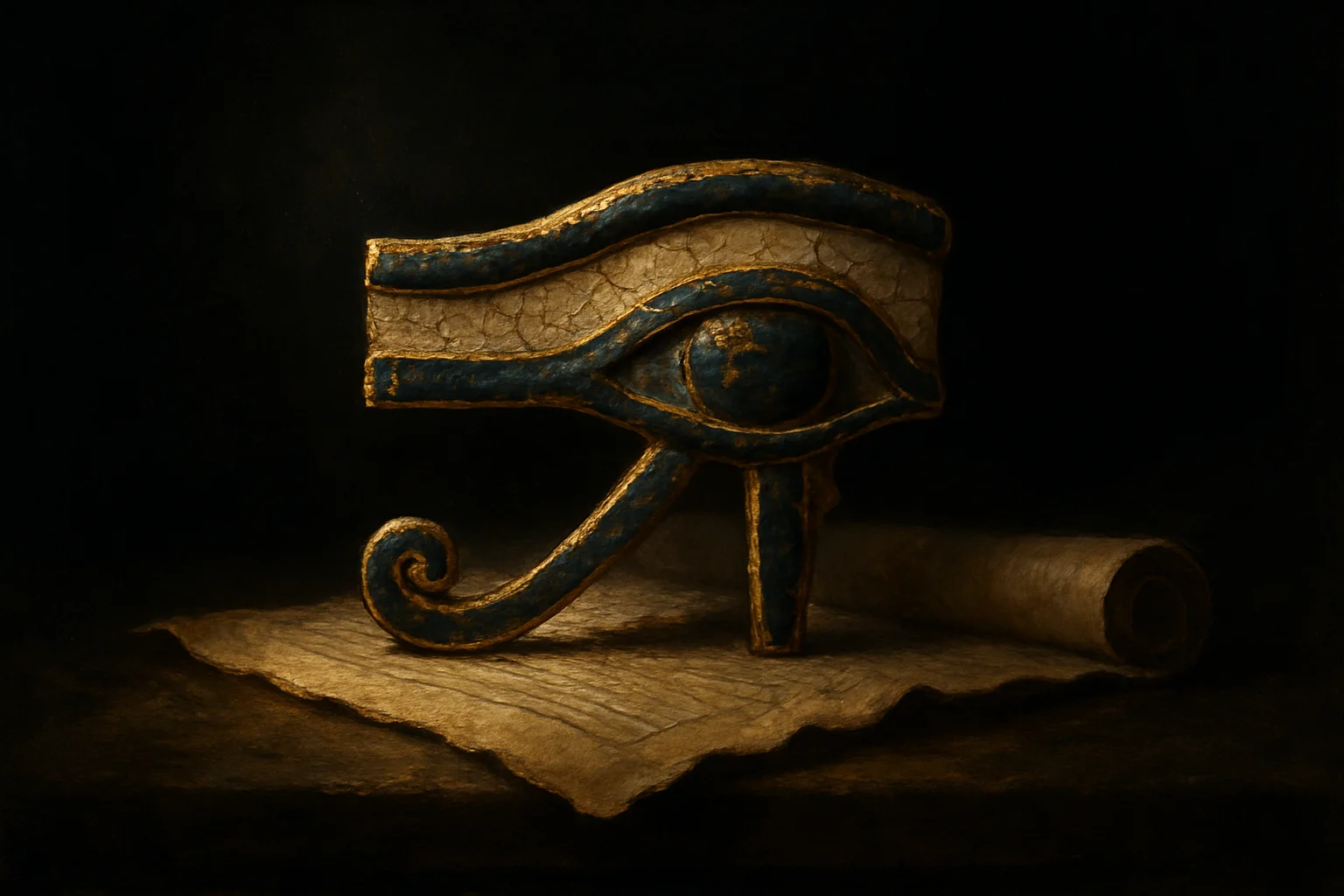
Eye of Horus (Udjat): Symbol, Myth, and Mathematics
The udjat eye appears in the Pyramid Texts as a token of wholeness. Explore its origin in the Osiris myth, its fractional notation, and its role as amulet.
Contents
The Eye of Horus, known in ancient Egyptian as udjat (meaning "the sound one" or "the whole one"), is a symbol of protection, healing, and royal power that first appears in the Pyramid Texts of the Old Kingdom around 2400 BCE. The symbol represents the restored eye of the falcon god Horus after it was torn out by Seth during their contest for the throne of Egypt. The udjat became one of the most widely used protective amulets in Egyptian civilization, worn by the living and placed on mummies to ensure safe passage into the afterlife.
Most modern accounts treat the Eye of Horus as a generic talisman without examining the funerary texts where it originates or the mathematical system encoded in its parts. The symbol's power derives not from vague mysticism but from a specific mythological event and a precise role in Egyptian funerary practices, where it served as both a tool of resurrection and a unit of measurement.
The Name and Its Meaning
The word udjat derives from the Egyptian root wḏꜣ, which carries meanings of soundness, wholeness, and health. The term appears throughout Egyptian religious texts as both noun and verb: to be sound, to be made whole, to heal. When applied to the eye of Horus, it signals not just an anatomical feature but a state of completeness restored after violence.
The symbol is sometimes called the wedjat in scholarly transliteration. Both spellings represent the same hieroglyphic sequence. The emphasis on wholeness becomes central to understanding the symbol's function: it does not merely protect but actively restores what has been damaged or lost. This restorative power made it essential in contexts of death and rebirth, where the deceased required reassembly and renewal.
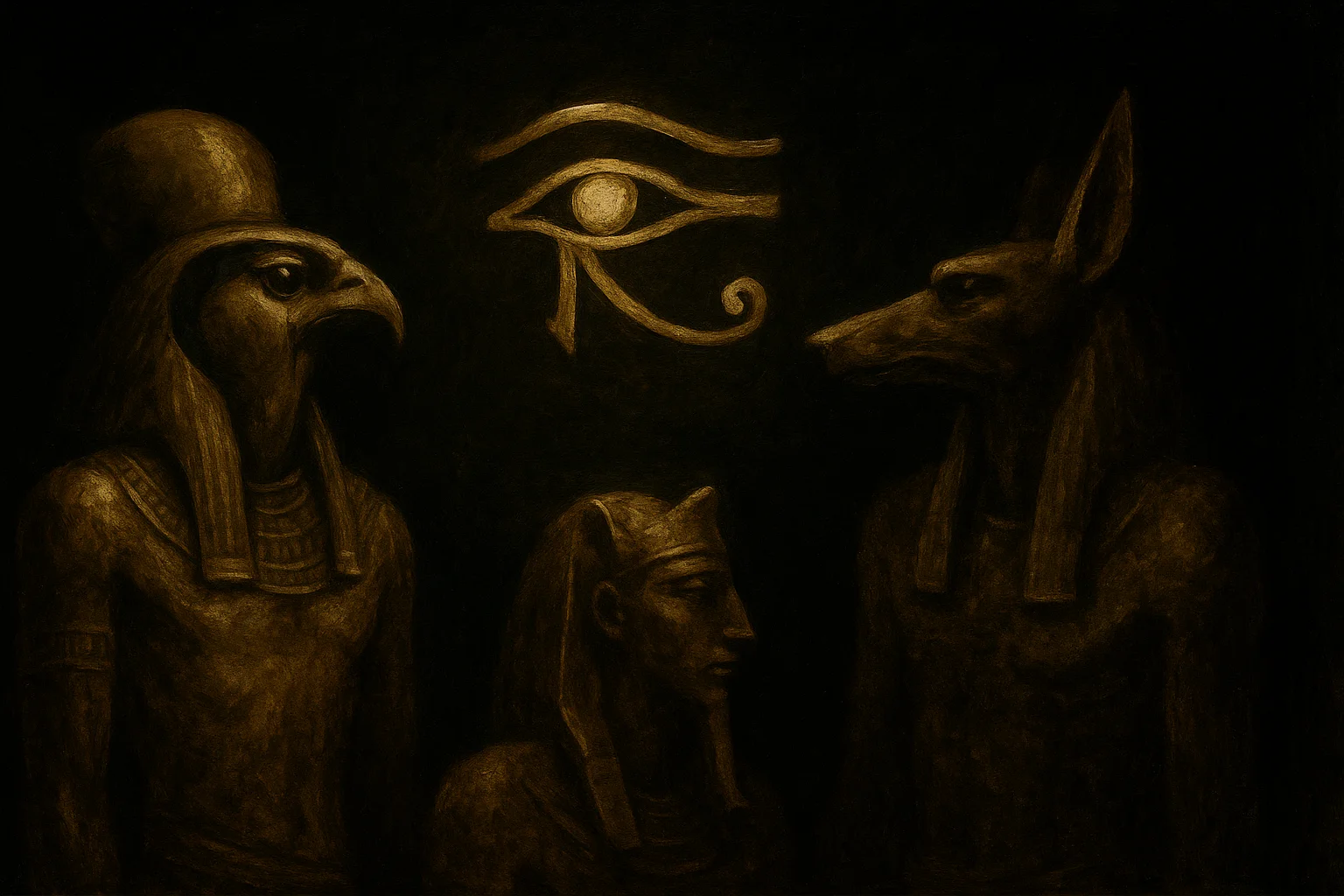
The Myth: Horus, Seth, and the Restored Eye
The Contest for the Throne
The origin of the udjat lies in the conflict between Horus and Seth for rulership of Egypt following the death of Osiris. The most complete narrative comes from Plutarch's De Iside et Osiride (sections 12-19), written in the first century CE but drawing on older Egyptian sources. After Seth murdered Osiris and usurped the throne, Horus, the son of Osiris and Isis, challenged his uncle's claim.
The contest took many forms across different periods. In some versions, the two gods engage in legal proceedings before a tribunal of Egyptian gods. In others, they fight directly. During one of these confrontations, Seth tears out Horus's left eye and scatters it in pieces across Egypt. The injury is not incidental: the eye represents Horus's power and legitimacy, and its destruction threatens his claim to kingship.
Thoth and the Act of Healing
Thoth, the god of wisdom, writing, and magic, gathers the scattered pieces and restores the eye to wholeness. The act of healing is described in the Pyramid Texts as snsn, "to make sound" or "to unite." Thoth's intervention transforms the damaged eye into the udjat, a symbol more powerful than the original because it has passed through destruction and been made whole again.
In some versions of the myth, Horus offers the restored eye to his dead father Osiris, who consumes it and is revived. This act establishes the udjat as a tool of resurrection, capable of restoring life to the dead. The eye becomes both a gift and a mechanism: it transfers vitality, heals wounds, and makes the incomplete whole. This mythological function explains its ubiquity in funerary contexts.
Primary Textual Evidence
Pyramid Texts and Coffin Texts
The earliest references to the Eye of Horus appear in the Pyramid Texts, inscribed inside the pyramids of Old Kingdom pharaohs beginning around 2400 BCE. These texts are not narrative myths but ritual utterances designed to ensure the king's resurrection and ascent to the sky. The udjat appears repeatedly as an offering presented to the deceased king.
Utterance 33 states: "O King, I have given you the Eye of Horus, that your face may be equipped with it." The eye is not merely protective but transformative, equipping the dead with the power to see and act in the afterlife. Utterance 258 describes the eye as "sound" and "complete," emphasizing its restored wholeness after the conflict with Seth.
The Coffin Texts, Middle Kingdom successors to the Pyramid Texts, expand the eye's function beyond royal resurrection. Spell 316 allows any deceased person, not just the king, to receive the udjat and its benefits. This democratization of funerary magic marks a shift in Egyptian religion, where symbols once reserved for royalty become available to anyone who could afford the proper burial.
The Book of the Dead
By the New Kingdom, the Eye of Horus appears in the Book of the Dead, a collection of spells written on papyrus and placed in tombs. Spell 140 specifically addresses the udjat, instructing the deceased to recite: "I am the Eye of Horus, the sound one." The spell identifies the deceased with the symbol itself, merging human and divine identity.
The text emphasizes the eye's role in navigation and vision in the afterlife. Without it, the deceased cannot see the path through the underworld or recognize the gods who judge them. The udjat grants not just protection but perception, the ability to comprehend and move through the dangerous geography of death.
The Udjat as Mathematical Notation
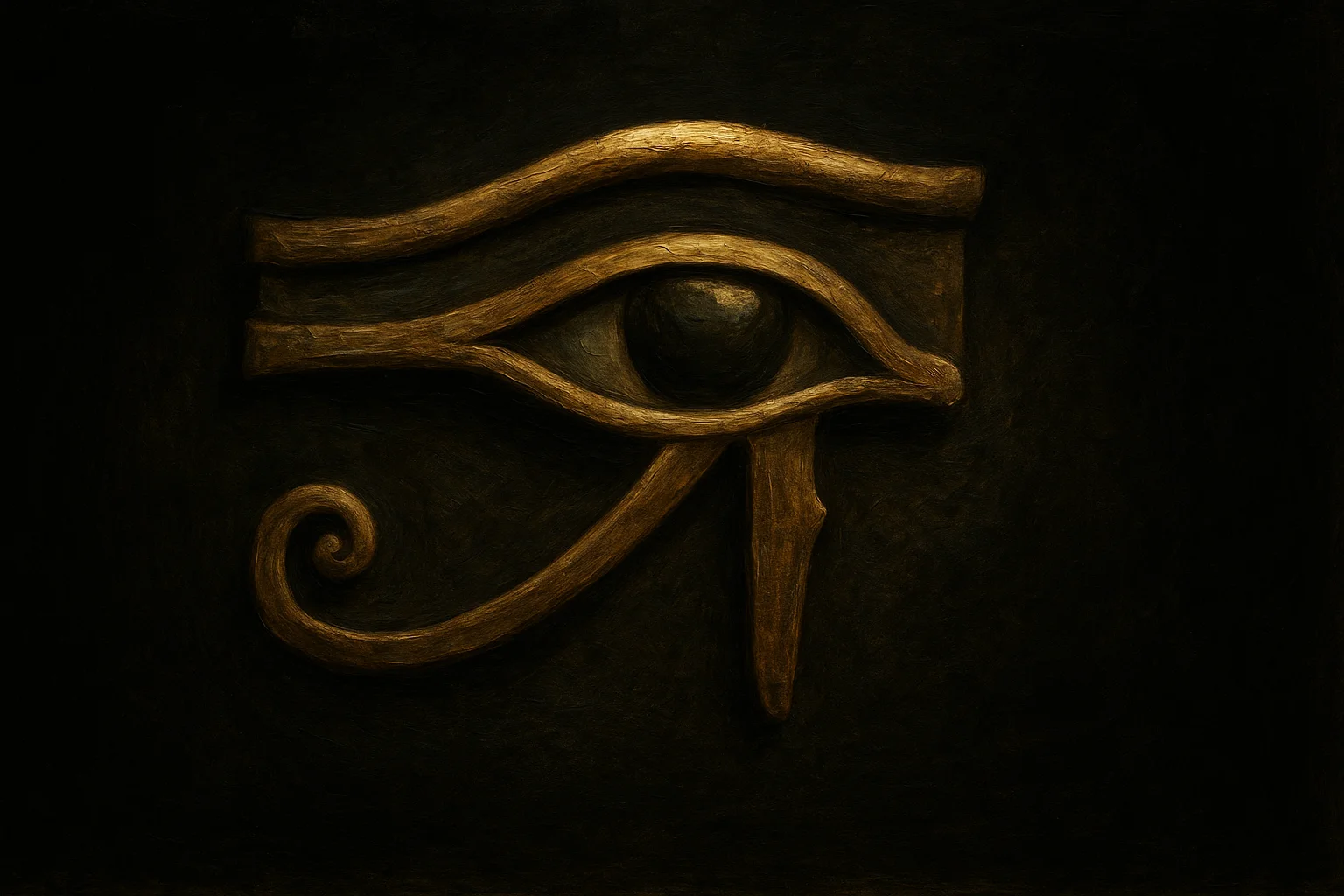
The Eye of Horus served a dual function in Egyptian culture: religious symbol and mathematical tool. Each part of the eye's iconography represents a fraction in the Egyptian system of mathematics in ancient Egypt, used primarily for measuring grain and other commodities.
- The right side of the eye: 1/2
- The pupil: 1/4
- The eyebrow: 1/8
- The left side of the eye: 1/16
- The curved tail: 1/32
- The teardrop: 1/64
These six fractions sum to 63/64, deliberately falling short of wholeness by 1/64. Thoth, according to tradition, supplies the missing fraction through magic, making the eye complete. This mathematical incompleteness and its magical resolution mirror the myth: the eye is damaged, restored, but requires divine intervention to achieve true wholeness.
Scribes used these fractional notations in accounting documents, particularly for measuring hekat, a standard unit of volume for grain. The connection between a sacred symbol and practical mathematics reflects the Egyptian worldview, where religious and practical knowledge were not separate domains but aspects of a single system of understanding.
Eye of Horus (Udjat)
Left eye of Horus torn out by Seth, healed by Thoth, represents the moon's phases and waxing/waning cycle, associated with healing and restoration, given as offering to the dead.
Eye of Ra
Right eye of Ra, never damaged, represents the sun's burning power, functions as a weapon sent to destroy enemies, associated with the goddesses Sekhmet and Hathor in their violent aspects.
Iconography and Visual Form
The standard depiction of the udjat combines human and falcon features, reflecting Horus's identity as a sky god who takes the form of a falcon. The eye itself is human in shape but includes the distinctive facial markings of a peregrine falcon: a dark teardrop line extending below the eye and a curved line sweeping back from the eye toward the ear.
These markings are not decorative but identificatory. They specify that this is the eye of Horus the falcon, not a generic human eye. The symbol almost always appears in profile, oriented to the viewer's right, representing the left eye of Horus, the one torn out by Seth. This specificity matters: the left eye is lunar, associated with the moon's phases and the cyclical nature of death and rebirth.
The udjat appears in multiple materials: painted on coffins, carved in stone, molded in faience, cast in gold. Size varies from tiny amulets worn on the body to large architectural elements on temple walls. The symbol's form remains remarkably consistent across three thousand years of Egyptian history, suggesting a standardized iconographic tradition maintained by scribes and craftsmen.
Use as Amulet and Funerary Object
Placement on Mummies
During mummification, embalmers often placed udjat amulets directly on the wrapped body or inserted them between layers of linen. The most common placement was over the incision on the left side of the abdomen, where embalmers removed the internal organs. The eye sealed the wound, protecting the body from violation and ensuring its wholeness in the afterlife.
Other amulets were placed near the heart, throat, or head. The positioning followed instructions in funerary texts, which specified where each protective symbol should rest. The udjat worked in concert with other Egyptian symbols like the ankh and scarab, each contributing a specific form of protection or power.
Ship Decoration and Daily Wear
Beyond funerary contexts, Egyptians painted the udjat on the prows of boats, where it served as a protective eye guiding the vessel and watching for danger. This practice extended beyond Egypt: Mediterranean sailors adopted the eye motif, and versions of it persist in modern Greek and Turkish fishing boats.
Living Egyptians wore udjat amulets as jewelry, particularly rings and pendants. These were not merely decorative but functional, believed to protect the wearer from illness, curses, and the evil eye. The symbol's association with healing made it appropriate for medical contexts, and some amulets include inscriptions requesting health or recovery from specific ailments.
Distinction from the Eye of Ra
The Eye of Horus is frequently confused with the Eye of Ra, but Egyptian texts treat them as distinct symbols with different mythological origins and functions. The Eye of Ra is the right eye, solar rather than lunar, and functions as a weapon. Ra sends his eye forth as a destructive force, often personified as the goddess Sekhmet or the cobra goddess Wadjet, to annihilate his enemies.
The Eye of Horus, by contrast, is passive and restorative. It does not attack but heals and protects. The lunar association connects it to cycles of renewal: the moon waxes and wanes, dies and is reborn, just as the eye is torn apart and made whole again. This cyclical pattern aligns with Egyptian concepts of death and resurrection, making the udjat appropriate for funerary use in ways the solar Eye of Ra is not.
Some confusion arises because both symbols can be depicted as eyes with similar markings. Context usually clarifies which eye is meant: if the text describes destruction or divine wrath, it is the Eye of Ra; if it describes healing, offering, or protection of the dead, it is the Eye of Horus.
The Udjat in Later Periods and Modern Reception
During the Greco-Roman period, the Eye of Horus merged with Greek and Roman protective symbols. Amulets from this era sometimes combine the udjat with Greek inscriptions or Roman iconography, reflecting the syncretic religious culture of Ptolemaic and Roman Egypt. The symbol's meaning remained consistent: protection, health, and wholeness.
In modern esoteric and New Age contexts, the Eye of Horus has been reinterpreted in ways that diverge from ancient Egyptian usage. It is sometimes conflated with the "all-seeing eye" of Freemasonry or described as a symbol of psychic vision or spiritual awakening. These interpretations lack basis in Egyptian texts, which consistently present the udjat as a tool of physical healing and funerary protection rather than mystical insight.
The symbol's visual appeal and association with ancient Egypt have made it popular in jewelry, tattoos, and graphic design. While these modern uses rarely reflect the symbol's original religious function, they demonstrate the udjat's enduring power as an image of protection and wholeness, a meaning that has persisted across millennia.
"O King, I have given you the Eye of Horus, that your face may be equipped with it, that the scent of the Eye of Horus may be toward you." Pyramid Texts, Utterance 33
Frequently asked questions
What does the word udjat mean in ancient Egyptian?
The word udjat derives from the Egyptian root wḏꜣ, meaning "sound," "whole," or "healthy," and refers specifically to the restored Eye of Horus after it was torn out by Seth and healed by Thoth. The term emphasizes the eye's state of completeness and wholeness rather than simply naming an anatomical feature. In Egyptian religious texts, wḏꜣ functions as both a noun and a verb, describing the act of making something whole or restoring it to health. The name itself encodes the symbol's primary function: to restore wholeness to what has been damaged, particularly the bodies of the dead.
Which myth explains the origin of the Eye of Horus?
The Eye of Horus originates in the myth of the conflict between Horus and Seth for the throne of Egypt after Seth murdered Osiris. During their contest, Seth tore out Horus's left eye and scattered it in pieces across Egypt, threatening Horus's claim to kingship. Thoth, the god of wisdom and magic, gathered the scattered pieces and restored the eye to wholeness, transforming it into the udjat. In some versions, Horus then offered the restored eye to his dead father Osiris, who consumed it and was revived, establishing the eye as a tool of resurrection and healing.
Where does the Eye of Horus first appear in Egyptian texts?
The Eye of Horus first appears in the Pyramid Texts, inscribed inside Old Kingdom royal pyramids around 2400 BCE, making it one of the earliest documented Egyptian religious symbols. These texts present the eye not as part of a narrative myth but as an offering given to the deceased king to equip him for the afterlife. Utterance 33 and Utterance 258 specifically describe the eye as "sound" and "complete," emphasizing its restored wholeness. Later texts, including the Coffin Texts and the Book of the Dead, expand the eye's use beyond royalty to any deceased person who could afford proper burial equipment.
How was the udjat symbol used in Egyptian mathematics?
Each part of the Eye of Horus iconography represents a specific fraction in the Egyptian mathematical system, used primarily for measuring grain and other commodities. The right side of the eye equals 1/2, the pupil 1/4, the eyebrow 1/8, the left side 1/16, the curved tail 1/32, and the teardrop 1/64. These six fractions sum to 63/64, deliberately falling short of wholeness by 1/64, which Thoth supplies through magic to make the eye complete. Scribes used these fractional notations in accounting documents, particularly when measuring hekat, a standard unit of volume for grain.
Is the Eye of Horus the same as the Eye of Ra?
The Eye of Horus and the Eye of Ra are distinct symbols with different mythological origins and functions, though they are frequently confused in modern sources. The Eye of Horus is the left eye, lunar in nature, torn out by Seth and restored by Thoth, functioning as a symbol of healing, protection, and resurrection. The Eye of Ra is the right eye, solar in nature, never damaged, and functions as a weapon sent forth to destroy enemies, often personified as the goddesses Sekhmet or Wadjet. Egyptian texts consistently distinguish between the two: the Eye of Ra appears in contexts of divine wrath and destruction, while the Eye of Horus appears in contexts of healing and funerary protection.
Why was the udjat placed on mummies and amulets?
The udjat was placed on mummies because it represented the restored wholeness necessary for resurrection, mirroring how Thoth healed Horus's damaged eye and how Horus used the eye to revive Osiris. Embalmers typically positioned udjat amulets over the incision on the left side of the abdomen where internal organs were removed, sealing the wound and protecting the body from violation in the afterlife. The eye's association with healing and its role in the Osiris myth made it essential funerary equipment, granting the deceased the ability to see, move, and comprehend the dangerous geography of the underworld. Living Egyptians wore udjat amulets as protection against illness, curses, and the evil eye.
Further reading on Mythologis
Free 25-page sample
Want the whole story?
Take the first 25 pages free. If it pulls you in, the full edition is yours as an instant PDF download, with a paperback on Amazon for selected titles.
Egyptian
The Egyptian Mythology Book: Ra, Osiris, Isis, Anubis, and the Sacred Stories of the Pharaohs
Ra, Osiris, Isis, Anubis, and the Sacred Stories of the Pharaohs
Three thousand years of Egyptian sacred stories. The Duat, the weighing of the heart, the cult of Osiris, and the daily voyage of the sun.
More from Egyptian
All articles
Egyptian
The Book of the Dead: Egypt's Guide to Eternity
Ancient Egypt's most sacred funerary text was not a single book but a living archive of spells, maps, and prayers that guided the dead through the perils between death and eternal life.
Egyptian
Eye of Horus: The Protective Amulet That Watched Over the Living and the Dead
Worn by pharaohs and fishermen alike, the Eye of Horus is one of antiquity's most potent protective symbols, carrying the weight of cosmic battle, divine healing, and eternal vigilance.

Egyptian
Ra the Sun God: Egypt's Supreme Ruler of Light and Creation
Ra, the ancient Egyptian sun god, blazed at the very heart of a civilization that worshipped light as the pulse of creation itself. Discover his origins, his many forms, and the sacred journey he took across the sky and through the underworld every single day.
Egyptian
The Ankh: Egypt's Eternal Symbol of Life
The ankh is ancient Egypt's most recognizable hieroglyph, a looped cross carried by gods and pharaohs alike as the very key to immortal life. Discover its origins, meanings, and sacred legacy.