

The Eye of Ra vs the Eye of Horus: Egyptian symbols of power, protection, and cosmic order
Discover how two of Egypt's most sacred symbols emerged from different myths but became intertwined in meaning: the Eye of Ra, instrument of divine vengeance, and the Eye of Horus, restored emblem of wholeness and healing. Learn their origins, symbolic power, and enduring cultural legacy.
Contents
The sun blazes across the sky. A golden eye opens. It sees everything below: the loyal, the treacherous, the hidden. This is the Eye of Ra, one of the oldest and most feared symbols in Egyptian religion. Yet centuries later, another eye emerges in the myths: the Eye of Horus, god of the sky and falcon hunter. Same symbol, different story. Same power, different meaning. Understanding both requires stepping into a world where eyes were not merely organs of sight but cosmic forces, divine weapons, and paths to wholeness.
The Egyptians did not think of symbols as decorative. They thought of them as alive. An image carved in stone or painted on papyrus did more than represent an idea; it was the idea, made real in the material world. The eye held this power absolutely. It could protect a household from harm. It could restore a broken body. It could strike down enemies. For over three thousand years, both Ra's eye and Horus's eye carried weight in Egyptian life, ritual, and spiritual practice.
Origins of the Eye of Ra: Instrument of Divine Vengeance
Ra, the sun god, commanded the most direct and undeniable power in Egyptian cosmology. Each dawn, he sailed his boat across the sky in his human or animal form, witnessing all that transpired below. His eye was his method of enforcement. When Ra grew angry, and the myths show he grew angry often, his eye became a weapon.
One of the most vivid accounts appears in the Contendings of Horus and Set, a papyrus text from around 1150 BCE, though the story itself is far older. In many versions, Ra sends his eye in the form of his daughter Sekhmet, a lioness-headed goddess, to punish humanity for plotting against him. Sekhmet becomes so consumed by bloodlust that she nearly destroys the entire human race. Ra must trick her into drunkenness to stop the slaughter. In other tellings, the Eye becomes Hathor, another of Ra's daughters, associated with love but equally capable of violence when channeling her father's wrath.
The Eye of Ra was not gentle. It was consequence. It was the solar heat that withered crops, the gaze that exposed lies, the fury that brought plagues. Ancient Egyptians understood the sun not as a benevolent nurturer but as a force that could sustain or annihilate depending on its mood. The eye embodied this duality. It was protective, no darkness could hide from the sun, but also aggressive, all-seeing, inescapable.

Depictions of the Eye of Ra typically showed a human eye marked with the distinctive cosmetic patterns of an Egyptian royal face, surrounded by a serpent or solar disk. Sometimes it appeared as a full solar disk with a serpent (the uraeus, a sacred cobra) coiled around it. The serpent itself was sacred: it represented the goddess Wadjet, another form of the Eye, and signified kingship and divine protection.
The Eye of Horus: Symbol of Restoration and Wholeness
Centuries into Egyptian history, another story began to rival Ra's in influence. This one centered on Horus, the falcon-headed son of Osiris and Isis. Where Ra's eye was an instrument of power and punishment, Horus's eye became something else: a symbol of healing, justice restored, and the cycle of death and renewal.
The story unfolds across the Pyramid Texts and later sources like Plutarch's account of Egyptian religion. Osiris was murdered by his jealous brother Set. Isis, grief-stricken, used her magic to resurrect Osiris long enough to conceive Horus in secret. Set then attacked the young god repeatedly, and in one crucial battle, tore out Horus's left eye. The left eye was damaged but not destroyed. Thoth, god of wisdom and magic, or in some accounts the goddess Hathor, restored it. The eye became whole again.
This restoration myth gave the Eye of Horus its meaning. It was not vengeance but wholeness recovered. It represented the triumph of order over chaos, the return of what was lost, the healing of wounds both physical and spiritual. In Egyptian legal tradition, the Eye of Horus symbolized the restoration of justice, the righting of wrongs.
The Eye of Horus was depicted similarly to the Eye of Ra: a human eye with distinctive markings. But its positioning and context differed. While Ra's eye radiated outward as a force of power, Horus's eye was shown in profile or frontal view, often placed over the heart or on amulets meant for personal protection and healing. The mark beneath the eye (the wedjat, or Udjat eye) became perhaps the most common protective symbol in all of Egypt, worn by everyone from pharaohs to laborers.

Symbolic Meanings: Vengeance versus Restoration
The two eyes came to represent different, sometimes opposite, aspects of divine order.
The Eye of Ra embodied:
- Divine sight and omniscience (the sun sees all)
- Solar power and cosmic order (ma'at, the principle of balance and justice)
- Aggressive justice: punishment, plague, annihilation
- Royal authority and dominion
- The heat of creation and destruction, necessary and terrible
The Eye of Horus embodied:
- Restoration and healing
- Personal protection and comfort
- The triumph of rightful order over usurpation (Horus's claim to the throne was just)
- Wholeness and completion
- Justice as restoration, not mere punishment
Yet the two were not always separate. As Egyptian theology evolved, and it evolved dramatically over three millennia, the boundaries blurred. Priests and scribes began to see the two eyes as expressions of a single cosmic principle viewed from different angles. Ra's eye was the instrument. Horus's eye was the result when justice was done correctly: order restored, wounds healed, the rightful heir enthroned.
The Wedjat Eye as a Unified Symbol
By the New Kingdom period (around 1550-1070 BCE), the distinction between Ra's eye and Horus's eye had softened in popular religion and amulet-making, though the mythological stories remained distinct. What emerged was the Wedjat eye (also spelled Udjat or Wedja), a symbol that combined elements of both and became the most ubiquitous protective emblem in Egypt.
The Wedjat eye appeared on amulets, in funerary art, painted on boats, inscribed in temple reliefs, and worn as jewelry. Egyptians believed it could protect the living and accompany the dead into the afterlife. Traders carried Wedjat amulets across the Mediterranean and into the Near East. The symbol was so effective, so trusted, that it survived the fall of pharaonic Egypt and appeared in Greco-Roman amulets centuries after the last temples were abandoned.
The Wedjat's power derived from its dual origin. It was protection because it invoked Horus's restoration and healing. It was power because it invoked Ra's cosmic dominion. Worn together, the two mythological narratives created something complete: a symbol that said, I see you. I protect you. I restore what is broken. I punish what threatens order.
Cross-Cultural Echoes: The Eye Across Mythologies
The Eye of Ra and Eye of Horus are distinctly Egyptian, but the archetype they represent appears across world mythology. Many cultures developed a belief that divine sight was an active, dangerous force.
In Hindu tradition, the third eye of Shiva functions similarly to Ra's eye: it is a force of destruction and purification, capable of annihilating entire worlds. The eye opens and cosmic order is restored through controlled chaos, not unlike Ra's periodic rages. In Mesoamerican religion, Tezcatlipoca, the Smoking Mirror god, sees all and punishes transgressions with the inevitability of Ra's gaze.
Greek mythology, by contrast, treated the eye more cautiously. The gaze of Medusa could turn men to stone, a dangerous passive power, but Greek gods rarely weaponized their sight in the way Ra did. This reveals something important: not all cultures saw vision as an inherently active force. The Egyptians did, and that shaped how they understood both divine power and protection.
Tattoo Symbolism and Modern Practice
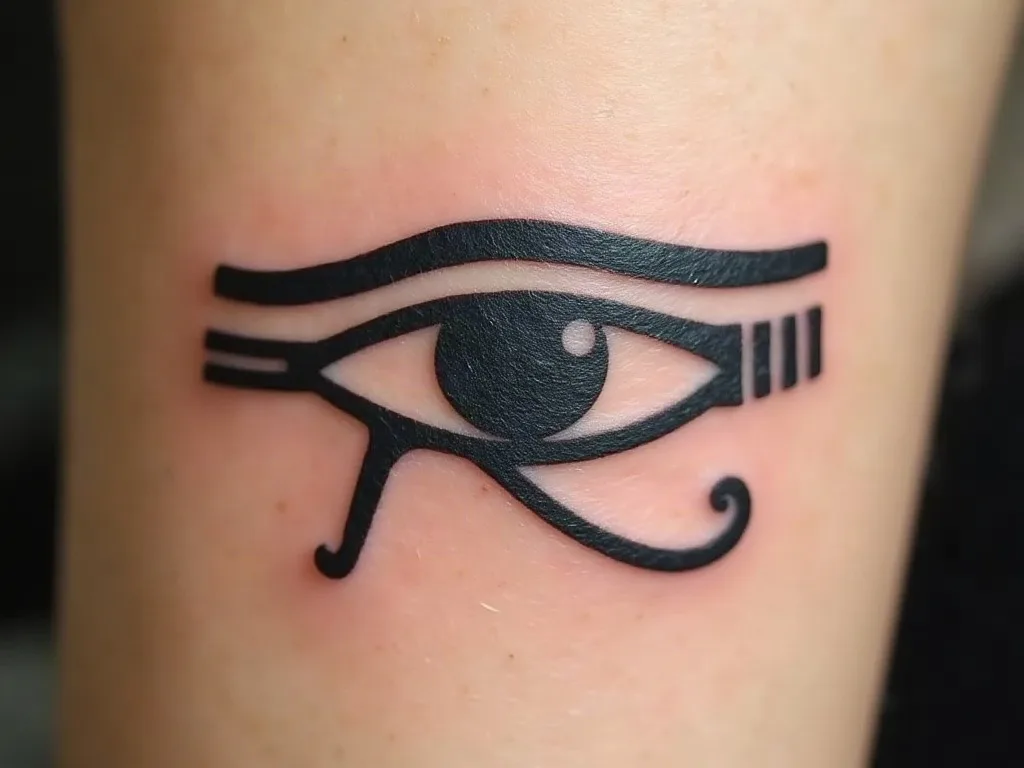
Today, the Eye of Ra and Eye of Horus continue to live in modern spiritual practice, tattoos, and esoteric symbolism, though often stripped of their original mythological context.
The Wedjat eye tattoo has become popular among people interested in Egyptian spirituality, protection, and healing. Many wearers choose it for its symmetrical beauty and its promise of restoration. Tattoo artists often depict it as a stylized human eye with the distinctive markings beneath: the stripe or tear-mark characteristic of Horus in his falcon aspect, combined with the cosmetic patterns associated with Ra's solar power. The symbol carries weight without demanding that the wearer fully understand the myths, it functions as a shorthand for "protection" and "inner sight."
The Eye of Ra tattoo appears less frequently in modern practice, though it is chosen by those drawn to solar symbolism, kingship, and commanding presence. It often appears paired with the sun disk or surrounded by radiating lines. Some esoteric practitioners associate it with enlightenment, divine will, and the ability to see truth clearly.
Neither symbol is inherently "darker" or "lighter" in modern use. The Eye of Ra's association with vengeance is often downplayed; instead, it is reframed as a symbol of clarity, sight, and power. The Eye of Horus is embraced for healing and protection, though its original context in a brutal battle for the throne is usually left unmentioned. Modern tattoo culture tends to prefer gentler narratives.
This is not a betrayal. It is continuity. The ancient Egyptians themselves constantly reinterpreted their symbols, blending different mythologies as their theology matured. A symbol carries what the user needs it to carry, provided it respects the source tradition's core meanings.
Scholarly Debates: When Did the Symbols Merge?
Egyptologists continue to study when and how the Eye of Ra and Eye of Horus became conflated in popular understanding and ritual practice.
One school of thought, represented by scholars like Henri Frankfort, argues that the merger was gradual and reflected genuine theological reasoning. As Ra and Horus were sometimes identified with one another in priestly theology (particularly during periods when the sun god was syncretized with other deities), their eyes naturally merged. By the Ptolemaic period (332-30 BCE), the distinction was largely academic; the common person encountered the Wedjat eye as a unified symbol.
Another view, held by some researchers of Egyptian popular religion, suggests that the merger happened primarily at the level of amulet-making and practical magic. Priests and craftspeople preserved the mythological distinctions in formal theology, but ordinary people, who wore amulets and left offerings, benefited from both eyes' powers by treating them as one. This would reflect a typical pattern in religious practice: the elite maintain doctrinal precision while the majority works with a simpler, blended understanding.
A third perspective, developed by scholars studying Egyptian funerary texts, points out that the two eyes served different ritual functions. The Eye of Ra was invoked in rituals of royal protection and cosmic order. The Eye of Horus was invoked in spells for personal healing and restoration. The texts themselves rarely confused them, even when both appeared in the same spell. What merged was not the myths themselves but their practical applications, people drew on both without needing them to be identical.
What is certain: by the time the temples fell silent under Christian rule and Islamic expansion, centuries of layered theology had made the Eye a symbol far more complex than any single myth.
The Eye in Temple Reliefs and Funerary Art
Carved and painted depictions of the Eye across Egyptian monuments reveal how the symbol operated in different contexts.
In temple reliefs, particularly in scenes of royal power and divine order, the Eye of Ra dominates. It appears in scenes of cosmic struggle where order is established through force. The sun disk with its radiating uraeus appears above pharaohs, legitimizing their rule as an extension of Ra's cosmic authority. These are not gentle images; they depict the enforcement of order.
In funerary art and tomb paintings, particularly from the New Kingdom onward, the Wedjat eye appears with greater frequency. Coffin lids, canopic jars (containers for mummified organs), and tomb walls bear the symbol. The intent is clear: the deceased, vulnerable and disoriented in the afterlife, needs protection. The eye watches over them. It heals the broken body. It restores what was lost.
Some of the most moving examples come from the tomb of Tutankhamun and from Deir el-Medina, the village where tomb workers lived. Ordinary people, not just pharaohs, surrounded themselves with the symbol. It was democratic in its reach: protection for the king, protection for the farmer, protection for the child.
Modern Reception and Continuing Power
The Eye of Ra and Eye of Horus have survived the fall of Egypt's temples and religions in ways that few other ancient symbols have. Why?
Partly it is aesthetic. Both eyes are visually striking and easily recognizable. A circle, a stripe, a few curved lines, and the symbol speaks. No complex narrative is required to appreciate its beauty.
Partly it is psychological. The symbol affirms a universal human need: to believe that seeing and being seen carry power. That protection exists. That wounds can heal. That order can be restored. These are not exclusively Egyptian concerns. They are human.
Partly it is historical. Egypt's spiritual tradition never fully died. The temples fell, but the symbols persisted through Greco-Roman syncretism, through Coptic Christianity's preservation of Egyptian language and imagery, and through the modern era's revival of interest in ancient Egypt. Each generation reinterpreted the symbols, but each maintained the core belief that the eye holds power.
In contemporary art, music, and esoteric practice, the Eye appears constantly. Beyoncé invoked it in visual symbolism. Tarot decks incorporate its image. Occult traditions from Freemasonry to chaos magic claim descent from Egyptian wisdom and use the eye as a symbol of illumination and power. These modern uses would likely baffle the ancient priests who carved the symbols into temple walls. Yet they would not surprise them. The Egyptians themselves constantly reimagined their symbols across centuries. They understood that a symbol does not contain a fixed meaning; it invites meaning.
Frequently asked questions about the Eye of Ra and Eye of Horus
Frequently asked questions
Are the Eye of Ra and Eye of Horus the same symbol with two names?
Not originally. Ra's eye was an instrument of solar power, punishment, and cosmic order. Horus's eye symbolized healing and restoration after injury. Over centuries of Egyptian history, particularly during the New Kingdom, they merged in popular understanding and amulet-making into the unified Wedjat symbol. But the myths remained distinct in formal theology.
What happened to Horus's eye, and why does it matter to the symbol's meaning?
In myth, Horus lost his left eye in battle against Set, his uncle, over the throne of Egypt. The eye was restored by Thoth or Hathor. This restoration myth gave the symbol its association with healing, wholeness, and justice. For Egyptians, a symbol drawn from a story of recovery was itself restorative.
Why did Egyptians believe the eye had power?
The Egyptians saw sight as an active force, not passive perception. Ra's eye did not merely see; it burned and punished. Light itself was understood as an agent of order and power. This belief shaped how they understood both divine authority and personal protection. The eye was the ultimate tool of enforcement.
Is it safe to wear a Wedjat eye tattoo if I am not Egyptian?
The symbol has been adopted globally and interpreted through many spiritual traditions. Scholars and contemporary Egyptian practitioners generally view respectful engagement with the symbol as honoring the tradition. The intent matters: wear it as a genuine connection to Egyptian cosmology and protection, not as a trendy design. The ancient Egyptians themselves constantly shared and reinterpreted their symbols across the Mediterranean and beyond.
Why is the Eye of Horus more common in modern amulets than the Eye of Ra?
The Wedjat eye, which merged both symbols, became the standard amulet form because it combined their powers: Ra's protective sight and Horus's healing restoration. For personal protection and healing, this unified symbol was more useful than invoking Ra's raw power, which was feared as well as revered. The symbol evolved to serve the needs of ordinary people, not just kings and priests.
Did the ancient Egyptians use the eye symbol in the way modern occult practitioners do?
Yes and no. Ancient Egyptians used the eye in amulets, carvings, and spells for protection and healing, much as modern practitioners do. But they understood it within a living religious tradition with priests, temples, and daily ritual. Modern esoteric use often extracts the symbol from that context and places it into new frameworks like tarot, chaos magic, or New Age spirituality. The symbol adapts, but the core belief in its protective power remains constant.
The Eye as a Living Symbol
What makes the Eye of Ra and Eye of Horus remarkable is not that they are ancient, but that they are still alive. Walk through Cairo today and you will see the symbol on amulets, painted on taxis, worn on jewelry. It has survived conquest, religious transformation, the rise and fall of empires, and the digital age. It survives because it answered a question that humans keep asking: How do we see truth? How are we protected? How is what is broken made whole?
The two eyes, one fierce, one healing, do not contradict these questions. They answer them from different angles. Ra sees all and enforces order through power. Horus sees truth and restores what was broken. Together, they describe a complete vision of cosmic order: power and compassion, sight and restoration, the fierce and the gentle working in concert.
The Egyptians understood that mythology was not history. It was a language for describing deeper patterns. The Eye, whether Ra's or Horus's, was a way of saying: This power is real. This protection exists. See clearly. Act justly. What is broken can be made whole.
That message does not expire.
Free 25-page sample
Want the whole story?
Take the first 25 pages free. If it pulls you in, the full edition is yours as an instant PDF download, with a paperback on Amazon for selected titles.

Mythology
The World Mythology Book: The Gods, Heroes and Myths of Every Culture
The Gods, Heroes and Myths of Every Culture, in One Volume
The whole of world mythology in a single volume: Greek, Norse, Egyptian, Japanese, Hindu, Celtic, Slavic, Mesoamerican and African myths gathered side by side, each drawn from the primary sources.