

Hachiman: The God of War, Virtues, and the Bow in Japanese Mythology
Discover how Hachiman, Japan's god of war and archery, evolved from an obscure local deity into one of Shinto's most beloved kami. Learn the myths, the samurai devotion, and why this war god champions virtue over violence.
Contents
The Hidden Prince Who Became a War God
Hachiman was not born into divinity. He began as a living boy, a prince whose name would reshape Japanese spirituality in ways no one could have predicted. Born in the 8th century to Emperor Shomu and Empress Komyo, this child would become one of Japan's most powerful kami, yet his rise to godhood offers no grand cosmic battle. Instead, it tells a stranger story: how mortals can ascend to the divine, and how a god of war can teach virtue instead of violence.
The Japanese Shinto tradition holds that kami are not distant, untouchable beings. They inhabit everything: mountains, rivers, trees, and crucially, exceptional humans. When a person of remarkable virtue or power dies, they may become a kami themselves. This happened to the boy who would become Hachiman. He was born in 725 CE, during Japan's Nara period, a time when the Japanese court was absorbing Buddhist philosophy even as Shinto worship deepened. His life, though brief and largely forgotten during his earthly years, would later be seen as a prelude to his transformation into one of Japan's eight million kami.
The road to godhood was neither swift nor obvious. It took centuries, a war, a Buddhist conspiracy, and a plague for this prince to fully emerge as Hachiman the war god. What makes his story unusual is that he never sought dominion over battlefields. Instead, samurai would later pray to him for protection, wisdom, and the virtue to wield power responsibly. A god of war who stood against unnecessary violence. That paradox defines him.
Origins: From Prince to Kami
The boy who became Hachiman was known in life as Prince Hachiman, or more formally, Emperor Sutoku... no, wait. That's a later confusion. Let me clarify the genealogy, because Japanese imperial history is deliberately obscure on this point.
The historical record shows that in 725 CE, a son was born to Emperor Shomu. Some sources call him Prince Todai; others blur the identity entirely. What matters is not his birth name but what happened after his death. By the Heian period (794-1185 CE), stories began to circulate that this prince had become something far greater: a kami who dwelt in a shrine in Usa, on the island of Kyushu. The Kojiki, Japan's oldest written mythology (compiled in 712 CE), makes no mention of him. The Nihon Shoki, the official historical chronicle, records him as a footnote. Yet by 740 CE, oracles were speaking of his presence.
The transformation crystallized in 749 CE. The emperor was casting the Great Buddha at the Todaiji Temple in Nara. This colossal image, still standing today, required enormous resources and faith. According to legend, the casting failed repeatedly. The metal would not set. Workers died in the heat. The project stalled. Then an oracle came: the kami at Usa Shrine had blessed the casting. Almost immediately, the metal flowed pure and hot. The Buddha was born. And the kami who had granted this miracle was hailed as a guardian of the imperial project itself.
That kami was understood to be the deified prince, now known as Hachiman.
The name itself reveals the layers. "Hachi" means eight, and "man" means ten thousand or banner. The "eight million kami" (yaoyorozu no kami) is Shinto's poetic way of saying that divinity pervades all things. So "Hachiman" can be read as "eight-bannered god" or as a reference to the fullness of the kami world. Over time, as his worship spread, he acquired the epithet Yawata no Kami (the kami of Yawata, his most famous shrine location), and his role solidified: he was the war god, but also the god of agriculture, silk production, and, most crucially, moral virtue.
The Syncretism: When War God Bows to Buddha
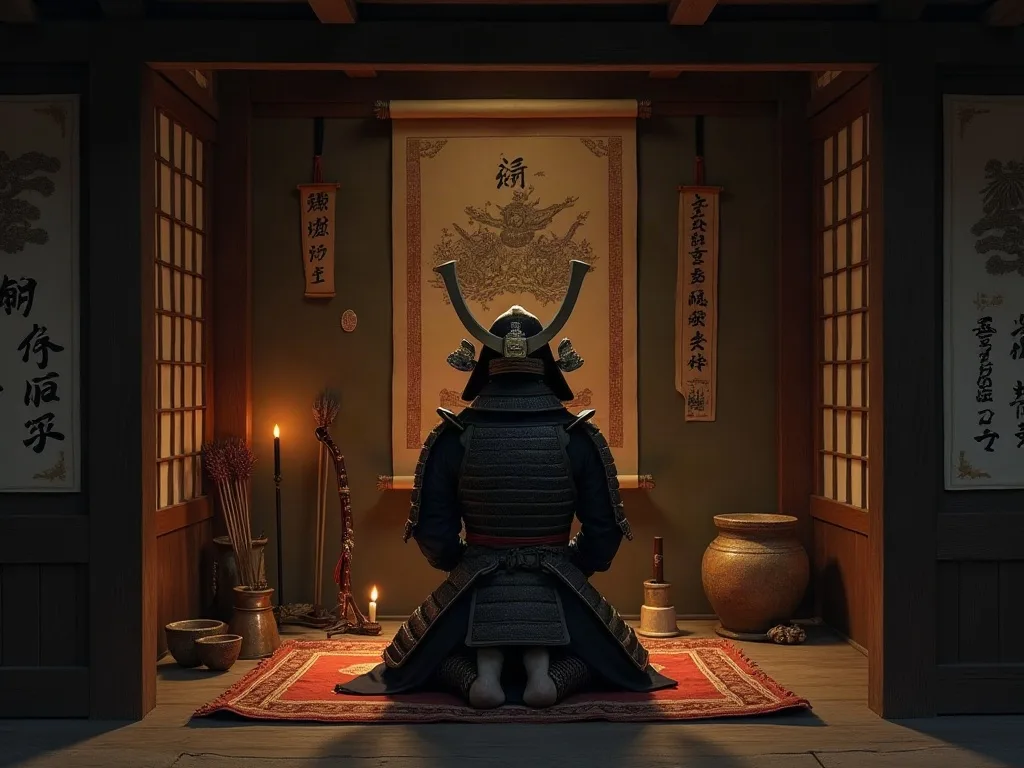
Here is something that startles Western readers: Hachiman was never purely Shinto. By the time his cult matured in the Heian period, Japan had already begun a centuries-long blending of Shinto and Buddhism. Temples were built next to shrines. Priests wore robes borrowed from Buddhist monks. And Hachiman was swept into this fusion.
Buddhism taught non-violence. It taught that killing, even in war, accumulated spiritual debt. Yet Japan was a warrior society. Samurai needed justification for their role. So the clever priests and monks engineered a synthesis: they declared that Hachiman was not merely a Shinto kami but a bodhisattva, a Buddhist being on the path to enlightenment. He was rebranded as a protector deity (deva) in the Buddhist pantheon. Some sources called him the reincarnation of a Buddhist saint. Others claimed he was an emanation of Amaterasu, the supreme sun goddess of Shinto, filtered through Buddhist philosophy.
This was not deception but pragmatism. Both Shinto and Buddhism claimed him because both traditions recognized that a god of war could also be a god of justice and protection. In warrior culture, these were not contradictions. A samurai was supposed to follow the code of bushido, which demanded loyalty, honor, discipline, and restraint. Hachiman embodied these virtues. He was the war god who taught that combat should be a last resort, undertaken only in defense of the righteous and the weak.
The Usa Shrine, his primary sanctuary on Kyushu, became the second-most important Shinto site after the Grand Shrine of Ise. Pilgrims traveled from across Japan to pray to him. Yet inside those shrine walls, Buddhist chapels stood. Monks chanted sutras alongside Shinto priests. This would have been scandalous in a purely orthodox Shinto context, but by the 10th century CE, syncretism was the norm. Hachiman sanctioned it, proving that divinity was large enough to contain contradiction.
The Samurai's God: War, Virtue, and Bushido
The rise of the samurai class in the 12th century transformed Hachiman from a court deity into a warrior's intimate companion. The samurai bushido code, codified centuries later but rooted in medieval practice, demanded absolute loyalty to one's lord, martial skill, and paradoxically, a contempt for cruelty. A true samurai was supposed to be as capable with a brush as with a sword. He was supposed to read poetry, compose music, and practice restraint.
Hachiman became the patron of this ideal. Every samurai of note maintained a shrine to Hachiman in his residence. Before major battles, warlords would dispatch emissaries to the Usa Shrine to request Hachiman's blessing. The famous samurai Minamoto Yoritomo, founder of the shogunate in 1185 CE, was said to be a direct descendant of Hachiman himself. This claim gave his dynasty spiritual legitimacy. His rival, Taira no Kiyomori, also invoked Hachiman's name, though with less success. The kami, it seemed, favored the Minamoto.
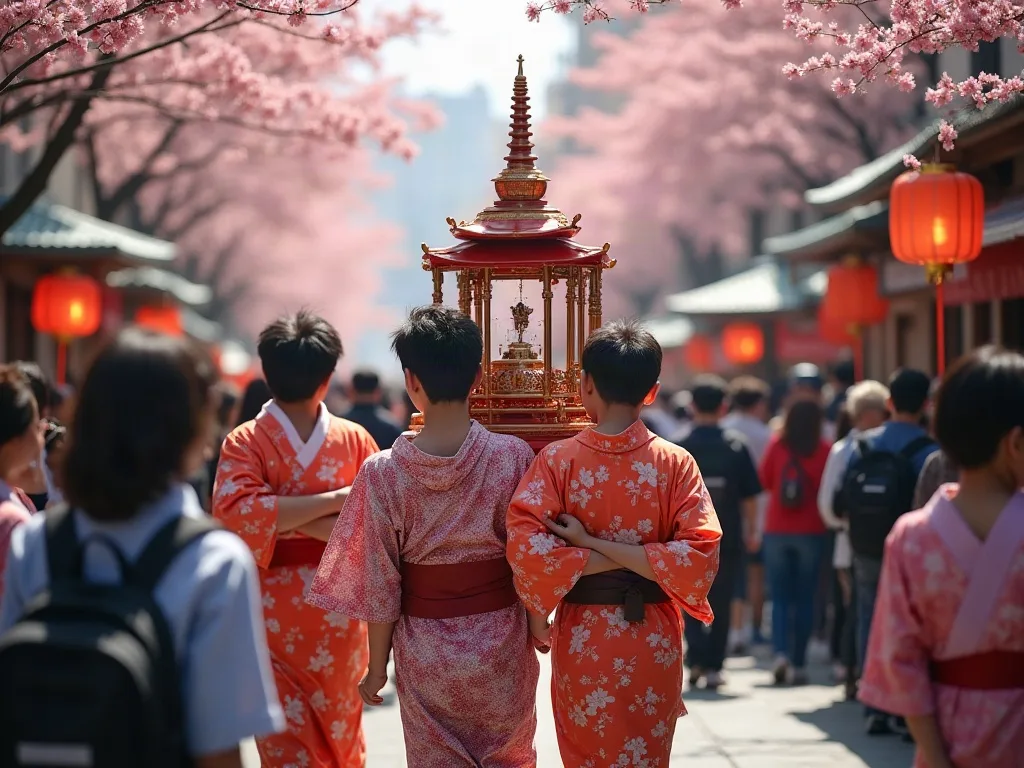
The most concrete expression of samurai devotion to Hachiman appears in hachiman matsuri, festivals celebrated at thousands of shrines across Japan. These festivals feature warrior processions, archery competitions, and ritual purifications. Young men carry portable shrines through the streets, dancing and shouting in synchronized bursts. The energy is controlled but explosive, channeling the warrior spirit into sacred performance. During the Edo period (1603-1868 CE), when the samurai class was at peace but culturally dominant, these festivals became social events where entire towns participated in honoring Hachiman.
The God of Bow and Arrow
Hachiman is consistently depicted with or associated with the bow and arrow. This is not metaphorical. In Japanese martial tradition, archery (kyudo) was not merely a practical skill but a spiritual discipline. An archer had to achieve mushin, or "no-mind," a state of meditation where the body moved without conscious thought. The arrow flew true only when the archer surrendered control. This Zen principle, grafted onto the warrior ethos, made archery a perfect vehicle for Hachiman's teaching: that true power lay not in force but in alignment with something larger than oneself.
Shrine icons typically show Hachiman as a youthful figure, sometimes dressed in imperial robes, sometimes in samurai armor. He carries a bow. In some depictions, he wears a crown and holds a sacred staff. But the bow is constant. It represents precision, patience, and the paradox of control through release.
The bow also connects Hachiman to one of Japan's oldest deities. Susanoo, the storm god and brother of Amaterasu, is famous for his association with the sword. But Hachiman's bond is with the bow, the weapon of precision rather than fury. This reflects a subtle hierarchy in Japanese martial values: the sword is raw power, but the bow demands finesse.
Shrines and Rituals: The Geography of Devotion
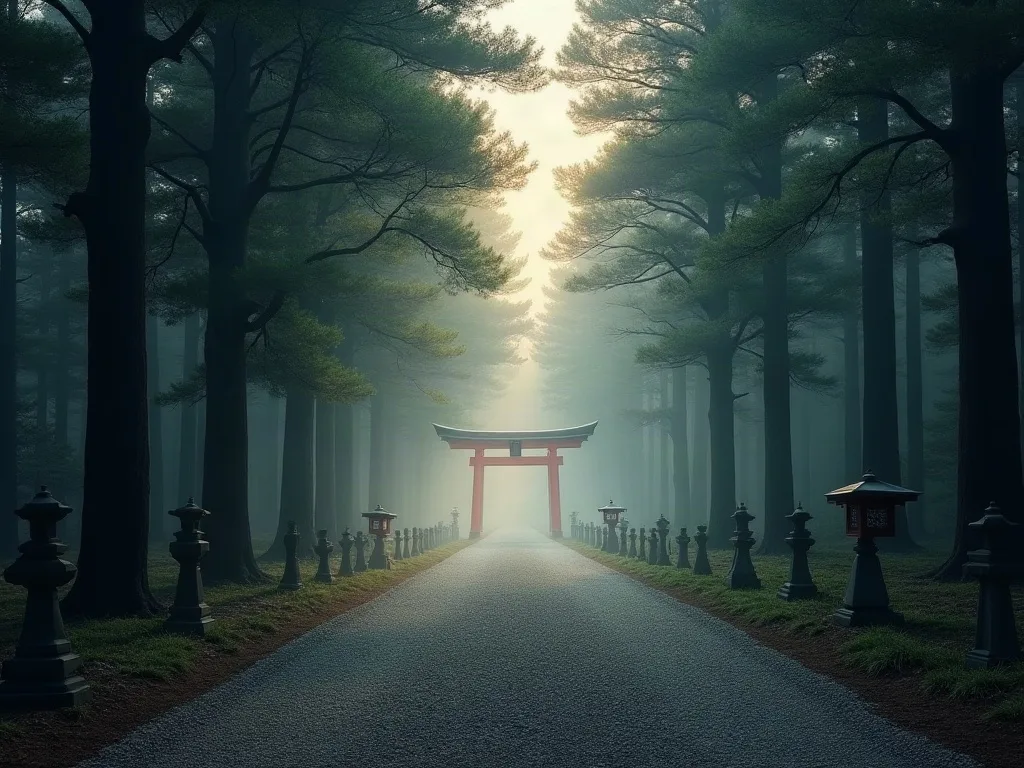
The Usa Shrine in Oita Prefecture remains Hachiman's primary sanctuary. Built by imperial decree in 725 CE, it is one of Japan's oldest religious sites, predating the establishment of the samurai class by centuries. The main hall stands within a forest of ancient cypress and cedar. The approach to the shrine follows a forest path, and pilgrims traditionally perform ritual purification at the entrance, washing their hands and mouth at a stone basin filled with running water. This misogi ritual removes spiritual pollution before entering sacred space.
Inside, the shrine maintains the classical Shinto architectural style: wooden beams, a thatched roof, simple geometric lines. Yet Buddhist elements are woven throughout. A bell tower stands near the main hall. Votive tablets inscribed with Buddhist prayers hang alongside Shinto ofuda (talismans). Priests in both Shinto and Buddhist robes move through the compound.
Smaller Hachiman shrines number in the thousands across Japan. Nearly every town has one. Urban shrines are often modest: a small wooden building tucked between modern apartment blocks, but immediately recognizable by the torii gate (the distinctive arched gateway marking sacred space) at the entrance. These shrines serve as neighborhood gathering points. During festivals, locals set up food stalls, and children run through the grounds in yukata robes. The sacred and the social blur seamlessly.
Rituals at Hachiman shrines follow a standard Shinto pattern. Visitors approach the altar, ring a bell to announce their presence to the kami, bow twice, clap twice, bow again, and make a silent prayer or spoken wish. Many pray for success in competitions, protection during travel, or strength before beginning a new undertaking. Children receive blessings for school entrance exams. Warriors historically sought blessings before battle.
The Kami's Interventions: Miracles and Manifestations
Japanese mythology does not present gods as distant judges. They intervene visibly, sometimes dramatically. Hachiman is recorded as manifesting in human form multiple times in medieval chronicles.
One famous incident involves the priest Gyogi, an influential Buddhist monk in the 8th century. According to tradition, Gyogi was constructing temples and helping to integrate Buddhism into Japan's spiritual landscape. He was also advocating for Buddhist ideas in the court. The story goes that Hachiman, in the form of an old monk, appeared to Gyogi and blessed his work, indicating that Buddhism and the kami realm were not enemies but allies. This encounter, recorded in the Tontoku Denryakki and other medieval texts, helped legitimize Buddhist-Shinto syncretism.
Another key story centers on a plague that struck Japan in the 8th century. The court attributed it to offended kami, particularly Hachiman, who felt neglected. Once a grand shrine was built and proper rituals performed, the plague lifted. This narrative pattern, divine displeasure followed by ritual appeasement and restoration, appears throughout Japanese religious literature. It reinforces the idea that gods are not abstract but present and responsive to human action.
More unexpectedly, Hachiman is recorded as appearing in battle visions. Samurai commanders reported seeing a youthful figure in armor riding across the sky during crucial engagements, his presence understood as divine blessing. Whether literal or psychological, a warrior's conviction that Hachiman was present, these visions shaped behavior. They gave soldiers confidence and moral grounding.
Hachiman in Popular Culture: From Ukiyo-e to Anime
The transition from medieval devotion to modern cultural presence was seamless. By the Edo period, Hachiman had become a popular subject in woodblock prints (ukiyo-e). Artists depicted him in various forms: as a young noble, as a warrior in ornate armor, as a wise elder. These prints were mass-produced and affordable, bringing divine imagery into ordinary homes. Families would buy a print of Hachiman and hang it near the entrance, invoking his protection.
In contemporary Japan, Hachiman appears in anime, manga, and video games. The shrine culture remains vibrant. Millions visit Hachiman shrines annually. Yet in popular fiction, he often appears as a background figure or as a source of mystical power. Recent anime series set in the present day occasionally feature a character discovering that they have Hachiman's favor or that a local shrine houses his presence. These adaptations strip away historical context but preserve the core idea: Hachiman is a god who manifests in the world, who takes sides, and whose blessing confers both power and responsibility.
The Studio Ghibli films, while not explicitly centered on Hachiman, draw heavily from the aesthetic and spiritual atmosphere of Japanese shrine culture. The reverence toward kami, the blend of the mundane and supernatural, the sense that divinity dwells in specific places and moments, all of this echoes Hachiman's world. Hachiman himself does not appear in these films, but his presence is implicit in the way sacred space is treated.
In video games, Hachiman often appears as a legendary weapon, a shrine guardian, or a summonable ally. Players invoke him for protection or strength. This is a modern remix of ancient practice: the ritual form changes, but the impulse, to call upon a protective deity in moments of need or challenge, remains unchanged.
The Paradox of a War God Who Teaches Peace
Here lies the deepest layer of Hachiman's mythology. In Western tradition, war gods are typically aggressive, bloodthirsty, demanding. Ares in Greece embodies chaos and slaughter. Hachiman is different. He teaches that war is sometimes necessary but never desirable. The ideal warrior is not the one who loves combat but the one who masters combat and chooses restraint.
This reflects a broader Japanese philosophical principle rooted in Zen Buddhism and Confucianism: that true strength lies in control, not in the display of force. A warrior who has mastered the bow does not need to fire. His competence is evident. His restraint is his power.
Hachiman also differs from other war deities in his patronage of productive skills. He is not only a god of archery and strategy but of agriculture, silk production, and craftsmanship. This dual nature, warrior and cultivator, suggests that Hachiman embodies not conquest but the protection of civilization itself. He defends the farmer so the farmer can grow rice. He protects the silk worker so garments can be made. War, in this framework, is infrastructure for peace, not an end in itself.
This philosophy had real consequences in samurai ethics. A samurai who served Hachiman was supposed to be capable of violence but reluctant to employ it. Loyalty to one's lord was paramount, but loyalty without cruelty was the ideal. In practice, samurai culture was rife with brutality, but the mythology consistently pulled toward restraint and virtue.
Hachiman and the Broader Kami Pantheon
Hachiman occupies a unique position in Shinto because he is a kami who ascended from mortality. Most major kami in the Shinto tradition are primordial beings, present at the creation of the islands of Japan. Amaterasu, the sun goddess, is one of the first beings to emerge in the cosmological account given in the Kojiki. Susanoo, the storm god, is her brother. These are cosmic figures.
Hachiman is different. He was born. He lived. He died. Then he ascended. This trajectory makes him more relatable and, in some ways, more powerful. He proves that divinity is not limited to primordial beings but can emerge from human virtue. This has profound spiritual implications: it means any human, through exceptional action or virtue, might become a kami. It blurs the boundary between mortal and divine.
Other kami have also undergone deification, but none with Hachiman's cultural persistence. Tenjin, another deified human (the scholar-politician Sugawara no Michizane), shares this trajectory, but Tenjin's cult, while significant, is more specialized. Tenjin protects scholars and students. Hachiman's reach is broader: warriors, farmers, mothers seeking protection for their children, craftspeople, and anyone seeking protection during times of transition or challenge.
Hachiman's Contested Identities: Which God Is He Really?
One of the most interesting scholarly debates around Hachiman concerns his true nature. Different regional cults emphasized different aspects. In some regions, Hachiman was primarily a war god. In others, an agricultural protector. In still others, a guardian of children or a healer.
Some historians argue that Hachiman is not a single coherent kami but a fusion of several regional deities and legendary figures, all gradually absorbed into a single cult by imperial decree and priestly organization. By this reading, the "historical prince" may be largely fictional, a later invention designed to give Hachiman a genealogy that would cement his position in the Shinto hierarchy.
Other scholars, working from shrine records and Heian-period texts, argue that Hachiman was indeed a deified imperial child, but that the stories about him were elaborated and mythologized over centuries. His "true" identity, whether as prince, as agricultural deity, as kami, may be unknowable, buried under layers of religious and political reinterpretation.
What is undeniable is that Hachiman was useful. He served the needs of an expanding imperial state, provided a kami that samurai could adopt as their own, and offered a model of virtue that transcended the purely martial. Whether or not he was a "real" person, he became real in Japanese consciousness.
The Modern Shrine: Hachiman Today
Walk into a contemporary Hachiman shrine and what strikes you is not the age but the continuity. The ritual forms remain largely unchanged. Visitors still perform purification. They still make offerings, coins or, increasingly, yen notes. They still draw fortune-telling papers (omamori) from boxes. Families bring newborns for blessing. Young people come before exams or job interviews.
The aesthetics have shifted slightly. Some shrines now have websites. QR codes link to digital offerings. Yet the core remains untouched. Hachiman is still a god you call upon. Still a presence in specific space. Still accessible to ordinary people.
What has changed is the diversity of prayer. In medieval times, most who prayed to Hachiman were warriors or those connected to the warrior class. Today, a shrine visitor might be a businessperson seeking clarity before a major decision, a student before college entrance exams, a mother praying for her child's safety, or a tourist curious about tradition. Hachiman has become democratized without losing his symbolic weight.
Frequently Asked Questions About Hachiman God of War
Frequently asked questions
Is Hachiman the same as Yawata?
Not exactly. Yawata refers to the geographical location of his most famous shrine, in Kyushu. Hachiman is the kami's name. But "Yawata no Kami" (the kami of Yawata) is a common epithet, so the terms are often used interchangeably. Different regions called him by slightly different names, but Hachiman eventually became the standard across all shrines.
Was Hachiman a real historical person?
The historical evidence is contested. Court records from the Nara period mention a prince connected to the casting of the Great Buddha and to the oracle at Usa, but the details are fragmentary. By the Heian period, religious texts had elaborated his life into a full legend. Scholars disagree on whether he was a specific individual or a composite figure, but what matters spiritually is that he was understood as human-become-divine, a model of deification through virtue.
Why is a war god also an agricultural deity?
In Japanese philosophy, war and cultivation are linked. A warrior protects the conditions for peace and productivity. Hachiman's dual role reflects the idea that strength without purpose is pointless. He guards the farmer so crops grow. He protects the nation so arts and crafts can flourish. This integration of martial and peaceful virtues is central to bushido ethics and to Hachiman's spiritual function.
Do people still pray to Hachiman in modern Japan?
Yes, extensively. Millions visit Hachiman shrines annually. People pray for protection before travel, for success in exams or work, for the health of children, and for guidance during transitions. The shrine culture remains vibrant. The ritual forms have barely changed in centuries, though digital elements are slowly integrating into shrine practice.
How is Hachiman different from Western war gods like Ares or Mars?
Hachiman emphasizes virtue, restraint, and protection over conquest and bloodlust. He is a god who teaches that true power lies in control. Ares in Greek tradition is associated with chaos and the brutality of battle. Mars in Roman tradition is more aligned with strategy and state power. Hachiman stands apart by embodying both martial skill and an ethical framework that privileges peace when possible.
Why is Hachiman venerated in both Shinto shrines and Buddhist temples?
From the 8th century onward, Japan developed Buddhist-Shinto syncretism (shinbutsu-shugo). Hachiman was declared a bodhisattva, a Buddhist protective deity, as well as a Shinto kami. This allowed him to serve both traditions and made sense theologically: both Buddhism and Shinto could recognize him as a guardian. The practice was officially outlawed during the Meiji Restoration (1868), but many shrines retained Buddhist elements as cultural heritage.
Hachiman's Unfinished Presence: From Medieval Shrine to Digital Age
What makes Hachiman's story compelling is not its conclusion but its ongoing evolution. He is not a myth that ended centuries ago. He is actively worshiped, constantly reinterpreted, appearing in new cultural forms while maintaining his essential identity as a protective, virtuous presence.
In recent decades, Japanese popular culture has increasingly mined Shinto mythology for characters and concepts. Manga and anime set in contemporary Japan frequently feature shrine visits, kami encounters, and invocations of divine protection. Hachiman has appeared in multiple anime and game franchises, usually as a guardian figure or as a source of spiritual power. His image as a young warrior in traditional garb translates seamlessly to visual media.
Yet these adaptations often strip away the philosophical depth. They retain Hachiman as a cool or powerful character but lose the connection to bushido ethics, to the integration of war and peace, to the idea that power demands restraint. A modern viewer might see Hachiman as simply the god who gives the protagonist strength, without understanding that in traditional belief, Hachiman's blessing includes a moral obligation.
This gap between ancient meaning and contemporary use is not unique to Hachiman or to Japanese mythology. It happens whenever ancient traditions enter popular culture. But it also suggests an opportunity: readers who encounter Hachiman in anime or games might be curious about the actual history, the real shrine practices, the philosophical framework that gave him coherence across centuries. That curiosity is the bridge between past and present, between mythological depth and cultural vitality.
Free 25-page sample
Want the whole story?
Take the first 25 pages free. If it pulls you in, the full edition is yours as an instant PDF download, with a paperback on Amazon for selected titles.

Mythology
The World Mythology Book: The Gods, Heroes and Myths of Every Culture
The Gods, Heroes and Myths of Every Culture, in One Volume
The whole of world mythology in a single volume: Greek, Norse, Egyptian, Japanese, Hindu, Celtic, Slavic, Mesoamerican and African myths gathered side by side, each drawn from the primary sources.