

Hecate, Goddess of Magic: Crossroads, Torches, and the Triple Moon
Hecate rules where roads split, where the living brush against the dead, and where magic has always lived. A deep guide to her origins, symbols, cults, and enduring power across mythology and modernity.
Contents
Three torches cut the dark at the crossroads. The dogs have started howling, the way dogs howl at nothing visible, and the smell of torches mingles with the cold earth smell of a road going three ways at once. Hecate, goddess of magic, stands there not as a horror but as a guardian: she holds the light precisely because the dark is real.
She is one of the oldest presences in Greek religion, old enough that Hesiod, writing in the eighth century BCE, placed her above the Olympian order in certain respects. In the Theogony, he describes her as a Titan's daughter honored by Zeus himself, a deity who could grant or withhold success in every domain from war to athletics to fishing. That breadth of power is the first surprise to readers who know her only as a witch-goddess lurking in horror films. The second surprise is the warmth Hesiod attributes to her: she is a nurse of youth, a companion to mortals, someone who appears at your side when you need luck.
The colder, more liminal Hecate emerged in later poetry and cult, as Athens codified its boundaries between living and dead, between civic space and wild space, between the known and the unknown. Both versions are true. Both are hers.
Her Origins: Titan Blood and a Unique Position in the Greek Cosmos
Hecate's parentage places her outside the standard Olympian genealogies that run through Zeus and Hera. Hesiod names her parents as the Titans Perses (a god of destruction or perhaps of shining light, the name is ambiguous) and Asteria, whose name means "starry one." Asteria was herself a goddess of falling stars and nocturnal oracles. She later transformed into the island of Delos to escape Zeus, which means Hecate's family tree is entangled with the very landscape of the Aegean.
The Titan lineage matters for several reasons. It explains Hecate's enormous scope: the Titans predated the Olympian division of cosmic labor, and Titan-born deities often held broad, undivided power over multiple spheres. It also explains her strange position in Zeus's cosmic order: she was never defeated in the Titanomachy. Hesiod is explicit that Zeus honored her above all others, because she was already a figure of power before the Olympians consolidated their rule. She was neither Olympian nor enemy. She was older, and Zeus was wise enough not to challenge her.
Some later traditions, particularly in the Orphic texts, made Hecate a triple goddess at the level of cosmic principle, a figure who presided over the phases of the moon alongside Artemis (waxing) and Selene (full), with Hecate herself governing the waning and dark moon. This lunar triple cannot be found cleanly in Hesiod or Homer, but it was firmly established by the time of the Chaldean Oracles in the second century CE, a Neoplatonic text that elevated her to the World Soul.

Her name's etymology has been debated for centuries. One influential reading connects Hekate to the Greek hekatos, meaning "far-reaching" or "far-darting," the same root used as an epithet for Apollo. This would make her name mean something like "she who works from afar," appropriate for a goddess of magic that operates at a distance. Another reading connects it to hekaton, "one hundred," a term associated with multiplicity. Neither etymology is settled.
The Symbols of Hecate: Torches, Keys, Dogs, and the Crossroads
The visual language around Hecate is extraordinarily coherent across centuries of Greek art and text. Each symbol carries genuine theological weight rather than decorative convention.
Torches: She almost always carries two, one in each hand. The torch at a crossroads is not merely atmospheric. It was the instrument used in the Hekate Deipnon, the monthly ritual meal left at crossroads on the dark of the moon to honor her. The torches also connect her to the search: in the Homeric Hymn to Demeter, Hecate is the one who hears Persephone's cry and, carrying her torches, accompanies Demeter in the search for the abducted girl. She is the light that goes with you into dark places.
The Key: From Hellenistic and Roman-era imagery, Hecate is often depicted holding a large key or set of keys. This connects directly to her role as guardian of thresholds and gates, including the gate between the living world and the underworld. The key is not just symbolic. It implies the power to unlock, to permit passage, to grant access where others are barred.
Dogs: Hecate's sacred animal was the dog, particularly black dogs, which were sacrificed in her honor and which were believed to announce her presence when they howled at night. The association was ancient and widespread. Dogs in Greece were psychopomps by nature, creatures that accompanied the dead, lived at the margins of the home, and were trusted by neither the city nor the wilderness entirely. As a liminal goddess, she claimed the liminal animal.
The Crossroads (triodos or trioditis): Hecate's most persistent association is with the three-way crossroads, a place that belonged to no territory, where three roads met without belonging fully to any. This was where her shrines (hekataia) stood: small pillars or triple-faced statues installed at the junctures of roads. The three-faced form, called triformis in Latin sources, appeared from at least the fifth century BCE and showed three bodies or three heads radiating outward to watch all roads at once.
The Strophalos (Hecate's Wheel): This spinning wheel or labyrinthine whorl appeared in the Chaldean Oracles and later became a major magical symbol in Neoplatonic and later Western esoteric traditions. It represented the cycles of rebirth and the power of the goddess over time and fate.

Hecate and Persephone: The Witness at the Abduction
The Homeric Hymn to Demeter, composed sometime in the seventh to sixth century BCE, gives Hecate a specific and emotionally resonant role in the most important myth of the Greek underworld cycle. When Hades abducts Persephone and Demeter begins her frantic search, it is Hecate who first comes to Demeter.
The hymn says she heard Persephone's cry from her cave, but could not see who took her. She arrives holding torches. She accompanies Demeter to Helios, the sun god who sees everything, who then tells them the truth of what happened. Hecate's role here is significant: she is not the abductor, not the rescuer, not an Olympian arbiter. She is the witness who kept searching, the companion who brought light to someone else's grief.
After Persephone returns from the underworld, Hecate becomes her companion and attendant in some versions, a figure who stands near the queen of the dead, moving freely between the worlds. This association confirmed her position as a liminal goddess of the Greek underworld, a deity who could cross the boundary that killed mortals.
The friendship between Hecate and Persephone deserves more attention than it typically receives. These are two goddesses who both belong to dual realms: Persephone as both spring maiden and queen of the dead, Hecate as both nurturing guide and guardian of ghosts. They mirror each other across the threshold. For an equally complex goddess who straddles life and death in a different tradition, the Hindu Kali offers a striking parallel: fierce, dark, associated with cremation grounds, yet also a fierce protector of devotees.
Her Role in the Medea of Euripides and the Witch Tradition
The transition from Hecate the cosmic Titan to Hecate the patron of witchcraft is largely Euripides' work, or at least his era's work. In Medea (431 BCE), Medea swears her most binding oath by Hecate, who she calls the mistress she honors most, the one who dwells in the inner hearth of her home. This is an intimate relationship, not a distant reverence. Medea is a priestess of Hecate as much as she is a princess of Colchis.
The Argonautica of Apollonius of Rhodes (third century BCE) develops this further. It shows the grove of Hecate where Medea works her magic, where the torches burn and the dogs circle. Hecate in these texts is the source of the witch's power: not just invoked symbolically but genuinely present, genuinely giving.
This patron relationship with mortal magic-workers was something that no other major Greek deity held so consistently. Circe in Homer's Odyssey (tenth century BCE in composition) is called a daughter of Helios but practices her craft in terms that later tradition consistently connected to Hecate. Apollonius explicitly makes Circe Medea's aunt, both of them in Hecate's lineage of power. By the Roman period, Virgil's Aeneid and Ovid's Metamorphoses had fully established Hecate as the presiding goddess of all magical practice in the classical imagination.
The Triple Goddess: Three Bodies, Three Faces, Three Realms
The triple form of Hecate (Hecate Triformis in Latin, Hekate Trioditis in Greek) is both one of her most famous attributes and one of the most misunderstood. It does not mean she is three separate goddesses. It means she faces all three roads at once: she sees every direction from the crossroads simultaneously.
Sculptors from the fifth century BCE onward depicted her as three women standing back to back, each facing a different road. Alcamenes, the Athenian sculptor, created such a figure for the entrance of the Acropolis, cited by Pausanias. This Hekate Epipyrgidia (Hecate on the tower) was one of Athens' most public divine presences.
The three-fold structure maps onto multiple cosmological frameworks:
- Sky, Earth, and Sea: the three domains Hesiod says she holds power over.
- Past, Present, and Future: the three temporal modes associated with prophecy, fitting for a goddess who sees from the crossroads.
- Waxing, Full, and Dark Moon: the Orphic-Neoplatonic lunar triad that connects her to Artemis and Selene.
- The Living, the Dead, and the Unborn: the three categories of existence at the threshold.
This multiplicity is not confusion. It is precision. Hecate governs the in-between, and the in-between is always facing more than one direction.
Hecate's Cult Practices: Deipna, Shrines, and the Thessalian Witches
Real worship of Hecate was widespread and local in ways that temples to Olympian gods often were not. Rather than a large centralized temple, her worship operated at the small-scale, intimate, nocturnal level.
The Hekate Deipnon (the "Hecate's Supper") was a monthly ritual held on the last night of the lunar month, the dark of the moon. Households would gather scraps of food, leftovers, egg shells, garlic, fish, and leave them at the nearest crossroads as an offering. The meal was also connected to purification: the household was sweeping out its spiritual debris, and Hecate was invited to carry it away. The dogs that gathered to eat the offering in the night were understood as her attendants.
Her shrines, hekataia, stood at nearly every doorway, crossroads, and city gate in the Greek world. Aristophanes mentions them casually enough that their presence was clearly unremarkable. This means Hecate was among the most physically present deities in daily Greek life, even if her literary profile was smaller than that of Zeus or Athena.
Thessaly, the region of northern Greece traditionally associated with witchcraft, was her primary cultic heartland in the popular imagination. Lucan's Pharsalia (first century CE) gives a vivid, terrifying account of the Thessalian witch Erictho, who calls on Hecate in forms that shift from beautiful to monstrous. This literary tradition reinforced the geography: Thessaly meant Hecate, and Hecate meant Thessaly.
In the Hellenistic magical papyri (Papyri Graecae Magicae, compiled roughly third to fifth century CE from Egyptian sources but saturated with Greek divine names), Hecate appears constantly. She is invoked for love magic, for protection, for curse-binding, for opening locked doors. The texts give her additional names: Ereschigal (a name borrowed from the Sumerian underworld goddess), Brimo (the "terrifying one"), Philerotes (lover of love), Propylaia (she before the gate). Each epithet reveals a different facet of her function.

Hecate Across Traditions: Echoes in Distant Mythologies
No mythology exists in a sealed room. Hecate's specific combination of attributes, a goddess who governs magic, the underworld threshold, the night, and protective liminality, has genuine parallels in traditions with no direct contact with Greece.
The Mesopotamian Inanna descended through seven gates to the underworld, and the figure of Ereshkigal who waited there held powers directly comparable to Hecate's gatekeeping function. The Chaldean Oracles, composed in Asia Minor in the second century CE, appear to have deliberately synthesized Hecate with Mesopotamian cosmological figures.
In the Slavic tradition, Baba Yaga occupies a structurally identical position: a female figure who lives at the boundary between the living world and the land of the dead, who controls passage, whose house stands on the crossroads of the worlds. She tests heroes, helps the worthy, destroys the foolish. She is accompanied by supernatural animals. She is not evil in the simple sense; she is the guardian of a threshold that has to be respected.
The Aztec Mictecacihuatl, the Lady of the Dead who ruled alongside Mictlantecuhtli and who watched over bones, offers another structural echo. These comparisons do not diminish any tradition. They reveal that human cultures at certain points of cosmological thinking tend to place a powerful female figure at the place where life and death meet, and they arm her with light and with danger in equal measure.
Hecate in the Chaldean Oracles and Neoplatonism
The most philosophically ambitious treatment of Hecate came not from a mythographer or a poet but from a second-century CE theurgic text known as the Chaldean Oracles, attributed to Julian the Theurgist. In this framework, Hecate became the World Soul (Anima Mundi), the divine intermediary between the transcendent Father-principle and the material world. She was the cosmic hinge.
Iamblichus and Porphyry, third and fourth century Neoplatonists, incorporated this Hecate into their philosophical theurgical systems. For Proclus in the fifth century CE, she was the governing principle of the sublunary realm, the sphere closest to earth, making her literally the goddess of the world as humans experience it. This elevated Hecate far beyond her popular image as a witch-goddess into the realm of metaphysics.
This Neoplatonic inheritance is the largely forgotten thread connecting ancient Greek cult to the Western ceremonial magic traditions of the Renaissance, the grimoire traditions of the seventeenth century, and eventually modern Wicca and neo-pagan revivals.
Hecate in Modernity: From Shakespeare to Neo-Pagan Revival
Hecate has never stopped working. Shakespeare gave her three appearances in Macbeth (c. 1606), where she appears as the queen of the witches herself, scolding the three Weird Sisters for acting without her knowledge. The speech is rich with classical atmosphere: the moon's vapors, her charmed drops, the very language of the Papyri Graecae Magicae filtered through Elizabethan drama.
William Blake depicted her in 1795 in a painting simply titled "Hecate," showing a massive, owlish, nocturnal figure surrounded by animals and open books, which now hangs in the Tate Britain. It is one of the most psychologically vivid images of her in Western art.
The modern Wiccan movement, established formally by Gerald Gardner in the 1950s, placed the Triple Goddess (Maiden, Mother, Crone) at the center of its theological structure, and Hecate as the Crone became a primary figure of worship in many Wiccan and neo-pagan traditions. The Charge of the Goddess and numerous contemporary rituals draw directly on her crossroads symbolism, her lunar cycle associations, and her sovereignty over magic.
Her presence in contemporary popular culture runs from the American Gods novel by Neil Gaiman (though she does not appear directly, her tradition shapes the atmosphere of every divine encounter there) to the television series Chilling Adventures of Sabrina, where she is named and invoked explicitly, to video games like Hades by Supergiant Games, where the crossroads setting is Hecate's territory by ancient right.
What persists across all these appearances is the specific quality Hesiod identified first: she is powerful, she helps those she favors, and she is to be respected rather than commanded. Witches who invoke her in fiction work best when they approach with an offering, not a demand. The ancient cult knew this. The modern imagination keeps rediscovering it.
Frequently Asked Questions About Hecate, Goddess of Magic
Frequently asked questions
What is Hecate the goddess of, exactly?
Hecate governs magic, witchcraft, the night, crossroads, thresholds, the moon (particularly the dark or waning phase), ghosts, and necromancy in classical Greek and Roman religious tradition. Hesiod's Theogony gives her a broader scope, including influence over war, athletics, fishing, and the rearing of children. Her domains shifted over centuries: early sources emphasize her cosmic breadth; later sources emphasize her liminal, nocturnal, and magical functions.
Is Hecate a good or evil goddess in Greek mythology?
Neither category applies cleanly. Hecate in primary sources is a goddess who grants success and protects those she favors. She governs dangerous territories, the crossroads, the dark of the moon, the threshold between living and dead, but so does a lighthouse govern dangerous shores. The association with evil is a later projection, driven partly by Roman authors who emphasized her terrifying aspects, and partly by Christian-era demonization of pagan night deities. In the Homeric Hymn to Demeter, she is a compassionate companion who helps Demeter find Persephone.
What is the Hecate Deipnon and how was it celebrated?
The Hekate Deipnon was a monthly purification and offering ritual held on the last night of the lunar month (the dark of the moon). Greek households collected food scraps, garlic, eggs, and other items and deposited them at the nearest crossroads as an offering to Hecate. The practice served a dual function: honoring the goddess and purifying the household by sweeping out accumulated spiritual pollution. The dogs that ate the food in the night were considered her sacred attendants.
Why is Hecate associated with the number three?
The triple association comes from her role as guardian of the triodos, the three-way crossroads, and from her cosmological function as a goddess who sees all directions simultaneously. Sculptors depicted her as three women back to back, each facing one road. The number three also maps onto her domain over sky, earth, and sea (Hesiod), over the three lunar phases in Orphic tradition, and over the three states of existence: living, dead, and unborn. The three-fold form is theological, not decorative.
What is the connection between Hecate and Medea?
Medea, the sorceress of Colchis, was Hecate's most devoted mortal servant in classical literature. In Euripides' Medea (431 BCE), Medea swears by Hecate as her most sacred oath. In Apollonius of Rhodes' Argonautica, Medea works her magic in a grove sacred to Hecate. The relationship is priestess-to-goddess: Medea's magical power derives from Hecate's patronage. This association made Hecate the defining divine patron of the witch figure in classical tradition, a role she retained through Roman literature and into the Renaissance.
What primary sources describe Hecate in detail?
The most important primary texts are: Hesiod's Theogony (lines 411-452), the earliest substantial literary account; the Homeric Hymn to Demeter (seventh-sixth century BCE), which places her alongside Demeter in the Persephone myth; Euripides' Medea (431 BCE); Apollonius of Rhodes' Argonautica (third century BCE); and the Papyri Graecae Magicae (third-fifth century CE), which preserve actual ritual invocations. The Chaldean Oracles (second century CE) represent the Neoplatonic philosophical elevation of Hecate to World Soul.
The Unresolved Question: Was Hecate Originally Greek?
One of the genuine open debates in classical scholarship concerns whether the cult of Hecate originated in mainland Greece at all. The earliest strong evidence for her worship comes from Caria, the region of southwestern Anatolia (modern Turkey), specifically from the sanctuary at Lagina, where her cult was deeply established and where major pan-Hellenic festivals were held in her honor as late as the second century BCE. The Lagina Hekataion produced some of the most elaborate sculptural friezes of her worship anywhere.
This Anatolian origin theory, developed by scholars including Walter Burkert and further refined by Sarah Iles Johnston in her 1990 study Hekate Soteira, suggests that Hecate entered the Greek pantheon from a Carian or Lydian source, perhaps as a local great goddess whose domain over all of nature was later compressed and specialized by Greek theological systematizing. The broad multi-domain power Hesiod attributes to her would fit a localized great goddess better than a specialist Greek deity.
If this is correct, it places Hecate in interesting company. Several Greek goddesses with unusually broad or structurally distinct profiles, including Aphrodite (Cypriot and Near Eastern antecedents) and Artemis herself, show signs of synthesis between Hellenic and Anatolian religious traditions. The crossroads-keeper who predated the Olympians may have arrived at those crossroads from a direction nobody has fully mapped.
This is not a settled question. But it is the right kind of open question: one that makes the goddess larger, not smaller, and that reminds us that every mythology sits at its own crossroads, drawing on roads that came from very far away.
Read the full book
Want the whole story?
The complete edition is an instant PDF download here, with a paperback on Amazon for selected titles.
Mythology
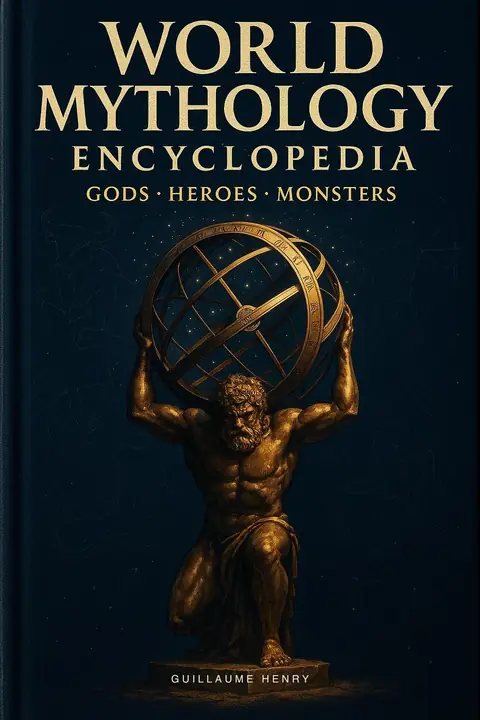
The World Mythology Book: The Gods, Heroes and Myths of Every Culture
The Gods, Heroes and Myths of Every Culture, in One Volume
The whole of world mythology in a single volume: Greek, Norse, Egyptian, Japanese, Hindu, Celtic, Slavic, Mesoamerican and African myths gathered side by side, each drawn from the primary sources.