
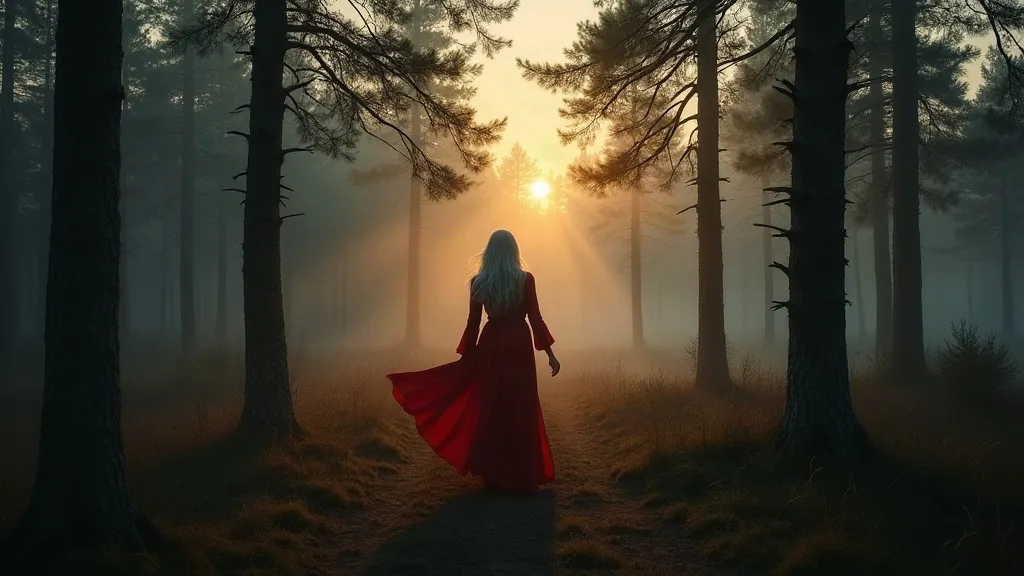
Huldra: The Forest Spirit Who Guards the Hidden Wild
Huldra is the beautiful and dangerous forest spirit of Scandinavian mythology, a woman who guards wilderness and livestock with allure and wrath. She appears throughout Norse sagas and medieval folklore as a test of virtue, a guardian of boundary, and a haunting vision of nature's hidden power.
Contents
Huldra steps from the forest. Her face is lovely, her long hair shines like silver birch. Then you see her back: where human skin should be, there is bark, or fur, or the trunk of a tree. Her tail, which she hides beneath her dress, thrashes when she turns. She is not quite human. She has never been quite human. And the forest is her domain.
The Huldra (sometimes spelled Hulder, from Old Norse hulda, meaning "hidden" or "covered") inhabits the deep forests of Scandinavia in myth and folk memory. She is a creature of profound ambiguity: beautiful seductress and vengeful spirit, guardian and predator, feminine and wild. Unlike the gods of Asgard or the giants at the edge of creation, Huldra belongs to no fixed cosmological tier. She emerges from the boundary between human settlement and untamed wilderness, and she moves across that boundary with ease, drawing humans into danger or testing their worth.
The figure did not originate in the written Eddas (the two main medieval collections of Norse poetry and prose, compiled in the 13th century long after paganism had faded). Instead, Huldra matured across centuries of Scandinavian oral tradition and folk practice, reaching her fullest form in medieval and early modern accounts. Yet her roots reach deep into pre-Christian Scandinavian culture: the impulse to personify wilderness, to give nature's hidden power a voice and a face, runs through all Norse tradition.
The Huldra's Origin: From Folk Memory to Written Record
No single Norse source text introduces Huldra as one introduces Odin or Loki. She was always local, always oral, always alive in the lived experience of Scandinavian people. Yet certain medieval texts and Scandinavian folk collections from the 16th century onward preserve her earliest recorded forms.
The figure appears scattered through Swedish folk traditions preserved in later printed collections. By the 1600s and 1700s, she was a standard figure in Scandinavian lore: the skogsrå in Swedish ("forest spirit"), the huldra in Norwegian and Danish, the hylde in older Danish forms. She was as real to rural communities as the wolves in the dark or the hunger of winter.
The Christian environment that swept across Scandinavia from the 10th century onward did not erase her. Instead, it transformed her. Pre-Christian wildness became something to be wary of, a temptation, a supernatural trap. Huldra's seductive beauty became coded as danger to Christian morality. Her connection to livestock and fertility was reinterpreted as theft or curse. Yet underneath these fears lay an older recognition: that wilderness is neither safe nor tame, that the forest harbors forces humans cannot fully control.
The earliest surviving written accounts of Huldra come from Scandinavian texts of the 16th and 17th centuries, particularly from Sweden. Swedish clergyman Johan Guse documented folk traditions that placed Huldra as a coherent entity. She was not a demon, in the Christian sense, but she was not human either. She dwelt in specific forests, often near particular mountains or water sources. She had preferences, moods, and a system of exchange with humans: offer her respect and sacrifice, and livestock might thrive; neglect or offend her, and she could take revenge.
This is not the mythological record of the ancient Eddas. It is something equally authentic: the mythology that lived in practice, in stories told by firelight, in protective rituals performed at the forest edge. By the time scholars began recording Scandinavian folklore in earnest (the 19th century onward), Huldra was already centuries old in her current form.
The Huldra's Appearance: Beauty and the Hidden Truth
The Huldra's appearance is her most defining feature, a visual code that tells the entire story of her nature at once.
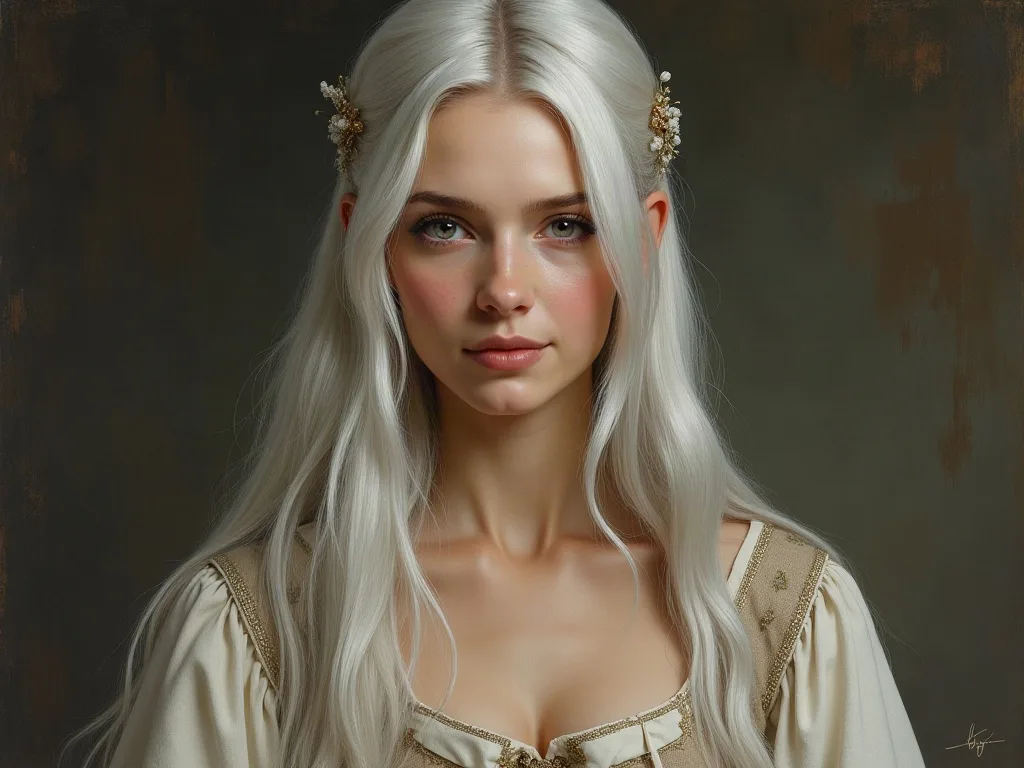
From the front, she is strikingly beautiful. She has the face of a human woman, often described as pale, luminous, almost too perfect. Her hair is long and luxuriant, often golden or silver. She dresses in the garments of a Scandinavian woman: a long dress, sometimes red or green, sometimes the white linen of an older tradition. She is young, often eternally young, with no mark of age upon her.
But turn her around, and the illusion breaks. Where her back should be, there is something other. In some versions, it is hollow, or wooden, like the interior of a tree. In others, she has a long tail, sometimes described as that of a cow or goose, which she carefully hides beneath her skirts. Some accounts say her back is furred like an animal. Others describe it as rough bark or moss-covered. A few versions claim she has a trollish or simian rear that she conceals with magic or clothing.
This duality is not arbitrary. It embodies the Huldra's entire being: beautiful on the surface (the face humans see, the seduction, the lure of the wild), but fundamentally inhuman beneath (the wilderness she truly is, the animal nature, the boundary she cannot fully cross). She can dress as a woman and speak as a human, but she cannot fully become human. She is forever marked as other.
Her tail, in particular, features heavily in Norwegian and Swedish folk tales. The tail is the giveaway. If a man sees or touches the Huldra's tail, the spell is broken. He cannot be seduced or controlled. Or perhaps he is already too far gone.
Some Scandinavian folk accounts describe Huldra with eyes that glow faintly in the dark, or with a faint animal musk about her. Others note that she has hooves instead of feet, hidden beneath her dress. Each variation served a purpose in the local culture: the glow kept travelers alert; the hidden hooves reinforced that this beautiful woman was not fully a woman; the smell was a marker of the wild, of the uncultivated.
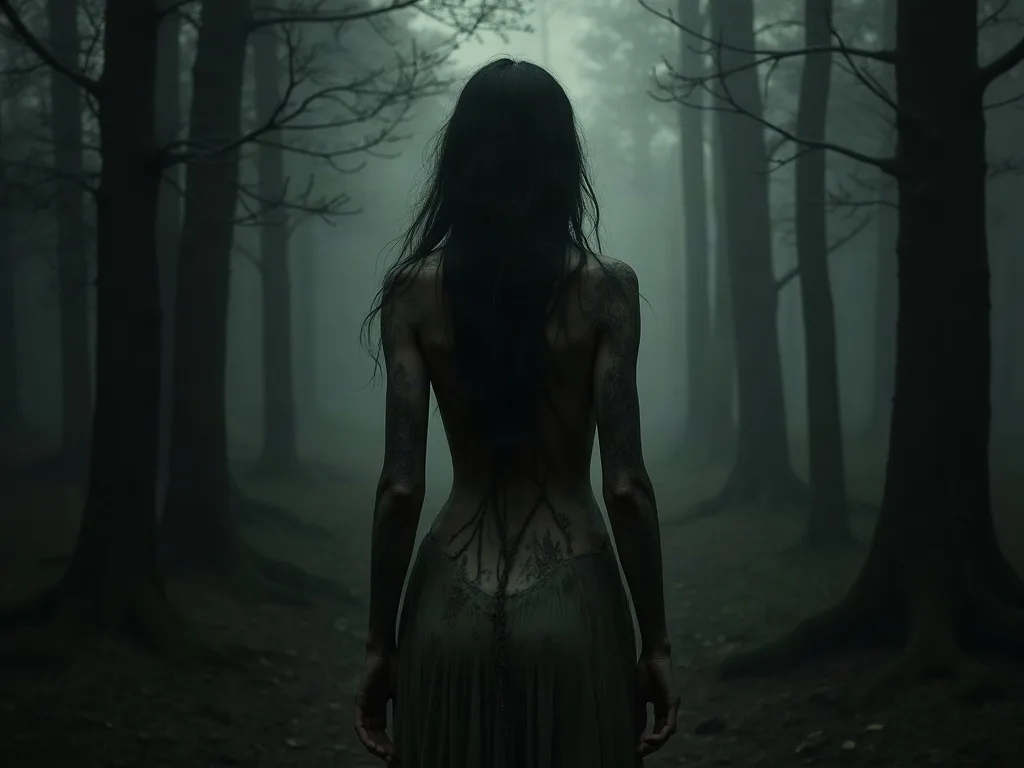
Huldra's appearance changed across regions and eras, but the core remained constant: a being whose beauty masks an inhuman nature, who can pass as human only from certain angles, whose true form is something other.
Huldra's Domain and Power: Guardian of Wilderness
Huldra is not a spirit of civilization. She dwells in the deep forests, in the mountains, in the wild places that Scandinavian culture marked as dangerous and sacred simultaneously. She is the skogsrå, the "spirit of the forest," and like the forest itself, she is both abundant and hostile.
Her primary domain is livestock. Huldra tends to cattle and goats in the summer pastures (the high meadows where Scandinavian herders grazed their animals during warm months before driving them down for winter). She is a keeper of these creatures, a guardian who ensures they grow fat and healthy, or a threat who steals them away. The relationship between humans and Huldra was transactional and contingent: she expected respect, offerings, acknowledgment of her authority over the wild spaces where human animals grazed.
Scandinavian folk traditions recorded specific practices to honor or appease Huldra. Butter was left for her at the boundary of the forest. First milk was poured as an offering. Some accounts describe a ritual where the herds master would formally address the skogsrå, acknowledging her mastery and requesting her permission to graze in her lands. Failure to perform these rituals could result in animals going missing, becoming sick, or straying into danger.
Huldra's power extends beyond herding. She is associated with fertility and abundance, but in a wild, uncontrolled sense. She is connected to pregnancy and childbirth; some Norwegian folk traditions describe her as a figure who can aid women in labor or punish those who displease her through infertility or curse. She is tied to music and dance, often depicted as playing a stringed instrument (particularly the fiddle or a goat herder's pipe). She dances in forest clearings at night, and humans who encounter this dance are drawn in, compelled to join until dawn, only to find that hours have passed like minutes, or nights have become days.
This is the Huldra's great danger: not violence (though she can be violent), but enchantment. She works through beauty and music and the allure of the wild. She seduces men away from human society. She dances women into exhaustion or madness. She makes bargains that seem fair but carry hidden costs. She is a test of human virtue and human restraint.
The Seduction: Huldra and Human Desire
The Huldra's most iconic role in Scandinavian folklore is seductress. In dozens of folk tales, she appears to a solitary man, often a young herder or hunter, and draws him into an encounter that transforms or destroys him.
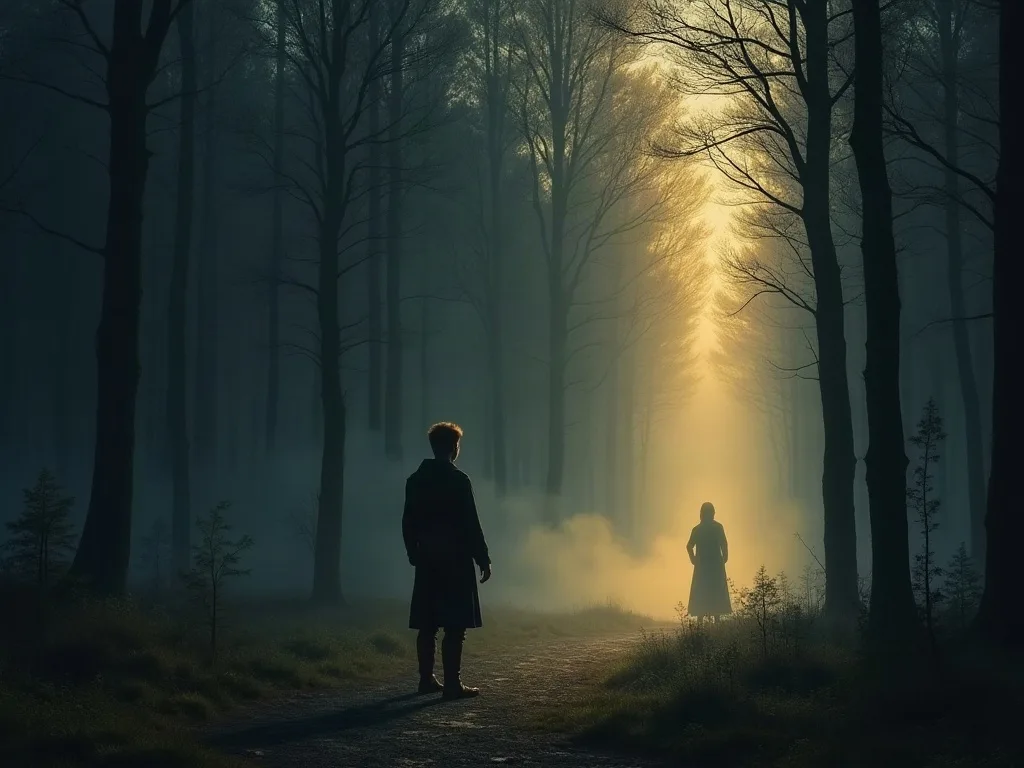
The seduction follows a pattern. The man is alone in the forest or at the mountain pasture. He sees a beautiful woman, far from any human settlement. She is graceful, often laughing or singing. She dances, or she beckons. Her beauty is supernaturally compelling, a test of the man's will and virtue. Some versions emphasize her nakedness or her offer of sexual union. Others focus on the spell of her music, her laughter, her mere presence.
The man's response determines the outcome. If he resists, if he recognizes her true nature or appeals to God (in Christian versions) or to his own humanity, he may escape. If he yields, if he touches her or follows her into the deep forest, he is drawn into her world. Time becomes unreliable. Days pass like hours, or hours stretch into nights. He may be trapped in her dwelling, in a mountain hall or a forest grove that cannot be easily left. He may be used by her and then abandoned, cast out or killed. In some tales, he returns to human civilization only to find that years have passed, or that his family no longer recognizes him.
These seduction stories served multiple purposes in Scandinavian culture. They were entertainment, certainly: a thrilling and scary tale told in winter. But they were also moral instruction, a warning against the allure of the untamed, against male desire leading men away from duty and civilization. They encoded the real dangers of the wilderness: a man alone could be lost, seduced by hunger or cold or his own confusion, drawn into death. The Huldra made that danger personal, female, beautiful. She made it impossible to see the wild as merely inert nature; it had agency, intention, a will that could bend human will toward danger.
Some folk tales introduce a rescue theme: a man who has been with the Huldra can be saved if a priest or a good woman intervenes, or if he manages to appeal to Christian mercy. These variations show how Norse tradition was absorbed and reinterpreted by a Christian culture, yet retained its essential shape.
The Huldra and Humankind: Exchange and Violation
Huldra's relationship with humans is neither friendship nor pure hostility. It is exchange, bounded by ritual and respect, and dangerous when those bounds are broken.
In some Scandinavian accounts, Huldra is depicted as a mother figure, a nurse or guardian of children, particularly children who were born out of wedlock or were abandoned. She may take a human infant into the forest and raise it as her own, or she may leave one of her own offspring in exchange (a changeling, in European folk tradition). This echoes patterns found across Indo-European mythology: the boundary between human and wild is permeable when it comes to children and kinship.
The Huldra may also appear as an adversary to humans who violate her space or her rules. A man who hunts excessively in her forest, taking more animals than is needed, might encounter her wrath. A herder who fails to leave her offerings, or who is disrespectful, could find his animals taken or cursed. She is not evil in these moments, precisely; she is enforcing the terms of exchange, the recognition that the forest is not human property but a domain where she holds authority.
Some Scandinavian folk traditions describe Huldra as capable of bearing human children, either through seduction or through a kind of negotiated union. These children are described as gifted or marked: they may have unusual beauty or talents, or they may bear some hidden sign of their mixed origin (a mark, a secret, an inability to fully integrate into human society). This echoes broader Norse mythology's treatment of hybridity: the idea that crossing boundaries between human and other produces not corruption but transformation, not monstrosity but altered capacity.
Regional Variations: The Huldra Across Scandinavia
The Huldra is primarily Scandinavian, but her form and name shift across the region and over centuries.
In Norwegian tradition, she is the huldra or hulder, often dwelling in specific mountains or forests known to local communities. Norwegian folk tales emphasize her beauty and her dancing, and many Norwegian accounts focus on the seduction of young men, particularly herders or hunters who ventured into high mountain pastures. The tail is nearly universal in Norwegian accounts.
In Swedish tradition, she is the skogsrå, the "forest spirit," and is often given a more naturalistic role as a guardian of woodland animals and a spirit associated with forestry and hunting. Swedish accounts sometimes depict her as less overtly malicious than Norwegian versions; she is a force to be respected and propitiated, but not necessarily a threat if proper deference is shown. Swedish sources from the 17th century onward describe rituals specific to Swedish forestry and herding practice, where the skogsrå is addressed by name and given offerings.
In Danish tradition, she is sometimes called the hylde or skovfrue (forest woman), and Danish accounts occasionally blur her with other figures from Germanic folk tradition, such as the elves or wood spirits of German lore. Danish sources tend to be less detailed than Norwegian or Swedish records, but they preserve similar core elements: the beautiful woman of the forest, the danger of seduction, the importance of recognizing her inhuman nature.
In Icelandic tradition, she is less prominent than in mainland Scandinavia, though Iceland retained its own figures of hidden folk and spirit guardians. The Icelandic landscape, dominated by lava fields and sparse forests, gave rise to different ecological spirits, though the principle of hidden beings guarding wild spaces remained central to Icelandic folklore.
Finnish tradition, while separate from Norse tradition proper, includes the metänneiti (forest maiden), a figure with striking similarities to Huldra: a beautiful woman of the forest who lures men, who must be treated with respect, whose true nature is inhuman. This convergence suggests that the Huldra archetype may reflect deeper Scandinavian and northern European patterns of perceiving wilderness as personified and gendered.
Huldra in Medieval Texts and Scholarly Understanding
The written record of Huldra is sparse compared to the gods of the Eddas, but it is real and significant.
Medieval Scandinavian sources include oblique references to spirits associated with forests and livestock in Christian contexts. The 13th-century Norwegian laws (such as the Magnus Code) include prohibitions against pagan ritual and propitiation of spirits, suggesting that folk practices related to forest spirits were widespread enough to warrant legal suppression. These references do not name Huldra specifically, but they point to the underlying belief system she inhabited.
Later Scandinavian texts, particularly from the 16th century onward, record Huldra more directly. Swedish clergyman and historian Johan Guse, writing in the 16th century, documented folk beliefs in a spirit named hulder or skogsrå. Similar accounts appear in Danish and Norwegian ecclesiastical records, where clergy attempted to convert or suppress belief in such spirits. These texts were often written by Christian authorities skeptical of or hostile to folk practice, yet they preserve real elements of what people believed and practiced.
By the 19th and 20th centuries, scholars and folklorists began systematically collecting Huldra tales and publishing them as a coherent tradition. Norwegian collector Peter Christen Asbjørnsen and his collaborator Jørgen Moe published collections of Norwegian folk tales in the 1800s that include numerous Huldra stories. Swedish folklorist Gunnar Olof Hyltén-Cavallius documented Swedish forest spirit traditions. German folklorist Wilhelm Mannhardt studied northern European tree spirits and forest spirits more broadly, situating Huldra within a wider Indo-European pattern.
These 19th-century collections and studies established Huldra as a legitimate subject of scholarly attention. By the 20th century, she had entered broader popular culture and literary traditions, no longer purely local but increasingly recognized as a significant figure in northern European folklore.
Huldra's Evolution: From Pagan Guardian to Romantic Phantom
The Huldra has undergone profound transformation since the pre-Christian era, though her core identity has remained remarkably stable.
In pre-Christian Scandinavian practice, Huldra was likely a spirit associated with a specific ecological niche: the high summer pastures, the forest boundary, the edge of cultivated land. She was neither wholly malevolent nor wholly benevolent, but rather a force that required negotiation and respect. Offerings and ritual acknowledgment were practical necessities, part of the work of living in a landscape that humans did not fully control.
With the Christianization of Scandinavia (10th through 12th centuries), the theological framework changed. Huldra could not be easily integrated into Christian cosmology. She was not a demon in the traditional sense (born from Hell), but she was not human, and she was not God-aligned. She came to be viewed with suspicion by the Church. She was the remnant of pagan practice, the seductress who drew people away from Christian duty, the wild force that civilization (now understood as Christian civilization) must resist or suppress.
Yet the folk memory of her persisted. Over centuries, the Huldra became romantically reimagined. By the 19th century, in the age of Romantic nationalism and the rediscovery of folklore as a source of national identity, Huldra was reconceived as a tragic or beautiful phantom of the wild, a figure to be celebrated rather than feared. She appeared in Scandinavian literature and art, often as a symbol of nature, of the untamed past, of a kind of freedom that civilization had lost.
The Norwegian composer Edvard Grieg, for instance, drew on Huldra imagery in his works. Scandinavian painters depicted her as a beautiful, melancholic figure, often nude or partially clothed, in forest settings. She became an icon of wild femininity, aligned with Romantic notions of nature as a source of inspiration and longing.
This is not, strictly speaking, medieval or pre-Christian tradition anymore. It is an artifact of how modern culture has reread ancient and folk material through contemporary values and aesthetics. Yet it shows Huldra's remarkable persistence: even as her context and meaning shifted, the figure herself remained recognizable, powerful, and alive.
Huldra and Other Beings of Boundary and Wildness
Huldra is not unique to Scandinavia, though she is distinctively Scandinavian in her particulars. Across European and Indo-European mythology, similar beings inhabit similar ecological and narrative spaces.
The Rusalka of Slavic tradition is a ghostly water spirit, often female, who seduces men and leads them to death. Like Huldra, she is beautiful, dangerous, and associated with a specific element (water rather than forest). Like Huldra, she represents the allure and the risk of the untamed.
The elves of Germanic and English tradition (particularly as described in Old English texts and later medieval accounts) share some features with Huldra: they are ambiguous beings, sometimes beneficial and sometimes harmful, who inhabit liminal spaces and interact with humans through enchantment and exchange. The alfen of Old English sources are not the small, winged creatures of modern fantasy, but rather powerful beings of beauty and danger.
The Dryads of ancient Greek tradition, the tree spirits who inhabit particular groves or forests, share Huldra's connection to wilderness and to specific places. A dryad is bound to her tree; a huldra is bound to her forest. Both guard their domain with jealous attention.
The Apsaras of Hindu mythology are celestial dancers and seductresses, sometimes described as river spirits or water nymphs. Like Huldra, they seduce men, dance with supernatural grace, embody the dangerous beauty of natural forces.
The Banshee of Irish tradition is a wailing female spirit associated with death and fate, operating at the boundary between human and supernatural worlds. While less directly seductive than Huldra, the banshee shares the archetype of the powerful woman of the liminal space, the being whose appearance signals transformation or danger.
These cross-cultural parallels suggest something deep in human mythology: the impulse to personify the wild as feminine, to imagine the boundary between human civilization and untamed nature as guarded by a beautiful, dangerous woman who tests human virtue and human will.
Huldra in Modern Culture and Contemporary Imagination
Huldra has never left the popular consciousness of Scandinavia, and in recent decades, she has found new life in global culture.
In contemporary Scandinavian literature, film, and art, Huldra appears regularly. Norwegian and Swedish writers have used her as a symbol of environmental concern, of the wild that modernity threatens to erase. She is a figure of nostalgia, but also of warning: what happens to a civilization that forgets the forest, that ceases to recognize the agency of nature?
In global popular culture, Huldra has appeared in fantasy literature, role-playing games (most notably in the World of Darkness and D&D-adjacent traditions), and television and film. She has been reimagined as an anti-hero, a tragic figure, a protector of nature, a seductress, and a monster, depending on the author's needs. Some modern interpretations lean into horror; others emphasize the erotic or the romantic.
This expansion into global culture has inevitably changed her. She has been flattened into types and templates, divorced from her specific Scandinavian ecological and cultural context. Yet the core archetype remains powerful enough to translate: a being of the boundary, beautiful and dangerous, who guards the wild and who tests human desire and human will.
The growth of contemporary Paganism and Heathenry (modern religious movements that attempt to revive or reconstruct pre-Christian Norse and Germanic traditions) has also kept Huldra alive in new ways. For modern practitioners, Huldra is not merely a folklore figure but a being to be respected, honored, and (in some cases) spoken with through meditation or ritual. She has become a living spiritual figure, not merely a historical or literary one.
Frequently Asked Questions About Huldra the Forest Spirit
Frequently asked questions
Is Huldra mentioned in the Eddas or other ancient Norse texts?
Huldra does not appear in the Poetic Edda or the Prose Edda, the two medieval collections of Norse mythology compiled in the 13th century. She is not a figure of the gods or the primary cosmological frame that those texts describe. Instead, she emerges from oral Scandinavian folk tradition and appears in written form in medieval and early modern Scandinavian records, particularly from the 16th century onward. This does not make her less authentic as a Norse or Scandinavian tradition, only differently situated: she belongs to the lived religion and folklore of common people rather than to the elite mythological corpus preserved by medieval scholars.
What does the name Huldra actually mean?
Huldra comes from Old Norse hulda, which means "hidden" or "covered." This etymology points to her essential nature: she is a being who conceals her true form, who hides her inhuman back beneath a beautiful exterior, who dwells in places concealed from ordinary human view. The name describes not just her physical appearance but her entire mode of being. Related terms appear across Scandinavian languages and suggest an ancient root for the concept, though Huldra as a coherent mythological figure crystallized in folk tradition over centuries.
Why does Huldra appear so differently in Norwegian versus Swedish traditions?
Norwegian and Swedish folklore developed somewhat independently over centuries, and their environments differed. Norway's steep mountains and deep forests shaped a Huldra figure often associated with high summer pastures and alpine settings, frequently seductive and dangerous to solitary young men. Sweden's more varied landscape and different herding practices produced a skogsrå figure often treated as a forest spirit to be negotiated with and respected through ritual. Both versions emerge from similar core beliefs about wildness and guardianship, but local ecology and cultural practice inflected the details. The tail, nearly universal in Norwegian accounts, is less prominent in Swedish versions, for instance.
Can Huldra be understood as a goddess, or is she something else?
Huldra is not a goddess in the sense that Frigg, Freya, or other Aesir females are gods. She has no cult, no temples, no formal priesthood, and she does not appear in cosmological myths about the creation or fate of the world. Rather, she is a spirit, a being of the boundary between human and wild, with local agency and local power. This distinction matters: Huldra's power is immediate and practical (she affects livestock, she seduces individuals, she dances in clearings), not cosmic or universal. To call her a goddess might be to elevate her beyond her actual role in Norse thought, which is significant but more modest than that of the Aesir.
Is Huldra evil, or just dangerous?
Huldra is neither morally evil nor entirely benevolent; she operates by her own logic, not by human moral standards. She will reward respect and punish disrespect. She will seduce if seduction suits her purposes, and she will guard if guarding does. She is dangerous because she is powerful and because her interests do not perfectly align with human interests. A man who encounters her may be transformed, destroyed, or merely tested, depending on his behavior and his will. To frame her as evil is to impose Christian moral categories on a pre-Christian entity; it is more accurate to see her as amoral in the ancient sense: a force of nature with agency and preference, but not operating within a human ethical framework.
Do modern Heathens or Norse Pagans still venerate Huldra?
Yes. Within contemporary Heathenry and other modern reconstructionist Pagan traditions, Huldra is sometimes honored and worked with. Some practitioners approach her as a spirit to be respected and negotiated with, in line with older folk practice. Others see her as a symbol or an archetype of wild nature deserving reverence. There is no unified practice or theology around her; modern Heathenry is diverse and decentralized. Some practitioners view folk figures like Huldra as equally important to the gods of the Eddas; others prioritize the textual sources. She remains a living figure in some contemporary religious contexts, even as she also lives in literature, art, and popular imagination.
Huldra's Persistent Mystery: Why She Endures
Huldra has survived nearly a thousand years of cultural transformation because she embodies something real and persistent: the human encounter with wildness, and the anxiety and allure that wildness produces.
She is not a god who was forgotten and then rediscovered by scholars. She was never written down in a definitive form and then faithfully transmitted. Instead, she lived in story, in ritual, in the daily practice of people who herded animals at the forest edge, who hunted in deep woods, who knew that civilization was only a thin boundary against forces that did not respect human intention.
In the Christian era, she became a test of virtue and faith. In the Romantic era, she became a symbol of lost nature and tragic beauty. In the modern ecological age, she can become a voice for the forest itself, a reminder that wilderness has agency and that human mastery over nature is incomplete and fragile.
Each iteration of Huldra tells us something about the era that tells the story. But underneath, the core remains: a beautiful, dangerous being who guards the wild, who does not fully become human no matter how lovely her face, who moves between worlds and draws humans toward transformation they may not survive. She is, in that sense, timeless. As long as humans live at the edge of wilderness, as long as nature exceeds and escapes human control, the figure of Huldra will find new shape and new voice.
Free 25-page sample
Want the whole story?
Take the first 25 pages free. If it pulls you in, the full edition is yours as an instant PDF download, with a paperback on Amazon for selected titles.

Mythology
The World Mythology Book: The Gods, Heroes and Myths of Every Culture
The Gods, Heroes and Myths of Every Culture, in One Volume
The whole of world mythology in a single volume: Greek, Norse, Egyptian, Japanese, Hindu, Celtic, Slavic, Mesoamerican and African myths gathered side by side, each drawn from the primary sources.