

Kali the Dark Mother: Destroyer, Liberator, and the Sacred Void
Kali the dark mother stands at the heart of Hindu paradox: a goddess of destruction and liberation, terror and love, her dance unmakes the cosmos so it can be remade. Discover why millions revere her as the ultimate force of transformation.
Contents
In the beginning, before time had a shape, there was only void. No stars. No earth. No gods. And in that darkness, Kali the dark mother moved.
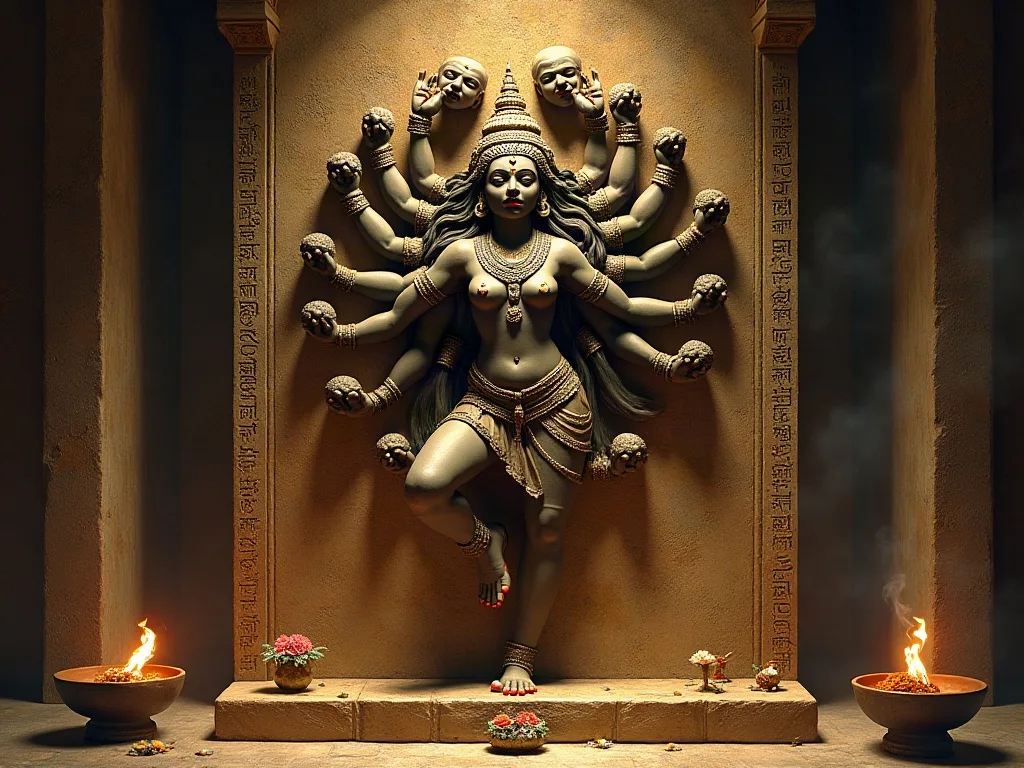
She moves still. In temples across India, her image hangs above altars: naked or draped in a skirt of severed arms, her skin black as the space between stars, her tongue red and lolling, her eyes blazing. In her hands, a curved sword and a bowl to catch blood. Around her neck, a garland of severed heads. She dances on her consort Shiva, his body white and still beneath her feet.
The first instinct of the Western eye is to recoil. How can this be a mother? How can this be divine?
But that recoil is exactly the point. Kali the dark mother is what happens when the divine refuses to be domesticated, when power is not dressed in velvet robes or softened by sentiment. She is the goddess of endings. She is the goddess of truth. And she is beloved by millions who have learned to see, in her terrible beauty, the face of love itself.
The Birth of Kali in the Devi Mahatmya
The Devi Mahatmya, an 11th-century Sanskrit text that narrates the triumphs of the Mother Goddess, tells of Kali's first emergence. The world had fallen into chaos. Two demons, Shumbha and Nishumbha, had grown so powerful through ritual discipline that the gods could not defeat them. In desperation, the assembled deities called forth the energy of their own consciousness, and from that summons arose Parvati, the divine mother.
But Parvati alone was not enough. As the battle raged, her fury deepened. From her brow burst forth a dark form, wild-eyed and terrible: Kali. She was born not as a separate being but as an intensification, a concentrating of the mother's rage into a force that could not be turned aside.
Kali did what gentler weapons could not. She hunted the demons across earth and sky. She drank their blood before it could strike the ground (for each drop that touched earth would spawn a thousand new demons). She devoured their armies. In the Devi Mahatmya, she is called the savior of the cosmos, the one who restored order when order had been shattered.
This is crucial: Kali was not born from anger alone. She was born from the cosmos's need. She was not an aberration but a necessity. The same Mother who gave milk also gave steel.
The Mahakala and the Dance of Annihilation
In the Tantric traditions of Kashmir and Bengal, Kali becomes inseparable from Shiva, the destroyer and transformer. While Shiva sits motionless in deep meditation, Kali dances. Her dance is cosmic and terrible. With each step, the universe trembles. The Tantras say she dances the mahakala, the great time, into existence.
Time itself is her rhythm. Death is her drum. The boundaries between life and dissolution dissolve beneath her feet.
In the most famous iconographic scenes, Kali stands astride Shiva's prone form. Her right foot presses his heart. Her left is raised in a gesture that seems both violent and ecstatic. Some scholars read this as triumph; others read it as a lovers' embrace. In Hindu philosophy, the distinction collapses. Creation and destruction, the lover and the beloved, the dancer and the danced are not opposites but aspects of a single reality.
The black color of her skin has spawned endless interpretation. It is said that Kali's blackness is the color of the void before creation, the color of everything that has been unmade, the color of potential itself. It is not the absence of light but the absence of limitation. It contains all colors. All possibilities.
The Fierce and the Tender: Iconography and Symbol
The imagery of Kali the dark mother carries meaning layered as an ancient palimpsest. Each element is a teaching.
The sword in her upper right hand cuts through illusion. It severs the bonds of ignorance. In Shakta philosophy (the traditions that place the Mother Goddess at the center of all things), Kali's sword is wisdom. It cuts so that truth may be seen.
The bowl in her left hand catches the blood of demons. But in a deeper reading, it represents the collecting of karma, the gathering of consequence. Nothing spilled is wasted. Everything is held in consciousness. Some traditions say the bowl contains amrit, the nectar of immortality, and that those who drink from it are liberated.
The garland of heads around her neck represents all the egos, all the false selves she has destroyed. Each head is a death necessary for awakening. The garland is not a trophy but a chrysalis.
Her skirt of severed arms (or sometimes, in other depictions, a skirt of flayed skin) contains the hands of those who tried to harm or oppose dharma, the sacred order. These are not punishments but transmutations. Even destruction becomes an offering at her feet.
Her red tongue, lolling from her mouth, is often described as a moment of shock. Some say she stopped mid-rampage, horrified by her own power, her own capacity for violence. Others say she is tasting victory, or the essence of what has been destroyed, absorbing it back into the cosmic body. The ambiguity is intentional. Kali does not resolve into comfort.
Her third eye, like Shiva's, sees all times at once. Past, present, future collapse into her gaze. She is the witness to all that is and all that dissolves.
Kali in the Tantric Traditions: Shakti Unchained
In the Tantra, particularly in the schools of Bengal and Assam, Kali is worshipped not despite her darkness but because of it. The Tantraka practitioners understood something the genteel world often forgets: transformation demands discomfort. Growth requires that the old self die.
The Tantric practitioner sits at the cremation ground, in the presence of death, and meditates on Kali. Here, surrounded by ash and bone, the small self dissolves. Here, Kali is the teacher who strips you to your essence. She burns away pretense. She shows you what remains when everything you identify with has been unmade.
In these traditions, Kali is called the liberator. The Sanskrit word for liberation, moksha, means release, and Kali is the supreme force of release. She cuts the cord that binds you to illusion. She dances you free.
The Tantric texts speak of Kali's mudra, her sacred hand gestures. One gesture, known as abhaya, signifies protection and fearlessness. Even as she destroys, she grants safety. Even as she terrifies, she offers refuge. This paradox is not resolved but lived. The devotee learns to sit with contradiction until contradiction itself reveals the seamless unity beneath.
The Ten Mahavidyas: Kali Among the Fierce Divine Feminine
In Hindu philosophy, the Mother Goddess manifests in ten major forms, called the Mahavidyas, the great wisdoms. Each represents a different face of the divine feminine power, each a different relationship to reality.
Kali is the first. She is the foundational power, the base from which all other manifestations arise. She is called Mahakali, the great time, and also Mahakala, death itself.
The other nine Mahavidyas include Tara, who guides through the ocean of suffering; Bhuvaneswari, the sovereign of the worlds; Chinnamasta, who cut her own head; Dhumavati, the widow; Bagalamukhi, the one who paralyzes wrongdoing; Matangi, the low-born queen of speech; and others. Each teaches a different yoga, a different path to the divine.
But Kali comes first. She is the threshold. Without her, without the death she represents, none of the other forms could manifest. She is the destroyer upon whose work all creation rests.
Kali in Sacred Texts: The Mahabharata and Beyond
The Mahabharata, the vast Sanskrit epic that is Hinduism's longest poem, contains multiple references to Kali. In some passages, she appears on the battlefield at Kurukshetra, drunk on blood, dancing amid the carnage. In others, she is an omen or a harbinger of transformation.
But the richest portrait of Kali comes from the Devi Bhagavata Purana, a text that traces her emergence and triumphs. Here, she is not a minor figure but the supreme deity, the ultimate reality wearing the mask of the dark mother.
The Devi Bhagavata tells of Kali's battle with the demon Mahakali (note the identical name: even demons take her form). In this battle, her power grows with each enemy she defeats, each act of destruction feeding her force. She is unstoppable, limitless, and in the end, she can only be appeased by being recognized as supreme.
This is a constant theme in Hindu mythology: the most fearsome power is also the most divine. The force that can destroy everything is the same force that sustains everything. Recognition and surrender are the only possible responses.
The Upanishads, the philosophical texts that form the foundation of Vedantic thought, speak of Brahman, the ultimate reality that underlies all existence. In many interpretations, Kali is understood as the dynamic power of Brahman, the Shakti through which the absolute expresses itself in the cosmos.
Kali Puja: Worship, Festivals, and Regional Variations
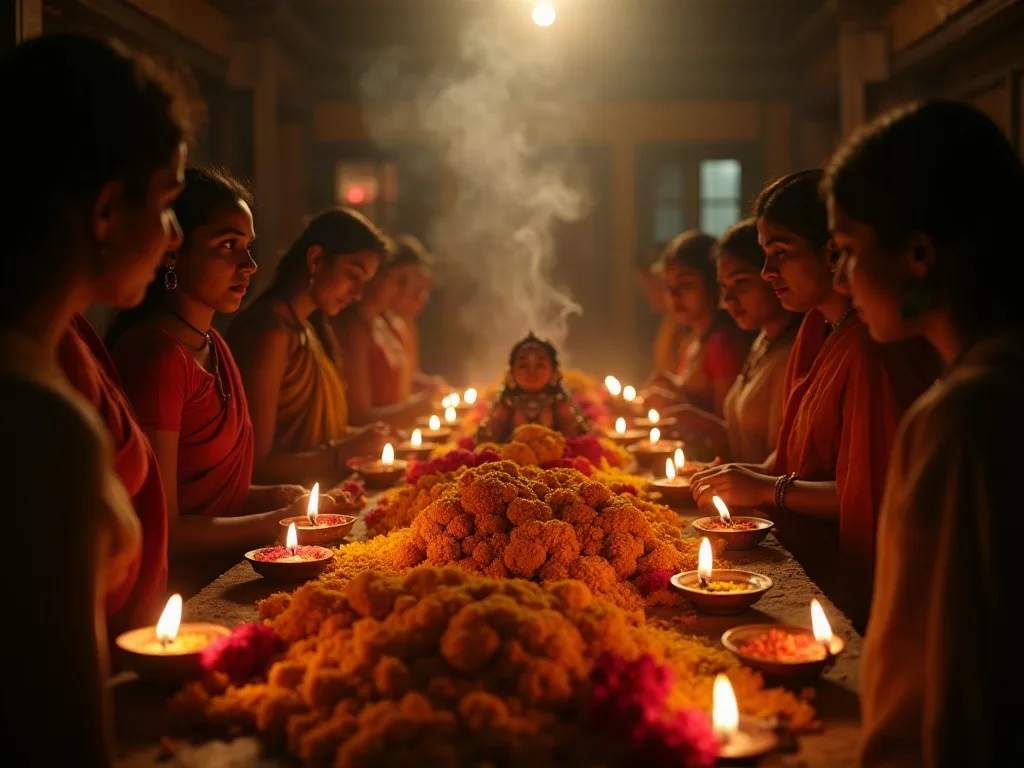
In Kolkata and throughout Bengal, Kali Puja is celebrated with intense devotion. Unlike other major Hindu festivals, which often emphasize joy and abundance, Kali Puja emphasizes honesty. Devotees make offerings not of sweets and flowers alone but of honest reckoning. They fast. They acknowledge mortality. They sit with the reality of impermanence.
In South India, particularly in Tamil Nadu and Karnataka, Kali appears in slightly different forms. She is called Kali Mata, the Mother, and her worship is often more joyful, less starkly terrifying. Local variations emphasize her role as the protector of children and the vulnerable.
In the Himalayan regions and among devotees of Tantra, Kali is approached through meditation. Practitioners visualize her dancing at the center of the cosmos, and in that visualization, they experience their own dissolution and rebirth.
One festival deserves particular attention: Kalipuja, celebrated in autumn, often coinciding with the new moon. On this night, temples dedicated to Kali are illuminated. Devotees gather and sing her praises. They invoke her in a state between reverence and rebellion, neither begging mercy nor offering worship but engaging in a kind of cosmic conversation with the force that unmakes everything they cling to.
The flowers offered to Kali are often red and black. The mantras chanted to her are fierce and fast. Even the drums that accompany her worship have a different rhythm, faster and more intense than those used for gentler deities. Everything in Kali worship honors her difference, her refusal to fit into expected patterns.
The Terror and the Tenderness: Kali in Contemporary Hindu Practice
For millions of contemporary Hindus, Kali the dark mother is not primarily a fearsome figure but a symbol of ultimate love. This paradox is not resolved but embraced.
The 19th-century Bengali saint Ramakrishna Paramahamsa, one of Hinduism's most influential modern figures, worshipped Kali as his divine mother. He spoke of her with such tenderness, such directness, that his love transformed how generations understood her. For Ramakrishna, Kali was not distant or terrible but intimate and present. She was the mother who would do anything for her children, even if that "anything" included stripping them of their illusions.
Ramakrishna would sit in front of Kali's image and weep. He spoke to her as one speaks to someone you know entirely. He asked her questions. He complained to her. He begged her. The relationship was not of a worshipper before a distant god but of a child with the mother who knows him completely.
This intimacy has rippled forward. Contemporary Hindu women, in particular, often approach Kali not as a figure of terror but as a source of strength. In Kali, they see a reflection of their own power, often suppressed or denied by patriarchal culture. Kali is a mother who does not demand that women be small or gentle. Kali is a mother who says: be fierce. Be true. Let no lie stand.
For many Hindu men, particularly those engaged in Tantric practice, Kali is the ultimate guru, the teacher who can only teach through destruction. She teaches by taking away, by showing you that everything you hold leads to suffering until you let it go. She is compassion in its most radical form: the willingness to burn away everything false so that truth can remain.
Kali Beyond India: Cross-Cultural Echoes and Modern Reinterpretation
Outside of Hindu tradition, Kali has been misunderstood, domesticated, and reframed through non-Hindu lenses. Colonial-era scholars, uncomfortable with her power and her sexuality, often portrayed her as evidence of "primitive" religion. Some feminist scholars, by contrast, have claimed her as a symbol of feminine power and resistance to patriarchy.
These reinterpretations are not necessarily wrong, but they are incomplete. Kali is not simply a feminist icon (though she can be read as one). She is not simply a symbol of power (though she is powerful). She is a complete theological statement about the nature of reality itself.
In contemporary global spirituality, Kali has been appropriated, simplified, and sometimes trivialized. She appears on album covers and in yoga studios and in the homes of seekers who understand her as a vague symbol of edginess or rebellion. This is not entirely false (she is, in a sense, the ultimate rebel), but it misses the depth.
The real Kali demands something the domesticated version does not: transformation. She demands that you let your small self die. She demands that you stop clinging. She demands honesty. And she offers, in return, a freedom so complete that it feels like death and rebirth simultaneously.
The Dance Continues: Kali in Scholarship and Contemporary Spirituality
Modern Hindu scholarship, particularly work by scholars like David Kinsley and Wendy Doniger, has sought to recover Kali from the distortions of both colonial dismissal and Western appropriation. These scholars have emphasized the textual depth of Kali worship, the philosophical sophistication of her symbolism, and the ongoing vitality of her worship in contemporary Hindu communities.
What emerges from serious scholarship is a figure of extraordinary complexity. Kali is not a single character but a matrix of meanings, a space where destruction and creation, terror and love, the personal and the cosmic all collapse into one.
She continues to inspire new interpretations. Contemporary artists, filmmakers, and writers have drawn on Kali's image to explore power, identity, mortality, and the feminine. Some of these explorations honor her complexity; others reduce her to a surface image. But the ongoing engagement speaks to something true: Kali the dark mother continues to work, continues to shatter comfortable assumptions, continues to teach.

Frequently asked questions about Kali the dark mother?
Frequently asked questions
Why is Kali depicted as dark-skinned when most other Hindu deities are depicted as fair-skinned?
Kali's blackness represents the void before creation, the totality of potential, the color that contains all other colors. It is not a marker of race but of cosmic principle. Some traditions say her skin is blackened by the ash of the cremation grounds, the ashes of all that has been destroyed. Far from being a lesser quality, Kali's darkness is what makes her supremely powerful. She is the dark womb from which all existence emerges.
Is Kali actually destructive or is her destruction always for a purpose?
In Hindu philosophy, destruction is never mere annihilation. It is transformation. Kali destroys illusion, ego, the false sense of self. She destroys demons who threaten cosmic order. But she destroys so that something new may be born. The Sanskrit term laya, dissolution, is never final; it is always a prelude to new creation. Kali's destruction is purposeful, necessary, and ultimately compassionate.
How can Kali be a mother goddess if she is so fierce and terrible?
In Hindu tradition, motherhood is understood as including protection through any necessary means. A mother protects her children by any force required. Kali's fierceness is an expression of her love. She will not tolerate harm to her devotees. She will not allow them to remain trapped in illusion. She loves so completely that she is willing to shatter the comfort of falsehood for the sake of truth. This is a vision of motherhood that includes both tenderness and strength.
What is the relationship between Kali and Shiva?
In iconography and in scripture, Kali and Shiva are inseparable. Shiva is the still point, the unchanging consciousness. Kali is the dynamic power through which that consciousness expresses itself. Some traditions say they are one being viewed from two perspectives. Others say they are complementary: Shiva at rest, Kali in dance. Their relationship is not hierarchical but complementary, neither above nor below the other.
Do contemporary Hindus still worship Kali, or is her worship mostly historical?
Kali worship remains vigorous and central in contemporary Hinduism, particularly in Bengal, Assam, and among Tantric practitioners worldwide. Kali Puja festivals draw thousands of devotees. Contemporary Hindu teachers and spiritual seekers continue to find in Kali a living presence, a force that transforms those who encounter her authentically. She is not a relic but an active, present, and demanding power in Hindu spiritual life today.
Why do some Hindu texts describe Kali as being appeased or calmed if she is the highest divine power?
The idea of Kali being "calmed" or "appeased" is itself a teaching. It suggests that cosmic forces, no matter how powerful, are responsive to devotion, to surrender, to recognition. When Kali is acknowledged as supreme, when she is properly honored, her destructive power becomes integrated. She is not less powerful but differently related to. The appeasement is not a weakening but a deepening of relationship.
The Paradox Unresolved: Why Kali Matters
The Western mind wants to resolve paradox. It wants Kali to be either fierce or loving, destructive or creative, terrible or divine. But Kali the dark mother refuses resolution. She stands at the place where all opposites meet and remain true simultaneously.
This refusal is precisely her teaching. Reality is not binary. Life and death are not opposites but aspects of a single flow. Terror and love are not incompatible but aspects of the same force. The cosmos is not built on static rules but on eternal, dynamic transformation.
For centuries, the dark mother has danced. She dances still. And in every age, in every heart that is brave enough to look at her without flinching, she teaches the same lesson: everything dies. Everything must die. And in that dying, everything is born anew. This is the dance. This is the law. This is the mercy of Kali the dark mother.
Free 25-page sample
Want the whole story?
Take the first 25 pages free. If it pulls you in, the full edition is yours as an instant PDF download, with a paperback on Amazon for selected titles.

Mythology
The World Mythology Book: The Gods, Heroes and Myths of Every Culture
The Gods, Heroes and Myths of Every Culture, in One Volume
The whole of world mythology in a single volume: Greek, Norse, Egyptian, Japanese, Hindu, Celtic, Slavic, Mesoamerican and African myths gathered side by side, each drawn from the primary sources.