
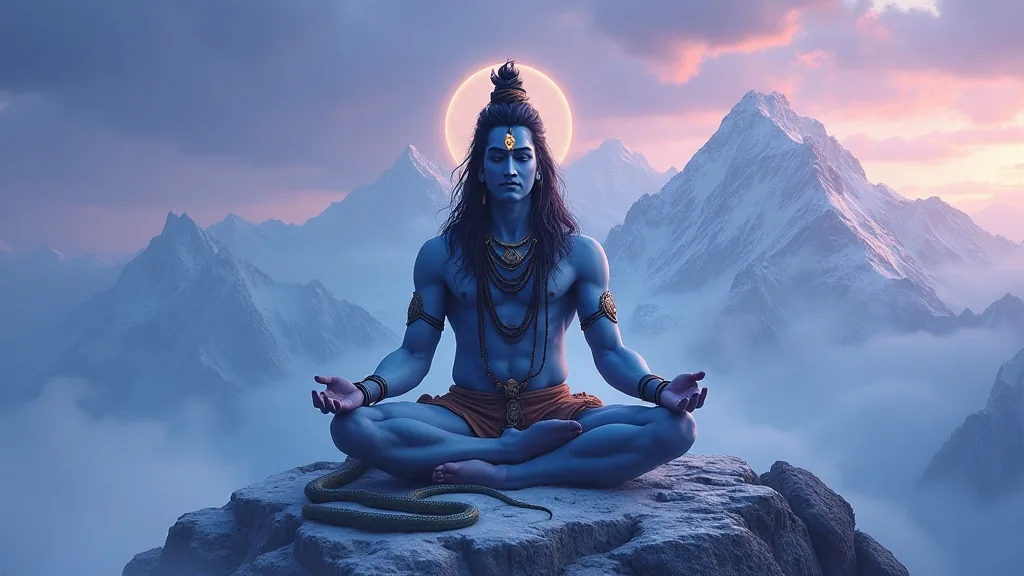
Shiva the Destroyer: Lord of Dissolution, Transformation, and Cosmic Renewal
Shiva the Destroyer stands at the heart of Hindu cosmology not as a god of mere annihilation, but as the force that dissolves reality so creation can begin again. His mythology is among the richest and most paradoxical in the world.
Contents
The God Who Ends Worlds to Renew Them
Few divine figures in any religious tradition carry the weight of contradictions that Shiva does. He is the great ascetic seated motionless on Mount Kailash, and the frenzied dancer whose footfall shakes the cosmos. He is the loving husband of Parvati and the wandering naked mendicant smeared in ash. He is the destroyer, yes, but the Sanskrit word most closely associated with this role, Samhara, does not mean destruction in the bleak, final sense that English implies. It means dissolution: the careful unraveling of what has been made, so that what must come next has room to exist.
Within the Hindu triad known as the Trimurti, Brahma creates, Vishnu preserves, and Shiva dissolves. Yet this neat division undersells Shiva considerably. Shaivite theology, particularly as expressed in the Shaiva Agamas and in the philosophical school of Kashmir Shaivism, holds that Shiva performs five cosmic acts, the Panchakriya: creation (Srishti), preservation (Sthiti), dissolution (Samhara), concealment (Tirodhana), and grace (Anugraha). Destruction is only one fifth of his nature, and even that fifth is inseparable from grace.
Origins: From the Vedic Rudra to the Great God
Shiva's roots reach back to the Rigveda, where a fierce deity named Rudra appears as the lord of storms, disease, and the howling wilderness. The name Rudra likely derives from a root meaning "the roarer" or "the one who causes to weep." He was addressed with careful reverence in the famous Shri Rudram hymn of the Yajurveda, a text still chanted in South Indian temples every morning. Worshippers begged Rudra to turn his benevolent face, his Shiva aspect (the auspicious one), toward them rather than his wrathful gaze.
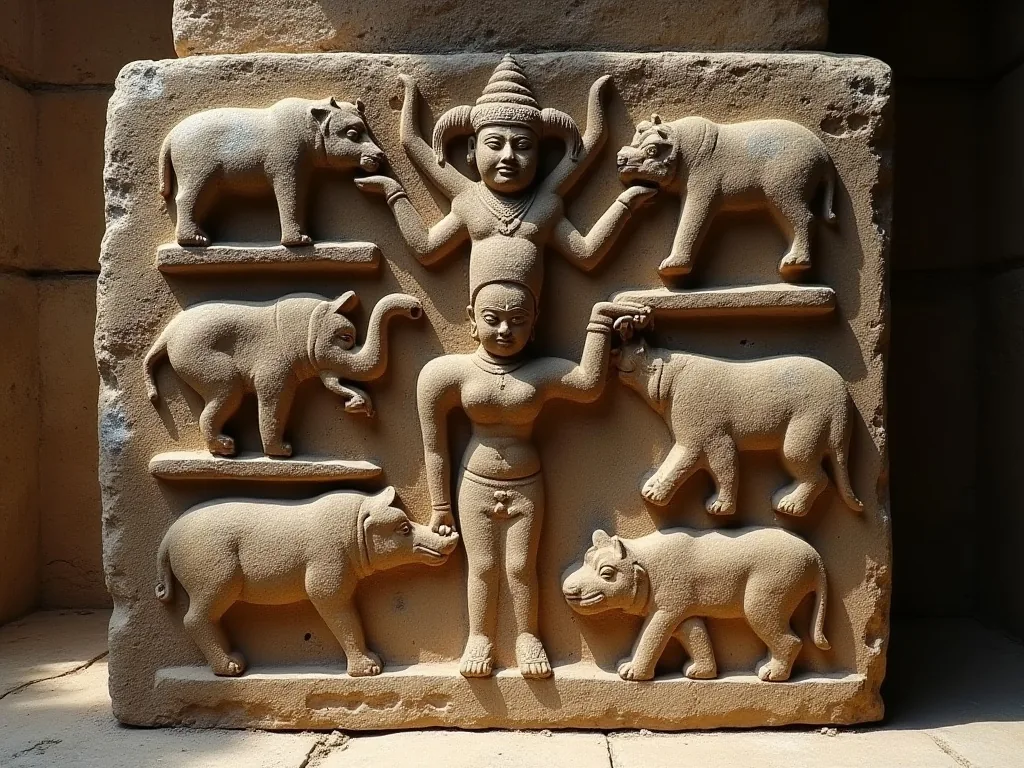
Over centuries, this Vedic Rudra merged with indigenous non-Aryan traditions. Archaeologists have pointed to a seal from the Indus Valley Civilization at Mohenjo-daro, the so-called Pashupati seal, which depicts a horned, cross-legged figure surrounded by animals. Many scholars identify this figure as a proto-Shiva, though the identification remains debated. By the time of the Mahabharata and the Puranas, Rudra had transformed fully into Shiva Mahadeva, the Great God, absorbing dozens of regional cults, names, and attributes along the way.
His most celebrated epithets number in the hundreds. The Shiva Sahasranama, the thousand names of Shiva found in the Mahabharata's Anushasana Parva, lists titles ranging from Bhairava (the terrible) and Ugra (the fierce) to Shankara (the beneficent) and Ashutosh (one who is easily pleased). No single epithet, not even "the Destroyer," captures the totality.
Nataraja: The Cosmic Dance of Dissolution
Perhaps no image in world religious art communicates the idea of creative destruction more vividly than Nataraja, Shiva as the Lord of Dance. The canonical bronze sculpture, perfected by Chola artists of South India between the ninth and twelfth centuries CE, depicts Shiva dancing within a ring of fire, his matted locks flying outward, one foot planted on the prostrate dwarf-demon Apasmara (who represents ignorance and heedlessness), and the other foot raised in the gesture of liberation.
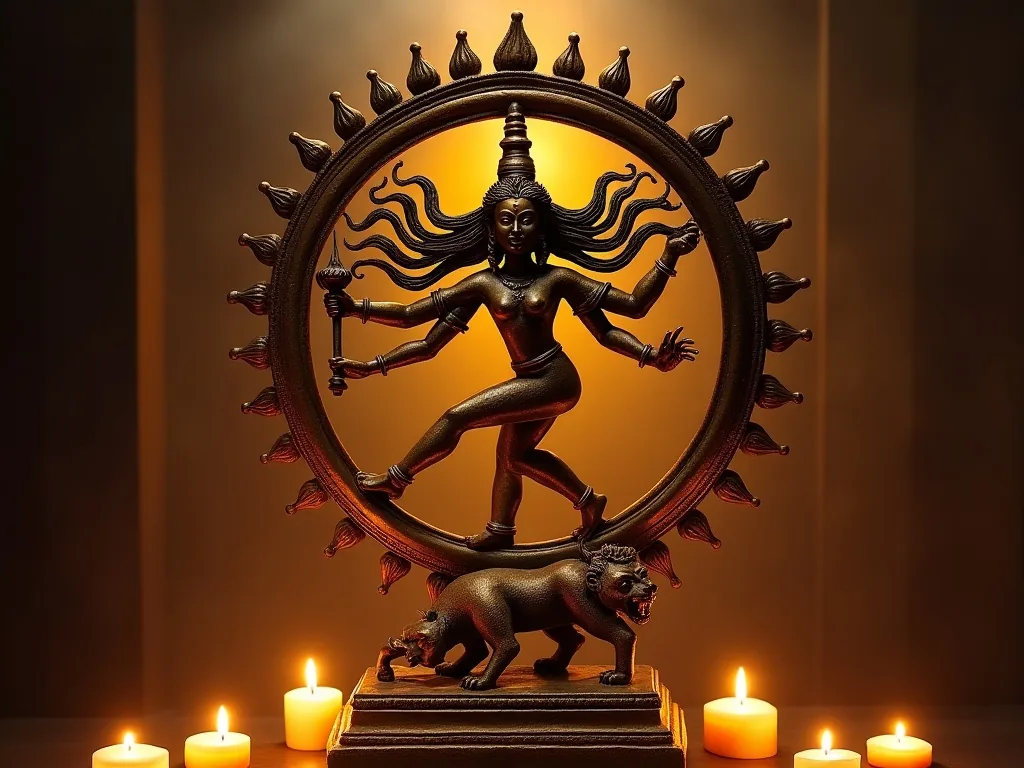
The dance Shiva performs is the Tandava, a term with layered meanings. The most fearsome form, the Rudra Tandava or Maha Tandava, is the dance that ends a cosmic cycle, the Kalpa. When one universe's time has run its full course, Shiva's drum sounds the final rhythm, his third eye blazes, and reality unravels back into undifferentiated potential. But the Ananda Tandava, the dance of bliss, is the form Nataraja embodies: a performance of ongoing cosmic processes, not a single apocalyptic event.
Each element of the Nataraja icon carries precise symbolic weight:
- The damaru (hourglass drum) in Shiva's upper right hand represents the primordial sound from which language, time, and creation emerge.
- The flame in his upper left hand represents the fire of dissolution.
- The abhaya mudra (gesture of protection) in his lower right hand reassures devotees: fear not.
- The gajahasta (elephant-trunk gesture) of his lower left hand points to the raised foot, which symbolizes liberation for those who surrender to him.
- The ring of fire is the cosmos itself, continuously created and consumed.
The Tamil Shaivite tradition celebrated in the Thevaram hymns of the Nayanars, saint-poets like Appar, Sundarar, and Thirugnanasambandhar, made the Nataraja of Chidambaram Temple in Tamil Nadu the supreme focus of devotion. They wrote that the cosmic dance takes place not only in the vast hall of the universe but inside the human heart.
The Third Eye and the Fire of Transformation
Shiva is always depicted with three eyes. The third eye, set vertically in the middle of his forehead, is not merely a symbol of omniscience, though it is that. It is the eye of pure awareness that sees through the illusory world of maya. When it opens in wrath, its fire obliterates whatever stands before it.
The most famous deployment of this eye appears in the myth of Kamadeva, the god of desire. When the other gods, desperate to end the demon Taraka's reign of terror, needed the warrior god Kartikeya to be born, they required Shiva to abandon his asceticism and desire Parvati. They sent Kama to pierce Shiva with an arrow of blossoming flowers. Shiva opened his third eye and incinerated Kama on the spot, reducing the god of desire to ash. The myth contains a theology: desire, in the form of kama (lust, craving), cannot survive contact with pure consciousness. Kama was later restored, at Parvati's request, in a form visible only to his wife Rati, earning him the name Ananga, the bodiless one.
This same fire of the third eye recurs in Shaivite eschatology. At the end of a cosmic age, Shiva in his form as Mahakala (the Great Time) absorbs all of existence. Mahakala is often depicted as dark-complexioned, garlanded with skulls, seated in the cremation ground. He does not merely witness death; he is the force that time itself bows before. In the Shaiva Puranas, even Brahma and Vishnu acknowledge that they too will eventually dissolve back into Shiva.
Cremation Grounds, Ash, and the Embrace of the Impure
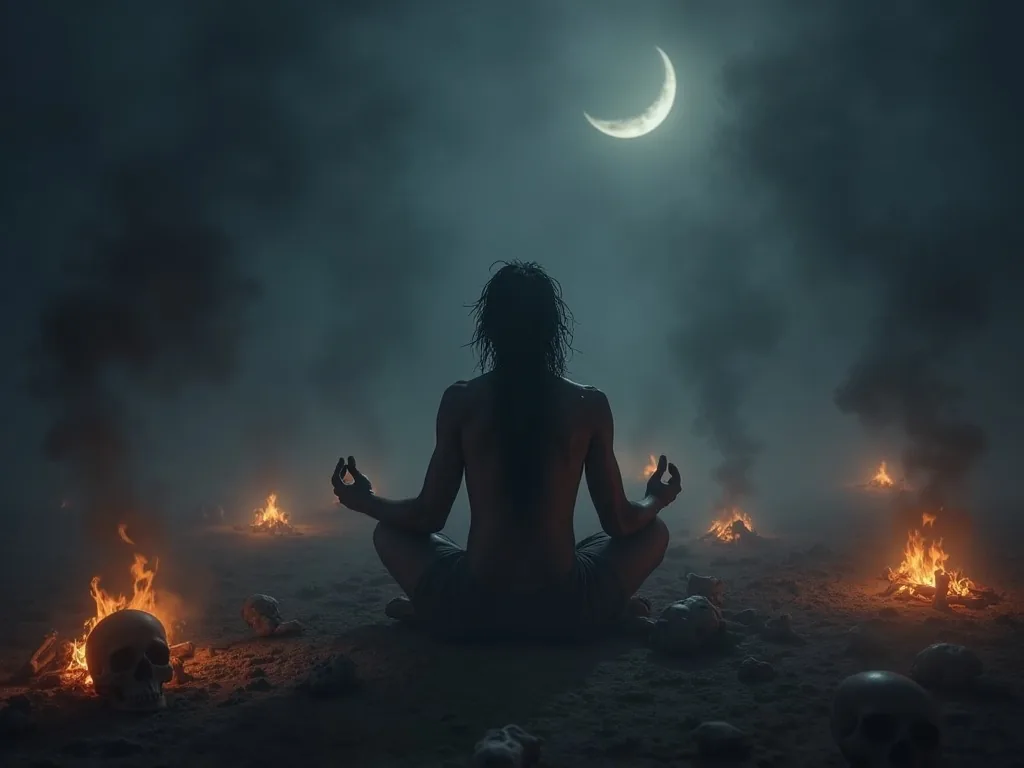
Among Shiva's most striking associations is his presence in the shmashana, the cremation ground. While most Hindu deities reside in ornate temples surrounded by ritually pure spaces, Shiva deliberately inhabits the margins of social and cosmological order. He smears himself with vibhuti, the sacred ash of cremated bodies. His companions, the ganas, are ghosts, demigods, and outcasts. He wears a garland of skulls, a crescent moon in his matted hair, and a living cobra around his neck.
This is not mere shock imagery. It articulates a sophisticated philosophical point: that which society fears and marks as impure, death, dissolution, the body's return to ash, is sacred. Shiva's presence in the cremation ground signals that no corner of existence lies outside the divine. The ash he wears, and that his devotees apply to their foreheads, is a reminder that the body is temporary and that what remains after all burning is pure consciousness.
The Aghora tradition, a radical ascetic lineage within Shaivism, takes this theology to its furthest edge. Aghoris meditate in cremation grounds, sometimes using human skulls as bowls, as a practice of dissolving the ego's terror of death. Their methods are extreme, but the underlying insight is Shiva's own: impermanence is not the enemy of the sacred. It is its very ground.
Shiva and Parvati: Destruction Held by Love
The mythology of Shiva would be incomplete without Parvati, the goddess who draws him from solitary asceticism back into relationship with the world. Their union is one of the great love stories of world mythology, told most beautifully in Kalidasa's fifth-century Sanskrit epic Kumarasambhava (The Birth of the War-God).
After his first wife Sati immolated herself in protest at her father Daksha's insult to Shiva, Shiva retreated into total absorption. He became a yogi beyond reach, his destructive potential unmoored from tenderness. Parvati, Sati reborn as the daughter of the mountain god Himavat, undertook fierce austerities to win Shiva's attention. She persisted where even the gods, and their hired accomplice Kama, failed. She won Shiva not through desire but through the depth of her own spiritual practice, her tapas.
Their reunion is theologically significant. Parvati represents Shakti, the dynamic feminine energy that activates and directs Shiva's otherwise static consciousness. In the Shakta reading of their relationship, Shiva without Shakti is shava, a corpse. Together they are the inseparable unity of awareness and energy that underlies all creation. Their son Kartikeya defeats Taraka. Their other son Ganesha guards every threshold. The destroyer, held in love, becomes the source of ongoing life.
Shiva Across Time: From Ancient Hymns to Living Devotion
Shiva's worship is among the oldest continuously practiced forms of religious devotion on earth. The Shri Rudram hymn chanted in his honor has been transmitted without interruption for at least three thousand years. The Maha Mrityunjaya Mantra from the Rigveda, addressed to Tryambaka (the three-eyed one), asks Shiva to liberate the devotee from death as a ripe fruit is freed from the vine, gently, naturally, without violence.
Shaivism spread across South and Southeast Asia with remarkable vitality. The temples of Angkor Wat were originally consecrated to Shiva before later Buddhist conversion. The great lingam shrines of India, from Rameshwaram in the south to Kedarnath in the Himalayas, draw millions of pilgrims each year. The Maha Shivaratri festival, observed every winter, celebrates the night when Shiva is said to perform the Tandava and when the lingam is believed to manifest spontaneously as a pillar of infinite light.
The Paradox at the Heart of Cosmic Order
Shiva's power as the destroyer is not a theological problem to be resolved. It is the point. Without dissolution there is no space for new form, no freedom from the weight of what has accumulated. Every philosophy and every life eventually confronts the necessity of letting go: of old identities, worn-out structures, the comfortable but confining. Shiva is the name Hindu tradition gives to that necessity when it is fully understood and fully embraced.
He is fearsome precisely because he is honest. He does not promise that things will last. He promises something rarer: that what dissolves returns, transformed, and that the consciousness watching it all, the witness behind the third eye, is never extinguished. In the iconography, the skull garland grins. The damaru drum beats on. The foot of liberation rises above the demon of ignorance. And the ring of fire, consuming and illuminating simultaneously, burns without end.
Free 25-page sample
Want the whole story?
Take the first 25 pages free. If it pulls you in, the full edition is yours as an instant PDF download, with a paperback on Amazon for selected titles.
Hindu
The Hindu Mythology Book: Vishnu, Shiva, Brahma, the Mahabharata, and the Sacred Stories of India
Vishnu, Shiva, Brahma, the Mahabharata, and the Sacred Stories of India
The Rigveda, the Mahabharata, the Ramayana, and the major Puranas. Every god, every avatar, every sacred epic.
More from Hindu
All articles
Hindu
Vishnu the Preserver: Keeper of Cosmic Order
Vishnu stands at the heart of Hindu cosmology as the eternal guardian of dharma, descending into the world age after age to restore balance whenever creation tilts toward ruin.
Hindu
Kali: The Fierce Mother Goddess Who Devours Time Itself
Kali is Hinduism's most electrifying deity: a goddess of death, liberation, and ferocious maternal love whose dark form conceals the deepest compassion in the cosmos.