

Nemesis: Goddess of Retribution, Balance, and Inevitable Reckoning
Nemesis was the Greek goddess who punished excess and arrogance, the divine force that cut mortals and gods alike back to size. Her story runs deeper than simple vengeance.
Contents
The wheel turns without mercy. A king grows drunk on his own fortune, a hero mistakes luck for virtue, a mortal beauty dares compare herself to Aphrodite. The sky does not strike them down at once. Something slower moves: a goddess who keeps account, who carries scales in one hand and a whip or sword in the other, who crosses the distance between Olympus and the human heart with the patience of mathematics. Her name was Nemesis, and the Greeks understood her not as cruelty but as correction.
She was not the goddess of punishment in the raw, vengeful sense. She was the goddess of due measure, the cosmic auditor who noticed when a mortal's luck had grown too large or a tyrant's pride had tipped the balance past what the universe could tolerate. The Greek word nemein means "to give what is due." Nemesis gave what was due. Nothing more. Nothing less.
That precision is what makes her terrifying. Arbitrary gods can be propitiated, bribed, deflected. Nemesis cannot. She is the logic inside the story, the moment when the narrative itself demands that the proud one fall.
The Origins of Nemesis: Hesiod, Night, and the Edges of the Cosmos
Nemesis first appears with clarity in Hesiod's Theogony (circa 700 BCE), where she is listed as a daughter of Nyx, the goddess of Night. That genealogy is deliberate. Nyx was one of the oldest beings in the Greek cosmos, born from Chaos itself before the Olympians took their thrones. Her children included Thanatos (Death), Hypnos (Sleep), the Moirai (Fates), Eris (Strife), and Nemesis. This is not a cheerful family. These are the forces that operate beneath the bright surfaces of Olympian mythology, the structural mechanics of mortal existence.
Being born of Night meant Nemesis predated the Olympian order. She owed nothing to Zeus, at least not in the way Athena or Ares did. Her authority came from something older: the basic principle that imbalance cannot hold, that the cosmos corrects itself the way water finds its level. Some later sources, including the lyric poet Mesomedes in his Hymn to Nemesis (2nd century CE), describe her spinning the wheel of fortune and cutting the proud down with her adamantine bridle, the unbreakable metal that also bound the Titans.
In Hesiod's Works and Days, Nemesis appears alongside Aidos (a goddess of shame, respect, or moral conscience) as one of the last divine presences to abandon humanity. When the Bronze Age collapsed into the Age of Iron, when human wickedness peaked, Aidos and Nemesis wrapped themselves in white and flew back to Olympus, leaving the earth without moral correction. That image, of these two figures departing together, tells us something important: the Greeks saw Nemesis not as a punisher but as a presence whose absence was the real catastrophe.

Family Tree: The Lineage That Places Her Outside Olympian Politics
Nemesis had two major genealogical traditions, and the tension between them reveals how her character evolved over centuries.
In the older Hesiodic line, she is the daughter of Nyx, full stop. No father is named. She belongs to the generation of primordial abstractions that preceded the Olympian personalities.
In a second tradition, she appears as a daughter of Oceanus, the great river encircling the world, which would make her a Titan-born figure of similarly ancient pedigree, a cousin to the Nereids and Oceanids who populated the seas.
A third thread, more mythologically loaded, makes her the daughter of Zeus himself, or at least places her in close enough relationship to him that Zeus is the one who pursues her in the shape-shifting chase myth (discussed below). This reading would make her half-sister to the Olympian generation, which complicates the image nicely: Zeus, who dishes out fortune and fate, pursued and fathered a child by the very goddess who corrects the excess of fortune and fate.
Her name appears in the works of Pindar, who uses nemesis as a common noun meaning "righteous anger" or "just resentment," suggesting the concept was deeply embedded in ordinary ethical language, not just formal theology. Homer uses the related term nemesaton in the Iliad to describe the feeling the gods experience when something morally inappropriate happens, the divine version of moral outrage. The goddess and the concept were inseparable in the Greek mind.
The Great Chase: Nemesis, Zeus, and the Egg of Helen
The myth that gave Nemesis her most dramatic narrative role centers on a pursuit, a transformation, and a birth. The variant survives in fragments of the Cypria (an early epic in the Trojan Cycle, now mostly lost but preserved in summaries by Proclus and others) and is elaborated by later mythographers including Apollodorus and the poet Athenaeus.
Zeus desired Nemesis. She refused him. To escape, she shape-shifted: she became a fish and dove into the sea, a bear and ran across the earth, a goose and took to the air. Zeus matched every transformation, pursuing her through each form until, in her goose shape, he took the form of a swan and caught her. The coupling produced an egg.
The egg was found, in some versions, by a shepherd near Rhamnus in Attica (Nemesis's sacred city), who brought it to Leda, queen of Sparta. Leda hatched the egg, and from it emerged Helen, whose beauty would ignite the Trojan War. In other versions, Leda herself had been visited by Zeus as a swan (the more famous account, which conflates the two women), but the Cypria tradition is clear: the true mother of Helen was Nemesis, the goddess of retribution.
The symbolic implications are considerable. The face that launched a thousand ships and caused one of the most catastrophic wars in Greek mythological history was the daughter of the goddess of cosmic correction. Helen's existence was itself a form of Nemesis at work: the retribution took the shape of overwhelming beauty, dropped into the world as an egg, hatching into a catastrophe no one could prevent.

What Nemesis Governed: Fortune, Hubris, and the Correction of Excess
The modern English word "nemesis" tends to mean "an opponent one cannot defeat" or "a long-overdue punishment." Both meanings preserve something real about the ancient goddess, but they flatten her.
Her actual domain covered three overlapping areas:
Redistributive justice. Nemesis corrected disproportionate good fortune. A man who had enjoyed too much success for too long drew her attention not because he had sinned, but because the imbalance itself was cosmically unstable. This is why the Athenians would sometimes pray to Nemesis after a great victory, asking her to avert envy from the gods and restore proportion. The practice was called phthonos avoidance, and it showed that the Greeks genuinely feared her intervention after success as much as after wrongdoing.
Punishment of hybris. Hybris (arrogance, specifically the arrogance of treating other humans or gods as objects for one's own gratification) triggered Nemesis directly. The story of Narcissus is the clearest example: he spurned all suitors, including the nymph Echo, and Nemesis answered those suitors' prayers by leading him to a pool where he fell in love with his own reflection and wasted away. This story, preserved by Ovid in the Metamorphoses (Book III), gives Nemesis the role of the goddess who makes the punishment fit the crime with eerie precision. Narcissus refused to love others; Nemesis gave him an object of love he could never possess.
The balancing of honor. In Pindar's odes, nemesis operates as the proper sense of shame that stops people from claiming more honor than they deserve. Heroes who overclaim invite the goddess. This is why Pindar, writing for athletic victors, was always careful to balance praise with reminders of mortality.
Nemesis
Nemesis enforces proportional correction after the fact: she responds to imbalance already created, correcting excess fortune or punishing hybris once it has occurred. Her instrument is consequence.
Themis
Themis embodies divine law and the order of right conduct before the fact: she establishes what is lawful, presides over oaths and assemblies, and sets the standard against which Nemesis measures. Her instrument is precept.
The Sanctuary at Rhamnus: Her Sacred City and Cult
Rhamnus, a small coastal town on the northeast tip of Attica facing Euboea, was the religious center of Nemesis worship. The sanctuary there was old, possibly predating the Persian Wars. Two temples stood on the site. The smaller, older one may have been dedicated to Themis (whose statue by the sculptor Chairestratos, inscribed with her name, was found there). The larger temple, unfinished and never fully roofed, held a famous cult statue of Nemesis herself.
That statue was the work of Pheidias, the same sculptor responsible for the Athena Parthenos in the Parthenon and the Zeus at Olympia. It was carved, according to the traveler Pausanias (writing in the 2nd century CE in his Description of Greece, Book I), from a block of Parian marble that the Persian army had brought to Marathon in 490 BCE. The Persians, supremely confident of victory, had brought the marble to sculpt a trophy monument celebrating their conquest of Athens. Nemesis had other plans. The Athenians defeated the Persians at Marathon, took the marble, and handed it to Pheidias. He carved the goddess of retribution from the very material the arrogant invaders had intended for their victory monument. No myth is as tidy as that, but few objects in the ancient world carried a more pointed symbolism.
Pausanias describes the statue: Nemesis wearing a crown decorated with stags and small Nikes (Victory figures), holding an apple branch in one hand and a bowl decorated with Ethiopians in the other. The stags may connect to swiftness or to the hunt. The apple branch recalls the golden apple of the Hesperides, suggesting the gift of fortune that Nemesis could give or withdraw.
Symbols, Attributes, and Iconography
Across vase paintings, coins, and sculptural descriptions, Nemesis carries a consistent set of attributes:
- The measuring rod or cubit (cubit derives from the Latin for elbow; the Greek measuring tool was the metron): she measures out what is proportionally owed.
- The wheel: fortune rotates; Nemesis controls the rotation, or at least sets limits on how high any one person may ride it. This attribute links her directly to the Wheel of Fortune concept that later filtered into medieval allegory and the Tarot.
- Wings: in some depictions she is winged, like Nike or Iris, suggesting that correction travels fast once it departs.
- A whip or sword: the instrument of enforcement, not torture.
- The apple branch: drawn from the garden of the Hesperides, marking her connection to the redistribution of divine gifts.
- Scales: appearing in later Hellenistic art, linking her visually to Dike (Justice) and anticipating the Roman Iustitia.
The lash and the scale together capture her perfectly. She was not a torturer. She was an accountant with the authority to collect.

Nemesis Across Traditions: Cosmic Justice Has Many Names
The principle that Nemesis embodies, that unearned or excessive fortune must be corrected, appears in too many traditions to dismiss as a Greek peculiarity.
In Hindu cosmology, the concept of karma operates on a similar axis: actions accumulate consequences, and cosmic balance reasserts itself across lifetimes. Shiva in his form as the destroyer operates partly on this logic, dismantling structures that have grown excessive so that new creation can begin. The redistribution is built into the cosmos.
In Norse mythology, the Norns who weave fate at the base of Yggdrasil cut threads as readily as they spin them. Odin himself, the master of fate, suffers losses proportional to his gains: every piece of wisdom costs something, an eye, a hanging, a son. The Norse cosmos understood that the powerful paid for their power.
In Egyptian theology, the goddess Ma'at embodied cosmic order, truth, and balance. The feather of Ma'at weighed against the heart in the Hall of Osiris performed the same function as Nemesis's scales: measuring whether a life had been lived in proportion. Excess, here spiritual rather than social, caused the scales to tip.
The Aztec concept of tlazolteotl, the divine force that both generates transgression and devours it, operates differently but addresses the same human anxiety: that imbalance accumulates and must eventually be resolved. The Aztec cosmos resolved it through sacrifice and ritual rather than through a single personified goddess, but the structural logic rhymes.
What all these traditions share is a refusal to let luck and power operate without limit. The form Nemesis takes in Greece, the cold and precise goddess born of Night, is specific to Greek moral imagination. The principle she embodies is universal.
Nemesis and the Moirai: How Fate and Retribution Divide Their Work
Both Nemesis and the Moirai (the three Fates: Clotho, Lachesis, Atropos) govern the boundaries of human life, but their domains are distinct and worth separating carefully.
The Moirai deal in destiny: what a person is allotted at birth, the thread spun, measured, and cut. Their work is prospective and impersonal. They do not respond to behavior; they establish the framework within which behavior occurs.
Nemesis is retrospective and responsive. She does not determine what a person gets. She corrects what a person has taken, or what fortune has given them in excess of due measure. Her work begins after the Moirai have already woven, when someone has violated the proportions set by the cosmic order.
The philosopher Theophrastus (successor to Aristotle) described phthonos (divine envy or resentment at disproportionate good fortune) as the mechanism through which Nemesis operated. In this view, even the gods experienced something like discomfort when a mortal's success became too extreme, and Nemesis was the instrument through which that discomfort became action.
This is why sacrificing to Nemesis after a victory made practical sense to the Greek mind. You were not apologizing for winning. You were acknowledging that your fortune had grown large, that you recognized the debt, and that you intended to manage it rather than let it compound until she came to collect.
Nemesis in the Roman World: Invidia, Fortuna, and the Cult's Expansion
Rome absorbed Nemesis with genuine enthusiasm. Her cult spread through the legions, who adopted her as a protector of gladiatorial arenas and military camps. Inscriptions from Britannia to Syria invoke her. She appears on Roman coins, in mosaic pavements, in small votive bronzes.
The Romans sometimes conflated her with Fortuna (Fortune), since both governed the wheel of luck, but the distinction mattered: Fortuna could be either good or bad, arbitrary and fickle. Nemesis was neither arbitrary nor fickle. She was precise.
The Latin poet Ovid, writing in Metamorphoses around 8 CE, gave Nemesis her most vivid literary moment in the story of Narcissus. The opening lines of that episode name her directly: a worshipper calls on Nemesis to punish Narcissus for his cruelty, and she answers. The sequence is tight: prayer, attention, arrival of consequence. Ovid understood that Nemesis worked not through spectacle but through the logic of the situation itself, turning Narcissus's own nature against him.
The Roman writer Claudian, writing in the 4th century CE, composed a partial epic called In Rufinum in which Nemesis acts as the cosmic force that brings down the corrupt minister Rufinus. She is invoked at the opening, described as measuring his crimes against his false prosperity, and then executing the correction. By Claudian's era, Nemesis had become a near-allegorical figure, but she had lost none of her moral authority.
Nemesis in Modernity: From Psychology to Pop Culture
The modern English word "nemesis" has traveled far from Rhamnus. In common use it means "an opponent who cannot be beaten" or "a long-deferred punishment." Both meanings preserve the sense of inevitability that defined the goddess: the thing that catches up with you precisely because it has been patient.
Carl Jung used the concept of enantiodromia, the tendency of things pushed to an extreme to flip into their opposite, which maps closely onto the Nemesis principle. Hubris contains its own correction; excess fortune bends back toward the mean.
In contemporary fiction, "nemesis" typically names a villain or recurring antagonist, particularly one whose existence is the direct consequence of the hero's own choices. That usage, however diluted, still carries the goddess's signature: the enemy you made yourself, the consequence walking toward you.
She appears explicitly in the video game Middle-earth: Shadow of Mordor (2014) through the "Nemesis System," a mechanic where enemy orcs remember injuries inflicted by the player and return stronger, bearing those wounds as promotions. The system is mechanically brilliant and mythologically apt: the consequence accrues, strengthens, and returns. That is exactly what she did.
In astrology, the asteroid 128 Nemesis, discovered in 1872, is named for her. It appears in natal charts as a point associated with self-undoing, the place where one's own excesses create one's greatest obstacle.
She is not merely a footnote to Greek mythology. She is a figure who identified something true about how the universe feels to human beings: that excess does not simply accumulate, that the ledger closes, that patience and precision are more frightening than rage.
Frequently Asked Questions About Nemesis, Goddess of Retribution
Frequently asked questions
What is the difference between Nemesis and the Erinyes (Furies)?
The Erinyes (Alecto, Megaera, Tisiphone) pursued specific crimes, particularly murder within a family and violations of oaths. They were relentless, emotional, and attached to particular transgressions. Nemesis operated at a higher level of abstraction: she corrected imbalance and excess fortune whether or not a specific crime had been committed. A person could attract Nemesis simply by being too lucky for too long. The Erinyes punished the guilty; Nemesis rebalanced the scales regardless of guilt.
Was Nemesis worshipped in actual Greek religious practice, or was she mainly a literary figure?
She had a genuine and active cult. The sanctuary at Rhamnus in Attica held two temples and contained the famous Pheidias statue carved from Persian marble. Inscriptions and dedications to Nemesis survive from across the Greek and Roman world, including military sites in Britannia and Syria. Roman gladiators and soldiers were among her most devoted worshippers. The cult was real and enduring, not simply a poetic personification.
What primary sources describe Nemesis in detail?
Hesiod's Theogony and Works and Days (circa 700 BCE) provide the earliest literary attestations. The lost Cypria epic, summarized by Proclus, preserves the myth of her pursuit by Zeus and the birth of Helen. Pausanias's Description of Greece (Book I, 2nd century CE) describes the Rhamnus sanctuary and its cult statue. Ovid's Metamorphoses (Book III, circa 8 CE) gives her the Narcissus story. The Hymn to Nemesis attributed to Mesomedes (2nd century CE) is a direct liturgical text addressed to her.
Why did the Persians inadvertently create Nemesis's most famous statue?
According to Pausanias, the Persian army brought a block of Parian marble to Marathon in 490 BCE intending to carve a trophy monument after what they assumed would be a swift victory over Athens. The Athenians won the battle. The marble was left behind. The Athenians gave the unused stone to the sculptor Pheidias, who carved from it a cult statue of Nemesis for her sanctuary at Rhamnus. The story reads as Nemesis operating through historical events: the marble of Persian arrogance became the body of the goddess who punishes arrogance.
Is Nemesis connected to the myth of Narcissus?
Yes, and the connection is explicit in Ovid's telling. In Metamorphoses Book III, the nymph Echo is humiliated by Narcissus's rejection. One of the rejected suitors prays to Nemesis, asking her to make Narcissus experience love that can never be returned. Nemesis hears the prayer and leads Narcissus to the pool where he falls in love with his own reflection. The punishment fits the offense precisely: Narcissus refused to love others, so he was given an object of love he could never reach.
How does Nemesis relate to the concept of hubris in Greek ethics?
Hubris (hybris in Greek) referred specifically to treating others as objects for one's own gratification, often involving public humiliation of the victim. It was considered a civic as well as a religious offense. Nemesis was the divine response to hubris: she restored the dignity of the violated party and cut the perpetrator back to size. More broadly, the cycle of hubris, leading to ate (ruin or delusion), leading to Nemesis, leading to catastrophe, was a foundational moral structure in Greek tragedy, visible in Aeschylus's Agamemnon and Sophocles's Ajax.
The Wheel Still Turns: Nemesis as a Living Ethical Concept
Scholars of Greek religion have debated whether Nemesis was ever fully personalized, whether she remained a quasi-abstract force or achieved genuine divine personality. The existence of her cult at Rhamnus, her named statues, her hymns, and her appearances in narrative myth suggests she crossed fully into personhood, at least in the popular imagination.
What keeps her relevant is not her ancient machinery but her psychological accuracy. Human beings still observe what she governed. The successful person who grows careless, the powerful figure whose certainty outruns their wisdom, the culture that mistakes prosperity for permanent entitlement: these situations feel as though they carry their correction inside them, coiled and waiting. Nemesis is the name the Greeks gave to that feeling, to the sense that the cosmos notices and remembers.
She did not require a victim to demand justice. She required only that the imbalance grow large enough to be undeniable. That is why Aidos (moral conscience) walked beside her in Hesiod's image of the departing goddesses: without the internal check, the external correction becomes inevitable. Without shame, you get the goddess.
The Athenians who prayed at Rhamnus before a military campaign, or after winning one, were not being theatrical. They were doing something practically rational given their cosmology: acknowledging that their fortune had weight, that weight attracted attention, and that the attention of Nemesis was best managed through recognition rather than ignored until it arrived. The wheel Mesomedes described, spun by her adamantine hands, was never stopped by prayer. Only by proportion.
Read the full book
Want the whole story?
The complete edition is an instant PDF download here, with a paperback on Amazon for selected titles.
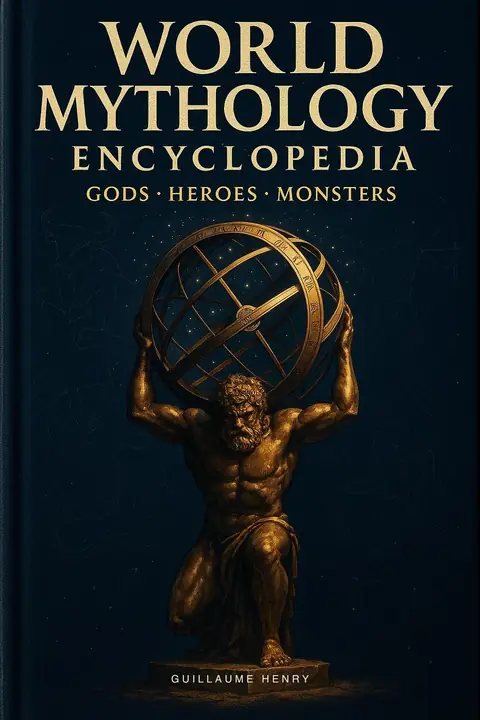
Mythology
The World Mythology Book: The Gods, Heroes and Myths of Every Culture
The Gods, Heroes and Myths of Every Culture, in One Volume
The whole of world mythology in a single volume: Greek, Norse, Egyptian, Japanese, Hindu, Celtic, Slavic, Mesoamerican and African myths gathered side by side, each drawn from the primary sources.