

Njord: Norse God of the Sea, Wind, and Coastal Wealth
Njord rules the sea and its bounties in Norse myth - patron of sailors, fishermen, and coastal traders. Explore his Eddic origins, his ill-fated marriage to Skadi, and his place among the Vanir gods.
Contents
The ships go out before dawn. The ropes smell of salt and pine resin. A Norse fisherman in the tenth century, hauling his net off the coast of Vestfold, would not have prayed to Odin for good weather. He would have called on Njord, god of the sea, the one who controlled the winds that filled sails and the currents that brought herring close to shore.
Njord is one of the oldest figures in Norse religious practice, old enough that the Roman writer Tacitus may have glimpsed his cult in its early form. He does not thunder. He does not make war. He brings the catch home. He is the quiet, essential god that maritime Scandinavia could not afford to ignore, and yet he remains far less known today than his son Freyr or the storm-wielder Thor. That gap is worth closing.
Njord's Place Among the Vanir and Aesir
Norse mythology divides its divine families into two great groups. The Aesir are the gods of Asgard, the warrior-kings: Odin, Thor, Tyr, Baldr. The Vanir are a separate, older clan, gods of fertility, the sea, and natural abundance. Njord belongs to the Vanir. He is one of their foremost members, alongside his children Freyr and Freya.
The two divine groups once fought a war. The Prose Edda, Snorri Sturluson's thirteenth-century compilation of Norse mythology, describes a conflict that ended in a truce and an exchange of hostages. Njord and Freyr went to live among the Aesir as those hostages, adopting the role of honored guests while never quite losing their Vanic nature. Snorri writes in the Ynglinga saga that Njord was "the third among the Aesir" in terms of prestige at Asgard, a remarkable standing for a former hostage.
His home in Asgard is called Noatun, which translates roughly as "Ship-Haven" or "Enclosure of Ships." The name alone says everything about his domain. He keeps his hall where boats are sheltered, where the smell of the sea comes in through every gap in the timber.

What the Eddas Actually Say About Njord's Power
Two primary texts preserve Njord's mythology in detail. The Prose Edda, written by Snorri Sturluson in Iceland around 1220, and the older Poetic Edda, a collection of poems set down in the Codex Regius manuscript around 1270 but drawing on much earlier oral traditions. Together they give a picture of a god whose powers were both practical and cosmic.
The Prose Edda's section called Gylfaginning puts it directly: Njord rules the course of the wind, stills the sea and fire, and is called upon by seafarers and fishermen. Snorri says he is "very rich and prosperous," which matters in a world where coastal wealth was real, measurable wealth. A calm sea meant a full net. A favorable wind meant a merchant ship arrived in port instead of breaking on a reef.
The Poetic Edda poem Grimnismal, in which Odin lists the homes of the gods, names Noatun as Njord's hall among the nine worlds and says he has little love for mountains. That small detail connects directly to one of his most famous stories.
The Lokasenna, another Poetic Edda poem, shows Njord at a feast among the gods. When the trickster Loki begins his infamous flyting, his verbal assault on each god in turn, he attacks Njord's Vanic origins, mocking him as a hostage who was sent from east of the Rhine. Njord responds calmly. He points out that he fathered a son, Freyr, "who is hated by no one" - a dignified answer that reveals his quiet pride in his legacy rather than any desire to trade insults.
The Marriage of Njord and Skadi: Two Worlds in Conflict
No story defines Njord god of the sea more clearly than his marriage to Skadi, the giantess of the mountains.
Skadi's father Thiazi had been killed by the Aesir after kidnapping Idun, the goddess who kept the golden apples of immortality. The gods had lured Thiazi into a trap and burned him as he tried to escape. Skadi put on her armor, took her weapons, and marched to Asgard alone to demand compensation. She is one of the few beings in all of Norse mythology who negotiates successfully with the Aesir from a position of strength.
The settlement included several provisions. One was marriage to a god of her choice, but with a condition: she had to choose her husband by looking only at their feet. She assumed the finest feet would belong to Baldr, who was beautiful beyond all others. She chose the best-looking pair of feet, clean and well-formed. They belonged to Njord.
The marriage began with goodwill. They tried to live together, splitting their time between her hall Thrymheim in the mountains and his Noatun by the sea. Nine nights in Thrymheim, nine nights in Noatun. Snorri preserves what appear to be fragments of their exchange in verse: Njord complains that the wolves howling from the hills are wretched compared to the swans he was used to hearing, while Skadi says she cannot sleep near the sea because the gulls wake her before dawn.
They parted. The marriage did not survive the geography. Two worlds that could not meet halfway. Scholars including John Lindow in his Norse Mythology: A Guide to Gods, Heroes, Rituals, and Beliefs (2001) read the story as a mythological encoding of the real tension between inland hunters and coastal fishing communities in Scandinavia, two populations with overlapping territory but different values and ways of life.

Njord in the Ynglinga Saga and the Historicized Tradition
Beyond the mythological poems, Njord appears in the Ynglinga saga, the opening section of Snorri's Heimskringla, a history of the Norse kings written in Iceland around 1230. Here Snorri takes a Euhemeristic approach: he treats the gods as real historical figures, great rulers of the past whom later generations elevated to divine status.
In this telling, Njord is a king in Asia who travels west with Odin and eventually rules over Sweden. He is described as generous, "so prosperous that people prayed to him for wealth." When he dies, his body is burned with great ceremony at a place called "by the sea." Even in this rationalized history, the coastal association survives.
The Ynglinga saga also mentions that Njord was "so filled with bounty" that people called on him in oaths and prayed to him for good seasons and prosperity, a role that overlaps with Freyr but emphasizes the maritime dimension specifically. Where Freyr governs the fertility of the land, Njord governs the fertility of the sea.
Nerthus: The Hidden Parallel
One of the most debated questions in Norse studies is the relationship between Njord and Nerthus, a goddess described by Tacitus in his Germania, written around 98 AD. Tacitus describes a Germanic deity he calls "Terra Mater," Earth Mother, whose Latin name he gives as Nerthus. Her cult, centered on an island in the northern sea, involved a procession of a sacred wagon draped in cloth, attended by a priest who alone could touch it, and a ritual washing in a hidden lake. The slaves who performed the washing were drowned afterward.
The name Nerthus is linguistically cognate with Njord. Both derive from the Proto-Germanic root *Nerthuz. This is not disputed. What scholars debate is whether Nerthus and Njord were once a single deity of indeterminate or dual gender, or whether they were always a divine pair, brother and sister or husband and wife, whose cult split along gender lines as Germanic religion developed.
Rudolf Simek in Dictionary of Northern Mythology notes that the Vanir were associated with incestuous sibling relationships, and the Lokasenna contains an accusation from Loki that Njord fathered his children Freyr and Freya with his own sister. If Nerthus was once Njord's divine twin, the mythology preserved a memory of that relationship in distorted form. The question remains open, but it pushes Njord's cult back to before the Viking Age, into the deep layers of Germanic religion that archaeology and linguistics are still piecing together.
Freyr, Freya, and the Vanic Inheritance
Njord's two children are among the most important figures in all of Norse religion. Freyr governs sunshine, rain, and agricultural prosperity. He owns the ship Skidbladnir that always catches a fair wind, and the boar Gullinbursti with bristles of gold. Freya is the foremost goddess of love and desire, mistress of the magic called seidr, and the one who takes half the fallen warriors from every battlefield while Odin takes the other half.
Both children amplify and extend their father's domain. Njord governs the bounty of the sea; Freyr governs the bounty of the earth. Together they cover the full spectrum of natural wealth that Norse communities depended on. Freya's seidr magic, meanwhile, is explicitly said in the Ynglinga saga to have been taught to the Aesir by Njord's people after the truce.
This means the entire tradition of Norse shamanic magic that scholars like Neil Price have connected to volva practitioners and the ritual staff traces back, at least mythologically, to the Vanic family with Njord at its head. He is not just a fisherman's patron. He is a root of something much older.
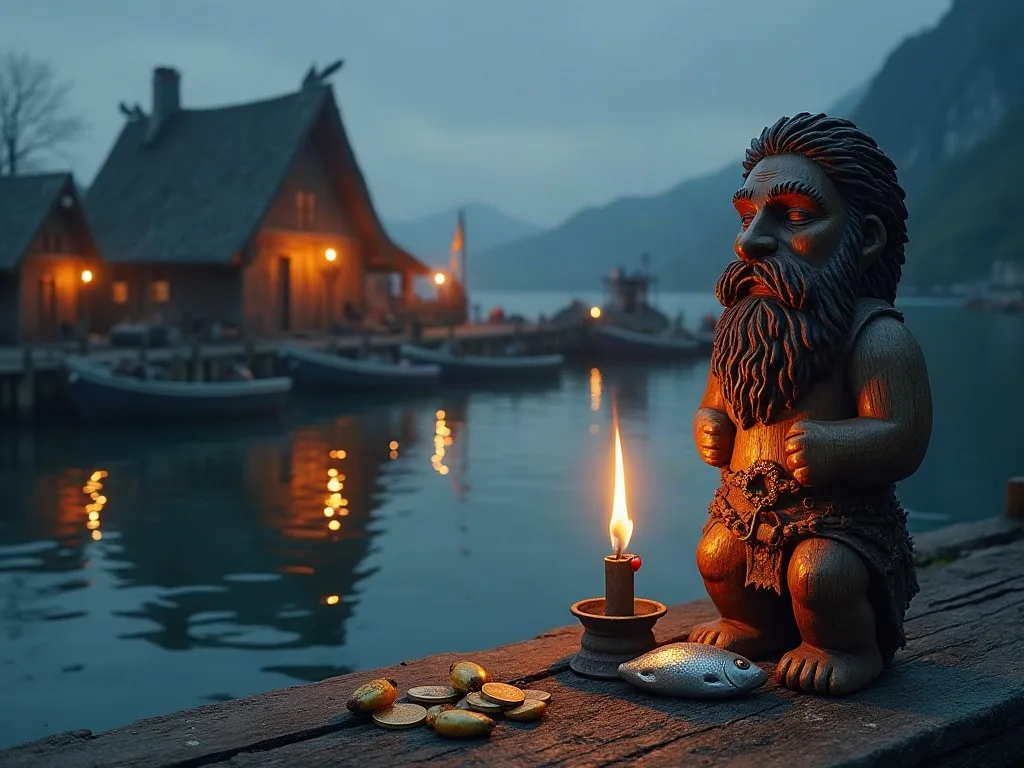
Njord in Archaeological and Place-Name Evidence
The literary sources are not the only record. Scandinavian place names preserve Njord's cult in physical geography. Names containing Njard- or Njar- appear across Norway, Sweden, and Denmark, concentrated in coastal and river-adjacent areas. Njardarlog in Norway is one example, a place-name that translates roughly as "Njord's Law" or "Njord's Water." These distributions match the expected zone of a sea-god's veneration, but they also extend inland along major rivers, suggesting his domain included freshwater routes as well.
Archaeological evidence is harder to pin to specific deities without written context, but votive deposits along coastal sites in Scandinavia, including miniature boats and fishing-related objects placed in bogs and along shorelines during the Iron Age and Migration period, fit the pattern of offerings to a maritime deity. Adam of Bremen's Gesta Hammaburgensis, written around 1075 AD, describes a great temple at Uppsala in Sweden where three gods stood: Odin, Thor, and Fricco, which most scholars identify as Freyr. Njord does not appear explicitly, but the Vanic pair of father and son suggests his cult may have been absorbed into Freyr's by that period, or simply overlooked by a Christian chronicler more interested in the dramatic figures.
Njord as a God of Wealth, Not Just Weather
A persistent misreading reduces Njord to a weather deity, a divine meteorologist who sends fair winds when properly propitiated. The Eddic evidence paints a richer picture. The Prose Edda calls him "very wealthy" and says he can "grant wealth in land and goods to those who call upon him." The wealth is specific: it comes from the sea. Fish, amber, walrus ivory, sealskin, and the profits of coastal trade were real economic forces in the Viking Age.
Njord as a patron of maritime wealth fits a society that built its prosperity on boats. The great chieftains of coastal Norway were not farmers who kept boats on the side. They were maritime lords. Control of a harbor, a fishing ground, or a trade route was power. Praying to Njord was praying for the economic engine of the coastal world to keep running.
This connects Njord to a broader comparative pattern. The Greek god Poseidon, the Roman Neptune, the Mesopotamian Enki, and the Polynesian Tangaroa all combine the sea's physical power with sovereignty over its resources, the fish, the trade routes, the coastal land itself. Njord fits this global archetype of the sea-lord as a god of abundance rather than just a god of storms.
Frequently Asked Questions About Njord, Norse God of the Sea
Frequently asked questions
Is Njord one of the Aesir or the Vanir?
Njord was born among the Vanir, the older clan of Norse gods associated with fertility, the sea, and natural prosperity. After the war between the Aesir and Vanir ended in a truce, he was sent to Asgard as a hostage-ambassador along with his son Freyr. He lived among the Aesir for the rest of his mythological life, but the Eddas always identify his Vanic origin as part of his character, as Loki's taunts in the Lokasenna make clear.
Why did the marriage between Njord and Skadi fail?
Njord and Skadi belonged to opposite landscapes. He was a coastal god whose home Noatun was built by the water; she was a mountain giantess whose hall Thrymheim sat high among snowy peaks. They tried alternating between the two locations, nine nights each, but neither could adapt. Njord disliked the wolves and the isolation of the hills; Skadi could not sleep through the crying of the seabirds. Snorri preserves what appear to be stanzas from their argument in Gylfaginning. The separation is usually read as a mythological explanation for the real ecological divide between coastal and mountain communities in Scandinavia.
What is the connection between Njord and the Germanic goddess Nerthus?
The names are linguistically related, both descending from the Proto-Germanic root *Nerthuz. Tacitus described a goddess named Nerthus among the Germanic tribes around 98 AD, whose cult centered on a sacred island and a ritually draped wagon. Since Norse myths mention that the Vanir practiced sibling marriage, and since Loki accuses Njord of fathering Freyr and Freya with his own sister, many scholars suggest Nerthus was once Njord's divine twin or female counterpart. The question of whether they were originally one deity or always a pair remains open in comparative Germanic religion.
What did people actually pray to Njord for?
The Prose Edda and Ynglinga saga are both explicit: people called on Njord for prosperity, safe voyages, and good fishing. Snorri writes that Njord "governs the course of the wind and stills sea and fire," so his intercession covered the main hazards of a sea voyage. He was also invoked for wealth more broadly, wealth that in coastal Scandinavia came primarily from the sea: fish, amber, walrus ivory, and the profit of maritime trade. The Ynglinga saga says people swore oaths in his name alongside Freyr and Odin.
How do Njord's children Freyr and Freya relate to his mythology?
Freyr and Freya extend and complement their father's domain. Where Njord governs the wealth of the sea, Freyr governs agricultural prosperity, sunshine, and rain. Freya governs desire, magic, and death. Together the three Vanir cover the full range of natural abundance. The Ynglinga saga also credits the Vanir, with Njord at their head, as the origin of the shamanic magic called seidr, meaning Njord's family is the mythological source of Norse ritual magic as well as coastal religion.
Are there any surviving temples or physical sites dedicated to Njord?
No confirmed archaeological site is definitively linked to Njord's cult. However, place names across Norway, Sweden, and Denmark preserve the root Njard-, concentrated in coastal and river-adjacent zones. Scholars including Rudolf Simek and John Lindow use these distributions as evidence that Njord's veneration was widespread in maritime Scandinavia. Votive deposits along coastal sites, including miniature boats and fishing objects in bogs, are consistent with offerings to a maritime deity, though attributing specific finds to a named god without written context is always uncertain.
Njord's Quiet Endurance: From Viking Sails to Modern Waters
Njord does not appear in Marvel films. He does not carry a hammer or lead armies. That absence is partly why he is underestimated, and partly why he is worth recovering.
The Norse gods who survived in popular culture are the loud ones: Odin the all-father, Thor the thunder-bringer, Loki the chaos-agent. Njord belongs to a different register. He is the god of the morning departure, the god of the net hauled up before breakfast, the god of the harbor market where amber and furs and dried fish change hands for silver. His mythology is built around the rhythms of actual coastal life.
Modern Norse paganism, broadly called Asatru or Heathenry, has quietly maintained Njord's worship alongside the more famous Aesir. Practitioners in coastal areas in particular, in Norway, Iceland, Sweden, and among diaspora communities in North America and Australia, invoke Njord as a protector of those who work at sea. Commercial fishermen, sailors, and maritime researchers have all been recorded calling on him in contemporary devotional contexts documented by scholars of new religious movements such as Matthias Gardell in Gods of the Blood (2003).
There is also the literary thread. When J.R.R. Tolkien constructed his mythology for The Lord of the Rings, he drew heavily on Norse sources; the sea-longing that haunts the Elves, their pull toward the grey havens and the western ocean, has often been compared to the Vanic current in Norse religion, that sense that something old and good belongs to the water. It is an indirect line, but Tolkien knew his Old Norse, and the melancholy beauty of Njord's domain, the sea that gives and takes, that calls and kills, runs through Western literary imagination in ways that are easy to miss.
The fishermen of Viking Age Vestfold are gone. The harbor gods of the Vanic religion have been filtered through Christian censorship and Snorri's careful reconstruction. But Njord is still there in the place names, in the sea-longing poems, in the shape of every story where the ocean is something more than scenery. He rules the wind. He stills the sea. He brings the catch home.
Free 25-page sample
Want the whole story?
Take the first 25 pages free. If it pulls you in, the full edition is yours as an instant PDF download, with a paperback on Amazon for selected titles.

Mythology
The World Mythology Book: The Gods, Heroes and Myths of Every Culture
The Gods, Heroes and Myths of Every Culture, in One Volume
The whole of world mythology in a single volume: Greek, Norse, Egyptian, Japanese, Hindu, Celtic, Slavic, Mesoamerican and African myths gathered side by side, each drawn from the primary sources.