
The Norns: Weavers of Fate in Norse Mythology
The Norns spin the destiny of gods and mortals at the roots of Yggdrasil. Learn who Urd, Verdandi, and Skuld are, what the Eddas say, and how their loom echoes across world mythology.
Contents
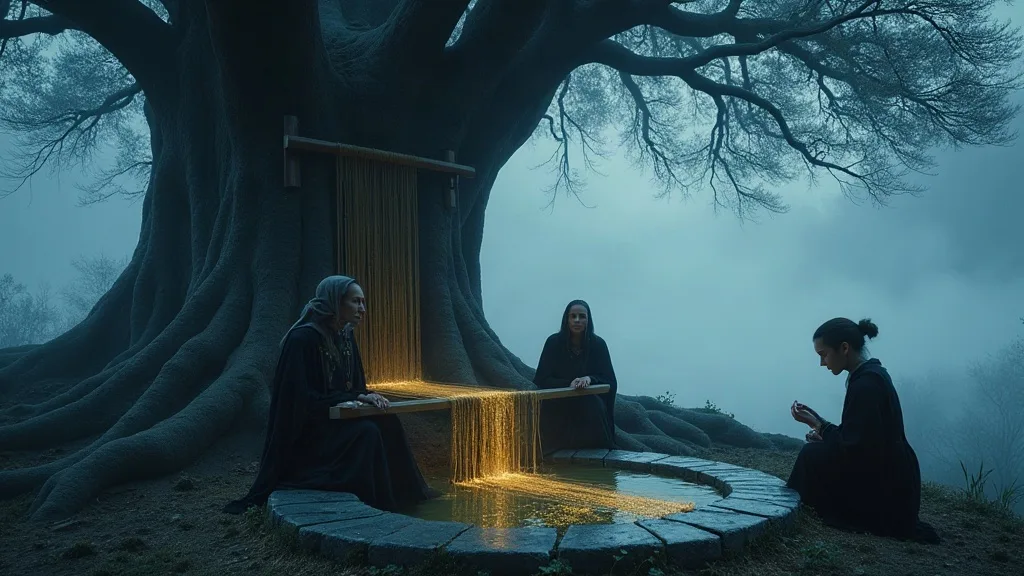
Three women sit at the base of the world tree. Around them, the roots of Yggdrasil drink from a sacred spring. One of the women lifts a thread. She does not choose the thread at random. She has always known which one it is. She places it on the loom, presses it flat, and moves on to the next.
No god interrupts her. Not Odin, who sacrificed an eye for wisdom. Not Thor, who can crack mountains. The three women weave without asking permission, because fate does not ask permission. It simply is.
This is the image the Old Norse poets return to again and again: the Norns, weavers of fate, sitting below the roots of the cosmic ash tree, spinning the lives of every being that has ever drawn breath. They are older than the Aesir gods. They will outlast Ragnarok. And the closer you look at their loom, the more it resembles something universal.
Who the Norns Are: Names, Roles, and the Well of Urd
The Norse sources name three Norns above all others: Urd, Verdandi, and Skuld. Their names come from Old Norse roots that scholars have long connected to time, though the exact translation is debated. Urd relates to the word urðr, meaning "what has become" or the past. Verdandi comes from verðandi, a present participle of the verb "to be" or "to become," pointing to the present moment. Skuld derives from skuld, connected to "debt" or "what shall be," gesturing toward the future.
The 13th-century Icelandic scholar Snorri Sturluson, writing his Prose Edda (a guide to Norse mythology he compiled around 1220 CE), places them clearly: "There stands a beautiful hall near the well, under the ash tree, and out of this hall come three maidens, who are called Urd, Verdandi, and Skuld. These maidens shape the lives of men." Snorri draws on earlier oral tradition and on the Poetic Edda, the older collection of mythological poems preserved in the Codex Regius manuscript from around 1270 CE.
The Poetic Edda poem Völuspá ("The Prophecy of the Seeress") gives the earliest clear account. A völva, the Old Norse word for a female seer, speaks: she describes how the three Norns came from the lake that stands beneath Yggdrasil, carrying stakes that they drove into the earth, then began weaving the fates of mankind. The poem says they established the laws, chose lifespans, and spoke the destinies of men.
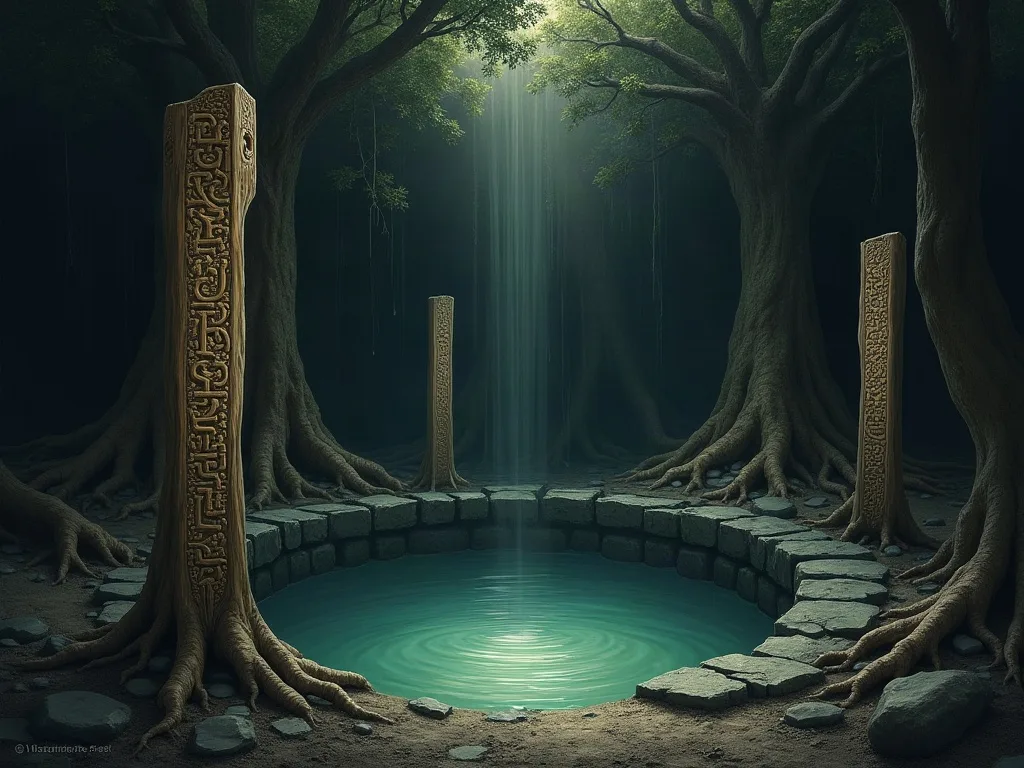
Their home is Urðarbrunnr, the Well of Urd, one of the three wells at the roots of Yggdrasil. The gods themselves ride there every day to hold their council. The well has water so sacred that anything dipped into it turns white as the membrane inside an eggshell. The Norns draw from it each day and pour it over the roots of the ash tree to keep Yggdrasil alive. Even the world tree depends on them.
The Loom and the Thread: How Norse Fate Actually Works
The mechanism of the Norns' work appears most vividly in the skaldic poem Darraðarljóð, "The Song of the Spear," preserved in the saga Njáls saga (written around 1280 CE, drawing on older material about the Battle of Clontarf in 1014 CE). There, twelve valkyries weave on a loom made of human entrails, using a sword as a beater and arrows as shuttles. The poem says they weave the web of war, choosing who will live and die on the battlefield. The imagery is brutal and precise: fate as textile, each thread a life.
The connection between Norns and weaving runs deep in Norse culture. Old Norse uses the verb rísta (to carve) and kljúfa (to cut) for fate-work too. The Norns carve runes on the stakes they plant at a person's birth. The elder poem Fáfnismál, where the dying dragon Fafnir speaks to Sigurd, says: "I know the Norns were not of one kindred who chose my life." This implies many Norns beyond the three named ones, a point the Prose Edda confirms: "There are also other Norns who visit every man when he is born, to shape his life."
This is critical. In Norse belief, fate is not a single ruling decree from one goddess. It arrives in layers. The three great Norns set the cosmic order. Smaller Norns, tied to different races of beings, attend individual births. Snorri says some Norns come from the Aesir, some from the elves, some from the dwarves. The fate you carry is woven from multiple hands, which is why some men prosper and others suffer from birth: the quality of one's Norns matters.
The Old Norse word for the individual destiny they assign is wyrd in the related Old English tradition, or örlög in Norse, meaning "primal law" or "foundational decree." It is layered, cumulative, built up from the decisions of ancestors as much as from the weaving of the Norns. Your fate is partly inherited.
The Three Norns and the Gods: Scenes at the Well
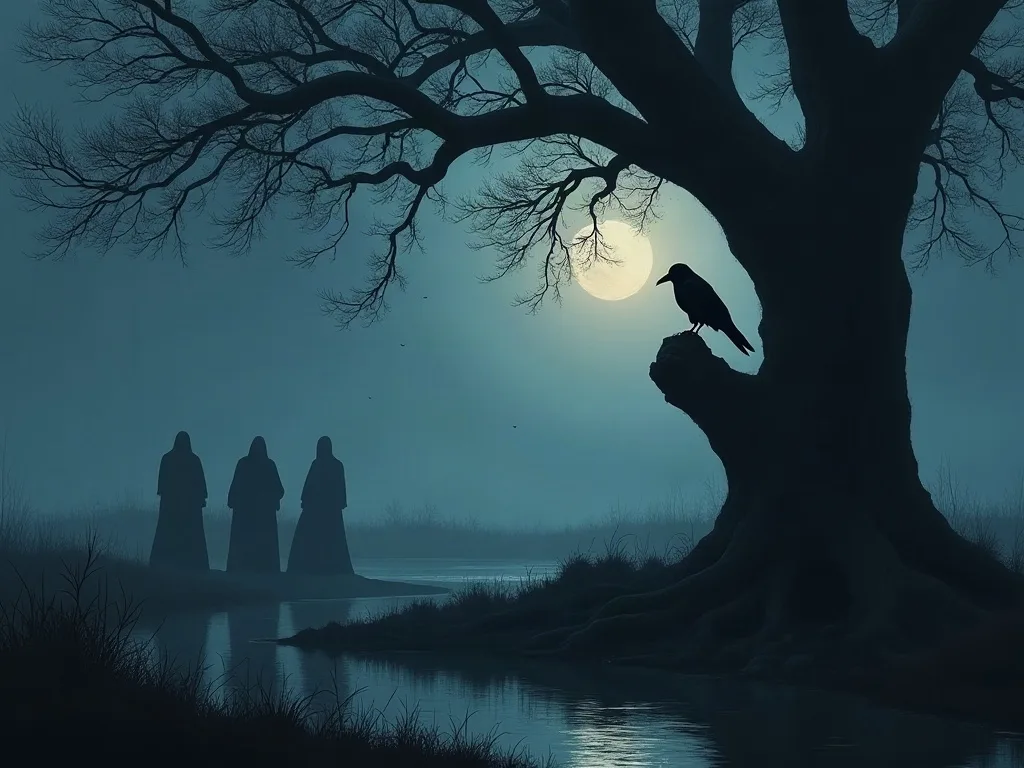
Odin visits Urðarbrunnr for wisdom. His ravens Huginn (thought) and Muninn (memory) fly out each morning and return at night to report what they have seen. But the raven-god himself makes the journey below the roots of the world tree, asking questions. The Norns do not answer to him. They answer to the logic of fate itself.
The most important Odin-and-fate scene unfolds not at the well but on the World Tree. In Hávamál, the great wisdom poem of the Poetic Edda, Odin hangs himself on Yggdrasil for nine days and nights, wounded by his own spear, to learn the runes. The runes are themselves a form of writing fate. When Odin masters them, he gains a partial access to the Norns' craft: he can read what is written, and sometimes write new things. But "sometimes" is the key word. He cannot rewrite the great threads. He can only navigate them.
The god Baldr learns this at terrible cost. Baldr, brightest of the Aesir, begins to dream of his own death. His mother Frigg extracts oaths from every object in the nine worlds not to harm her son. She misses the young mistletoe. The Norn-woven destiny is already in place. The blind god Höðr throws the mistletoe dart, guided by Loki's hand, and Baldr falls. Odin, who knows the most about fate, cannot stop it. The Norns have already woven it.
This is perhaps the Norse mythology's darkest theological point: fate as woven by the Norns is not punishment, it is simply structure. There is no appeal, no court, no loophole. Even divine parenthood cannot unravel the thread.
Norns, Valkyries, and Dísir: Untangling the Female Powers of Fate
Norse mythology holds three categories of female figures who touch destiny, and readers often mix them up.
The Norns sit at the cosmic level. They set the framework of fate itself.
The Valkyries (from valkyrja, "chooser of the slain") operate within that framework. They ride to battlefields and select which warriors die and which survive. They carry out the Norns' weaving on the human scale. The valkyrie Brynhildr in the Völsunga saga acts partly as a fate-agent, choosing the wrong warrior by Odin's command and paying for it with her imprisonment behind a wall of fire. The valkyries have names, backstories, and emotions. The Norns do not.
The Dísir are ancestral female spirits attached to families and clans. They bring luck or ill-luck to bloodlines across generations. They are worshipped at the dísablót, a mid-winter sacrifice recorded in several Norwegian and Swedish sources. The dísir blur into the Norns in some sagas: a dying man may see the dísir coming for him, described in terms almost identical to the Norns' arrival at birth.
These three layers, cosmic Norns, battlefield Valkyries, and ancestral Dísir, form an interlocking system. Fate in Norse thought is not a single divine decree but a web produced by many weavers at different scales.
What the Eddas Actually Say: Reading the Primary Sources
Getting the Norns right means returning to the two foundational texts.
The Poetic Edda is a collection of anonymous poems, copied around 1270 CE from sources that are older by centuries. The most important poem for the Norns is Völuspá. Stanzas 19-20 describe the three Norns driving stakes into the earth and carving runes: "They set up laws, they chose lives, they told the fates of the children of men." The seeress-narrator of Völuspá is herself a figure who can read what the Norns have woven, which is why she can prophesy Ragnarok in such detail.
The Prose Edda, compiled by Snorri Sturluson around 1220 CE, is the most systematic account. In the section called Gylfaginning ("The Beguiling of Gylfi"), Snorri describes Urðarbrunnr and the three Norns in detail. He is a Christian writing about pagan beliefs, which introduces some caution: scholars like John Lindow (in his 2001 Handbook of Norse Mythology) note that Snorri occasionally systematises the mythology in ways that make it tidier than the older, messier poems suggest.
A third source deserves attention: the runic poem Sigrdrífumál ("The Lay of Sigrdrífa") in the Poetic Edda. The valkyrie Sigrdrifa teaches Sigurd the meaning of runes, and she names the Norns directly as the source of victory-runes and birth-runes. The text explicitly says Norns carve runes on the bow of a ship, on a bear's paw, on eagle's wings, on the pillars of a hall. Fate is literally written on the world, everywhere, if you know how to read it.
The 14th-century Icelandic Völsunga saga, a prose retelling of older heroic poetry, shows the Norns at work in a more personal scene. When the hero Helgi is born, the Norns arrive at night and decree his fate by torchlight. It is a scene of weight and intimacy: three women in a birth-room, deciding the span of a life, then leaving without a word.
The Norns and Ragnarok: Does Fate Itself End?
One of the strangest questions in Norse cosmology: if the Norns weave fate, and if Ragnarok is fated, do the Norns also weave the end of the world?
The Völuspá implies yes. The seeress describes seeing, in the far future, the earth sinking into the sea and the sky going dark. She describes Surtr, the fire giant from Muspelheim, burning the nine worlds with his sword. She describes Odin's death in the jaws of the wolf Fenrir. All of this, she says, she sees. That means it is already woven.
But the poem does not end in darkness. After Ragnarok, the earth rises again, green and new. Fields that sow themselves bear grain. The surviving gods meet on the plain Iðavöllr and find the golden game-pieces they used before the end, lying in the grass. A new sun rises, daughter of the old sun. The Völuspá closes with an image of a hall fairer than the sun, roofed with gold, where the righteous will dwell.
If this is all woven, then the Norns weave not only doom but renewal. The thread does not cut cleanly at Ragnarok. It continues. This makes the Norns something stranger than simple destroyers: they are the structure of time itself, including the time after time seems to end.
Echoes Across the Loom: Norns and Fate-Weavers in Other Traditions
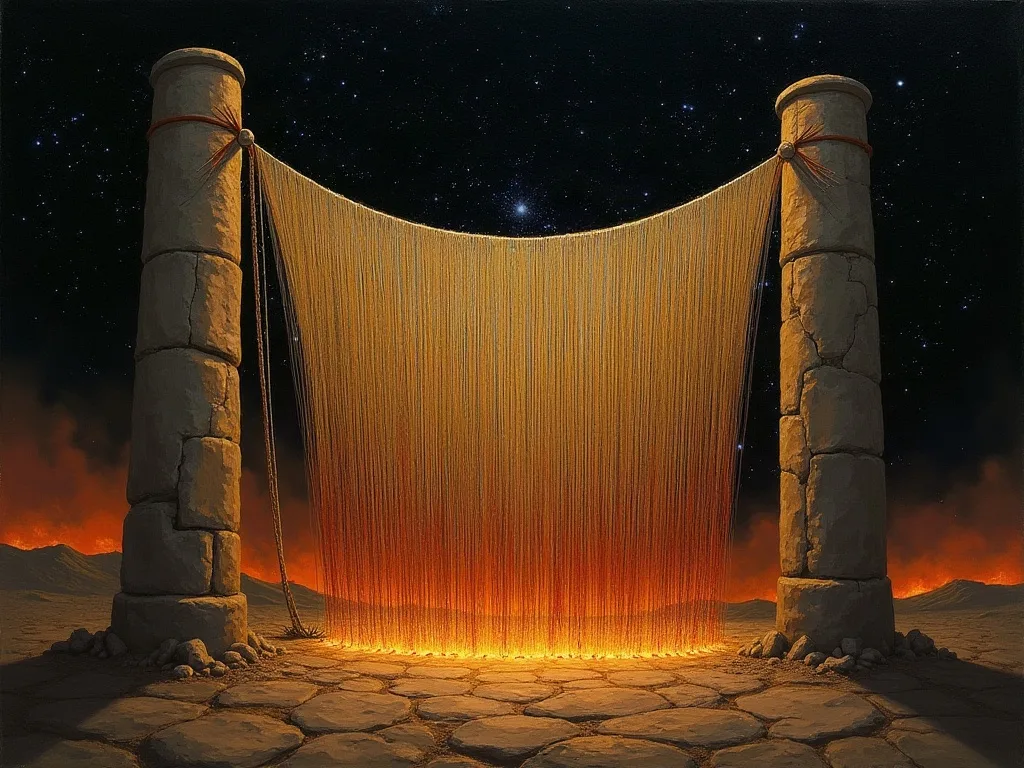
The Norns as weavers of fate have near-exact counterparts in cultures that had no contact with Norse Scandinavia. The parallels are striking enough to suggest either very ancient shared roots or a near-universal human instinct to imagine fate as textile.
The Greek Moirai, usually called the Fates in English, are three women: Clotho ("the Spinner"), Lachesis ("the Allotter"), and Atropos ("the Inflexible One who cuts"). Clotho spins the thread of life, Lachesis measures it, Atropos cuts it. Hesiod, writing around 700 BCE in the Theogony, calls them daughters of Zeus and Themis. Homer, in the Iliad, describes even Zeus checking himself when he considers saving a doomed warrior: the scales of fate tip, and the god holds back. The Greek and Norse systems differ in theology (the Greek gods can sometimes bend the Moirai's work, or so the myths hint), but the triple structure and the textile metaphor are nearly identical.
The Roman Parcae are direct inheritors of the Greek tradition: Nona, Decuma, and Morta. Later Roman writers merged them with the Moirai. They appear on Roman sarcophagi spinning thread beside a birth-scene, a visual echo of the Norse Norn arriving at Helgi's cradle.
In Slavic mythology, the Rozhanitsy are female fate-beings who appear at birth to decree the child's life. Their name connects to rozhat', "to give birth." They come in pairs or threes. Scholars like Leszek Słupecki have noted that the winter feast for the Rozhanitsy parallels the Norse dísablót both in timing and in offering type, usually food and drink, not blood sacrifice.
In Hindu mythology, the concept of karma and dharma does some of the same theological work, but the closest analogy to the Norns' personal fate-decree is the god Brahma writing each person's destiny on their forehead at birth. The Sanskrit term vidhi (fate, decree) covers a similar field. The Apsaras sometimes act as fate-carriers in epic literature, though without the systematic loom-imagery.
The Aztec tradition has the tonalpohualli, a 260-day ritual calendar where each day-sign carried a specific fate-quality. The priests who read it, the tonalpouhqui, functioned somewhat like Norns: they announced the fate-character of a newborn and advised the parents on how to navigate it. The day of birth was the determinant, just as the Norse Norns attend at the moment of birth. Quetzalcoatl himself was born under the sign Ce Acatl, "One Reed," which shaped his entire cosmic biography.
The Baltic tradition preserves Laima, a fate-goddess in Lithuanian and Latvian folklore who decides the length of human life, often pictured as a cuckoo bird whose calls you count to learn your remaining years. Like the Norns, Laima works at birth and cannot be bargained with.
What links all these figures is not borrowing. It is convergence. Humans everywhere faced the same basic fact: some people are born lucky, some are born doomed, and there is no satisfying reason for the difference. The response, across cultures and centuries, is to posit women at a loom, spinning what you cannot change.
How Saga Heroes Navigate a Woven Fate
Knowing your fate is woven does not make Norse heroes passive. The sagas are full of men and women who know the Norns have decreed their death and choose how to meet it.
The hero Gunnar of Hlíðarendi, in Njáls saga, receives a prophecy that he will die if he leaves Iceland a second time after being exiled. He is riding to the ship when his horse stumbles and he turns to look back at his farm, at the hillside in the autumn light. He says he will not go. He stays, and dies at home surrounded by enemies, shooting arrows until his bowstring snaps, asking his wife Hallgerðr for a strand of her hair to restring it. She refuses: he once slapped her, and she remembers. He dies. The Norns were right. But the manner of dying, facing enemies alone without flinching, that was his.
This is the Norse ethical response to fate: not resignation, but style. The örlög is fixed. The conduct inside it is your own. The Eddic poem Hávamál puts it directly: "Cattle die, kinsmen die, the self must also die; but the glory of great deeds never dies, for the man who wins it well."
This ethical tension, between a woven destiny and a personally chosen response, is what gives Norse Norns mythology its particular gravity. The Norns do not diminish the heroes. They make heroism meaningful, because every act of courage is chosen freely inside a frame that permits no escape.
Frequently Asked Questions about the Norns in Norse Mythology
Frequently asked questions
Are the Norns goddesses in the traditional Norse sense?
The Norns sit outside the usual divine categories of the Aesir and the Vanir. Snorri Sturluson's Prose Edda describes them as a separate class of beings entirely. They are not worshipped in the same way as Odin or Freya; there is no recorded cult dedicated specifically to them. They are closer to cosmic forces given female form than to gods who engage with the human world through prayer and sacrifice.
What is the difference between Urd, Verdandi, and Skuld?
Their names point to a relationship with time. Urd connects to what has already happened (the past), Verdandi to what is happening now (the present), and Skuld to what is owed or what will come (the future). Scholars including John Lindow and Rudolf Simek note that this tidy past-present-future reading may be a later rationalisation, possibly influenced by how the Greek Moirai were described. The Eddic sources themselves do not spell out these distinctions so neatly.
Can anyone escape or change the fate the Norns weave?
The Norse sources are consistent: no. Even Odin, the most knowledge-hungry of the gods, cannot undo what the Norns have set. He can read fate, navigate within it, and delay certain outcomes, but Ragnarok still comes, and Baldr still dies. The heroic ideal in the Eddas and sagas is not to escape fate but to face it with courage and earn a good name, the only thing that outlasts a woven death.
What is the Well of Urd and why does it matter?
Urðarbrunnr, the Well of Urd, is one of three wells beneath the roots of Yggdrasil. It is where the gods hold their daily council and where the Norns draw sacred water to pour over the world tree's roots. The well's water is so holy that anything submerged in it turns white. In a cosmological sense, it represents the accumulated weight of all past decisions and fates: memory, law, and destiny stored as water.
How do the Norse Norns compare to the Greek Moirai?
Both are triple female figures who govern fate through textile metaphor. The Moirai spin, measure, and cut a thread; the Norns weave and carve runes. A key difference is scope: in Greek myth, Zeus occasionally challenges the Moirai (or at least appears to weigh their decrees), while in Norse myth no god attempts to overturn the Norns' work. The Norse version is theologically more absolute. Both systems likely reflect very old Proto-Indo-European ideas about fate as a spun thread, a root the linguist Georges Dumézil traced across multiple Indo-European traditions.
Do the Norns appear in modern retellings or popular culture?
Yes, widely. Neil Gaiman's 2017 novel American Gods features the Norns under their anglicised names, though lightly. They appear in the Marvel comics universe as recurring figures in Thor storylines. The video game series God of War (especially the 2018 and 2022 entries) builds heavily on Norn-related imagery, including the runic writing of fate and the Well of Urd. The most rigorous modern treatment is probably in Alan Garner's novel Thursbitch (2003), which draws on Germanic fate-weaving in a literary context.
The Norns in Modernity: What a Pre-Christian Fate-System Still Teaches
The Norns have not stayed in medieval Iceland. They have migrated.
Every time a novelist gives a character a fate they cannot outrun but can meet with dignity, every time a screenwriter builds toward an ending the audience senses before it arrives, something structurally Norn-like is at work. The loom is a metaphor for narrative itself. Stories have threads. Threads are set early. How characters walk toward the inevitable is the story.
The philosopher Friedrich Nietzsche, writing in the 1880s, developed his concept of amor fati, "love of fate," which has an almost uncanny resonance with the Norse heroic response to the Norns. He did not derive it directly from the Eddas, but he read Germanic sources deeply. The idea that one should not merely accept fate but embrace it as the structure inside which a meaningful life is built, that idea runs through both Nietzsche and the Hávamál.
More recently, scholars like Carolyne Larrington (in her 2017 revised translation of the Poetic Edda for Oxford World's Classics) have highlighted how the Norns function as a critique of divine power, not a celebration of it. In a world where even Odin bows to the women at the well, the mythology questions whether the most powerful being in the cosmos is really the most important one. The women who weave silently, without armies or halls, without worship or altar-fire, turn out to hold the only real authority.
That is a genuinely radical thought. Three women at a well, shaping the lives of every being that has ever existed, asking no permission from anyone. The Norse poets put that image at the centre of their cosmology, under the roots of the world tree, near the water that feeds everything, and left it there as the most fundamental truth they could offer.
The loom keeps moving. The thread keeps running. And the three women do not look up.
Free 25-page sample
Want the whole story?
Take the first 25 pages free. If it pulls you in, the full edition is yours as an instant PDF download, with a paperback on Amazon for selected titles.

Mythology
The World Mythology Book: The Gods, Heroes and Myths of Every Culture
The Gods, Heroes and Myths of Every Culture, in One Volume
The whole of world mythology in a single volume: Greek, Norse, Egyptian, Japanese, Hindu, Celtic, Slavic, Mesoamerican and African myths gathered side by side, each drawn from the primary sources.