

Parvati: The Mountain Goddess and Divine Consort
Parvati the mountain goddess embodies devotion, fertility, and cosmic power in Hindu mythology. Daughter of the Himalayas, consort of Shiva, and mother of Ganesha, she shapes the fate of gods and mortals alike through grace, will, and maternal wisdom.
Contents
In the high peaks of the Himalayas, where snow never fully melts and silence is broken only by wind, a goddess sits in meditation. This is Parvati the mountain goddess, daughter of the mountains themselves, her skin luminous as moonlight, her eyes deep as forest pools. The peaks are her home. The snow leopards that roam the heights know her step. And yet, her reach extends far beyond the summits: into the hearts of billions who worship her as the supreme mother, the ideal wife, the cosmic power that holds all creation together.
Parvati is one of the most beloved figures in Hinduism. She appears in household shrines as the gentle consort; in temples as the supreme Shakti, the feminine divine energy that animates the universe. Her story is one of unyielding devotion, divine marriage, and the birth of gods. To understand Parvati is to understand how Hindu tradition balances male and female power, how love and ascetic renunciation intertwine, and how a woman's choice to pursue a path, her own courage, can reshape the cosmos.
The Daughter of Mountains
The mountains themselves gave Parvati birth. Her father is Himavan, the king of mountains, whose peaks touch the sky. The Puranas, ancient Hindu texts compiled between 400 and 1000 CE, tell that her mother was Mena, a river nymph of incomparable beauty. From this union came a child who would inherit both the strength of stone and the fluidity of water.
The name Parvati comes from parvat, the Sanskrit word for mountain. It means simply "of the mountain" or "the mountain one." In the Shiva Purana, one of the oldest texts devoted to her consort Shiva, she is called by many names: Gauri (the golden one, for her luminous skin), Uma (light, splendor), Annapurna (she who fills bowls with grain, the nourisher), and Durga (the unreachable), each name capturing a different facet of her power and nature.

As a young woman, Parvati grew up surrounded by the grandeur of her father's realm. Legends describe her playing in mountain springs, dancing with attendants in meadows of wildflowers that bloomed only where she walked. Yet she harbored a secret desire: she wished to marry Shiva, the great yogi and destroyer god, the ascetic who sat alone in the high Himalayas, lost in eternal meditation.
Shiva was not an ordinary match. He had renounced the world. His body was smeared with ash from cremation grounds. He wore a serpent as a necklace and had a third eye on his forehead, an eye that burned with power so fierce it could reduce mountains to dust. No other goddess or divine being had won his heart. For countless ages, he had sat alone, withdrawn from the affairs of gods and mortals alike.
The Pursuit of Shiva
Parvati's desire to marry Shiva was not simple infatuation. In the Hindu cosmology, every action ripples through creation. The union of Parvati and Shiva would produce a child of unimaginable power. The gods themselves knew this, and they needed that child. A demon named Tarakasura had won a boon: he could be killed by no man, no god, no weapon ever created. Only a child born of Shiva could defeat him. But Shiva had withdrawn from the world. How could such a child be born?
The gods called upon Kamadeva, the god of desire, to awaken Shiva's heart. Kamadeva is depicted carrying a bow made of sugarcane, with arrows tipped in flowers. He is irresistible. Even ascetics fall under his spell. Kamadeva journeyed to Shiva's mountain retreat, bow in hand, and fired an arrow of desire directly at the meditating god.
For a moment, Shiva opened his eyes. His third eye blazed open. And in a single flash of cosmic fury, Shiva incinerated Kamadeva to ash. The god of desire did not perish permanently; he was eventually reborn. But Shiva returned to his meditation, unmoved, untouched. Desire, the arrow, the god himself: all were meaningless to one so deep in spiritual renunciation.
Parvati learned of this. She understood then that ordinary beauty would not sway Shiva. Only spiritual power, only devotion as deep as his own renunciation, could reach him. She withdrew to the mountains herself, adopted the life of an ascetic, and began to meditate with fiercer discipline than any yogi. She ate nothing but leaves, then only air, then only the essence of thought itself. Her body became thin as a reed. Her skin turned golden from the inner radiance of her practice.
For thousands of years, by one account, she performed tapas, the Hindu word for the heat of spiritual austerity. This was not punishment. This was power. Through tapas, a being accumulates cosmic energy, bends reality toward their will. The mountains shook with her meditation. The gods watched in awe.
The Marriage of Heaven and Earth
Finally, Shiva noticed her. As she sat in profound meditation, he appeared before her not as the terrifying ascetic, but in a gentle form, a wandering sage in beggar's clothes. He tested her. He claimed that Shiva was a worthless god, destructive and crude, unfit for a goddess of her refinement. Parvati defended Shiva with passion. She spoke of his greatness, his profound knowledge, his role in the cosmos. Shiva smiled. He had found his equal.
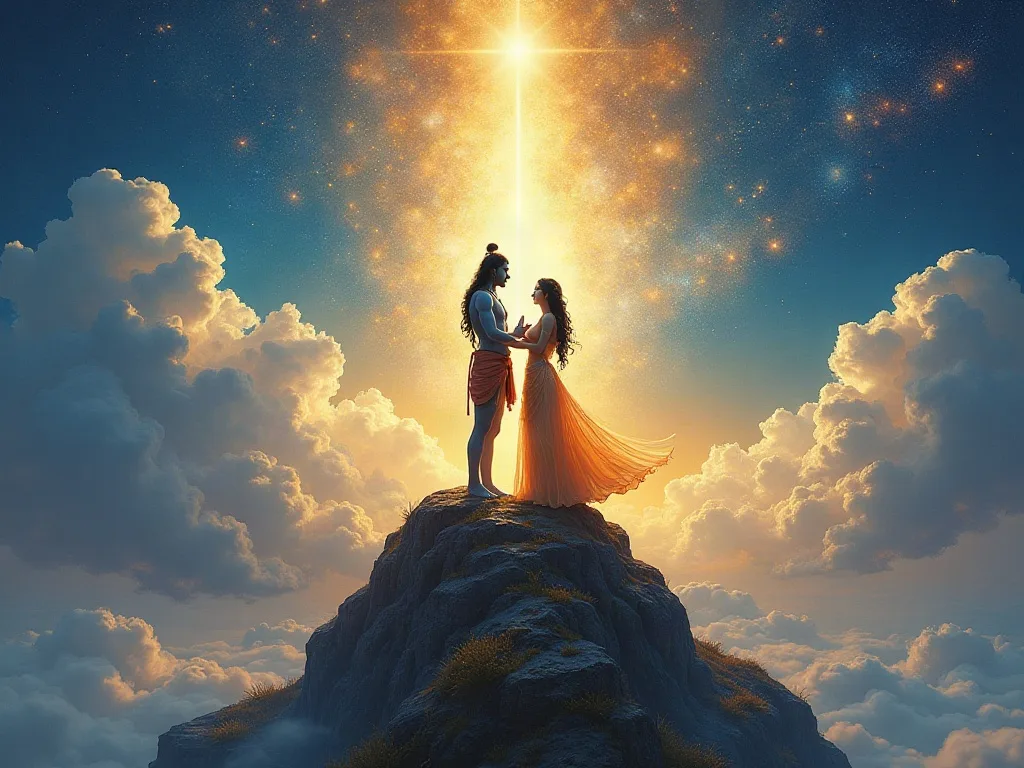
They were married in a ceremony described in the Shiva Purana as one of the most auspicious events in all of creation. The heavens themselves seemed to celebrate. Flowers rained from the sky. The gods danced. Even time itself seemed to pause in wonder at the union of the supreme ascetic and the daughter of mountains.
The marriage night of Shiva and Parvati is treated with remarkable poetic reverence in Hindu texts. It is not scandal or scandal-adjacent. It is sacred. The poets describe how their union generated such cosmic energy that the entire universe trembled. Some accounts say their love-making lasted 100,000 years, so deep was their union. The result of this cosmic embrace would be the birth of gods.
Mother of Ganesha and Kartikeya
From Parvati came forth Ganesha, the beloved elephant-headed god, remover of obstacles, lord of beginnings. The Shiva Purana tells that Parvati created Ganesha from the sandalwood paste she rubbed upon her skin as she bathed, breathing life into the figure with her own hands. She placed him at the entrance to her chamber as a guard. When Shiva returned and tried to enter, Ganesha, loyal to his mother, refused him passage. In fury, Shiva severed the boy's head with a single stroke of his sword. Parvati's anguish was absolute. Shiva, moved by her tears and his own regret, commanded that the first creature he encountered be brought to him. That creature was an elephant. Shiva took its head and placed it upon the boy's body, bringing him back to life. Thus Ganesha was born and reborn, forever marked by his mother's will and his father's power.
Parvati also gave birth to Kartikeya, also known as Skanda or Murugan, the six-faced god of war and martial prowess. It was Kartikeya, born of their union, who would eventually defeat Tarakasura, fulfilling the purpose for which the gods had long prayed for Shiva and Parvati to marry. The Skanda Purana, an ancient Hindu scripture dedicated to this god, emphasizes that Kartikeya's power comes directly from his mother: her devotion is his foundation, her will his sword.
The Forms of Power
Parvati is not a single, static figure. She exists in multiple forms, each revealing different aspects of cosmic reality.
As Annapurna, she is the nourisher, depicted carrying a vessel of rice and a ladle. She feeds the hungry. In times of famine, Hindus pray to Annapurna. The name literally means "full of food." There is no hunger, no lack, in her presence. She represents the feminine principle of abundance and care. Many temples in Hindu regions are dedicated specifically to Annapurna.
As Gauri, she is golden, radiant, the embodiment of beauty and grace. This is Parvati in her most gentle aspect, the loving mother and devoted wife. She is worshipped as the ideal of feminine virtue in Indian culture, though Gauri is never weak. Beneath the gentleness lies absolute power.
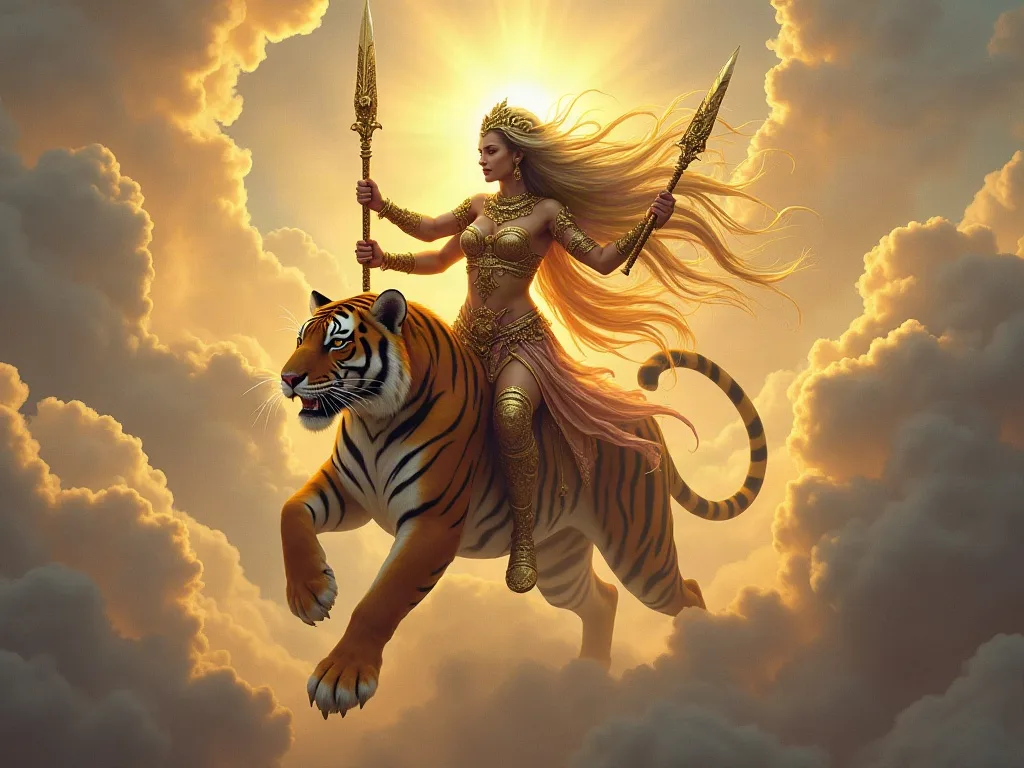
As Durga, she is the warrior mother, depicted with many arms, each wielding a different weapon, riding upon a tiger or lion. In this form, she battles demons and protects her children. The festival of Durga Puja, celebrated across Hindu and Bengali communities each autumn, honors her victory over Mahishasura, a buffalo demon. This celebration lasts ten days, culminating in the slaying of evil and the triumph of good. It is Parvati's fiercest form, yet she fights always to protect, never for conquest.
As Kali, she is the dark mother, wild-haired, tongue lolling, draped in skulls, dancing upon the corpse of Shiva himself. In this avatar, she represents the ultimate destruction of ego, the terror that precedes enlightenment, the fierce love that dissolves all illusion. Many Western observers have misunderstood Kali, seeing her as evil. Hindu practitioners know her differently: she is the mother who must destroy you to free you, the ultimate expression of maternal love that asks everything of you, holds nothing back.
The Ideal Woman, Reframed
In classical Indian literature and in many Hindu communities, Parvati is held up as the ideal wife and mother. She is devoted to Shiva, supportive of his spiritual path, never jealous, never demanding. She is the perfect balance of strength and tenderness.
Yet this reading flattens her. Parvati is ideal not because she is submissive. She is ideal because she pursued what she wanted with absolute discipline. She meditated for thousands of years. She challenged Shiva with her spiritual power. She created Ganesha without Shiva's direct participation. She bore his children and ruled as co-creator of the universe. She is the ideal because she was utterly, uncompromisingly herself.
Modern Hindu feminists and scholars have reclaimed Parvati as a figure of genuine agency. She chose Shiva. She chose her path. She chose to give birth to gods. Her devotion was not passive acceptance but active choice. The Sanskrit term pativrata, often used to describe her, is usually translated as "devoted to her husband." But the term also implies a woman who keeps her vow, who stands by her word, who is unshakeable in her commitments. It speaks to integrity as much as to service.
Parvati in Regional Traditions
Across the Indian subcontinent, Parvati takes on distinct regional forms and emphases.
In South India, particularly in Tamil Nadu, Parvati is worshipped as Meenakshi, a warrior queen with fish-shaped eyes, who rules the city of Madurai and marries Shiva (called Sundareswara in the South) in an elaborate ceremony that is re-enacted each year. Meenakshi temples draw millions of pilgrims. The annual Meenakshi Tirukalyanam festival celebrates this cosmic marriage with processions, music, and rituals that have continued for over a thousand years.
In Kashmir, in the northern reaches that border the actual Himalayas, Parvati is known as Sharika, a mountain goddess who inhabits the peak of Hari Parbat. She is fierce, independent, and deeply connected to the land itself. The Sharika Peeth shrine has been a pilgrimage site for centuries.
In Bengal, Parvati's fiercest form, Durga, holds particular prominence. The festival of Durga Puja is the most important festival in the Bengali calendar. It is not merely a religious observance; it is the heartbeat of Bengali cultural identity. For ten days, cities and villages transform into spaces of art, music, and communal celebration.
Parvati and the Feminine in Hindu Philosophy
The Hindu philosophical tradition recognizes Shakti, the divine feminine energy, as the animating force of the universe. Brahman, the ultimate reality, is often conceived as masculine principle (passive awareness); Shakti is the active principle that creates, sustains, and dissolves all things. Without Shakti, Brahman is inert. Without Brahman, Shakti has no ground to move upon. They are inseparable.
Parvati, as the consort of Shiva and as a supreme goddess in her own right, embodies Shakti. She is not Shiva's possession or ornament. She is his equal, his complement, his necessary other. In some theological interpretations within Shaivism (the branch of Hinduism that prioritizes Shiva), Parvati is understood as Shiva himself, manifested in feminine form. In others, she is a separate but equal principle. The philosophical debates about her exact relationship to Shiva have animated Hindu theology for two thousand years.
This conception stands in stark contrast to many Western philosophical traditions, which often posit a fundamental separation between masculine and feminine, spirit and matter, consciousness and creation. The Hindu vision is fundamentally different: the universe is the dance of these forces together, neither complete without the other, neither superior.
Parvati in Modern Hinduism and Beyond
Today, Parvati remains central to Hindu practice and devotion. She is worshipped daily in millions of homes. Mantras dedicated to her are chanted for protection, fertility, and spiritual advancement. Women pray to her for strong children, happy marriages, and inner strength. Men pray to her for wisdom and courage.
In the diaspora, Hindu communities around the world maintain temples and celebration spaces dedicated to Parvati and her forms. The Meenakshi temples of North America, the Durga Puja celebrations in London and Toronto, the Annapurna shrines in Sydney: these represent the living continuity of Parvati's presence in the modern world.
In contemporary Hindu art and literature, Parvati has inspired new interpretations. Poets have explored her inner life, her negotiations with Shiva, her role as a mother and as a cosmic force. Films and television series based on Hindu mythology have depicted her with renewed complexity and nuance. She remains not an ancient relic but a living presence, speaking to contemporary concerns about power, devotion, motherhood, and the balance between individual will and cosmic purpose.
Her influence has also extended into global popular culture, from references in contemporary literature to her iconography in visual art and design. The image of Parvati, serene yet powerful, has become recognizable worldwide as a symbol of maternal strength and spiritual depth.
Frequently asked questions about Parvati the mountain goddess?
Frequently asked questions
What are the main stories about Parvati and Shiva's courtship?
The Shiva Purana and Skanda Purana recount how Parvati performed intense spiritual austerities (tapas) for thousands of years to win Shiva's attention. Shiva, initially unmoved by even the god of desire, eventually recognized her as his spiritual equal and married her. Their union was celebrated throughout the cosmos and led to the birth of Ganesha and Kartikeya.
How is Parvati connected to Durga and Kali?
Parvati, Durga, and Kali are forms or avatars of the same divine feminine power, understood differently across Hindu traditions. Durga is Parvati's fierce warrior aspect, manifested to defeat demons; Kali is her most extreme form, representing the destruction of ego and illusion. Some texts present them as separate goddesses; others as manifestations of one supreme Shakti.
What role did Parvati play in the birth of Ganesha?
According to the Shiva Purana, Parvati created Ganesha from the sandalwood paste on her skin while bathing, giving him life through her own will. She placed him as a guard at her chamber. When Shiva tried to enter and Ganesha refused, Shiva beheaded him in anger. Shiva later restored Ganesha to life by giving him an elephant's head, making him eternal.
Why is Parvati called the mountain goddess?
Parvati's name literally means "of the mountain" in Sanskrit (parvat = mountain). She is the daughter of Himavan, the king of mountains, born from the union of the mountains and a river nymph. The Himalayas are her home and her realm, making her intrinsically connected to the mountains themselves.
What is the significance of Parvati in modern Hindu worship today?
Parvati remains one of the most widely worshipped goddesses in Hinduism. She is honored in daily household prayers, in major festivals like Durga Puja (celebrating her warrior form), and through pilgrimages to temples dedicated to her various manifestations, particularly Meenakshi temples in South India and Durga shrines across the Hindu world.
How does Parvati represent Shakti, the divine feminine energy?
In Hindu philosophy, Shakti is the active, creative principle of the universe. Parvati, as the supreme consort of Shiva and as a goddess in her own right, embodies this Shakti. She is the power that moves through creation, sustains it, and dissolves it. Without Shakti, the universe cannot manifest; without Parvati, Shiva's potential remains dormant.
The Unfinished Dance
Parvati's story does not end. In Hindu mythology, the cycles of creation and destruction continue eternally. The dance of Shiva and Parvati, the cosmic embrace of masculine and feminine, continues without pause or final resolution. Each age brings new challenges, new demons, new tests. Each time, Parvati rises to meet them: as warrior, as mother, as nourisher, as the still point at the center of all turning.
She reminds those who worship her that devotion need not be passive. That strength can live alongside gentleness. That a woman's will, pursued with discipline and love, can reshape the cosmos. That the feminine is not a secondary principle but the very force through which all things become real. In her multiple forms and her unwavering presence across two thousand years of Hindu tradition, Parvati holds a mirror to anyone seeking to understand what power truly means.
Free 25-page sample
Want the whole story?
Take the first 25 pages free. If it pulls you in, the full edition is yours as an instant PDF download, with a paperback on Amazon for selected titles.

Mythology
The World Mythology Book: The Gods, Heroes and Myths of Every Culture
The Gods, Heroes and Myths of Every Culture, in One Volume
The whole of world mythology in a single volume: Greek, Norse, Egyptian, Japanese, Hindu, Celtic, Slavic, Mesoamerican and African myths gathered side by side, each drawn from the primary sources.