
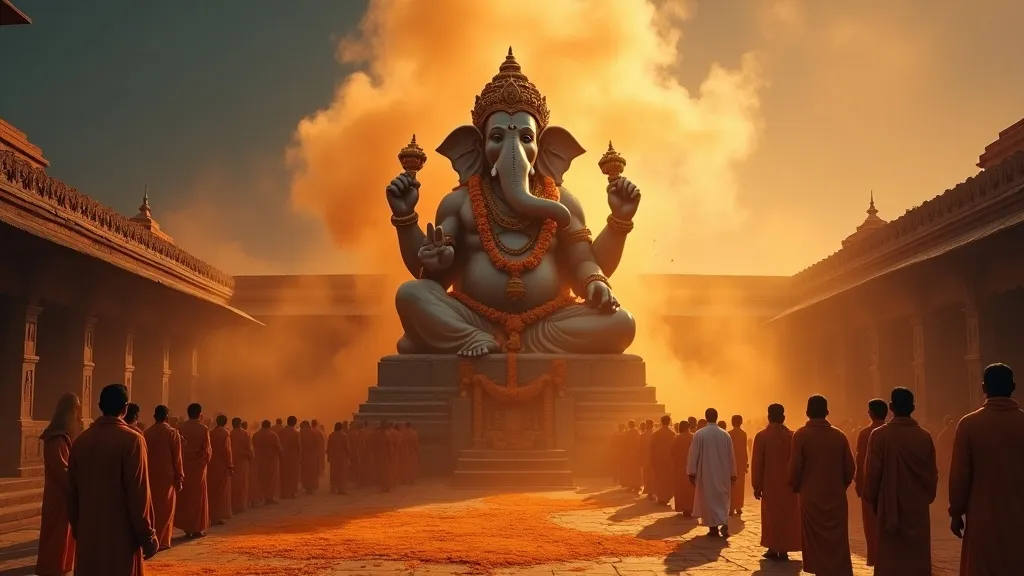
Ganesha: Remover of Obstacles, Lord of Beginnings
Ganesha guards every threshold in Hindu life. With his elephant head, his broken tusk, and his bowl of sweets, he clears the road before any journey begins.
Contents
Before a merchant opens his ledger, before a bride crosses her threshold, before a poet writes his first line, he pauses. He presses his palms together, whispers a name, and the name is Ganesha. The elephant-headed son of Shiva has stood at the entrance of Hindu religious life for at least fifteen centuries of textual record, and probably longer in the oral currents that ran beneath every written tradition. He is Vighneshvara, the lord of obstacles, and Ganapati, the lord of hosts. He both places obstructions in the path of the unworthy and dissolves them for those who approach with clear intent.
His form is impossible by every anatomical rule. A rounded human belly sits below a single tusked elephant head. Four arms radiate outward, holding a goad, a noose, a broken tusk, and a bowl of modak sweets. A mouse crouches at his feet, patient as a disciple. Nothing about the image is accidental. Every curve, every object, every asymmetry carries the freight of centuries of theological reasoning, and what looks playful from a distance is, up close, a precise philosophical statement.
This is not a minor deity at the edges of a pantheon. Ganesha, remover of obstacles, is invoked at the start of Hindu rituals, at the opening pages of Sanskrit manuscripts, at the inauguration of temples, businesses, marriages, and military campaigns. He is singular: worshipped across sectarian lines that divide almost every other figure in the tradition.
How Ganesha Came to Have an Elephant Head
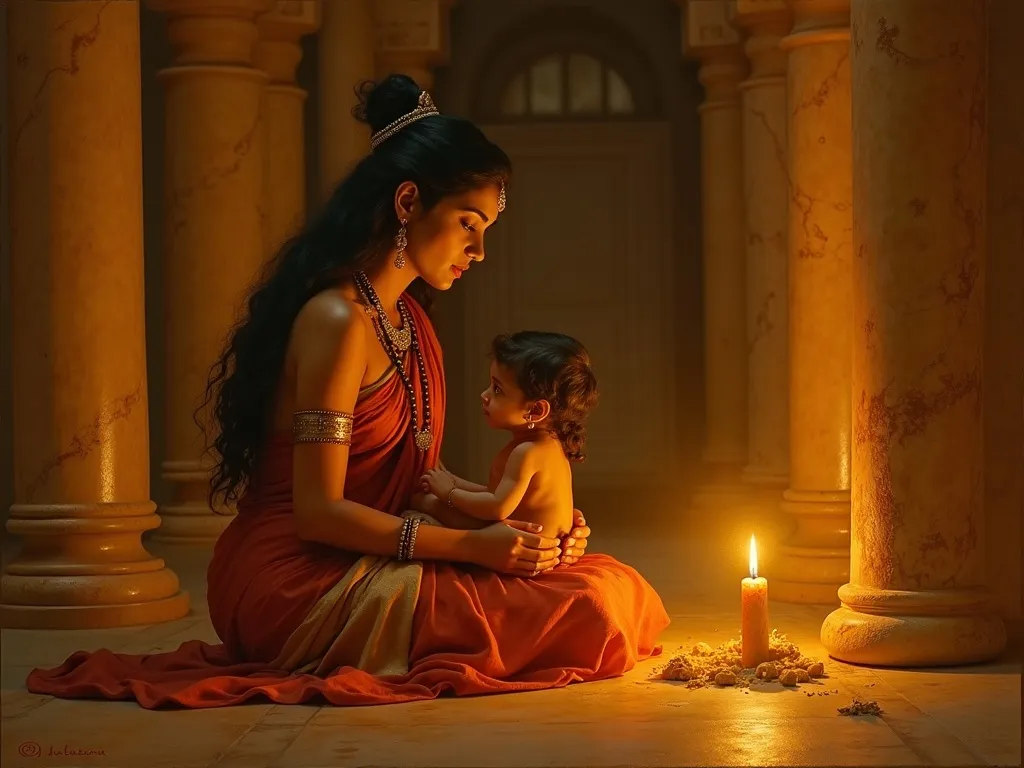
The story of Ganesha's origin is one of the most dramatized passages in the Shiva Purana, and it carries the violence and tenderness that characterize so much of Hindu mythological narrative. Parvati, wife of Shiva and daughter of the Himalaya, wanted a guardian. She was tired of being interrupted at her bath. She scraped the turmeric paste from her own skin, mixed it with earth and sacred herbs, and shaped a boy from this material. She breathed life into him and told him to stand at the door and let no one enter.
The boy obeyed. When Shiva returned from his long meditation in the mountains, he did not recognize the child and was refused entry to his own home. Shiva, whose anger is legendary, called his attendants. They fought the boy. The boy won. Shiva himself stepped forward, and in the battle that followed, he severed the child's head.
Parvati's grief was total. Shiva, realizing what he had done, sent his gana soldiers north to find the head of the first sleeping creature they encountered, facing toward them. They found an elephant. They returned with its head. Shiva placed it on the boy's body, breathed life back into him, and declared that this child would henceforth be adored before all other gods. He gave the boy the name Ganapati, lord of the ganas, Shiva's own retinue of divine attendants.
This myth rewards careful reading. Parvati creates the child from her own body without male participation: a creation story that emphasizes the shakti, the feminine creative force, as its own complete source. The decapitation and replacement of the head is an initiatory motif found across South Asian ritual: the destruction of the ordinary self and its replacement with something larger, less bounded. Ganesha after resurrection is not merely restored. He is promoted.
Later Puranic texts, particularly the Mudgala Purana and the Ganesha Purana, expand his biography dramatically. These texts treat him not as a subsidiary deity but as Brahman itself, the absolute ground of being, who merely takes elephant form as one of innumerable manifestations. For Ganapatya worshippers, a tradition documented at least from the 7th century CE, Ganesha is not a son of Shiva. He is the source from which Shiva and all other gods emerge.
The Eight Forms and the Ashtavinayaka
Hindu devotion rarely settles for a single image when it can proliferate sacred geography across the landscape. In the Pune district of Maharashtra alone, eight svayambhu (self-manifested) shrines house eight forms of Ganesha collectively known as the Ashtavinayaka. Pilgrims travel a circuit of these temples, and the journey itself becomes a ritual act: a circumambulation of the divine.
The eight forms are:
- Mayureshvara at Morgaon, seated on a peacock, considered the first and last stop of the pilgrimage circuit.
- Siddhivinayaka at Siddhatek, on the banks of the Bhima river.
- Ballaleshvara at Pali, the only Ashtavinayaka shrine named after a devotee rather than an attribute of the god.
- Varadavinayaka at Mahad, giver of boons.
- Chintamani at Theur, the wish-fulfilling jewel.
- Girijatmaja at Lenyadri, born of the mountain goddess, carved inside a Buddhist cave complex repurposed for Shaiva-Ganapatya worship.
- Vighnahar at Ozar, the one who removes obstacles, the name most transparently linked to the ganesha remover of obstacles theology.
- Mahaganapati at Ranjangaon, the great Ganapati.
Each shrine holds its own mythology, its own associated miracles, its own festival calendar. The circuit typically takes five to seven days and has been traveled by pilgrims for at least five centuries by contemporary record, though the shrines themselves are far older.
The Broken Tusk and What It Holds
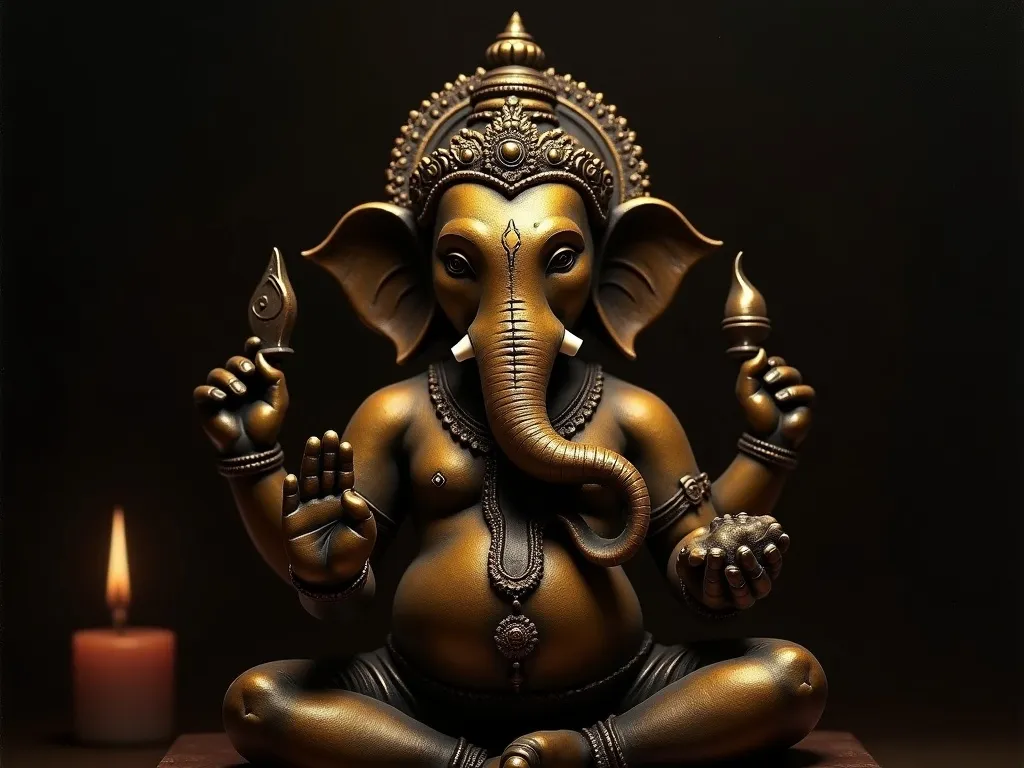
Ganesha is almost always depicted with one complete tusk and one broken tusk. The broken tusk is called ekadanta, one tooth, and it is itself an epithet: Ekadanta is among the 108 names listed in the Ganesha Sahasranama. The iconographic detail is explained by several competing myths, and the competition itself is instructive.
One account belongs to the Brahma Vaivarta Purana. Parashurama, the axe-wielding avatar of Vishnu, came to pay his respects to Shiva. Ganesha stood at the door and blocked him. A battle followed. Parashurama hurled his axe. Ganesha, recognizing the weapon as a gift from Shiva himself, chose not to block it with his body and instead received it on his tusk, which broke. Out of respect for his father's gift, he absorbed the blow rather than deflect it.
A second account, already mentioned, ties the broken tusk to the Mahabharata dictation. When Ganesha's pen broke during that prodigious act of writing, he snapped off his own tusk and continued. He valued the continuity of the work over the integrity of his form.
Both stories teach the same thing from different angles. The broken tusk is not a wound. It is a choice. Ganesha carries incompleteness deliberately, as a reminder that wholeness sometimes requires sacrifice, that the pursuit of knowledge or the honoring of a lineage can cost a piece of yourself.
The Mouse, the Modak, and Sacred Symbols
The vahana, or divine vehicle, of Ganesha is Mushika, the mouse. This pairing has delighted and puzzled observers for centuries. A great mountain of a deity riding a tiny rodent seems incongruous until you understand the symbolic grammar.
In Sanskrit literature, the mouse is associated with penetration: it gets into everything, enters cracks, gnaws through barriers. Ganesha's capacity to remove obstacles is literally embodied by the creature who can move through the smallest gap. Some tantric readings go further: the mouse represents the ego, the restless, greedy, self-interested mind that gnaws through one's concentration. Ganesha, seated on it, has mastered and tamed that impulse rather than eliminated it.
The modak, the sweet dumpling that appears in almost every image, carries its own layered meanings. In Maharashtra it is typically a steamed rice-flour shell filled with coconut and jaggery. In Tamil Nadu it is called kozhukattai. In Sanskrit texts it represents bliss: the sweetness that opens when wisdom dissolves the knot of ignorance. Ganesha holds it toward himself, toward the devotee, and sometimes he has already eaten it. He is the keeper of the sweet and the one who distributes it. He is both the teacher and the reward of study.
His four arms in the most common iconography hold the ankusha (goad, to urge the mind forward), the pasha (noose, to restrain passion), the broken tusk (to write, to accept sacrifice), and the modak (the sweet fruit of right action). Some forms show a fifth or sixth arm holding a water lily, a hatchet, or a rosary. Each attribute corresponds to a set of theological teachings about the relationship between action, restraint, wisdom, and reward.
Ganesha Across the Hindu Traditions
Shaiva Tradition
Ganesha is the son of Shiva and Parvati, created either by Parvati alone or by both parents together depending on the Purana. He leads Shiva's gana attendants and serves as the gateway through which devotees approach his father. His powers are real and formidable, but they derive from Shiva's grace. The Shiva Purana gives the most detailed account of his birth and beheading.
Ganapatya Tradition
For Ganapatya practitioners, Ganesha is the supreme deity, parabrahman in elephant form. Shiva and Parvati are understood as his devotees in this school, not his parents in the usual sense. The Ganesha Purana and Mudgala Purana present eight avatars of Ganesha who descend to earth to defeat cosmic demons across successive world ages, a structure parallel to Vishnu's dashavataras.
Vaishnavas have generally been comfortable venerating Ganesha as a subsidiary figure worthy of propitiation at the start of worship, even while centering their devotion on Vishnu or his avatars. The Vishnu Purana and the Bhagavata Purana mention him without hostility. Shakta traditions identify his power as an expression of the goddess's shakti, emphasizing Parvati's role in his creation.
Ganesha's cross-sectarian appeal is historically unusual. Most great Hindu deities inspire intense sectarian loyalty that sometimes shades into competition. Ganesha inspires near-universal acceptance. Adi Shankaracharya, the 8th-century philosopher who systematized Advaita Vedanta and is associated with establishing the panchayatana puja (the five-deity worship), placed Ganesha among the five central deities alongside Shiva, Vishnu, Devi, and Surya. This theological move ensured that almost every Hindu household would have reason to invoke Ganesha regardless of their primary affiliation.
The Ganesh Chaturthi Festival
Once a year, for ten days between August and September (the exact dates shift with the lunar calendar), Maharashtra and much of South India transforms. Clay images of Ganesha, some no taller than a child's hand, others rising four storeys above the street, appear in homes and in elaborate public pandals. The celebration is Ganesh Chaturthi, marking the god's birthday on the fourth day of the waxing moon in the month of Bhadrapada.
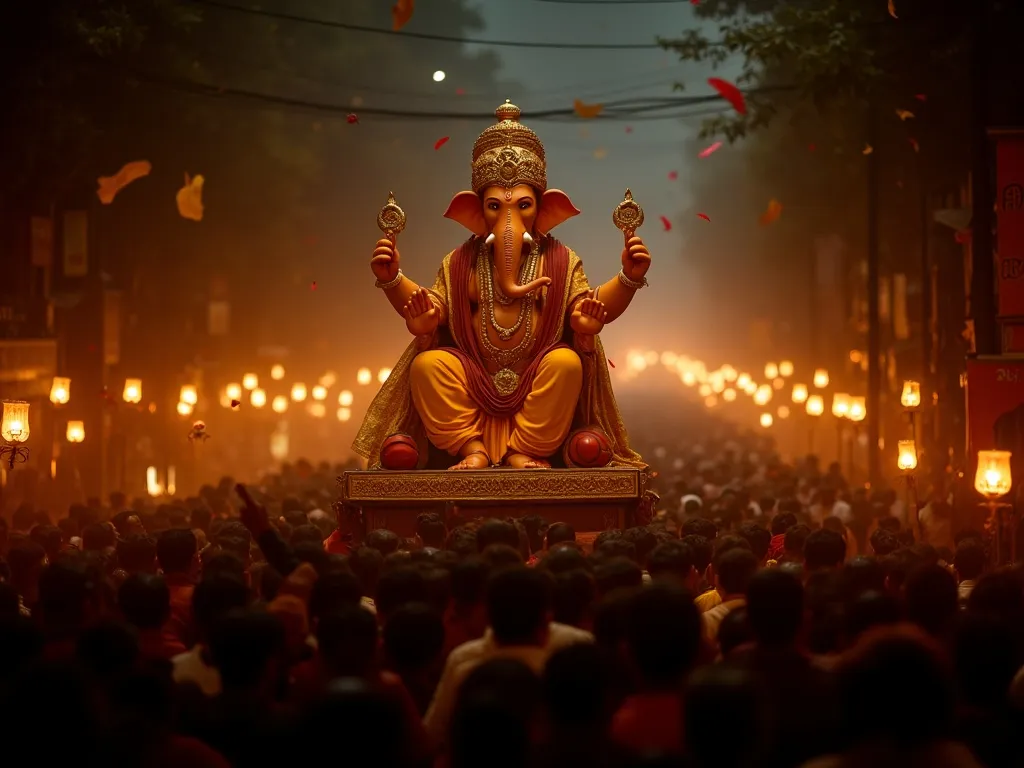
The festival in its present public form owes a great deal to Bal Gangadhar Tilak, the nationalist leader who in 1893 encouraged the transformation of what had been a largely domestic observance into a massive public celebration. Tilak recognized that Ganesha's cross-caste appeal made him the ideal organizing symbol for a Hindu identity that could cut across the social divisions the British colonial administration exploited. The public festival became a vehicle for political meetings, theatrical performances, and the circulation of nationalist newspapers under the cover of religious celebration.
On the tenth day, Anant Chaturdashi, the images are carried in procession to rivers, lakes, or the sea and immersed. The dissolution is not mourning. It is completion. The clay returns to earth. Ganesha, being present in everything, is not lost. He simply steps back behind the veil until next year's invitation.
Ganesha Beyond South Asia: Spread Across the Buddhist and Southeast Asian World
The reach of ganesha remover of obstacles iconography extends well past the borders of the Indian subcontinent. Buddhist traditions absorbed Ganesha early, and his image appears in Tibetan and Japanese Buddhism in forms that show both his Hindu origins and significant local transformation.
In Tibetan Buddhism he appears as Vinayaka, sometimes as a demonic force to be propitiated, sometimes as a protector deity. The relationship is complicated: early Buddhist texts occasionally cast Vighnaraja (a Ganesha-like figure) as an obstacle-maker rather than a remover, reflecting the theological competition of the first millennium CE.
In Japan, under the name Kangiten or Shoten, he appears in Tendai and Shingon Buddhist contexts as a deity of bliss and prosperity, depicted as two elephant-headed figures embracing. This form has essentially no parallel in Hindu iconography and represents a genuine Japanese theological innovation built on an imported substrate.
In Cambodia during the Angkorian period (9th-15th centuries CE), Ganesha images appear across temple complexes including Angkor Wat's predecessors, brought by the Shaiva traditions that shaped Khmer royal religious practice. In Java and Bali, his presence survived the gradual conversion of the archipelago to Islam in most areas; Balinese Hinduism continues to honor him actively today.
Thailand, Myanmar, and Nepal all maintain distinct regional iconographies of Ganesha, each inflected by local aesthetics and the specific traditions that transmitted his worship. This is not cultural export through conquest but through the slower traffic of merchants, monks, and court priests who carried Sanskrit manuscripts and bronze casting techniques across the Indian Ocean world.
The Theology of Beginning: Why Obstacles Are Sacred
The deepest question about Ganesha is not why he removes obstacles but why he places them. The Ganesha Purana is explicit: Ganesha creates vighna, obstruction, for those who are arrogant, unprepared, or acting without proper intention. Obstacles are not accidents. They are diagnostic. They reveal whether a goal is genuinely worth pursuing and whether the person pursuing it has the moral clarity to deserve success.
This theology has practical implications that Hindu philosophical traditions explored carefully. The goad in Ganesha's hand is the instrument that moves the elephant. To remove an obstacle is not to make the path frictionless. It is to provide the precise amount of pressure needed to move forward. The ankusha and the pasha, goad and noose, are a paired teaching: urge forward where laziness holds you back, restrain where desire runs ahead of wisdom.
The ganesha remover of obstacles epithet, Vighnaharta, is paired in the Ganesha Sahasranama with Vighnakarta, maker of obstacles. Both names appear in the same hymn, and their juxtaposition is the point. The god who clears your road is the same god who placed the boulder there. He is not opposing an external force. He is managing the relationship between effort, readiness, and result.
This makes Ganesha less a deity of luck and more a deity of discernment. Propitiation is not a transaction. The devotee who approaches him asking for help is also, in the ritual logic of the tradition, submitting to his evaluation. The obstacles that remain after worship are not failures of divine attention. They are information.
Ganesha in Modern Art, Architecture, and Popular Imagination
The iconographic tradition of Ganesha is ancient but not frozen. Contemporary artists across India and the diaspora have placed him in urban traffic jams, digital landscapes, and abstract canvases. The Pune sculptor Ram Sutar, who built the colossal statues at Sardar Patel's memorial, has worked extensively with Ganesha iconography, as have generations of traditional murti makers in Maharashtra whose families have practiced the craft for three or four hundred years without interruption.
In literature, Ganesha appears in Manil Suri's novel The Death of Vishnu and in Salman Rushdie's The Moor's Last Sigh, where he is used both literally and as a structural metaphor for artistic creation and physical impediment simultaneously. The connection to writing, grounded in the Mahabharata dictation myth, makes him an almost irresistible figure for writers thinking about the obstacle between thought and page.
The connection between the Mahabharata and Ganesha also surfaces in contemporary Indian cinema and television. The 1988-1989 television serialization of the Mahabharata directed by B.R. Chopra opened each episode with an image of Ganesha, returning to the source myth of his role as scribe and guardian of the epic itself.
Outside India, the global spread of yoga, Ayurveda, and Hindu-inflected meditation practices has made Ganesha's silhouette recognizable far from any temple. His image appears in yoga studios in São Paulo, Berlin, and Toronto, frequently stripped of theological context but sometimes, when the teacher knows their material, explained with full respect for the philosophical depth he represents. Regardless of context, the form carries meaning. The elephant head, the broken tusk, the mouse waiting below: these are not arbitrary aesthetic choices, and the tradition from which they emerged rewards the effort of understanding them properly.
Frequently Asked Questions about Ganesha, Remover of Obstacles
Frequently asked questions
Why does Ganesha have an elephant head?
The Shiva Purana explains that Shiva severed the head of his unrecognized son in a moment of rage. To restore the boy to life, Shiva's attendants brought the head of the first sleeping creature they found facing north, which was an elephant. The theological significance runs deeper than the narrative: the elephant head symbolizes extraordinary intellect (the elephant is the wisest and most long-memoried of animals in Sanskrit literature), the capacity to remove obstacles with the ease of a forest elephant clearing trees, and the large ears that hear all petitions.
What does 'Vighnaharta' mean and how is it different from 'Vighnakarta'?
Vighnaharta (also Vighnahara or Vighnahari) means "one who destroys obstacles," from vighna (obstacle) and harta (remover or destroyer). Vighnakarta means "one who creates obstacles." Both names appear in the Ganesha Sahasranama, the hymn of 1,008 names. The tradition treats both capacities as aspects of the same divine function: Ganesha places obstacles before those who are not ready and removes them for those who approach with genuine readiness and right intention.
Is Ganesha the son of Shiva and Parvati in all Hindu traditions?
Not in all traditions. In mainstream Shaiva and Smarta practice, yes: Ganesha is the son of Shiva and Parvati, born either from Parvati's bodily substance alone or through a combined creative act. In the Ganapatya tradition, however, Ganesha is the supreme deity, parabrahman itself, and Shiva and Parvati are devotees, not parents. The Ganesha Purana and Mudgala Purana support this reading with cosmogonies that predate Shiva's own emergence. Both readings have coexisted within Hinduism for well over a thousand years.
Why is the mouse Ganesha's vehicle, given the size difference?
The vahana (vehicle) in Hindu iconography is never chosen for practical plausibility. Mushika the mouse represents the mind: quick, darting, capable of entering the smallest crack, prone to gnawing through what it touches. A god who rides and masters the mouse has brought the restless mind under control without destroying its energy. The image of the enormous deity balanced on the tiny mouse is deliberately paradoxical, pointing at the paradox that the most difficult obstacle any person faces is internal.
When did Ganesh Chaturthi become a major public festival?
The domestic celebration of Ganesha's birthday on the fourth day of Bhadrapada is documented for centuries, but the large-scale public festival format was significantly shaped by Bal Gangadhar Tilak in 1893 in Pune. Tilak organized the ten-day public event as a vehicle for nationalist organizing during British colonial rule, using Ganesha's cross-caste appeal to gather Hindus across social divisions. The festival has grown steadily since independence and now draws millions of participants across Maharashtra, Karnataka, Andhra Pradesh, and the global Hindu diaspora.
Does Ganesha appear in Buddhist or Jain traditions?
Yes, in both. In Tibetan Buddhism, a Ganesha-like figure called Vinayaka appears as a deity to be propitiated, sometimes as a potential obstacle-maker who must be honored to ensure his cooperation. In Japanese Tendai and Shingon Buddhism, he becomes Kangiten, depicted as two elephant-headed figures embracing, associated with bliss and marital harmony. In Jainism, Ganesha images appear at temple entrances and in manuscript colophons, particularly in western India, functioning similarly to his Hindu role as the deity invoked at the start of significant undertakings.
The Obstacle and the Threshold: Ganesha as Cosmic Gatekeeper
Every tradition needs a figure who stands at the boundary between the ordinary and the sacred. Ganesha, remover of obstacles, holds that position in Hinduism with unusual permanence. The threshold he guards is not just the door of a temple or the first page of a manuscript. It is the psychological and spiritual boundary between unreadiness and capacity.
There is a Sanskrit term, antahkarana, that refers to the inner instrument: the composite of mind, intellect, ego, and memory that processes experience and generates action. Ganesha's iconography maps onto this instrument with precision. The large head holds the intellect. The large ears receive information. The trunk, which can uproot a tree or pick up a single needle from the ground, represents the range and precision of conscious attention. The belly holds everything that has been consumed and digested from experience.
To invoke Ganesha at the start of an action is not a superstition. It is a deliberate act of self-examination. The ritual pause before the name is spoken is itself the practice: Am I ready? Is this action well-grounded? Have I prepared? The deity, by existing as the evaluator of readiness, gives practitioners a formal structure for asking those questions before any significant undertaking begins.
Scholars including Paul Courtright, whose 1985 study Ganesha: Lord of Obstacles, Lord of Beginnings remains a standard reference, and Robert Brown, who edited Ganesh: Studies of an Asian God in 1991, have noted that Ganesha's liminality is the core of his function. He belongs to no single sectarian camp, to no single social stratum, to no single moment in the ritual calendar. He is always at the edge of what comes next. That structural position, more than any single myth or attribute, explains why he has outlasted every political shift, every dynasty, every wave of foreign influence across fifteen centuries of documented history, and will likely outlast the next fifteen as well.
Free 25-page sample
Want the whole story?
Take the first 25 pages free. If it pulls you in, the full edition is yours as an instant PDF download, with a paperback on Amazon for selected titles.

Hindu
The Hindu Mythology Book: Vishnu, Shiva, Brahma, the Mahabharata, and the Sacred Stories of India
Vishnu, Shiva, Brahma, the Mahabharata, and the Sacred Stories of India
The Rigveda, the Mahabharata, the Ramayana, and the major Puranas. Every god, every avatar, every sacred epic.
More from Hindu
All articles
Hindu
Shiva the Destroyer: Lord of Dissolution, Transformation, and Cosmic Renewal
Shiva the Destroyer stands at the heart of Hindu cosmology not as a god of mere annihilation, but as the force that dissolves reality so creation can begin again. His mythology is among the richest and most paradoxical in the world.
Hindu
Vishnu the Preserver: Keeper of Cosmic Order
Vishnu stands at the heart of Hindu cosmology as the eternal guardian of dharma, descending into the world age after age to restore balance whenever creation tilts toward ruin.
Hindu
Kali: The Fierce Mother Goddess Who Devours Time Itself
Kali is Hinduism's most electrifying deity: a goddess of death, liberation, and ferocious maternal love whose dark form conceals the deepest compassion in the cosmos.